
New York is sending out $1 billion in utility relief rebates this fall, giving you a perfect opportunity to take control of your energy costs.
Key Takeaways
- The state is automatically mailing rebate checks of up to $200 to more than eight million eligible residents between September and December 2026 to offset compounding inflation.
- Severe winter weather, aging grid upgrades, and natural gas volatility are the primary drivers of rising utility delivery and supply charges across the state.
- You can protect your wallet by switching to a fixed-rate energy provider or signing up for state-funded savings and efficiency programs like EmPower+.
Setting up a new home or managing a household budget in the Empire State can feel like a financial tightrope, especially when your monthly electric and gas bills keep climbing. If you have opened your utility statements lately, you have probably noticed that the numbers are creeping upward, even if your actual energy use has not changed. Thankfully, a massive state-funded relief plan is on the way to help ease that strain. We want to help you understand exactly how the new Protecting Our Wallets Energy Rebate — officially known as the POWER Check program — works, why your local rates are changing, and what smart, eco-conscious steps you can take to keep more money in your pocket.
What Is the New York POWER Check Rebate Program?
This $1 billion program is designed to deliver immediate financial relief to roughly 8.2 million New Yorkers struggling with high energy costs. Approved as part of the state budget, the program sends a one-time relief payment directly to your mailbox. The best part is that you do not have to fill out any complicated paperwork or wait in long digital lines to get your cash. The New York State Department of Taxation and Finance will automatically mail these checks out between September and December 2026 based on your Tax Year 2024 returns.
Who Qualifies for a Rebate Check?
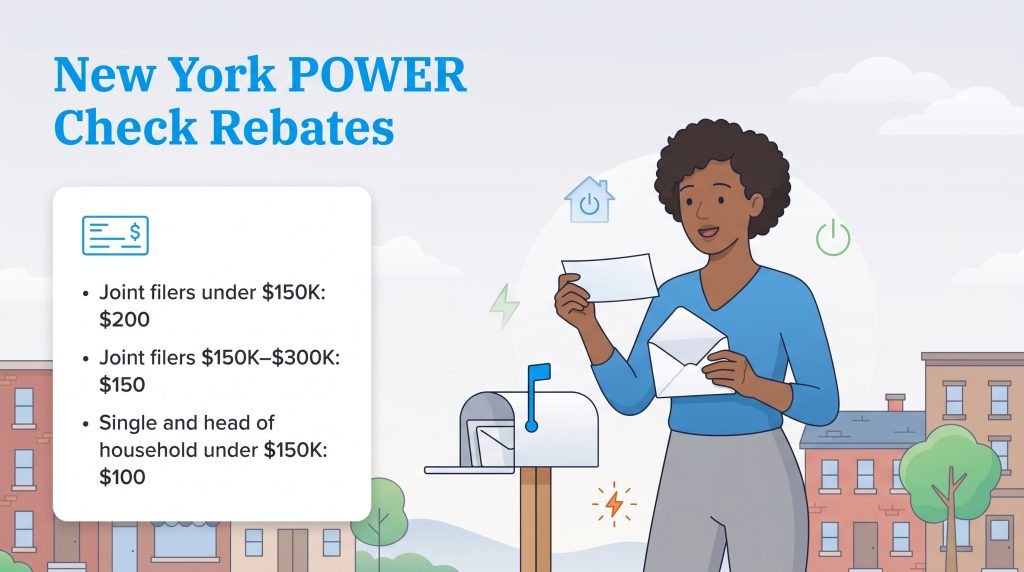
To get your check, you must have been a full-time resident of New York State in 2024, filed a timely resident tax return, and not have been claimed as a dependent on someone else’s taxes. The specific check amount you receive depends on your adjusted gross income (AGI) and your tax filing status :
- Joint Filers and Surviving Spouses (AGI under $150,000): You will receive a $200 check.
- Joint Filers and Surviving Spouses (AGI between $150,000 and $300,000): You will receive a $150 check.
- Single Filers and Heads of Household (AGI under $150,000): You will receive a $100 check.
Why Are New York Utility Rates Changing?
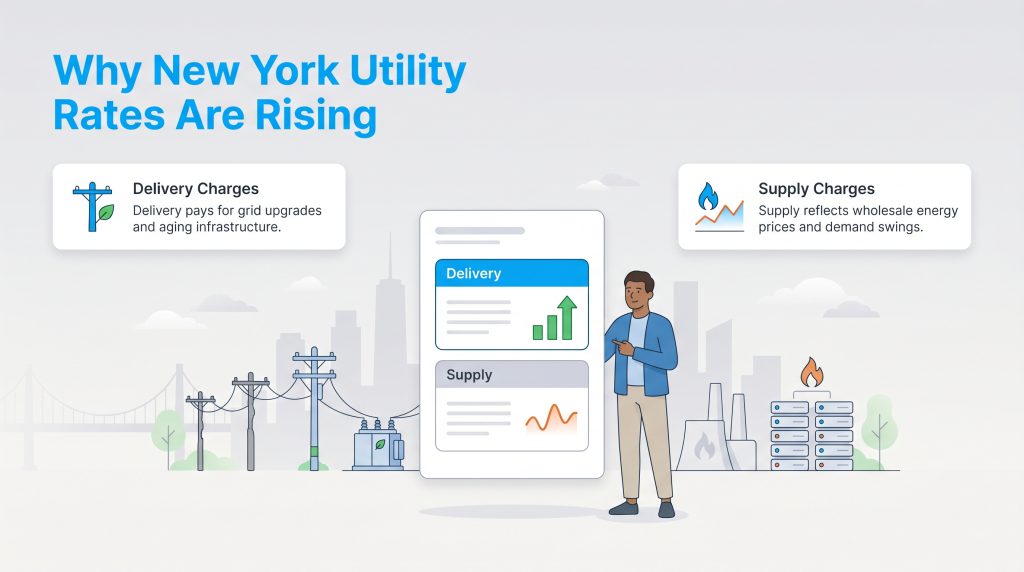
To tackle your energy bills effectively, it helps to understand what is driving those rising numbers in the first place. Your monthly utility bill is split into two major parts: delivery charges and supply charges. Delivery charges are fixed fees that cover the physical transport of energy, while supply charges change based on broader market pricing.
Understanding Rising Delivery Charges
Delivery charges make up about 60% or more of your total bill, and they are rising because our physical energy infrastructure is aging. Local utilities are spending heavily to replace outdated poles, wires, substations, and leak-prone natural gas pipelines to ensure safety and prevent outages. Climate policy also plays a big role. To meet New York’s ambitious goal of 70% clean energy by 2030, utilities must build new transmission lines to connect upstate wind and solar to downstate grids. Regulated utilities earn a Public Service Commission approved profit margin on these infrastructure projects, which directly impacts what you pay.
Understanding Fluctuating Supply Charges
The other portion is your supply charge — the market cost of the actual electricity or natural gas you consume — which is dictated by wholesale energy markets. Most of New York’s electricity is still generated by natural gas-fired plants, meaning that when wholesale gas prices rise, your electric rates follow suit. Severe weather, like a long winter cold snap where temperatures stay below freezing for nine consecutive days, forces natural gas demand to skyrocket. At the same time, massive energy-intensive projects like artificial intelligence data centers are increasing the overall demand on the grid, causing wholesale prices to swing dramatically.
How These Changes Impact Your Monthly Bill
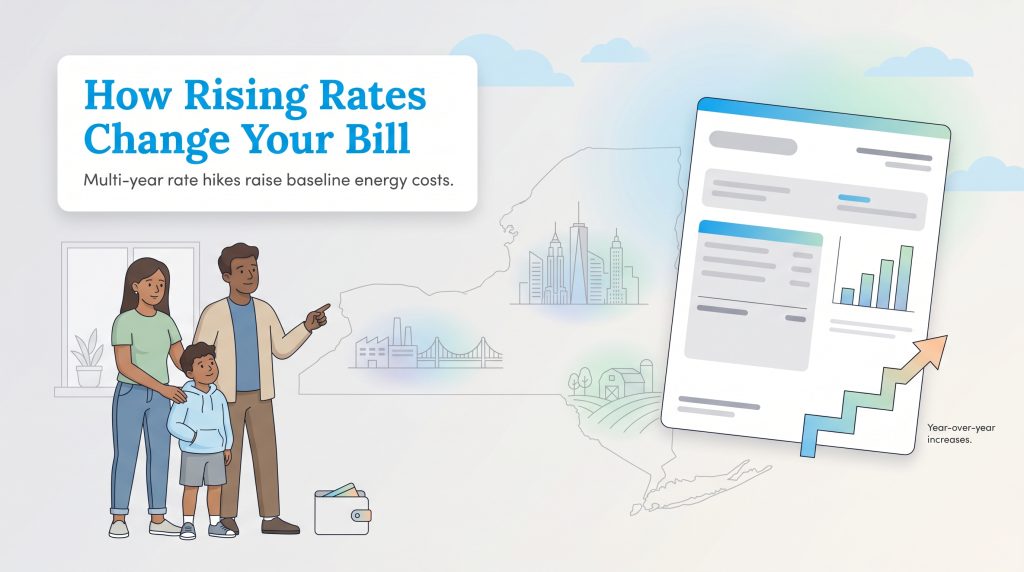
The actual financial impact on your household depends heavily on where you live and which utility company serves your area. Major cities and regions across the state are seeing significant, multi-year rate increases approved by the Public Service Commission. These structured increases mean that rates do not just jump once; they keep stepping up over several years, resetting your baseline costs.
What to Expect in Major New York Cities
Whether you live in New York City, Buffalo, or the Hudson Valley, you are likely feeling the pinch. Let’s break down how the approved and pending rate cases impact typical residential customers across the state:
| Utility Provider | Major Cities Impacted | Multi-Year Rate Case Status | Average Monthly Bill Impact | Estimated Cumulative Change |
|---|---|---|---|---|
| Con Edison | New York City, Yonkers | Approved 3-Year Plan (Jan 2026) | NYC (280 kWh): +$4.00 (2026), +$3.55 (2027), +$4.22 (2028). Westchester (425 kWh): +$5.25 (2026), +$4.84 (2027), +$4.95 (2028). | Electric: +10.4% cumulative hike by 2028. Gas: +15.8% cumulative hike by 2028. |
| National Grid | Buffalo, Syracuse, Albany | Approved 3-Year Plan (Aug 2025) | Electric (625 kWh): +$14.32 (Yr 1), +$6.44 (Yr 2), +$4.34 (Yr 3). Gas (78 therms): +$7.66 (Yr 1), +$8.08 (Yr 2), +$9.18 (Yr 3). | Electric: +31% cumulative hike over three years. Gas: ~17% cumulative total revenue increase. |
| Central Hudson | Poughkeepsie, Newburgh | Approved Joint Proposal (Aug 2025) | Electric (typical usage): +$12.65 per month. | Electric: +7.85% total bill increase. |
| Orange & Rockland | Spring Valley, Middletown | Approved 3-Year Plan (Mar 2025) | Electric (600 kWh): Flat revenue in Year 1, followed by a +4.6% bill increase in 2025, +3.3% in 2026, and +3.5% in 2027. | Electric: ~11.8% cumulative total bill increase over three years. |
| NYSEG (Pending) | Binghamton, Elmira | Initial Rate Case Filing (June 2025) | Electric (600 kWh): +$33.12 per month (initial utility proposal). | Electric: +23.7% total bill increase requested. |
| RG&E (Pending) | Rochester | Initial Rate Case Filing (June 2025) | Electric (600 kWh): +$33.01 per month (initial utility proposal). | Electric: +26.0% total bill increase requested. |
These rate hikes have placed immense financial pressure on low- and middle-income families, with collective statewide utility debt reaching $1.84 billion by late 2025.
Smart Steps to Take Control of Your Energy Costs
While a rebate check is a welcome cushion, finding long-term relief requires taking an active role in how you shop for and manage your energy. Because New York has a deregulated energy market, you do not have to accept the default supply rate offered by your utility company. You can choose to buy your electricity or natural gas from an independent Energy Service Company.
Comparing Your Supply Options
When you shop for an Energy Service Company (ESCO), your local utility still delivers the energy, maintains the lines, and responds to any emergencies, so your physical reliability never changes. However, you can choose from three main types of plans to fit your household budget :
- Fixed-Rate Plans: These plans lock in a set price per kWh or therm for three to 36 months. They provide excellent budget predictability and shield you from brutal winter price spikes.
- Variable-Rate Plans: These plans offer flexibility with no cancellation fees, meaning your rate changes month to month. They can save you money during mild spring or autumn weather, but they carry a massive financial risk during extreme cold or hot spells.
- Green Energy Plans: Choosing a green energy plan is an environmentally mindful choice that supports the transition to clean power. Many ESCOs offer 100% renewable electricity sourced from wind, solar, and hydro through Renewable Energy Certificates (RECs) at highly competitive rates.
You can easily explore and compare these plans by searching to find the best rate for your ZIP code.
Knowing Your Consumer Protections
To keep the market fair and transparent, New York enforces strict consumer protection laws. Under the ESCO Consumers Bill of Rights, providers are prohibited from demanding upfront prepayments. If you choose to switch, you have an unconditional three-day right to cancel the contract without any penalty. Furthermore, early cancellation fees are strictly limited by law to $100 for contracts of one year or less, and $200 for contracts longer than one year. If you ever suspect that your supplier was switched without your permission — a practice known as “slamming” — you can file a formal complaint online to get the issue resolved immediately.
State-Funded Assistance and Efficiency Programs
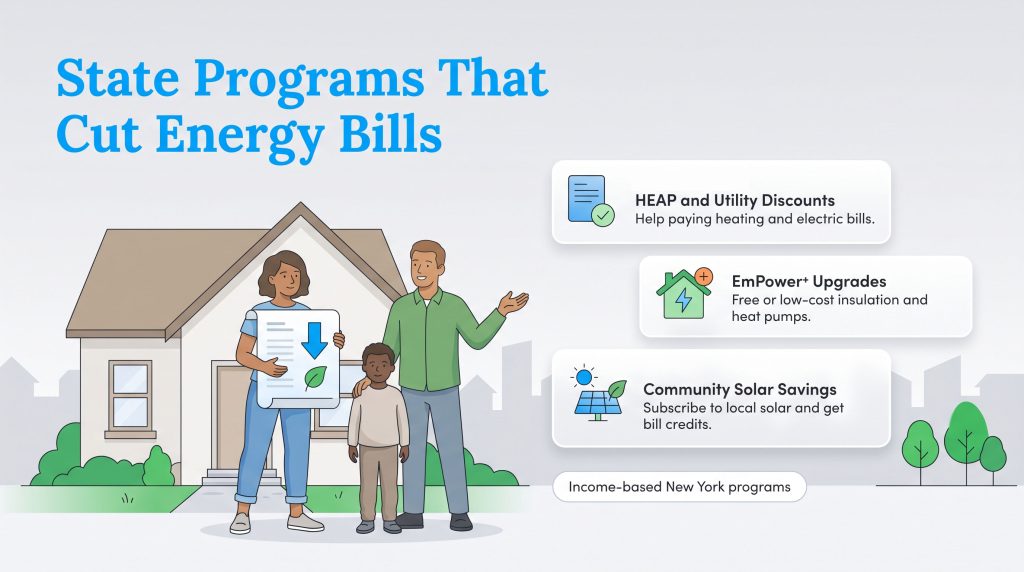
If you are finding it difficult to keep up with your monthly payments, New York offers several robust, state-funded assistance programs designed to help lower your energy burden. Rather than just relying on conservation, these programs tackle the structural costs of your energy bills. Our goal is to make sure you know exactly where to find help when you need it.
Programs You Should Know About
- Home Energy Assistance Program (HEAP): This program provides critical financial aid to help income-eligible households pay for winter heating, summer cooling, and emergency heating equipment repairs.
- Energy Affordability Program (EAP): EAP is run through your local utility to provide direct, automatic monthly discounts on your bill. The goal of this program is to ensure that vulnerable families do not pay more than 6% of their household income on energy.
- Enhanced Energy Affordability Program (EEAP): If your income is just slightly too high to qualify for the traditional EAP, you might still qualify for the EEAP. This program provides monthly discounts specifically tailored for moderate-income households. You can self-identify and apply directly on the .
- EmPower+: Managed by the state, this program is an excellent energy-saving option that provides free or highly discounted energy-efficiency home improvements. Qualifying renters and homeowners can get professional air sealing, modern insulation, and cold-climate heat pump installations to slash their energy use for the long haul.
- Community Solar: Subscribing to a local community solar project is another fantastic, eco-conscious alternative that allows you to support renewable energy. You do not need to install expensive solar panels on your roof; instead, you subscribe to a local solar array and receive monthly credits directly on your existing electric bill.
Taking Charge of Your Energy Future
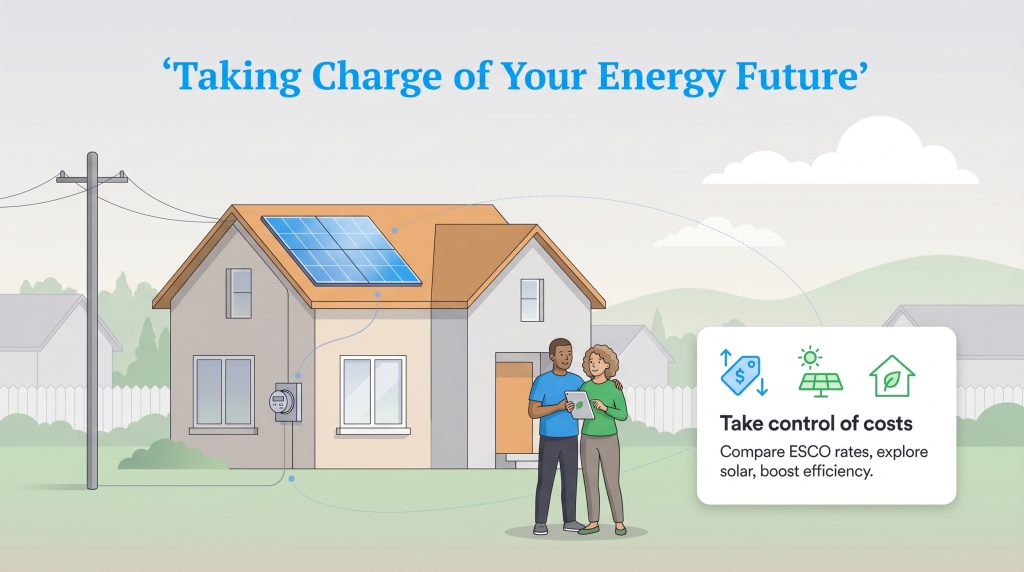
Navigating New York’s shifting utility landscape can feel overwhelming, but you have more power than you might think. While the state’s upcoming $1 billion in direct rebates provides a much-needed short-term break for your budget, the real secret to long-term savings lies in playing an active role in how you use and buy power. By combining immediate financial relief with smart, sustainable strategies — like comparing competitive ESCO rates, exploring community solar, or taking advantage of home efficiency upgrades — you can build a more resilient household budget. We are here to help you make those smart, eco-conscious transitions every step of the way, ensuring your new home is as affordable as it is comfortable.
Frequently Asked Questions About New York Utility Bills
Do I need to apply to receive my POWER Check rebate?
What happens to my service if I choose to switch to an ESCO?
What is the difference between fixed and variable energy rates?
Can my utility bill still rise if I cut my energy use?
About the Author

Claudio is a sustainability-focused writer with a background in Anthropology and Psychology from NC State University. He has spent over 15 years working in writing, interpretation, and translation, driven by a deep interest in how human culture shapes the environment. Today, he shares his curiosity with readers by writing about sustainable living solutions and the connection between everyday choices and environmental impact.