
A Complete Guide to FirstEnergy’s Coverage, Rates, Outage Tools, and Customer Reviews to Help You Manage Your Electricity Services
Key Takeaways
- FirstEnergy serves roughly 6 million customers across six states through 10 regional distribution companies.
- You can choose your energy supplier in deregulated areas to find better rates than the default price to compare.
- The company is investing heavily in grid modernization and renewable energy to achieve carbon neutrality by 2050.
Moving into a new home or looking to lower your monthly utility bill often starts with understanding exactly who delivers your power. FirstEnergy operates as a massive parent holding company that manages 10 distinct regional utility subsidiaries across the Midwest and Mid-Atlantic, delivering electricity to roughly 6 million customers. Because this footprint covers so many different local markets, navigating their services, fees, and rates can feel overwhelming if you are not familiar with your neighborhood’s specific provider. Whether you want to lock in a lower supply rate, check the FirstEnergy 24/7 Power Center for real-time storm updates, or figure out the easiest way to pay your bill, we have compiled everything you need to confidently set up and manage your household electricity.
FirstEnergy Service Area and Subsidiaries
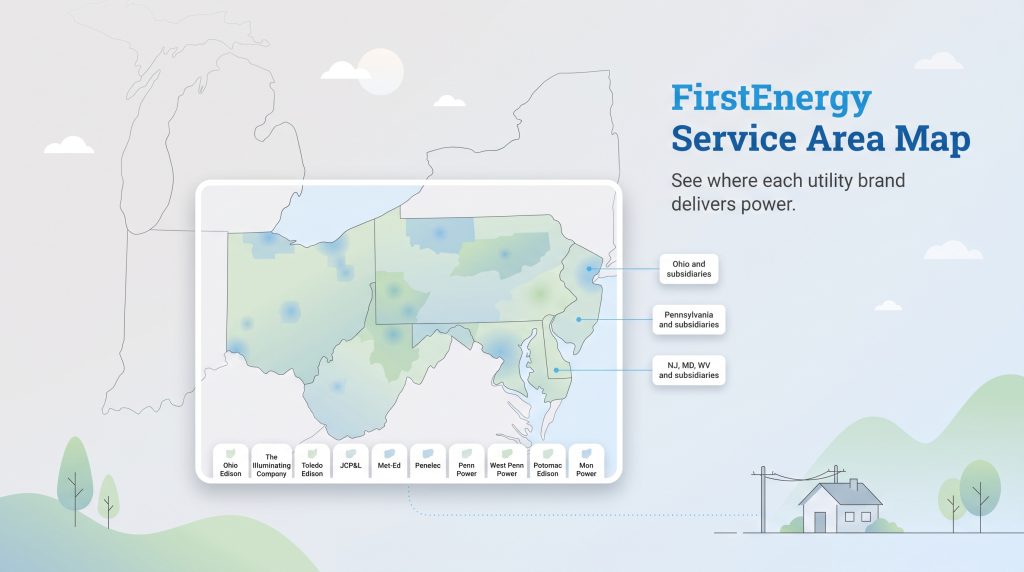
Headquartered in Akron, Ohio, FirstEnergy Corp. (NYSE: FE) is one of the largest investor-owned electric systems in the United States. The company primarily operates as a transmission and distribution utility. This means they own and maintain the physical poles, wires, and meters that deliver electricity to your home, rather than generating all the power themselves.
FirstEnergy serves a sprawling 65,000-square-mile area. Because they operate under different localized brand names depending on where you live, you might not see the “FirstEnergy” logo on the side of the bucket truck in your neighborhood. Instead, you will see the name of one of their 10 regulated distribution companies.
Here is the complete breakdown of their 10 operating subsidiaries by state and service territory:
- Ohio Edison: The Ohio Edison coverage area spans central and northeastern Ohio, serving major cities such as Akron, Youngstown, Mansfield, and Canton.
- The Illuminating Company: This subsidiary covers northeastern Ohio, focusing heavily on the Greater Cleveland area, including Cleveland, Mentor, and Euclid.
- Toledo Edison: Dedicated to northwestern Ohio, providing reliable service to Toledo, Bowling Green, and Sandusky.
- Jersey Central Power & Light (JCP&L): Covers a significant portion of New Jersey, serving central and northern communities like Morristown, Lakewood, Freehold, and Toms River.
- Met-Ed: Serving the eastern and south-central parts of Pennsylvania, including Reading and York.
- Penelec: Covering northern and central Pennsylvania along with a small portion of southern New York, delivering power to cities like Erie and Altoona.
- Penn Power: Operating primarily in western Pennsylvania, notably around New Castle and Mercer.
- West Penn Power: Providing electricity to southwestern, central, and northern Pennsylvania.
- Potomac Edison: Serves the region across parts of Maryland and the eastern panhandle of West Virginia, including Frederick and Hagerstown, MD; and Martinsburg, WV.
- Mon Power: Covering a vast majority of northern and central West Virginia, including Charles Town and Morgantown.
FirstEnergy Residential Plans and Pricing
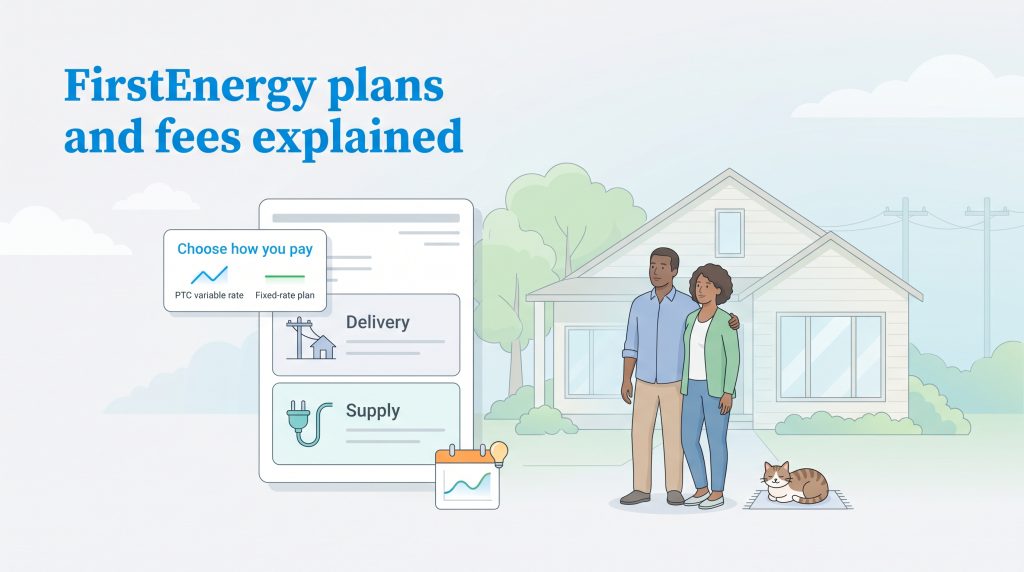
Understanding how you are charged for electricity is the first step to lowering your monthly bill. In deregulated states, your electric bill is split into two main parts: delivery and supply. FirstEnergy will always charge you a regulated delivery fee to maintain the local grid, but you have options when it comes to the supply portion of your bill.
If you don’t actively choose a retail energy supplier, FirstEnergy will automatically place you on their default variable rate, also known as the Price to Compare (PTC). The PTC is calculated based on the fluctuating costs of the wholesale energy market and is typically updated on a quarterly or seasonal basis. Because this default rate goes up and down, many consumers prefer to shop for a fixed-rate plan from a third-party supplier, which locks in a single, predictable price per kilowatt-hour for the duration of the contract.
💡 Pro Tip: If you struggle with seasonal bill spikes during hot summers or freezing winters, ask customer service about the Budget Billing program. This free FirstEnergy service averages your annual electricity usage into 12 predictable, equal monthly payments to help balance your household budget.
FirstEnergy Fees and Deposit Requirements
Utility bills often include administrative costs that can sneak up on you if you aren’t prepared. Whether you are setting up new service or managing an existing account, FirstEnergy maintains a standard fee structure across most of its operating companies.
- Deposit Requirements: If you are a new customer without an established credit history or have a low credit score, FirstEnergy typically requires a security deposit equivalent to two months of estimated average usage. The deposit is usually refunded with interest after 12 consecutive months of on-time payments.
- Late Payment Penalties: Missing your due date usually results in a late fee assessed as a 1.5% charge on the past-due balance.
- Reconnection Fees: If your service is disconnected due to non-payment, you will be required to pay the past-due balance, a potential new security deposit, and a reconnection fee.
FirstEnergy Energy Choice Suppliers
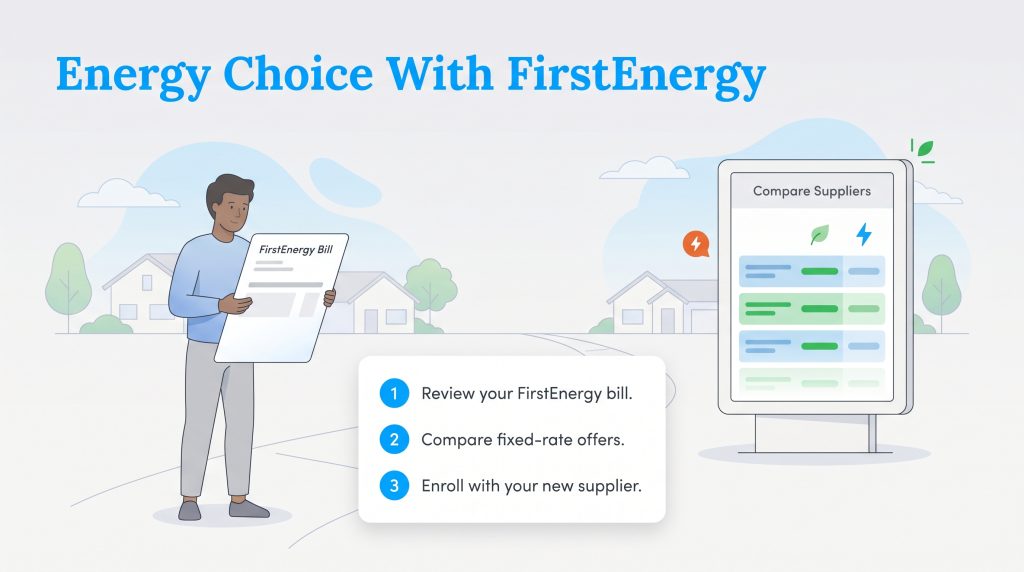
Customers living in deregulated areas within Ohio, Pennsylvania, New Jersey, and Maryland have the power to choose their Retail Electric Provider (REP). Taking advantage of energy choice allows you to break free from FirstEnergy’s default variable rate and shop around for lower costs, smart home bundles, or green energy plans tailored to your lifestyle.
Switching your supplier is entirely free and surprisingly easy. Follow these three simple steps to change providers without interrupting your power service:
- Review Your Current Bill: Locate your current Price to Compare (PTC) and your customer account number on your most recent FirstEnergy statement.
- Compare Available Rates: Use your state’s official public utility commission website to shop for competitive offers. Look for a fixed-rate plan that guarantees a lower price per kilowatt-hour than your current PTC.
- Enroll With Your New Provider: Once you sign up with a retail supplier online, they will handle the transition directly with FirstEnergy. There is no physical equipment to install, and your power will not go out during the switch. FirstEnergy will simply update the supply line on your next monthly bill.
Top REP Options in FirstEnergy’s Service Areas
If you choose to shop the market, you will encounter numerous reputable suppliers. Here are a few prominent options offering competitive service in FirstEnergy territories:
Energy Harbor: Formerly a subsidiary of FirstEnergy, they are now an independent company specializing in carbon-free nuclear energy plans, making them a top choice for reliable, emission-free power.
Constellation: As one of the largest retail energy providers in the nation, Constellation is known for stability. They offer excellent fixed-rate plans (locking in your price for 12 to 36 months) and frequently bundle services with smart home technology.
Direct Energy: A household name offering flexible options, including free weekend electricity plans. They are popular for their customer perks and ongoing rewards programs.
NRG Home: NRG is a major industry player. If you want a 100% eco-conscious alternative, their subsidiary Green Mountain Energy is often the go-to standard for sustainability.
AEP Energy: Although AEP operates its own rival utility footprint, their retail arm sells power in FirstEnergy territories. They are widely trusted for straightforward, no-nonsense fixed rates without hidden fees.
FirstEnergy Green Energy Initiatives
Despite its historical reliance on fossil fuels in fully regulated territories, FirstEnergy is steering toward a highly sustainable future. The company has officially pledged to achieve Carbon Neutrality by 2050, starting with an aggressive benchmark goal of a 30% reduction in greenhouse gases by 2030.

- Calculate Your Moving Costs
- Compare Moving Companies
- Get Multiple Quotes
- Move with Confidence
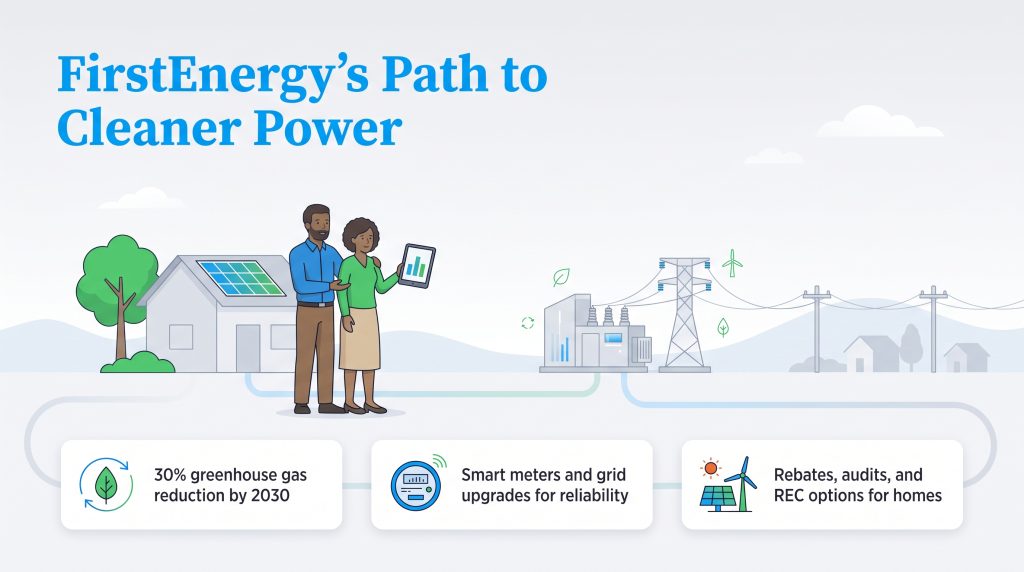
To facilitate this clean energy transition, the company is investing billions into their “Energizing the Future” grid modernization initiative. FirstEnergy is actively deploying smart meters across millions of homes, which helps customers accurately track their daily usage and enables the utility grid to automatically detect and isolate local power outages faster.
FirstEnergy’s generation portfolio is also evolving. While they still operate major coal-fired stations (such as Harrison and Fort Martin) and maintain a 16% ownership stake in the Bath County Pumped Storage Station, they are steadily adding renewable energy to the mix. FirstEnergy secures wind-generated electricity through strategic power purchase agreements and has initiated numerous commercial solar projects.
Rebates, Home Audits, and Savings Programs
FirstEnergy offers several robust incentives to help everyday customers lower their usage and shrink their carbon footprint. Because energy efficiency laws vary by state, specific availability will depend on your local subsidiary.
- Home Energy Audits: The company facilitates highly discounted or free in-home energy audits. A certified professional will inspect your insulation and evaluate your HVAC system, often leaving you with complimentary energy-saving items like LED bulbs.
- Appliance Rebates & Recycling: Customers in states like Pennsylvania, New Jersey, and Ohio can frequently claim cash rebates ranging from $25 to $500 for installing ENERGY STAR® certified appliances. Additionally, FirstEnergy will often haul away an old, inefficient refrigerator for free and pay you a $50 recycling bounty.
- Renewable Energy Credits (RECs): For eco-conscious consumers who want to actively support clean energy development, FirstEnergy provides options to purchase RECs, which certify that your home’s electricity consumption is matched by green generation sources on the grid.
How to Report a FirstEnergy Power Outage
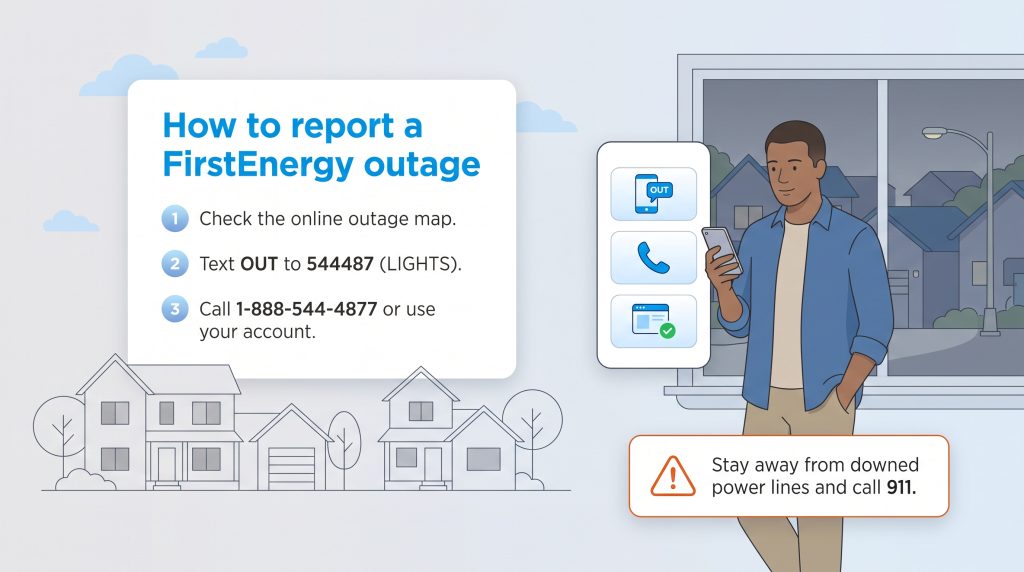
Severe weather in the Midwest and Northeast can knock out power unexpectedly. When the lights go dark, communicating with your utility company immediately is the best way to speed up restoration times. FirstEnergy offers several distinct methods to log your repair ticket securely.
- Check the Outage Map: Before calling, view the interactive FirstEnergy power outage map online. This tool displays the number of affected customers in your neighborhood and provides an estimated restoration timeline.
- Report via Text Message: The fastest way to log a disruption is by texting OUT to 544487 (LIGHTS). Once reported, you can text STAT to the same number to receive updates on your local repair crew’s progress.
- Call Customer Service: You can quickly reach the automated outage line by calling the FirstEnergy customer service number at 1-888-LIGHTSS (1-888-544-4877). The system usually recognizes your phone number and registers the outage instantly.
- Use the Digital Portal: Log into your account on the FirstEnergy website or mobile app and tap the “Report Outage” button.
🚩 Heads Up: If you spot a downed power line in your neighborhood, stay at least 30 feet away and assume the wire is live. Call 911 immediately, followed by the dedicated emergency line at 1-888-LIGHTSS.
FirstEnergy Pay My Bill and Account Management
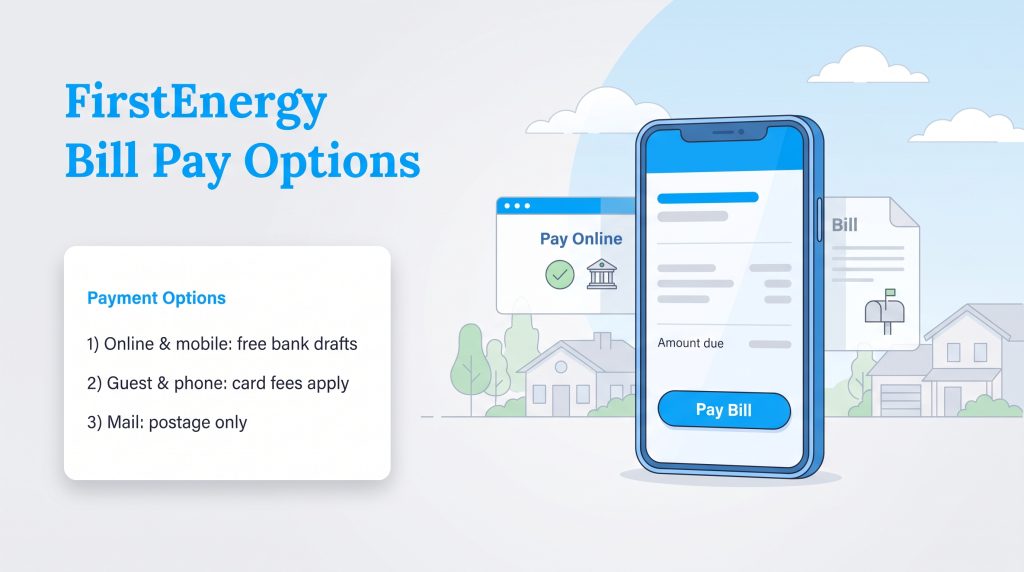
Managing your electricity usage does not require waiting for a paper bill in the mail. FirstEnergy provides a unified digital experience to make monthly payments straightforward and secure.
If you prefer to handle your account via a smartphone, note that you will need to search for your specific operating company’s name (e.g., “JCP&L” or “Ohio Edison”) in the iOS App Store or Android Google Play store. Because of their regional structure, there is no single app generically named “FirstEnergy.” Once downloaded, the application automatically updates its branding and serves as a centralized hub to track your daily usage, manage paperless eBilling, and process payments.
Here is a breakdown of your standard payment options and any associated fees:
| Payment Method | Details | Fees |
|---|---|---|
| Online Portal | Log into your account via the website to pay directly from a linked checking or savings account. | Free for direct bank drafts |
| Mobile App | Pay using your smartphone through your regional operating company’s application. | Free for direct bank drafts |
| Guest Pay | Pay online without creating an account by simply entering your account number and zip code. | Third-party processing fees apply for credit/debit cards |
| Phone | Call the automated payment system to process a transaction securely over the phone. | Third-party processing fees apply |
| Send a physical check or money order to the payment address listed on your current paper bill. | Postage costs only |
FirstEnergy Reviews and Ratings
When reviewing consumer watchdog sites like the Better Business Bureau, Trustpilot, and active Reddit communities, FirstEnergy garners a mixed bag of feedback. This varied response is very typical for a utility operating at such a massive scale.
On the positive side, customers frequently praise FirstEnergy’s modern digital tools. Users consistently appreciate the accuracy of the interactive outage map and the convenience of the mobile app, which allows them to track repair progress during heavy storms without ever waiting on hold for a representative.
Conversely, the most frequent complaints center around post-storm restoration delays in rural areas and unexpected bill shock during the peak winter heating season. Many billing disputes in deregulated areas actually stem from third-party supply charges. Because FirstEnergy consolidates the billing process, they often bear the brunt of customer frustration when a retail supplier drastically raises variable supply rates.
If you are unable to resolve a serious billing or service issue directly with FirstEnergy, you have the right to file a formal dispute with your state’s Public Utilities Commission (such as the PUCO in Ohio or the PA PUC in Pennsylvania) for an independent administrative review.
Preparing Your Home for FirstEnergy
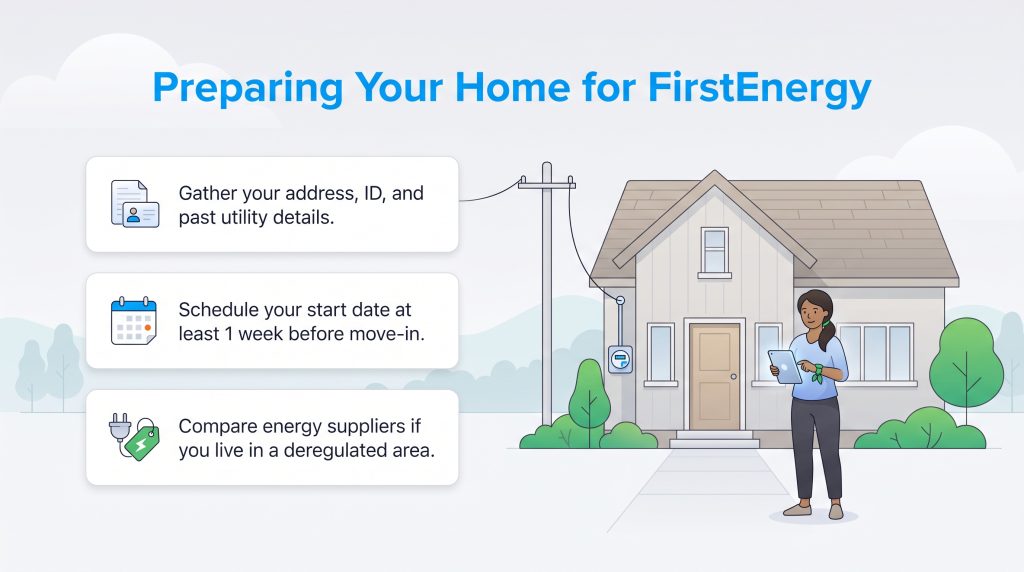
If you are moving into a new residence within FirstEnergy’s massive service footprint, establishing your electrical connection is a streamlined process. To ensure your lights are on when you arrive, follow this simple new service setup checklist:
- Gather Prior Address History: Prepare your new service address, your Social Security Number for a soft credit check, and information regarding your previous utility provider. If you have a solid 12-month payment history, ask if FirstEnergy will waive any required security deposit.
- Choose a Start Date: Contact FirstEnergy online or by phone at least a week before your move-in day. Schedule the activation for the morning of your arrival so you aren’t left unpacking in the dark.
- Select an Energy Supplier (If Applicable): If you are moving into a deregulated territory, take time to shop for a competitive retail electric provider rather than automatically accepting the default utility rate.
Finalizing Your FirstEnergy Service Setup
FirstEnergy provides the essential infrastructure and modern digital tools needed to keep your lights on and your account easily manageable. While their deep commitment to grid modernization and a carbon-neutral future makes them a highly reliable delivery partner, you do not have to settle for their default supply pricing in a deregulated market. We recommend checking the Price to Compare on your very first bill and shopping local retail suppliers to ensure you secure the most competitive rate for your household’s ongoing energy needs.
Frequently Asked Questions About FirstEnergy
Who does FirstEnergy serve?
What is the FirstEnergy customer service number?
How do I find the FirstEnergy power outage map?
Does FirstEnergy have a mobile app to pay my bill?
How do I start new service with FirstEnergy?
What is the FirstEnergy price to compare?
Why did my FirstEnergy bill go up?
About the Author

David has been an integral part of some of the biggest utility sites on the internet, including InMyArea.com, HighSpeedInternet.com, BroadbandNow.com, and U.S. News. He brings over 15 years of experience writing about, compiling and analyzing utility data.