

Setting Up Your Utilities in Ohio Is Simple When You Understand Your Options for Electricity, Natural Gas, Water, and Internet Services
Key Takeaways
- The Ohio Energy Choice program lets eligible households select their electricity and natural gas suppliers, including green energy plans.
- Start your setup one to two weeks before moving to schedule in-person gas activations and avoid service delays.
- The average Ohio household spends roughly $240 per month on core electricity, natural gas, and water services.
When you are moving to Ohio and setting up utilities, you gain a major advantage for your household budget: a deregulated energy market that lets you choose your electricity and natural gas suppliers. If you’re used to a single utility company handling everything from the power lines to the billing rates, this guide will walk you through how to set up utilities in Ohio, navigate the Ohio Energy Choice program, and connect your essential services. Follow this step-by-step moving utilities checklist to ensure a seamless setup process, avoid common billing traps, and take control of your monthly utility costs from day one.
Ohio Utility Setup Timeline and Pre-Move Checklist
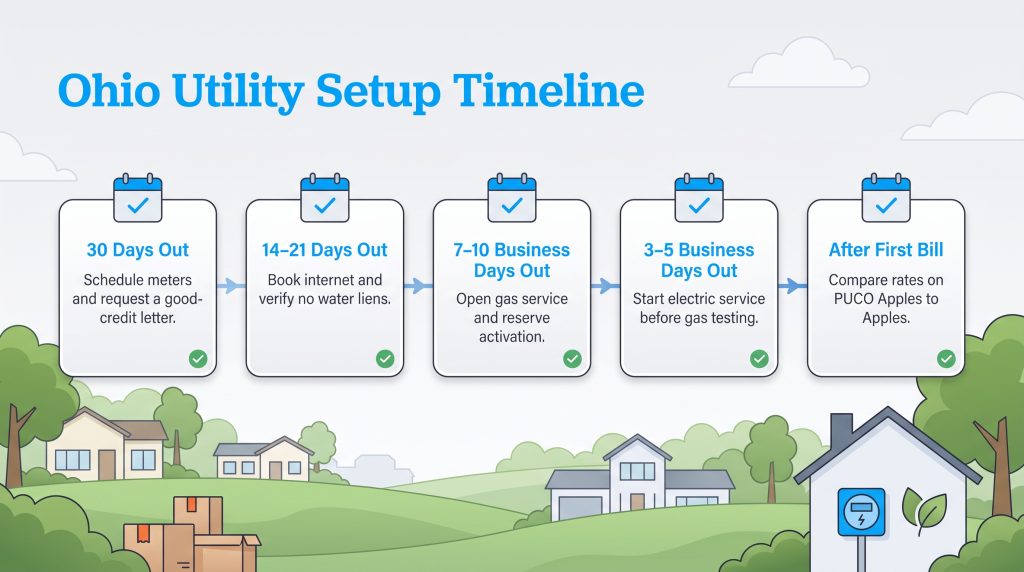
Timing your utility requests properly guarantees you won’t spend your first night in the Buckeye State unpacking boxes in the dark or taking a cold shower. Because different utility providers require varying lead times for physical meter installations, technician visits, and credit verifications, following a structured countdown keeps your move on track.
| Timeline Before Move-In | Action Required |
|---|---|
| 30 Days Out | Schedule physical meter installations for newly constructed homes and request a 24-month letter of good credit from your current utility providers to waive Ohio security deposits. |
| 14–21 Days Out | Book your fiber or cable internet installation appointment and verify with your title company that no unpaid municipal water liens are attached to the property deed. |
| Seven to 10 Business Days Out | Open your base natural gas delivery account with Enbridge Gas Ohio, Columbia Gas, or Duke Energy, and reserve your four-hour in-person technician activation window. |
| Three to Five Business Days Out | Start your electric service with AEP Ohio, FirstEnergy, Duke Energy, or AES Ohio so the power is active before the gas technician arrives to test your furnace. |
| After First Bill Arrives | Locate the Price to Compare on your initial billing statement and use the PUCO Apples to Apples portal to lock in a fixed-rate or 100% renewable energy supplier. |
Average Monthly Utility Costs in Ohio
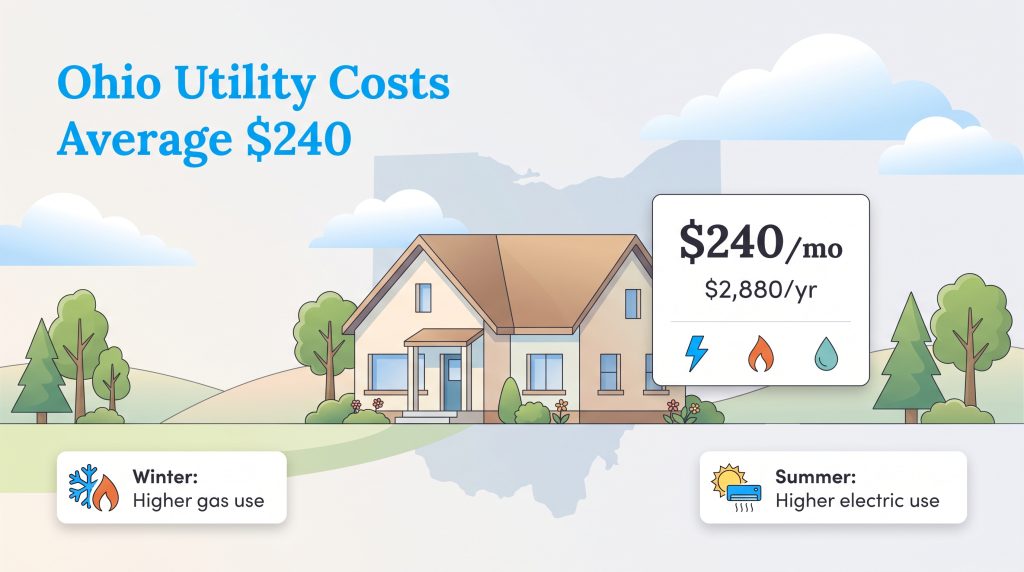
Before you start dialing providers or comparing supply rates, it helps to review a complete guide to utility bills and costs to see how much room your new utilities will take up in your monthly budget. The average utility bill in Ohio sits at roughly $240 per month — or $2,880 per year — for core services including electricity, natural gas, and water. Of course, your exact monthly total will depend heavily on the square footage of your property, the age of your insulation, and your household’s daily consumption habits.
| Home Size | Electricity | Natural Gas | Water | Estimated Total (Monthly / Annual) |
|---|---|---|---|---|
| 2BR Apartment | $78/mo | $41/mo | $29/mo | $148/mo ($1,776/yr) |
| Small 3BR House | $112/mo | $62/mo | $39/mo | $213/mo ($2,556/yr) |
| Average 3-4BR House (State Average) | $125/mo | $70/mo | $45/mo | $240/mo ($2,880/yr) |
| Large 4-5BR House | $156/mo | $94/mo | $59/mo | $309/mo ($3,708/yr) |
While $240 per month is a reliable year-round baseline, Ohio’s distinct four-season climate causes noticeable swings from one season to the next. Freezing winter temperatures and lake-effect snow off Lake Erie push furnaces to work overtime from November through March, driving up natural gas bills across the state. Conversely, hot and humid Midwest summers shift the financial load onto your electric bill as central air conditioning units run continuously throughout July and August. Enrolling in a utility distributor’s budget billing program or locking in fixed supply rates can help smooth out these seasonal spikes so you aren’t caught off guard by a mid-winter heating bill.
Step 1: Understand Ohio’s Deregulated Energy Market
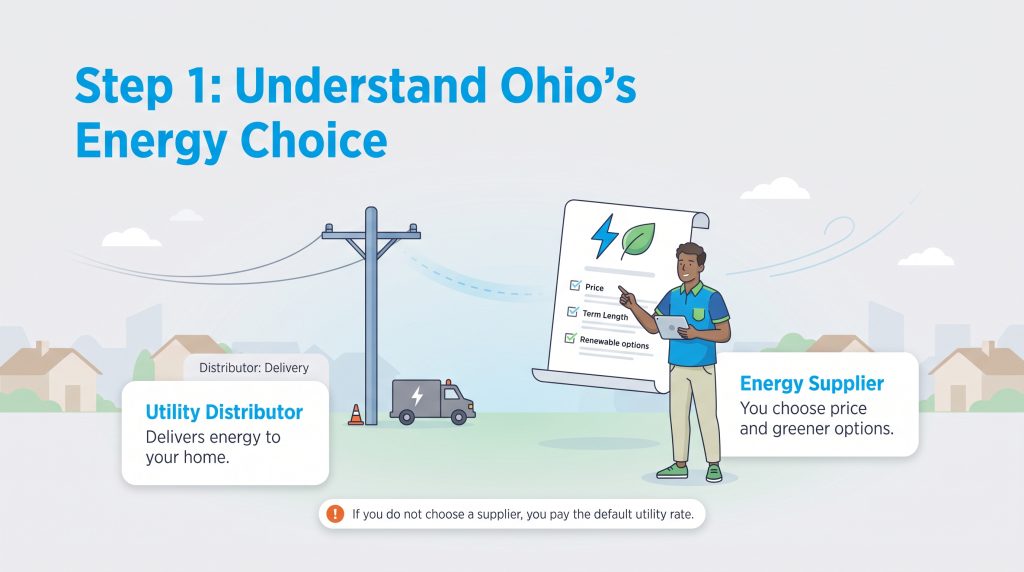
One of the biggest perks of relocating to the Buckeye State is the financial flexibility provided by its deregulated energy market. If you’re arriving from a state where a single utility monopoly controls both delivery and generation prices, the system here requires a quick mental adjustment. The official Ohio Energy Choice program allows eligible residential customers to shop around and choose the specific retail company that supplies their electricity and natural gas. This statewide program unbundles your power and gas services into two distinct parts: delivery and supply.
Utility Distributors vs Retail Energy Suppliers
To avoid confusion when your first statement arrives in the mail, you need to understand the separate roles of your local delivery company and your chosen retail supplier:
| Category | Utility Distributor | Retail Energy Supplier |
|---|---|---|
| Core Responsibility | Owns and maintains the physical poles, wires, pipelines, and meters in your neighborhood. | Generates or purchases the actual electricity or natural gas your household consumes. |
| Can You Choose Them? | No. Assigned to your home exclusively based on your geographic location and ZIP code. | Yes. Chosen entirely by you through the competitive retail energy market. |
| Who to Call for Outages | Call your distributor 24/7 for power outages, downed lines, gas leaks, or meter repairs. | Never call for emergencies; they only manage your supply rate and contract terms. |
| Billing Role | Sends your monthly statement, reads your meter, and charges PUCO-regulated delivery fees. | Sets your generation supply rate (per kWh, Mcf, or Ccf), which appears as a line item on your distributor’s bill. |
Warning: Failing to choose a retail energy supplier results in an automatic assignment to a default Standard Service Offer (SSO) or Standard Choice Offer (SCO) from your distributor. While this guarantees your lights and heat will turn on when you move in, the default rate fluctuates periodically based on wholesale market auctions and isn’t always the most cost-effective or eco-friendly option for your home.
Municipal Energy Aggregation (Opt-Out Programs)
Even if you don’t actively shop for a retail supplier after moving in, you might still be enrolled with one through Governmental Energy Aggregation. Across Ohio, hundreds of cities, villages, townships, and counties use voter-approved authority to form bulk buying groups on behalf of their local residents. Your local municipal leaders negotiate directly with competitive retail suppliers to secure a group fixed rate or green energy plan for the entire community.
Nearly all municipal aggregation programs in Ohio operate on an “opt-out” basis. Shortly after you open your base utility account, your city or township’s chosen supplier will mail you an official enrollment notice detailing their negotiated rate and contract terms. You are automatically enrolled in your community’s aggregation program unless you sign and return the opt-out notice within 21 days, call to decline, or actively select your own retail energy supplier.
Step 2: Identify Your Local Utility Distributors by Region
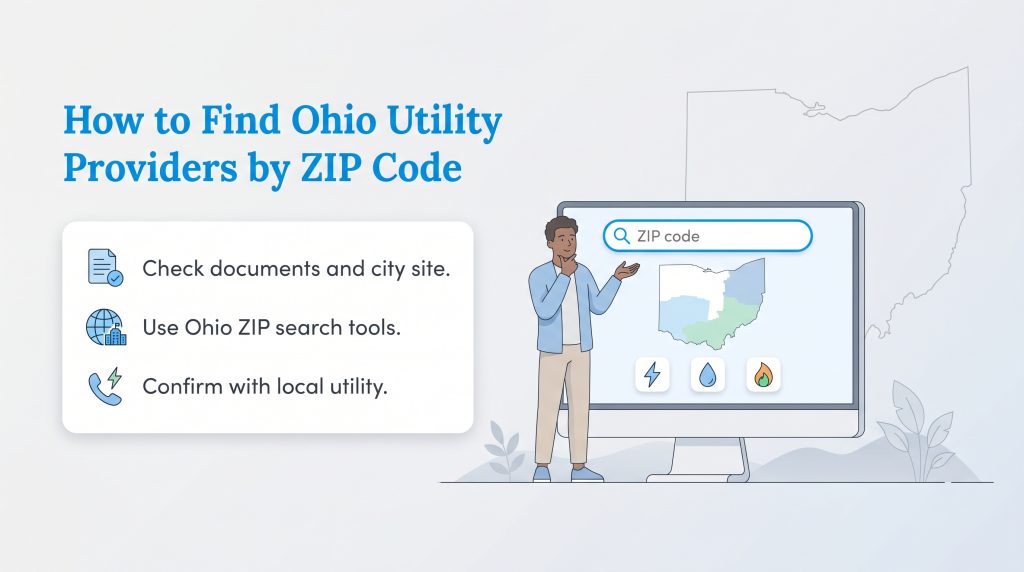
Before you can shop for competitive supply rates, you have to open an active delivery account with the company that manages the physical infrastructure in your neighborhood. Because you cannot choose your local distributor, figuring out who operates the grid and pipelines in your ZIP code is your mandatory first step. Whether you need to submit an AEP Ohio start service request or schedule an Enbridge Gas Ohio start service appointment (formerly Dominion Energy in Northeast Ohio), use the directory below to contact the primary utility companies servicing the state:
| Ohio Region | Utility Type | Primary Provider Name | Customer Service Phone Number / Setup Portal |
|---|---|---|---|
| Central Ohio | Electric | AEP Ohio | 800-672-2231 / aepohio.com |
| Central Ohio | Natural Gas | Columbia Gas of Ohio | 800-344-4077 / columbiagasohio.com |
| Northeast Ohio | Electric | FirstEnergy (The Illuminating Company, Ohio Edison) | 800-589-3101 (Illuminating Co.) / 800-633-4766 (Ohio Edison) / firstenergycorp.com |
| Northeast Ohio | Natural Gas | Enbridge Gas Ohio (formerly Dominion Energy) | 800-362-7557 / enbridgegas.com/ohio |
| Northwest Ohio | Electric | Toledo Edison (FirstEnergy) | 800-447-3333 / firstenergycorp.com |
| Northwest Ohio | Natural Gas | Columbia Gas of Ohio / Enbridge Gas Ohio | 800-344-4077 (Columbia Gas) / 800-362-7557 (Enbridge Gas) |
| Southwest Ohio | Electric | Duke Energy Ohio, AES Ohio | 800-544-6900 (Duke Energy) / 800-433-8500 (AES Ohio) |
| Southwest Ohio | Natural Gas | Duke Energy Ohio | 800-544-6900 / duke-energy.com |
| Southeast Ohio | Electric | AEP Ohio | 800-672-2231 / aepohio.com |
| Southeast Ohio | Natural Gas | Columbia Gas of Ohio | 800-344-4077 / columbiagasohio.com |
| Statewide Exceptions | Electric | 85+ Municipal Utilities & 24 Rural Electric Cooperatives | Contact your local city utility department (e.g., Cleveland Public Power, Columbus Division of Power, Westerville Electric Division) or local co-op directly. |
If you live near a service territory border and aren’t sure which company covers your exact street, review your closing documents or lease agreement, or check the interactive service territory maps on the Public Utilities Commission of Ohio (PUCO) website.
📌 Quick Fact: Not every Ohio resident is served by a massive investor-owned utility. If your home falls within one of Ohio’s 85+ municipal electric systems (including Cleveland Public Power, the Columbus Division of Power, or the Westerville Electric Division) or is served by a member-owned rural electric cooperative, your utility is governed locally rather than by PUCO. As a result, municipal and cooperative electric customers are exempt from PUCO Energy Choice deregulation and purchase both their power supply and delivery directly from their local public provider.
Step 3: Gather Your Required Documents and Waive Security Deposits
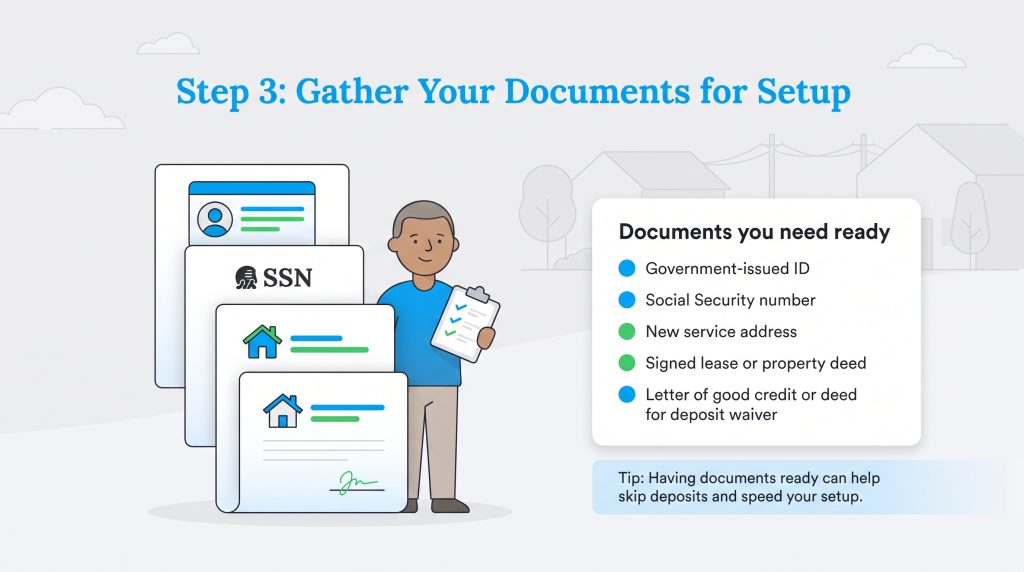
Getting your paperwork organized ahead of time drastically reduces friction when you sit down to transfer utilities to your new address. Instead of scrambling through moving boxes to find personal details while waiting on hold, having your information handy ensures you can activate your base accounts quickly and breeze through any required identity and soft credit checks. Gather the following items before calling your distributor or filling out their online form:
- A valid government-issued photo ID (such as a driver’s license or passport)
- Your Date of Birth
- Your Social Security Number (used for identity verification and soft credit screening)
- Your primary Phone Number and email address
- Your complete new service address (including apartment or unit numbers)
- A copy of your signed lease agreement or property deed
When you open a new account, Ohio utility deposit rules depend on your initial soft credit screening. Under PUCO regulations, a regulated utility deposit cannot exceed your estimated average 30-day bill plus 30%. However, if you are moving from out of state or lack an established local credit profile, you can waive this upfront security deposit entirely by completing one of three quick actions:
- Submit a 24-month letter of good credit: Call your previous out-of-state electric or gas provider before moving and request an official payment history letter verifying you held an active account for 24 consecutive months with no more than two late payments.
- Upload your property deed or closing disclosure: If you purchased your Ohio home, submitting proof of creditworthy property ownership through your new distributor’s online portal satisfies PUCO credit requirements without an upfront fee.
- Complete a customer guarantor form: Have an existing, creditworthy customer of that same Ohio utility distributor sign a guarantor agreement backing your initial 12 months of service.
💡 Pro Tip: If your household is experiencing financial hardship while relocating, Ohio offers strong income-based utility protections to get your power and heat running without steep upfront costs. Income-eligible residents (at or below 175% of the federal poverty level) can apply for the Home Energy Assistance Program (HEAP) for a one-time bill credit or enroll in the Percentage of Income Payment Plan Plus (PIPP Plus), which caps monthly electric and gas payments at a small, fixed percentage of your household income. Furthermore, from mid-October through April 15, PUCO’s annual Winter Reconnect Order allows any residential customer facing disconnection or trying to establish new service to get their gas and electricity turned on for a capped maximum payment of $175 (plus a reconnection fee of no more than $36), regardless of prior account balances or deposit requirements.
Step 4: Shop for Green Energy Suppliers Using Your “Price to Compare”
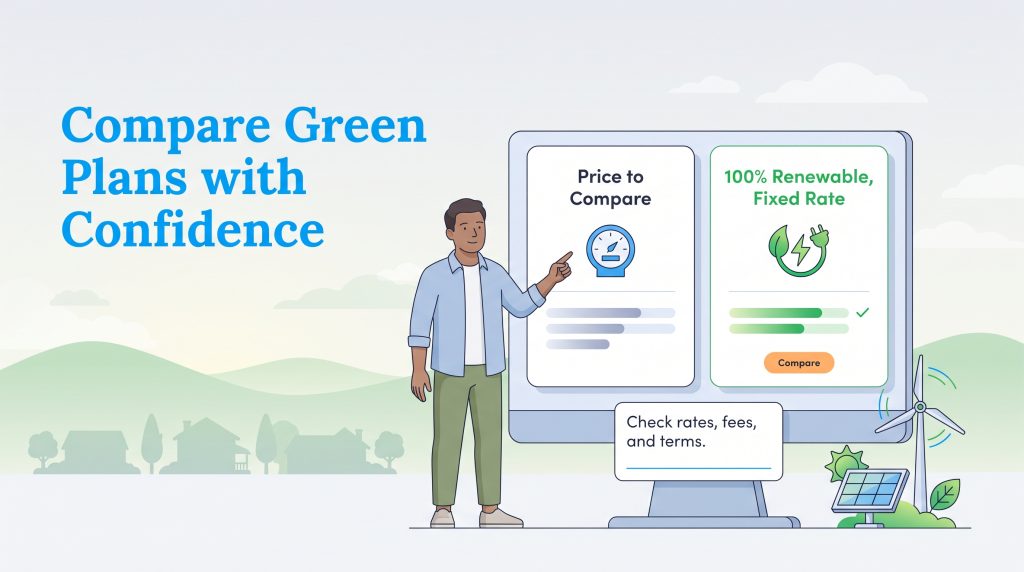
Once your base distribution accounts are active and you have your new account numbers, you can make an environmentally mindful choice regarding the power flowing into your home. Ohio’s deregulated market makes it easy to find green energy suppliers Ohio residents trust to back their household consumption with wind, solar, or hydroelectric generation. While the physical electricity delivered to your outlets comes from the shared regional grid, enrolling in a green plan ensures your usage is fully offset by renewable energy certificates (RECs).
Before you lock in a contract with a competitive retail supplier, you must know your utility distributor’s Price to Compare (PTC). Understanding the Price to Compare Ohio utilities print on your statement is essential because it represents the exact default generation rate — expressed in cents per kilowatt-hour (kWh) for electricity or dollars per thousand cubic feet (Mcf) or hundred cubic feet (Ccf) for natural gas — that your local distributor charges if you don’t pick a third-party supplier. If a retail supplier’s rate is lower than your Price to Compare, you’ll save money; if it’s higher, you’ll pay a premium (which some households willingly accept for 100% renewable energy or long-term fixed-rate stability). Always locate your current Price to Compare on your initial welcome letter, on your first monthly bill, or at the top of PUCO’s comparison portal before signing up for a retail plan.
Follow this three-step process to navigate the official PUCO Apples to Apples comparison tool and find an eco-conscious alternative that fits your budget:
- Visit the PUCO Apples to Apples portal, select Electric or Natural Gas, and choose your specific residential utility distributor from the menu to view your current Price to Compare at the top of the chart.
- Use the filtering options on the left side of the results page to adjust the renewable content slider to “100% Renewable” and filter for “Fixed” rate structures to isolate predictable, energy-saving options.
- Compare the remaining supplier offers against your Price to Compare, checking carefully for hidden monthly recurring charges, promotional introductory rates that expire after three months, and early termination fees.
🌱 Eco Edge: Already live in Ohio and moving across the state? Before you shop for a brand-new plan, call your current retail energy supplier. If you are moving within the same utility territory (or to another Ohio territory your supplier services), many companies allow you to transfer your existing fixed-rate or green energy contract to your new address. Furthermore, if you are relocating to a part of Ohio where your current retail supplier does not operate, PUCO consumer rules generally require the supplier to release you from your contract and waive any early termination fees once you provide proof of your new address.
Step 5: Schedule Water, Sewer, and Trash Services
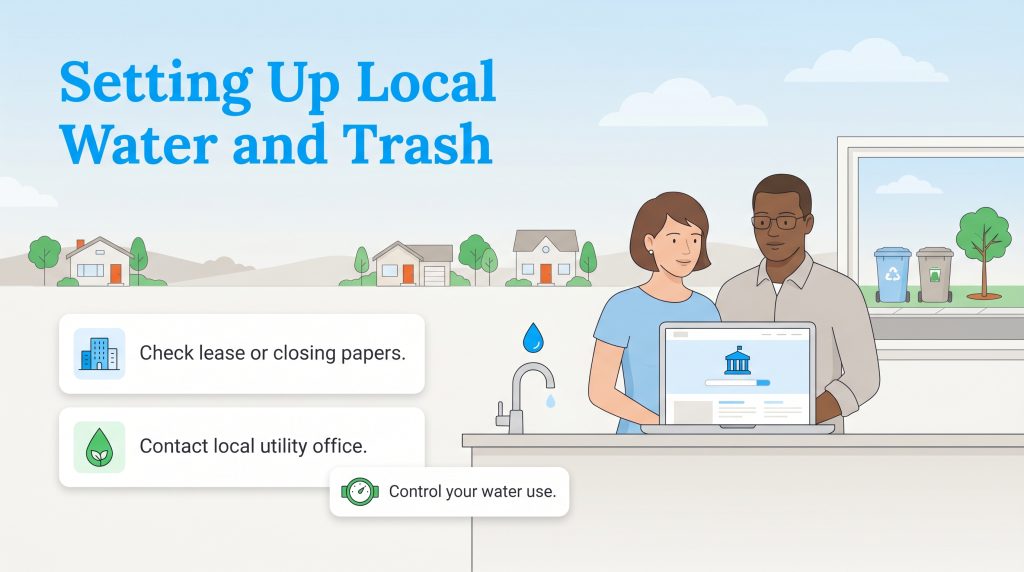
Unlike natural gas and electricity, your water, sewer, and trash collection fall entirely outside of Ohio’s deregulated market framework. You won’t shop around on a state portal for competing water rates. In most major cities and suburbs, these services operate as municipal utilities you set up directly through your local city hall, public utilities department, or county sanitary engineer.
However, depending on your exact neighborhood or township, your water and waste might be managed by a large regional water district or a private company rather than a city government. Use these primary contact numbers if your new home is serviced by one of Ohio’s major regional providers:
- City of Columbus Department of Public Utilities (Water & Power): Call 614-645-8276 to transfer municipal water and sewer service in the greater Columbus metro area.
- Cleveland Division of Water: Call 216-664-3130 for residential water activation across Cuyahoga County and surrounding Northeast Ohio suburbs.
- Greater Cincinnati Water Works (GCWW): Call 513-591-7700 to establish service in Cincinnati and participating Southwest Ohio communities.
- Del-Co Water Company: Call 740-548-7600 if you are moving into Delaware County or neighboring Central Ohio townships.
- Aqua Ohio: Call 877-987-2782 for private residential water service across dozens of Ohio counties.
- Rumpke Waste & Recycling: Call 800-828-8171 to set up private curbside trash and recycling pickup in unincorporated townships and suburbs not covered by municipal waste crews.
Always review your lease agreement or closing documents before making these phone calls. If you rent, your landlord may keep water, sewer, and trash in their own name and bill you a flat monthly fee. If you bought a home, verify with your title company during closing that the seller’s final water meter reading was recorded and paid in full — in Ohio, unpaid municipal water and sewer balances attach to the property as a lien and transfer directly with the property deed to the new homeowner.
💸 Money-Saver: Swap out your standard bathroom fixtures for a WaterSense-labeled low-flow showerhead right after moving in to immediately decrease both your monthly water consumption and the gas or electricity required to heat that water.
Even though you can’t choose your local water provider, you have complete control over how much flows down your drains. Adopting practical, everyday strategies to reduce your home water usage helps ease the strain on local watersheds and protect your budget.
Step 6: Connect High-Speed Internet and Cable Services
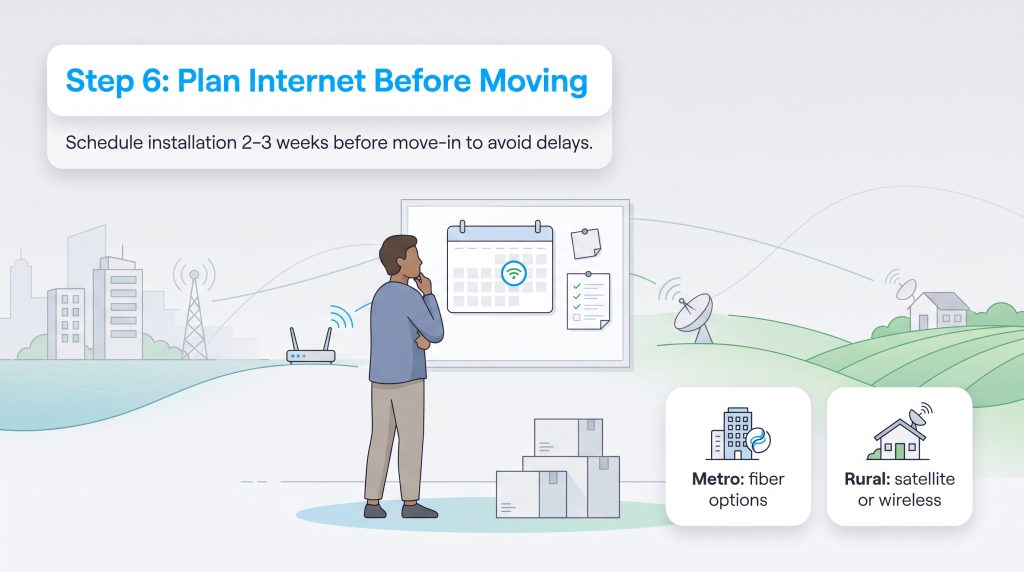
While broadband internet isn’t regulated like electricity or water, getting online is non-negotiable for remote work, smart home devices, and streaming. Your connectivity options in Ohio will vary dramatically depending on your ZIP code. If you’re moving into major metropolitan areas like Columbus, Cleveland, Cincinnati, Dayton, or Toledo, you’ll likely choose between high-speed cable and fiber networks from providers like Spectrum, AT&T Fiber, Altafiber, Breezeline, or Buckeye Broadband. Conversely, if your new home is in a rural agricultural township or the rolling hills of Southeast Ohio, 5G fixed wireless or satellite connections might be your primary options.
We strongly recommend researching providers and locking in an installation appointment two to three weeks ahead of your moving day. If the previous resident used the same provider and the wiring is still intact, you can often opt for a self-installation kit that ships straight to your door. Otherwise, technician slots book up fast during peak summer moving seasons, and scheduling early keeps you from burning through mobile hotspot data during your first week of unpacking. For more strategies on evaluating speeds and selecting reliable equipment, read our advice on finding a reliable internet connection.
Protecting Your Budget From Submetering and Energy Scams
While Ohio’s utility laws give consumers plenty of freedom, certain regulatory loopholes and aggressive sales tactics can catch newcomers off guard. Whether you’re signing a lease in a brand-new apartment complex or unpacking boxes in a suburban house, knowing how to spot these two common utility traps will save you hundreds of dollars a year.
Utility Submetering in Apartments and Condos
If you’re setting up utilities as a renter or buying a condo in Ohio — especially in booming metro areas like Columbus and its surrounding suburbs — you need to watch out for utility submetering Ohio landlords frequently use. Submetering occurs when a landlord, developer, or condo association buys electricity and water in bulk at wholesale rates and hires an unregulated third-party middleman company (such as Nationwide Energy Partners or American Power & Light) to measure individual unit usage and bill residents. Because these third-party resellers aren’t classified as traditional public utilities, they often operate outside of standard PUCO consumer protections.
For renters, living in a submetered building has two major drawbacks: you are completely blocked from participating in the Ohio Energy Choice program to shop for cheaper or green rates, and your bill is often padded with steep administrative fees, common-area charges, and markups. Before you sign a lease, ask your landlord or leasing agent one direct question: “Are electricity and water billed directly by the regulated utility distributor (like AEP Ohio or Duke Energy), or are they billed through a third-party submetering firm?” Knowing the answer upfront helps you accurately calculate the true monthly cost of the apartment.
Door-to-Door Energy Scammers and “Slamming”
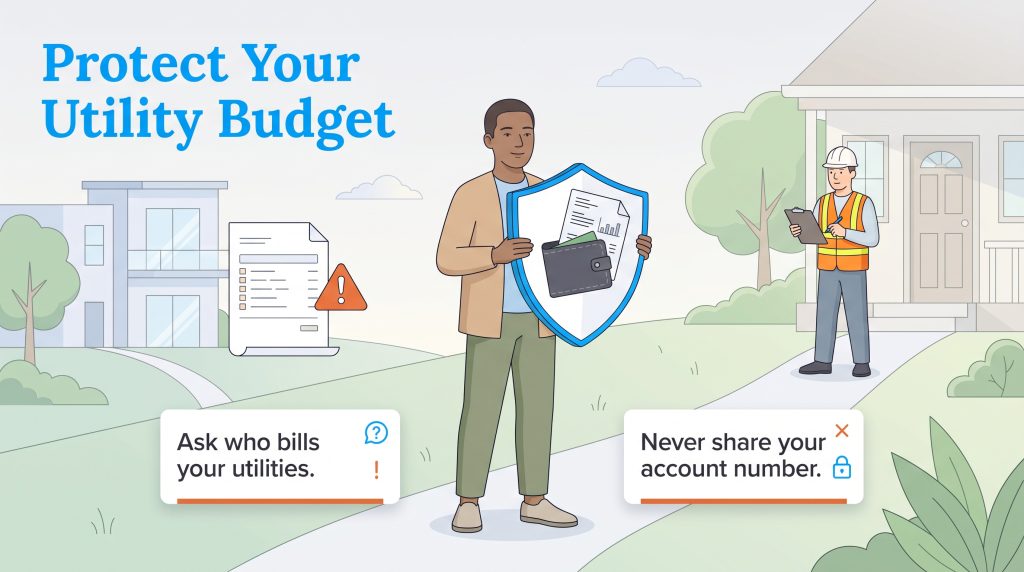
Shortly after you move into a new Ohio neighborhood, don’t be surprised if someone wearing a high-visibility vest and carrying a clipboard knocks on your door claiming to be from “the electric company” or an “energy auditing program.” These are third-party retail energy salespeople, not employees of your local utility distributor. While some follow the rules, unscrupulous canvassers use deceptive tactics to ask to see your utility bill “to verify you are receiving a local discount” or “check your rate compliance.”
Never show your utility bill or share your account number, Service Delivery Identifier (SDI), or Point of Delivery (POD) ID with an unsolicited door-to-door salesperson. With just that number from your bill, a dishonest representative can enroll you in an overpriced variable-rate supply contract without your explicit permission — an illegal practice known as “slamming.” Remember that your regulated distributor will never go door-to-door asking to inspect your paper bill. Always do your energy shopping privately online through the official PUCO Apples to Apples portal.
Coordinating Move-In Day Utility Activations
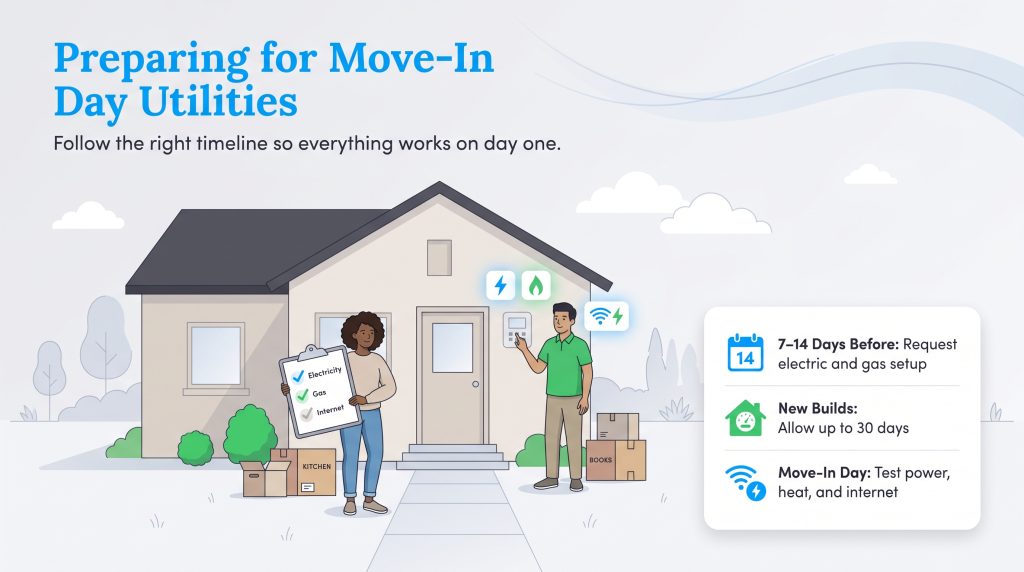
While electric and municipal water meters can usually be activated remotely without anyone home, executing a smooth utility setup process on moving day requires careful coordination for your natural gas service. If the gas service at your new property was physically shut off between residents or the meter is located indoors, an adult aged 18 or older must be on-site during a scheduled four-hour appointment window to grant the technician access. You must ensure your electricity is active prior to your four-hour natural gas technician window so the technician can safely cycle furnace blower motors, test electronic ignitions, and inspect appliances for leaks.
🚩 Heads Up: Moving into a newly built home that doesn’t have a physical natural gas meter installed yet? Standard customer service reps can’t schedule a turn-on until the meter hardware is in place. If you are building in an Enbridge Gas Ohio territory, call their dedicated Construction Support team at 888-619-0786 (or Columbia Gas Construction Services at 800-344-4077) at least 30 days before closing to verify your service line and physical meter installation status.
When moving day finally arrives, do a quick walk-through to test your home’s systems before the moving truck pulls away. Make sure your main circuit breaker is switched on, flip the light switches, run the hot water tap, verify that your heating and cooling systems respond to the thermostat, and connect your phone to the Wi-Fi router. If anything isn’t working as expected, you’ll have your account numbers and distributor phone numbers right at your fingertips.
Managing Your First Ohio Utility Bills and Long-Term Efficiency
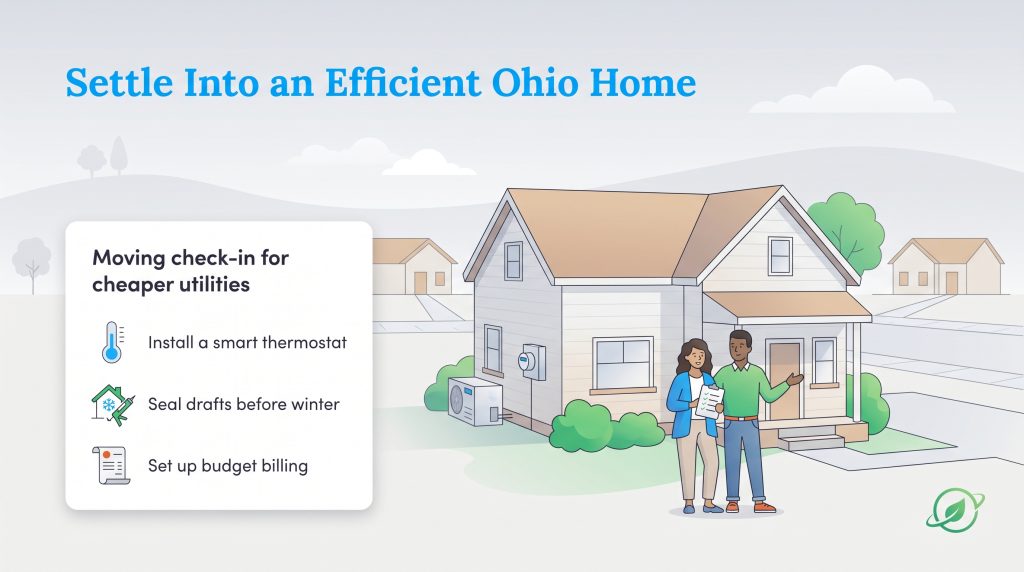
Once the last box is unpacked, remember to cancel utilities at your old address so you can shift your focus from initial setup to long-term household efficiency. Install an ENERGY STAR-certified smart thermostat to trim heating and cooling waste, weatherstrip drafty windows and doors before the first November frost arrives, and set a digital calendar reminder 30 days before your retail energy supplier contract expires so your account never rolls onto a pricey month-to-month variable rate. Taking these proactive steps ensures your new Ohio home stays comfortable, sustainable, and budget-friendly through every season.
Frequently Asked Questions About Setting Up Utilities in Ohio
How many days before moving to Ohio should I set up my utilities?
Does an adult need to be home when utilities are turned on in Ohio?
Can I transfer my current Ohio energy supplier contract when I move to a new address?
Why did I receive an automatic energy aggregation opt-out letter after moving to an Ohio city?
How do I find my Price to Compare on my Ohio utility bill?
What is utility submetering in Ohio apartments and how can I avoid it?
How much is a typical utility deposit in Ohio?
About the Author

LaLeesha has a Masters degree in English and enjoys writing whenever she has the chance. She is passionate about gardening, reducing her carbon footprint, and protecting the environment. She also recently served as President of the Board for City Sprouts (a community garden).

David has been an integral part of some of the biggest utility sites on the internet, including InMyArea.com, HighSpeedInternet.com, BroadbandNow.com, and U.S. News. He brings over 15 years of experience writing about, compiling and analyzing utility data.