Written By: Claudio Kriegel | Updated On: May 26th, 2026

Default residential rates for Duke Energy Ohio and AES Ohio are rising on June 1, 2026, but you have the power to switch and protect your monthly budget.
Key Takeaways
- Starting June 1, 2026, default electricity supply rates are increasing by 6% for Duke Energy Ohio and 15% for AES Ohio customers, adding an estimated $6.20 to $15.00 more to typical monthly bills.
- These supply rate hikes are driven by record-high regional capacity costs and surging electricity demand from newly built, energy-heavy data centers.
- Because Ohio is an energy choice state, you can bypass these default rate hikes by locking in a lower fixed-rate plan with a competitive supplier or participating in local community aggregation programs.
If you have been keeping a close eye on your household budget lately, we have some news that might make you want to pay extra attention to your next utility statement. Beginning June 1, 2026, default residential electricity supply rates for both Duke Energy Ohio and AES Ohio are scheduled to increase, meaning many families across southwestern and west-central Ohio will face immediate bill hikes ranging from $6.20 to $15.00 per month. While these rising grid pressures can feel overwhelming, you do not have to simply sit back and accept higher charges. Since Ohio is an energy choice state, we are here to help you understand why these changes are happening, how they will impact your home, and how you can easily switch to a more affordable, eco-conscious alternative to keep your hard-earned money in your pocket.
Understanding the June 2026 Rate Hikes
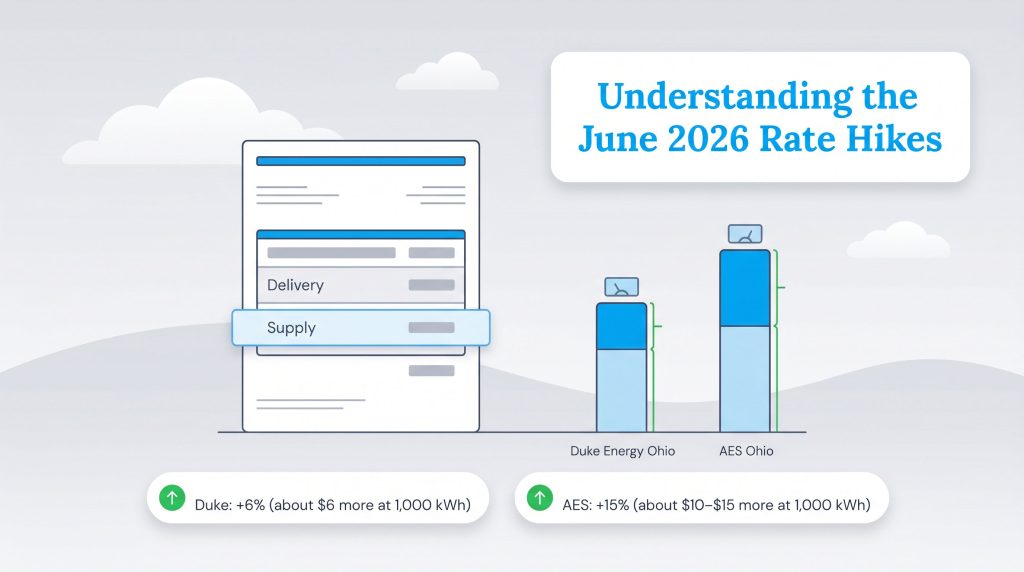
When you receive your monthly electric bill, the total amount is split into two primary parts: delivery and supply. While your local utility company always handles the physical delivery of power and maintains the grid lines, the supply portion covers the actual generation of the electricity you consume. If you do not actively choose an independent retail supplier, you are billed under your utility’s default supply rate, also known as the Price to Compare. Beginning June 1, 2026, these default standard offer rates are moving upward.
For Duke Energy Ohio residential customers on standard Rate RS plans, the Price to Compare is rising from 10.0819 cents per kWh to 10.7016 cents per kWh, representing a 6% increase. If your home consumes 1,000 kWh of electricity in a typical month, this change will add roughly $6.20 directly to your supply charge.
Meanwhile, customers served by AES Ohio (formerly Dayton Power & Light) will feel an even sharper pinch. The utility’s default standard rate of 9.45 cents per kWh is set to jump by 15% to 10.856 cents per kWh. For that same 1,000 kWh household, this adjustment means an extra $10 to $15 — and potentially up to $20 during hot summer afternoons when air conditioners run continuously. The table below breaks down these utility-specific changes so you can see exactly what to expect on your upcoming bills.
| Utility Service Territory | Benchmark Rate (Through May 31, 2026) | New Default Rate (Effective June 1, 2026) | Estimated Monthly Impact (Per 1,000 kWh) |
| Duke Energy Ohio | 10.0819¢ per kWh | 10.7016¢ per kWh | +$6.20 |
| AES Ohio | 9.4500¢ per kWh | 10.8560¢ per kWh | +$10.00 to +$15.00 |
Why Are Ohio Electricity Rates Changing?
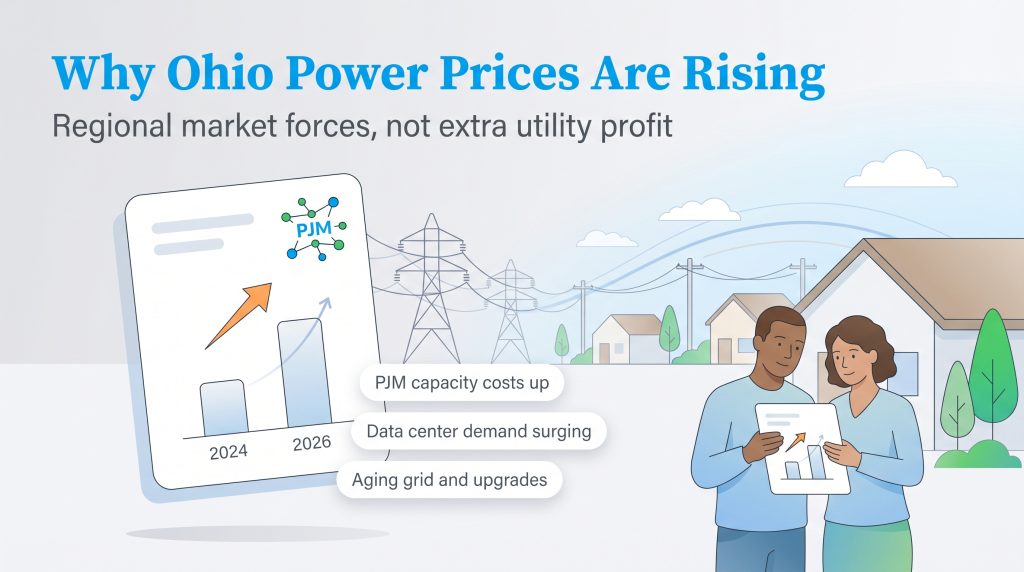
It is easy to assume that local utilities are simply raising rates to pocket extra profits, but the reality is tied to broader regional market forces. Your local utility actually passes supply costs directly to customers without any extra markup. The major driver behind the upcoming rate hikes is the soaring cost of grid capacity within the PJM Interconnection — the regional transmission organization that manages the electric grid and coordinates wholesale power across 13 states, including Ohio. PJM uses competitive auctions to ensure there is always enough power plant availability to keep the lights on during peak demand periods.
Surging Grid Pressures and Capacity Auction Costs
Capacity charges make up roughly 25% of your overall electricity supply cost, and these regional costs have reached historic heights. In the PJM capacity auction for the 2025–2026 delivery year, prices cleared at $269.92 per megawatt-day, representing an astronomical 833% jump from the prior year. The pressure continued during the subsequent auction for the 2026–2027 delivery year, which cleared at an all-time record rate of $329.17 per megawatt-day, exceeding the preliminary $325.00 price cap initially set by the Federal Energy Regulatory Commission. These extremely tight auctions clear with paper-thin supply margins, pushing retail rates up across the state.
Exploding Power Demand From Data Centers and AI
At the heart of this grid capacity crunch is an unprecedented wave of energy demand. Tech giants are rapidly building massive, power-hungry computational data centers to support advanced artificial intelligence and cloud computing. The roughly 2,700 data centers operating across the United States consumed over 4% of all domestic electricity in 2022, a figure projected to more than double to 9% by 2030. Within PJM territory alone, AI and data centers are driving nearly all of the 32 gigawatts of projected new demand by the end of the decade, stretching existing generation resources to their absolute limits.
Lagging Baseload Supply and Infrastructure Costs
While electricity demand is growing exponentially, the regional supply is struggling to keep pace. Older, reliable coal- and natural gas-fired power plants are retiring rapidly due to economic pressures and environmental standards. Meanwhile, replacing that firm baseload power with wind, solar, and battery storage projects has been incredibly slow. Developers face severe delays in PJM’s interconnection queue, alongside localized opposition and supply chain bottlenecks. On top of these supply challenges, local utilities are making heavy capital investments to modernize aging physical infrastructure. For example, AES Ohio implemented a base distribution rate update on Nov. 6, 2025, that added approximately $16.50 to typical residential monthly bills, followed by subsequent rider updates on Jan. 1, 2026, that added another $2.66 per month.
Major Ohio Cities and Areas Impacted
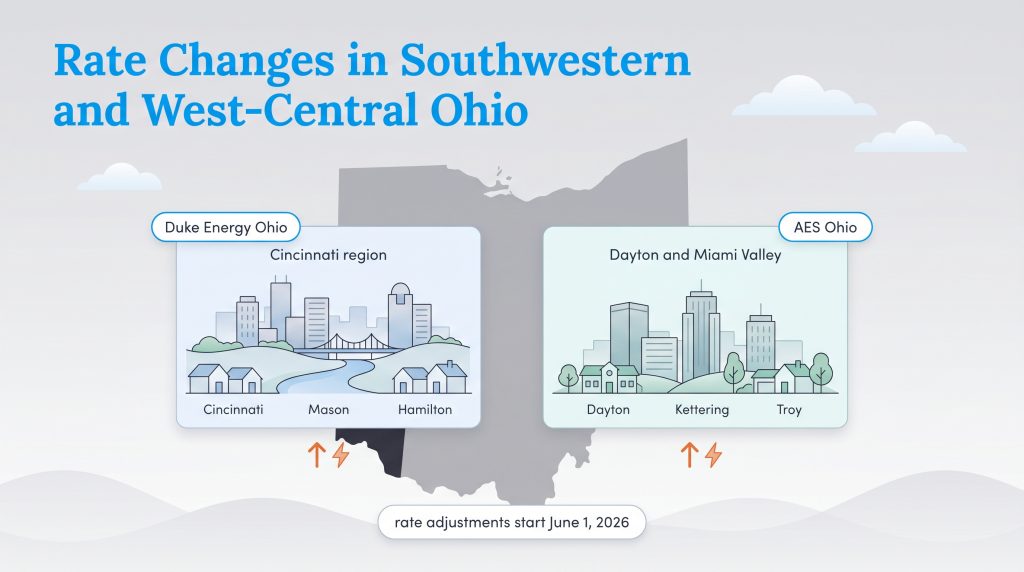
The upcoming rate adjustments on June 1, 2026, will directly impact residential households and small businesses across southwestern and west-central Ohio.
Duke Energy Ohio Territory
If you live in the greater Cincinnati metropolitan area, you are likely served by Duke Energy Ohio. This territory spans several southwestern counties — including Hamilton, Butler, Warren, and Clermont — and encompasses cities like Cincinnati, Middletown, Mason, Hamilton, Lebanon, and Batavia.
AES Ohio Territory
If you reside in the Miami Valley, your electricity is delivered by AES Ohio. This service area covers west-central counties such as Montgomery, Greene, Miami, Clark, and Preble. Major municipal centers affected by the AES rate hike include Dayton, Kettering, Centerville, and Xenia.
How You Can Bypass the Rising Rates
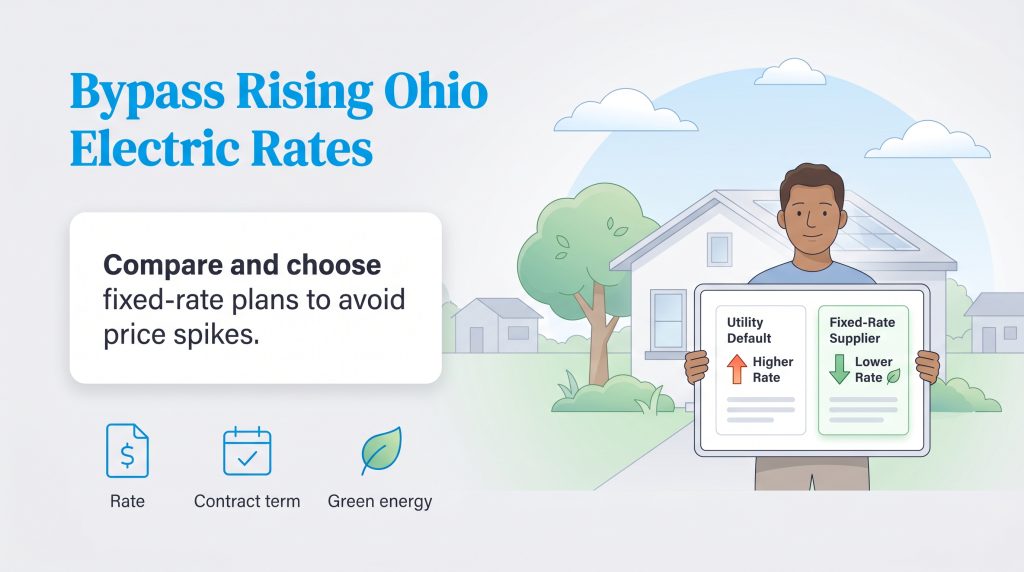
With default standard offer rates heading up, it is the perfect time to remember that you have options. According to state data, utility costs in Ohio sit about 4.08% higher than the national average, making active energy management a smart way to find breathing room in your budget. Because Ohio operates a fully deregulated energy choice market, you are not locked into buying your power supply from Duke Energy or AES Ohio. While your local utility will continue to deliver the electricity, maintain the wires, and restore power during outages, you can choose an independent supplier to secure a better rate.
Shopping for a Competitive Fixed-Rate Plan
By visiting the Public Utilities Commission of Ohio’s official Ohio Apples to Apples comparison chart, you can evaluate hundreds of plans side-by-side. If you want to protect your wallet from summer rate spikes and market volatility, we highly recommend selecting a fixed-rate contract. These plans lock in your price per kWh for a set term — typically ranging from 12 to 36 months. Many independent suppliers offer rates that are currently below the upcoming utility Price to Compare default rates. When comparing suppliers, keep these key details in mind:
- Monthly Administrative Fees: Some plans advertise an incredibly low rate but tack on a hidden $9.99 monthly administrative fee, which can quickly wipe out your savings if you live in a smaller home or apartment.
- Early Termination Fees: Breaking a fixed-rate contract early can trigger cancellation penalties ranging from $25 to $150. Look for plans with low or zero termination fees to maintain your flexibility.
- Variable-Rate Transitions: Be sure to check what happens at the end of your contract. Many promotional fixed rates will automatically transition into expensive, fluctuating variable rates if you do not actively switch or renew before the term expires.
Choosing an Environmentally Mindful Option
Shopping the open market is also a fantastic opportunity to align your utility spending with your environmental values. Many competitive suppliers offer plans that feature 100% renewable energy or carbon-free power backed by clean wind, solar, or nuclear generation. Opting for a certified green plan is an environmentally mindful choice that supports regional clean energy development while keeping your household footprint low. Choosing an eco-conscious alternative does not have to cost a fortune, as many green fixed-rate plans are highly competitive with default standard utility offers.
Municipal Aggregation and Community Programs
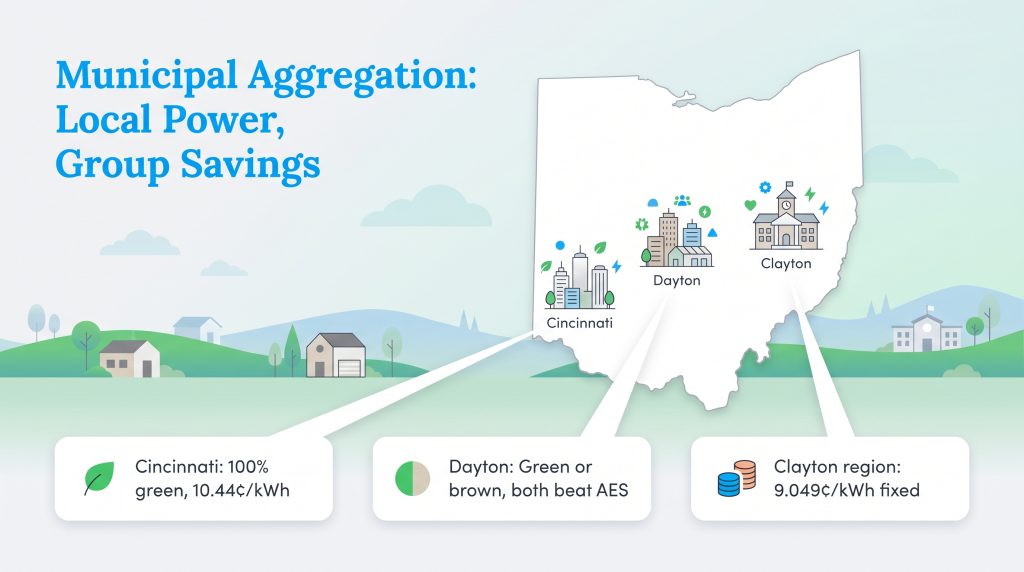
If shopping for an individual supplier feels too tedious, you might already have a built-in defense option through your local government. Under Ohio’s municipal choice aggregation laws, cities and townships can pool the purchasing power of their residents to negotiate bulk wholesale contracts with certified energy providers. These community-wide programs are typically structured as “opt-out” plans, meaning you are automatically enrolled unless you actively return a paper opt-out form.
Cincinnati’s Green Energy Aggregation
The city of Cincinnati operates one of the oldest and largest municipal programs in the country, originally launched in 2012. Historically, the program offered a fixed rate of 10.73 cents per kWh through May 2026. For the new period running from May 2026 to November 2026, the Cincinnati Electric Aggregation Program has secured an introductory fixed rate of 10.44 cents per kWh for 100% green power. This green rate successfully beats Duke Energy Ohio’s new default Price to Compare of 10.7016 cents per kWh. Because of high regional capacity market volatility, the city opted for a shorter six-month fixed term, after which the rate will transition to a variable model. You can leave the program at any time with zero early termination or cancellation fees if you find a better individual deal.
Dayton’s SOPEC Renewable Program
If you are an AES Ohio customer living in Dayton, your citywide aggregation is managed by the Sustainable Ohio Public Energy Council (SOPEC) with electricity supplied by AEP Energy. For the 12-month period starting in June 2026, the Dayton Electric Power Aggregation program has established competitive rates to help protect local budgets. The default “Green” program option provides 100% renewable-backed energy at a fixed rate of 10.691 cents per kWh. If you prefer, you can opt down to the traditional fossil-fuel “Brown” option at 10.576 cents per kWh. Both of these municipal aggregation rates beat AES Ohio’s upcoming default Price to Compare of 10.856 cents per kWh, saving a typical Dayton household an estimated $16.50 over the course of the year.
Clayton and the Miami Valley Communications Council
In Clayton and 17 other nearby communities represented by the Miami Valley Communications Council, local leaders have pooled their bulk buying power to secure even deeper rate relief. For the 12-month term running from January 2026 through December 2026, the council selected Constellation NewEnergy to supply a highly competitive fixed rate of 9.049 cents per kWh. If you are an eligible resident in these communities, remaining in this opt-out program is an easy way to enjoy rates that sit well below the default AES standard offer.
Energy Efficiency and Utility Assistance Options
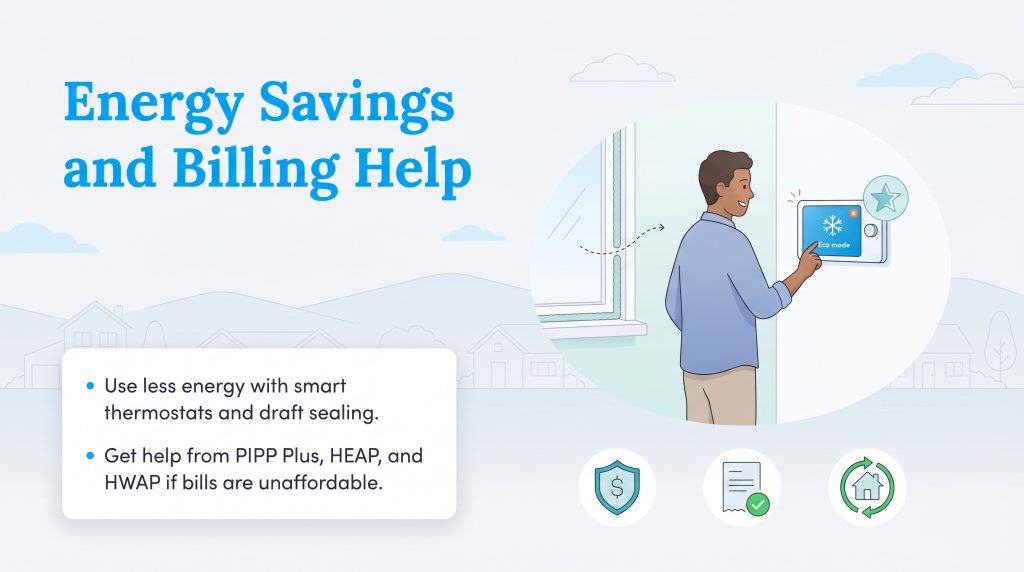
While switching your electricity supplier is the most immediate way to lower your rate, reducing your overall consumption is the most reliable way to slash your bill. Since the cheapest kilowatt-hour is the one you never use, making simple household upgrades can pay off in a big way. We recommend installing an ENERGY STAR certified smart thermostat to automatically scale back your cooling when you are away, and regularly sealing drafts around your windows and doors to ease the strain on your air conditioner.
If the upcoming June rate hikes present a genuine financial hardship, several state-mandated and utility-partnered programs are available to help keep your power connected. The Percentage of Income Payment Plan (PIPP Plus) allows income-qualified households to pay a capped percentage of their monthly income toward their utility bills instead of the full face value. Additionally, the Home Energy Assistance Program (HEAP) provides a direct, one-time annual financial credit to primary utility accounts, while the Home Weatherization Assistance Program (HWAP) offers free home efficiency improvements like professional insulation and heating system tune-ups to help structurally lower your home’s energy footprint.
Taking Charge of Your Ohio Power Bills
With summer heat just around the corner and utility rates moving upward, staying active and informed is your best defense against soaring household costs. Whether you decide to compare competitive fixed-rate plans on the open choice market, remain in your local municipal aggregation program, or focus on simple energy-saving improvements around your home, taking just 15 minutes to review your electric bill this week can lead to major savings. By taking control of your utility supply options today, you can protect your monthly budget and build a more predictable, budget-friendly financial future for your household.
About the Author

Claudio is a sustainability-focused writer with a background in Anthropology and Psychology from NC State University. He has spent over 15 years working in writing, interpretation, and translation, driven by a deep interest in how human culture shapes the environment. Today, he shares his curiosity with readers by writing about sustainable living solutions and the connection between everyday choices and environmental impact.