Explore How Energy Harbor Provides Carbon-Free Electricity and Predictable Fixed-Rate Plans for Your Home
Key Takeaways
- Energy Harbor (formerly FirstEnergy Solutions) specializes in 100% carbon-free electricity plans backed by a massive zero-emission nuclear generation fleet.
- The $6.8 billion Vistra Energy Harbor acquisition integrated 4,000 megawatts of 24/7 nuclear power into the Vistra Vision platform for enhanced market reliability.
- Shoppers can easily lock in budget stability by choosing a Safe Harbor fixed-rate plan with terms up to 36 months and zero monthly recurring service fees.
Choosing the right energy provider can feel overwhelming, but Energy Harbor — formerly known as FirstEnergy Solutions — simplifies the process as a massive zero-carbon generator and retail supplier serving residential and commercial customers. By pairing competitive pricing with its own emission-free nuclear fleet, the company offers an environmentally mindful choice for securing 100% carbon-free electricity. The March 2024 Vistra Corp. acquisition, a landmark $6.8 billion transaction that folded 4,000 megawatts of 24/7 nuclear capacity into the “Vistra Vision” zero-carbon platform, further strengthened Energy Harbor’s position in the market to ensure top-tier financial stability for consumers. Whether you are looking for long-term budget stability through predictable rates or a greener way to power your home, this supplier delivers straightforward options without relying on a confusing mix of short-term gimmicks.
Energy Harbor Plans and Pricing
| Plan Name | Rate /kWH | Plan Term | Cancellation Fee | |
|---|---|---|---|---|
| Safe Harbor Value 12 | 10.5¢ | 12 Months | $0.00 | Check Availability |
| Safe Harbor Value 8 | 10.6¢ | 8 Months | $0.00 | Check Availability |
| Safe Harbor Value 20 | 10.7¢ | 20 Months | $0.00 | Check Availability |
| Safe Harbor Value 15 | 10.8¢ | 15 Months | $0.00 | Check Availability |
*Plans and pricing vary by location. Search your ZIP code to find plans available in your area.
When comparing Energy Harbor electricity plans, it helps to understand how your monthly utility statement is divided. In deregulated energy states, your bill splits into two core parts: delivery charges and supply charges. Your local utility company manages the physical poles, wires, and meters, charging a regulated delivery rate that remains the same regardless of who supplies your power. Energy Harbor steps in to manage the supply portion — the actual per-kilowatt-hour (kWh) cost of the electricity your household consumes. Instead of offering unpredictable variable-rate plans for new residential enrollments, the company focuses exclusively on fixed-rate options that shield your supply rate from unexpected wholesale market spikes during peak summer and winter seasons.
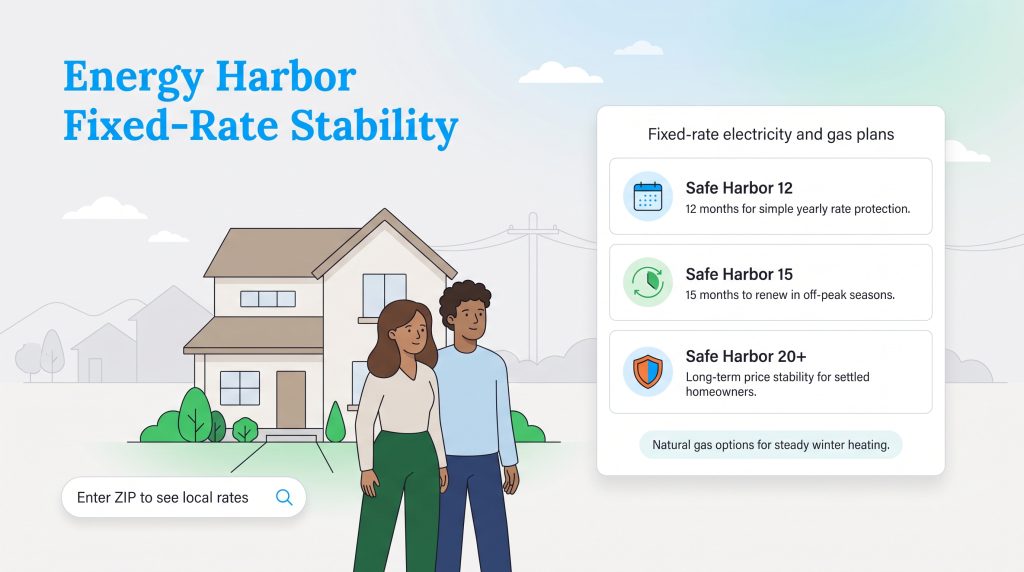
Safe Harbor Fixed-Rate Plans
The signature Safe Harbor fixed-rate plans lock in your supply price for a set term, meaning the energy generation rate on your bill remains constant from month to month. Typical contract lengths range from 12 to 36 months, providing ample long-term price protection to fit various housing situations without tacking on recurring monthly base charges.
| Plan Name | Term Length | Best For |
|---|---|---|
| Safe Harbor 12 | 12 Months | Renters or homeowners who want an annual rate lock to reevaluate the market next year. |
| Safe Harbor 15 | 15 Months | Customers looking to shift their contract renewal date to an off-peak season when rates are generally lower. |
| Safe Harbor 20 (or 24-36) | 20+ Months | Settled homeowners prioritizing maximum long-term stability and immunity to inflation. |
Energy Harbor Natural Gas Rates
In addition to zero-carbon electricity, Energy Harbor natural gas rates are available in select deregulated markets, particularly across Ohio. Just like their electric counterparts, these plans are built around fixed-rate price stability so you can avoid sudden utility price surges when winter temperatures drop. Depending on your local utility territory, natural gas plans are priced and measured per thousand cubic feet (MCF) or per hundred cubic feet (CCF). You can easily enroll in fixed-rate natural gas plans if your home is serviced by Columbia Gas of Ohio, Enbridge Gas Ohio (formerly Dominion Energy Ohio), CenterPoint Energy, or Duke Energy Ohio.
How Energy Harbor Compares to Local Utility Default Rates
To figure out if switching to Energy Harbor will actually save you money, you need to check your local utility’s “Price to Compare” (PTC). The PTC is the default supply rate your utility charges if you don’t pick a third-party supplier. Because utility default rates change quarterly or semi-annually based on wholesale energy auctions, locking in a Safe Harbor plan below the current PTC gives you immediate savings and shields your wallet if utility prices jump later in the year.
Here is a look at how a typical monthly supply bill breaks down for an average household using 1,000 kWh per month when comparing a sample Safe Harbor 12 plan against a standard Ohio or Pennsylvania utility PTC:
| Supply Option | Sample Supply Rate (per kWh) | Monthly Usage | Estimated Monthly Supply Cost | Annual Supply Cost |
|---|---|---|---|---|
| Local Utility Default Rate (PTC) | 9.2 cents ($0.092) | 1,000 kWh | $92 | $1,104 |
| Energy Harbor Safe Harbor 12 Plan | 7.9 cents ($0.079) | 1,000 kWh | $79 | $948 |
| Estimated Savings | 1.3 cents ($0.013) per kWh | — | $13 per month | $156 per year |
Note: The figures above represent a sample illustration of supply charges only. Regulated utility delivery charges and local taxes apply equally to both options. You can compare live supplier rates against your local utility’s current PTC using the official Energy Choice Ohio Apples to Apples tool or PA Power Switch.
Coverage Area and Major Cities Served
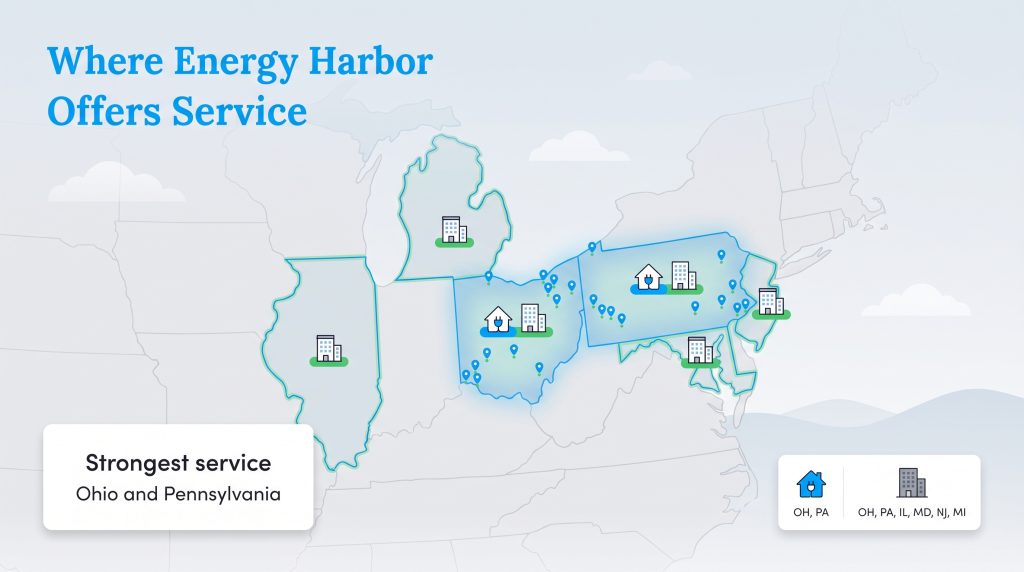
If you are looking to switch providers, checking the Energy Harbor service area is the essential first step. As a major player in deregulated energy markets within the PJM interconnection region, the supplier offers options across six states for residential and commercial accounts.
| State | Customer Type Served | Services Offered | Partnering Local Utilities |
|---|---|---|---|
| Ohio | Residential & Commercial | Electricity & Natural Gas | AEP Ohio, Duke Energy Ohio, AES Ohio, FirstEnergy (Ohio Edison, The Illuminating Company, Toledo Edison), Columbia Gas, Enbridge Gas, CenterPoint Energy |
| Pennsylvania | Residential & Commercial | Electricity | PECO, PPL Electric, Duquesne Light, FirstEnergy (Met-Ed, Penelec, Penn Power, West Penn Power) |
| Illinois | Commercial (Select Residential Aggregation) | Electricity | ComEd, Ameren Illinois |
| Maryland | Commercial & Select Residential | Electricity | BGE, Pepco, Delmarva Power, Potomac Edison |
| New Jersey | Commercial | Electricity | PSE&G, JCP&L, Atlantic City Electric |
| Michigan | Commercial | Electricity | Consumers Energy, DTE Energy (via Michigan Electric Choice) |
For everyday household consumers, Energy Harbor Ohio coverage and Pennsylvania service areas are the most robust. In Ohio, you will find plans available across major electric territories — including AEP Ohio, Duke Energy Ohio, AES Ohio, and FirstEnergy’s local utilities (Ohio Edison, The Illuminating Company, and Toledo Edison) — serving large hubs such as Cleveland, Akron, Toledo, Columbus, Dayton, and Cincinnati. In Pennsylvania, they supply power to customers in territories like PECO, PPL Electric, Duquesne Light, and FirstEnergy PA, reaching metros like Allentown, Reading, Harrisburg, Pittsburgh, and Philadelphia suburbs.
Deals, Discounts, and Ways to Save
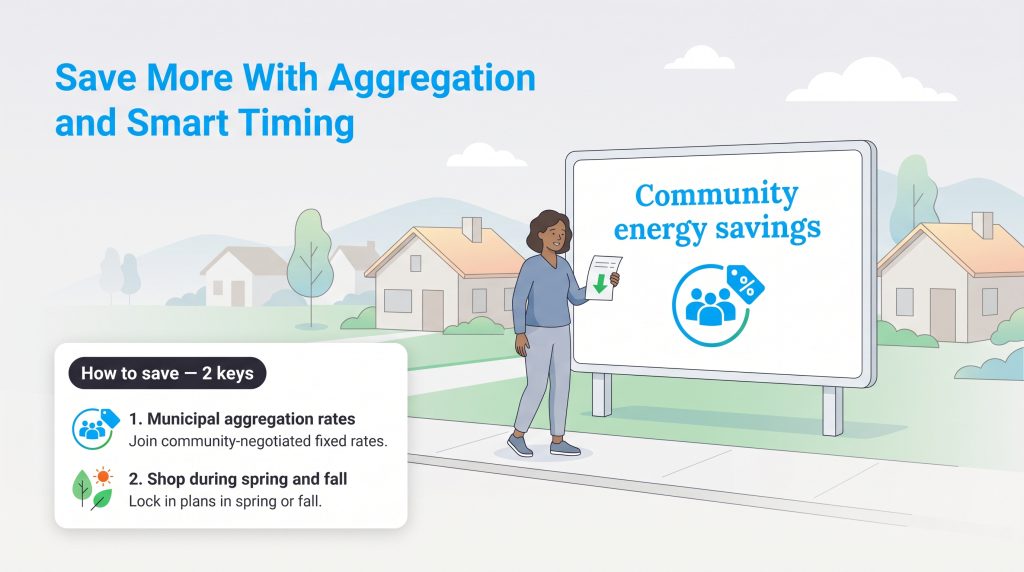
While Energy Harbor does not typically rely on flashy sign-up bonuses or gimmicky introductory rates, you can still find practical ways to lower your household energy bills. Timing the energy market is one of the smartest strategies available to residential shoppers. Locking in a Safe Harbor fixed-rate plan during the shoulder seasons — typically spring (April and May) or fall (September and October) when overall grid demand is mild — can help you secure a much more favorable price per kilowatt-hour. By avoiding the peak summer cooling and winter heating shopping periods, you maximize your long-term savings potential.
Navigating Municipal Aggregation Programs
Energy Harbor’s most significant discounts often come through Energy Harbor municipal aggregation programs. In states like Ohio, voter-approved local governments — including cities, townships, and counties — use their collective buying power to negotiate bulk fixed rates on behalf of their residents. If your community partners with Energy Harbor, eligible households are automatically placed into the discounted community rate unless they actively opt out.
If you receive an official aggregation notice in the mail, follow these three steps to make sure you get the best deal for your home:
- Read the Opt-Out Notice Carefully: Check the offered supply rate (in cents per kWh or dollars per MCF/CCF), the contract length, and whether the community plan includes 100% carbon-free power.
- Verify the Rate Against Your Utility’s PTC: Pull up your latest utility bill and compare the community aggregation rate directly against your utility’s Price to Compare. Also, check if Energy Harbor’s standard individual Safe Harbor plans or competing retail offers beat the municipal rate.
- Submit Your Opt-Out Form Before the Deadline (If Desired): If you want to join the community plan, you don’t need to do anything — you will be enrolled automatically. If you prefer to stay with your local utility’s default rate or pick your own individual contract, return the postage-paid opt-out card, submit your opt-out code online, or call the dedicated aggregation phone number within the 21-day window printed on your letter.
💸 Money-Saver: Municipal aggregation contracts almost never carry early termination fees. If you get automatically enrolled in an Energy Harbor community plan and later find a cheaper individual fixed rate elsewhere, you can usually leave the aggregation program at any time without paying a penalty.
Sustainability and Zero-Carbon Initiatives
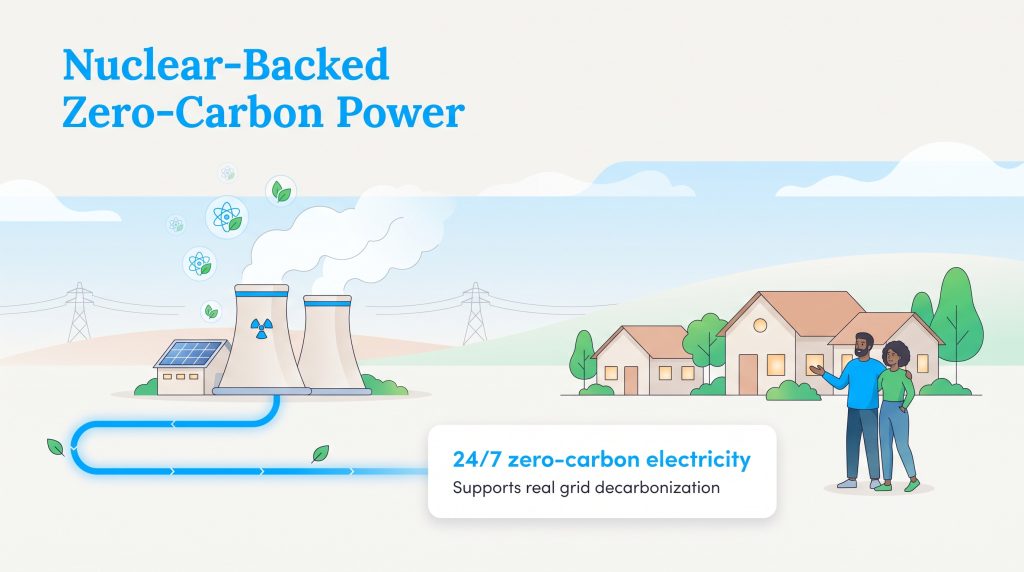
Energy Harbor stands out in the retail energy space due to its impressive vertical integration. Rather than simply buying bulk fossil-fuel power on the wholesale market and slapping Renewable Energy Certificates (RECs) on top of it, the company actually owns and operates massive physical generation assets under the Vistra Vision umbrella. This fleet includes three major nuclear installations: the Beaver Valley Power Station in Shippingport, Pennsylvania, the Davis-Besse Nuclear Power Station in Oak Harbor, Ohio, and the Perry Nuclear Power Plant in Perry, Ohio.
Because nuclear power does not emit greenhouse gases during generation, the zero-carbon nuclear electricity produced by these three facilities is genuinely clean at the source. Together, these plants generate roughly 33 terawatt-hours of emission-free electricity annually, seamlessly supplying over three million homes across the PJM power region. While Energy Harbor also utilizes Emissions-Free Energy Certificates (EFECs) alongside RECs sourced from solar, wind, and hydroelectric facilities to verify its retail products, its foundation of base-load nuclear power means you are supporting true grid decarbonization. It is an energy-saving option that delivers reliable performance year-round.
🌱 Eco Edge: Opting for a nuclear-backed zero-carbon plan is one of the most effective ways to lower your household emissions, providing 24/7 clean energy even when the sun isn’t shining and the wind isn’t blowing.
Fees and Guarantees
Understanding the fine print is a vital part of choosing any energy provider. Energy Harbor keeps its fee structure relatively straightforward, charging zero sign-up fees and zero recurring monthly maintenance fees on standard residential plans. However, reviewing your specific contract disclosure statement is still essential. While many 12-month plans and municipal aggregation agreements carry a $0 cancellation fee, some longer-term fixed-price contracts include an early termination fee (ETF). Depending on your specific agreement and state regulations, this fee typically ranges from $50 to $150 if you decide to cancel Energy Harbor contract obligations before the term expires.
Fortunately, you have strong consumer protections in place when you sign up. State regulations provide a built-in rescission window that lets you back out of a new agreement without penalty if you change your mind:
- Ohio Electricity Plans: You have seven calendar days from the postmark date on your local utility’s confirmation notice to cancel without penalty.
- Ohio Natural Gas Plans: You have seven business days from the postmark date on your utility confirmation letter to rescind your enrollment.
- Pennsylvania Electricity Plans: You have three business days after receiving your written disclosure statement from Energy Harbor to cancel free of charge.
Beyond the initial rescission period, you are also exempt from any early termination fees if you physically move to a new residence and provide proper notice of relocation.
How to Report and Search for Outages
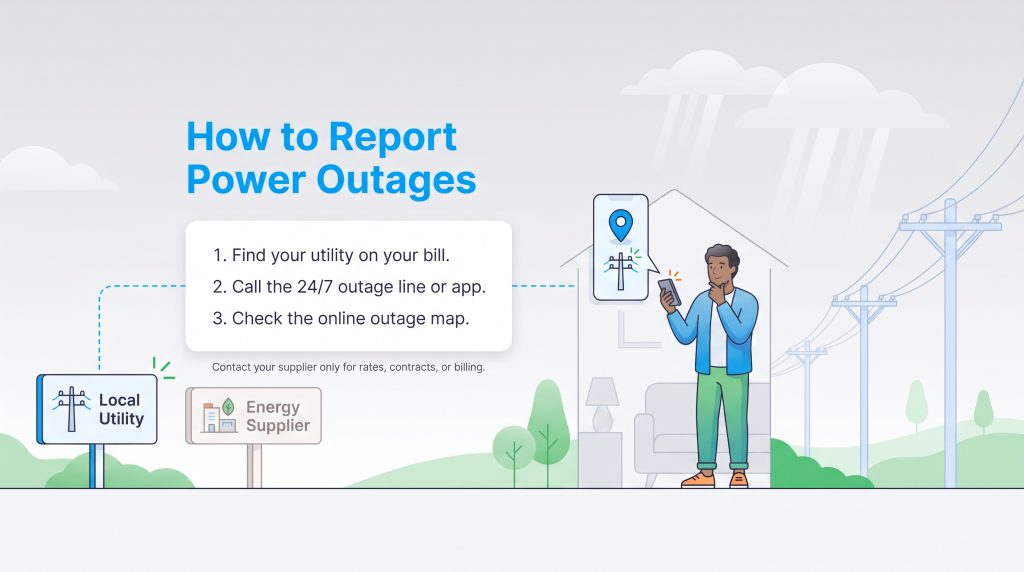
🚩 Heads Up: Energy Harbor is your energy supplier, not your local utility. Do not contact Energy Harbor to report a power outage or a downed power line. You must contact your local utility company directly to safely restore power.
If your lights go out during a storm or you smell natural gas, it is critical to understand the separation of duties in a deregulated market. Energy Harbor generates and supplies the energy commodity, but your local Electric Distribution Utility (EDU) or Natural Gas Distribution Company (NGDC) owns and maintains the physical power lines, gas mains, poles, and meters that deliver energy to your home.
To report an outage or service emergency effectively, follow these simple steps:
- Locate the name and emergency number of your local utility company on your most recent monthly bill (such as AEP Ohio, PECO, PPL Electric, or FirstEnergy).
- Call the utility’s dedicated 24/7 outage hotline or use their official mobile app to report the disruption.
- Check your local utility’s online outage map for live crew updates and estimated restoration times.
You should only rely on Energy Harbor customer service for questions regarding your specific supply rate, contract renewals, or direct billing inquiries.
Why Choose (or Not Choose) Energy Harbor?
Weighing the advantages and drawbacks is crucial before committing to a new contract. Here is a breakdown of what makes Energy Harbor shine and where they might fall short depending on your household needs.
Pros of Energy Harbor
- Predictable Flat-Rate Billing: Safe Harbor plans lock in your supply rate for 12 to 36 months, protecting your household budget from seasonal market volatility.
- Authentic Zero-Carbon Footprint: Backed by physical nuclear stations in Ohio and Pennsylvania, their carbon-free plans deliver genuine emission-free electricity rather than relying solely on paper offsets.
- Vertical Integration & Vistra Backing: Because they generate their own power under Vistra Corp.’s massive umbrella, they possess far greater financial stability than smaller middleman brokers.
Cons of Energy Harbor
- Lack of Short-Term Flexibility: They do not offer month-to-month plans for new enrollments, though they occasionally provide three-month or six-month promotional terms.
- Cancellation Fees on Select Plans: While many plans have a $0 exit fee, certain multi-year contracts carry early termination fees between $50 and $150 if you switch providers mid-term.
- Higher Introductory Rates Than Teaser Plans: Their rates reflect true long-term stability, meaning they may look slightly higher upfront than the one-month “teaser” rates offered by aggressive competitors.
Who is this provider best for? Energy Harbor is the ideal match for settled renters and homeowners seeking long-term price stability and clean energy. If you want a straightforward, set-it-and-forget-it plan that lowers your carbon footprint without requiring active monthly management, this supplier is an excellent fit.
What Customers Are Saying: Energy Harbor Reviews
When diving into Energy Harbor reviews across the web, you will uncover a mostly positive, stable track record compared to the broader retail energy industry. Because Energy Harbor avoids surprise variable rate hikes and hidden monthly fees, customer satisfaction remains relatively high across Ohio and Pennsylvania.
📌 Quick Fact: Third-Party Ratings Summary — Energy Harbor LLC maintains an A- rating with the Better Business Bureau (BBB), averages between 3.8 and 4.3 out of 5 stars on major consumer review aggregators, and logs remarkably low formal complaint ratios with the Public Utilities Commission of Ohio (PUCO) and the Pennsylvania Public Utility Commission (PA PUC) relative to its massive customer base.
One crucial detail to keep in mind when researching reviews on the Better Business Bureau is a widespread name mix-up. Many frustrated consumers accidentally leave complaints on the BBB profile for “Energy Harbor Solar” — a completely unrelated solar panel installation company based in Florida that holds an “F” rating — rather than the official Energy Harbor LLC headquartered in Akron, Ohio. When filtering strictly for verified electric and gas supply customers in the Midwest and Mid-Atlantic, feedback is far more favorable.
Across local forums like Reddit (especially in community hubs like r/Columbus and r/Cleveland), residents consistently highlight the value of their municipal aggregation rates. Many users note that switching to an Energy Harbor carbon-free plan was entirely seamless and provided welcome financial relief when standard utility default rates spiked.
Conversely, informal logs with state utility commissions occasionally highlight frustrations with third-party door-to-door sales agents or telemarketers operating on behalf of the supplier. Additionally, some customers express surprise if they miss their contract expiration notice and roll into a variable holdover rate. If a representative knocks on your door, always ask to see an official vendor badge and read the contract summary before signing. If you ever experience buyer’s remorse after a high-pressure pitch, remember to use your state’s statutory rescission window to cancel the contract without penalty.
Energy Harbor Customer Service and Account Management
Whether you need to check when your current fixed rate expires, ask a question about a community aggregation letter, or renew your plan, reaching Energy Harbor customer service is simple. The company offers multiple support channels for residential and small commercial customers:
- Residential Customer Service Phone Number: Call 1-888-254-6359 (available Monday through Friday, 8 a.m. to 5 p.m. EST).
- Community Aggregation & Alternate Support Line: Call 1-877-855-2424 for dedicated assistance with municipal opt-out notices and enrollment questions.
- Customer Support Email: Send inquiries to [email protected].
- Corporate Mailing Address: Energy Harbor LLC, 168 E. Market Street, Akron, OH 44308.
For day-to-day billing, nearly all residential customers enjoy the convenience of Consolidated Billing. With this setup, you do not receive a separate invoice from Energy Harbor. Instead, your Energy Harbor supply charges appear as a clear line item directly on your regular monthly statement from your local utility (such as AEP Ohio, FirstEnergy, PECO, or Columbia Gas). You simply make one single payment to your local utility company each month just like you always have, and the utility forwards the supply portion to Energy Harbor behind the scenes.
If you want to view your contract expiration date, shop for renewal offers, or manage a direct-billed commercial account, you can use the online Energy Harbor My Account web portal via the Energy Harbor login page on their website. Keep in mind that Energy Harbor does not offer a dedicated mobile app for iOS or Android devices. All digital account management is handled directly through their mobile-friendly web portal or through your local utility company’s smartphone app.
Choosing Energy Harbor for Your Home
Energy Harbor sits in an ideal sweet spot for budget-minded homeowners and renters who want to support clean energy without paying steep green premiums. Backed by Vistra Corp. and its own fleet of 24/7 zero-carbon nuclear power plants in Ohio and Pennsylvania, the company offers genuine environmental value alongside rock-solid financial stability. Because they skip confusing tiered pricing and recurring monthly fees in favor of straightforward Safe Harbor fixed-rate plans, they are one of the safest, most predictable suppliers for everyday households looking to shield their budgets from seasonal energy spikes.
Before you sign a fixed-rate agreement, run through a quick three-point checklist to ensure you lock in the best deal. First, check your latest utility bill to confirm that Energy Harbor’s per-kWh or per-MCF/CCF rate beats your local utility’s current Price to Compare. Second, check the contract Terms of Service to see if an early termination fee applies to your specific plan length. Finally, set a calendar reminder on your phone for 30 days before your contract end date so you can proactively lock in a fresh fixed rate and avoid rolling onto a month-to-month holdover rate.
Frequently Asked Questions About Energy Harbor
How do I pay my Energy Harbor bill?
Why is Energy Harbor on my electric or gas bill if I didn’t sign up?
Is Energy Harbor formerly FirstEnergy Solutions?
Is Energy Harbor a utility company or a supplier?
Does Energy Harbor charge an early termination fee?
How do I cancel my Energy Harbor contract?
What happens when my Energy Harbor fixed-rate plan expires?
About the Author

LaLeesha has a Masters degree in English and enjoys writing whenever she has the chance. She is passionate about gardening, reducing her carbon footprint, and protecting the environment. She also recently served as President of the Board for City Sprouts (a community garden).