
- Free Xfinity Mobile Line for 1 year
- Free Peacock Premium*
- Free WiFi Equipment for 24 months
- $100 Visa Prepaid Cards for students
Electric Providers in Chicago

- 11.19¢ /kWh
- 90 days
- 3-36 Months
- Proven Leader in Clean Energy

- 7.49¢ /kWh
- None
- 1-6 Months
- Focus on Affordability

- 9.95¢ /kWh
- 90 days
- 12 Months
- Employee-Owned

- 12.69¢ /kWh
- None
- 12 Months
- No Cancellation Fees

- 12.9¢ /kWh
- 90 days
- 1-36 Months
- 100% Renewable Plans

- 9.49¢ /kWh
- None
- 6-15 Months

- 11.5¢ /kWh
- None
- 12-36 Months
- Earn Free Electricity Every Month
- 11.39¢ /kWh
- None
- 12-20 Months
- Best for Flexibility

- 13.1¢ /kWh
- None
- 12 Months

- 11.59¢ /kWh
- None
- 6-12 Months
- No Sign Up or Cancellation Fees

- 11.29¢ /kWh
- 90 days
- 8-24 Months
- Total Satisfaction Guarantee


See Top Plans in Your Area
Top 14 Natural Gas Providers in Chicago
- $0.5490 /THM
- 12-36 Months
- Best for Home Protection Bundles
- $0.3913 /THM
- 12 Months
- $0.399 /THM
- 12 Months
- $0.47 /THM
- 3 Months

- $0.619 /THM
- 12-24 Months
- $0.5490 /THM

- $0.659 /THM
- $0.21560 /THM

- $0.35 /THM

- $0.379 per therm /THM

- $0.56 /THM

- $0.659 /THM

- $0.80060 /THM

- $0.3911 /THM

See Top Plans In Your Area
Top 12 Internet Providers in Chicago

- 2 Gbps
- Cable & Fiber
- Unlimited
- TV & Phone
- 98.49%
- $30.00/mo
- Lock in Your Price for 5 Years

- 5 Gbps
- Fiber
- Unlimited
- Mobile
- 89.38%
- $35.00/mo
- Get a $200 Reward Card*

- 5 Gbps
- Cable
- 1 TB
- 53.91%
- $19.95/mo

- 300 Mbps
- 5G
- Unlimited
- Mobile
- 100%
- $35.00/mo
- Wireless Internet Great for Renters

- 498 Mbps
- 5G
- 1.2 TB
- Mobile
- 98.67%
- $50.00/mo
- Wireless Internet

- 300 Mbps
- 5G
- Unlimited
- Mobile
- 98.62%
- $40.00/mo
- Wireless Internet

- 150 Mbps
- Satellite
- 150-850 GB
- Phone
- 99.99%
- $39.99/mo

- 400 Mbps
- Satellite
- Unlimited
- 99.97%
- $55.00/mo

- Varies
- Fiber, Cable, 5G, & Satellite
- Varies
- 95%
- $39.95/mo

- 5 Gbps
- Fiber
- Unlimited
- 4.11%
- $29.95/mo

- 7 Gbps
- Fiber
- Unlimited
- Phone
- 2.42%
- $29.99/mo

- 2 Gbps**
- Cable
- Unlimited
- TV & Phone
- 2.01%
- $30.00/mo
- Most Affordable Plans
Water & Sewage Providers in Chicago

Top 7 Trash and Recycling Providers in Chicago
Utilities Summary for Chicago, IL
| Electric Companies: | 24 |
| Natural Gas Companies: | 14 |
| Water & Sewage Providers: | 1 |
| Garbage, Trash & Recycling Providers: | 7 |
| Municipal Electricity: | No |
Utilities For Your Home in Chicago
Moving to Chicago means joining one of the most vibrant, diverse, and dynamic cities in the country. Known as the “Windy City,” Chicago is rich in culture, architecture, food, and history. Popular neighborhoods include Lincoln Park with its green spaces and family-friendly vibe, Wicker Park with eclectic dining and nightlife, and Hyde Park, home to the University of Chicago and the Museum of Science and Industry. If you’re looking for luxury high-rises and lakefront views, the Gold Coast and Streeterville are popular picks, while Pilsen and Logan Square are cultural and artistic hubs.
As you get settled, one of your first steps will be setting up essential utilities like electricity, natural gas, water, trash, and internet. Chicago has a mix of regulated and deregulated markets, which means you’ll have choices in some areas and city-managed services in others.
The Chicago Electricity Market: ComEd, Deregulation, and Smart Savings
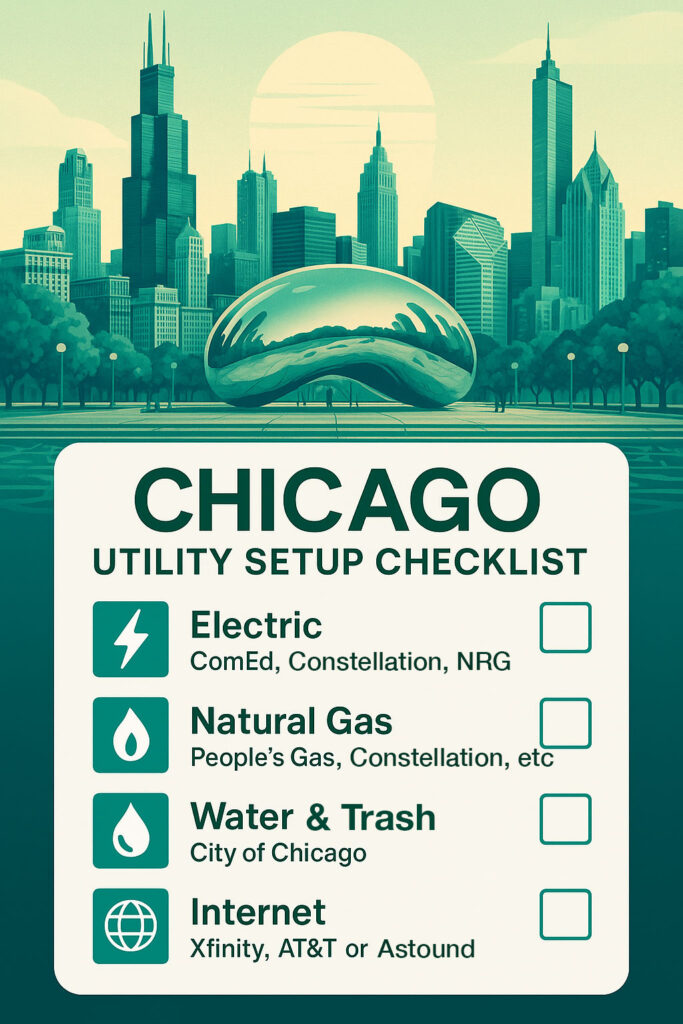
Navigating electricity in Chicago is different than in most of the country. Illinois is a deregulated energy market, which means you have the power to choose who supplies your energy, but you do not have a choice in who delivers it.
Understanding the difference between “Delivery” and “Supply” is the single most important factor in avoiding scams and keeping your bills low.
Delivery vs. Supply: Who Owns the Wires?
No matter who you buy your electricity from, Commonwealth Edison (ComEd) is responsible for the infrastructure.
- Delivery (Regulated): ComEd owns the poles, wires, and meters. If your power goes out, you call ComEd. You cannot switch your delivery provider; it is determined by your geography.
- Supply (Deregulated): This is the actual electricity you use. You can buy this from ComEd (the default) or from an “Alternative Retail Electric Supplier” (ARES).
Note for New Residents: You do not need to choose a supplier. If you do nothing, you are automatically enrolled in ComEd’s default hourly or fixed-rate supply service, which is regulated by the Illinois Commerce Commission.
The “Price to Compare” (2025–2026 Rates)
To know if a third-party supplier is offering a good deal, you must know ComEd’s current default rate, known as the “Price to Compare.”
- Current Rate: As of October 2025, the ComEd non-summer supply rate is approximately 9.689¢ per kWh.
- The Trend: Rates have risen recently due to increased “Capacity Charges” (the cost to ensure power is available during peak demand).
Advanced Savings: Hourly Pricing & Community Solar
If you want to lower your bill beyond the standard rates, Chicago offers two unique programs that generic moving guides often miss.
ComEd Hourly Pricing
Chicago has near-universal smart meter coverage, allowing residents to access real-time market rates. Instead of a fixed rate (e.g., ~9.7¢/kWh), you pay what electricity costs at that exact hour.
- Who is this for? People who can shift energy usage (laundry, dishwashing, EV charging) to off-peak hours, typically late nights or mornings.
- The Risk: Prices can spike during hot summer afternoons. However, historically, participants save an average of 15%–20% compared to the fixed rate.
- Action: Check your potential savings at ComEd Hourly Pricing.
Illinois Shines (Community Solar)
You do not need to own a roof to use solar power in Chicago. The Illinois Shines program allows renters and condo owners to “subscribe” to a solar farm located elsewhere in ComEd territory.
- How it works: You subscribe to a project and receive credits on your ComEd bill for the energy your share produces.
- The Benefit: Most subscriptions guarantee a 10%–20% savings on the supply portion of your bill compared to the default ComEd rate.
- Action: Browse open projects on IllinoisShines.
Estimated Monthly Costs by Apartment Size
Chicago electricity bills fluctuate heavily by season. While a mild October might cost very little, specific charges like the “Cloud Tax” and delivery fees add up.
| Unit Type | Est. Monthly Cost | Key Factors |
| Studio / 1-Bed | $50 – $100 | Low square footage keeps heating/cooling costs down. |
| 2-Bedroom | $70 – $140 | Vintage buildings with drafty windows can push this higher. |
| Single Family | $100 – $170+ | Central A/C and basement usage significantly increase load. |
Estimates based on average usage of ~14¢–16¢/kWh (Supply + Delivery + Taxes).
Top 5 Electricity Providers in Chicago
#1 Constellation: Constellation consistently comes out on top in Chicago. With a long track record of reliability, strong BBB ratings, and a reputation as one of the largest providers in Illinois, they’re a safe choice for new residents. Customers frequently highlight their straightforward pricing, competitive fixed-rate plans, and access to 100% renewable electricity options. Their mobile app and online portal are well-built, making account management simple. Because they also serve as a gas supplier in Illinois, many households appreciate the option of bundling. Constellation earns the #1 spot for its blend of trustworthiness, stability, and plan variety.
#2 NRG Home: NRG ranks second thanks to its wide selection of plans and added perks like reward points and gift cards for signing up. Customers often like the extras, though pricing can sometimes be slightly higher than Constellation’s. BBB ratings and reviews sit in the mid-to-high range, and online sentiment points to an overall satisfactory experience for most customers. NRG’s mobile app and customer service responsiveness also stand out compared to some competitors. For those who value rewards programs and incentives, NRG is an appealing option.
#3 Spark Energy: Spark Energy lands in the middle of the pack. They’ve been in the Illinois market for years and offer straightforward fixed-rate plans that many customers appreciate for stability. Their BBB profile is mixed, with reviews highlighting competitive rates but occasional complaints about contract clarity and billing. On the positive side, Spark tends to be price competitive, which earns them favor with budget-conscious customers. For shoppers who prioritize low rates over extras, Spark is a solid option.
#4 Think Energy!: Think Energy! is known for its simple and transparent approach. They offer a smaller selection of plans compared to Constellation or NRG, but many customers value the lack of gimmicks. Online sentiment is generally positive, especially around easy-to-understand contracts, though some reviews mention limited plan variety. Their BBB rating is steady, and fees are usually in line with industry averages. Think Energy! works well for those who want a no-frills, reliable experience, but falls lower in the ranking because of its limited plan menu.
#5 Xoom Energy: Xoom Energy comes in fifth in this ranking. While they offer both electricity and gas plans in Chicago, customer reviews and Reddit discussions frequently raise concerns about billing issues and customer service challenges. Their BBB profile reflects similar complaints, though some customers report positive experiences with competitive pricing. Xoom’s plan options are diverse, including renewable energy choices, but the mixed reputation puts them behind more reliable competitors. For shoppers, Xoom can be a value play, but it comes with more risk compared to others on this list.
Why to Trust Our Rankings
- Grounded in public data. We use Illinois’ official shopping resources and oversight data, the Plug-In Illinois Complaint Scorecard and ComEd’s Price-to-Compare, as the backbone for our scores.
- Real customer voices, not anecdotes. We aggregated ~198 BBB customer reviews across the five suppliers we ranked (Constellation 44, NRG 60, Spark Energy 24, XOOM Energy 19, Think Energy 51) at the time of scoring to calibrate sentiment and recurring pain points.
- Local reality check. We also scanned 20+ Chicago/Illinois threads where residents share first-hand experiences with alternative electric suppliers, capturing themes like door-to-door enrollments, renewal surprises, and how offers compare to ComEd’s default rate.
- Chicago-specific rules baked in. We verify consumer protections like the 10-day rescission window for ARES enrollments and use Illinois’ own shopping guidance when we evaluate fine print.
See the full methodology we use for retail electric providers
Tips for Choosing a Provider
- Review whether a fixed-rate or variable-rate plan better suits your needs.
- Check for early termination fees if you’re unsure about how long you’ll stay in your home.
- Compare renewable energy options if sustainability matters to you.
Energy Conservation & Rebates
ComEd offers several energy efficiency rebates:
- Smart thermostat rebate: up to $100.
- Rebates for ENERGY STAR® appliances like refrigerators, washers, and dryers.
- Discounts on home energy assessments and weatherization improvements.
- Lighting and HVAC system rebates (amounts vary, often $50–$500 depending on equipment).
The Natural Gas Landscape: Geographic Boundaries & Winter Realities
Unlike the electric grid, where ComEd covers the entire region, the natural gas market in Chicago is strictly divided by municipal boundaries. If you are moving from a suburb to the city (or vice versa), you will likely need to switch providers.
The “Peoples vs. Nicor” Line
Your gas provider is determined solely by where you pay taxes. There is no choice of infrastructure provider.
- City of Chicago (Peoples Gas): If your zip code is within the city limits (typically starting with 606), your provider is Peoples Gas.
- Action: Sign up online or call 866-556-6001.
- Suburbs (Nicor Gas): If you live in Evanston, Oak Park, Cicero, or other surrounding municipalities, you are likely in Nicor Gas territory.
- Action: Verify your location using on Nicor Gas.
Understanding Your Bill: The “Delivery” Shock
New residents are often surprised that their gas bill remains high even in months when they use very little gas. This is due to the high “Delivery” charges approved for Chicago’s infrastructure upgrades.
Your bill is split into two main parts:
- Delivery (Fixed + Variable): This pays for the pipes and maintenance.
- Fixed Customer Charge: As of 2025/2026, a standard residential heating customer pays approx. $25.81 per month just to have the account open, before using a single therm of gas.
- Distribution Charge: You are also charged ~46¢ per therm for the delivery of the gas.
- Supply (The Gas Itself): This is the cost of the actual fuel.
- Current Rate (Jan 2026): The price of gas is currently around 41.8¢ per therm.
- Note: Peoples Gas does not profit on the supply portion; it is a direct pass-through cost.
Managing the “Winter Spike”
Chicago winters (October – April) can cause bills to triple. A $30 summer bill can easily become a $150+ winter bill for a 2-bedroom apartment.
- Budget Billing: To avoid cash-flow shock in January/February, enroll in the Budget Billing plan immediately after your service is established. This averages your estimated annual costs into 12 equal monthly payments.
- Assistance Programs: If you fall behind, do not wait for a shut-off notice.
- Share the Warmth: Provides grants up to $200 for eligible fixed-income households.
- LIHEAP: Federal assistance is available, with applications typically opening in October for seniors and November for the general public.
Safety in Vintage Apartments
Chicago has a high density of vintage buildings with older gas appliances.
Pilot Lights: Many older Chicago stoves and radiators use standing pilot lights. If you move in and the gas is on but your stove won’t light, do not assume it’s broken. You may simply need a pilot lighting service, which Peoples Gas provides.
The “Rotten Egg” Smell: If you smell sulfur, do not use a phone or light switch inside the unit. Leave immediately and call the 24-Hour Emergency Line: 866-556-6002.
Top Natural Gas Providers in Chicago
- Constellation: Offers competitive gas rates and fixed-term plans for price stability.
- Spark Energy: Known for customer rewards and budget-friendly plans.
- Just Energy: Provides natural gas and green energy options, with loyalty rewards.
- Ambit Energy: Offers straightforward plans and opportunities to bundle gas and electric.
Tips for Choosing a Provider
- Compare rates carefully against the Peoples Gas utility rate.
- Look at contract lengths and cancellation fees.
- Consider whether you want renewable natural gas or carbon offset programs.
Energy Conservation & Rebates
Peoples Gas provides a range of rebates for efficiency upgrades:
- Up to $500 for installing an efficient furnace or boiler.
- Rebates on water heaters ($150–$300).
- Free home energy assessments that may include LED bulbs, faucet aerators, and water-saving showerheads.
Water, Sewer & Waste: The Unified Utility Bill
In Chicago, water, sewer, and trash services are consolidated into a single invoice known as the Unified Utility Bill, issued by the Department of Finance. Unlike other cities where these might be separate bills, Chicago bundles them to streamline payment.
Anatomy of the Bill (2025–2026 Rates)
If you are responsible for this bill (typically homeowners or renters in single-family homes), you need to understand the four distinct charges that make up the total.
- Water Charge: The cost of the water itself.
- Current Rate: Approximately $4.89 per 1,000 gallons.
- Sewer Charge (The 100% Surcharge): This is often a shock to new residents. The sewer fee is calculated as 100% of your water charge.
- The Math: If you use $50 worth of water, your sewer fee is also $50.
- Water-Sewer Tax: A separate tax levied on top of the usage, currently $2.51 per 1,000 gallons.
- Garbage Fee: A flat fee of $9.50 per month per dwelling unit.
Metered vs. Non-Metered (Assessed) Accounts
Chicago is unique because many older properties do not have water meters.
- Non-Metered (Assessed): You are billed a flat rate based on your building’s size, lot size, and plumbing fixtures, regardless of how much water you actually use.
- Metered: You pay for exactly what you use.
- Opportunity: If you have a non-metered home, you can join the MeterSave program. It installs a meter for free and offers a 7-year guarantee that your bill will not exceed your old assessed rate, removing the financial risk of switching.
- Action: Check eligibility on the MeterSave website.
Trash & Recycling: The “4-Unit Rule”
Your trash pickup depends entirely on the size of your building. This is a critical detail for new renters.
- 1 to 4 Units: You are serviced by the City of Chicago (DSS).
- You pay the $9.50/month garbage fee on your utility bill.
- You use the Blue Cart for recycling.
- 5+ Units (and Commercial): You are serviced by Private Scavengers (e.g., Waste Management, Lakeshore Recycling).
- You do not pay the City garbage fee; the cost is usually absorbed by your HOA or landlord.
- Recycling Warning: Landlords of 5+ unit buildings are legally required to provide recycling, but compliance varies. If you don’t see a recycling bin, ask your landlord for the “Private Scavenger” recycling schedule.
Blue Cart Recycling Rules
If you are on the City (Blue Cart) service, strict rules apply to prevent contamination.
- NO Plastic Bags: This is the #1 rule. Do not bag your recyclables; dump them loose into the blue cart. Bags jam the sorting machines.
- What Goes In: Glass jars, plastic bottles (caps on), cardboard (flattened), and aluminum cans.
- Check the Guide: Verify questionable items.
Water Quality & Free Testing
Chicago’s water mains are generally safe, but the service lines connecting older homes to the street are often made of lead.
Action: Request a free kit by calling 311 or visiting Lead Safe Chicago.
Free Test Kit: The city offers a free lead testing kit to any resident. You collect a tap water sample, mail it back (prepaid), and they email you the results.
Waste Management: The “4-Unit Threshold” & Recycling Realities
Trash collection in Chicago operates on a two-tier system based entirely on building density. Your experience, and your monthly costs, depend on whether your building has four units or fewer.
The Service Divide: Who Picks Up Your Trash?
- City Service (DSS): If you live in a single-family home, 2-flat, 3-flat, or 4-flat, your trash and recycling are collected by the Department of Streets and Sanitation (DSS).
- Cost: You pay a $9.50/month garbage fee on your Unified Utility Bill.
- Schedule: Trash is usually picked up weekly; Blue Cart recycling is bi-weekly. Check your schedule.
- Private Service (5+ Units): If you live in a building with 5 or more units (or a commercial building), the city does not pick up your trash. Your landlord or HOA is legally required to hire a “Private Scavenger” (e.g., Waste Management, Lakeshore Recycling).
- Cost: There is no separate line item on a city bill. The cost is absorbed into your rent or HOA dues.
Blue Cart Recycling Rules (City Service)
If you have a city-provided Blue Cart, strict contamination rules apply. The City of Chicago can mark carts as “contaminated” and send them to the landfill if rules aren’t followed.
- The Golden Rule: NO Plastic Bags. Never bag your recyclables. Plastic bags jam the sorting machinery. Dump cans, bottles, and paper loose into the cart.
- Accepted Items: Glass jars/bottles, aluminum/steel cans, cartons (milk/juice), plastic bottles/containers (leave caps on), and flattened cardboard.
- Prohibited: Styrofoam, plastic wrap, clothing, and “tanglers” (hoses/cords).
Rights for Renters in Large Buildings
Under the Chicago High Density Residential and Commercial Recycling Ordinance, landlords of buildings with 5+ units are legally required to provide single-stream recycling for tenants.
- The Reality: Many landlords fail to provide this or don’t educate tenants on where the bins are.
- Your Right: If your building does not have recycling, you can report the violation to 311. However, private haulers often have different rules than the city (e.g., some accept different plastics), so ask your landlord for the specific “accepted items” list for your hauler.
“Beyond the Bin”: Compost & Hazardous Waste
Chicago has recently expanded options for waste that cannot go in standard bins.
- Food Scrap Drop-Off (Composting): As of late 2025, the city has expanded its free composting program to over 25 locations, including many Chicago Public Library branches (e.g., Lincoln Belmont, Portage-Cragin, and Woodson Regional).
- What goes in: Fruit/veggie scraps, eggshells, coffee grounds. (No meat/dairy).
- Action: Find your nearest drop-off spot.
- Hazardous Waste & Electronics: You cannot throw TVs, computers, paint, or harsh chemicals in the trash.
- The Solution: The Household Chemicals & Computer Recycling Facility on Goose Island (1150 N. Branch St).
- Hours: Tuesdays (7am–12pm), Thursdays (2pm–7pm), and the first Saturday of every month (8am–3pm).
- Bulk Pick-Up: If you have city trash service and need to toss a mattress or couch, do not just leave it in the alley. Call 311 to schedule a free bulk pick-up to ensure it is taken away promptly.
Best Internet Providers in Chicago
Chicago has strong internet coverage, with options for fiber, cable, and 5G home internet. The right provider depends on whether you want the fastest speeds, the lowest price, or mobile bundling options.
- AT&T: Offers fiber service with speeds up to 5 Gbps in many neighborhoods, about 89% of Chicago. Great for streaming and remote work.
- Xfinity: Widely available to over 97% of the city with cable internet, flexible bundles, and extensive Wi-Fi hotspot access.
- Astound Broadband (RCN): Popular for fast speeds at competitive prices, especially in central and north side neighborhoods. Limited availability in about 49% of the ChiTown area.
- T-Mobile 5G Home: A wireless home internet option that’s easy to set up and portable.
- Verizon 5G Home: Offers competitive speeds and pricing for households looking for wireless broadband.
The “Cloud Taxes” (Updated Jan 1, 2026)
Chicago applies specific local taxes to digital services that many new residents are not accustomed to paying. These are not hidden fees from the provider; they are city mandates.
- The Streaming Tax (Amusement Tax): You will see a 10.25% tax added to the bill for electronically delivered amusements.
- Applies to: Netflix, Spotify, PlayStation Network, Disney+, etc.
- Impact: A $22.99 Netflix subscription actually costs ~$25.35/month in Chicago.
- The SaaS Tax (Personal Property Lease Tax): As of January 1, 2026, the tax rate on non-possessory computer leases (cloud software) has increased to 15%.
- Applies to: “Software as a Service” such as Adobe Creative Cloud, Zoom subscriptions, Dropbox, or AWS/Google Cloud storage.
- Pro Tip for Freelancers: If you work from home and pay for your own software tools (like the Adobe Suite or Quickbooks Online), budget for this 15% surcharge. It is significantly higher than standard sales tax.
Digital Equity Programs
Chicago has aggressive programs to bridge the digital divide for families and students.
- Chicago Connected: This program provides no-cost, high-speed internet to eligible Chicago Public Schools (CPS) students and their families. It has been extended through the 2025–2026 school year.
- Check Eligibility: cps.edu/ChicagoConnected
- Library Hotspot Lending: Any adult resident with a Chicago Public Library card can borrow a Wi-Fi hotspot for 3 weeks at a time for free. This is an excellent stop-gap solution if you have a gap between move-in day and your internet installation.
- Action: Reserve a hotspot at Chicago Public Library.
Tenant Protections: The RLTO, Heat & Cooling Rights
Chicago has some of the strongest tenant protections in the country, specifically regarding utilities. These are codified in the Residential Landlord and Tenant Ordinance (RLTO). Knowing these rights before you sign a lease, or when the temperature drops, can save you from physically dangerous and financially draining situations.
The Chicago Heat Ordinance (Sept 15 – June 1)
From September 15 to June 1, landlords are legally required to maintain minimum temperatures in all rental units.
- The Rules:
- Daytime (8:30 AM – 10:30 PM): Minimum of 68°F.
- Nighttime (10:30 PM – 8:30 AM): Minimum of 66°F.
- Portable Heaters Don’t Count: Landlords cannot tell you to “just buy a space heater.” The building’s permanent heating system must be capable of maintaining these temperatures.
- Action: If your apartment is freezing, call 311 immediately. The city takes this seriously and can fine landlords up to $1,000 per day.
The “Cooling Ordinance” (New for 2025/2026)
While air conditioning is not mandatory in every apartment, a recent ordinance (fully effective as of 2024) protects tenants in larger buildings during extreme heat.
- The Requirement: If you live in a building that is over 80 feet tall OR has more than 100 units (typically high-rises or large complexes) and does not provide central A/C, the landlord must provide a designated common area cooling center.
- The Trigger: This cooling center must be open and available to all tenants whenever the outdoor heat index exceeds 80°F.
The “Heating Cost Disclosure” (Don’t Sign Without It)
Under the RLTO, you have the right to know how energy-efficient an apartment is before you are legally bound to it.
- The Law: If the tenant is responsible for paying heating costs (gas or electric), the landlord must provide the projected annual cost of heating the unit based on the previous tenant’s usage.
- Why It Matters: A “cheap” apartment with drafty windows and an ancient furnace could cost you $300/month in gas during January.
- Action: Ask for the heating disclosure form. If the landlord refuses to provide it, they are in violation of the ordinance.
“Essential Services” & Shut-Off Protections
Utilities like heat, electricity, gas, and water are classified as Essential Services.
- Landlord Negligence: If your utilities are included in the rent, but the landlord fails to pay the bill and service is shut off (or if the furnace breaks and isn’t fixed within 24 hours), the RLTO gives you powerful remedies:
- Procure & Deduct: You can pay to restore service or buy space heaters/water and deduct the cost from your rent.
- Withhold Rent: You can withhold a portion of rent reflecting the reduced value of the unit.
- Terminate Lease: You may have the right to break your lease and move out without penalty.
Note: Always consult a tenant’s rights organization (like the Metropolitan Tenants Organization) before withholding rent to ensure you follow the strict legal notice procedures.
Conservation, Sustainability, & Green Energy Programs
Chicago is deeply committed to sustainability. The city has a Climate Action Plan that includes goals for reducing greenhouse gas emissions and expanding renewable energy adoption.
- Chicago Energy Benchmarking Ordinance: Helps track building energy use to promote efficiency.
- Renew Chicago Home Retrofit Program: Provides financing for energy-saving home upgrades.
- Our Roots Chicago Program: Expands green space to cool neighborhoods and reduce emissions.
Financial Assistance for Utility Bills in Chicago
Chicago offers multiple resources to help residents manage their utility bills, especially during difficult times.
- LIHEAP (Low-Income Home Energy Assistance Program): Provides grants for heating and electricity costs.
- Percentage of Income Payment Plan (PIPP): Caps monthly energy bills based on income.
- Peoples Gas Share the Warmth Program: Matches customer donations to help those struggling with heating costs.
- ComEd CARE Programs: Offers bill assistance, flexible payment options, and hardship grants.
- City of Chicago Utility Billing Relief (UBR): Provides debt forgiveness and lower monthly payments for qualifying households on city water bills.
About the Author

David has been an integral part of some of the biggest utility sites on the internet, including InMyArea.com, HighSpeedInternet.com, BroadbandNow.com, and U.S. News. He brings over 15 years of experience writing about, compiling and analyzing utility data.
Chicago Internet Connectivity
Fastest Internet Providers in Chicago
| Provider | Connection Type | Download Speed |
|---|---|---|
| Xfinity | Cable & Fiber | 2 Gbps |
| AT&T Fiber | Fiber | 5 Gbps |
| Astound Broadband | Cable | 5 Gbps |
| Verizon 5G Home Internet | 5G | 300 Mbps |
| T-Mobile 5G Home Internet | 5G | 498 Mbps |
| AT&T Air | 5G | 300 Mbps |
| Viasat | Satellite | 150 Mbps |
| Starlink | Satellite | 400 Mbps |
| Earthlink | Fiber, Cable, 5G, & Satellite | Varies |
| Metronet | Fiber | 5 Gbps |
| Frontier | Fiber | 7 Gbps |
| Spectrum | Cable | 2 Gbps |
*Not all speeds available in all areas
Chicago Drinking Water Quality Information
Clean drinking water is essential for maintaining good health and overall well-being. Safe, contaminant-free water helps prevent the spread of diseases, supports proper hydration, and ensures the body's vital functions operate smoothly.
Chicago's Primary Drinking Water Source: Surface Water
Drinking Water Contaminant Levels
Legal limit: 15 ppb
Legal limit: No Limit Set
Legal limit: 100 ppb
Legal limit: No Limit Set
Legal limit: 60 ppb
Legal limit: No Limit Set
Legal limit: No Limit Set
Legal limit: No Limit Set
Legal limit: No Limit Set
Legal limit: No Limit Set
Legal limit: No Limit Set
Utilities in Nearby Cities
Frequently Asked Questions
Why is my Chicago electric bill so high even when I'm not home?
This is likely due to “Delivery Charges” and taxes rather than your usage. In Chicago, you pay a fixed monthly connection fee plus per-kWh delivery charges to ComEd to maintain the grid, regardless of how much power you use. Additionally, Chicago applies a Municipal Utility Tax and specific state charges that can make up 30–40% of your total bill.
Pro Tip: Check if you are signed up with an “Alternative Retail Electric Supplier” (ARES). Some suppliers charge rates 2-3x higher than the default ComEd rate. You can cancel these and return to ComEd.
What is the "Cloud Tax" I see on my streaming and software bills?
Chicago applies two specific taxes to digital goods that most other cities do not.
-
Amusement Tax (10.25%): Applies to streaming entertainment like Netflix, Spotify, and PlayStation Network.
-
Personal Property Lease Transaction Tax (15%): As of January 1, 2026, this tax on “non-possessory computer leases” (cloud software like Adobe Creative Cloud, AWS, or business databases) increased to 15%.
Does my landlord pay for water, or do I?
In most Chicago apartment buildings (2-flats, 3-flats, and large courtyards), the landlord pays the water bill because there is typically only one water meter for the entire building. However, if you are renting a single-family home or a modern townhome with its own meter, the lease may require you to set up the account in your name. Always check your lease for “Water/Sewer” responsibility.
Do I need to pay a security deposit for ComEd or Peoples Gas?
It depends on your credit history.
-
ComEd: May require a deposit if you have a low credit score or previous unpaid balances. The deposit is typically calculated as 1/6th of the estimated annual billing for that unit. You can often split this into installments.
-
Peoples Gas: Similarly requires a deposit for new customers with limited credit history. However, they may waive this if you can provide a “Letter of Credit” from your previous utility company showing 12 months of on-time payments.
How far in advance should I set up utilities before moving to Chicago?
You should call two weeks before your move date.
-
Crucial Step: Request your service start date for the day before you move in. This ensures the lights are on for your movers and you can test the heat/AC immediately. If the previous tenant shut off service, it can take ComEd/Peoples Gas a few days to send a technician to physically reconnect the line.
Why did the city skip my trash pickup?
If you live in a building with 5 or more units, the City of Chicago (Department of Streets & Sanitation) does not pick up your trash. Your landlord is legally required to hire a private scavenger (like Waste Management or Flood Brothers). If your bin is overflowing, you must contact your property manager, not the city.
Note: If you live in a 1-4 unit building and the city missed you, report it via 311.
Why did the city sanitation crew leave a warning tag on my blue recycling cart?
Chicago operates a strict “Sort It Out” recycling audit program where sanitation crews inspect blue carts for contamination before dumping them. If you bag your recyclables inside a plastic garbage bag, or if you toss in unrinsed food containers or greasy pizza boxes, the crew will leave your bin on the ground with a bright orange tag. You must physically remove the contaminated items and leave the recycling loose for the following week’s pickup.
What is the legal heating requirement in Chicago?
From September 15 to June 1, landlords must ensure rental units are at least 68°F during the day (8:30 AM – 10:30 PM) and 66°F at night (10:30 PM – 8:30 AM). If your apartment is colder than this and your landlord won’t fix it, you can call 311 to file a report, and the landlord can face fines of up to $1,000 per day.
I smell gas in my new apartment. What should I do?
Do not use a phone or light switch inside the apartment, as a spark could ignite the gas. Leave the building immediately and call Peoples Gas Emergency at 866-556-6002 or 911 from a safe distance. This service is free and available 24/7.
What is the "Purchased Electricity Adjustment" on my default ComEd bill?
The Purchased Electricity Adjustment (PEA) is a rolling, monthly variable charge or credit on your statement that reflects the precise mathematical difference between what ComEd estimated electricity would cost and what they actually paid for it on the wholesale market. Because ComEd is legally blocked from making a profit on the energy commodity itself, the PEA ensures that you pay the exact raw cost of power, causing your default rate to fluctuate slightly above or below the base generation rate every month.
What is the "Non-Metered Account" trap in vintage Chicago buildings?
If you move into an unmetered vintage building, you are billed a flat rate every six months based entirely on estimated building size, front footage, and the number of sinks or toilets on the property. If your household is small and conservative with water, an unmetered account will cause you to pay an artificial premium. While the city’s old meter programs are heavily backlogged, property owners can contact the Department of Water Management to request a physical meter installation to transition to cheaper, usage-based billing.
Can my condo board block fiber internet installations in a historic building?
Yes. While federal telecom laws grant you the right to access wireless services, property developers and historic condo boards hold full legal control over the building’s common areas and vertical utility shafts. If your HOA board has an exclusive marketing agreement with a cable giant or objects to fiber technicians drilling through historic brick and plaster, they can legally block competitor line drops, restricting your entire building to a single internet service provider.