Find Water Utility Providers For Your Home

Unlike many other home services, you don’t have the option to shop around for residential water and sewer services because your home is served exclusively by the single local utility connected to your street. Enter your street address or ZIP code to find your official provider, review service setup requirements, and check your local rates.
Start Here
Municipal Department vs. Regulated Private Utility
Almost every point of confusion regarding residential water bills, service activations, and infrastructure repairs traces back to one question: are you served by a municipal utility or an investor-owned water company?
Because physical pipelines cannot be duplicated efficiently, your home is served by an assigned supplier. However, the organizational structure of that supplier determines how rates are approved, how capital investments are funded, and whom you contact when an issue arises.
Municipal Water System
Public Department or Authority
- Governance: Administered by a local city, town, or regional water authority under the direction of an elected city council or appointed utility board.
- Rate-Setting: Established on a non-profit, cost-recovery basis via public municipal hearings and local rate ordinances.
- Billing Structure: Water, wastewater (sewer), stormwater management, and municipal trash collection are frequently consolidated onto a single monthly municipal statement.
- Capital Funding: Funded through municipal revenue bonds, customer usage tariffs, and federal or state revolving loan funds.
Regulated Private Utility
Investor-Owned Utility
- Governance: Owned by public shareholders or private utility holding corporations and operated as a regulated commercial enterprise.
- Rate-Setting: Regulated by State Public Utility Commissions (PUCs) or Public Service Commissions (PSCs) through formal, litigated rate cases.
- Billing Structure: Operates independently of municipal tax bills; clean water is billed by the corporate utility, while wastewater treatment may be billed separately by a regional sewer district.
- Capital Funding: Funded via corporate debt, shareholder equity, and commission-approved rates of return on capital investments.
The Short Version: Municipal utilities are public non-profit entities governed by local officials and bundled with city services. Regulated private utilities are commercial corporations overseen by state utility commissions and billed as standalone utility accounts.
Ownership
Four Ways Homes Receive Water Service
Understanding your water system’s operational model clarifies your legal rights as a consumer, the applicable dispute-resolution process, and who pays for line maintenance.
| Operating Model | Governance & Administration | Regulatory Oversight | Typical Geographic Territory | Rate Structure Basis |
| Municipal Department | City, town, or county public works agency. | Elected city council or local public utility board. | Incorporated city and municipal urban service boundaries. | Cost-recovery operating budget and capital infrastructure funds. |
| Investor-Owned Utility (IOU) | Publicly traded or private corporate water utility. | State Public Utility Commission (e.g., CPUC, NJ BPU, PA PUC). | Multi-city suburban tracts, unincorporated corridors, privatized systems. | Litigated rate base with state-approved return on equity. |
| Special Utility District (MUD / PUD) | Autonomous political subdivision or regional water authority. | Elected district board of directors or county commissioners. | Master-planned communities, exurban developments, unincorporated areas. | Volumetric consumption rates plus local ad valorem property taxes. |
| Private Well System | Individual parcel infrastructure owned entirely by homeowner. | County environmental health departments (permits and setbacks). | Rural acreages, low-density exurbs beyond pipeline networks. | Zero volumetric utility fees; 100% homeowner maintenance and power costs. |
Sources
Where Drinking Water Comes From and How It Is Regulated
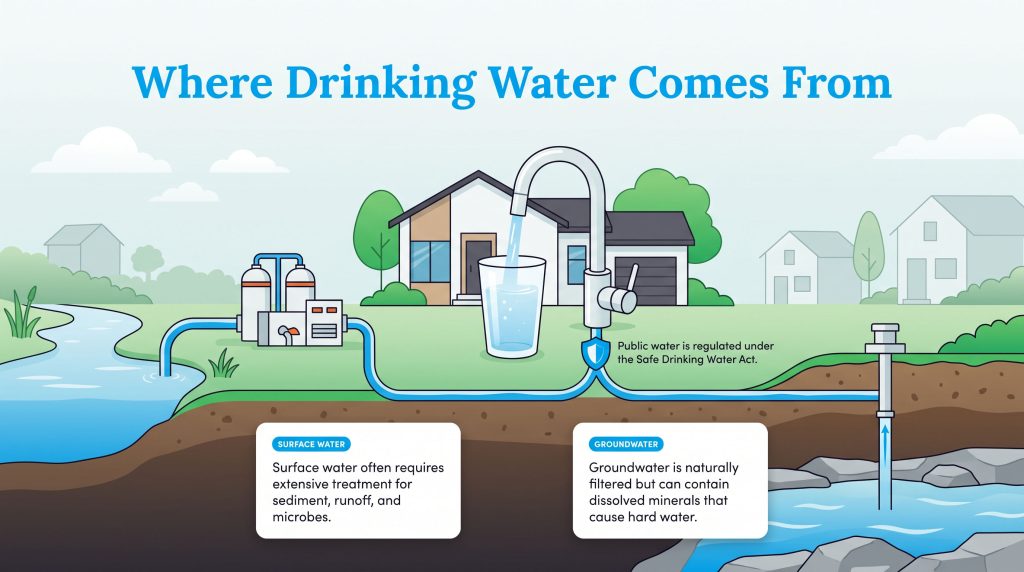
Residential drinking water originates from two distinct hydrological sources, each presenting specific filtration requirements and mineral characteristics:
- Surface Water (Rivers, Lakes, and Reservoirs): Supplies the majority of major metropolitan systems. Because surface supplies are vulnerable to seasonal agricultural runoff, organic sediment, and microbial pathogens, treatment plants prioritize extensive coagulation, flocculation, sedimentation, and multi-barrier disinfection.
- Groundwater (Subterranean Aquifers): Pumped to the surface using deep municipal or private wells. While natural subterranean strata filter out suspended sediment and organic matter, groundwater frequently carries dissolved minerals, including calcium, magnesium, iron, and manganese, resulting in hard water.
Statutory Protections: The Safe Drinking Water Act (SDWA)
Public water systems delivering water to 25 or more individuals or 15 or more service connections are legally bound by the Safe Drinking Water Act of 1974. Under this federal statute, the EPA establishes enforceable Maximum Contaminant Levels (MCLs) across biological, chemical, radiological, and synthetic pollutants.
Every public water supplier must distribute a Consumer Confidence Report (CCR) to all billing customers by July 1 annually. Your CCR identifies:
- The exact hydrological source of your local water supply.
- Every detected regulated substance alongside its Maximum Contaminant Level Goal (MCLG) and enforceable limit.
- Disinfection residual levels and compliance with federal testing cadences.
Current Water Quality Priorities
- Lead and Copper Compliance: Federal Lead and Copper Rule revisions require utilities to publish public inventories of all service line materials and accelerate the replacement of legacy lead service pipes linking municipal mains to home foundations.
- PFAS and PFOA Limits: Municipal treatment facilities are actively installing advanced granular activated carbon (GAC) contactors and reverse osmosis filtration systems to comply with federal drinking water standards for toxic per- and polyfluoroalkyl substances (“forever chemicals”).
- Disinfection Byproducts (DBPs): Water suppliers balance chlorine or chloramine application to eliminate pathogenic bacteria (such as E. coli and Giardia) while keeping total trihalomethanes (TTHMs) and haloacetic acids (HAA5) beneath EPA carcinogen thresholds.
Billing
Understanding Your Water Bill: Meters, CCF, and Rate Tiers
Water utility statements can be difficult to decipher because they measure consumption using non-standard volumetric units and apply layered fixed and variable charges.
Fixed Base Charges
Your monthly bill includes a fixed service charge that remains constant regardless of whether you consume zero gallons or ten thousand gallons. This fee covers meter reading administration, billing infrastructure, fire hydrant capacity, and base grid upkeep. The fee is determined by the physical diameter of your water meter; standard single-family residential homes use a 5/8-inch by 3/4-inch meter.
Volumetric Charges: Gallons vs. CCF
Water utilities record household usage using one of two volumetric metrics: single Gallons or Hundred Cubic Feet (CCF, also expressed as HCF).
1 CCF = 100 Cubic Feet = 748 Gallons
If your statement indicates that your household consumed 8 CCF during a 30-day billing cycle, your physical water usage was:
8 * 748 = 5,984 Gallons
Inclining Block Rate Structures
To promote municipal conservation, the majority of urban and suburban water providers structure usage rates into tiered consumption blocks:
- Tier 1 (Baseline Indoor Consumption): Billed at the lowest per-unit rate. Covers necessary indoor health, cooking, and sanitary needs (typically up to 4 to 6 CCF per month).
- Tier 2 (Moderate Consumption): Billed at an intermediate rate for standard household usage, including full laundry and daily dishwasher cycles.
- Tier 3 (High / Discretionary Consumption): Billed at a premium rate with steep surcharges designed to economically penalize extensive landscape irrigation, swimming pool refills, or unresolved household leaks.
Wastewater and Sewer Billing Mechanics
In most jurisdictions, your wastewater (sewer) fee is higher than your clean water fee. Collecting, pumping, aerating, digesting, and chemically sanitizing domestic sewage to meet EPA environmental discharge standards requires significantly more capital, electrical power, and chemical processing than purifying raw incoming water.
Because residential sewer lines do not contain outflow meters, utilities base wastewater billing on one of two formulas:
- Direct Ratio Calculation: Sewer fees match your exact metered clean water usage, assuming 100% of water entering the home leaves through the drains.
- Winter Quarter Averaging (WQA): The utility averages your metered clean water consumption strictly during winter months (December, January, and February) when outdoor lawn irrigation is dormant. That baseline volume serves as your maximum billable sewer cap for the remainder of the year, preventing homeowners from paying sewage processing surcharges on water absorbed by lawns and landscaping.
Major Utilities
The Largest Regulated Water Utility Companies
While the majority of Americans receive water from local municipal departments, millions of households are served by publicly traded, regulated investor-owned utilities.
American Water (NYSE: AWK)
The largest publicly traded water and wastewater service provider in the United States, providing service to approximately 14 million people across 14 regulated states and 19 domestic military installations. Primary operating subsidiaries include New Jersey American Water, Pennsylvania American Water, Illinois American Water, California American Water, and Indiana American Water.
Essential Utilities (NYSE: WTRG)
Formerly known as Aqua America, Essential Utilities is the second-largest investor-owned water utility holding company in the country. Its Aqua subsidiaries provide drinking water and wastewater services to over 3 million customer connections across Pennsylvania, Ohio, Texas, Illinois, North Carolina, Virginia, and Indiana.
California Water Service Group (NYSE: CWT)
The largest regulated water utility in the Western United States, delivering drinking water and wastewater services to more than 2 million residents across over 100 communities. It operates through state-regulated entities: California Water Service (Cal Water), Hawaii Water Service, New Mexico Water Service, and Washington Water Service.
Veolia North America
The North American subsidiary of Veolia Group, providing contract municipal utility operations, advanced industrial water treatment, and regulated water utility services across several states, including regulated utility operations in New York, New Jersey, Idaho, and Delaware.
American States Water Company (NYSE: AWR)
Through its primary operating subsidiary, Golden State Water Company, American States Water delivers regulated retail water service to over 260,000 residential customers across California. Its ASUS subsidiary operates long-term water and wastewater concession contracts on federal military installations.
Browse by State
Browse Water Utilities by State
Locate municipal water authorities, regulated private utilities, state drinking water standards, and public utility commission oversight rules across all 50 states and Washington, D.C.:
- Alabama
- Alaska
- Arizona
- Arkansas
- California
- Colorado
- Connecticut
- Delaware
- Florida
- Georgia
- Hawaii
- Idaho
- Illinois
- Indiana
- Iowa
- Kansas
- Kentucky
- Louisiana
- Maine
- Maryland
- Massachusetts
- Michigan
- Minnesota
- Mississippi
- Missouri
- Montana
- Nebraska
- Nevada
- New Hampshire
- New Jersey
- New Mexico
- New York
- North Carolina
- North Dakota
- Ohio
- Oklahoma
- Oregon
- Pennsylvania
- Rhode Island
- South Carolina
- South Dakota
- Tennessee
- Texas
- Utah
- Vermont
- Virginia
- Washington
- West Virginia
- Wisconsin
- Wyoming
- Washington, D.C.
Getting Set Up
Setting Up New Residential Water Service
When moving into a new home or changing rental properties, follow this operational checklist to ensure uninterrupted service:
- Initiate Setup 5 to 7 Days in Advance: Contact your municipal department or private water utility at least five business days before closing or lease commencement. If the property has been vacant, physical shutoff valves at the curb box may be padlocked, requiring field technician dispatch.
- Prepare Verification Documents: Utilities require formal identity and residency validation. Homeowners must supply their closing settlement statement or recorded deed. Renters must provide an executed lease showing the landlord or property management company’s information.
- Account Security Deposits: Most municipal and investor-owned providers charge account establishment fees ($20 to $50) and a security deposit ranging from $50 to $200.
- Deposit Waiver Strategy: Many water providers will waive security deposits if you provide a formal Letter of Credit from your previous electric, gas, or water utility certifying 12 consecutive months of on-time payments with zero delinquent notices.
- Document Day-One Meter Readings: On possession day, locate your meter pit (near the front curb) or interior basement meter and take a clear, timestamped smartphone photo of the numerical dial face. Keep this on file to avoid paying for usage, leaks, or inaccurate estimates incurred while the home was vacant.
Conservation
Home Water Management, Leak Detection, and Efficiency
According to the EPA, residential plumbing leaks waste roughly 9,400 gallons of clean water per household every year. Managing your system requires knowing how to operate emergency cutoffs and isolate silent failures.
Where Home Water Is Used
Understanding standard indoor household water distribution highlights the most impactful areas for conservation:
| Domestic Fixture / Use Case | Share of Total Indoor Usage | Standard Legacy Consumption | EPA WaterSense Standard |
| Toilets | 24% | 3.5 to 6.0 Gallons Per Flush (GPF) | 1.28 Gallons Per Flush (GPF) |
| Showers | 20% | 2.5 Gallons Per Minute (GPM) | 1.5 to 1.75 Gallons Per Minute (GPM) |
| Faucets (Bathroom & Kitchen) | 19% | 2.2 Gallons Per Minute (GPM) | 1.5 Gallons Per Minute (GPM) |
| Washing Machines | 17% | 30 to 40 Gallons Per Load | 12 to 14 Gallons (Energy Star) |
| Plumbing Leaks (Silent / Unrepaired) | 12% | 9,400+ Gallons Annually Per Home | Zero Continuous Flow |
| Other Domestic Uses | 8% | Variable Non-Certified Rates | High-Efficiency Baselines |
Emergency Main Water Shutoff
Every occupant should know the exact location of the interior main water shutoff valve. In cold climates, this valve is typically located in the basement or crawlspace where the primary copper or PEX water main penetrates the foundation. In warmer regions, it is often found in a utility closet near the water heater or on an exterior wall.
- Ball Valves (Modern): Feature a straight lever handle. Turn the handle 90 degrees perpendicular to the pipe to isolate water flow completely.
- Gate Valves (Legacy): Feature a round wheel. Turn clockwise through several complete rotations until seated firmly. Exercise these valves annually to prevent mineral sediment from freezing the stem.
- Exterior Curb Stop: If an interior pipe ruptures before the main valve, access the utility meter pit near the street curb. Using a water meter key or curb key, turn the brass valve head one-quarter turn to align the lock wings.
Running a Zero-Consumption Leak Diagnostic
To confirm whether your pressurized plumbing system has an active hidden leak:
- Shut off every faucet, shower, ice maker, and automatic irrigation controller.
- Open your utility meter lid to inspect the register face.
- Look at the low-flow indicator — typically a small red cogwheel, silver triangular dial, or flashing digital water drop symbol.
- If the indicator is spinning or registering flow while all home appliances are inactive, water is leaking through your pressurized lines.
The Toilet Flapper Dye Test
Toilets are responsible for the vast majority of unexplained utility bill spikes, wasting up to 200 gallons per day without making an audible sound.
- Remove the lid from your toilet tank.
- Drop four to five drops of dark food coloring or a leak detection dye tablet into the tank water.
- Do not flush the toilet. Wait 15 minutes.
- If colored water appears in the toilet bowl, the rubber flapper valve at the bottom of your tank has degraded or warped and needs replacement.
Go Deeper
More on Home Water
Explore our dedicated research libraries, hardware guides, and financial assistance resources:
Account Setup & Utility Billing
- How to Set Up Water & Utility Services
- How to Transfer Water Service
- How to Read Your Water Meter
- How Water Usage Is Measured
- Understanding Your Water and Sewer Bill
Water Quality, Testing & Filtration
- How to Test Your Home Water Quality
- How to Identify and Test for Lead
- How to Test Your Water for Bacteria
- PFAS in Drinking Water
- Microplastics in Drinking Water
- Water Filtration Systems
- What is Hard Water?
- Distilled vs. Purified Water
Conservation, Hardware & Emergency Plumbing
FAQs
Frequently Asked Questions About Home Water Utilities
Can I choose or switch my residential water company?
Why is my wastewater (sewer) bill higher than my water bill?
How do I convert CCF on my water bill to gallons?
Who is responsible for fixing a broken water line: the utility or the homeowner?
The Utility Company: Owns and maintains the main pipeline beneath the public roadway and the service lateral running up to the municipal water meter box or street curb stop.
The Homeowner: Owns and is 100% financially responsible for the private supply pipe running from the meter box into the house, as well as all interior plumbing, pressure regulators, and fixtures.
What should I do if my tap water turns discolored, brown, or smells unusual?
About the Authors
David has been an integral part of some of the biggest utility sites on the internet, including InMyArea.com, HighSpeedInternet.com, BroadbandNow.com, and U.S. News, with more than 15 years writing about, compiling, and analyzing utility data.
Editorial Authority & Review Standards
UtilitiesForMyHome.com is committed to providing independent, objective utility coverage data and regulatory analysis. Our platform maps 45,429 water and wastewater providers across 19,684 incorporated municipalities.
Strict Data Independence: Regulated utilities, municipal water boards, and private corporations cannot pay to alter their service boundaries, expand their mapped footprints, or improve placement in search queries. Monopolistic utilities are displayed strictly according to verified geographic and statutory service boundaries. Learn more about our data auditing process by visiting our Editorial Methodology.
Find Water Providers at Your Address
Confirm your service territory, review your utility’s latest regulatory filings, and access municipal setup forms: