

Discover the Most Accurate and Affordable Ways to Ensure Your Tap Water Is Safe for Your Family
Key Takeaways
- Check with your local utility provider first for free testing vouchers or annual water quality reports before spending money.
- Use DIY home test kits for a quick, initial screening, but understand they are less accurate than professional analysis.
- Send samples to an EPA-certified laboratory for the most reliable results if you suspect lead contamination in your pipes.
Lead is entirely invisible, odorless, and tasteless, making proactive testing the only surefire way to confirm if your family’s water is truly safe to drink. Moving into a new home or raising a young family comes with plenty of responsibilities, and figuring out how to test your water for lead should be right at the top of your priority list. Because you can’t rely on sight or smell to detect this dangerous heavy metal, securing accurate data is essential. Whether you’re searching a digital municipal database, conducting a quick visual inspection of the plumbing in your basement, or sending carefully collected samples to a certified lab, checking your water quality is a straightforward process that fits nearly any budget. By confirming your tap water is genuinely clean, you can confidently protect your household’s long-term health and ditch the ongoing expense and environmental waste of relying on single-use bottled water for your daily hydration needs.
Why Testing for Lead in Water Is Crucial
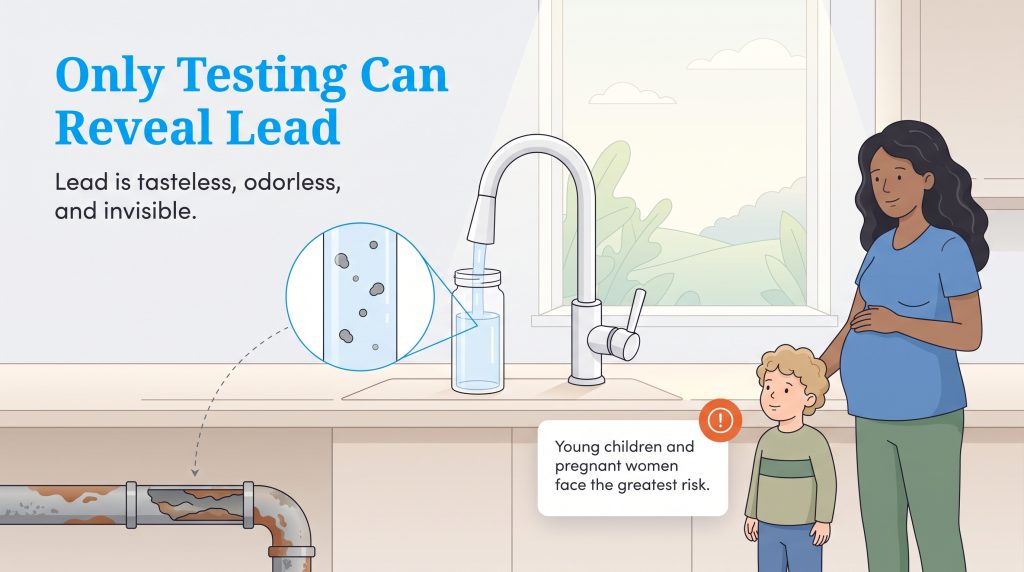
Lead poses severe health risks, particularly to pregnant women and young children who have rapidly developing brains and nervous systems. The primary source of lead in residential drinking water isn’t usually the natural water source itself, but rather the gradual corrosion of older municipal infrastructure and household plumbing components as water travels to your tap.
If your home was built prior to the 1986 nationwide ban on lead plumbing under the Safe Drinking Water Act, there is a significantly higher chance that your primary service lines, indoor branch pipes, or the solder holding your copper joints together contain dangerous levels of lead. Even newer homes aren’t automatically off the hook. While pure lead pipes were banned in 1986, “lead-free” brass plumbing fixtures and faucets legally contained up to 8% lead until federal Safe Drinking Water Act rules were strictly tightened to 0.25% in Jan. 2014.
Signs It Is Time to Test Your Water for Lead
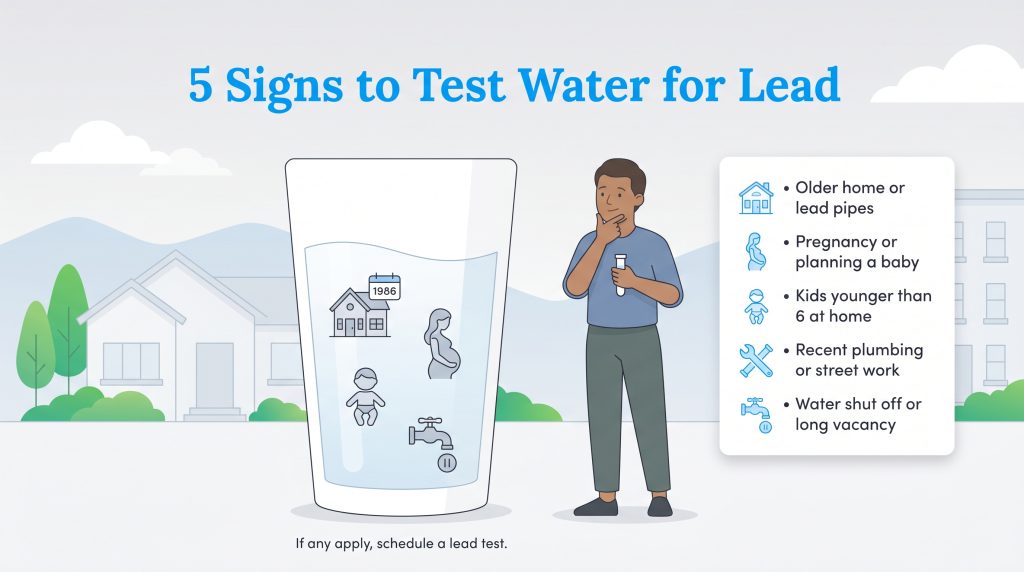
While there are no physical signs of lead in water itself, certain life events demand your immediate attention. If you’re pregnant, have children under six in the household, recently completed major indoor plumbing repairs, noticed utility crews digging up the street outside, or returned home after the water was shut off for an extended period, you should fast-track a screening. Heavy metals aggressively accumulate in your body over time, meaning even microscopic doses from your daily cup of morning coffee can silently build up to toxic levels. Long-term ingestion can lead to devastating consequences, including:
- Developmental issues: Slower learning capacities, persistent behavioral challenges, lower overall IQs, and noticeably stunted physical growth in infants and children.
- Reproductive complications: Heightened physiological risks for pregnant women, including lead stored in a mother’s bones releasing back into the active bloodstream, instances of premature birth, low birth weight, and direct developmental danger to the fetus.
- Cardiovascular effects: Increased blood pressure, chronic instances of hypertension, and significantly higher risks of long-term heart disease in healthy adults.
- Kidney damage: Decreased renal function and the potential onset of chronic kidney disease over extended periods of localized exposure.
🚩 Heads Up: If you suspect lead in your water, do not try to remove it by boiling the water. Boiling doesn’t remove lead and can actually increase its concentration because the clean water evaporates while the heavy metals remain permanently trapped in the pot.
1. Check Your Utility Records and Service Line Maps Before Testing
Before you spend a single dollar on laboratory fees or start inspecting basement pipes, you can gather valuable clues about your home’s water safety right from your laptop. Public water utilities are required by federal law to track water quality data and map out the materials used in their distribution networks.
Review Your Consumer Confidence Report (CCR)
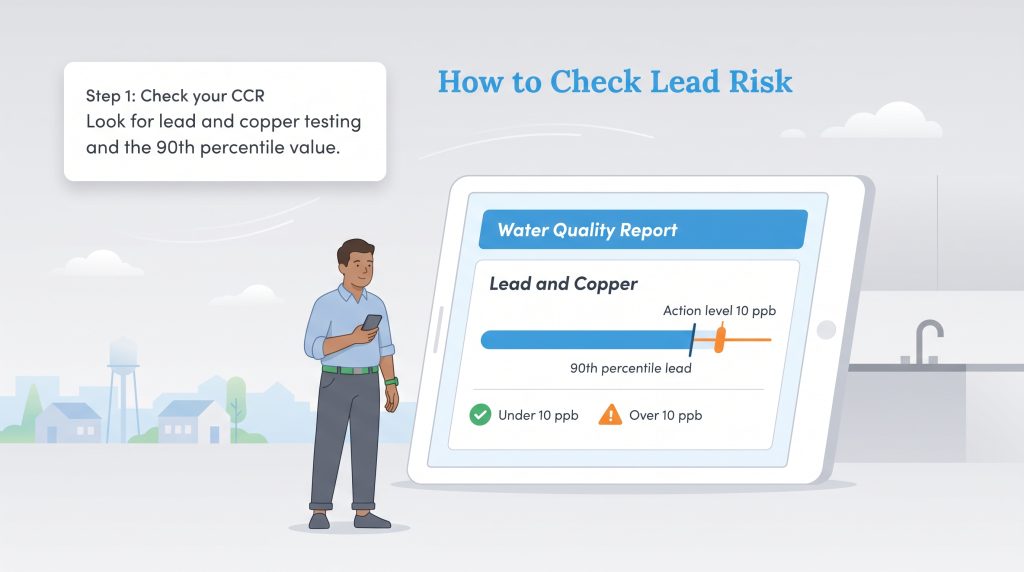
Your first move is to look up your community’s annual water quality data. A Consumer Confidence Report (CCR) is a yearly summary provided by your municipal utility every July that details exactly where your drinking water comes from and what contaminants were detected over the past 12 months. Visit your local utility’s website to view the latest report, and scan specifically for the table detailing lead and copper testing at residential taps.
This section highlights community-wide lead levels, typically listed as the 90th percentile value. If that consumer confidence report lead number exceeds the federal action level of 10 ppb, your municipality is actively dealing with systemic corrosion or service line issues. Even if your city passes with flying colors, remember that a CCR only reflects a sample of tested homes — it doesn’t guarantee that the individual pipes attached to your house are lead-free.
Look Up Your City’s Lead Service Line Inventory Map
Addressing the root cause of lead in drinking water means investigating the underground pipes delivering water to your property. Start by checking your city’s officially published lead service line inventory online. Under recent EPA mandates, local municipalities are legally required to maintain and share these registries with the public.
Type your exact street address into the interactive digital map to see the classification of both the public utility side and the private homeowner side of your underground lateral pipe. Your home will usually be categorized as “Lead,” “Galvanized Requiring Replacement,” “Non-Lead” (such as copper or plastic), or “Unknown.” If your property is flagged as lead, galvanized, or unknown, it’s time to head downstairs and inspect the plumbing yourself.
2. Inspect Your Home Plumbing and Perform a Pipe Scratch Test
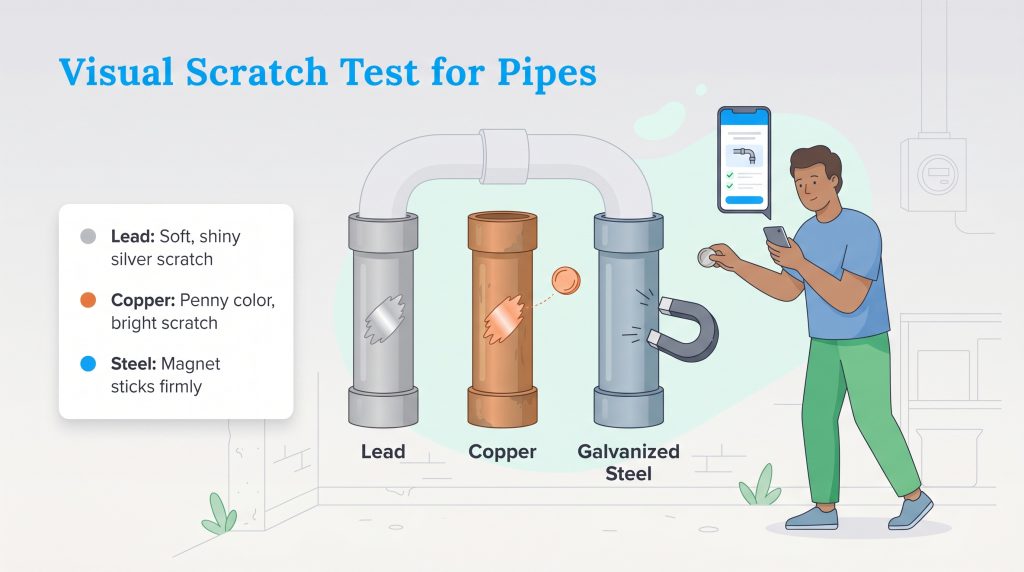
If your city’s database lists your service line material as “Unknown,” or if you want to verify your interior plumbing firsthand, you can perform a quick pipe scratch test for lead. Grab a flashlight, a spare coin or flathead screwdriver, and a strong refrigerator magnet. Head to your basement, utility closet, or crawlspace and locate the main water shut-off valve where the primary service pipe enters your home through the foundation floor or wall.
- The Scratch Test for Lead: Carefully and firmly scratch the outside of the unpainted metal pipe between the wall entry point and the main shut-off valve using the edge of your coin. If it’s lead, the metal will feel noticeably soft and scrape away easily, revealing a bright, shiny silver streak underneath the dull gray exterior. Lead pipes also tend to have rounded, bulbous joints where the pipe was wiped with molten solder rather than sharp, threaded fittings.
- The Magnetic Test for Galvanized Steel: Hold your strong magnet directly against the scratched area. Magnets will completely ignore lead and copper, but they will firmly stick to galvanized steel pipes. While steel isn’t made of lead, older galvanized pipes have a rough interior zinc coating that acts like a magnet for microscopic lead particles released from upstream utility mains, sporadically releasing that trapped lead into your tap water years later.
- Identifying Copper Pipes: Copper plumbing matches the distinctive, reddish-brown color of an older penny (though it may develop green oxidation patches over time). When scratched with a coin, the revealed metal underneath will shine like a bright, newly minted penny, and a magnet will not stick to it. Be sure to look closely at the joints connecting the copper sections; dull gray, metallic rings at the elbows indicate lead solder, which was widely used before 1986.
- Identifying Plastic (PEX or PVC) Pipes: Modern plastic plumbing is completely smooth, rigid or semi-flexible, and typically comes in solid white, blue, red, or gray. It won’t scratch to reveal a metallic shine, and a magnet won’t react to it. While interior plastic pipes are 100% lead-free, always check the brass valves and fittings connecting them, and verify that the underground pipe entering the house before the meter isn’t still made of older metal.
If you uncover soft, silver pipes, galvanized steel, or old lead solder on your copper joints, wash your hands thoroughly and move immediately to water testing. Many utility companies even let you upload a smartphone photo of your scratched pipe to update their inventory and qualify for replacement grants. For more tips on managing your home’s water infrastructure, read our guide on understanding your water bill.
3. Choose the Best Method for Testing Your Tap Water
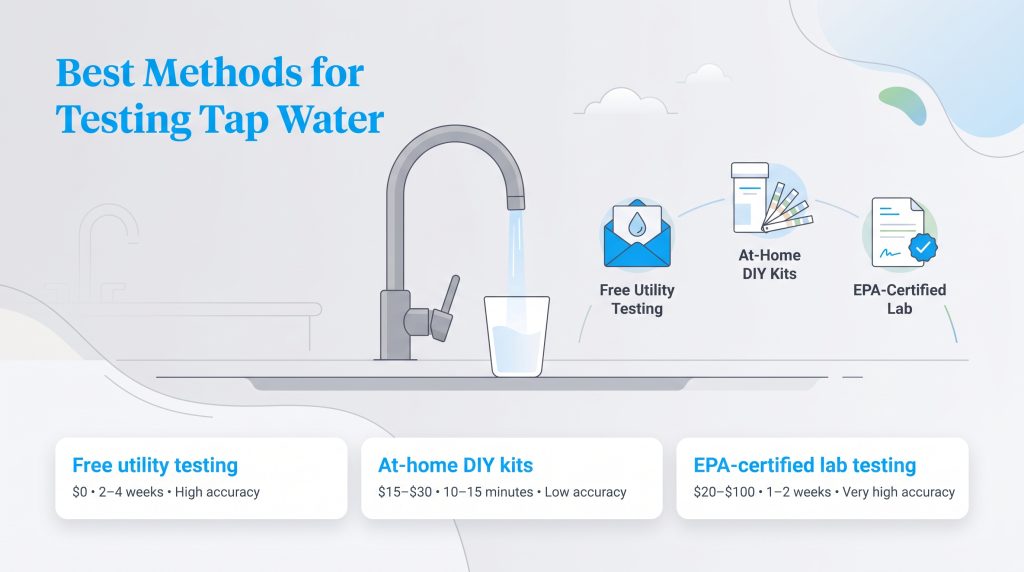
Checking public maps and scratching basement pipes tells you if a hazard exists, but testing the water itself is the only way to know if lead is actively leaching into your drinking glass. When you’re ready to test tap water for lead, you have three distinct avenues to explore. We broke down the most common testing methods below to help you choose the right option based on your budget, timeline, and desired level of analytical detail.
| Testing Method | Average Cost | Turnaround Time | Overall Accuracy |
|---|---|---|---|
| Free Utility Testing | $0 | 2 – 4 Weeks | High |
| EPA-Certified Lab | $20 – $100 | 1 – 2 Weeks | Very High (Exact ppb) |
| At-Home DIY Kits | $15 – $30 | 10 – 15 Minutes | Low (Prone to false negatives) |
Request a Free Test From Your Local Water Utility
You might be able to get your home’s water thoroughly analyzed by professionals without spending a single dime out of pocket. Start your testing journey by looking for free lead water testing programs in your area. Visit your local water utility website, check your county health department portal, or call your city’s 311 public service line to ask if they distribute complimentary municipal sampling kits.
Under tightened federal regulations, many cities and public utility providers actively encourage residents to test their water, especially in historic neighborhoods undergoing main upgrades or homes with confirmed lead service lines. If eligible, the city will mail you collection bottles, process the water at their municipal lab, and send you an official report. The only drawback is patience: high municipal demand means it can take two to four weeks to get your results back.
Send a Sample to an EPA-Certified Lab
If your utility doesn’t offer free kits — or if you don’t want to wait a month for answers — investing in independent laboratory analysis is the universal gold standard for household safety. Finding an EPA certified water testing lab is straightforward: you can call the EPA Safe Drinking Water Hotline at 1-800-426-4791 or check your state health or environmental department’s online directory to locate accredited laboratories in your area.
Many homeowners assume professional chemical analysis costs hundreds of dollars, but a targeted lead screening is surprisingly affordable. Expect to pay anywhere from $20 to $100 depending on the facility and whether you bundle in other metals like copper or arsenic. You simply order a mail-in kit online or pick up bottles from a local lab, collect your tap water according to the provided instructions, and ship the vials back. Within one to two weeks, lab technicians will provide a precise measurement of your lead concentration down to exact parts per billion (ppb).
Use an At-Home DIY Lead Test Kit
If you want immediate feedback today while waiting on a lab kit, picking up an at-home lead test kit or at-home lead test strips from a hardware store is a popular, inexpensive option. These rapid kits cost $15 to $30 and rely on a chemical reaction that changes the color of a paper pad or vial within 10 to 15 minutes to signal the presence of heavy metals. However, you need to keep serious accuracy limitations in mind when reviewing your visual results.
Disclaimer: At-home colorimetric strips are highly prone to user error and dangerous false negatives. If the heavy metal concentration falls slightly below their minimum chemical detection threshold, they may fail to show a positive result. Most retail strips are calibrated to trigger around the older 15 ppb threshold, meaning they can easily miss water containing 5 ppb or 10 ppb of lead. Furthermore, they cannot detect microscopic particulate lead flakes unless the sample is treated with acid in a lab, and they won’t give you an exact numerical concentration. Treat a DIY strip as a rough preliminary check, never as the final word on your family’s safety.
4. Collect an Accurate Water Sample
Even the most sophisticated laboratory equipment is only as reliable as the water sample you send in. Because lead leaches into water slowly while it sits motionless against metal pipes, timing and technique are everything. Before you start, let the water in your entire home sit completely undisturbed for at least six hours (overnight is easiest) — that means no flushing toilets, running the dishwasher, or taking showers.
Always collect your sample from the kitchen or bathroom sink you use most often for drinking, and always use the cold water tap. Do not remove or clean the faucet aerator (the mesh screen at the tip of the spout) prior to testing; trapped particulate lead in that screen is a real part of your daily exposure, and removing it can skew your results downward. Depending on your home’s plumbing setup, labs and utilities rely on a first draw vs fifth liter water sample protocol alongside flush testing to pinpoint exactly where contamination originates:
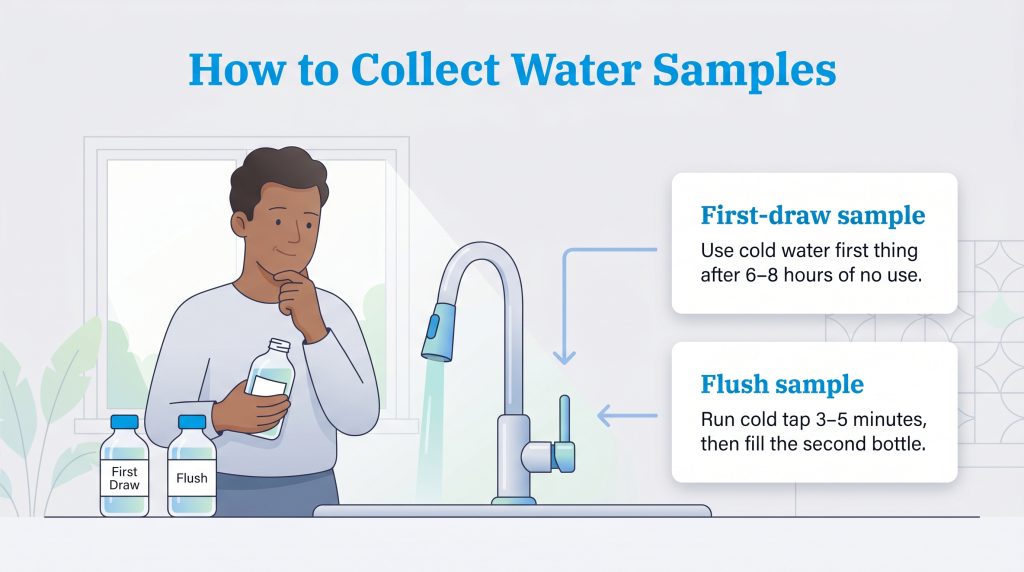
- The First-Draw Sample (1st Liter): Place your first 1-liter sample bottle directly under the dry kitchen faucet before turning the handle. Turn the cold water on fully and fill the bottle right to the shoulder line. Because this captures water that sat stagnant right behind the spout for six or more hours, it reveals if lead is leaching from your kitchen faucet, under-sink shut-off valves, or interior copper pipe solder.
- The Fifth-Liter Sample (For Lead Service Lines): Under the updated EPA Lead and Copper Rule Improvements (LCRI), utilities and certified labs frequently test both the first liter and the fifth liter when a home has a known or suspected lead service line. To take this sample, line up five numbered 1-liter bottles before opening the tap. Keep the cold water running continuously without shutting the valve off, filling bottles one through five in strict sequential order. While the first bottle captures indoor plumbing water, the fifth liter captures the exact slug of water that was sitting stagnant outside inside your underground lead service line. Depending on your kit, you will send back either the fifth bottle, or both the first and fifth bottles.
- The Flush Sample: If your kit uses a traditional two-bottle diagnostic test instead of sequential liters, cap your first-draw bottle, turn the cold water faucet on high, and let it run freely down the drain for three to five full minutes. Once the pipe has been thoroughly cleared, fill your second sample bottle. Comparing a first-draw sample against a flush sample helps technicians verify if running the tap successfully clears the lead or if contamination is still entering from the municipal main.
💡 Pro Tip: If your household uses a point-of-use water pitcher or a screw-on faucet filter, bypass or remove the filter attachment before collecting your baseline test sample (without unscrewing the metal faucet aerator itself). Once you know your raw tap water’s lead level, you can always purchase a second test vial to sample your filtered water and confirm your filter cartridge is doing its job.
5. Read Your Lead Water Test Results
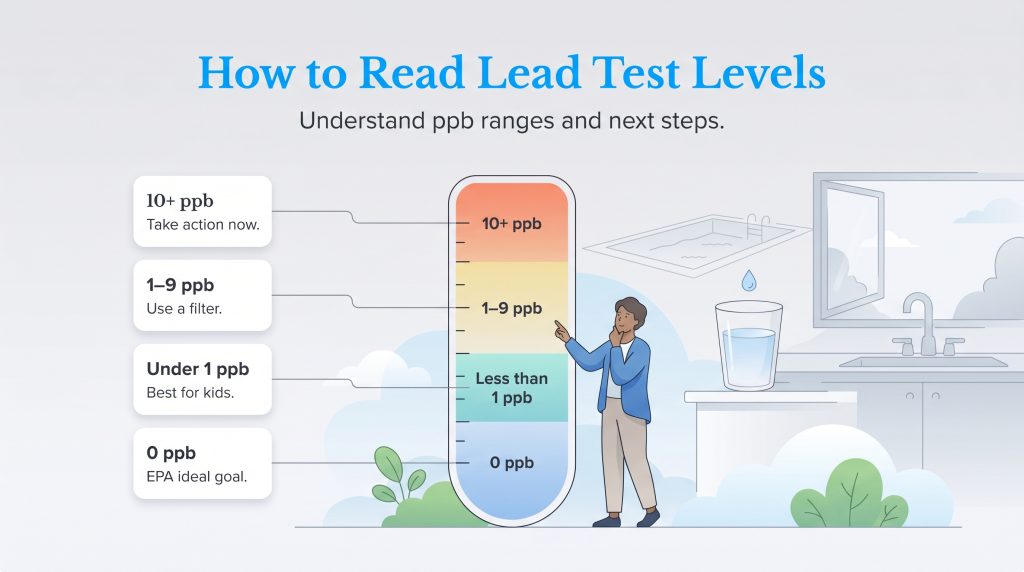
When your laboratory report arrives in your inbox, the technical metrics can look intimidating at first glance. Most labs report lead concentrations in parts per billion (ppb) or micrograms per liter (µg/L), which are identical measurements (1 ppb equals 1 µg/L). Some labs report in milligrams per liter (mg/L) or parts per million (ppm) — if yours uses mg/L, just multiply the number by 1,000 to convert it to ppb (for example, 0.001 mg/L equals 1 ppb, and 0.010 mg/L equals 10 ppb).
The medical consensus is crystal clear: no amount of lead in the human body is completely safe. However, regulatory agencies use specific numerical benchmarks to help you gauge the severity of your exposure and decide how urgently to respond. Use the table below to interpret your lab numbers:
| Lead Concentration (ppb) | Equivalent in mg/L | Regulatory & Health Benchmark | Recommended Household Action |
|---|---|---|---|
| 0 ppb (Non-Detect / ND) | 0.000 mg/L | Meets the EPA Maximum Contaminant Level Goal (MCLG) of zero. | No action needed. Your water is free of detectable lead. Retest every few years or after plumbing work. |
| 1 – 9 ppb | 0.001 – 0.009 mg/L | Low-level contamination detected. Exceeds the American Academy of Pediatrics (AAP) recommendation of keeping school/home water below 1 ppb for children. | Install an NSF/ANSI 53 water filter for all drinking and cooking water, especially if pregnant women or young children live in the home. Clean faucet aerators and flush stagnant pipes before use. |
| 10 ppb or Higher | 0.010 mg/L or higher | Exceeds the EPA federal Action Level (recently lowered from 15 ppb to 10 ppb under the Lead and Copper Rule Improvements). | Switch immediately to certified filtered water or bottled water for drinking, cooking, and mixing baby formula. Contact your local water utility to report the result and inquire about lead service line replacement programs. |
Understanding the difference between the EPA’s health goal (0 ppb) and the federal lead action level 10 ppb is crucial. The 10 ppb threshold isn’t a health-based “safe” limit for your kitchen glass — it’s an administrative trigger that forces public utilities to step up corrosion control treatments and accelerate pipe replacements when more than 10% of sampled homes in a city pass that mark. If your personal tap shows even 2 ppb or 5 ppb, lead is actively leaching from your plumbing, and you should take steps to filter your drinking water immediately.
What to Do If You Find Lead in Your Tap Water
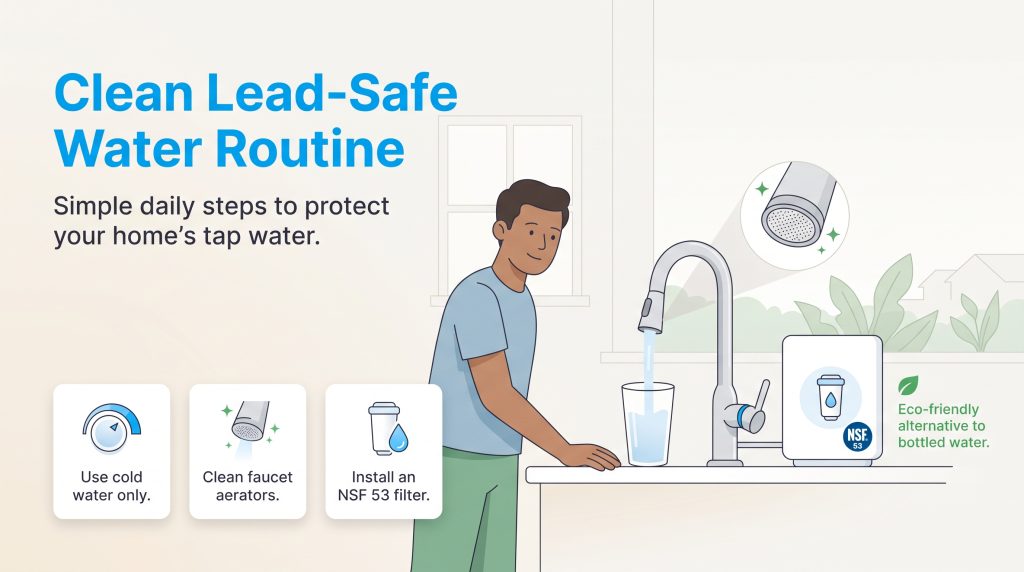
If your test results reveal any trace of lead, don’t panic — you can eliminate your daily ingestion risk right away without waiting for a plumber to tear open your walls. Putting a smart, consistent kitchen routine in place will shield your family while you evaluate long-term pipe or fixture upgrades:
- Only use cold water for cooking and drinking: Never use hot tap water to boil pasta, brew morning coffee, or mix infant baby formula. Warm and hot water dissolves lead from aging pipes and brass fixtures much faster and at significantly higher volumes than cold water. Always draw cold water from the tap and heat it on the stove or in a kettle.
- Clean all faucet aerators: Make it a regular habit (once a month or immediately after nearby street construction) to unscrew and rinse out the small mesh aerator screens at the tip of your kitchen and bathroom faucets. Tiny flakes of particulate lead and mineral scale frequently get trapped in these screens, continuously contaminating clean water as it flows past them into your glass.
- Install an NSF/ANSI 53-certified filter: Standard carbon taste filters will not protect you from heavy metals. You must use a point-of-use (POU) filtration system explicitly certified to NSF/ANSI Standard 53 for lead reduction. Whether you choose a certified pitcher or faucet-mount water filter, an under-sink carbon filter, or a reverse osmosis setup (which should carry the NSF/ANSI Standard 58 certification for lead), treating the water right before it hits your glass is the most reliable way to keep your family safe.
- Flush your pipes after stagnation: Whenever a faucet hasn’t been used for six or more hours (such as first thing in the morning or when returning home from work), run the cold tap before collecting water for drinking or cooking. If your home has copper or plastic service lines, running the cold tap for 30 seconds until the water feels noticeably colder is usually sufficient. If your home has a lead or galvanized service line, let the cold water run for three to five full minutes to pull fresh water straight from the street main. Keep in mind that taking a morning shower or flushing the bathroom toilet only clears the main line — it does not flush the stagnant water sitting inside your kitchen drinking branch lines, so you still need to run the kitchen faucet briefly before filling your glass.
🌱 Eco Edge: Utilizing a certified pitcher or under-sink filter is an environmentally mindful choice. It provides a highly sustainable alternative to constantly buying heavy, expensive cases of single-use plastic water bottles to keep your family safe.
Special Lead Testing Rules for Private Well Owners and Renters
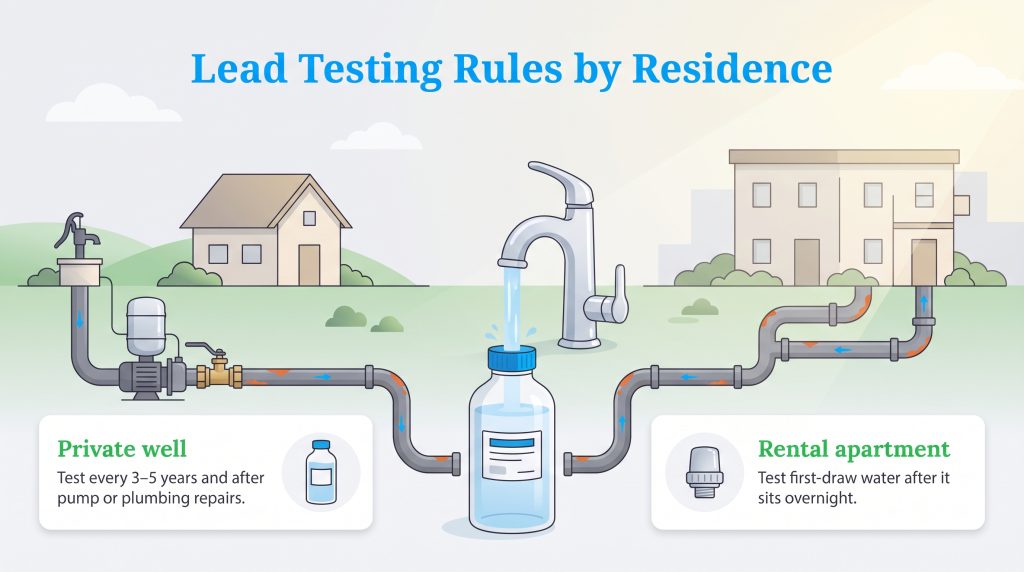
Most public water guides assume you are a homeowner hooked up to a city water main, leaving millions of households in the dark. If you rely on a private rural well or rent an apartment in a multi-unit building, your legal protections, testing options, and filtration solutions look very different.
- For Private Well Owners: Private residential wells are not regulated by the federal EPA Safe Drinking Water Act. That means you won’t receive an annual Consumer Confidence Report, your property won’t appear on municipal service line maps, and you aren’t eligible for free utility test vouchers — making your household 100% responsible for monitoring your own water safety. While underground aquifers rarely contain natural lead, private well water is frequently slightly acidic (low pH) or lacks the corrosion-inhibiting minerals that cities add to municipal water. This aggressive groundwater corrodes brass well components, submersible pump seals, pressure tank fittings, and interior copper pipe solder, leaching lead right into your tap. Well owners should test their water through an EPA-certified lab every three to five years, and immediately after replacing a submersible well pump or performing plumbing repairs.
- For Renters and Apartment Dwellers: When you don’t own the building, you often can’t access a locked basement utility room to scratch pipes, and you don’t receive the monthly municipal water bill where utilities tuck their water quality notices. Start by asking your landlord or property manager for a copy of the city’s latest Consumer Confidence Report and any building-specific lead disclosures, or look up the building’s street address on your city’s public lead service line map yourself. Because you don’t need basement access to test what comes out of your sink, order a mail-in EPA-certified lab kit (or request a free city kit) and take a first-draw sample directly from your kitchen faucet after the water sits overnight. If lead shows up and your landlord won’t upgrade the plumbing, bypass the building’s pipes by using renter-friendly, non-permanent point-of-use filtration — such as an NSF/ANSI 53 certified pitcher filter or a tool-free, screw-on faucet mount filter that you can easily pack up when your lease ends.
Securing Your Home Water Supply
Guaranteeing your tap water is free from invisible heavy metals is one of the smartest, most proactive measures you can take to protect your household’s long-term health. You don’t need a plumbing degree or a massive budget to get reliable answers. By reviewing your city’s lead service line inventory, inspecting your pipes with a coin and magnet, and sending a properly collected sample to an EPA-certified lab, you take the guesswork out of your home’s utilities. And if your test does uncover lead, installing a certified NSF/ANSI 53 filter gives your family immediate protection and peace of mind right at the tap.
Frequently Asked Questions About Lead Water Testing
Can I get my water tested for lead for free?
Yes. Many local municipalities and public water utility companies offer free lead testing programs to their residents, especially in neighborhoods with older infrastructure or known lead service lines. Check your local water utility’s official website or call your city’s 311 public service line to see if they will mail you a complimentary sampling kit.
How much does a lab test for lead in water cost?
If your local utility doesn’t offer free testing vouchers, ordering a professional analysis from an EPA-certified laboratory typically costs between $20 and $100. The exact price depends on the lab facility, shipping costs, and whether you are testing solely for lead or bundling a broader heavy metal panel.
Do standard refrigerator water filters remove lead?
Not always. Basic carbon filters in many refrigerators are only certified under NSF/ANSI Standard 42 to improve taste and odor by reducing chlorine. They will not reliably remove heavy metals unless the filter box explicitly carries the NSF/ANSI Standard 53 certification for lead reduction. Always check the fine print on your replacement cartridge to verify.
Is it safe to shower, bathe, or wash dishes in water with lead?
Yes. According to the EPA and CDC, human skin does not absorb lead from water, so showering and bathing are safe for adults and children — provided that young children do not accidentally swallow the bathwater. You can also safely wash dishes and clothes in water containing lead, as the metal will not cling to dried plates or fabrics at harmful levels.
How often should you test your tap water for lead?
If you are on municipal water and your initial lab test comes back at 0 ppb with no lead pipes present, you only need to retest if you welcome a new baby, notice street utility construction outside, or replace indoor plumbing. However, if you have a known lead service line or rely on a private well, experts recommend testing your water every three to five years, or once a year if you are actively monitoring a filtration system.
Can a water softener remove lead from drinking water?
No, whole-house water softeners are designed to remove hardness minerals like calcium and magnesium using ion exchange, and they are not certified to remove lead for safe drinking. In fact, softened water can sometimes be slightly more corrosive to older indoor solder and brass fixtures if the plumbing sits downstream from the softener, which is why you should always pair a softener with an NSF/ANSI 53 or 58 point-of-use filter at your kitchen sink.
What is the difference between a first-draw, fifth-liter, and flush water sample?
A first-draw sample captures the very first liter of water out of the faucet after sitting stagnant for at least six hours, testing for lead leaching from indoor faucets and solder. A fifth-liter sample captures the fifth sequential liter drawn from the tap, which isolates the water that was sitting stagnant underground inside an exterior lead service line. A flush sample is taken after letting the cold tap run for three to five minutes to test the water flowing directly from the city water main.
About the Author

LaLeesha has a Masters degree in English and enjoys writing whenever she has the chance. She is passionate about gardening, reducing her carbon footprint, and protecting the environment. She also recently served as President of the Board for City Sprouts (a community garden).

David has been an integral part of some of the biggest utility sites on the internet, including InMyArea.com, HighSpeedInternet.com, BroadbandNow.com, and U.S. News. He brings over 15 years of experience writing about, compiling and analyzing utility data.