

Understanding your Consumer Confidence Report helps you make informed decisions about your home’s tap water and filtration needs.
Key Takeaways
- A Consumer Confidence Report (CCR) is an annual document required by the EPA that details the quality, source, and safety of your municipal drinking water.
- Comparing your water’s contaminant levels to the Maximum Contaminant Level (MCL) is the most crucial step to ensure your tap water is legally safe to drink.
- Renters may need to look up or request a CCR, while private well owners usually need independent testing because private wells aren’t covered by municipal CCR rules.
When you’re settling into a new home, your local water quality report can feel like one more utility document you’re supposed to understand overnight. You might skim the tiny text and scientific acronyms, wondering whether you actually need to worry about what flows out of your kitchen faucet. We want to clear up that confusion by decoding the tricky abbreviations, explaining exactly how to read the data table, and helping you decide if your tap water is safe as-is or if you should invest in a home filtration system.
What Is a Consumer Confidence Report (CCR)?
A Consumer Confidence Report is basically an annual report card for your local drinking water. Community water systems generally must provide customers with a CCR each year by July 1. This transparent reporting process is mandated by the federal Safe Drinking Water Act.
Understanding this document gives you a clearer picture of what your public water system found during required testing. First, it tells you exactly where your water comes from, such as a nearby river or an underground aquifer. Second, it lists which specific contaminants were detected during routine testing over the past year. Finally, it highlights whether your municipal system had any health-based violations that could impact local safety.
How to Find Your Local Water Quality Report
Unpacking boxes and organizing utility bills takes up plenty of mental energy during a move. You might have accidentally tossed your physical water report into the recycling bin alongside old mail. If you need to find your CCR after the fact, start with your water provider’s website or the EPA’s Consumer Confidence Report resources.
Alternatively, navigating directly to your local utility provider’s website usually yields immediate results. For example, if you’re moving to Houston, our Houston utilities guide can help you start with local provider information before checking the city’s official water report.
Pro Tip
While physical reports are usually mailed alongside your summer water bill, most utility districts maintain a digital archive of their reports online year-round for easy access.
Do Renters and Private Well Owners Get a Water Quality Report?
Federal reporting requirements feature a few notable gaps depending on your living situation and water source. Renters may not receive a CCR in the mail if the landlord, property manager, or HOA pays the water bill. However, community water systems are still expected to make a good-faith effort to reach consumers who don’t receive direct bills. If you rent, check your water provider’s website, ask your landlord, or call the utility directly.
Knowing how your water is monitored helps you decide when a follow-up test is worth it. Here is how different living situations impact your reporting status:
- City Water: Homeowners connected to a municipal supply automatically receive a CCR annually, keeping them fully informed about public water treatment efforts and local contaminant levels.
- Well Water: EPA doesn’t regulate private wells under the federal CCR program, so well owners are usually responsible for testing and maintaining their own water supply.
- Renters: Since the active utility account often belongs to the property owner, tenants might miss out on mailed reports. You’ll need to manually check your local water authority’s website to review the testing data.
What Your CCR Does and Doesn’t Tell You
A CCR reflects testing across the public water system, but it may not tell you exactly what’s coming out of your specific faucet, especially if your home has older plumbing. The report highlights public compliance, but it won’t show issues caused by your specific home’s plumbing, lead risks from private interior pipes, or short-term changes after main breaks. It also doesn’t measure private well quality or address taste, odor, or hardness problems that aren’t necessarily health violations.
The Ultimate CCR Glossary: Common Water Report Terms
Reading your annual assessment often feels like deciphering a foreign language. Utilities use specific scientific abbreviations to classify chemical thresholds, which quickly overwhelms the average reader. Understanding the difference between the MCL and MCLG is crucial for determining if your tap is actually legally compliant. Similarly, you need to know what parts per million (ppm) means to grasp the scale of the particles in your glass.
We translated the most confusing acronyms into everyday language so you can interpret your data with total confidence. Lead and copper can look a little different from other contaminants because they’re often reported using an action level rather than a standard MCL. If your CCR shows elevated lead, copper, or a lead action level exceedance, contact your water utility and consider testing water from your own tap.
| Term | Acronym | Plain English Meaning |
|---|---|---|
| Maximum Contaminant Level | MCL | The highest legal level of a contaminant allowed in public drinking water. |
| Maximum Contaminant Level Goal | MCLG | The level of a contaminant where there is no known or expected health risk. |
| Action Level | AL | The concentration of a contaminant that triggers mandatory water treatment requirements. |
| Not Detected | ND | The substance was not detected at or above the lab’s reporting limit. |
| Parts per million | ppm | A very small concentration measurement. In water, 1 ppm is roughly the same as 1 milligram per liter. |
| Parts per billion | ppb | An even smaller concentration measurement. In water, 1 ppb is roughly the same as 1 microgram per liter. |
Five Steps to Reading the Contaminant Data Table
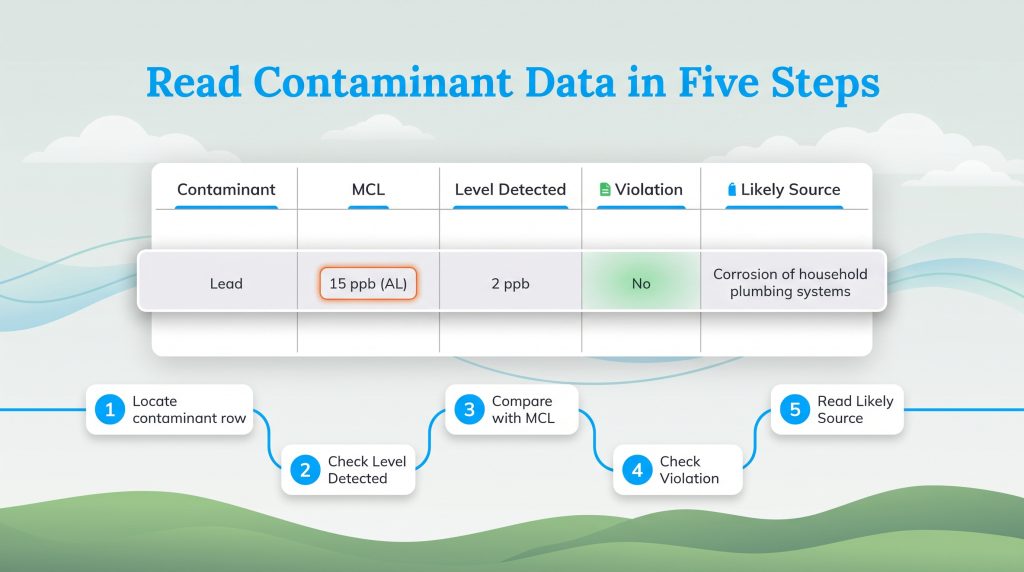
Unlocking the mysteries of your local drinking water starts with the dense grid of numbers situated near the middle of the document. Figuring out how to read your water quality report can feel intimidating, but breaking the data down column by column simplifies the whole process. Once you know which columns matter, the report becomes much easier to scan.
Here is a simplified example of what a CCR contaminant row might look like:
| Contaminant | MCLG | MCL | Level Detected | Range Detected | Violation | Likely Source |
|---|---|---|---|---|---|---|
| Lead | 0 | 15 ppb (AL) | 2 ppb | 0-3 ppb | No | Corrosion of household plumbing systems |
| Chlorine | 4 ppm | 4 ppm | 1.2 ppm | 0.8-1.5 ppm | No | Water additive used to control microbes |
Follow this linear progression to analyze your home’s water supply effectively:
- Locate the detected contaminant row: Find the specific substance listed on the far left side of the table, such as lead, copper, or arsenic.
- Check the “Level Detected” column: This number shows the measured concentration of that substance in the tested water.
- Compare it against the MCL: Look at the Maximum Contaminant Level column to find the strict, legal federal limit. If the detected level is below the MCL and there’s no violation, the system met the enforceable federal limit for that contaminant during the reporting period.
- Check the “Violation” column: Utilities usually mark this with a simple “Yes” or “No.” A “Yes” indicates the detected level exceeded legal limits and poses a potential health risk.
- Read the “Likely Source” column: This section explains exactly where the contaminant comes from, whether it’s natural erosion, fertilizer runoff from nearby farms, or corrosion from old plumbing systems.
Working your way across the table from left to right creates a complete narrative about what is entering your home and where it originated.
What to Do Based on What You Find
Figuring out how to read your water report is only half the battle. You also need to know what actions to take when you spot a specific issue. Use this quick guide to translate your findings into practical next steps.
| If You See This | What It Might Mean | What to Do Next |
|---|---|---|
| No violations, but chlorine taste | Treated water is safe but has a noticeable taste | Try an activated carbon filter |
| Lead or copper concerns | Plumbing or service line may be contributing metals | Test water from your own tap |
| Nitrate near the limit | Higher concern for infants and pregnant people | Contact the utility and consider certified treatment |
| Coliform violation | Possible microbial contamination | Follow boil water notices and utility guidance |
| Hard water minerals | Usually aesthetic, not a health violation | Consider a softener if scale is damaging fixtures |
When to Consider a Home Water Filtration System
Your municipal report might show that every single contaminant falls well below the legal federal limit, but that doesn’t guarantee your water tastes or looks perfect. You might wonder, is cloudy tap water safe to drink? While cloudiness often just indicates harmless trapped air bubbles or hard water minerals, aesthetic issues like a strong chlorine smell frequently push homeowners toward secondary treatment options.
Furthermore, public reports only measure the quality of the water traveling through the city’s main distribution lines. If you live in an older property, you still need to test your private plumbing to ensure dangerous metals aren’t leaching into your sink from outdated pipes. When you discover unpleasant odors or outdated plumbing fixtures, take the time to explore our home water solutions. Before buying a filter, check whether it’s certified to reduce the specific contaminant you’re concerned about. A carbon pitcher can improve taste and chlorine odor, but it won’t solve every contaminant issue.
The most sustainable filter is the one matched to your actual water issue. Buying a system you don’t need can waste money, replacement cartridges, and water.
Eco Edge
Investing in a whole-house filter or an under-sink reverse osmosis system is an environmentally mindful choice that can reduce your need for purchasing single-use plastic water bottles.
Making Sense of Your Home’s Tap Water Quality
Decoding the specific contents of your tap water empowers you to protect your family without feeling overwhelmed by dense technical terms. Taking a few moments to review this annual document ensures you spot potential hazards early and make confident choices about household filtration. As you settle into your new space, remember that organizing your property goes beyond the kitchen sink. Setting up a comfortable environment involves reviewing all of your services, so take a moment to evaluate your moving plans to keep the rest of your home running efficiently.
Frequently Asked Questions About Consumer Confidence Reports
We compiled answers to the most common questions new residents ask when reviewing their annual water data. Review these insights to better understand local regulations and testing protocols.
Is My Water Safe if the CCR Shows No Violations?
What Is the Difference Between MCL and MCLG?
Should I Test My Tap Water Even if I Get a CCR?
How Accurate Are Annual Water Quality Reports?
What Should I Do if My Water Report Shows a Violation?
Why Does My Water Smell Like Chlorine if the Report Says It Is Safe?
How Often Should Private Well Owners Test Their Water?
About the Author

David has been an integral part of some of the biggest utility sites on the internet, including InMyArea.com, HighSpeedInternet.com, BroadbandNow.com, and U.S. News. He brings over 15 years of experience writing about, compiling and analyzing utility data.

Claudio is a sustainability-focused writer with a background in Anthropology and Psychology from NC State University. He has spent over 15 years working in writing, interpretation, and translation, driven by a deep interest in how human culture shapes the environment. Today, he shares his curiosity with readers by writing about sustainable living solutions and the connection between everyday choices and environmental impact.