

Tracking your household water usage bridges the gap between the spinning dial in your yard and the charges on your monthly utility bill
Key Takeaways
- Reading your water meter allows you to track real-time consumption and identify plumbing issues before they cause costly damage.
- Utilities typically measure water in Centum Cubic Feet (CCF) or gallons, and knowing how to convert these numbers helps you budget efficiently.
- Performing a simple 20-minute leak test with your water meter can help you save money and conserve hundreds of gallons of water per month.
Understanding water measurements helps you connect what your meter records with what your utility charges each month. If you are a new homeowner or a renter taking on utility accounts for the first time, looking at your first water statement can feel like trying to decipher a secret code. Between the mysterious acronyms, tiered rate structures, and an outdoor meter you have probably never opened, it is easy to just pay the balance and hope for the best. We want to take the guesswork out of the process by helping you decode those utility abbreviations and showing you exactly how to read the physical equipment buried in your yard. By understanding your home water measurements, you gain the power to track your usage, spot expensive leaks before they cause serious property damage, and confidently lower your monthly costs without sacrificing your daily comfort.
Translating Utility Acronyms: CCF vs. Gallons
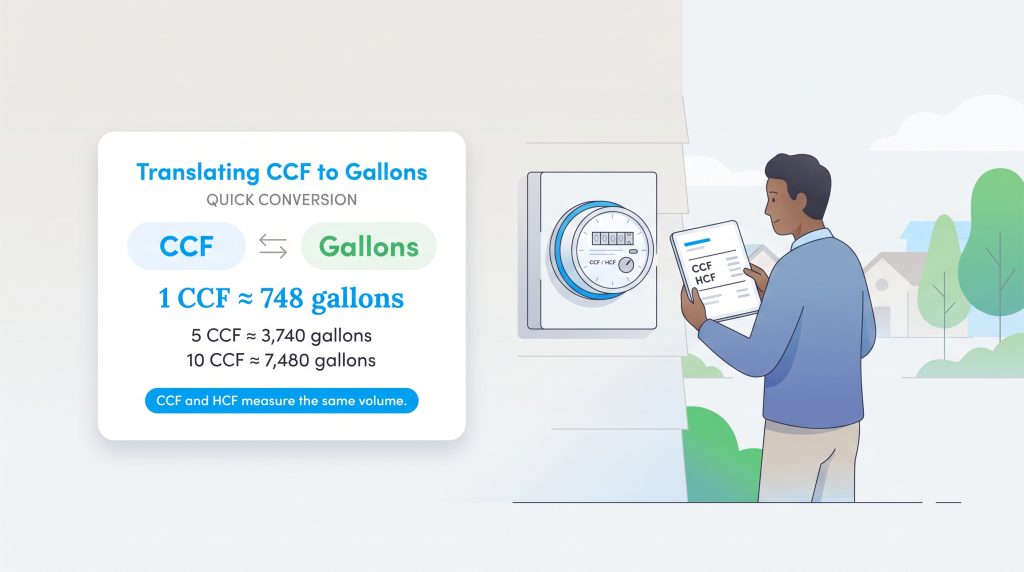
Navigating the nuances of understanding water bills often comes down to learning a new vocabulary. Most residential meters measure volume in cubic feet, but people usually think about water in gallons. Imagine a box that is one foot long, one foot wide, and one foot tall — that holds about 7.48 gallons. To make billing simpler, utility companies group these into blocks of 100. When you wonder how many gallons in a CCF, the math is straightforward because one Centum Cubic Foot equals about 748 gallons, or more precisely about 748.05 gallons. Bridging the gap between CCF vs HCF water is even easier since they represent the exact same thing; one uses the Roman numeral “C” for 100, while the other simply stands for Hundred Cubic Feet. Once you can translate these units, managing your home water utilities becomes a much clearer process. For more context on why providers use these specific administrative units, reviewing the EPA’s guide on water bills provides excellent background information.
📌 Quick Fact: The abbreviations CCF and HCF mean the exact same thing on your utility statement, representing 100 cubic feet of volume.
| CCF (Centum Cubic Feet) | Gallons |
|---|---|
| 1 CCF | About 748 gallons |
| 5 CCF | About 3,740 gallons |
| 10 CCF | About 7,480 gallons |
How Is Residential Water Measured?
To understand how residential water is measured, start right where your community’s main supply line meets your private plumbing. As water flows from the municipal pipe into your house, it passes through a meter that tracks how much water passes through to record the exact volume. Every time a specific amount of water pushes through that internal mechanism, the dial advances its count. While your physical hardware captures this raw volume as it happens, your paper statement translates that data into billing units. Grasping this connection is the foundational step toward understanding water utility rates, as it proves that your charges are usually based on metered flow, though some providers may estimate temporarily.
How to Read a Water Meter at Your Home
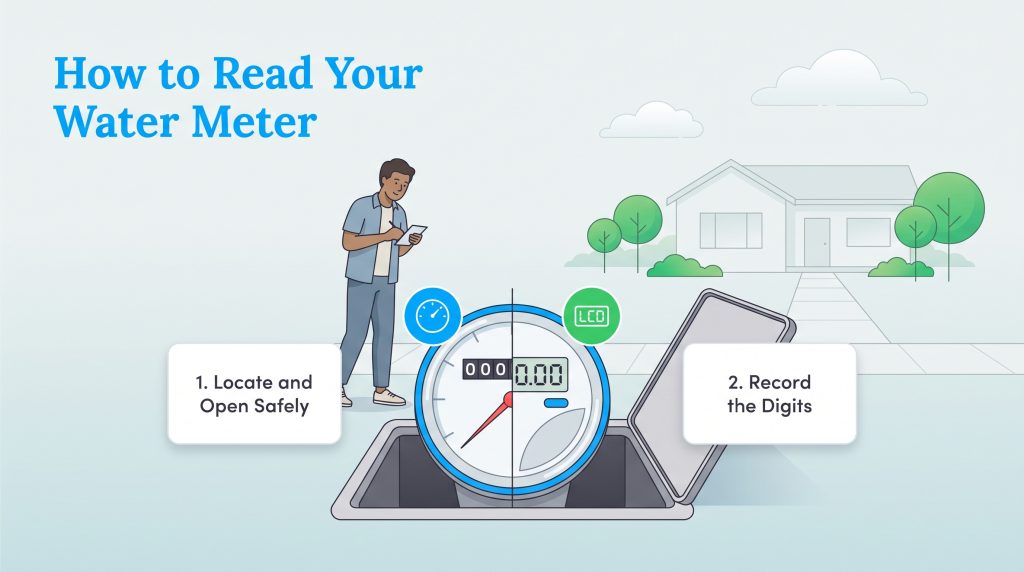
Learning exactly how to read a water meter puts you firmly in control of your household utility expenses. Finding and accessing this equipment can feel a bit intimidating initially, but the process is highly straightforward once you know what to look for. While utility workers perform this task quickly on their monthly routes, taking your time ensures accuracy and builds your confidence as a resident. Before opening a meter box, check your utility’s rules. In some areas, the meter and lid are utility-owned equipment, and customers are asked not to tamper with them. If the lid is stuck, the box is flooded, or you see exposed wiring, call your water provider instead of forcing it open. Follow these simple steps to safely capture your current reading.
- Locate the meter box: Start by looking near your front curb, along the sidewalk, or occasionally in the basement if you live in a colder climate. The cover is usually a heavy iron or concrete lid marked “Water.”
- Open the lid safely: Slip on a sturdy pair of work gloves to protect your hands. Use a screwdriver or a specialized utility key to pry the heavy lid open. Always watch out for bugs, spiders, or small frogs that love to hide in these dark, damp spaces.
- Flip up the protective cover: Most hardware features a small plastic or metal cap over the actual glass face to prevent scratching. Lift it up to reveal the data.
- Record the digits: Record the main odometer-style numbers from left to right. Some meters show fixed zeros, red digits, or decimal places that represent smaller fractions of a billing unit, so compare your reading format with the example on your utility bill if available.
Analog Dials vs Digital Displays
As you look beneath that protective cap, you will encounter either a traditional mechanical device or a modern electronic screen. Older analog dials feature spinning sweep hands and physical tumbling numbers that roll forward as water passes through the pipe. Modern digital displays, often relying on ultrasonic technology, offer an LCD screen that requires light to activate — some LCD screens activate with a button, while others require you to flash your smartphone beam across the solar panel to wake it up. If you are focused on eco-conscious sustainable living, smart water monitors can also help you track usage in real time. Some, such as Flume-style devices, attach near the meter, while inline systems, such as Moen Flo-style shutoff devices, are installed on your main water line. Always confirm compatibility with your utility-owned meter before installing anything near it.
Using Your Water Meter to Find Hidden Leaks
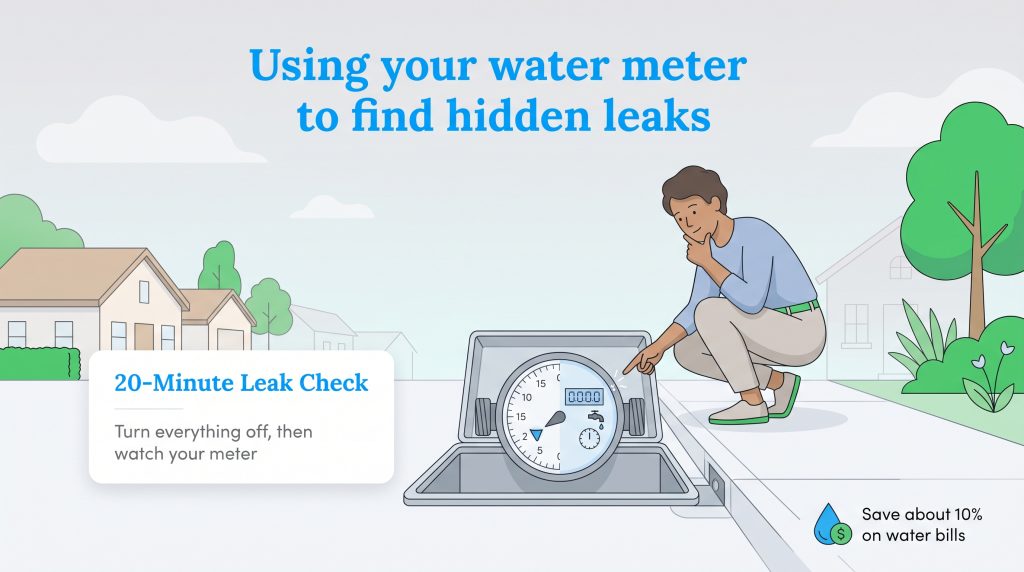
Unnoticed drips can silently drain your wallet, but your meter can also help you find hidden leaks. We highly recommend running a simple diagnostic test twice a year to ensure your pipes are completely secure. First, turn off every faucet, shower, and water-using appliance inside and outside your house. Head out to the street and check your equipment’s low-flow leak indicator. On an analog device, this is usually a small red or black triangle or star wheel that spins when even a tiny amount of water moves. On a digital screen, look for a leak indicator, which may be a faucet icon, alert code, or flow symbol. If the indicator is completely still, wait about 20 minutes without flushing a toilet or running a tap, then check the main numbers again. If the digits have increased, you have an active leak somewhere on your property. A 20-minute test can reveal many active leaks, especially running toilets or irrigation problems. For very slow leaks, repeat the test over one to two hours when no one needs water. For further guidance on tracking down the culprit, check out the EPA’s Fix a Leak Week resources.
💸 Money-Saver: Fixing easily corrected household plumbing leaks can save the average family about 10% on their monthly utility bills.
Understanding Water Bills and Common Rate Structures
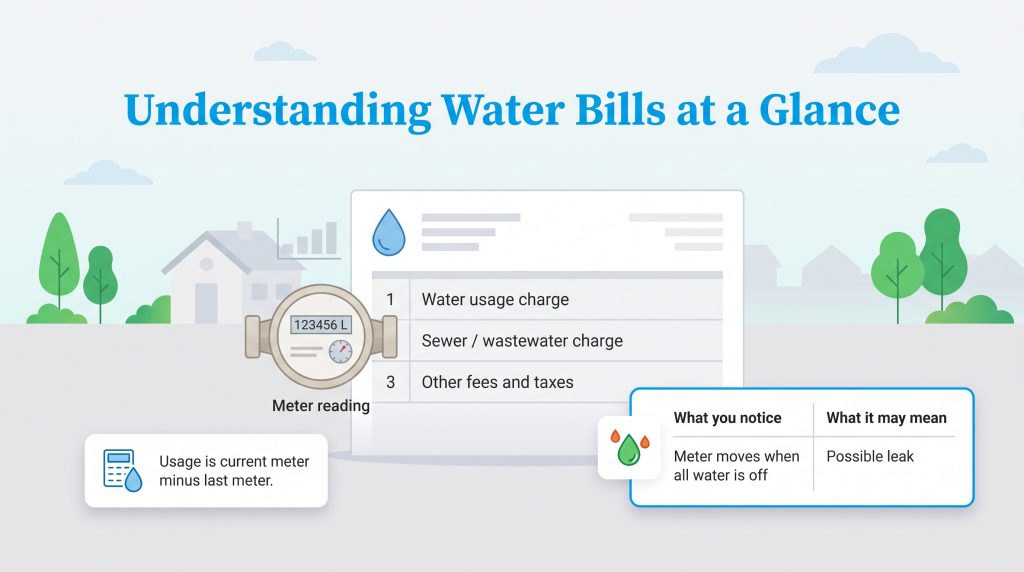
To estimate your water bill, start with your provider’s pricing model. When setting up your new home utilities, you will likely encounter one of two primary rate structures. Uniform rates charge a flat, consistent price for every single CCF or gallon you consume, regardless of the total volume. In contrast, tiered rates — also known as increasing block structures — reward conservation by charging a lower price for your initial, essential usage. Once you cross a specific threshold, the cost per unit increases significantly. Your provider determines your total volume by simply subtracting last month’s meter reading from the current month’s reading.
For example, if last month’s reading was 120 CCF and this month’s reading is 126 CCF, you used 6 CCF. Since 6 CCF equals about 4,488 gallons, you would multiply 6 by your provider’s rate per CCF, then add fixed service, sewer, stormwater, or local fees. Your bill may also include wastewater or sewer charges. Some utilities base sewer charges on the same water usage reading, while others use winter averaging or a separate fixed fee.
When you review your statement, you will likely see a few standard line items. Most providers list your previous reading, current reading, total usage, water service charge, sewer or wastewater charge, and occasionally stormwater fees or local taxes. Familiarizing yourself with these terms helps you spot billing errors quickly.
When to Call Your Water Provider or a Plumber
Sometimes, a high bill or strange meter reading requires outside help. Call your utility if the meter box is damaged, flooded, inaccessible, or if your bill seems based on an incorrect reading. Call a plumber if the meter moves while all water is off and you cannot identify the fixture causing the leak. It is also wise to check whether your provider offers leak adjustment credits once the repair is complete.
| What You Notice | What It May Mean | What to Do Next |
|---|---|---|
| Meter moves when all water is off | Possible leak | Check toilets, irrigation, hose bibs, and appliances |
| Bill says “estimated” | Utility did not get an actual read | Compare your meter to the next bill |
| Usage spikes in summer | Irrigation or outdoor use | Adjust sprinkler schedule and check for broken heads |
| Usage rises every month | Slow leak or habit change | Run a longer meter test |
Eco-Conscious Tips to Reduce Average Home Water Usage
According to the EPA’s data on water usage, the average American uses about 82 gallons of water a day at home. When multiplied by an entire family, your average home water usage per month can quickly climb into the thousands of gallons. Fortunately, you don’t need to overhaul your routine to use less water. Implementing a few smart, environmentally mindful choices can significantly reduce your environmental footprint.
- Upgrade older showerheads and bathroom faucets to highly efficient WaterSense labeled fixtures.
- Adjust your landscaping irrigation schedules to run during the early morning hours, which prevents excessive evaporation.
- Only run your dishwasher and washing machine when you have completely full loads.
- Place a bucket in your shower to catch the cold flow while you wait for the temperature to heat up, then use it to water your indoor plants.
🌱 Eco Edge: Installing ENERGY STAR certified appliances is an incredibly effective energy-saving option that reduces both your electricity and water consumption simultaneously.
Taking Control of Your Monthly Water Expenses
Mastering your utility metrics transforms a frustrating monthly expense into a manageable, predictable part of your household budget. When you understand the relationship between the physical dial in your yard and the printed charges on your statement, you are no longer at the mercy of sudden rate hikes or hidden plumbing disasters. We encourage you to step outside, pry open that heavy iron lid, and take an active role in tracking your consumption. Monitoring your usage proactively protects both your wallet and our vital natural resources.
Frequently Asked Questions About Understanding Water Measurements
These quick answers cover the most common questions homeowners and renters have when they compare meter readings, billing units, and monthly water charges.
Why is my water bill measured in CCF instead of gallons?
How can I tell if my water meter is analog or digital?
What is the normal average home water usage per month?
Can a running toilet cause a noticeable spike on my water meter?
How often do water utility companies actually read the meter?
Why does my water bill include sewer charges?
Can my water company estimate my meter reading?
About the Author

LaLeesha has a Masters degree in English and enjoys writing whenever she has the chance. She is passionate about gardening, reducing her carbon footprint, and protecting the environment. She also recently served as President of the Board for City Sprouts (a community garden).

Claudio is a sustainability-focused writer with a background in Anthropology and Psychology from NC State University. He has spent over 15 years working in writing, interpretation, and translation, driven by a deep interest in how human culture shapes the environment. Today, he shares his curiosity with readers by writing about sustainable living solutions and the connection between everyday choices and environmental impact.