

Transitioning to a private well gives you full control over your home’s water supply, provided you follow a consistent testing and maintenance schedule.
Key Takeaways
- Private well owners take full responsibility for testing, treating, and maintaining their own drinking water systems.
- Annual testing for bacteria and nitrates is essential to help ensure your groundwater remains safe for your family to drink.
- A proactive seasonal maintenance schedule prevents costly repairs, improves water quality, and extends the lifespan of your well pump.
Trading municipal utility bills for the independence of a private well is an exciting milestone, but it also shifts the responsibility of clean drinking water squarely onto your shoulders. As you settle in after moving, you’ll quickly discover that navigating well water requires a slightly different approach than simply turning on the tap and trusting the city. We put together this practical checklist to help you confidently budget, test, and maintain your new water utility from day one.
What to Check Before Buying a House With Well Water
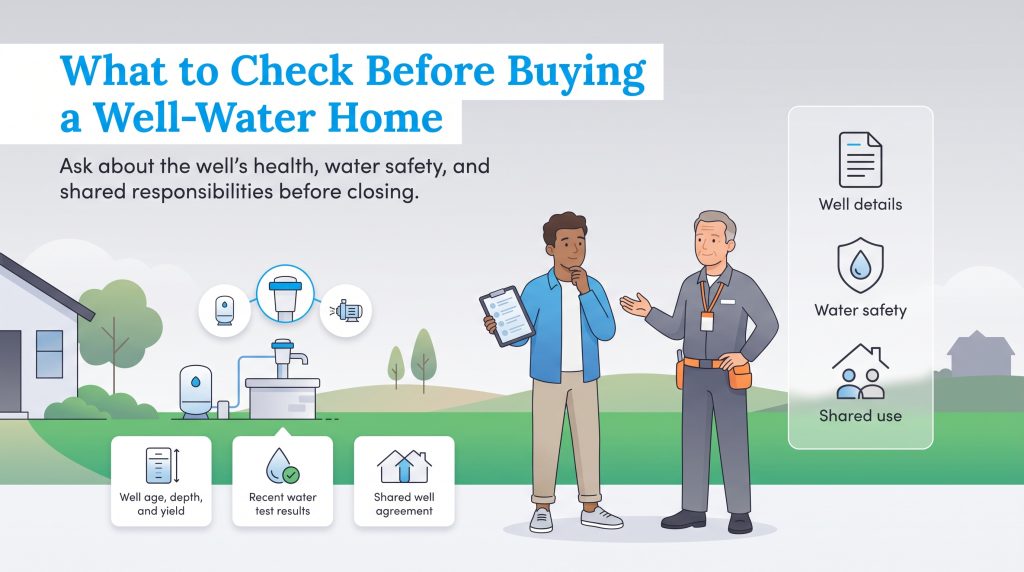
Before you finalize your home purchase, taking time to evaluate the existing well system can save you from unexpected replacement costs. Performing your due diligence gives you a clear picture of the equipment’s health and helps ensure the water is safe for everyday use.
Consider asking the seller for the well log or completion report, which details the well’s age, depth, yield, and recovery rate. You should also confirm whether the system is private or shared, as a shared well agreement involves specific legal and maintenance responsibilities. Be sure to check the distance between the well and potential contamination sources like the septic system, fuel tanks, or livestock areas. Finally, confirm if your lender, insurer, county, or state requires specific water testing before closing.
| What to Review | Why It Matters | Who to Ask |
|---|---|---|
| Well age, depth, and yield | Helps estimate reliability and future repair risk | Seller, county, well contractor |
| Recent water test results | Shows whether treatment is needed | Seller, certified lab |
| Well inspection report | Identifies pump, casing, cap, and pressure tank issues | Licensed well contractor |
| Distance from septic system | Reduces contamination risk | Inspector, county records |
| Shared well agreement | Clarifies legal and maintenance responsibilities | Seller, real estate agent, attorney |
Well Water vs. City Water: What New Homeowners Need to Know
When transitioning to a new residential water supply, understanding the core differences between well water vs. city water will immediately change how you manage your home. Municipal water is regulated under federal drinking water standards and administered through state and local systems, treated with chemicals like chlorine to eliminate bacteria, and pushed to your faucets using city-maintained pressure systems. You pay a monthly bill for this convenience, and the local government handles all the heavy lifting behind the scenes. On the flip side, drawing from a private well puts you fully in charge. Your household taps directly into a natural underground aquifer, meaning no municipal water supply bills and no chemical additives unless you choose to install them. However, while you save on a monthly city water bill, you’ll still pay for electricity to run the pump, along with testing, maintenance, and treatment costs. Since private wells operate outside the jurisdiction of federal regulators, you step into the role of the water utility manager. It’s up to you to monitor water quality, service the equipment, and ensure the system operates safely year-round.
Taking on this role might sound intimidating at first, but it primarily boils down to staying observant and setting up a predictable routine. Without a municipal safety net, you act as the first line of defense against potential contamination. You also manage the physical hardware that makes your water flow, which adds a unique layer to your household maintenance checklist.
How Your Well Water System Works
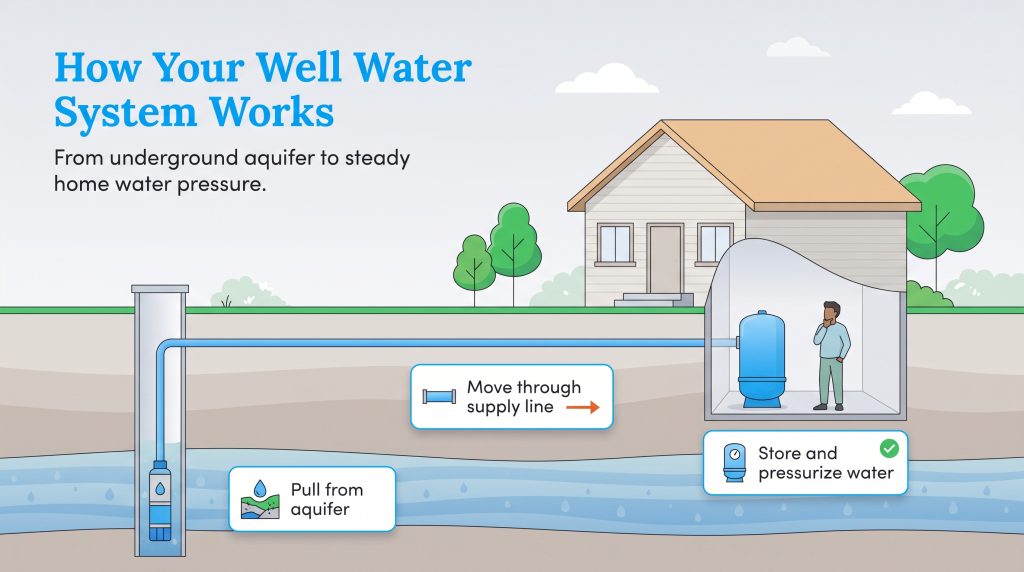
Buying a house with well water means inheriting a surprisingly straightforward mechanical system designed to pull groundwater straight into your plumbing. Deep beneath your property sits an aquifer, which is essentially a natural underground layer of water-bearing rock or gravel. In many modern drilled wells, a submersible well pump sits deep inside a drilled casing, pushing this groundwater up a pipe and into your home. Once inside, the water travels into a pressurized storage tank. This pressure tank is the unsung hero of your utility setup. It holds a reserve of water under compressed air, providing the immediate blast of pressure you feel when you turn on the shower. As you use water, the tank’s pressure slowly drops until it hits a specific threshold, triggering the well pump to kick on and refill the reserve. Understanding this simple cycle of pulling, storing, and pressurizing helps you pinpoint where things might be going wrong if your faucets ever start sputtering.
How to Test Well Water
Because local municipalities and federal agencies do not monitor private drinking water supplies, consistent testing remains the most definitive way to know what is flowing out of your faucets. You can’t always taste, smell, or see harmful contaminants like coliform bacteria, arsenic, or high nitrate levels. If you’re wondering if well water is safe to drink, the answer is usually yes — provided you take the initiative to verify its purity.
Figuring out exactly how to test well water usually involves a few strategic steps to ensure accuracy. When you conduct your initial assessment, follow these straightforward guidelines:
- Source a state-certified laboratory: Avoid relying solely on unverified third-party companies that might use test results as a sales pitch for expensive equipment. Start with the EPA’s private well guidance, then contact your state health department or certification program to find a certified drinking water laboratory near you.
- Collect a pristine water sample: Follow the lab’s instructions meticulously. Usually, this involves removing the aerator from your kitchen sink, running the cold water for a few minutes, and filling a sterile container without letting the rim touch anything that could introduce outside bacteria.
- Submit and review the data: Deliver the sample to the lab within the strict timeframe required — often within 24 hours. Once the results arrive, compare your levels against established health standards to identify any necessary treatments.
Embracing this process empowers you to protect your family’s health proactively. While dealing with water testing might feel like a chore during a stressful move, it ultimately gives you solid peace of mind and complete authority over the safety of your home.
Choosing a Well Water Test Kit
When shopping around for a well water test kit, you’ll generally encounter two primary options: comprehensive mail-in laboratory kits and basic DIY at-home test strips. At-home strips offer great convenience and rapid results, making them a decent choice for a quick mid-year spot check on basic metrics like pH or water hardness. However, their color-matching system leaves significant room for human error and lacks the sensitivity to detect dangerous trace contaminants like arsenic or lead.
For new homebuyers conducting their initial property inspections, we strongly recommend utilizing a certified mail-in laboratory kit. These comprehensive packages require you to ship a sample directly to a professional facility where scientists run rigorous diagnostics. While you might wait a week or two for the official findings, the resulting data is highly accurate and provides a definitive, trustworthy baseline for your new property.
Common Well Water Problems and Solutions
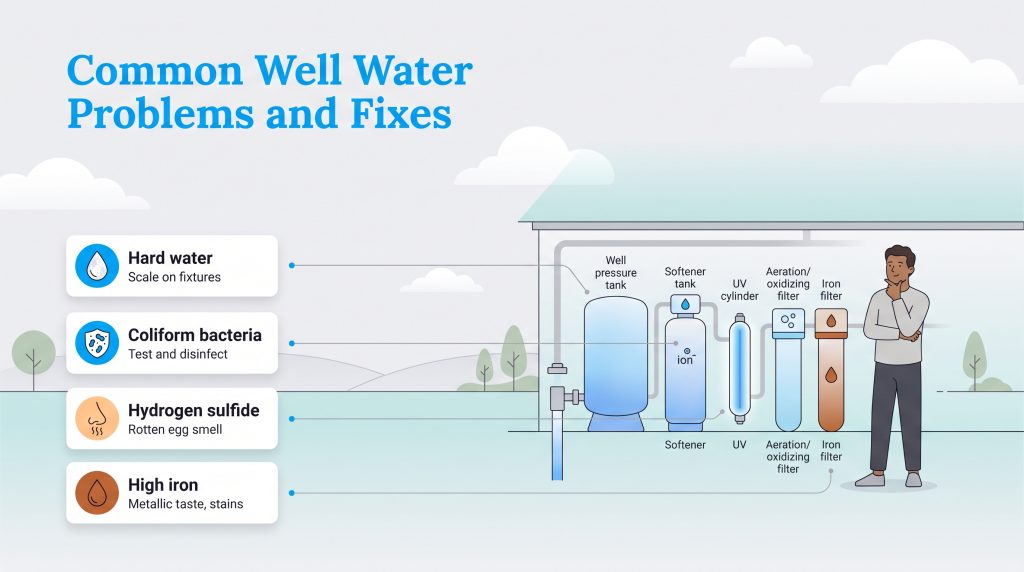
Even robust, well-maintained systems occasionally experience hiccups. Groundwater naturally interacts with rocks, soil, and organic matter, which means the composition of your utility supply can fluctuate over time. Anticipating common well water problems helps you diagnose quirky smells or strange fixture stains before they evolve into expensive plumbing disasters. Most localized issues fall into a few recognizable categories, ranging from harmless cosmetic annoyances to serious health hazards that require immediate mitigation.
Whenever you notice a sudden shift in how your tap water looks, tastes, or behaves, treat it as an early warning sign. While some homeowners quickly adapt to minor inconveniences like mild hard water, leaving severe imbalances unchecked can severely damage your pipes and water heater. We put together a quick reference guide below to help you match your symptoms with standard industry fixes.
| Common Problem | Warning Sign | Typical Solution |
|---|---|---|
| Hard Water (Calcium & Magnesium) | Stubborn white scale buildup on showerheads, faucets, and glassware. | Install a dedicated ion-exchange water softener. |
| Coliform Bacteria | Can signal that harmful organisms may be entering the water. | Perform a professional shock chlorination or install a UV purifier. |
| Hydrogen Sulfide Gas | A distinct, overwhelming rotten egg odor when you turn on the tap. | Utilize an aeration system or a specialized oxidizing filter. |
| High Iron Content | Metallic taste and aggressive rust-colored stains in sinks and toilets. | Add an iron filtration unit or a water softener for trace amounts. |
By familiarizing yourself with these symptoms early on, you help ensure that your home’s infrastructure stays protected.
Whole-House Well Water Filtration Options
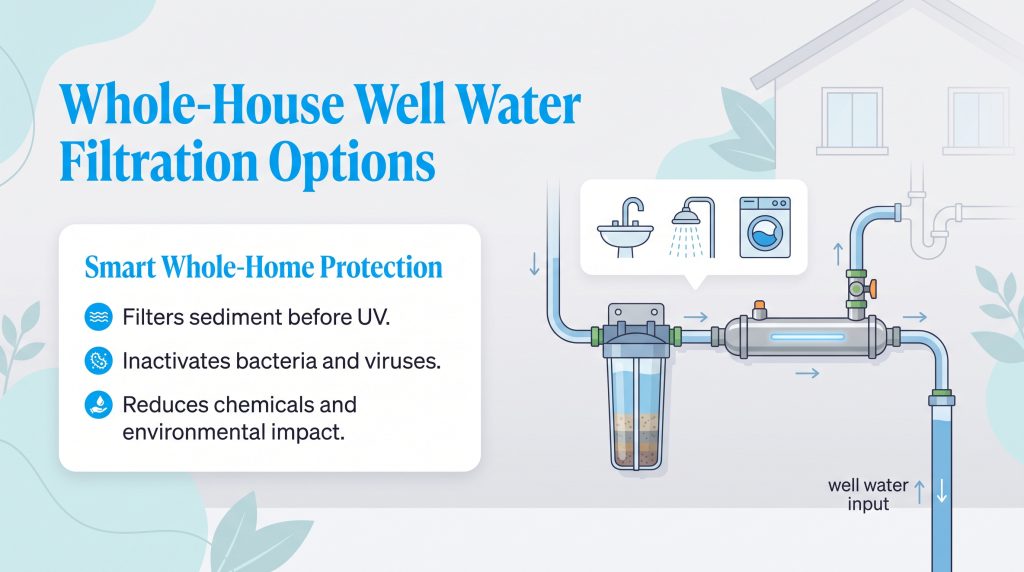
If your lab results reveal persistently high levels of contaminants, investing in a whole house well water filtration system serves as the most effective line of defense. Unlike a small kitchen pitcher filter that only purifies your drinking water, a whole-house setup intercepts the supply typically after the pressure tank and before water reaches your household plumbing, ensuring every single faucet, showerhead, and appliance in the home receives cleanly treated water.
Modern purification technology offers several excellent eco-conscious alternatives to relying on heavy, continuous chemical treatments. For instance, pairing a mechanical sediment filter with an ultraviolet (UV) light purifier is a great energy-saving option that successfully inactivates harmful bacteria and viruses without dumping harsh chlorine into your plumbing or the surrounding watershed. However, UV systems work best after sediment filtration and do not remove dissolved contaminants like heavy metals or nitrates. When you’re actively exploring environmentally mindful choices for your property’s upkeep, a carefully calibrated UV system provides exceptional, round-the-clock protection while actively minimizing your overall ecological footprint. Ultimately, customizing your filtration rig to target your specific well’s water profile prevents excessive equipment wear and provides a much better daily experience.
Budgeting for Well Water Costs
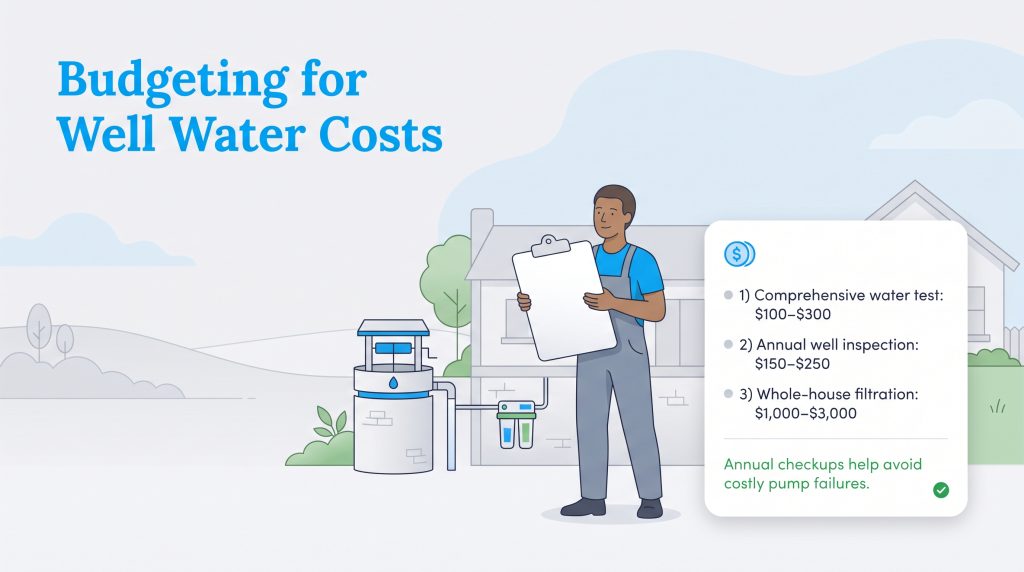
Transitioning to a private water supply eliminates your monthly municipal utility bill, but it doesn’t mean your water is entirely free. As a responsible owner, you must set aside a dedicated budget to keep the mechanical and filtration components running smoothly. Keep in mind that all costs fluctuate depending on your region, well depth, hardware complexity, and local labor rates. The typical estimates below can help you plan:
| Service or Equipment | Typical Estimated Cost Range | What It Includes |
|---|---|---|
| Comprehensive Laboratory Water Test | $100 — $300 | Analysis for heavy metals, bacteria, and nitrates. |
| Routine Annual Well Inspection | $150 — $250 | Checking the pump’s amperage, casing, and pressure tank performance by a certified professional. |
| Whole-House Filtration System | $1,000 — $3,000 | Upfront hardware and installation to treat the property’s water supply. |
By proactively planning for these expected expenses, you avoid the sting of surprise plumbing bills and keep your household budget perfectly balanced.
Annual Well Water Maintenance Schedule
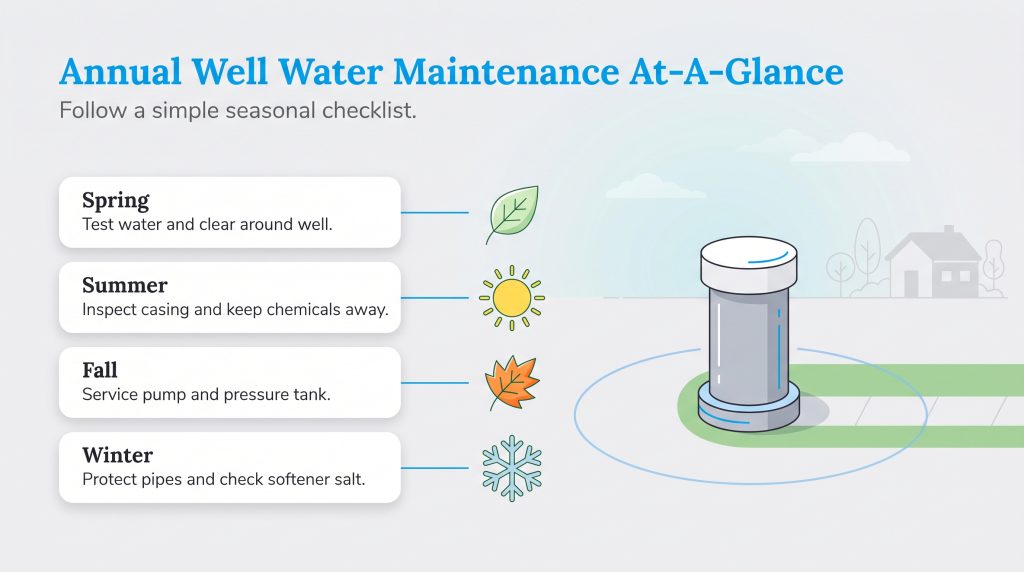
Maintaining your groundwater supply doesn’t require a daily time commitment, but ignoring the equipment for years will inevitably lead to failure. Establishing a consistent well water maintenance schedule helps ensure that you catch minor vulnerabilities before they threaten your health or wallet. By breaking these tasks down into a seasonal rhythm, the upkeep feels much more manageable.
Review the annual well maintenance recommendations from the CDC, and use this straightforward seasonal checklist to stay on track:
- Spring: Schedule your annual bacterial and nitrate laboratory test to ensure melting snow and heavy spring rains have not introduced surface contaminants into your aquifer. Clear away any overgrown weeds, deep-rooted brush, or debris within a 10-foot radius of the wellhead.
- Summer: Visually inspect the physical well casing above ground for unexpected cracks, severe rust, or missing cap bolts. Strictly enforce a sanitary zone around the casing — keep fertilizers, pesticides, and motor oil at least 100 feet away from your wellhead to prevent chemical runoff from leaching into your drinking water.
- Fall: Call in a licensed contractor to perform a routine mechanical inspection on the submersible pump and the indoor pressure tank. Verify that the pressure gauge reads accurately and the system isn’t constantly cycling on and off.
- Winter: If your pressure tank or filtration equipment is located in an unheated garage or basement, insulate the surrounding pipes to prevent devastating freeze-outs. Check the salt levels in your water softener monthly, as household usage tends to increase when everyone stays indoors.
Staying disciplined with this framework protects your investment and ensures quality water all year.
Enjoying Safe, Reliable Water in Your New Home
Taking ownership of your household water supply is incredibly rewarding when you approach it with the right mindset. While stepping away from the convenience of a municipal grid introduces a new set of chores, the long-term benefits easily outweigh the learning curve. By adhering to a diligent maintenance routine, you secure an independent utility free from sudden city infrastructure rate hikes. As you settle into your new home, remember that managing a private well doesn’t have to be daunting. Simply stick to your seasonal checklist and test your water annually, and your well will continue providing a reliable, refreshing resource for your entire family.
Frequently Asked Questions About Well Water
If you’re still getting accustomed to private well ownership, it’s completely normal to have questions about day-to-day management. Here are a few common questions that new homeowners ask about keeping their well systems safe and fully operational.
Is It Safe to Drink Well Water Without a Filter?
How Often Should You Test Your Well Water?
What Happens to a Well When the Power Goes Out?
Do You Pay a Monthly Water Bill With a Private Well?
Does Well Water Increase the Value of a Home?
About the Author

LaLeesha has a Masters degree in English and enjoys writing whenever she has the chance. She is passionate about gardening, reducing her carbon footprint, and protecting the environment. She also recently served as President of the Board for City Sprouts (a community garden).

David has been an integral part of some of the biggest utility sites on the internet, including InMyArea.com, HighSpeedInternet.com, BroadbandNow.com, and U.S. News. He brings over 15 years of experience writing about, compiling and analyzing utility data.