

Protecting Your Household From Microscopic Contaminants Starts With Choosing The Right Water Filtration System
Key Takeaways
- Microplastics have been detected in drinking water systems around the world, though their exact long-term health impacts are still being actively researched, and concentrations vary widely by source, location, and testing method.
- Reverse osmosis (RO) systems are one of the most effective household options for reducing both microplastics and nanoplastics in your home’s tap water.
- Testing water for microplastics at home isn’t practical yet, making proactive filtration your best, most eco-conscious line of defense.
Millions of tonnes of plastic waste pollute our environment every year, and this global crisis has finally reached the most intimate part of our homes: the kitchen sink. While turning on the faucet in your new residence should bring a sense of comfort and hydration, the hidden reality of microplastics water contamination has many homeowners rethinking what flows from their taps. Finding out your local utility might be delivering microscopic bits of plastic alongside your morning coffee can certainly feel unsettling, but you do not need to panic. The definitive solution to protecting your family lies in upgrading your home utilities; installing a high-quality, point-of-use water filtration system is the most effective way to eliminate these contaminants and secure clean, safe drinking water.
What Are Microplastics And How Do They Contaminate Our Water?
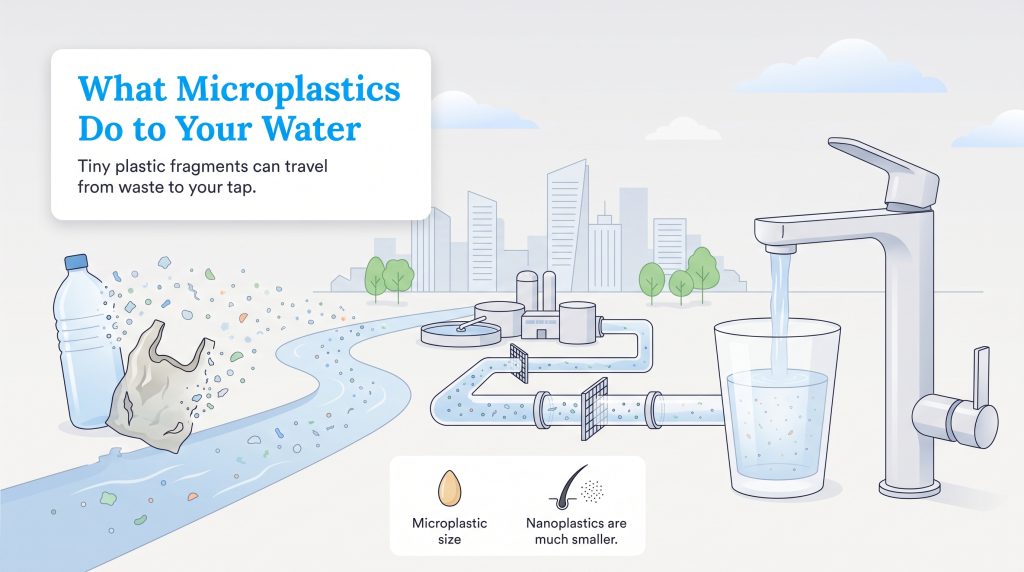
To grasp the scale of the issue, picture a standard pencil eraser. Microplastics encompass any plastic fragment smaller than that — typically measuring less than five millimeters across. While this sounds straightforward, these fragments originate from vastly different sources before infiltrating your household water supply. Scientists generally categorize these contaminants into two distinct groups:
- Primary Microplastics: These are intentionally manufactured at a minuscule size for commercial use. Examples include the exfoliating microbeads once common in face washes, cosmetics, and industrial abrasive scrubbers.
- Secondary Microplastics: The vast majority of microplastics in household water supply systems come from larger plastic items breaking down over time. Think about the synthetic fibers shed from your fleece jacket in the washing machine or the steady degradation of tires leaving rubber particles on the highway.
📌 Quick Fact: The United Nations Environment Programme estimates that roughly 19 to 23 million tons of plastic waste enter aquatic ecosystems every single year, fueling the steady increase of microplastics in municipal water supply networks.
The Journey From Plastic Waste To Your Faucet
Sun, wind, and friction slowly grind discarded materials down until they resemble fine grains of synthetic sand. Once these particles become airborne or wash down local storm drains, they inevitably make their way into rivers, lakes, and underground aquifers. From there, they infiltrate the exact sources cities rely on to source your drinking water.
Water treatment plants capture a tremendous amount of physical debris, but microplastics are notoriously tricky to catch entirely. Because of their incredibly small size, buoyancy, and varied shapes, a fraction of them slip right through municipal filtration screens and eventually cycle straight into the pipes feeding your neighborhood. If you are evaluating home water filtration systems for the first time, learning about this journey highlights why relying solely on city treatment might not meet your personal water quality standards.
What Are Nanoplastics Vs. Microplastics?
If you are comparing nanoplastics vs. microplastics, the main difference is size, but the difference in scale is staggering. While a microplastic can be as large as a sesame seed, a nanoplastic is unimaginably tiny — measuring less than one micrometer in diameter. To put that into perspective, you would need to stack dozens of nanoplastics together just to match the width of a single human hair.
Because they are so microscopic, nanoplastics behave entirely differently in the environment and inside the human body compared to their slightly larger counterparts. They can bypass standard physical barriers far more easily, making them a unique challenge for both environmental scientists and residential water filtration engineers. Understanding this difference is crucial when selecting a home filter, as a system built only for larger debris will let these tiny particles slip right past.
The Health Effects Of Microplastics In Drinking Water
It is entirely natural to feel concerned when you hear about plastic floating in your water glass. We want to address consumer fears directly, without leaning into sensationalism. When assessing the health effects of microplastics in water, the current scientific consensus is still evolving, but modern studies reveal that humans may unknowingly ingest tens of thousands of these particles annually through drinking water alone.
Leading global health authorities currently treat this issue with serious caution. The World Health Organization’s report on microplastics in drinking water found that available evidence does not show a clear, acute human health crisis at commonly reported levels. However, the medical community is actively investigating whether prolonged exposure over decades could trigger chronic inflammation, endocrine disruption, oxidative stress, or other subtle cellular damage as particles accumulate in human tissues.
Beyond the physical particles themselves, scientists are increasingly alarmed by the chemical baggage these plastics carry. Microplastics often act as microscopic sponges, absorbing heavy metals and dangerous “forever chemicals.” The intersection of PFAs and microplastics means that when you ingest a plastic fragment, you might also be ingesting the toxic industrial chemicals bound tightly to its surface.
🚩 Heads Up: While research is ongoing, remember that local water municipalities heavily treat and sanitize your water, successfully capturing the vast majority of larger, immediate threats before a single drop reaches your faucet.
Bottled Water Vs. Tap Water: Which Is Safer?
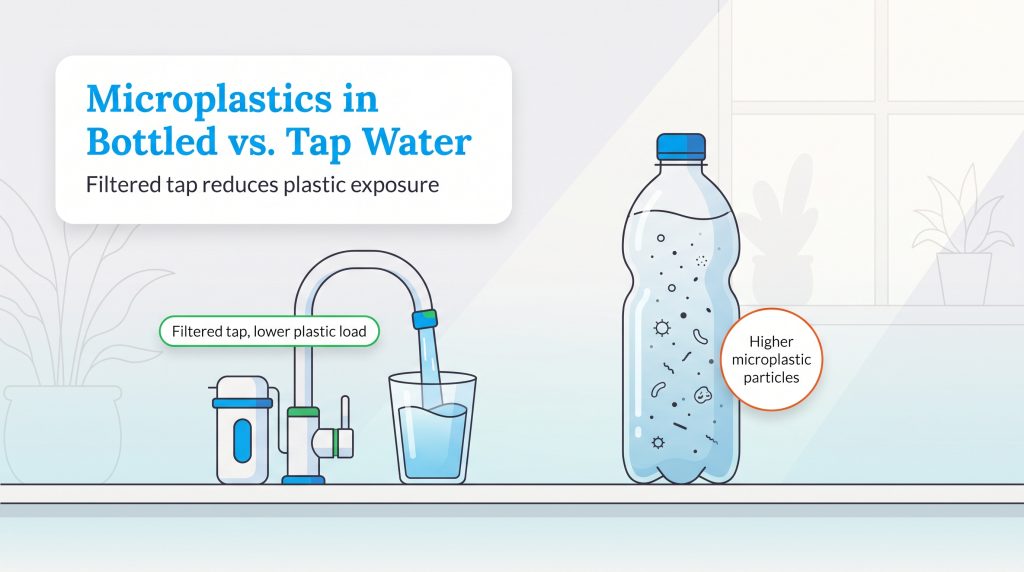
When utility concerns arise, many people instinctively grab a plastic case from the grocery store, assuming it represents the safest, cleanest option for their family. Unfortunately, science paints a very different picture when comparing bottled water vs. tap water microplastics. Recent breakthrough studies, including data from Columbia University, have detected astronomical levels of plastic in commercial bottled water — averaging hundreds of thousands of nanoplastic fragments per liter.
The issue is not just the source water; it is the packaging itself. The PET plastic bottle and its cap actively shed secondary microplastics directly into the liquid you eventually drink, especially when the bottle is exposed to heat, UV light, or repeated handling during shipping.
Swapping municipal tap water for single-use bottles creates a deeply counterproductive loop. You ingest significantly more plastic while simultaneously funding an industry that actively contributes to global plastic pollution. Adopting environmentally mindful choices means trusting and improving your home utilities rather than abandoning them. We can state unequivocally that filtering your municipal tap water at home is the safer, more eco-conscious, and much more cost-effective choice in the long run.
🌱 Eco Edge: Installing a reliable home filter is an environmentally mindful choice that severely reduces single-use plastic pollution while also saving your household hundreds of dollars a year on bottled water purchases.
How To Remove Microplastics From Tap Water
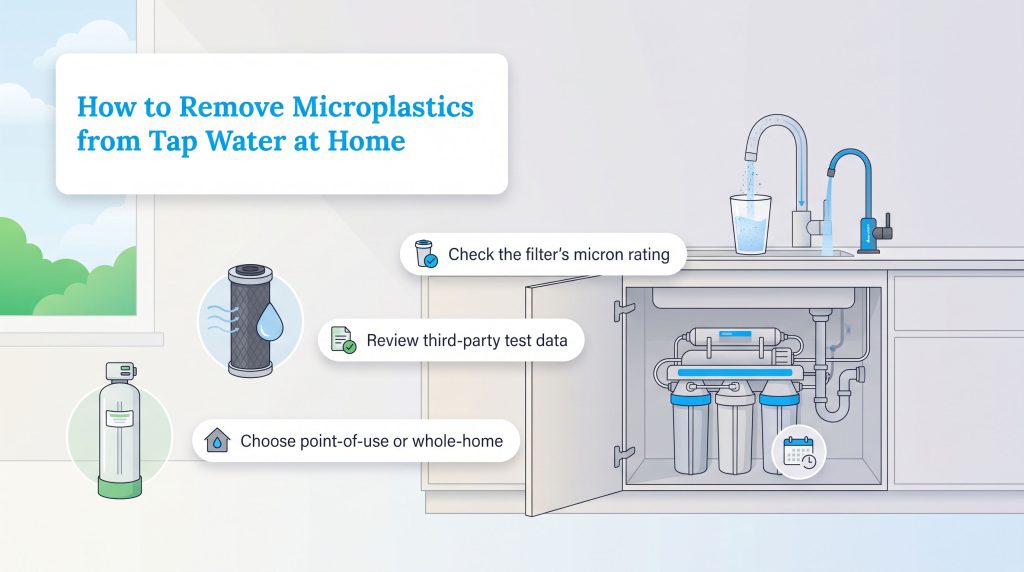
Even though city utilities do the heavy lifting to clean our water, taking matters into your own hands offers an essential layer of protection. Upgrading your home’s utility setup with a dedicated filtration system serves as your final, most reliable barrier. If you are researching how to remove microplastics from tap water, you will find that not all filters are created equal. The key is identifying technologies capable of trapping particles down to the micrometer or nanometer level.
Investing in the right hardware does not just improve your water quality — it protects your family while aligning with eco-conscious living. By filtering what flows directly into your sink, you completely bypass the need for wasteful, single-use alternatives. When determining whether water filters remove microplastics effectively, we highly recommend following a quick buyer’s checklist:
- Check the filter’s absolute micron rating (aim for 0.5 microns or smaller).
- Review third-party certification or manufacturer test data.
- Confirm replacement filter cost and schedule.
- Decide whether you need point-of-use filtration or whole-home filtration.
Reverse Osmosis (RO) Systems
If you are asking, do reverse osmosis filters remove microplastics, the answer is a resounding yes. A reverse osmosis (RO) system works by forcing pressurized tap water through a specialized, semi-permeable membrane. Because these membranes have microscopic pores rated around 0.0001 microns, they act as an impenetrable wall for physical plastic fragments. A properly maintained RO system can significantly reduce both microplastics and nanoplastics in drinking water, alongside dissolved solids, heavy metals, and some PFAS.
RO systems typically install neatly right under your kitchen sink, making them a fantastic, permanent utility upgrade for any homeowner prioritizing water quality. Keep in mind that RO systems do produce a small amount of wastewater during the purification process, so look for modern, high-efficiency models with lower waste ratios if sustainability is a major priority for your household.
💡 Pro Tip: A clogged or overdue membrane can reduce your system’s performance and water pressure, so set a calendar reminder for a replacement the day you install the system.
Solid Carbon Block Filters
For those looking for an energy-saving option that does not produce any wastewater, a solid carbon block filter is an excellent choice. Unlike granular activated carbon (the loose black beads found in standard pitcher filters), a solid carbon block is compressed tightly. This dense structure forces water to navigate a maze of microscopic pores, physically trapping larger microplastics before they reach your glass.
To ensure a carbon block filter handles microplastics in drinking water, you must verify its micron rating. You need a block rated at 0.5 microns or smaller. While they may struggle to catch the absolute tiniest nanoplastics that an RO system would catch, high-quality carbon blocks are incredibly effective, affordable, and perfect for renters who want a simple under-sink or countertop installation.
Water Distillers
Water distillation is one of the oldest and most effective purification methods available. A countertop distiller works by boiling your tap water into steam, which then condenses back into a liquid in a separate chamber. Because plastic fragments do not evaporate, they are left behind in the boiling chamber alongside heavy metals and hard minerals.
Distillers guarantee exceptional removal of microplastics and nanoplastics, but they come with trade-offs. The process is remarkably slow — often taking several hours to produce one gallon of clean water — and relies entirely on electricity to heat the element. Additionally, distillation removes beneficial minerals from the water, which can leave it tasting slightly “flat” compared to RO or carbon-filtered water.
Comparison: Best Water Filters For Microplastics
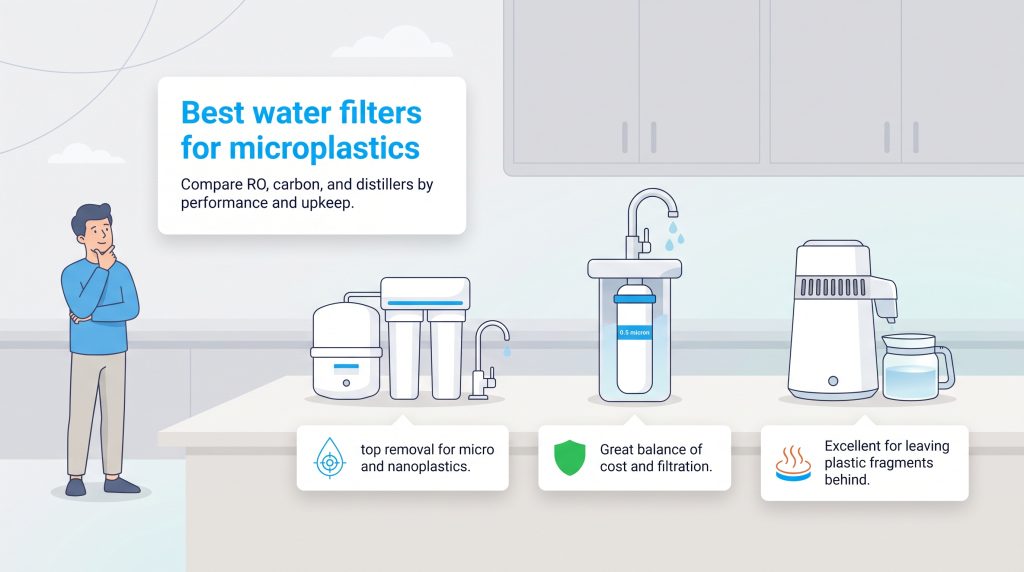
Choosing the best water filter for microplastics depends heavily on your household’s unique needs, budget, and physical space. The comparison table below highlights the performance and requirements of the top three residential filtration methods to help you make an informed decision. Reviewing these differences ensures you select a system that aligns perfectly with your specific clean water goals.
| Feature | Reverse Osmosis (RO) | Solid Carbon Block | Water Distillers |
|---|---|---|---|
| Microplastic Removal Efficacy | Excellent. Removes particles down to 0.0001 microns, capturing both micro and nanoplastics. | Moderate to High. Highly dependent on the absolute micron rating (must be 0.5 or lower). | Excellent. Leaves all physical plastic fragments behind during the evaporation phase. |
| Upfront Cost | $200 – $500+ | $50 – $150 | $100 – $300 |
| Maintenance Requirements | Requires filter and membrane changes every 6 to 12 months. | Requires filter cartridge replacements every 3 to 6 months. | Requires frequent, manual cleaning of the boiling chamber to remove scale buildup. |
| Installation Difficulty | Moderate. Usually requires minor plumbing adjustments under the kitchen sink. | Low to Moderate. Easily attaches to a faucet or swaps into a simple under-sink housing. | Low. Countertop models simply plug directly into a standard electrical outlet. |
Actionable Steps To Reduce Household Plastic Exposure
Combating microplastics water contamination doesn’t stop with a single purchase. To truly safeguard your home’s utility ecosystem and minimize your family’s daily ingestion of plastics, you need a multi-layered approach. Follow these three actionable steps to drastically reduce your household plastic exposure:
- Install a point-of-use (POU) RO filter under the kitchen sink: Because whole-house filters often lack the sub-micron rating required to catch nanoplastics, targeting your main drinking source is the most impactful move. A POU reverse osmosis system ensures the water you cook with and drink daily is aggressively filtered right before it hits your glass.
- Swap degraded plastic plumbing fixtures where feasible: Older polyvinyl chloride (PVC) pipes and aging plastic plumbing components can degrade over time, shedding secondary microplastics directly into your indoor plumbing system. If you are renovating, consider updating degraded lines with more durable, stable materials to limit internal contamination.
- Switch to glass or stainless steel for water storage: Filtering your tap water is pointless if you immediately store it in an old, degrading plastic pitcher or a single-use bottle. Transition your kitchen to reusable glass carafes and stainless steel water bottles. These materials are inert, meaning they will not leach chemicals or shed microscopic fragments into your freshly purified water.
Safeguarding Your Home’s Water Supply
Navigating the emerging complexities of water quality doesn’t have to be an overwhelming chore. While the presence of microscopic plastics in our ecosystems is a genuine modern challenge, you possess the tools to protect your household right now. Before making any major decisions, you can always check your utility’s annual Consumer Confidence Report or rely on forward-thinking state data, like the California State Water Resources Control Board, to better understand regional water trends. However, because DIY home testing kits for microplastics simply do not exist yet, proactive defense is your smartest strategy.
We believe that setting up your home should empower you to live healthier and more sustainably. By upgrading your utility setup with a high-quality RO system, a dense carbon block, or a water distiller today, you immediately transform your tap water from a point of concern into a source of comfort. Choosing a well-matched filter gives you a practical way to eliminate exposure, permanently cut back on costly bottled water, and make your home’s water setup deeply dependable for years to come.
Frequently Asked Questions About Microplastics In Water
Can I test my tap water for microplastics at home?
How small are the microplastics found in household drinking water?
What should I look for when buying a filter for microplastics?
Are microplastics in tap water dangerous?
Is boiling water or using a water softener effective against microplastics?
Are water pitchers like Brita effective against microplastics?
Do standard refrigerator water filters remove microplastics?
Will a whole house water filter remove microplastics?
About the Author

LaLeesha has a Masters degree in English and enjoys writing whenever she has the chance. She is passionate about gardening, reducing her carbon footprint, and protecting the environment. She also recently served as President of the Board for City Sprouts (a community garden).

David has been an integral part of some of the biggest utility sites on the internet, including InMyArea.com, HighSpeedInternet.com, BroadbandNow.com, and U.S. News. He brings over 15 years of experience writing about, compiling and analyzing utility data.