
- Free Xfinity Mobile Line for 1 year
- Free Peacock Premium*
- Free WiFi Equipment for 24 months
- $100 Visa Prepaid Cards for students
Quick Utility Facts
- The electric utility is either PGE or Pacific Power depending on which part of Portland you are in.
- The natural gas utility is NW Natural.
- Water is provided by the Portland Water Bureau.
- The city’s Sanitation Department oversees trash and recycling, but actual pickup is handled by a private company assigned to your neighborhood.
- Internet service choice is between Xfinity, Quantum Fiber, and CenturyLink.
- The cheapest internet plan is $30.00/month from Xfinity.
Top 2 Electric Providers in Portland

Electricity in Portland operates under a regulated public utility framework split geographically between two major providers: Portland General Electric (PGE), which covers the majority of the city west of the Willamette River and large sections of South/East Portland, and Pacific Power (a subsidiary of PacifiCorp), which serves prominent residential stretches across North and Northeast Portland. Because Oregon’s retail electricity market is fully regulated by the Oregon Public Utility Commission (OPUC), your property’s precise street address dictates your utility provider, requiring you to open your account directly through PGE or Pacific Power. Both utilities offer optional Time-of-Use and Peak Time Rebate programs designed to encourage energy conservation. To curb monthly utility expenses during dark, wet Pacific Northwest winter months — when heat pumps and supplemental space heaters draw continuous power — households can leverage smart thermostats and shift high-draw appliance tasks like laundry and electric vehicle charging to late-night off-peak hours.
Natural Gas Providers in Portland


Natural gas distribution across the metropolitan area is managed exclusively by NW Natural (Northwest Natural Gas), operating as a fully regulated public utility. Your gas rates are tied directly to state-approved tariffs that bundle wholesale gas procurement, delivery costs, and regulatory safety riders. NW Natural assesses a mandatory fixed monthly basic service charge on every residential account before a single therm of gas is consumed. Because natural gas is heavily relied upon to fire forced-air furnaces, water heaters, and fireplaces during damp Portland winters, gas usage drops significantly in the summer. However, this fixed baseline facility fee ensures your statement carries a persistent monthly overhead year-round, meaning your bill will never hit zero even in July or August when your home heating system is completely idle.
Top 9 Internet Providers in Portland

- 2 Gbps
- Cable & Fiber
- Unlimited
- TV & Phone
- 99.33%
- $30.00/mo
- Lock in Your Price for 5 Years
- 940 Mbps
- DSL & Fiber
- 1 TB
- Phone
- 81.45%
- $50.00/mo

- 8 Gbps
- Fiber
- Unlimited
- Phone
- 81.45%
- $30.00/mo

- 400 Mbps
- Satellite
- Unlimited
- None
- 100%
- $55.00/mo

- 300 Mbps
- 5G
- Unlimited
- Mobile
- 99.92%
- $35.00/mo
- Wireless Internet Great for Renters

- 498 Mbps
- 5G
- 1.2 TB
- Mobile
- 98.91%
- $35.00/mo
- Wireless Internet

- 300 Mbps
- 5G
- Unlimited
- Mobile
- 97.51%
- $40.00/mo
- Wireless Internet

- 150 Mbps
- Satellite
- 150-850 GB
- Phone
- 100%
- $39.99/mo

- Varies
- Fiber, Cable, 5G, & Satellite
- Varies
- 95%
- $39.95/mo
Internet and digital broadband connectivity across the Rose City is a competitive, high-speed battlefield dominated by symmetrical multi-gigabit fiber from Quantum Fiber (Lumen/CenturyLink), a universal hybrid-coaxial cable footprint from Xfinity (Comcast), expanding fiber layouts from Ziply Fiber, and select coverage from Astound Broadband (formerly Wave). Symmetrical fiber optic lines provide exceptional low-latency bandwidth ideal for remote tech employment and media streaming. However, physical broadband availability depends heavily on neighborhood age and architectural layout. If you are moving into a historic craftsman bungalow or pre-war home in established neighborhoods like Hawthorne, Division, Alberta Arts District, Laurelhurst, or Nob Hill/NW 23rd, older utility pole drops or plaster interior walls can create technical installation delays. Furthermore, modern high-density condo towers in the Pearl District or South Waterfront frequently feature exclusive corporate property marketing agreements that dictate unit-level broadband access paths.
Water & Sewage Providers in Portland

Water, sewer, and urban stormwater utilities are managed through a coordinated municipal framework where drinking water is delivered by the Portland Water Bureau (sourcing clean raw water from the protected Bull Run Watershed and Columbia South Shore Well Field) and wastewater/stormwater treatment is handled by the Bureau of Environmental Services (BES). Billed on a single consolidated municipal statement, residents face noticeable baseline cost shifts following a combined rate adjustment that raised sewer/stormwater fees by 5.15 percent and water fees by 8.1 percent, adding roughly $10.20 per month to the average residential statement to fund critical capital investments like the multi-million-dollar Bull Run Filtration Project. Statements also include a dedicated Flood Safety Benefit Fee ($1.20/month) to maintain Columbia River levees. Because wastewater treatment forms the largest financial portion of your bill, fixing internal plumbing leaks promptly is vital to preventing artificially inflated monthly charges.
Top 16 Trash and Recycling Providers in Portland
Trash, recycling, and organic composting services are overseen by the City of Portland Bureau of Planning and Sustainability (BPS), but physical curbside collection is executed by private franchised hauling companies assigned by neighborhood (such as Waste Management, Sunset Garbage, or Heiberg Garbage). Portland operates a unique Four-Bin System under a strict “pay-as-you-throw” model, where your garbage fee is determined by the capacity of your gray trash cart. The most critical logistical rule for incoming residents is the collection schedule: gray garbage carts are collected EVERY OTHER WEEK, while blue recycling carts (paper, plastic, metal), green compost carts (food waste and yard trimmings combined), and small yellow bins (glass bottles/jars strictly separated) are all collected WEEKLY. Because garbage is only picked up every 14 days, all food scraps must be placed directly into the green compost cart to prevent odor and pest issues; bins must be rolled curbside by 6:00 AM on collection morning with 3 feet of clearance from obstacles.
Utilities Summary for Portland, OR
| Electric Companies: | 2 |
| Natural Gas Companies: | 1 |
| Water & Sewage Providers: | 1 |
| Garbage, Trash & Recycling Providers: | 16 |
| Municipal Electricity: | No |
Connecting Utilities in Portland, OR
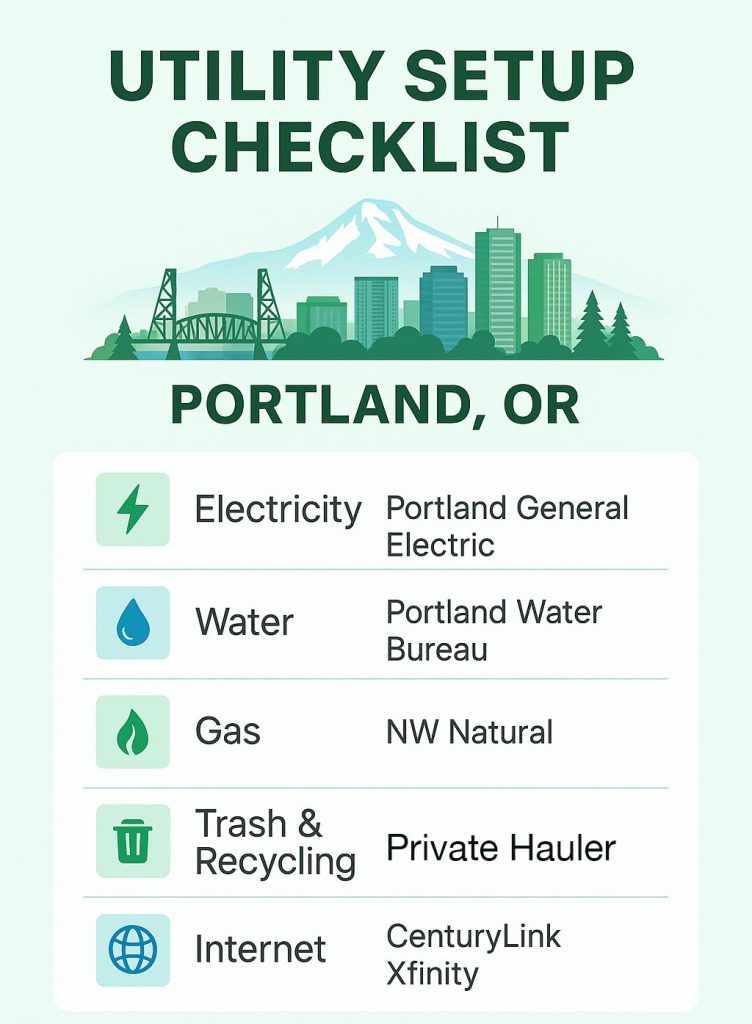
Nestled in the Pacific Northwest, Portland is renowned for its lush green landscapes, vibrant arts scene, and a strong commitment to sustainability. As you settle into your new home, you’ll notice how deeply green energy and conservation run through the city’s core. From community solar initiatives to pesticide‑free parks, Portland encourages residents to live lightly and sustainably, so your transition isn’t just practical, it’s planet‑friendly too.
Electric Service: Portland General Electric (PGE)
PGE is the primary electricity provider for Portland residents, serving over 900,000 customers across Oregon. PGE offers more than just reliability, with a rich history dating back to 1888, it’s now on a trajectory to deliver 80% carbon‑free power by 2030 and 100% by 2040. They also top national rankings for customer participation in green‑power programs, showcasing Portlanders’ commitment to sustainability. While Portland is primarily served by PGE west of the Willamette River, Pacific Power covers much of the east side
Rebates & Efficiency Programs
- Residential Energy Efficiency Rebates: Get incentives for energy‑saving appliances and retrofits through PGE and Oregon’s DSIRE program.
- Peak Time Rebates & Smart Thermostat Programs: Sign up to shift power use during peak hours and score bill credits or reduced rates.
- Income‑Qualified Bill Discount: If your income qualifies, PGE can discount your bill by 15-80%, no documents required, based on household size and income
Natural Gas: NW Natural
NW Natural has been serving the Pacific Northwest for over 160 years, providing natural gas services to more than 2.5 million people. Their dedication to safety, reliability, and environmental stewardship makes them a trusted energy partner in the region.
Energy Efficiency Rebates: NW Natural offers rebates for:
- High-Efficiency Furnaces: Incentives for upgrading to energy-efficient heating systems.
- Water Heaters: Rebates for installing efficient natural gas water heaters.
- Smart Thermostats: Discounts on qualifying smart thermostat models.
Pro Tip: Schedule a home energy assessment to identify additional opportunities for energy savings and rebates.
Water Service: Portland Water Bureau
The Portland Water Bureau delivers high-quality drinking water from the Bull Run Watershed to residents and businesses. They are committed to maintaining a resilient water system and promoting water conservation.
Water Efficiency Rebates: The bureau offers programs to encourage water efficiency, including:
- Water Efficiency Kits: Free kits containing water-saving devices like faucet aerators and showerheads.
- Toilet Rebates: Rebates for replacing old toilets with high-efficiency models.
- Outdoor Watering: Guidance and incentives for installing efficient irrigation systems.
For more details, visit the Portland Water Bureau’s Water Efficiency Programs page.
Trash and Recycling in Portland
Unlike some cities, Portland does not provide municipal trash pickup. Instead, residents must sign up with a private waste hauler that operates under city regulations. The Bureau of Planning and Sustainability oversees the system, ensuring consistency in service and pricing. Portland was one of the first U.S. cities to implement a citywide composting program, allowing residents to include food scraps in their green yard waste bins.
How Trash Pickup Works in Portland
- The city assigns private haulers to different neighborhoods, so you don’t get to choose your provider, but you do get standardized pricing and service levels.
- Services include weekly trash, compost, and recycling pickup for residential customers.
- Billing is handled directly by your assigned waste hauler.
Finding Your Waste Hauler
To determine your assigned provider, use the Portland’s Waste Collection Finder and enter your address.
Best Internet Providers in Portland
Portland has a variety of internet service providers, offering everything from ultra high-speed fiber-optic connections to cable to wireless 5G home internet. Here are some of the best options available:
- Type: Cable
- Speeds: Up to 2 Gbps
- Coverage: over 99% of Portland
- Why Choose It? Xfinity offers broad coverage and multiple plan options, making it a convenient choice for most households.
- Type: Fiber
- Speeds: Up to 8 Gbps
- Coverage: ~82% of Portland
- Why Choose It? Quantum Fiber provides ultra-fast fiber internet with symmetrical upload and download speeds, perfect for remote work and gaming. Quantum is slowly taking over and upgrading CenturyLink’s network, but in areas they aren’t yet available, CenturyLink offers speeds up to 1 Gbps.
- Type: 5G Wireless Home Internet
- Speeds: 100-245 Mbps
- Coverage: Expanding in Portland, with strong availability in metro areas
- Why Choose It? T-Mobile’s 5G Home Internet is a contract-free, plug-and-play option with no data caps. It’s great for those who want flexibility and don’t need super high speeds.
- Type: 5G Wireless Home Internet
- Speeds: 85 Mbps – 1 Gbps (varies by location and signal strength)
- Coverage: Available in select parts of Portland
- Why Choose It? Verizon’s 5G Home Internet delivers fast speeds with simple setup, and there are no hidden fees or contracts.
- Type: Satellite
- Speeds: 50-250 Mbps
- Coverage: Available anywhere with a clear view of the sky
- Why Choose It? Starlink is a great option for rural areas or locations without access to wired broadband.
Conservation & Green Energy Options
Portlanders can tap into a range of conservation programs:
- Energy Trust of Oregon: Rebates for everything from efficient appliances to solar installations; funded via a public purpose charge.
- Oregon Solar + Storage Rebates & Solar Within Reach: Help households go solar, with incentives especially for income-qualified residents.
- Net Metering: Your solar panel system can sell excess power back to the grid, crediting your bill.
- Regional efforts like Northwest Energy Efficiency Alliance support efficient appliances and building programs, indirectly benefiting your home.
- PGE decarbonization goals: Moving toward renewable generation and supporting community solar programs too.
Financial Assistance Programs Available in Portland
Here’s a roundup of help available if paying utility bills gets tight:
- LIHEAP & Oregon Energy Assistance (OEAP) through PGE: Federally/state-funded programs providing bill support and weatherization aid.
- Energy Trust weatherization grants via OHCS: Helps low-income families upgrade insulation, heating systems, and more.
- Oregon Energy Fund: Statewide nonprofit distributing energy bill assistance through local partner agencies in Multnomah County.
- Community programs: Impact NW, Our Just Future, SEI offer emergency bill help and referrals for water, sewer, gas, and electricity.
- Portland’s Utility Safety‑Net Assistance: Bill discounts and vouchers for qualified households; recertify every two years.
Each of these streams can help individually or stack together, ensuring vulnerable families can stay powered, warmed, and hydrated.
About the Author

David has been an integral part of some of the biggest utility sites on the internet, including InMyArea.com, HighSpeedInternet.com, BroadbandNow.com, and U.S. News. He brings over 15 years of experience writing about, compiling and analyzing utility data.
Portland Internet Connectivity
Fastest Internet Providers in Portland
| Provider | Connection Type | Download Speed |
|---|---|---|
| Xfinity | Cable & Fiber | 2 Gbps |
| CenturyLink | DSL & Fiber | 940 Mbps |
| Quantum Fiber | Fiber | 8 Gbps |
| Starlink | Satellite | 400 Mbps |
| Verizon 5G Home Internet | 5G | 300 Mbps |
| T-Mobile 5G Home Internet | 5G | 498 Mbps |
| AT&T Air | 5G | 300 Mbps |
| Viasat | Satellite | 150 Mbps |
| Earthlink | Fiber, Cable, 5G, & Satellite | Varies |
*Not all speeds available in all areas
Portland Drinking Water Quality Information
Clean drinking water is essential for maintaining good health and overall well-being. Safe, contaminant-free water helps prevent the spread of diseases, supports proper hydration, and ensures the body's vital functions operate smoothly.
Portland's Primary Drinking Water Source: Surface Water
Drinking Water Contaminant Levels
Legal limit: 1300 ppb
Legal limit: 15 ppb
Legal limit: No Limit Set
Legal limit: 100 ppb
Legal limit: No Limit Set
Legal limit: 60 ppb
Legal limit: No Limit Set
Legal limit: No Limit Set
Legal limit: No Limit Set
Legal limit: No Limit Set
Legal limit: No Limit Set
Utilities in Nearby Cities
Frequently Asked Questions
How far in advance should I set up my utilities?
For electricity and gas, at least 2–3 business days before your move-in date. For internet, 2 weeks is recommended to secure an installation slot.
What identification is required to start service?
Most providers (PGE, NW Natural, Portland Water Bureau) require a Social Security Number. If you don’t have one, you can typically use a Driver’s License, Passport, or Tribal ID, though you may need to call to finalize the setup.
Do I have a choice between PGE and Pacific Power?
No. Service areas are strictly defined. Most of Portland is PGE, but Pacific Power serves specific pockets in North Portland (like Hayden Island) and parts of the downtown core. Check your address on the Oregon Utility Map if you are unsure.
Is there a "Clean Energy" fee on my bill?
You will see a Public Purpose Charge (about 1.5%–3%) on your bill. This is mandated by the state to fund energy efficiency and renewable energy projects through the Energy Trust of Oregon.
Do I need to be home for the gas to be turned on?
Usually no, provided the technician has access to the exterior meter. However, if the gas has been off for a long period, NW Natural may require an adult to be present to perform a safety check and relight pilots.
Why is my water bill so high?
In Portland, your “Water Bill” actually includes three services: water usage, sanitary sewer (treatment), and stormwater (management of rainwater runoff). The sewer portion is often the most expensive part of the bill.
What is "Stormwater Billable Area"?
This charge is based on the amount of “impervious surface” (roof, driveway, etc.) on your property that prevents rain from soaking into the ground. Residents can get a discount on this through the Clean River Rewards program if they manage their own runoff (e.g., rain barrels or rain gardens).
I’m renting a house — do I need to set up trash service?
No. Per Portland City Code 29.30.140, landlords are legally required to set up and pay for the base garbage, recycling, and compost service for residential rentals (up to 4 units). The bill must be in the landlord’s name.
How often is my trash picked up?
Standard service in Portland is every other week for garbage (grey bin), and weekly for recycling (blue bin), glass (yellow bin), and compost/yard debris (green bin).
What is the fastest internet option in Portland?
Fiber-to-the-home is widely available via Quantum Fiber, and Google Fiber (in select areas). These offer symmetrical speeds (same upload/download), which is superior to the cable internet provided by Xfinity.
Are there discounts for low-income residents?
Yes. The Portland Water Bureau offers a “Smart Discount” (automatic eligibility) or a Bill Discount Program based on income. PGE and NW Natural also offer Income-Qualified Bill Discount programs that can lower your monthly bill by 15%–25%.
Why did Portland water and sewer utility bills increase?
The Portland Water Bureau and Bureau of Environmental Services implemented combined rate adjustments (increasing water by 8.1% and sewer by 5.15%) to fund major infrastructure projects. These include the federally mandated Bull Run Filtration Project to protect clean drinking water, major pipe repairs, Columbia Boulevard treatment plant upgrades, and a new Flood Safety Benefit Fee ($1.20/month) to maintain Columbia River flood levees.
What is Portland's "Four-Bin System" and why is glass kept separate?
Portland requires residents to sort waste into four distinct streams: regular trash (gray cart, bi-weekly), single-stream paper/plastic/metal (blue cart, weekly), food scraps and yard waste (green cart, weekly), and glass (yellow bin, weekly). Glass must be placed completely loose in the yellow bin—never in the blue cart—because broken glass contaminates paper and plastic recyclables during automated sorting at local recovery facilities.