
Setting up and managing your Pacific Power service is a breeze when you know the latest rates, transfer processes, and smart energy programs available to you.
Key Takeaways
- Pacific Power service setup can easily be started, stopped, or transferred online before your move using their digital portals.
- Your rate depends on your state and usage, so verifying current standard pricing or opting into Time of Use plans can significantly impact your monthly bill.
- Outage reporting and wildfire safety protocols across Oregon, Washington, and Northern California are managed via the outage map, mobile alerts, and preemptive shutoffs.
Whether you are unpacking boxes in Bend or settling into a new place in Walla Walla, securing reliable electricity is one of your top priorities as you coordinate your move. Setting up utilities often feels like a tedious chore, but understanding how Pacific Power operates makes the transition remarkably straightforward. We know you want to flip the switch and focus on enjoying your new space, not wading through confusing utility jargon or navigating unexpected Pacific Power outages. By learning the ins and outs of the PacifiCorp coverage area, Time of Use (TOU) plans, vital wildfire safety protocols, and direct digital tools, you can confidently take control of your monthly energy usage and keep your home humming comfortably year-round.
Pacific Power Coverage Area and Availability
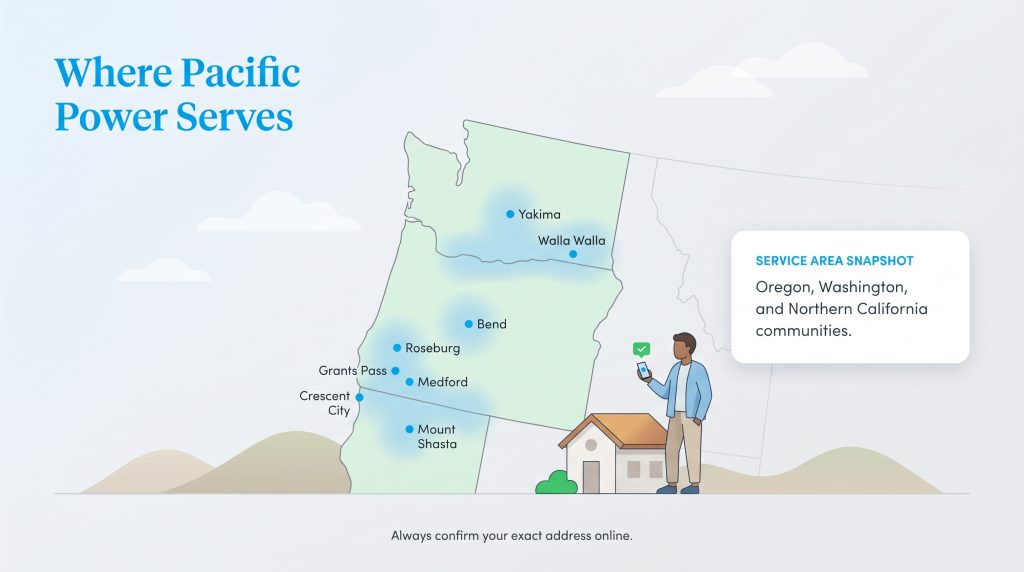
Pacific Power delivers electricity to roughly 700,000 customers across three distinct states, meaning your exact rates, fees, assistance options, and billing plans rely entirely on your geographic location. As a major operating division of its parent company, PacifiCorp — which also operates Rocky Mountain Power in Utah, Wyoming, and Idaho — Pacific Power focuses on the Pacific Northwest grid. If you are relocating across the state or moving in from out of town, you will want to confirm that your new home falls within their established boundaries.
You will find active Pacific Power service in major Oregon cities like Bend, Medford, Grants Pass, and Roseburg; Washington locales such as Yakima and Walla Walla; and Northern California towns including Mount Shasta and Crescent City. To guarantee seamless service, always verify your specific address through the official Pacific Power login portals before your scheduled move-in date.
Pacific Power Plans and Pricing Options
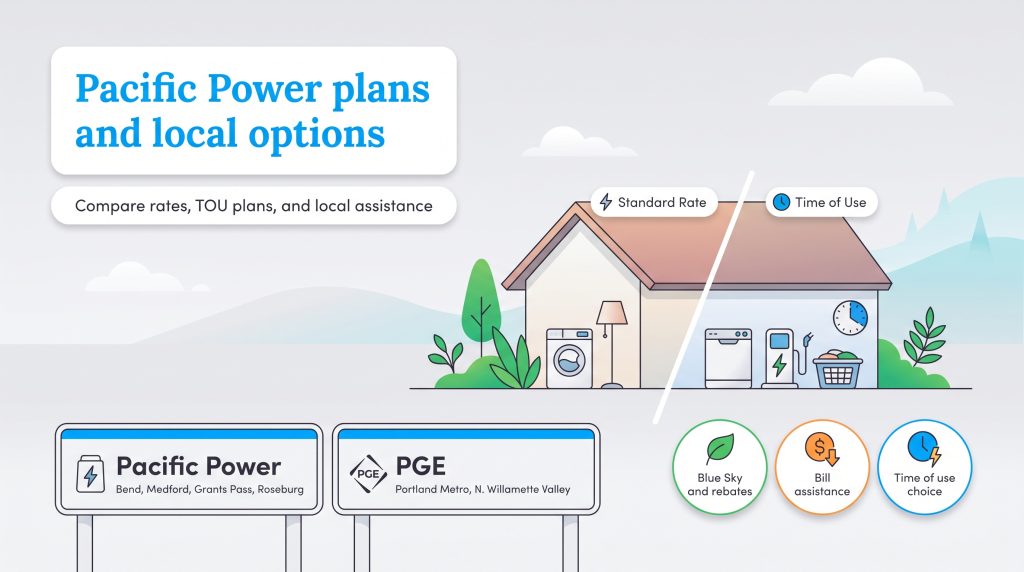
When reviewing your monthly statement, you will notice it is divided into a few distinct parts: a basic customer charge (to maintain your physical connection), delivery or distribution charges, energy usage charges measured in kilowatt-hours (kWh), and state-specific taxes or public purpose riders. Standard residential pricing generally uses a tiered flat rate where electricity costs remain constant regardless of when you flip the switch. Because Pacific Power residential rates vary so widely by state regulation, we always recommend comparing your recent kWh usage against the latest official pricing rather than relying on generalized regional averages.
| State | What to Check | Why It Matters |
|---|---|---|
| Oregon | Residential rate schedule, Time of Use availability, Blue Sky options | Oregon customers may have different pricing and renewable options than Washington or California customers. |
| Washington | Current residential tariff, assistance programs, outage alerts | Rate structures and deposit rules can vary by state regulation. |
| Northern California | Residential schedule and wildfire-related programs | California customers may have different wildfire safety and billing considerations. |
Time of Use (TOU) Rate Plans
You do not have to settle for standard flat-rate billing if it doesn’t fit your daily lifestyle. By enrolling in Pacific Power time of use plans, you can actively reduce your monthly bills simply by shifting your heaviest electricity tasks — like running the dishwasher, doing laundry, or charging an electric vehicle — to off-peak hours. Conversely, you will pay a premium during designated peak hours, which are typically late afternoon and early evening when the regional grid faces the most stress. Before making the switch, evaluate your household habits carefully; if you cannot avoid heavy power usage during peak times, a TOU plan could unexpectedly raise your bill.
Comparing Local Coverage: Pacific Power vs. PGE
We frequently hear new residents ask if they should choose Pacific Power or Portland General Electric (PGE) for their new home. In almost all cases, your physical location dictates your utility provider, meaning direct competition doesn’t exist on a street-by-street level. Most Oregon residents cannot freely choose between Pacific Power and PGE; provider access strictly depends on your new service address. PGE handles the vast majority of the Portland metropolitan area and the northern Willamette Valley, while Pacific Power operates as the primary electrical provider for distinct regional hubs further south and east.
| Utility | Main Oregon Service Areas | Can You Choose It? | Renewable/Energy-Saving Programs | Best Next Step |
|---|---|---|---|---|
| Pacific Power | Bend, Medford, Grants Pass, Roseburg | No, dependent on address | Blue Sky, Wattsmart rebates, Time of Use | Check coverage map before moving |
| Portland General Electric (PGE) | Portland Metro Area, Northern Willamette Valley | No, dependent on address | Green Future, Peak Time Rebates | Verify your zip code online |
Deals, Discounts, and Low-Income Assistance
If you are struggling to manage your monthly utility costs, Pacific Power facilitates several critical state-mandated relief programs designed to help budget-conscious users keep the lights on.
- California CARE Program: California residents who meet specific income requirements can enroll in the California Alternate Rates for Energy (CARE) program, which provides a discount of 20% or more on monthly electric bills.
- Oregon Low Income Discount Program: Oregon customers can apply for tiered bill reductions. Depending on where your household falls on the federal poverty level index, you could see substantial recurring monthly savings.
- Energy Efficiency Rebates & NEIF Financing: Homeowners can access weatherization rebates and Wattsmart incentives. For larger upgrades, the National Energy Improvement Fund (NEIF) offers commercial financing and approved residential contractor loans to offset the upfront costs of installing eco-conscious HVAC systems or smart thermostats.
How to Report and Search for Pacific Power Outages
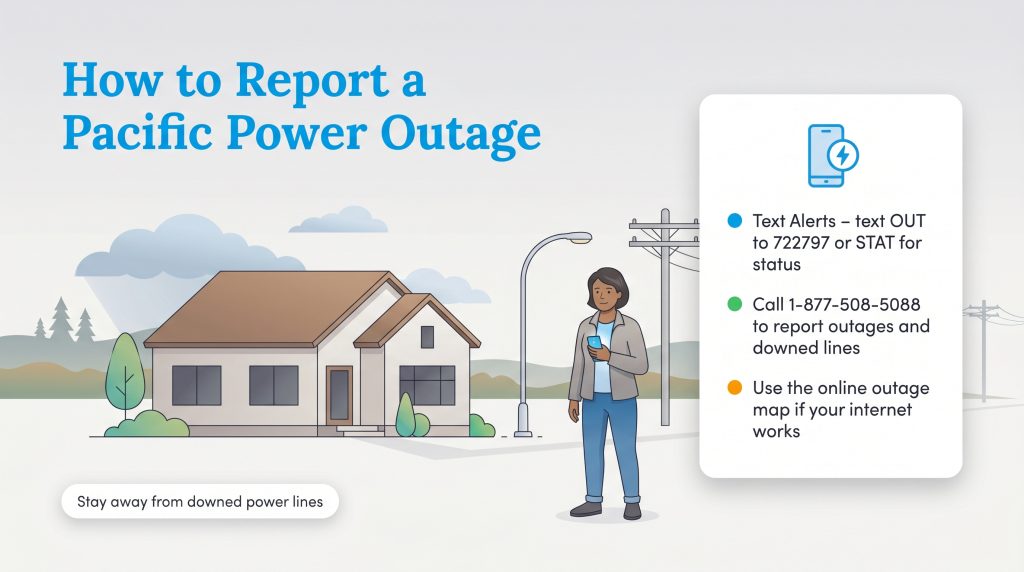
Weather in the Pacific Northwest can be notoriously unpredictable, and heavy snow, ice, or intense windstorms occasionally lead to grid interruptions. Knowing how to report a power outage immediately keeps you safe and ensures repair crews are dispatched to your exact neighborhood. If the lights go dark, taking swift action through their digital infrastructure is your best move.
- Text Alerts: The fastest way to report your status is to text “OUT” to 722797. You can later text “STAT” to check on repair progress.
- Phone Support: Call the dedicated emergency line at 1-877-508-5088 to report a blackout or a downed line. (If you just need the main Pacific Power customer service number for billing inquiries, dial 1-888-221-7070).
- Online Portal: Access the live Pacific Power Outage Map directly from your mobile browser. This map provides real-time tracking, suspected causes, and estimated restoration times.
Public Safety Power Shutoffs (PSPS) and Wildfire Safety
In recent years, the threat of catastrophic wildfires has dramatically altered how western utilities manage the grid. During extreme weather conditions — specifically high winds paired with critically dry vegetation — the provider may initiate a Public Safety Power Shutoff Pacific Power event. A PSPS is a preemptive de-energization of the grid designed to prevent power lines from sparking a blaze. The utility also utilizes “Enhanced Safety Settings” (ESS) on rural lines, which makes the grid highly sensitive so power shuts off instantly if a tree branch merely brushes a wire.
Because PSPS events can last for days until crews manually inspect the lines, preparation is critical. Build a home emergency backup kit that includes:
- At least one gallon of bottled water per person per day and non-perishable food.
- High-lumen flashlights and a fresh supply of batteries (avoid using open-flame candles).
- Portable, pre-charged battery banks to keep your mobile phones powered for emergency alerts.
- A manual can opener and a battery-powered radio for localized broadcast updates.
Mobile App and Account Management
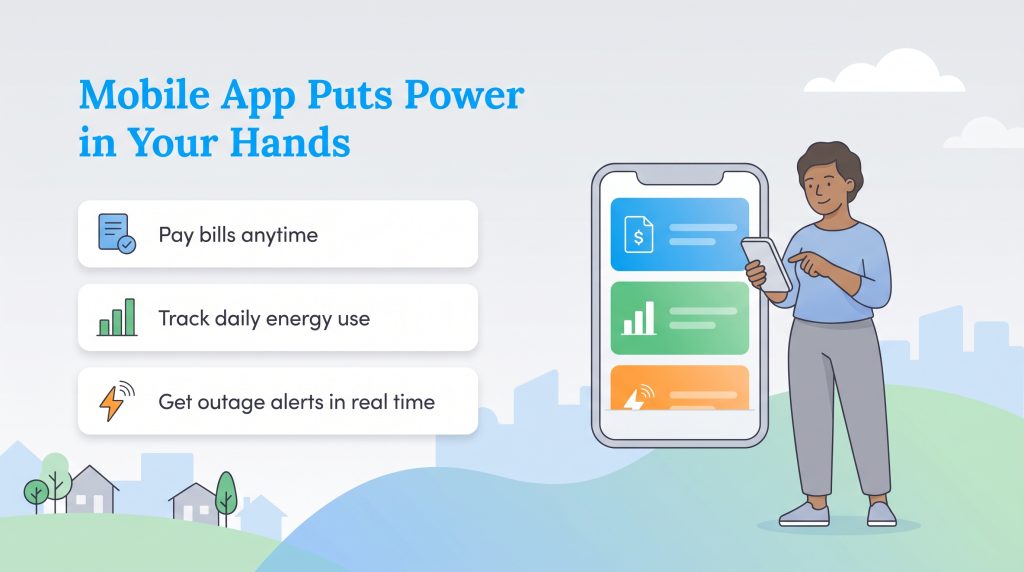
Gone are the days of mailing paper checks and waiting on hold for account updates. The official Pacific Power app — available for free on both iOS and Android devices — puts total utility management in the palm of your hand. Once you complete your Pacific Power login setup, the mobile platform empowers you to handle the top three essential utility tasks instantly.
First, you can pay your bills securely and set up auto-pay parameters to avoid late fees. Second, the app offers detailed graphical insights to help you track your daily usage, which is an invaluable tool for households trying to optimize their Time of Use plans. Finally, the app serves as a direct pipeline to the outage center, allowing you to report a blackout and receive push notifications when crews arrive in your neighborhood.
Fees, Guarantees, and Recent Rate Changes
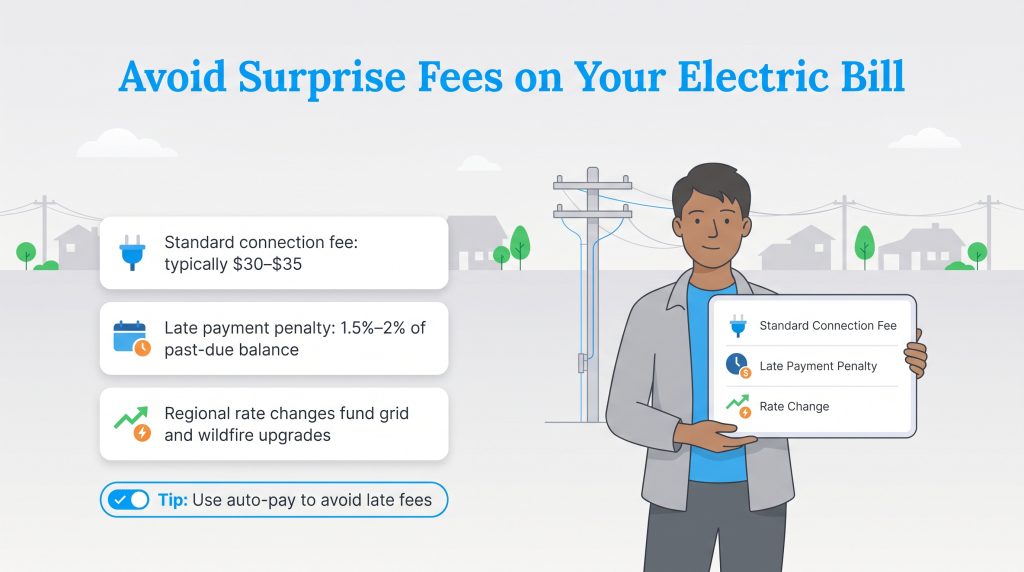
Understanding the administrative fees associated with your account ensures you won’t be caught off guard by your first bill. Setting up a new connection generally incurs a standard activation fee, and missing a billing cycle will trigger late penalties. Additionally, staying informed about broader regional rate trends can help you budget for the year ahead.
| Fee Type | Estimated Cost / Structure | How to Avoid or Minimize |
|---|---|---|
| Standard Connection Fee | Typically $30 – $35 (varies by state) | Required for new setups, but transferring existing service digitally can sometimes waive extra agent fees. |
| Late Payment Penalty | 1.5% to 2% of the past due balance | Enroll in auto-pay through the app and ensure sufficient funds are linked to your account. |
It is also important to note that modernizing the electrical grid comes with shifting costs. Recently, a notable 17% Pacific Power rate increase adjustment was proposed to the Oregon Public Utility Commission (OPUC). According to corporate filings, these proposed adjustments are necessary to fund comprehensive grid upgrades, expand renewable infrastructure, and cover mounting insurance and liability costs associated with wildfire prevention.
Sustainability, Renewable, and Green Energy Initiatives
If minimizing your carbon footprint is a priority, you will be glad to know that the utility is actively navigating a massive energy transition. The company is aggressively retiring its legacy coal plants and pivoting toward vast wind power developments across the West. For consumers who want to actively accelerate this eco-conscious shift, the Blue Sky program is an excellent opportunity. By voluntarily paying a small premium on your monthly bill, you can opt into this community renewable energy initiative. Your contribution directly funds local, independent solar, wind, and geothermal projects, fostering cleaner air and reliable green jobs in your region.
Customer Reviews: Who This Provider Is Best For
When diving into third-party sentiment and Pacific Power reviews across local town halls and platforms like Reddit, feedback is understandably mixed. On the critical side, frequent frustrations center around the company’s aggressive Enhanced Safety Settings. Residents in rural and heavily forested areas complain that these hyper-sensitive lines lead to frequent, disruptive micro-outages during the dry summer months. Furthermore, concerns regarding the aforementioned proposed rate increases weigh heavily on budget-strained households.
However, the provider earns substantial praise for its grid reliability during non-fire seasons and its responsive digital interface. Customers highly rate the seamless mobile app and the transparent tracking features available during winter storm outages. Ultimately, this provider is best for eco-conscious homeowners who can actively utilize Time of Use plans and Blue Sky initiatives to manage their footprint, but rural users must remain proactively prepared for seasonal wildfire safety interruptions.
Preparing Your Home for Pacific Power Service
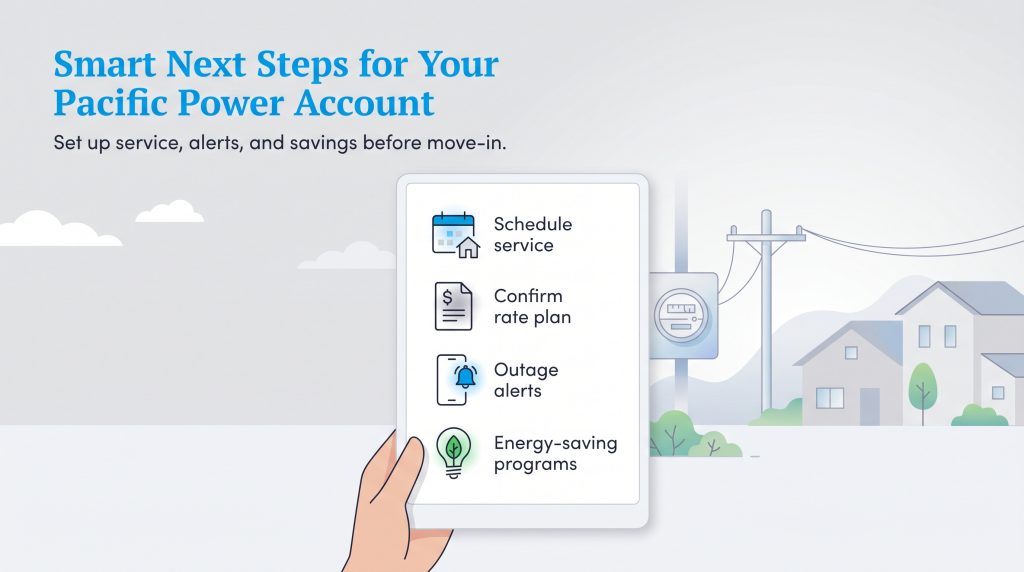
Once you know whether the provider serves your address, your next steps are straightforward: schedule your service connection before moving day, confirm your rate schedule to capitalize on off-peak hours, sign up for text-based outage alerts, and review energy-saving rebate programs that fit your household. A few minutes of proactive digital setup today can help you avoid billing surprises, reduce peak-hour energy strain, and settle into your new home with complete peace of mind.
Frequently Asked Questions About Pacific Power
Where does Pacific Power provide service?
Is Pacific Power the same as PacifiCorp?
How do Pacific Power’s Time of Use (TOU) plans work?
Does Pacific Power have a mobile app to pay my bill?
How do I report a power outage to Pacific Power?
What is a Public Safety Power Shutoff (PSPS)?
Does Pacific Power require a deposit for new customers?
How can I lower my monthly Pacific Power bill?
What is the Pacific Power Blue Sky program?
How accurate is the Pacific Power outage map?
How far in advance should I start Pacific Power service?
About the Author

David has been an integral part of some of the biggest utility sites on the internet, including InMyArea.com, HighSpeedInternet.com, BroadbandNow.com, and U.S. News. He brings over 15 years of experience writing about, compiling and analyzing utility data.