Learn how to set up your NW Natural account, understand gas rates, and make eco-conscious energy choices in the Pacific Northwest.
Key Takeaways
- Submit your online start or transfer service request at least three business days before moving into your Western Oregon or Southwest Washington home.
- Prepare for the 2026 Oregon and Washington rate increases by enrolling in Equal Pay or applying for the Income-Qualified Bill Discount Program.
- Keep key contact numbers handy, including Customer Service (800-422-4012), the 24/7 Automated Payment line (833-347-2116), and the Gas Odor Emergency hotline (800-882-3377).
Moving to the Pacific Northwest brings a mix of beautiful evergreen landscapes and the busy work of unpacking boxes. Amid the excitement of settling into your new home, you’ll likely need to set up service with NW Natural, the primary natural gas provider for Western Oregon and Southwest Washington. For a smooth transition, you can reach their main Customer Service team at 800-422-4012, call the 24/7 Automated Payment line at 833-347-2116 to handle a quick NW Natural bill pay transaction, or report suspected leaks immediately via the Gas Odor Emergency hotline at 800-882-3377. Our goal is to streamline your move by guiding you step-by-step through your NW Natural login and account setup, breaking down the 2026 utility rate increases, and showing you how to claim rebates so your space stays warm without stretching your budget.
How to Start, Stop, or Transfer NW Natural Service
Setting up your utilities before the moving truck arrives ensures you won’t spend your first night in the Pacific Northwest taking a freezing cold shower. You can easily manage your NW Natural start service request, stop service at an old address, or transfer your current account between local residences directly through the provider’s online portal. Because online applications take up to three business days to process, you should submit your request well ahead of your target move-in date.
Follow these steps to initiate, stop, or transfer your residential gas service:
- Gather Your Information: Before starting, make sure you have your new street address, your desired move-in or stop-service date, your primary contact details, and a valid government-issued ID or Social Security number for identity and credit verification.
- Access the Online Portal: Navigate to the NW Natural website and select the “Start, Stop or Move Service” option. Existing customers can simply use their NW Natural login credentials to transfer an active residential profile to a new home within the coverage territory.
- Select Your Preferred Date: Choose the exact date you take legal possession of the property. Keep the three-business-day processing window in mind, and note that standard technician activations are not scheduled on weekends or holidays.
- Confirm Meter Access: If the natural gas was completely shut off at the property after the previous tenant left, a field technician will need clear access to the exterior gas meter and your indoor appliances to safely relight pilot lights and check for leaks.
If you are setting up a commercial business account, encountering issues with your online application, or need to place an urgent stop-service request within less than three business days, you will need to speak with an agent directly. You can reach NW Natural customer service at 800-422-4012 during regular business hours, Monday through Friday from 7:00 a.m. to 6:00 p.m. PST.
NW Natural Plans, Pricing, and 2026 Rate Updates
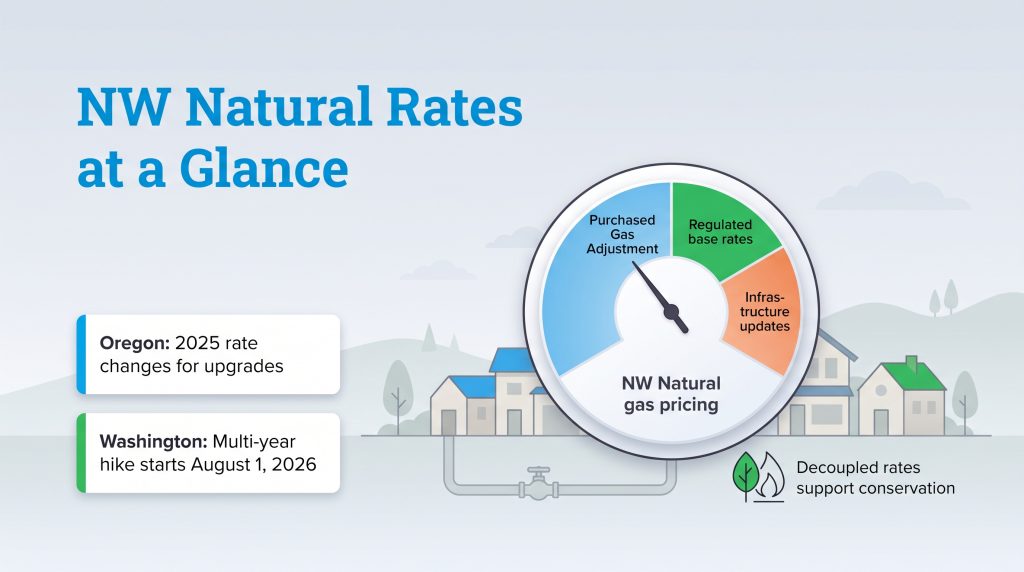
Understanding your upcoming utility bills requires a close look at how NW Natural rates are structured. As a fully regulated utility, all pricing is reviewed and approved by the Oregon Public Utility Commission (OPUC) and the Washington Utilities and Transportation Commission (WUTC). Rather than shopping for competing retail plans, every residential customer pays a standardized rate composed of three primary bill components:
- Fixed Monthly Service Charge: This baseline minimum fee covers customer support, billing administration, and meter maintenance, remaining consistent every month regardless of whether you burn any fuel.
- Variable Gas Usage Cost: Measured per therm, this charge combines the state-regulated delivery tariff with the Purchased Gas Adjustment (PGA). Under the PGA system, the wholesale market cost of natural gas is passed directly through to consumers without any corporate markup.
- Optional Smart Energy Charges: If you voluntarily enroll in the utility’s carbon offset program, your statement will include either a flat monthly contribution or a small per-therm addition.
Recently, residents have felt the financial pinch of rising energy and pipeline maintenance costs across the region. In Oregon, residential customers are subject to a 7.3% rate increase effective Oct. 31, 2026, which adds roughly $6.30 per month to the average household bill. Meanwhile, Washington residents are navigating a multi-year rate hike that began Aug. 1, 2026. Because this utility operates on a “decoupled” rate structure, its corporate profits aren’t tied directly to the volume of gas sold, aligning its internal conservation programs with your desire to use less energy.
| Service Region | Pricing Structure | 2026 Rate Updates |
|---|---|---|
| Oregon Residents | Fixed monthly service charge + OPUC per-therm tariff and PGA passthrough. | 7.3% rate increase effective Oct. 31, 2026 (adds ~$6.30/month for the average residential customer). |
| Washington Residents | Fixed monthly service charge + WUTC per-therm tariff and PGA passthrough. | Subject to a state-approved multi-year rate hike that began Aug. 1, 2026. |
Billing Options, Payment Plans, and Financial Assistance
Because Pacific Northwest winters are notoriously damp and chilly, your gas usage will naturally spike between November and March before dropping to almost nothing in July. To help you stay on top of your household budget, the utility provides flexible NW Natural bill pay channels, seasonal smoothing plans, and generous income-qualified grants.
Ways to Pay Your NW Natural Bill
You can settle your monthly statement using any of the following convenient methods:
- Online via the Paymentus Portal: Log into your online account or use the one-time guest checkout through the Paymentus Customer Payment Portal. It supports credit cards, debit cards, e-checks, and recurring Auto Pay enrollment at no extra transaction fee.
- Pay by Text: Register your mobile number in your online account settings to receive text alerts when your statement is ready, allowing you to authorize payment with a quick reply.
- 24/7 Automated Phone System: Call 833-347-2116 anytime day or night to pay over the phone using your card or bank routing numbers.
- In-Person Pay Stations: Prefer paying with cash? You can visit authorized retail pay stations — including select grocery and check-cashing counters across Oregon and Washington — to pay in person.
- By Mail: Send a personal check or money order along with your paper bill stub to NW Natural, P.O. Box 6017, Portland, OR 97228-6017.
Monthly Payment Plans
Whether you want to eliminate winter bill shock or need breathing room to catch up on an overdue balance, you can enroll in one of three structured payment plans. Furthermore, customers enrolled in standard billing automatically benefit from the Weather Adjusted Rate Mechanism (WARM Billing Method) from Dec. 1 through May 15, which adjusts your per-therm delivery rate in real time during unusually freezing or mild winter spells so your bill stays closer to seasonal norms.
| Payment Plan | Best For | How It Works |
|---|---|---|
| NW Natural Equal Pay | Current accounts avoiding winter bill spikes | Averages your projected annual gas usage into 11 predictable monthly payments, followed by a 12th-month “true-up” bill or credit adjustment based on actual meter reads. |
| Level Pay | Past-due accounts needing total predictability | Combines 1/12 of your past-due balance with an equalized monthly usage installment, locking in a consistent monthly total over 12 months. |
| Current Bill Plus | Past-due accounts preferring exact summer bills | Divides your overdue balance into 12 equal installments and adds 1/12 of that debt on top of your actual current monthly gas bill. |
Income-Qualified Bill Discount Program
If your household is struggling with rising utility rates, the NW Natural Bill Discount Program provides immediate, ongoing monthly relief. In Oregon, residential customers earning less than 60% of the state median income can save between 15% and 85% on their monthly gas bills, depending on their specific income tier. In Washington, households earning at or below 80% of the area median income qualify for ongoing monthly discounts ranging from 15% to 80%.
💸 Money-Saver: Applying for the NW Natural Bill Discount Program takes just minutes online, and no proof of income is required to apply — you simply self-certify your household size and estimated annual earnings.
Beyond ongoing monthly percentage reductions, qualifying low-income households who have fallen behind on winter heating costs can also access up to $1,500 in gas bill grants over a two-year period through partnering local Community Action Agencies.
Coverage Area and Major Cities Served

Before you pack up the moving truck, you’ll want to confirm that your new home actually falls within the NW Natural coverage area. This provider supplies natural gas through more than 800,000 service connections across a broad swath of Western Oregon and Southwest Washington, spanning from the Willamette Valley out to the Oregon Coast and up through Clark County.
Because utility boundaries can shift dramatically from one county to the next, we always recommend verifying your specific address by checking their official online service map. Currently, the company serves more than 2 million people across several major Pacific Northwest communities, including:
- Portland
- Eugene
- Salem
- Vancouver (WA) and the broader Clark County region
- Albany
- Corvallis
- Astoria
- Coos Bay
Deals, Discounts, and Energy Trust Rebates
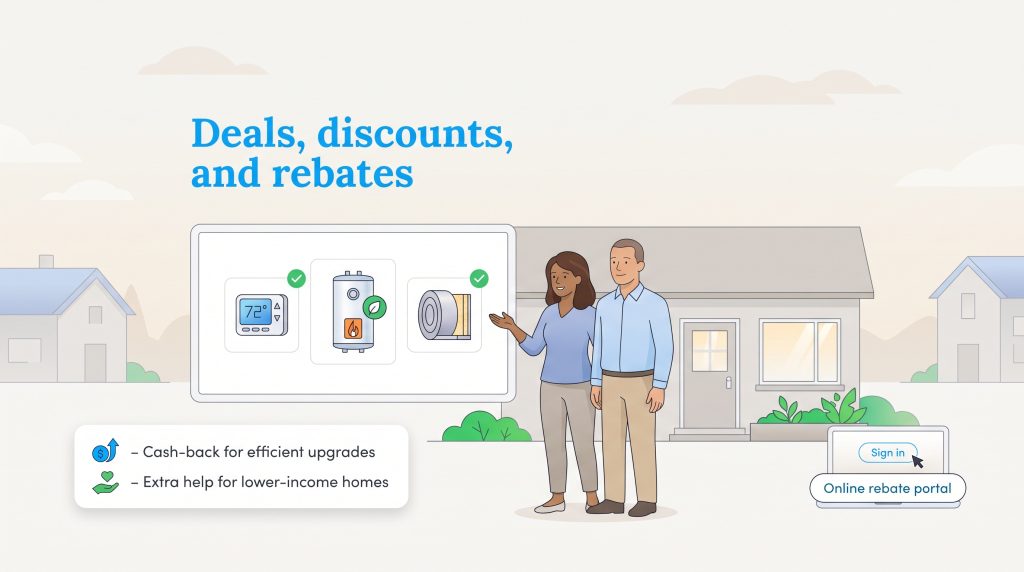
Managing your monthly utility expenses is much easier when you take advantage of available financial tools and NW Natural rebates. For eco-conscious homeowners looking to lower their carbon footprint while trimming winter heating bills, the provider’s partnership with the Energy Trust of Oregon is a goldmine. This collaboration offers substantial cash-back incentives when you upgrade older home equipment to ENERGY STAR certified appliances.
By utilizing these efficiency programs, you can claim hundreds of dollars in rebates on high-efficiency gas furnaces, condensing tankless water heaters, gas fireplaces, and upgraded attic or wall insulation. You can also score instant discounts on smart thermostats and earn additional bill credits by enrolling eligible devices in the Thermostat Rewards program, which slightly adjusts your temperature during peak winter mornings. Furthermore, income-qualified residents can apply for completely free home weatherization services — including air sealing, duct repair, and insulation upgrades — administered through local Community Action Agencies. Creating your online account early ensures you have immediate access to these rebate portals as soon as you get your house keys.
Fees, Deposits, and Service Guarantees
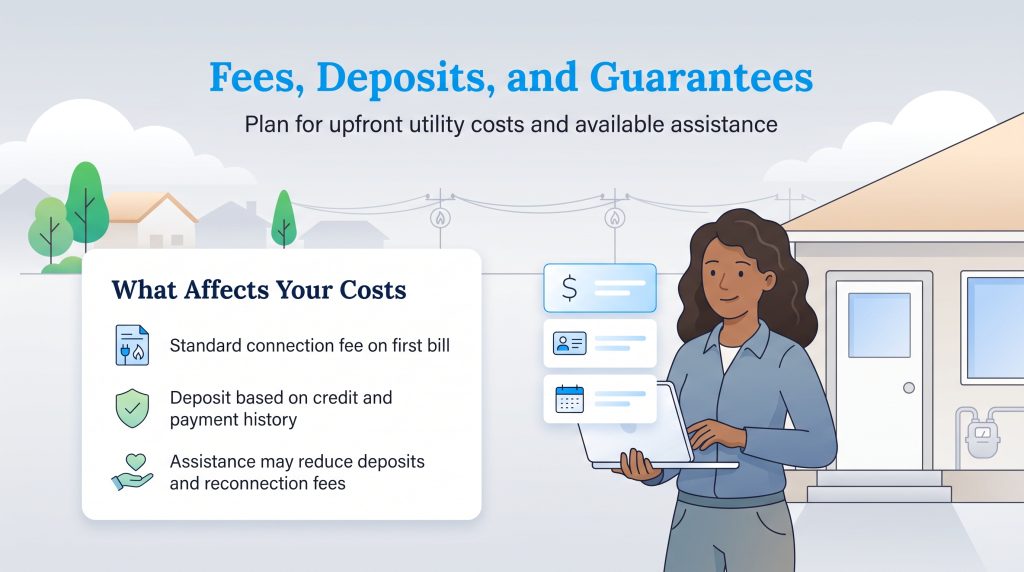
Moving requires budgeting for multiple upfront costs, and securing your utilities is no exception. When your gas service is activated, you may see standard connection fees applied to your first monthly statement. Whether you are required to pay an upfront security deposit depends on a soft credit check run during the application process, which evaluates your credit profile and past utility payment history without lowering your credit score.
Fortunately, there are several ways to bypass an upfront security deposit. Deposit requirements are typically waived if you have maintained 12 consecutive months of on-time payments with NW Natural or another regulated utility, or if you pass the initial credit screening. Additionally, under Oregon and Washington state utility protections, low-income households who qualify for the Bill Discount Program or LIHEAP energy assistance have standard security deposits waived entirely. If your gas is ever disconnected due to non-payment or seasonal shutoffs, standard reconnection fees apply to send a technician out to relight your meter, though these fees can also be reduced or waived for income-qualified residents.
Reporting Gas Leaks and Emergencies
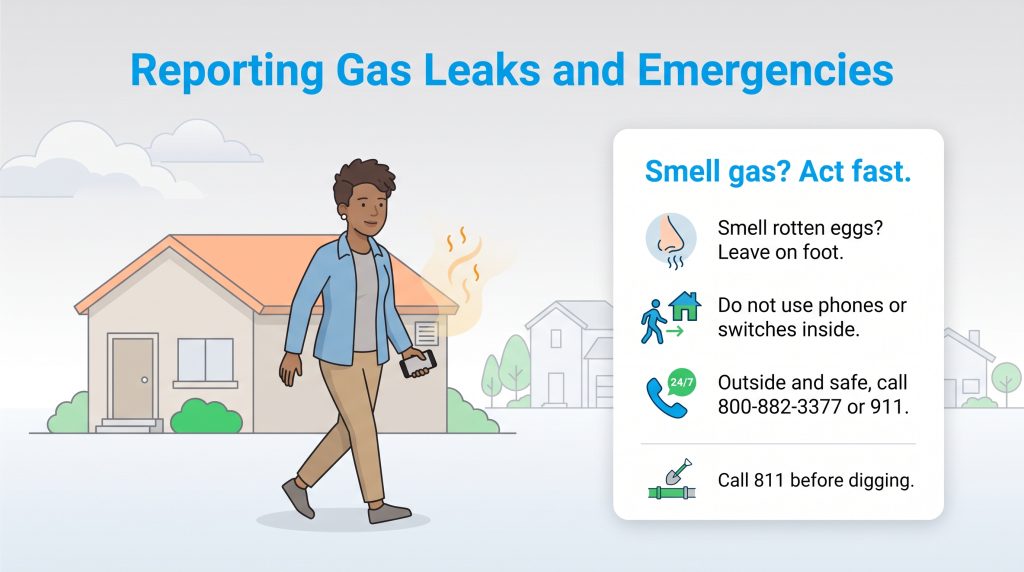
Maintaining household safety is a top priority, and knowing exactly how to report gas leak NW Natural emergencies is essential for every resident. Because natural gas is naturally colorless and odorless, the utility adds a chemical called mercaptan to give it a distinctive sulfur or rotten-egg smell. The company strictly enforces its “Smell. Go. Let Us Know.” protocol to keep communities safe. If you ever detect that rotten-egg odor, hear a hissing sound near a gas line, or notice dead vegetation over a buried pipe, you must evacuate immediately.
🚩 Heads Up: If you smell a rotten-egg odor, leave the premises on foot immediately. Do not flip electrical switches, unplug appliances, use your garage door opener, or use your cell phone inside. Once you are safely outside and away from the building, call the 24/7 NW Natural emergency hotline at 800-882-3377 or dial 911.
Additionally, always remember to call 811 at least two full business days before digging, planting trees, or driving fence posts in your yard. This free service dispatches locators to mark buried utility lines with paint and flags so you don’t accidentally strike a pressurized gas pipeline.
The NW Natural Safety App
To help residents keep emergency guidelines in their pocket, the provider offers the NW Natural Safety App for both iOS and Android devices. This mobile tool allows you to store emergency contact numbers, review earthquake and winter storm preparedness checklists, and quickly pull up instructions on how to identify and report suspected gas odors.
However, you should keep your expectations in check before downloading it. The app currently holds a dismal 1.6- to 1.7-star rating on both the Apple App Store and Google Play Store. Why are users so frustrated? Despite having the utility’s name, the app cannot be used to view your monthly gas usage, manage your account settings, or pay your bills. If you want to handle an NW Natural bill pay transaction or check your balance on your smartphone, skip the app store entirely and use your mobile web browser to access the mobile-friendly Paymentus web portal instead.
Sustainability and Renewable Energy Initiatives

If you’re striving to minimize your household’s ecological footprint while still relying on gas heating, you can take advantage of the utility’s targeted conservation and decarbonization initiatives.
Their popular “Smart Energy” carbon offset program lets residential customers voluntarily counter the greenhouse gas emissions produced by their home appliances. You can easily opt in through your online account by choosing either a flat monthly fee (starting around $6 per month) or a variable per-therm rate (roughly $0.105 per therm) that scales with your actual consumption to offset 100% of your household gas usage. Your contributions directly fund Verified Carbon Standard offset projects — such as capturing methane from regional dairy farms and landfills — while accelerating the utility’s broader investments in Renewable Natural Gas (RNG) and clean hydrogen blending.
🌱 Eco Edge: The provider’s overarching roadmap toward carbon neutrality makes them an environmentally mindful choice for residents concerned about long-term fossil fuel impacts.
Customer Reviews and Reputation
When researching any utility, checking third-party consumer boards is vital for understanding community sentiment. On the official trust front, NW Natural holds an A+ rating with the Better Business Bureau, where it has maintained continuous accreditation since 1974. Across local Reddit forums like r/Portland and r/Eugene, however, day-to-day customer opinions are more nuanced.
Unsurprisingly, the most vocal online complaints center around the consecutive 2025 and 2026 rate increases, with many homeowners frustrated by the climbing cost of keeping older Pacific Northwest homes warm through the winter. On the other hand, residents consistently praise the company for its rock-solid reliability during ice storms and its rapid emergency leak response teams, who routinely arrive at homes within minutes of an odor call.
One recurring topic on r/Portland and r/Eugene involves unannounced visits from third-party contractors — such as Hydromax USA — showing up in residential yards to conduct mandatory safety inspections on gas meters and service lines. While these federally mandated corrosion and leak surveys are completely legitimate, you should always protect your home security. Ask to see the worker’s photo ID badge, which will clearly state they are an authorized contractor for NW Natural. Note that meter inspectors rarely need to enter your living space unless a leak is detected or a pilot needs relighting; if you ever feel uneasy, ask the technician to wait outside on the porch and call NW Natural customer service at 800-422-4012 to verify their identity.
Why Choose NW Natural and Who It’s Best For

If you are moving to Oregon or Washington from a deregulated energy state, you might be wondering if you can shop around for a cheaper gas supplier. The reality is that neither state has deregulated its residential natural gas market. For homes within this territory that are piped for gas, NW Natural operates as the regulated monopoly provider.
Still, homeowners often debate whether to stick with natural gas appliances or convert their homes entirely to electric alternatives. Sticking with NW Natural is best for households that prioritize rapid, high-output winter warmth, chefs who love the instant flame control of gas cooktops, and families who want backup resilience during winter power outages. While modern electric heat pumps are extraordinarily energy-efficient and provide summer air conditioning, gas furnaces deliver immediate, toasted warmth that cuts right through the damp chill of coastal winters. Furthermore, during severe Pacific Northwest wind and ice storms that knock out the electric grid, gas water heaters, stovetops, and fireplaces often continue operating without grid electricity — though modern gas furnaces still require a small battery backup or generator to power their blower fans and electronic ignitions.
Preparing Your Pacific Northwest Home for Move-In Day

Setting up your natural gas service doesn’t have to be a moving-week headache if you knock out a few key tasks ahead of time. Use this rapid pre-move checklist to lock in reliable heat and keep the 2026 rate increases from catching your budget off guard:
- 1 to 2 Weeks Before Moving: Submit your online start or transfer service application. Remember that online requests require at least three business days to process, and you’ll want time to schedule a technician if the gas is physically shut off at the meter.
- During Your First Week: Complete your NW Natural login setup to access the Paymentus portal, turn on paperless Auto Pay, and enroll in Equal Pay so your winter heating bills are smoothed into predictable monthly installments.
- Within Your First 30 Days: Apply for the Income-Qualified Bill Discount Program if your household qualifies for the 15% to 85% monthly savings, and visit the Energy Trust of Oregon portal to claim cash-back rebates on smart thermostats, high-efficiency furnaces, and tankless water heaters.
By pairing your account setup with smart billing tools and efficiency incentives, you can settle into your new Pacific Northwest home knowing your family will stay warm, safe, and right on budget.
Frequently Asked Questions About NW Natural
Can I choose a different natural gas provider instead of NW Natural?
How far in advance should I request to start or transfer NW Natural service?
Why did my NW Natural gas bill go up this year?
How does NW Natural Equal Pay work?
How do I qualify for the NW Natural Bill Discount Program?
Is there a fee to pay my NW Natural bill online with a credit card?
How do I report a gas leak to NW Natural?
Does NW Natural charge a deposit to start service?
Where can I pay my NW Natural bill in person?
Does NW Natural offer a mobile app for paying bills?
How do I find authentic NW Natural customer reviews?
About the Author

LaLeesha has a Masters degree in English and enjoys writing whenever she has the chance. She is passionate about gardening, reducing her carbon footprint, and protecting the environment. She also recently served as President of the Board for City Sprouts (a community garden).