

Properly timing your utility setup in Washington state ensures a seamless move and unlocks sustainable, money-saving energy options.
Key Takeaways
- Schedule your utility transfers at least two weeks before your move-in date to avoid service interruptions.
- Compare renewable energy options offered by local providers to lower your household’s carbon footprint.
- Request a final meter reading at your old home to prevent being overcharged during the transition.
Moving to Washington comes with plenty of perks, from mountain views to relatively low electricity rates, but utility setup can get confusing fast because providers vary by address. Setting up utilities when moving to Washington state doesn’t have to be a headache if you know who to contact and when to schedule service. This guide walks you through when to transfer electric, natural gas, water, sewer, trash, and internet, as well as how to select renewable energy options so your home is ready on move-in day.
Understanding Washington Utility Providers
Washington doesn’t have broad residential electric choice the way some deregulated states do. In most cases, your provider is assigned by your address and the designated service territory for that area. Depending on where you live, your home may be served by an investor-owned utility, a municipal utility, a public utility district (PUD), or a cooperative. The Washington Utilities and Transportation Commission regulates investor-owned energy utilities, while public utilities are typically governed by local boards or city governments.
Because you generally cannot shop around for a competing energy supplier, navigating the transition is usually quite straightforward once you know who services your specific county. For example, Seattle residents often use Seattle City Light for electric and Puget Sound Energy (PSE) for natural gas, depending on the exact address. The table below highlights major Washington utility providers, but your exact provider depends on your city, county, and location.
| Provider Name | Primary Services Offered | Typical Service Area |
|---|---|---|
| Puget Sound Energy (PSE) | Electric, Natural Gas | Many areas of Western Washington (Bellevue, Redmond, Bellingham) |
| Seattle City Light | Electric | Seattle and select nearby communities |
| Tacoma Public Utilities | Electric, Water | Tacoma and parts of Pierce County |
| Avista Utilities | Electric, Natural Gas | Parts of Eastern Washington (Spokane) |
| Snohomish County PUD | Electric, Water | Snohomish County and Camano Island |
| Clark Public Utilities | Electric, Water | Clark County (Vancouver area) |
| Pacific Power | Electric | Parts of Southeastern and Central Washington (Yakima, Walla Walla) |
How to Find Your Washington Utility Provider
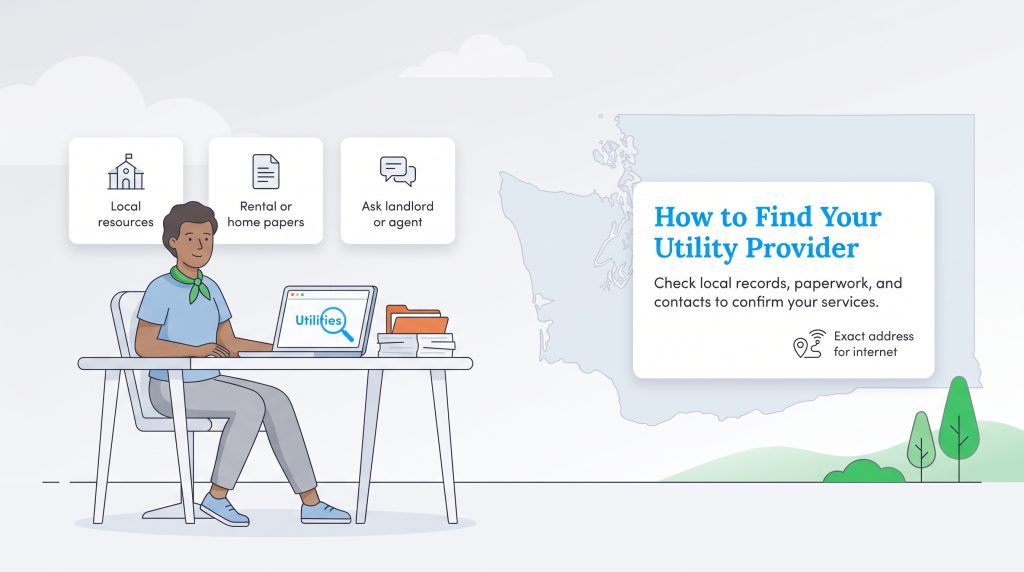
Finding out exactly who provides your essential services requires a quick check of local records. Follow these simple steps to confirm your utility companies:
- Search local resources: Check your city or county website for “utilities” or “start service” to find municipal providers.
- Review your paperwork: Check your lease, closing documents, seller disclosure, or property listing for active service details.
- Ask the current contacts: Reach out to your landlord, property manager, real estate agent, or escrow officer.
- Look up specific addresses for internet: Search internet availability by exact address, because fiber or cable networks can change block by block.
Average Utility Costs in Washington State
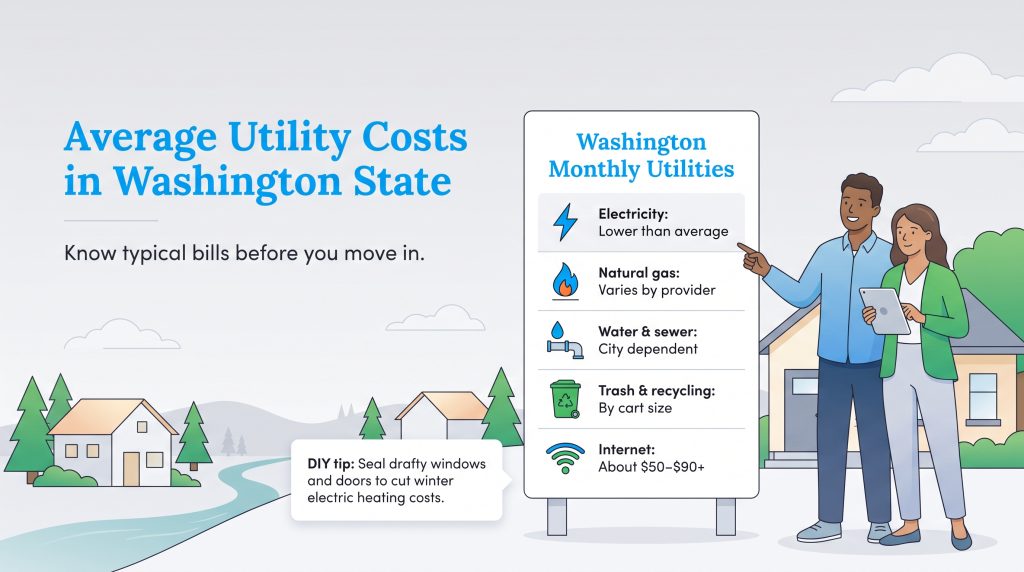
Budgeting for a new home means calculating your monthly overhead, and residents here often catch a financial break when it comes to power. This affordability directly stems from the region’s massive hydroelectric infrastructure. Thanks to the Columbia River basin and numerous dams, Washington relies on a low-cost, hydropower-heavy electricity mix that keeps residential rates highly competitive.
According to recent data from the U.S. Energy Information Administration’s Washington profile, Washington homeowners enjoy some of the cheapest residential electricity prices in the country. Of course, your actual monthly bill will fluctuate depending on your home’s square footage, the age of your appliances, and whether you rely on electric baseboard heating during the damp winter months. While baseline rates remain low, winter heating demands can still cause an unexpected spike if your new space lacks proper insulation.
To help you anticipate your monthly budget, we compiled typical cost factors for major Washington utilities. Keep in mind that exact costs vary heavily based on your specific city, household size, and seasonal usage.
| Utility | Typical Washington Cost Factor | What Affects the Bill |
|---|---|---|
| Electricity | Lower than national average (averaging roughly 10–12 cents per kWh) | Heating type, home size, insulation, appliance efficiency |
| Natural Gas | Varies by provider and global market rates | Furnace or water heater fuel, winter usage, fixed monthly base charges |
| Water and Sewer | Highly localized (e.g., Seattle rates differ greatly from Spokane) | Household size, summer irrigation, sewer base charges |
| Trash and Recycling | Usually billed monthly or bi-monthly by cart size | Cart size, pickup frequency, municipal vs. private hauler rates |
| Internet | Roughly $50–$90+ per month | Speed tier, fiber availability, promotional vs. standard pricing |
Even with favorable regional rates, finding creative ways to save on your electric bill always pays off. Simple adjustments like sealing drafty windows or upgrading to LED bulbs maximize your home’s energy efficiency right from the start.
💸 Money-Saver: Conduct a DIY home energy audit the moment you move in by checking for drafts around exterior doors and windows. Sealing these gaps immediately prevents expensive winter heat from escaping and may help lower your winter bill, especially in older homes.
Don’t Forget Trash, Recycling, and Internet Services
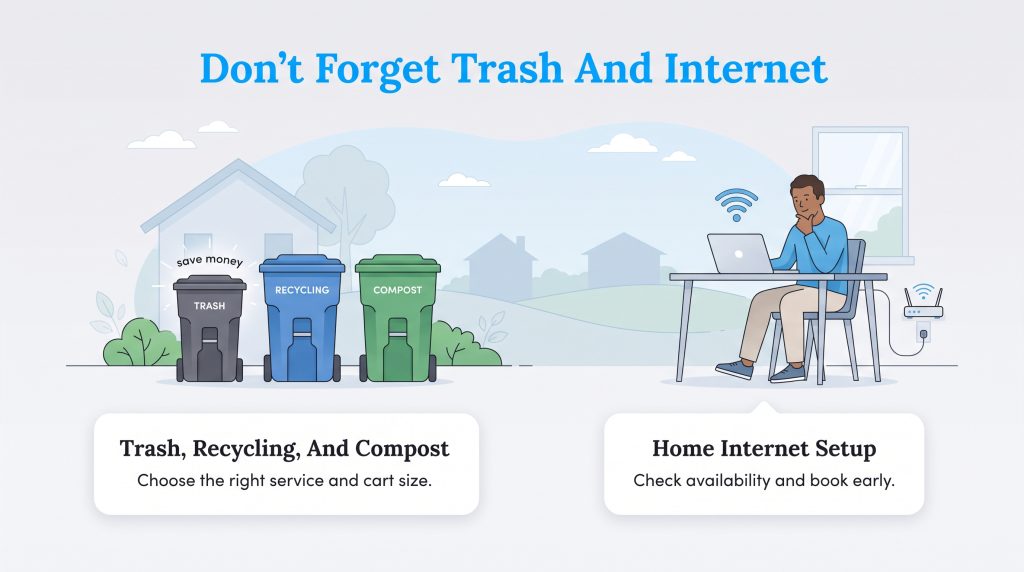
A complete moving checklist extends beyond just electricity and water. In Washington, many cities have strong recycling and composting programs, so setting up your solid waste collection correctly is essential. If you’re renting, ask your landlord whether trash is included in your monthly rent. If you’re buying a home, check your local city or county solid waste page. In some areas, garbage service is provided by a private hauler under city contract, while places like Seattle handle it directly through Seattle Public Utilities. Choosing the smallest practical trash cart can sometimes reduce your monthly costs.
Setting up your digital connection requires just as much attention. Start by checking fiber, cable, DSL, or fixed wireless availability by your exact address, and make sure to compare home internet options carefully. Schedule installation at least one to two weeks early, especially if a technician needs to come out. For rural Washington residents, options may be more limited, so comparing fixed wireless or satellite internet may be worth your time.
The Ultimate Timeline for Setting Up Utilities in Washington State
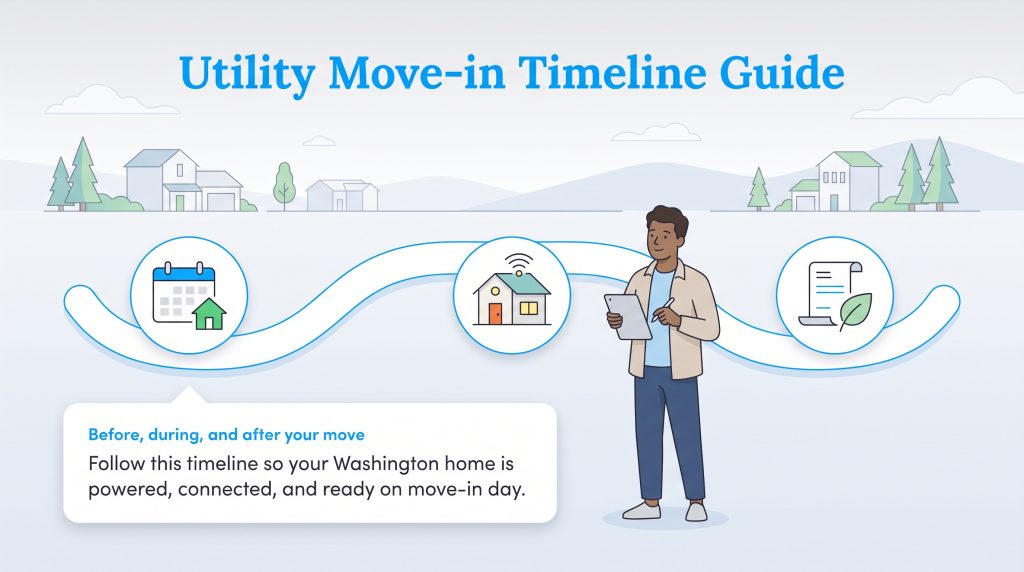
Timing is everything when transferring your essential household services to a new address. We mapped out a chronological sequence to keep your transition on track. By following these steps, you give yourself a better chance of walking into a fully powered, fully connected home on move-in day.
Documents and Details You’ll Need
Before making any calls, gather the following information to speed up the process:
- Your new service address and move-in, lease start, or closing date.
- A government-issued ID and Social Security number (if required for credit checks).
- Previous utility account numbers, if transferring service within the same provider.
- Closing or lease contacts, such as your landlord, property manager, or escrow officer.
Three Weeks Before Moving
Identify your electric, gas, water, sewer, trash, and internet providers. Ask your landlord or escrow officer which specific services you’re responsible for covering. This is also the time to compare internet availability by address and check whether providers require deposits or credit letters.
Two Weeks Before Moving
Contact your new providers to schedule your official start dates, and don’t forget to schedule shut-off dates at your old home. Book your internet installation now to ensure a technician is available. While you have the utility representatives on the phone, ask about green power programs, paperless billing, budget billing, and available rebates.
Move-In Week
Confirm all your appointments and save your new account numbers. You can also enroll in autopay if desired. If you are moving to a property with municipal trash service, verify whether the trash and recycling carts are already present at the home.
Move-In Day
Once you arrive, test the lights, outlets, heat, water, and hot water. Locate the breaker panel, main water shut-off, gas shut-off valve, and internet equipment so you know exactly where they are in an emergency. Finally, photograph your meters if they are easily accessible.
After Move-In
Review your first bill carefully to ensure you aren’t paying overlapping charges. Adjust your trash cart size if you notice you have excess space, and schedule any energy-saving upgrades or weatherization rebates.
Utility Setup Nuances for Renters vs. Homeowners
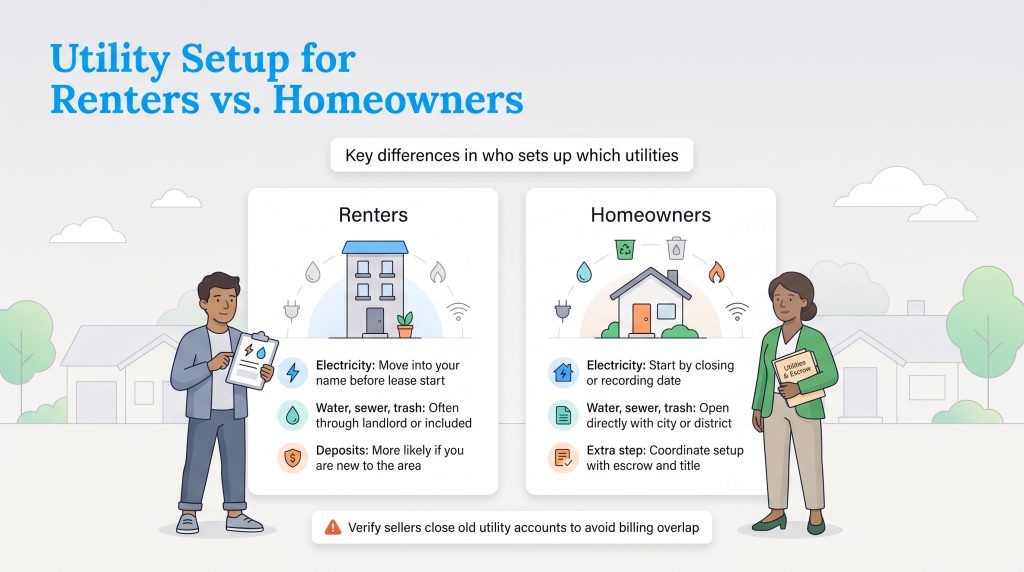
Setting up your essential services looks noticeably different depending on whether you’re signing a lease or holding the deed. For renters, the primary task involves transferring the billing into your name before the property management company hands over the keys. If you’re moving with an out-of-state credit history, be prepared to budget for potential utility security deposits. Local municipalities often require these upfront fees for new residents, though they frequently refund them after a year of on-time payments.
Homeowners face a slightly more complex web of responsibilities, as they must carefully coordinate the transition with their escrow officer. Buyers should thoroughly review the Form 17 seller disclosure document to identify property systems, but you should rely on your title and escrow review to uncover any lingering property liens tied to unpaid utility bills. You also need to ensure your service activation dates align perfectly with the official county recording day, as you’re legally responsible for the property’s energy usage from that exact moment onward. To help clarify these roles, review the quick breakdown below.
| Task | Renters | Homeowners |
|---|---|---|
| Electricity | Usually set up in your name before the lease start date | Set up before the closing or official recording date |
| Water and Sewer | Often handled by the landlord or billed back to the tenant | Usually handled directly with the city or local utility district |
| Garbage and Recycling | Often included in rent or billed through the property | Set up through the city, county, HOA, or private hauler |
| Natural Gas | Set up if your unit has gas heat or appliances | Set up if your new home uses active gas service |
| Internet | Compare by address and schedule installation | Compare by address and check for existing wiring or fiber terminals |
| Deposits | Possible for brand-new customers without local history | Possible, depending on the provider and credit or payment history |
🚩 Heads Up: Always verify with your real estate agent that the previous homeowner has officially closed their utility accounts. If the seller leaves their account active, it can create frustrating billing overlaps that take weeks for the local municipality to untangle.
Renewable Energy Options and Eco-Friendly Utilities
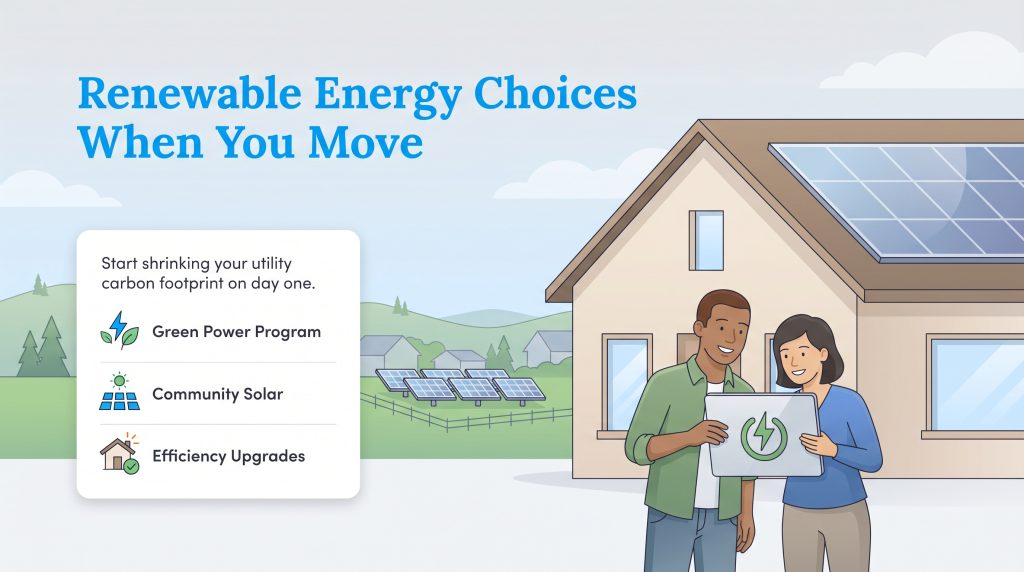
One major element missing from most relocation guides is how easily you can shrink your household carbon footprint during a move. Washington maintains a robust commitment to sustainability, giving residents great access to green energy. Even though you can’t shop around for different electric companies, you can still seek out renewable energy options Washington utilities provide directly through their managed programs.
Many major regional providers allow customers to purchase green power blocks, ensuring a specific percentage of their monthly electricity usage comes from wind or solar generation. Some utilities offer programs guided by the EPA Green Power Partnership, or use third-party certification like Green-e to verify their renewable energy credits. This allows you to support local renewable infrastructure for a small monthly premium. Opting into a community solar project serves as another environmentally mindful choice where available, offering renters a way to support clean energy without physically installing panels on their roof.
If you own your property, exploring residential solar options provides a fantastic long-term investment. Taking advantage of these programs represents a powerful, energy-saving option that pays dividends for both the local ecosystem and your eventual property value. Additionally, look into ENERGY STAR appliances, LED lighting upgrades, or heat pump installations to further improve your home’s overall efficiency.
🌱 Eco Edge: You can make an immediate green impact by opting into paperless billing and checking whether your provider offers a smart thermostat rebate the day you activate your account. These simple steps significantly reduce physical waste and optimize your daily heating schedules.
How to Transfer Utilities Smoothly When Moving Out
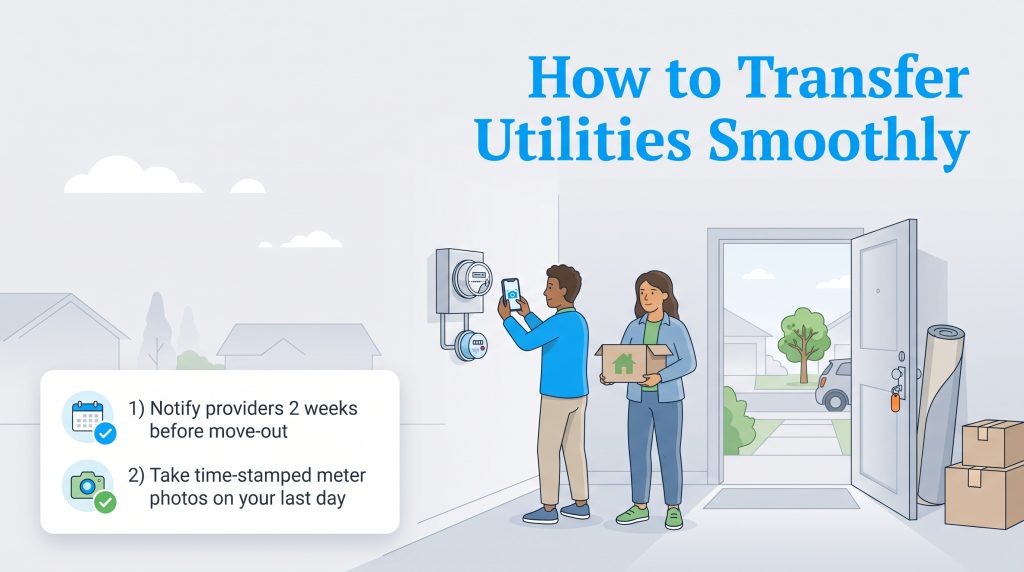
While setting up utilities in Washington state correctly is vital for your arrival, closing out your old accounts properly requires just as much attention. If you’re relocating from another city within the Pacific Northwest, you want to leave your previous residence without dragging any surprise expenses along with you. Inform your current providers of your exact move-out date at least two weeks prior to your departure to ensure they process the shut-off orders on time.
The most crucial step in dispute prevention happens on your very last day in the old home. Before you lock the door and drive away, take a clear, time-stamped photo of your final electric and water meter readings. Having this hard visual evidence helps reduce the risk of being overcharged just in case the company delays their official reading and tries to bill you for energy consumed by the next occupant or cleaning crew.
Taking Charge of Your Pacific Northwest Energy Transition
Organizing your essential services early and thoroughly researching your local provider options helps ensure a stress-free move while opening the door to greener, more affordable electricity. By locking in your activation dates ahead of time and actively choosing sustainable power programs, you set the stage for a smooth arrival. Now that your household infrastructure is securely handled, you can step away from the logistical headaches and focus entirely on enjoying your new home in the Pacific Northwest.
Frequently Asked Questions About Moving to Washington State Utilities
These quick answers cover the most common questions we hear from people setting up utilities in Washington. Use them to double-check provider responsibilities, deposits, renewable options, and city-specific setup steps before move-in day.
Who is my electric provider in Washington state?
How do I set up water and sewer in Seattle?
What is the average cost of electricity in Washington?
Can I choose my energy supplier in Washington state?
Do I need natural gas service in Washington?
Do renters need to pay utility deposits in Washington?
How do I sign up for renewable energy programs?
Who handles trash and recycling when I move to Washington?
About the Author

LaLeesha has a Masters degree in English and enjoys writing whenever she has the chance. She is passionate about gardening, reducing her carbon footprint, and protecting the environment. She also recently served as President of the Board for City Sprouts (a community garden).

Claudio is a sustainability-focused writer with a background in Anthropology and Psychology from NC State University. He has spent over 15 years working in writing, interpretation, and translation, driven by a deep interest in how human culture shapes the environment. Today, he shares his curiosity with readers by writing about sustainable living solutions and the connection between everyday choices and environmental impact.