
- Free modem and anti-virus software
- No contracts and unlimited data
- Bundle with TV to save more
- Speeds up to 7 Gbps**
Quick Utility Facts
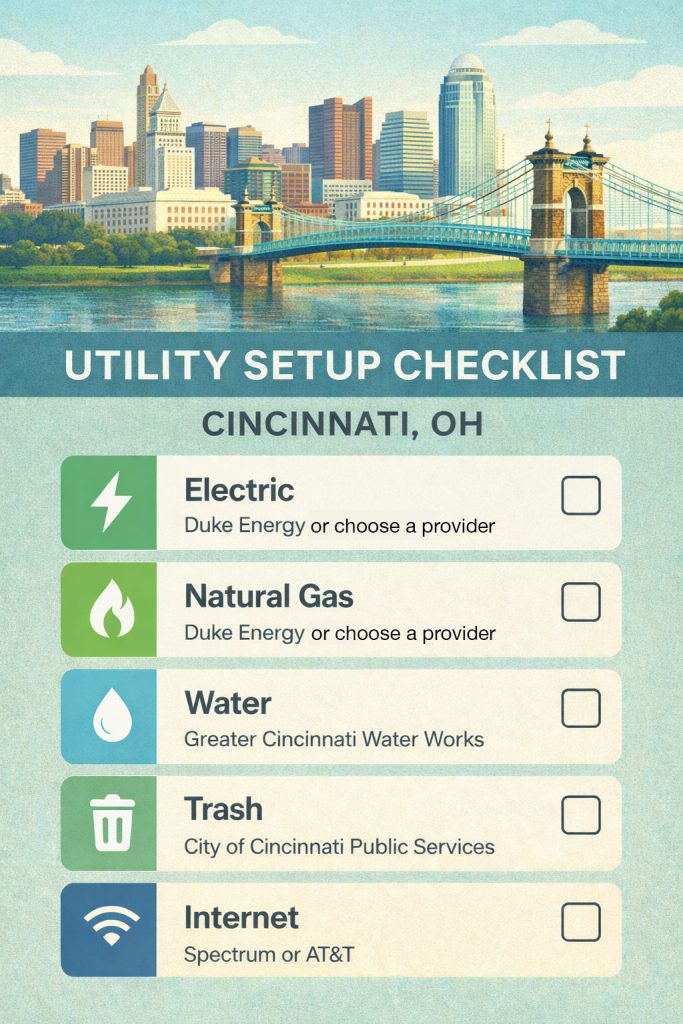
- The electric and natural gas utility in Cincinnati is Duke Energy.
- You have the power to choose a different electric or natural gas plan and provider that is right for your home.
- The primary internet service providers are Spectrum, altaFiber, and AT&T Fiber.
- The cheapest internet plan in Cincinnati is $30.00/month from Spectrum.
- Drinking water is provided by GCWW.
- The City of Cincinnati manages trash and recycling services, while Rumpke performs the actual pickup.
Top 39 Electric Providers in Cincinnati

- 8.19¢ /kWh
- 100%
- None
- 6-24 Months
- Carbon-Free Commitment

- 6.99¢ /kWh
- 25%
- None
- 1-6 Months
- Focus on Affordability
- 8.99¢ /kWh
- 0%
- None
- 12-20 Months
- Best for Flexibility

- 8.98¢ /kWh
- 6-100%
- None
- 1-36 Months
- Best for Low Rates

- 10.59¢ /kWh
- 100%
- None
- 3-24 Months
- 100% Renewable Energy

- 10.29¢ /kWh
- 100%
- None
- 9-20 Months
- 100% Carbon-Free Electricity

- 0¢ /kWh
- 100%
- 90 days
- 12 Months
- Employee-Owned

- 9.49¢ /kWh
- None
- 8-24 Months

- 9.99¢ /kWh
- 100%
- None
- 1-12 Months
- Zero Cancellation Fees

- 10.29¢ /kWh
- None
- 8-24 Months
- No Cancellation Fees

- 10.39¢ /kWh
- 90 days
- 8-24 Months
- Total Satisfaction Guarantee
- 10.49¢ /kWh
- 100%
- None
- 8-24 Months
- No Cancellation or Extra Fees

- 10.49¢ /kWh
- 100%
- None
- 12 Months
- Price Protection Plans

- 7.45¢ /kWh

- 8.37¢ /kWh
- None

- 8.49¢ /kWh
- 31%
- 60 days
- 12-36 Months
- Popular Bill Credit Plans

- 9¢ /kWh

- 9.49¢ /kWh
- 9.69¢ /kWh

- 9.9¢ /kWh

- 10¢ /kWh
- 10.3¢ /kWh

- 10.49¢ /kWh
- 10.6¢ /kWh

- 10.6¢ /kWh
- None
- 3-12 Months
- Best for Rewards Programs

- 11.28¢ /kWh

- 11.09¢ /kWh
- None
- 6-24 Months
- Wide Plan Selection

- 10.59¢ /kWh
- 24%
- None
- 12-36 Months
- Best for Apartments

- 11.49¢ /kWh
- 26-100%
- 90 days
- 3-36 Months
- Proven Leader in Clean Energy
- 11.9¢ /kWh

- 11.99¢ /kWh

- 10.99¢ /kWh
- None
- 6-12 Months
- No Sign Up or Cancellation Fees

- 12.99¢ /kWh
- 24%
- 90 days
- 12-36 Months
- Get Rewarded for Higher Usage

- 13.3¢ /kWh
- 100%
- None
- 12 Months
- 15.4¢ /kWh

- 15.9¢ /kWh

- 23¢ /kWh

- 33.37¢ /kWh
- 10.06¢ /kWh

See Top Plans in Your Area
Electricity across the Queen City is delivered physically by Duke Energy Ohio, which maintains the transmission poles, overhead lines, and digital meters, and dispatches crews for storm outage restorations. Because Ohio operates under a deregulated energy choice market overseen by the Public Utilities Commission of Ohio (PUCO), your electric bill is split into supply and delivery. You have three options for your electric generation: you can stay on Duke Energy’s default Standard Service Offer (“Price to Compare”), shop independently on PUCO’s Apples to Apples portal, or participate in the voter-approved Cincinnati Electric Aggregation Program. The city’s aggregation program (supplied by Dynegy) automatically enrolls eligible residents into a fixed-rate, 100% green renewable power contract that allows you to opt out at any time without cancellation fees. Duke Energy appends non-negotiable delivery charges, distribution fees, and state riders onto every account, bringing typical residential bundled electricity rates to roughly 14 to 16.5 cents per kWh. Shifting heavy appliance usage away from humid summer afternoon cooling windows and keeping your thermostat set efficiently during regional heatwaves helps keep seasonal electric expenses in check.
Top 25 Natural Gas Providers in Cincinnati
- $0.5690 /therm
- 12-36 Months
- Best for Home Protection Bundles
- $0.0000 /therm
- 12 Months
- Employee-Owned
- $0.4990 /therm
- 1-12 Months
- Zero Cancellation Fees
- $0.4990 /therm
- 1 Month
- Focus on Affordability
- $0.5023 /therm
- 12-18 Months
- Trusted by 4 Million Customers
- $0.5996 /therm
- Price Protection Plans
- $0.6123 /therm
- 1-24 Months
- $0.4190 /therm
- $0.4390 /therm
- 100% Carbon-Free Electricity
- $0.5590 /therm
- $0.5590 /therm
- Get Rewarded for Higher Usage
- $0.5785 /therm
- Carbon-Free Commitment
- $0.5790 /therm
- $0.6390 /therm
- $0.6500 /therm
- $0.6990 /therm
- Popular Bill Credit Plans
- $0.7990 /therm
- $0.6890 /therm
- $0.8900 /therm
- $0.8990 /therm
- $0.9383 /therm
- Best for Rewards Programs
- $0.9546 /therm
- $0.9650 /therm
- $0.9900 /therm
- $0.4896 /CCF

See Top Plans In Your Area
Natural gas service across Cincinnati is delivered physically by Duke Energy Ohio, which owns, operates, and inspects the physical underground gas mains and handles 24/7 leak response. Just like the electric grid, natural gas supply is deregulated under Ohio’s Gas Choice framework. Residents can purchase their natural gas supply from an independent competitive retail marketer via PUCO’s Apples to Apples portal, enroll in the City of Cincinnati’s municipal natural gas aggregation program, or remain on Duke’s default Standard Choice Offer (SCO), which reflects wholesale market pass-through prices without retail markups. Duke Energy bills mandatory distribution delivery rates, capital improvement riders, and a fixed monthly customer charge on every statement. Because Cincinnati winters bring sub-freezing temperatures that demand sustained heating from radiator boilers, heat pumps, and forced-air furnaces, natural gas consumption peaks sharply between December and March. Usage plummets once spring arrives, but Duke’s mandatory fixed monthly customer fee ensures your account carries a baseline infrastructure maintenance cost year-round, even in July or August when space-heating systems sit idle.
Top 12 Internet Providers in Cincinnati
- 7 Gbps**
- Cable & Fiber
- Unlimited
- TV & Phone
- 96.6%
- $30.00/mo
- Most Affordable Plans

- 2 Gbps
- Fiber
- Unlimited
- 85.51%
- $40.00/mo

- 5 Gbps
- Fiber
- Unlimited
- Mobile
- 65.48%
- $35.00/mo
- Get a $200 Reward Card*

- 400 Mbps
- Satellite
- Unlimited
- None
- 100%
- $55.00/mo

- 300 Mbps
- 5G
- Unlimited
- Mobile
- 100%
- $35.00/mo
- Wireless Internet Great for Renters

- 498 Mbps
- 5G
- 1.2 TB
- Mobile
- 99.95%
- $35.00/mo
- Wireless Internet

- 300 Mbps
- 5G
- Unlimited
- Mobile
- 99.75%
- $40.00/mo
- Wireless Internet

- 150 Mbps
- Satellite
- 150-850 GB
- Phone
- 100%
- $39.99/mo

- Varies
- Fiber, Cable, 5G, & Satellite
- Varies
- 95%
- $39.95/mo

- 2 Gbps
- Fiber
- 1 TB
- 5.67%
- $29.00/mo

- 7 Gbps
- Fiber
- Unlimited
- Phone
- 2.09%
- $29.99/mo

- 2 Gbps
- Cable & Fiber
- Unlimited
- TV & Phone
- 1.74%
- $30.00/mo
- Lock in Your Price for 5 Years
Getting internet hooked up in Cincinnati is quick, with two main players covering the metro area. Your best bet for ultra-fast, symmetrical speeds is altafiber (formerly Cincinnati Bell), which has built out an extensive fiber-to-the-home network across Greater Cincinnati, alongside widespread cable coverage from Spectrum (Charter Communications) and 5G home internet from T-Mobile and Verizon. If you are settling into a historic brick home in Over-the-Rhine (OTR), Mount Adams, Clifton, or Columbia-Tusculum, running new fiber drops from alley poles or through multi-wythe structural brick walls can occasionally require the technician to plan out an entry point with you on installation day. If you are moving into a newer apartment complex along the riverfront at The Banks or in Oakley, high-speed fiber or coax is generally ready to activate right when you move in.
Water & Sewage Providers in Cincinnati

Water and wastewater services operate through a coordinated municipal framework shared between Greater Cincinnati Water Works (GCWW) for drinking water and the Metropolitan Sewer District of Greater Cincinnati (MSD) for wastewater collection and treatment. Drawing raw supply primarily from the Ohio River at the Richard Miller Treatment Plant alongside deep groundwater from the Great Miami Aquifer, GCWW typically bills single-family residential customers on a quarterly or monthly cycle. MSD wastewater treatment is billed in tandem and includes a monthly minimum base charge ($43.06 for a standard 5/8-inch meter, which covers your first 3 CCF of water) plus volumetric commodity fees for usage above that baseline. To protect residents from paying sewage treatment fees for summer garden hoses and lawn sprinklers, MSD uses a Winter Period calculation: your monthly sewer charge from April through December is capped based on your average indoor water consumption measured during January, February, and March. Because sewer rates scale directly with your water intake, an unnoticed toilet flapper leak during those winter tracking months will artificially inflate your sewer cap for the rest of the year.
Top 16 Trash and Recycling Providers in Cincinnati
Curbside trash and recycling in Cincinnati are run by the City of Cincinnati Department of Public Services (DPS), with curbside recycling contracted out to local waste giant Rumpke. Household garbage goes into your green city-issued rolling cart and is picked up weekly, while recycling is collected every other week in green Rumpke recycling carts. Because Rumpke’s regional recycling headquarters is based right in Cincinnati, they have an advanced facility that accepts a wide range of everyday plastics (including yogurt cups, fruit tubs, and clean takeout tubs), but plastic grocery bags and garbage bags are strictly prohibited—everything must go into the green recycling bin loose. If you have oversized household items like old couches or furniture, the city provides curbside bulk collection on your regular trash day, though large metal appliances and Freon units require scheduling ahead by calling 311 or submitting a request online. Make sure your bins are rolled to the curb after 5:30 PM the evening before your collection day or by 6:00 AM that morning, leaving about three feet of space around each cart.
Utilities Summary for Cincinnati, OH
| Electric Companies: | 39 |
| Natural Gas Companies: | 25 |
| Water & Sewage Providers: | 1 |
| Garbage, Trash & Recycling Providers: | 16 |
| Municipal Electricity: | No |
A Guide to Utility Services in Cincinnati
Nestled along the Ohio River, Cincinnati blends historic charm with modern innovation. Known for its rich arts scene, family-friendly neighborhoods, and vibrant sports culture, it’s a city full of character. As you settle in, one of the most important steps is getting your utilities up and running, so let’s walk through everything you need to know about electricity, gas, water, trash, internet, green energy options, and available assistance programs.
Powering Your Home: The Duke Energy vs. Supplier Guide
If you are moving to Cincinnati from out of state, your electricity bill might look different than you are used to. Ohio is a “Choice” state, which means the company that delivers your power is different from the company that generates it.
Understanding this difference is the key to avoiding scams and keeping your monthly budget in check.
The Distributor: Duke Energy Ohio
Duke Energy is the non-negotiable part of the equation. They own the poles, wires, and gas pipelines connected to your home. Regardless of who you buy your electricity from, Duke Energy is responsible for delivering it and maintaining the safety of the grid.
- Service Territory: Duke serves approximately 840,000 electric customers across Southwest Ohio.
- Emergency Contact: If your power goes out or you smell gas, do not call your supplier. You must contact Duke Energy immediately.
- Electric Outage Reporting: 800-543-5599
- Gas Leaks & Emergencies: 800-634-4300
- New Service Setup: To turn on service at your new address, you should contact Duke Energy at least 3 business days before your move-in date.
- Start Service Online
- Phone: 800-544-6900
- Offers the Smart $aver® program, which provides rebates on energy-efficient appliances and HVAC upgrades.
- Customers can track usage, set up alerts, and enroll in budget billing via the Duke Energy mobile app or online portal.
The “Good Payment” Deposit Waiver
Duke Energy typically runs a credit check for new accounts. If a security deposit is required, know that it is not lost money. If you maintain a good payment record (no more than one late payment) for 12 months, the deposit can be waived or refunded after 24 months of continuous service.
The Supplier: Your “Energy Choice”
In Ohio, you have the right to choose the company that generates your electricity. This is known as Competitive Retail Electric Service (CRES).
If you do nothing, you will be automatically enrolled in Duke Energy’s “Standard Service Offer.” However, you can often find lower rates by shopping around.
- The “Price to Compare” (PTC): This is the most important number on your bill. It is the rate Duke Energy charges for generation. You should use this as your benchmark.
- Current Benchmark: As of January 2026, the residential Price to Compare for Duke Energy Ohio is approximately 10.06 cents per kWh. If a supplier offers you a rate higher than this, you will pay more than necessary.
- How to Shop Safely: The only official, unbiased source for comparing supplier rates is the Public Utilities Commission of Ohio (PUCO) website.
Warning: Be careful with “Variable Rate” plans. These often start with a low introductory rate but can spike significantly after the first few months. We generally recommend sticking to “Fixed Rate” plans to keep your budget predictable.
Top 5 Electric Suppliers in Cincinnati, OH
Energy Harbor – 4.8 / 5.0
Best Overall Value & Transparency
Energy Harbor is a fully integrated energy producer and retailer headquartered in Akron, Ohio. Born from the restructuring of FirstEnergy Solutions, the company has established itself as a major player in the US power market with a specific focus on carbon-free baseload generation. They serve nearly one million residential and commercial customers, leveraging their fleet of nuclear power plants to provide price stability that many asset-light competitors cannot match.
Why We Ranked Them #1: Energy Harbor takes the top spot for 2026 because they consistently score highest on our “Fees & Fine Print” (15% weight) and “Price & Value” (35% weight) metrics. Unlike many competitors who attach $150 early termination fees to their contracts, Energy Harbor typically offers their “Safe Harbor” residential plans with $0 Early Termination Fees. This transparency, combined with fixed rates that are currently undercutting the Cincinnati municipal aggregation rate, makes them the safest and most flexible choice for the average household.
What Customers in Ohio Are Saying: Customer sentiment is overwhelmingly positive regarding billing simplicity. Reviews frequently mention the “no-nonsense” approach to contracts and the ease of switching. While some historical feedback cites aggressive door-to-door sales (a common industry issue), recent verified reviews highlight the seamless nature of their digital enrollment process and fair renewal offers.
Best For: Renters and risk-averse homeowners who want a competitive fixed rate without being locked into a contract by high cancellation fees.
Constellation – 4.6 / 5.0
Best for Long-Term Stability
Constellation is the nation’s largest producer of carbon-free energy and a Fortune 200 company serving over 2 million residential customers. As the retail arm of a massive generation fleet (formerly part of Exelon), they have the financial fortitude to weather extreme market volatility. They are a “blue-chip” provider in the deregulated energy space, offering everything from standard power to renewable energy products and smart home bundles.
Why We Ranked Them #2: Constellation scores exceptionally well on “Reliability” (20%) and “Plan Breadth” (10%). They are one of the few suppliers offering true long-term stability with fixed-rate contracts extending up to 36 months. While their rates are sometimes slightly higher than the absolute lowest “teaser” rates on the market, the premium buys you industry-leading customer service and the security of a contract backed by a massive balance sheet.
What Customers in Ohio Are Saying: Ohio residents frequently describe Constellation as “professional” and “reliable.” Long-term customers appreciate the stability of their bills and the quality of the online account portal. The few negative reviews tend to focus on the renewal process, where customers who forgot to renew were moved to a variable rate, underscoring the importance of managing your contract end-date.
Best For: Homeowners who want to “set it and forget it” by locking in a price for 3 years to protect against inflation and capacity market spikes.
3. IGS Energy – 4.5 / 5.0
Best for Green Energy & Local Support
Headquartered in Dublin, Ohio, IGS Energy is one of the largest independent, family-owned energy suppliers in the country.15 They have built a strong reputation over the last 30 years by focusing on sustainability and community involvement. Unlike many competitors who view green energy as a niche product, IGS has integrated carbon-neutral natural gas and renewable electricity into the core of their business model.
Why We Ranked Them #3:
IGS Energy is the clear leader for our “Price & Value” metric when filtered for renewable energy. For Cincinnati residents looking to beat the city’s aggregation rate while still supporting green energy, IGS is the top choice. They combine competitive pricing (often in the 9.7¢ – 10.9¢ range) with a strong local presence, scoring highly on “Independent Trust Signals” (10%).
What Customers in Ohio Are Saying: Local sentiment is warm toward IGS as a “hometown” brand with a conscience. Reviews often highlight the company’s commitment to solar and sustainable projects in Ohio. Customer service is generally rated highly, though like many major suppliers, there are occasional complaints regarding the tactics of third-party sales vendors.
Best For: Eco-conscious Cincinnati residents who want to support an Ohio-based company and use green energy without overpaying.
4. AEP Energy – 4.3 / 5.0
Best Brand Trust & Rewards
AEP Energy is the competitive retail subsidiary of American Electric Power, one of the largest and most respected utility holding companies in the U.S. While distinct from the regulated utility (AEP Ohio), they leverage the same heritage of operational excellence. They supply electricity to hundreds of thousands of customers across the PJM grid, offering a reliable alternative to the local utility default.
Why We Ranked Them #4: AEP Energy ranks highly on “Independent Trust Signals” (10%) and “Plan Breadth” (10%). Their affiliation with AEP provides immediate peace of mind for customers wary of unknown brands. They differentiate themselves with the AEP Energy Reward Store, where customers can earn credits toward smart thermostats and energy-saving devices, adding tangible value beyond the kilowatt-hour rate.
What Customers in Ohio Are Saying: Users consistently praise the clarity of AEP Energy’s bills and the lack of hidden fees. The brand trust is high; many customers feel safer buying power from a company carrying the “AEP” name than from less recognizable competitors. Positive feedback frequently mentions the value of the reward points for smart home upgrades.
Best For: Tech-savvy homeowners who can utilize the Reward Store perks, and anyone prioritizing brand recognition and trust.
5. Public Power – 3.8 / 5.0
Best for High-Usage Homes
Public Power is a value-focused brand under the Vistra Corp umbrella, a Fortune 500 integrated power company. They specialize in offering rate structures that can provide significant savings for specific types of users. Backed by Vistra’s massive generation assets, they are a financially stable provider that competes aggressively on price.
Why We Ranked Them #5: Public Power enters the top 5 specifically for their value to high-consumption households. They frequently offer rates that appear drastically lower than the market average (e.g., 8-9¢ range) but pair them with a monthly flat fee (often $10-$15).25 While this hurts their score on “Fees & Fine Print” due to complexity, it mathematically results in the lowest effective rate for homes using over 2,000 kWh per month.
What Customers in Ohio Are Saying: Reviews are polarized based on usage. High-usage customers (those with EVs or large homes) rave about the savings, often seeing bills significantly lower than the utility default. Conversely, lower-usage customers who didn’t read the fine print regarding the monthly fee often express frustration, pulling down the overall sentiment score.
Best For: High-usage households (2,000+ kWh/month) who can do the math to ensure the flat fee is offset by the lower per-kWh rate.
Why Trust These Rankings?
Our rankings are independent, data-driven, and devoid of “pay-to-play” influence. To determine the scores above, we analyzed Public Utilities Commission of Ohio (PUCO) “Apples to Apples” rate filings to verify pricing, cross-referenced complaint ratios from the Better Business Bureau (BBB) to gauge reliability, and stress-tested parent company financials to ensure stability in a volatile market.
We believe that a cheap rate is only good if the company behind it is honest. That’s why our algorithm weights Price & Value (35%) and Reliability & Complaints (20%) as the two most critical factors.
Read more about Our Methodology for Ranking Electric Suppliers
Community Aggregation: That “Opt-Out” Letter
Shortly after you move in, you may receive a letter from your local township or municipality (such as the City of Cincinnati, Blue Ash, or Colerain) stating that you will be automatically enrolled in an energy program unless you “opt out.”
Do not panic. This is not a scam.
- What is it? This is Community Aggregation. Your local government has negotiated a bulk rate for all residents, often to secure a lower price or 100% renewable energy.
- What should you do? Compare the rate offered in the letter to the current Duke “Price to Compare” (listed on your bill or the PUCO website).
- If the aggregation rate is lower, you can simply do nothing; you will be enrolled automatically.
- If you prefer to stay with Duke or choose your own supplier, follow the instructions in the letter to opt out. There is no penalty for opting out during this window.
Heating Your Home: The Natural Gas Guide
Just like electricity, the natural gas market in Cincinnati is deregulated. This means you have choices, but it also creates a complex billing structure. Duke Energy Ohio delivers the gas, but you can choose who you buy it from.
The Distributor: Duke Energy
Duke Energy owns the pipelines and meters. No matter who you buy your gas from, Duke Energy charges you for distribution (delivery).
- Emergency: If you smell gas (rotten eggs) or suspect a leak, leave the area immediately and call Duke Energy at 800-634-4300.
- Digging? Before installing a fence or planting a tree, you must call 811 (OUPS) at least 48 hours in advance to have underground lines marked. This is a free service required by law.
Your Supply Options: SCO vs. Fixed Rate
If you do not choose a specific supplier, you are placed on the Standard Choice Offer (SCO).
- How SCO Works: You are assigned a supplier selected by Duke Energy. The rate is variable and changes monthly based on the market price of natural gas (NYMEX) plus a small retail adjustment.
- Pros: You always pay the current market rate, which can be very low in mild winters.
- Cons: Your bill is unpredictable. If global gas prices spike, your bill spikes immediately.
- Fixed Rate Plans: You can shop for a supplier who offers a locked-in rate for 12 or 24 months. This offers budget stability but may be more expensive than the SCO if market prices drop.
- Compare Rates: Use the PUCO Apples to Apples tool to compare gas suppliers.
City of Cincinnati Aggregation
The City of Cincinnati has a negotiated bulk rate for natural gas, similar to its electric program.
- Current Status: As of late 2025/2026, the City’s program often offers a fixed rate (e.g., ~$0.619 per CCF) designed to protect residents from extreme market volatility.
- Eligibility: Residents are automatically enrolled unless they opt out.
- Check Your Rate: You can view the current City aggregation rate and compare it to Duke’s current SCO rate.
Budgeting for Winter (The “Budget Billing” Solution)
Natural gas bills in Cincinnati are highly seasonal. A drafty Victorian home in neighborhoods like Clifton or Walnut Hills can see gas bills jump from $30 in July to $250+ in January.
- Recommendation: Enroll in Budget Billing with Duke Energy immediately. This averages your estimated annual usage into 12 equal monthly payments, preventing the dreaded “holiday bill shock” in December and January.
Decoding the “Omni-Bill”: Water, Sewer, and More
If you are moving from a city where you receive separate bills for water, sewer, and trash, the Cincinnati system may surprise you.
The Greater Cincinnati Water Works (GCWW) acts as the billing agent for multiple services. This means your single monthly “Water Bill” is actually a consolidated invoice for up to four different municipal services.
What is on your bill?
When you open your GCWW bill, you will likely see line items for:
- Water: Charges from GCWW for the water you actually drink and use.
- Sewer: Charges from the Metropolitan Sewer District (MSD). Note: Due to federally mandated infrastructure updates (“Project Groundwork”), sewer rates in Cincinnati are significant and often exceed the cost of the water itself.
- Stormwater: A fee based on the “impervious surface” (concrete/roof) area of your property, used to maintain storm drains.
- Waste Collection: If you live within the City of Cincinnati limits, your trash collection fee is often included here rather than in your taxes.
The “Summer Sewer Cap” (Budget Pro-Tip)
Because sewer charges are high, MSD offers a financial safeguard for homeowners known as the Summer Sewer Cap.
- How it works: During the summer months, the utility assumes that extra water usage is for outdoor activities (watering lawns, washing cars, filling pools) and does not enter the sewer system.
- The Calculation: Your summer sewer fees are capped based on your average daily usage during the winter months (typically January, February, and March).
- The Strategy: To keep your summer bills low, try to conserve water during the winter “base” period. This sets a lower cap for the rest of the year.
Setting Up Service
- Online: The easiest way to start service is via the My GCWW portal. You can manage autopay and view daily usage charts here.
- Phone: Call 513-591-7700.
- Timing: Try to schedule your start date at least 2 business days in advance.
Renters vs. Landlords: In Cincinnati, water, sewer, and trash charges stay with the property, meaning the owner is ultimately liable for unpaid bills.
- For Renters: You can set up a “tenant account” to receive a courtesy bill in your name, but many landlords prefer to keep the bill in their name and add it to the rent to ensure it is paid. Clarify this with your landlord before move-in.
Water Quality & Safety
- Hardness: Cincinnati has “moderately hard” water (approx. 7-8 grains per gallon). You generally do not need a water softener, but some residents prefer one.
- “No ID, No Entry”: GCWW has a strict safety policy. All field employees carry a photo ID. Never let a worker into your home to “check the meter” or “test the water” unless they show this ID. If you are unsure, keep the door locked and call 513-591-7700 to verify their work order.
Rebates and Water Conservation
- GCWW promotes water efficiency with low-flow showerhead and faucet giveaways.
- Rebates may be available for rain barrels or irrigation system upgrades.
- Leak detection services are available for homeowners to reduce water waste.
Trash & Recycling: The City vs. Suburb Split
Trash collection in Cincinnati is not one-size-fits-all. Your service provider depends entirely on your specific municipality and the type of building you live in.
Living in the City of Cincinnati (1–4 Unit Homes)
If you live within the Cincinnati city limits in a single-family home or a small apartment building (up to 4 units), your trash collection is managed by the Department of Public Services (DPS).
- The “Dwelling” Rule: Buildings with 5 or more units are considered “commercial” and are not eligible for city trash pickup. If you move into a large apartment complex, your landlord must contract a private hauler (usually Rumpke).
- The Cart System: You cannot just use any trash can. You must use a “City-approved” cart compatible with the automated lifting arms on the trucks.
- Moving Tip: If your new home is missing its cart, or you need a larger one, you can purchase/register one through the 311Cincy app or by calling 513-591-6000.
- Bulk Items (Furniture/Mattresses): You cannot simply leave a couch on the curb. You must schedule a bulk pickup in advance via the 311Cincy Portal.
- Limit: Up to 5 items per scheduled pickup.
- Mattress Rule: For safety, mattresses and upholstered furniture should be wrapped in plastic before being placed at the curb to prevent bed bug spread.
Living in the Suburbs (or Large Apartments)
If you live in a township (like Anderson, Delhi, or Green) or a municipality like Norwood, your service is likely provided by Rumpke.
- The Red & Brown Trucks: Rumpke is the dominant private hauler in the region.
- Setup: In many suburbs, Rumpke service is set up automatically via the municipality, but billing methods vary. Some include it in property taxes, while others require a direct subscription. Check your township’s website immediately upon moving in.
- Contact: If you need to set up service individually, contact Rumpke at 1-800-828-8171.
Recycling Rules: The “No Bag” Policy
Whether you have City or Rumpke service, the recycling rules in Cincinnati are strict regarding one item: Plastic Bags.
- The Golden Rule: Never put your recyclables inside a plastic grocery bag. Plastic bags jam the sorting machines at the recycling plant. Keep recyclables loose in your bin.
- What is Accepted: Glass bottles/jars, aluminum/steel cans, plastic bottles/jugs (keep lids on), and cardboard.
- What is NOT Accepted: Plastic bags, batteries, clothing, hose/wires, and Styrofoam.
The “Hard-to-Recycle” Solution: The Hub
For items that cannot go in your curbside bin, like electronics, Styrofoam, lightbulbs, and plastic bags, Cincinnati has a unique resource: the Cincinnati Recycling & Reuse Hub.
- Location: Lower Price Hill (911 Evans St).
- What they take: They accept a massive array of items that curbside programs reject.
- Know Before You Go: As of January 1, 2026, the Hub has implemented a small drop-off fee (starting at ~$15/month or per drop-off) to cover processing costs. It is a fantastic resource for clearing out “moving waste” responsibly.
Yard Waste (Seasonal)
- City Residents: Yard waste is collected bi-weekly on your recycling day, typically from April through early January.
- The Rules: You must use paper yard waste bags or a dedicated can marked “Yard Waste.” Plastic bags are strictly prohibited and will be left at the curb.
Best Internet Providers in Cincinnati
Cincinnati offers a competitive internet market with fiber, cable, DSL, and 5G wireless options. The best provider for your home depends on location, speed requirements, and bundling options.
Top Internet Providers:
- Altafiber (formerly Cincinnati Bell)
- Available to about 94% of the city
- Offers fiber internet up to 2 Gbps with symmetrical speeds.
- Includes whole-home Wi-Fi solutions.
- Locally headquartered and well-regarded for customer service.
- Spectrum
- Covers almost 94% of homes in Cincinnati
- Offers cable internet up to 1 Gbps.
- No contracts or data caps.
- Often bundled with TV and phone services.
- AT&T Fiber
- Available in select areas, about 50% of the city, with speeds up to 5 Gbps.
- Strong bundling discounts with wireless service.
- T-Mobile 5G Home Internet
- Offers wireless home internet with speeds averaging 100–300 Mbps.
- Great for renters or areas without fiber.
- HughesNet & Viasat
- Satellite options for rural or hard-to-reach areas.
- Slower speeds and higher latency.
Budgeting for Your Cincinnati Utilities
One of the biggest questions for new residents is: “How much is this going to cost?”
To help you plan, we have compiled estimates for a standard 2-bedroom home or apartment (approx. 1,000 sq. ft.) in the Cincinnati area. Please note that these are estimates; older homes with poor insulation (common in neighborhoods like Hyde Park or Northside) may have significantly higher heating/cooling costs.
Estimated Monthly Utility Budget
| Utility Service | Estimated Monthly Cost | Factors Influencing Cost |
| Electricity | $90 – $145 | Heavily seasonal. High usage in summer (A/C) and winter (if you have electric heat). |
| Natural Gas | $50 – $130 | Winter peak for heating. Summer bills can be as low as $30-$40 (cooking/hot water only). |
| Water & Sewer | $60 – $90 | Warning: Sewer fees in Cincinnati are high and often exceed the cost of the water itself. |
| Internet | $50 – $80 | Depends on speed tier (e.g., 500 Mbps vs. 1 Gig). Promotional rates often expire after 12 months. |
| Trash | $0 – $30 | City of Cincinnati: Typically included in taxes (no monthly fee). Suburbs: Often billed quarterly ($60-$90) or added to your water bill. |
| TOTAL | $250 – $475 | Varies by season, home efficiency, and household size. |
The “Hidden” Costs to Watch For
- The Sewer Surprise: As mentioned in the Water section, your water bill includes sewer charges from MSD. Do not budget based solely on water usage; expect the sewer portion to double that line item.
- Old Housing Stock: Cincinnati has beautiful historic architecture, but 100-year-old windows are drafty. If you are renting an older unit, budget for the higher end of the Electric and Gas ranges.
- Introductory Internet Rates: Both Altafiber and Spectrum offer attractive “New Customer” rates. Be aware that these typically jump by $20-$30/month after the first year.
How to Get the Real Numbers (The “12-Month Average”)
Don’t guess, ask for data. Before you sign a lease or close on a house, you have two ways to verify the utility costs for that specific address:
- Ask the Landlord/Seller: Request to see the “Average Monthly Utility Cost” for the past year.
- Call the Utility: You can call Duke Energy (800-544-6900) and provide the specific address. While they cannot give you the previous owner’s personal details, they can often provide the high, low, and average monthly bill amounts for that service address over the last 12 months. This is the most accurate way to build your budget.
Financial Assistance for Utility Bills in Cincinnati
Utility bills can be a burden, especially for low-income households. Fortunately, several programs offer help.
City and State Resources
- PIPP Plus (Percentage of Income Payment Plan Plus)
- Caps monthly electric and gas bills at a set percentage of your income.
- Must apply through your local Community Action Agency.
- HEAP (Home Energy Assistance Program)
- Offers winter and summer crisis funds to help with heating or cooling bills.
- Apply through Ohio Development Services Agency.
- WarmUp Cincy
- Provides funding for energy-efficiency upgrades in low-income rental housing.
- 513Relief.org
- Connects residents with emergency rental and utility bill assistance during financial hardship.
- Salvation Army & St. Vincent de Paul
- Offer crisis utility bill payment assistance throughout the city.
Conservation and Green Energy Initiatives
Cincinnati is recognized for its commitment to sustainability and clean energy.
Noteworthy Programs
- Cincinnati’s Green Electricity Aggregation Program provides 100% renewable electricity to city residents who don’t opt out.
- The Green Cincinnati Plan outlines carbon neutrality by 2050.
- PACE financing is available for homeowners and businesses making energy-efficiency upgrades.
- Residents can opt into Duke Energy’s Renewable Advantage program to offset usage with solar or wind energy credits.
About the Author

David has been an integral part of some of the biggest utility sites on the internet, including InMyArea.com, HighSpeedInternet.com, BroadbandNow.com, and U.S. News. He brings over 15 years of experience writing about, compiling and analyzing utility data.
Cincinnati Internet Connectivity
Fastest Internet Providers in Cincinnati
| Provider | Connection Type | Download Speed |
|---|---|---|
| Spectrum | Cable & Fiber | 7 Gbps |
| AltaFiber | Fiber | 2 Gbps |
| AT&T Fiber | Fiber | 5 Gbps |
| Starlink | Satellite | 400 Mbps |
| Verizon 5G Home Internet | 5G | 300 Mbps |
| T-Mobile 5G Home Internet | 5G | 498 Mbps |
| AT&T Air | 5G | 300 Mbps |
| Viasat | Satellite | 150 Mbps |
| Earthlink | Fiber, Cable, 5G, & Satellite | Varies |
| Brightspeed | Fiber | 2 Gbps |
| Frontier | Fiber | 7 Gbps |
| Xfinity | Cable & Fiber | 2 Gbps |
*Not all speeds available in all areas
Cincinnati Drinking Water Quality Information
Clean drinking water is essential for maintaining good health and overall well-being. Safe, contaminant-free water helps prevent the spread of diseases, supports proper hydration, and ensures the body's vital functions operate smoothly.
Cincinnati's Primary Drinking Water Source: Surface Water
Drinking Water Contaminant Levels
Legal limit: 1300 ppb
Legal limit: 15 ppb
Legal limit: No Limit Set
Legal limit: No Limit Set
Legal limit: 100 ppb
Legal limit: No Limit Set
Legal limit: 60 ppb
Legal limit: No Limit Set
Legal limit: No Limit Set
Legal limit: No Limit Set
Legal limit: No Limit Set
Legal limit: No Limit Set
Legal limit: 0.004 ppb
Legal limit: No Limit Set
Legal limit: No Limit Set
Utilities in Nearby Cities
Frequently Asked Questions
Why is my Cincinnati water bill so high?
In Cincinnati, your “water bill” is actually a consolidated invoice for multiple services. It typically includes charges for water, sewer (which is often more expensive than the water itself due to infrastructure upgrades), stormwater management, and often your city waste collection fee.
Who do I call if my power goes out?
You must call Duke Energy Ohio at 800-543-5599. Do not call the supplier you pay for electricity generation (like Energy Harbor or Dynegy); Duke Energy owns the lines and is responsible for all emergency repairs.
Do I have to pay for trash cans in Cincinnati?
If you live within the City of Cincinnati limits, you must use a city-issued trash cart. If you move into a home that is missing its cart, you are responsible for purchasing a new one. You can order a cart through the 311Cincy portal. The city does not provide carts for free to new residents unless the previous owner left them.
What is the "Summer Sewer Cap"?
This is a billing mechanism used by the Metropolitan Sewer District (MSD) to save you money. MSD calculates your sewer bill in the summer based on your average winter water usage. This ensures you aren’t charged sewer fees for water used on your lawn or pool, which doesn’t enter the sewer system.
Can I recycle plastic bags in my curbside bin?
No. Plastic bags jam the sorting machines at the Rumpke recycling facility. You should never put plastic bags (or recyclables inside plastic bags) in your green bin. Take them to a grocery store drop-off or the Cincinnati Recycling & Reuse Hub.
I received a letter about "Energy Aggregation." Is it a scam?
Likely not. Many local governments (including the City of Cincinnati and various townships) negotiate bulk energy rates for residents. These are legitimate “opt-out” programs. However, you should always compare the rate offered in the letter to the current “Price to Compare” on your Duke Energy bill to ensure you are actually getting a deal.
Which internet provider is better: Altafiber or Spectrum?
It depends on your needs. Altafiber (formerly Cincinnati Bell) offers fiber-optic service with “symmetrical” speeds (same upload/download), which is generally better for working from home and video calls. Spectrum uses a cable network and typically offers lower upload speeds but has wide availability and contract-free plans.
How does Greater Cincinnati Water Works (GCWW) handle lead service lines?
GCWW manages an active, citywide Lead Service Line Replacement Program designed to systematically replace aging lead water service lines. You can search your address on GCWW’s online Lead Map to check whether your property’s connection or the city-owned main is made of lead, and apply for financial assistance or free public-side line replacement.