

Learn How Ohio’s Default Natural Gas Rate Works and Whether It’s the Right Choice for Your Home
Key Takeaways
- The Standard Choice Offer (SCO) is the default natural gas rate in Ohio for eligible customers who haven’t chosen a specific supplier.
- Your monthly rate is calculated using the NYMEX market price plus a Retail Price Adjustment, meaning it changes every month based on demand.
- While the SCO guarantees a market-based price, switching to a Retail Choice plan or government aggregation program can provide more predictable bills and eco-conscious options.
If you live in Ohio and use natural gas, the Standard Choice Offer (SCO) is your state-mandated default natural gas rate. For many residents — especially those served by Columbia Gas of Ohio, CenterPoint Energy, or Enbridge (formerly Dominion East Ohio) — the SCO serves as the automatic setting for natural gas supply when you move into a new home. It isn’t a penalty or a hidden fee; rather, it is a regulated, market-based rate assigned automatically because you haven’t actively selected an independent energy supplier or joined a local aggregation initiative. The Public Utilities Commission of Ohio (PUCO) heavily oversees this rate, ensuring its primary goal is to pass the true commodity cost of fuel through to you without unauthorized markups. Understanding how this pricing works and utilizing tools like the state’s comparison chart can help you decide whether to stick with the default natural gas rate or shop around for a plan offering better stability.
What Is the Standard Choice Offer (SCO) for Natural Gas?
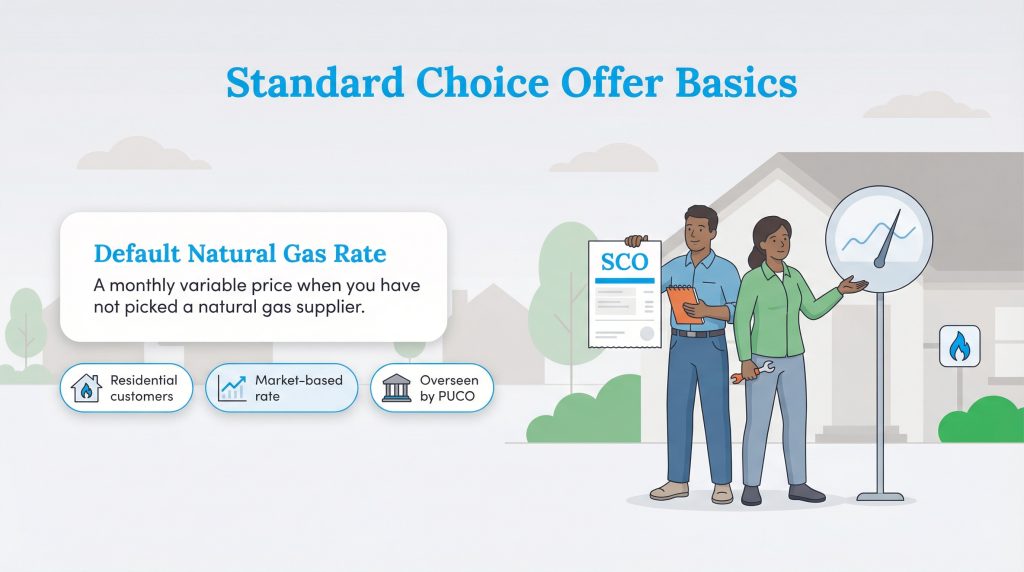
The Standard Choice Offer (SCO) functions as the essential baseline for Ohio residents who have not opted into a third-party retail contract. It ensures you have uninterrupted access to a reliable supply of natural gas at a fair, regulated price. Unlike a fixed-rate plan where you pay the exact same amount per unit of gas for a year or more, the SCO is a variable rate that fluctuates monthly based on national energy trends.
It is crucial to know that your local distribution company still physically delivers the natural gas to your home, maintains the pipelines, reads your meter, and handles all emergency calls regardless of your SCO status. The SCO strictly dictates the rate you pay for the gas supply itself, not the delivery infrastructure. Heavily overseen by state regulators, its structure ensures that if you are a new homeowner setting up utilities, you won’t fall victim to unexpected supply markups while deciding on your long-term energy strategy.
How the Standard Choice Offer Is Calculated
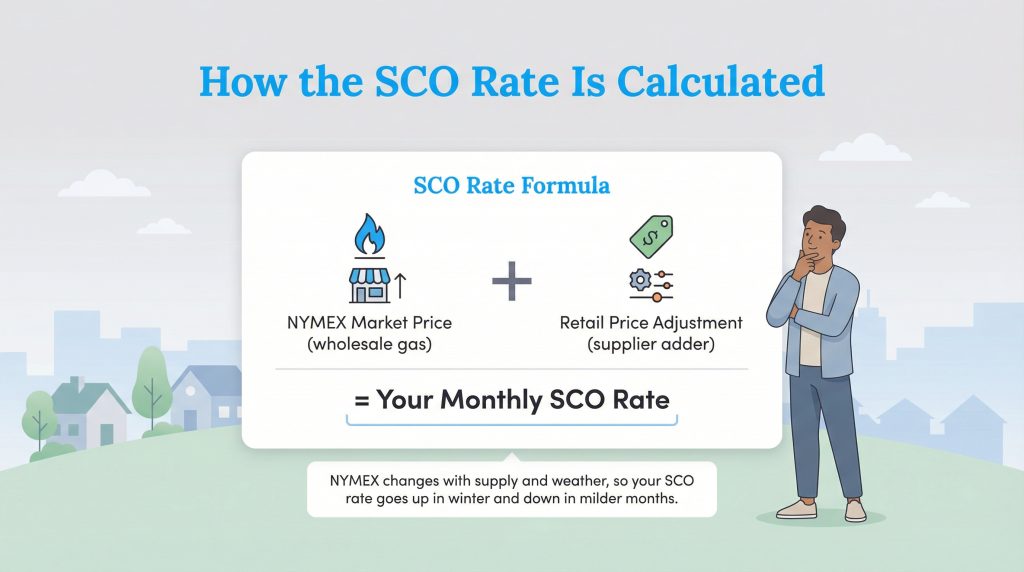
One of the biggest advantages of the Standard Choice Offer is its structural transparency. While the price changes monthly, the formula used to set that price is public and thoroughly regulated. Understanding this calculation provides a clear window into the national energy market and helps clarify why your bill spikes in the winter or drops during the summer.
To figure out what you are paying, you can look at this simple equation:
SCO = NYMEX month-end settlement price + Retail Price Adjustment
- NYMEX month-end settlement price: This represents the wholesale cost of natural gas on the national market (the New York Mercantile Exchange). Seasonal weather demand directly dictates this component. For example, during severe cold snaps when residents turn on their heating systems, the NYMEX price naturally surges. Conversely, milder spring weather typically causes the price to drop.
- Retail Price Adjustment: This covers the chosen supplier’s administrative costs and risks for the year. Because it is set through competitive bidding, this service fee stays relatively stable for an entire 12-month period.
Importantly, your local utility company does not profit from the SCO supply rate. It is a direct pass-through cost, meaning you pay exactly what it costs the supplier to secure the gas on the wholesale market plus that approved adjustment. This structure protects you from arbitrary price gouging on the commodity itself.
Natural Gas Supplier Vs. Delivery Utility
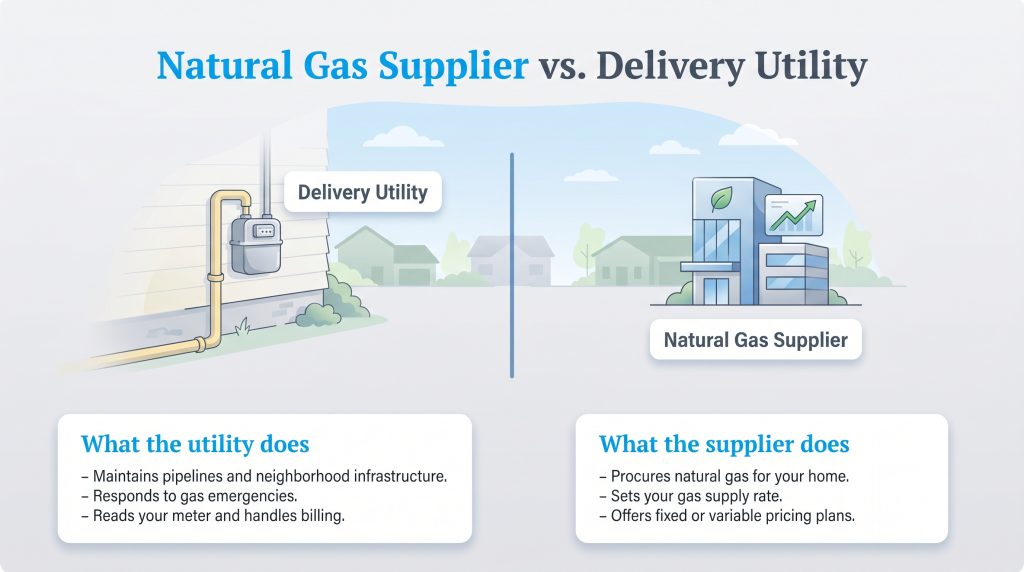
Understanding the difference between a natural gas supplier vs. delivery utility is essential for reading your bill correctly and recognizing where your money goes each month. While one company procures your fuel, a completely separate entity maintains the physical infrastructure. Your delivery utility does not profit from the SCO gas supply charge.
| Delivery Utility | Natural Gas Supplier |
|---|---|
| Maintains the physical pipelines and neighborhood infrastructure. | Procures the actual natural gas supply on the open market. |
| Responds immediately to emergency calls, such as gas leaks. | Determines the rate you pay for the raw commodity (gas supply). |
| Reads your physical meter and handles your monthly billing statements. | Competes to offer various rate structures (fixed or variable) for your home. |
Utility-Specific SCO Details (Columbia, Enbridge, CenterPoint)
While the overarching SCO framework is identical statewide, the exact Retail Price Adjustment varies slightly depending on which utility conducts the local PUCO auction for your area. Here is a closer look at the three major utility zones in Ohio:
- Columbia Gas standard choice offer: Serving a massive portion of the state, Columbia Gas holds its own annual auction to determine the retail adjustment for its footprint. If you live in Columbus, Toledo, or surrounding areas, your SCO rate is specifically tethered to this local auction.
- Enbridge Gas Ohio SCO: Formerly known as Dominion Energy Ohio, Enbridge services much of Northeast Ohio, including Cleveland and Akron. Their SCO rate follows the identical NYMEX baseline but features a distinct retail adjustment tailored to their operational region.
- CenterPoint Energy SCO: Operating primarily in the Dayton and West Central Ohio regions (previously Vectren), CenterPoint Energy conducts a separate auction. Customers here will see an SCO rate that reflects the unique bidding environment of their local service territory.
Current Approved SCO Suppliers
It can be alarming to open your utility statement and see an unfamiliar corporate name listed as your natural gas provider. However, if you are on the default rate, there is no need to worry. The state holds an auction where various energy companies bid for the right to service different groups of default customers.
These specific companies won recent auctions and are legally bound to charge you the exact PUCO SCO rate rather than their private retail rates. Current approved SCO suppliers frequently include:
- AEP Energy
- Boardwalk Continuum Marketing
- Direct Energy Services
- Snyder Brothers Energy Marketing
- SouthStar Energy Services
- United Energy Trading
If one of these names appears on your bill under the “Supply Charges” section, you are still safely enrolled in the default regulated program.
SCO Vs. Retail Choice Vs. Government Aggregation
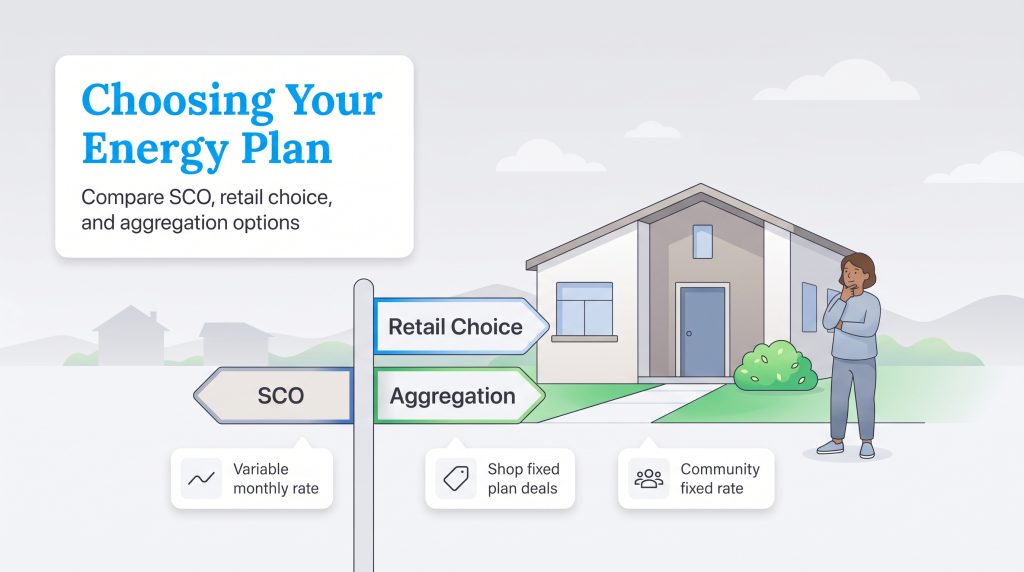
When setting up utilities, you face a common decision: Should you stay on the standard default rate, switch to a retail supplier, or join a local aggregation program? There is no single “right” answer. You can explore more about the differences between fixed and variable rates or the benefits of flat rate natural gas plans to help inform your decision, as it depends entirely on your budget, risk tolerance, and personal sustainability goals.
| Plan Type | Rate Structure (Variable/Fixed) | Early Termination Fees | How to Enroll |
|---|---|---|---|
| Standard Choice Offer (SCO) | Variable (Changes Monthly) | None; you can leave at any time. | Automatic default if you take no action. |
| Retail Choice | Mostly Fixed (can be Variable) | Varies; many fixed plans charge an exit fee. | Shop and enroll through the Energy Choice Ohio website. |
| Government Aggregation Program | Typically Fixed (Community Rate) | Usually none (opt-out available). | Automatic if your community passes a ballot measure. |
Retail choice allows you to proactively shop for an environmentally mindful supplier to find terms that fit your life, helping you implement everyday sustainable living tips. Alternatively, an aggregation program offers an excellent middle ground, providing budget stability without requiring you to comb through individual plans on your own.
How the Annual SCO Auction Works
Every year, the PUCO standard choice offer retail price adjustment is determined by an annual competitive auction overseen by the state. Certified retail natural gas suppliers submit bids to secure the right to service SCO customers. The winning bids set the retail adjustment, which typically runs annually from April to March of the following year. This rigorous bidding process ensures the Ohio standard choice offer remains a dependable, market-based price that protects residents from unnecessary overhead fees while providing suppliers a fair rate for their administrative services.
How to Find the SCO on Your Gas Bill
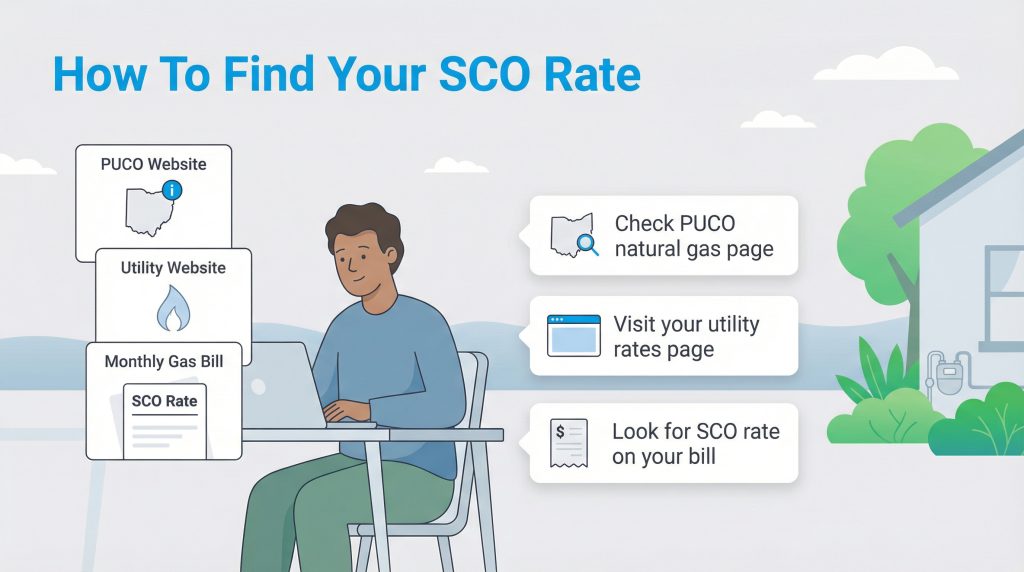
If you want to evaluate your current energy strategy, you first need to know exactly what you are paying. Finding your natural gas default rate and your assigned default supplier is a straightforward process:
- Locate your most recent utility bill, either via your online portal or your printed paper statement.
- Look for the “Supply Charges” or “Gas Cost” section, which is typically found on the second page of your Ohio billing breakdown.
- Identify the named supplier and check for a multiplier labeled as “Price Per Ccf” or “Mcf” to confirm your exact rate for that specific billing cycle.
You can also check the natural gas section of the Public Utilities Commission of Ohio (PUCO) website to verify seasonal trends before making a switch.
Evaluating Your Energy Strategy
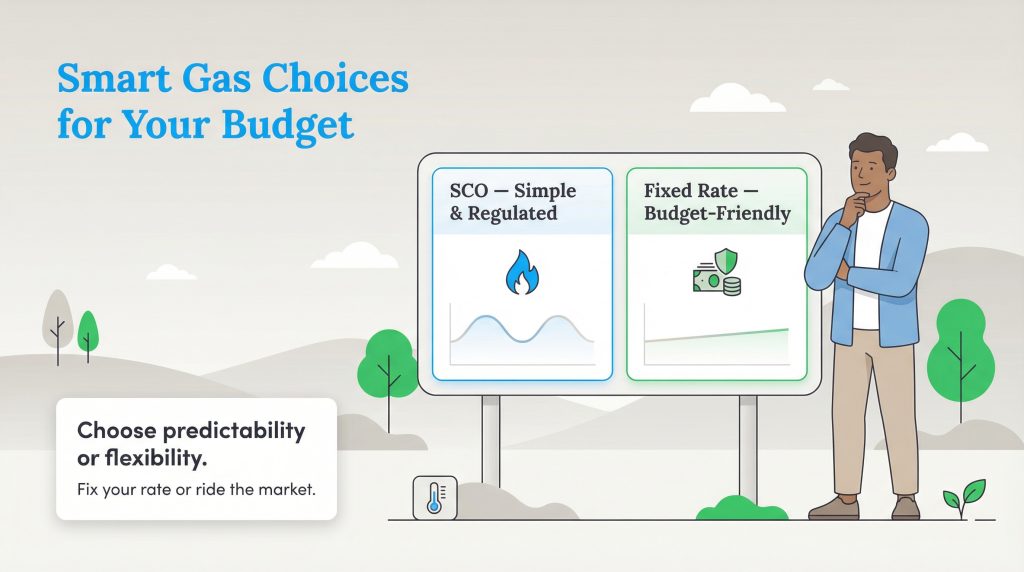
Deciding between the default rate, a retail supplier, and a community initiative ultimately comes down to how much you value bill predictability versus market flexibility. Here is a quick checklist to help you evaluate your current setup:
- Stay on the SCO if: You prefer a hands-off approach and don’t mind your bill fluctuating with the seasons. It’s a safe bet if you want to pay the true market price for the gas commodity without worrying about early termination fees or long-term contracts.
- Use Energy Choice Ohio if: You are managing a strict household budget and want to avoid winter price shock. By leveraging the state’s Apples to Apples comparison chart, you can proactively shop for a fixed-rate retail plan that locks in your pricing for 12 to 36 months, allowing you to opt for eco-conscious suppliers.
- Join a government aggregation program if: Your local community has successfully negotiated a competitive bulk rate and you want the benefits of a fixed price without having to research and vet individual plans yourself.
Verdict: Deciding to Keep or Drop the Standard Choice Offer
No matter which path you choose, staying informed about your energy rates ensures you stay in complete control of your utility costs. If budget certainty during the harsh winter months is a top priority, utilizing the Apples to Apples comparison chart to secure a fixed rate is an excellent strategy. However, if you are comfortable riding out seasonal market dips and spikes, remaining on the standard choice offer is a perfectly viable, heavily regulated option. You can reduce your monthly consumption proactively with simple habit changes; learn more in our guide to saving on your gas bill. For more information on managing your home’s energy setup efficiently, continue exploring deeper strategies and insights.
Frequently Asked Questions About the Standard Choice Offer
Is the Standard Choice Offer a fixed or variable rate?
Does the Standard Choice Offer include my delivery charges?
How do I switch from the Standard Choice Offer to a fixed rate?
Is the Standard Choice Offer usually cheaper than a fixed-rate plan?
Can I cancel the Standard Choice Offer at any time?
Why is there a supplier name on my bill if I’m on the SCO?
Does the SCO include carbon offsets or renewable gas?
Why did my Standard Choice Offer rate go up this month?
Do I have to pay a security deposit if I stay on the Standard Choice Offer?
Can I use budget billing if I am on the Standard Choice Offer?
About the Author

David has been an integral part of some of the biggest utility sites on the internet, including InMyArea.com, HighSpeedInternet.com, BroadbandNow.com, and U.S. News. He brings over 15 years of experience writing about, compiling and analyzing utility data.

Claudio is a sustainability-focused writer with a background in Anthropology and Psychology from NC State University. He has spent over 15 years working in writing, interpretation, and translation, driven by a deep interest in how human culture shapes the environment. Today, he shares his curiosity with readers by writing about sustainable living solutions and the connection between everyday choices and environmental impact.