

5G home internet offers a faster, more affordable alternative to satellite for many rural households, though availability remains the biggest hurdle.

- 300 Mbps
- 5G
- Unlimited
- $35.00/mo

- 498 Mbps
- 5G
- 1.2 TB
- $35.00/mo

- 300 Mbps
- 5G
- Unlimited
- $40.00/mo

- 400 Mbps
- Satellite
- Unlimited
- $55.00/mo

- 150 Mbps
- Satellite
- 150-850 GB
- $39.99/mo
*Not all internet providers and speeds available in all areas.
Key Takeaways
- 5G home internet is generally cheaper and has lower latency than traditional satellite internet, making it better for gaming and video calls.
- Satellite internet offers wider coverage, serving remote areas where 5G towers haven’t reached yet.
- Starlink is the exception, offering speeds and latency closer to 5G but at a significantly higher equipment and monthly cost.
Deciding between 5G home internet and satellite internet often comes down to one fundamental difference: pulling data from a local ground-based cellular tower versus beaming signals entirely from space. If you are going through the process of moving to a rural or semi-rural area where fiber and cable internet are unavailable, these two wireless options are likely your best alternatives. Today’s robust 5G fixed wireless access networks and modern low-earth orbit (LEO) satellites can easily handle 4K streaming, remote work, and smart home devices. To help you find the best internet for rural homes, we’ve broken down a complete comparison covering The Core Differences: How They Work, a deep dive into LEO (Starlink) vs Traditional GEO Satellite, a Head-to-Head: Speed and Latency Comparison, details on Upfront Costs, Data Caps, and Equipment, and finally, Making the Right Internet Choice for Your Home.
The Core Differences: How They Work
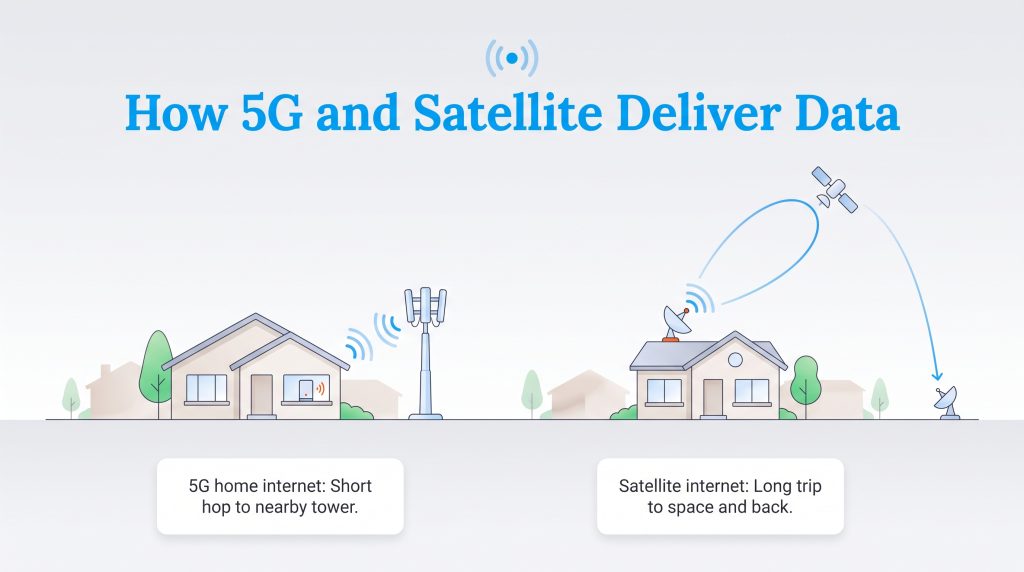
When you sit down to compare the average speed of 5G vs satellite, it helps to visualize the invisible pipeline delivering data to your house. 5G home internet operates as a fixed wireless connection. This means it utilizes the exact same local cellular towers that connect your smartphone. When you load a video, the signal takes a short, ground-level wireless hop from a nearby tower directly to a small gateway router sitting in your window. Because the tower is typically within a few miles of your house, the data travels quickly and efficiently.
Satellite internet beams your data from a dish mounted outside your home all the way into space and back down to a ground station. Traditional satellite providers use geostationary satellites orbiting roughly 22,000 miles above the equator. That immense physical distance creates a delayed, cumbersome pipeline for your data to navigate.
LEO (Starlink) vs Traditional GEO Satellite
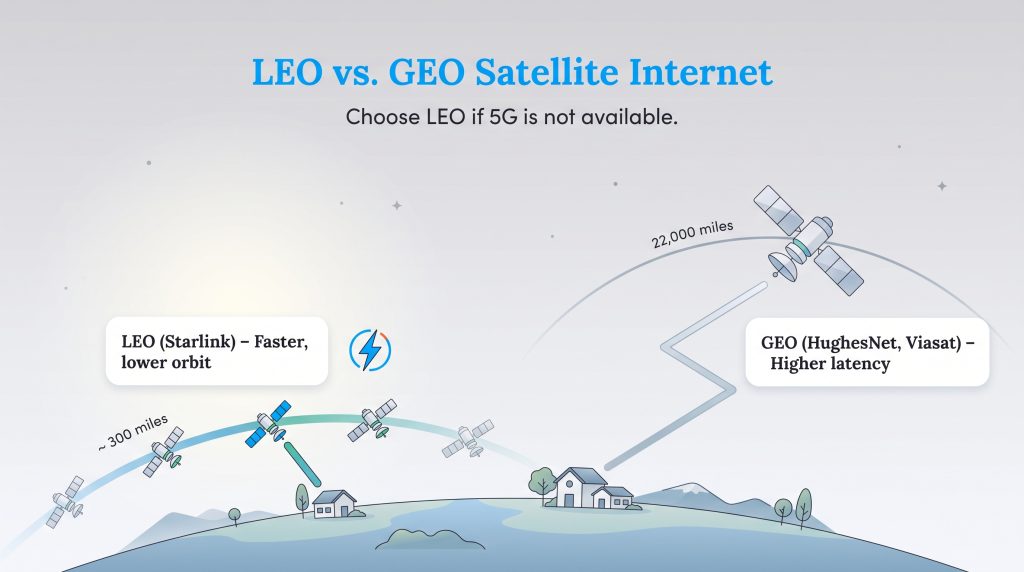
Not all satellite internet is created equal. The industry splits largely into two categories based on orbit distance: Low Earth Orbit (LEO) and Geosynchronous Equatorial Orbit (GEO). Starlink revolutionized remote connectivity by deploying LEO satellites roughly 300 miles above the Earth. This shorter distance drastically speeds up travel time for your data, allowing LEO networks to compete closely with ground-based internet.
Traditional GEO networks, operated by companies like HughesNet and Viasat, rely on satellites parked 22,000 miles away. While this extreme height allows a single satellite to blanket a massive portion of the continent with a signal, the data journey is painfully slow. As an eco-conscious consumer or remote worker, you should only settle for traditional GEO satellite internet for rural areas if 5G and LEO options are entirely unavailable at your address.
Coverage and Availability: Rural vs Urban Access
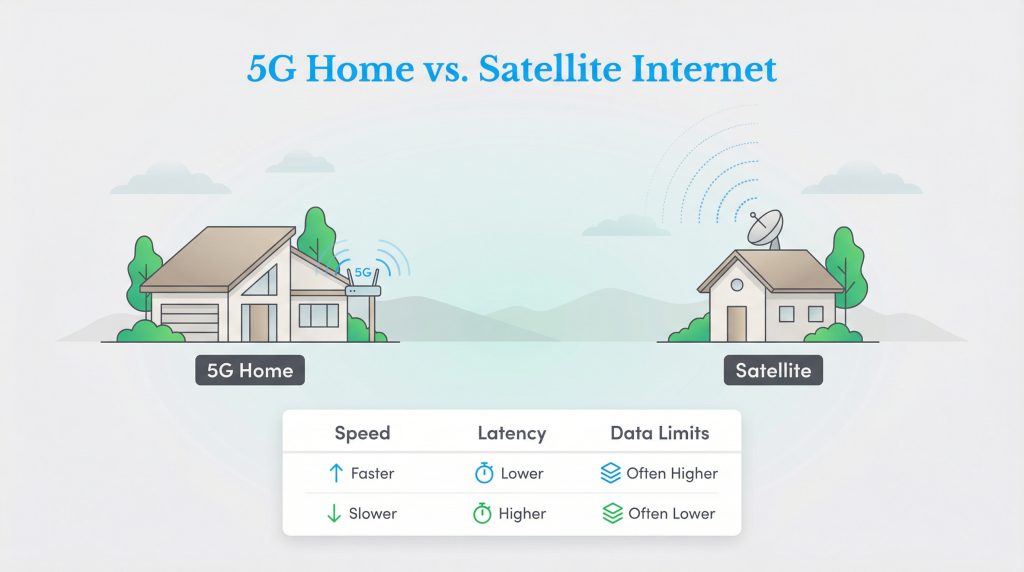
Depending on your exact physical location, one service might naturally edge out the other. Here is a baseline breakdown of how the specifications generally compare. Note that actual speeds and monthly rates fluctuate based on your region’s network capacity and specific provider.
| Feature | 5G Home Internet | Traditional Satellite (GEO) | Starlink (LEO) |
|---|---|---|---|
| Peak Download Speeds | 300 Mbps–1 Gbps | 25–100 Mbps | 50–250 Mbps |
| Upload Speeds | 10–50 Mbps | 3–5 Mbps | 10–20 Mbps |
| Latency (Ping) | 20–40 ms | 600 ms+ | 20–60 ms |
| Data Caps | Usually Unlimited | Strict Caps | Unlimited / Priority |
| Average Base Price | $50–$60 | $65–$150 | $120+ |
Pros and Cons of 5G Home Internet
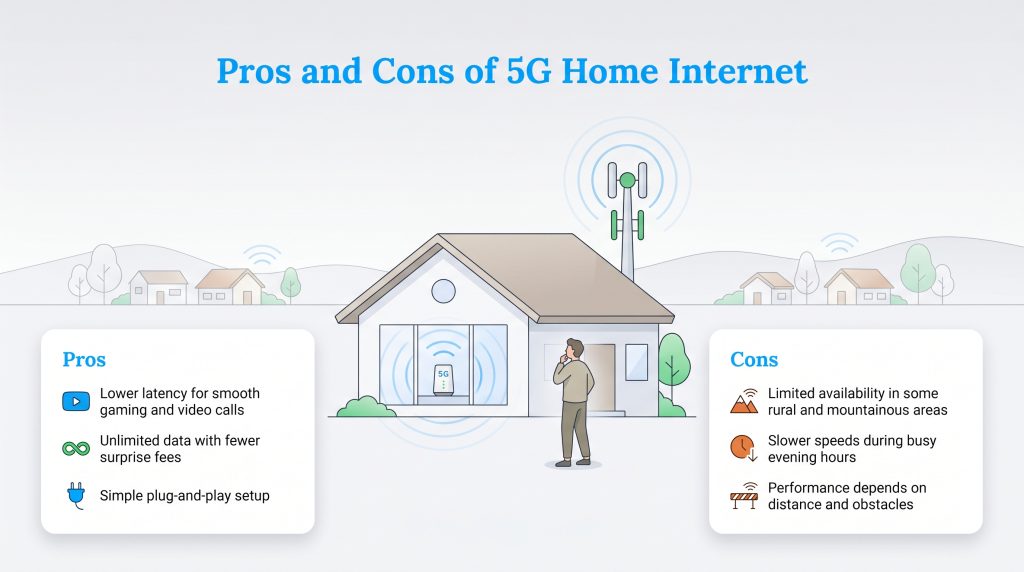
Checking 5G home internet availability should be step one for any rural household. It often strikes the perfect balance between speed and budget, though it isn’t flawless.
Pros of 5G Home Internet
- Lower Latency: The localized signal reacts fast, ideal for gaming and video calls.
- Unlimited Data: Major 5G providers rarely enforce hard data caps or charge surprise overage fees.
- Plug-and-Play Setup: You only plug the gateway into a wall outlet. No technicians required.
- Affordability: Plans frequently sit around $50, especially when bundled with a mobile plan.
Cons of 5G Home Internet
- Limited Deep Rural Reach: High-speed 5G towers have not expanded into extremely remote or mountainous zones.
- Network Deprioritization: Speeds may dip during peak evening hours if mobile phone traffic overwhelms the tower.
- Inconsistent Speeds: Performance hinges entirely on your distance from the tower and physical terrain blocks.
Pros and Cons of Satellite Internet
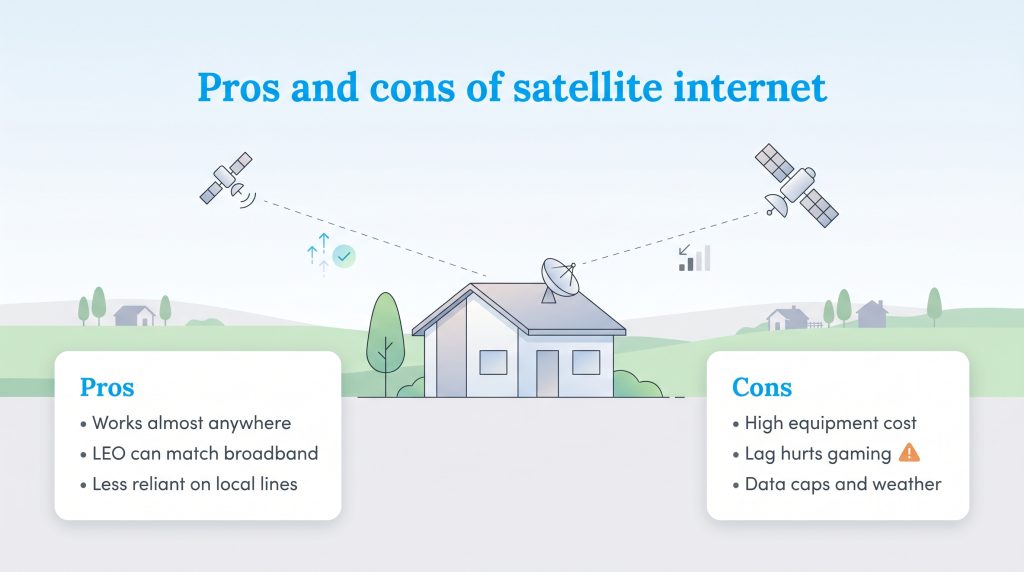
If your property sits miles away from the nearest fiber trench or cell tower, exploring the satellite internet pros and cons will confirm it serves as a crucial lifeline — despite the obvious trade-offs. Understanding these limitations is essential before committing to a long-term contract.
Pros of Satellite Internet
- Near-Universal Coverage: Accessible almost anywhere, provided you have a clear view of the sky.
- High-Speed LEO Networks: Starlink routinely achieves download speeds capable of handling modern smart homes.
- Independent Infrastructure: Highly resilient against localized neighborhood power outages or cable cuts.
Cons of Satellite Internet
- Expensive Equipment: Expect to pay $299 to $599 upfront just for the necessary dish hardware.
- Extreme Latency (GEO): Traditional networks suffer massive lag, effectively ruining multiplayer gaming.
- Strict Data Allowances: GEO providers often throttle your speeds heavily once you hit your monthly cap.
- Weather Interruptions: Heavy downpours or snow accumulation can block the signal.
Head-to-Head: Speed and Latency Comparison
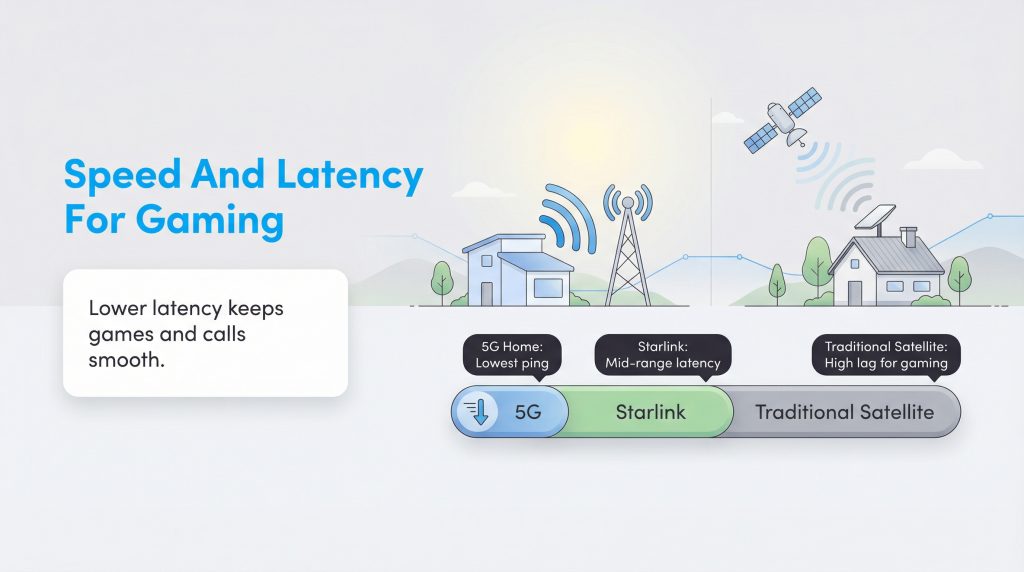
Looking strictly at download numbers won’t tell you the whole story. You must also consider how those speeds hold up under pressure and how quickly the network responds to your inputs. To determine if 5G is better than satellite internet for your lifestyle, you have to examine latency. If you aren’t sure what performance metrics your household actually requires to stay operational, check out our guide on how much internet speed you really need.
Latency (or ping) is the measurement of how long it takes for a data packet to travel from your device to a server and back. When comparing internet latency satellite vs 5G, the ground-based network wins out. 5G internet typically averages a snappy 20–40ms ping, making it the superior choice for fast-paced gaming and talking on Zoom without accidentally interrupting your coworkers. While Starlink’s LEO network competes closely (20–60ms), traditional GEO satellite signals experience crushing lag (600ms+), making real-time applications a miserable experience.
| Network Type | Peak Download | Upload Speed | Expected Latency |
|---|---|---|---|
| 5G Fixed Wireless | 300 Mbps–1 Gbps | 10–50 Mbps | 20–40 ms |
| Starlink (LEO) | 50–250 Mbps | 10–20 Mbps | 20–60 ms |
| HughesNet/Viasat (GEO) | 25–100 Mbps | 3–5 Mbps | 600+ ms |
If you are pitting Starlink vs Verizon 5G home internet (or a T-Mobile plan), 5G networks frequently achieve much higher peak speeds — sometimes up to 1 Gbps — provided you live near a tower broadcasting high-band capacity. However, if your home receives only a weak, low-band cell signal, Starlink’s consistent 50–250 Mbps easily wins the speed battle.
Upfront Costs, Data Caps, and Equipment
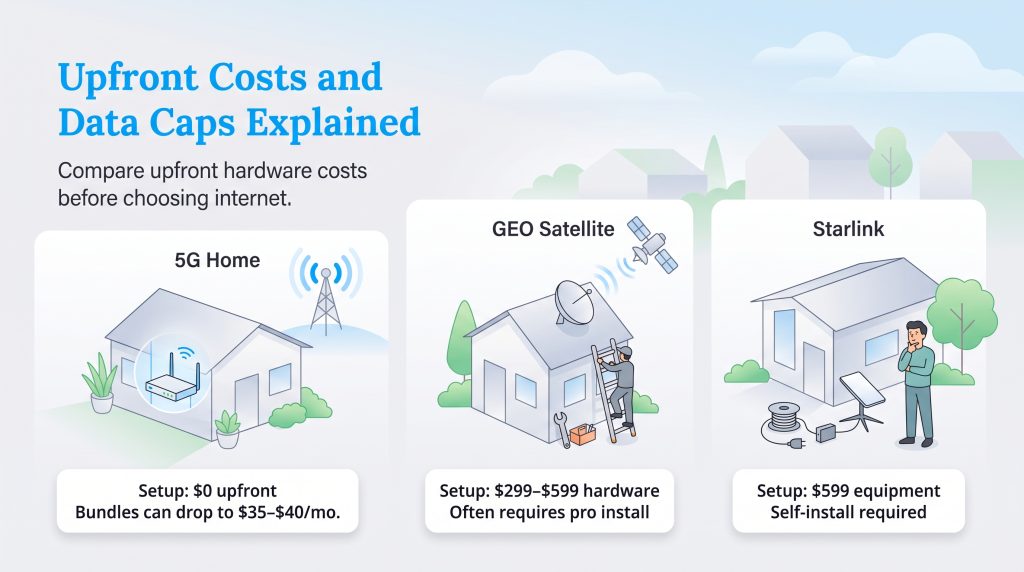
Evaluating setup requirements reveals some of the starkest differences between these two technologies. 5G plans usually offer transparent, flat-rate billing, whereas satellite contracts often include costly barriers to entry.
- 5G Gateway Setup: Usually costs $0 upfront. The provider loans or gives you the plug-and-play gateway router entirely for free as long as you maintain the service.
- Traditional GEO Setup: You can expect to pay anywhere from $299 to $599 just to secure the dish hardware. Many of these legacy providers also require scheduling a professional installation.
- Starlink Setup: Requires a high upfront investment of $599 for the advanced phased array antenna, though you install the hardware yourself.
Understanding Strict Data Caps
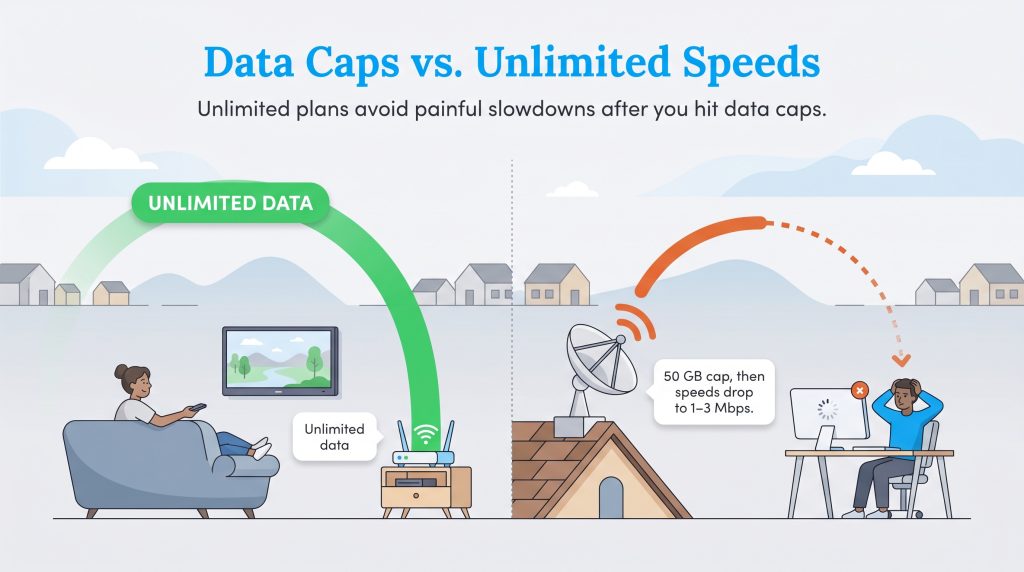
Most 5G home internet networks feature entirely unlimited data. You can download massive gaming updates, work from home, and stream continuously without fear of service interruption. Starlink generally mimics this unlimited approach, offering data tiers that rarely slow down under standard household usage.
Traditional GEO networks heavily rely on strict data caps. Understanding exactly how data caps work—and how much internet data you need—is crucial before locking yourself into a lengthy contract. If you sign up for a 50GB plan and use all your allotted data within the first couple of weeks, the provider intentionally “throttles” your connection. Throttling severely drops your speeds to around 1 to 3 Mbps. At that crawl, joining a remote video meeting or streaming HD content becomes nearly impossible until your next billing cycle begins.
Reliability: Weather Impact and Network Congestion
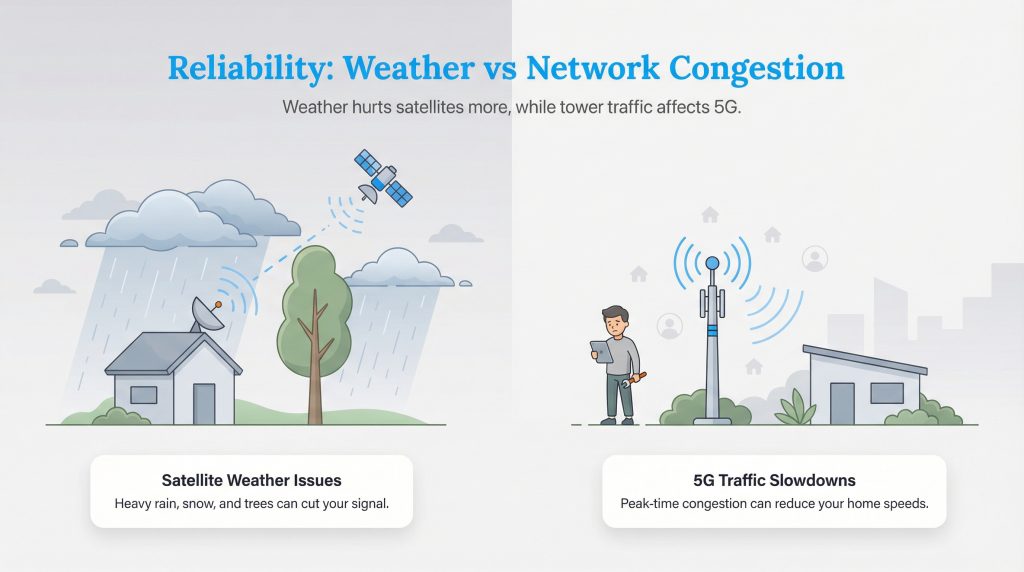
When bad weather rolls in, reliability becomes an immediate concern. Because these signals traverse different environments, they fail for different reasons.
- Rain Fade (Satellite): Because radio frequency signals must punch through the entire atmosphere to reach space, heavy rain, thick storm clouds, or heavy snowpack directly block the radio waves, causing temporary outages. Satellite dishes also require a perfectly clear view; even swaying tree branches can disrupt your connection.
- Tower Congestion and Line-of-Sight (5G): Ground-based 5G bypasses most severe weather problems. However, it suffers from network deprioritization. Carriers prioritize smartphone traffic over fixed home internet. At 7 p.m. when neighbors arrive home and stream content, your local tower can become congested, temporarily slowing your speeds.
Mobile Use Cases: Internet for RVs, Boaters, and Nomads
Deciding between T-Mobile 5G home internet vs satellite for travel boils down to your preferred camping style. Using a 5G mobile hotspot is excellent for “front-country” travel along major highways or established RV parks. It offers cheap, low-power connectivity. However, the signal dies the moment you venture off the beaten path.
For those who love off-grid boondocking, satellite internet is unmatched. Systems like Starlink Roam allow you to park your rig deep in a desert and still pull down high-speed service. The trade-off is a much higher monthly cost and a heavy power draw on your RV batteries.
Redundancy: Using 5G and Satellite Together for Backup Internet
If you absolutely cannot afford downtime, relying on a single network feels risky. Setting up a dual-WAN router allows you to run two different internet sources simultaneously. The router constantly monitors your primary connection (like Starlink). If extreme weather knocks it out, the system instantly fails over to your backup 5G gateway. Your Zoom meeting might glitch for half a second, but you will stay securely online.
The Eco-Conscious Choice: Energy Consumption and Hardware Waste
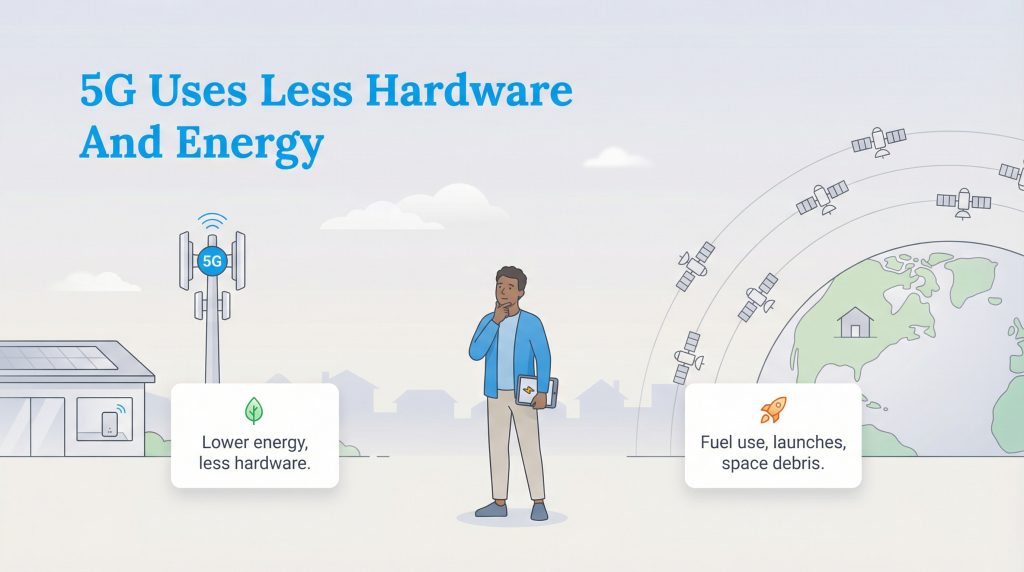
When aiming for sustainable living or building an off-grid cabin, fixed wireless clearly provides the more environmentally mindful choice. A 5G gateway sips roughly 10 to 15 watts of power. Because it taps into existing cell tower infrastructure, it requires zero major construction or newly trenched cables.
In contrast, a Starlink dish actively tracks satellites across the sky and uses internal heaters to melt snow, drawing 50 to 75 watts continuously. This high consumption demands extra solar panels and larger battery banks. Furthermore, maintaining massive satellite constellations requires highly emissive rocket launches, which contribute to the problem of orbital space junk. (You can read more about this via NASA’s resources on space debris).
Installation: Plug-and-Play vs Drilling Holes
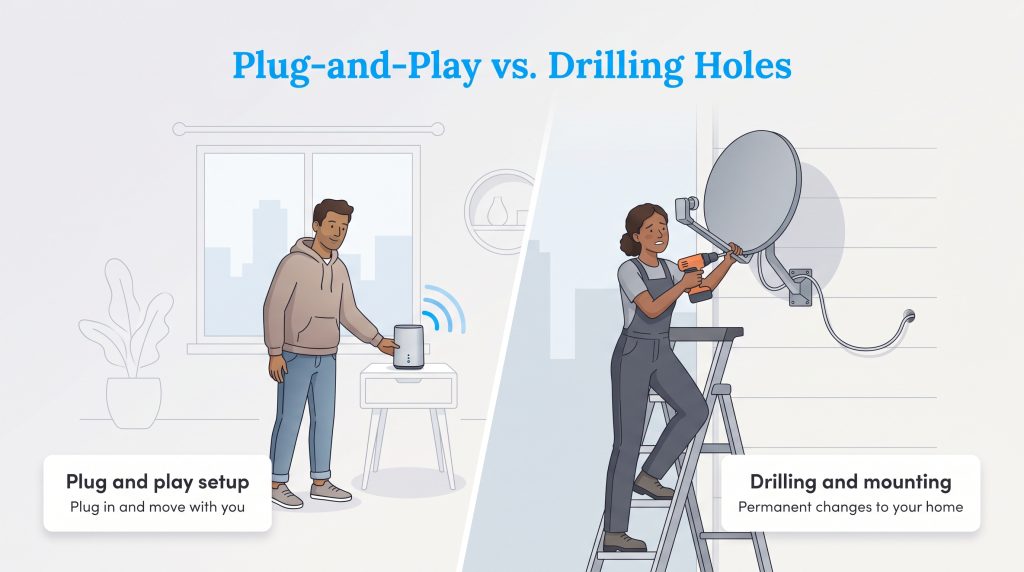
Renters typically love 5G internet because the setup is frictionless. You unbox a router-sized gateway, plug it into a standard wall socket, and place it near a window. When your lease ends, you simply pack the gateway in a box and plug it in at your new apartment.
Installing satellite internet feels much more like a heavy DIY project. Mounting a bulky dish requires climbing ladders, drilling lag bolts into your roof or siding, and routing cables directly through exterior walls. This permanent structural modification makes satellite internet notoriously unfriendly to renters.
Making the Right Internet Choice for Your Home
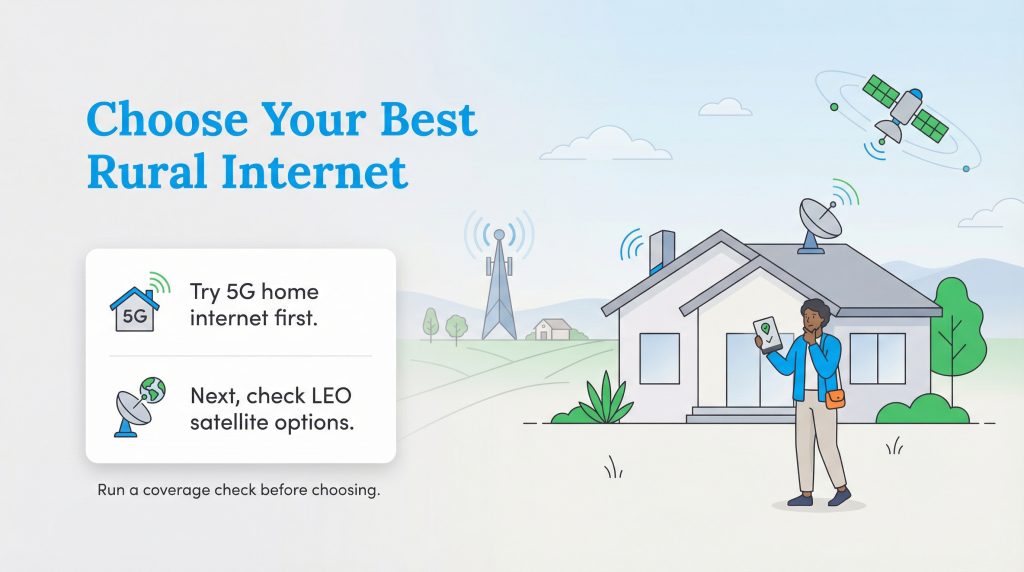
If you are still struggling to choose the best rural internet providers for your household, follow this clear step-by-step framework:
- Always check 5G availability first. Plug your exact home address into the major cellular carriers’ websites. If 5G fixed wireless is available, its combination of zero upfront equipment fees and strong performance makes it the smartest starting point.
- Evaluate your sky visibility for LEO satellite. If 5G isn’t viable, map out the property. Do you have a wide-open, completely unobstructed view of the sky? If so, investing the $599 in Starlink hardware ensures incredibly fast speeds off the grid.
- Consider traditional GEO as a last resort. Only sign up for traditional satellite providers if both 5G and LEO options fail, and you absolutely need basic connectivity for emails and light browsing.
Whether you choose the high-speed local pipeline of a 5G gateway or the vast, space-based reach of modern satellite internet, rural living no longer means sacrificing strong digital connectivity. By evaluating your monthly budget, data usage, and geographic hurdles, you can confidently set up the perfect network to power your home.
Frequently Asked Questions About 5G and Satellite Internet
Is 5G home internet faster than Starlink?
Can I get 5G home internet in a rural area?
Does bad weather affect 5G internet as much as satellite?
Can I use 5G home internet in an RV?
Does satellite internet use more electricity than a 5G router?
Can I use satellite internet for gaming?
About the Author

LaLeesha has a Masters degree in English and enjoys writing whenever she has the chance. She is passionate about gardening, reducing her carbon footprint, and protecting the environment. She also recently served as President of the Board for City Sprouts (a community garden).

David has been an integral part of some of the biggest utility sites on the internet, including InMyArea.com, HighSpeedInternet.com, BroadbandNow.com, and U.S. News. He brings over 15 years of experience writing about, compiling and analyzing utility data.