
- Free modem and anti-virus software
- No contracts and unlimited data
- Bundle with TV to save more
- Speeds up to 7 Gbps**
Quick Utility Facts
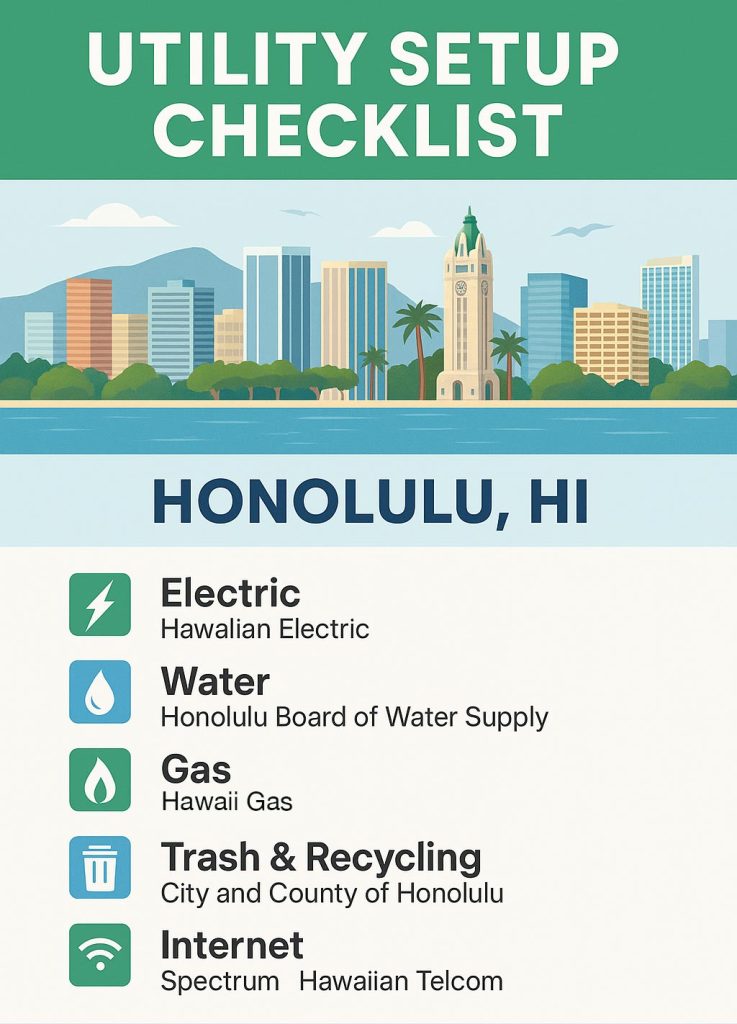
- The electric utility is Hawaiian Electric. Honolulu has some of the highest electric rates in the country.
- Not all homes have natural gas, but if you do the natural gas utility is Hawaii Gas.
- Your choice for internet service is primarily Spectrum or Hawaiian Telcom.
- The City of Honolulu provides trash, recycling, and water services.
Electric Providers in Honolulu


Electricity across Oahu is delivered exclusively by Hawaiian Electric (HECO), an investor-owned utility operating under a regulated public utility framework overseen by the Hawaii Public Utilities Commission. Because service is tied directly to HECO’s island grid, your account is established directly through their portal. Due to Oahu’s reliance on imported fuel, high shipping logistics, and isolated grid infrastructure, residential electricity rates are the highest in the nation, averaging roughly 38 to 44 cents per kWh in 2026. Standard statements combine base generation charges with fluctuating Energy Cost Recovery Factors, Purchased Power Adjustments, and Revenue Balancing Account riders. To combat extreme energy costs—especially if running window or split-system air conditioning — HECO heavily promotes time-of-use (TOU) schedules like “Shift and Save,” where electricity used during midday solar peak hours (9:00 AM to 5:00 PM) is heavily discounted compared to expensive evening peak hours (5:00 PM to 9:00 PM).
Natural Gas Providers in Honolulu
Natural gas service across Honolulu is distributed by Hawaiʻi Gas (Hawaii Gas), operating as a fully regulated public utility overseen by state utility regulators. Because the Hawaiian islands lack natural geological gas reservoirs, the utility distributes Synthetic Natural Gas (SNG) produced locally alongside liquefied petroleum gas (LPG/propane) through an underground pipeline grid across urban Honolulu. Hawaiʻi Gas bundles commodity supply costs with mandatory pipeline delivery rates, state safety riders, and a fixed monthly customer charge on every residential statement. While gas usage is primarily restricted to domestic water heaters, clothes dryers, and cooking ranges, this fixed basic customer fee ensures your statement carries a persistent baseline charge year-round, meaning you pay a monthly infrastructure maintenance fee even if your fuel consumption drops to near zero during warm weather.
Top 5 Internet Providers in Honolulu
- 7 Gbps**
- Cable & Fiber
- Unlimited
- TV & Phone
- 95.35%
- $30.00/mo
- Most Affordable Plans

- 2 Gbps
- Fiber
- Unlimited
- 84.56%
- $40.00/mo

- 400 Mbps
- Satellite
- Unlimited
- None
- 100%
- $55.00/mo

- 150 Mbps
- Satellite
- 150-850 GB
- Phone
- 99.88%
- $39.99/mo

- Varies
- Fiber, Cable, 5G, & Satellite
- Varies
- 95%
- $39.95/mo
Broadband and digital communications across the island represent a high-speed data battlefield heavily split between an expanding fiber-to-the-home network from Hawaiian Telcom and a widespread hybrid-coaxial cable footprint from Spectrum. Symmetrical multi-gigabit fiber connections offer exceptional low-latency bandwidth ideal for remote employment and media streaming, but your actual physical line availability depends on local island geography and building age. If you are moving into an established historic property or single-family home in neighborhoods like Kaimuki, Manoa, or Palolo, older utility pole drops and dense vegetation can delay physical fiber drops, while high-density condo towers in Waikiki, Ala Moana, or Kakaako frequently feature exclusive corporate property marketing agreements that dictate unit-level broadband access paths.
Water & Sewage Providers in Honolulu

Water and wastewater utilities operate through a coordinated municipal framework split between the Honolulu Board of Water Supply (BWS) for potable water and the City and County of Honolulu Department of Environmental Services (ENV) for wastewater treatment. Drawing clean drinking water from deep underground volcanic aquifers, BWS bills on a monthly or bi-monthly cycle featuring an escalating four-tiered volumetric usage scale paired with a base monthly meter fee ($35.93 for a standard 5/8-inch residential meter starting in mid-2026). Wastewater treatment — managed by ENV — was restructured under a revised 2026 rate schedule that includes a $63.55 monthly base fee for single-family metered homes paired with a $7.95 per 1,000-gallon volumetric consumption charge. Because sewer processing fees scale sharply with metered water intake, an undetected running toilet or plumbing leak will artificially compound your monthly municipal statement.
Top 9 Trash and Recycling Providers in Honolulu
Trash, recycling, and organic waste collection services are operated directly by the City and County of Honolulu Department of Environmental Services (ENV) Refuse Division for single-family residences using an automated three-cart system. Household garbage is collected weekly in gray carts, while single-stream recyclables (blue cart) and green yard waste (green cart) are collected every other week on an alternating schedule. Under the rollout of the G.R.O.W. (Green Recycling Organic Waste) Program, select Oahu neighborhoods are now permitted to add food scraps directly to their green carts alongside yard trimmings. Containers must be set curbside by 6:00 AM on collection morning with the handle facing your property, maintaining a strict 5-foot spatial clearance from cars, mailboxes, and utility poles. Bulky item collection (furniture, appliances) is not picked up automatically and must be pre-scheduled online through Opala.org.
Utilities Summary for Honolulu, HI
| Electric Companies: | 1 |
| Natural Gas Companies: | 1 |
| Water & Sewage Providers: | 1 |
| Garbage, Trash & Recycling Providers: | 9 |
| Municipal Electricity: | No |
Connect Your Home to Utilities in Honolulu
Honolulu is more than just beautiful beaches and golden sunsets, it’s a vibrant city with a rich cultural tapestry, buzzing urban life, and lush island nature all rolled into one. As the capital of Hawaii and the largest city on Oahu, it blends bustling neighborhoods with laid‑back vibes. Whether you’re in Waikīkī, Manoa, or the slopes of Kalihi, it’s a place where island tradition meets modern living. Now, let’s look at the essentials to keep your home running smoothly, starting with utilities.
Electricity
Hawaiian Electric Company (HECO) is Honolulu’s main electricity provider, serving about 95% of the population across Oahu. They’re a longstanding pillar in Honolulu, operating since 1891, and have ambitious goals to reach 100% renewable energy by 2045.
HECO partner, Hawaii Energy, administers a wide range of energy efficiency rebates. You can get cash incentives for:
- Heat pump water heaters, solar‑water‑heater tune‑ups
- ENERGY STAR appliances
- LED lighting and ceiling fans
- HVAC tune‑ups
Combined with federal and state credits, these rebates can cover up to ~70% of costs for major upgrades. Plus, programs like GEM$ On-Bill Money Saver offer on-bill financing for solar and energy storage systems, helpful if you’re planning solar installations.
HECO’s sustainability mission is strong: they run the “Bring Your Own Device Plus (BYOD Plus)” storage incentives and have plans for energy storage and rooftop solar expansion. So, it’s an exciting time to save energy and support green infrastructure.
Natural Gas
Hawaii Gas is Honolulu’s primary provider of gas service, supplying both Synthetic Natural Gas (SNG) and propane to residential customers in O‘ahu’s pipeline-connected areas and beyond. While the city lacks natural gas pipelines in the traditional sense, Hawaii Gas maintains a locally produced SNG plant near Campbell Industrial Park and an extensive 1,000-mile underground pipeline network delivering gas from Kapolei to Hawai‘i Kai. This infrastructure allows many Honolulu homes to access continuous, reliable gas service.
Benefits include:
- Efficiency & cost savings: Gas appliances typically use up to 28% less energy than electric equivalents.
- Clean burning fuel: SNG emits up to 40% less CO₂ than oil or coal when used instead of electric generation.
- Resilience: Unlike electric power, Hawaii Gas service continues during grid outages, making it ideal for gas stoves, water heaters, clothes dryers, and even gas-powered backup generators.
Installation & Rebates
Hawaii Gas supports both new pipeline connections and propane tank setups for homes outside the pipeline system. They help you pair up with licensed plumbers, coordinate permitting, and handle all external installation work.
As part of their “Good Energy Rewards” program, you may receive:
- $500 credit when installing a gas water heater plus two other gas appliances
- $100 credit for adding or replacing a gas range, cooktop, oven, dryer, or water heater.
Additionally, their Utility Customer Appreciation Credit provides a monthly rebate funded by the company’s agreement post-acquisition, something to look forward to.
Water & Wastewater
The Honolulu Board of Water Supply handles water and sewer utilities. Since water is precious in Hawaii, conservation is key. Expect tiered pricing encourages efficient use, so shorter showers and fixing leaks can lead to noticeable savings.
Bonus tip: collect rainwater for gardening (where local codes allow) to reduce your meter usage.
Trash & Recycling
The City and County of Honolulu Refuse Division runs regular curbside trash, recycling, and bulky-item pick-up. If you live in a multi-unit building, property management may coordinate. Recycling is mandatory, paper, cardboard, glass, metal, green waste, and more go into your blue carts. They also offer seasonal bulky-item and appliance collection events. It’s a good idea to compost food scraps, both to reduce landfill waste and to create nutrient-rich soil for a garden!
Best Internet Providers in Honolulu
Honolulu offers impressive options for internet, though availability varies by neighborhood:
- Spectrum: Covers ~90% of Honolulu, offers speeds up to 1 Gbps over it’s cable network, no data caps. Plans start around $30/mo intro pricing.
- Hawaiian Telcom (altaFiber): Covers ~92% of the urban center, fiber service reaches up to 1 Gbps. Known for reliable fiber, but often with annual contracts and router fees.
- T-Mobile 5G Home Internet: Coverage 64%, with speeds up to 245 Mbps over it’s wireless network.
- Verizon Home Internet: ~99% coverage, speeds up to 300 Mbps over a wireless 5G network.
- Satellite: Starlink (up to ~300 Mbps) and Hughesnet for remote areas.
Conservation & Green Energy Choices
Honolulu offers a variety of eco-conscious options:
- Residential solar installations are booming, powered by companies like Island Pacific Energy and Sunetric, both offering financing, power purchase, and installation services.
- State and federal solar incentives (35% state + 30% federal) are available.
- HECO’s storage rebates, energy-efficiency programs, and renewable portfolio goals support a cleaner grid.
If you’re interested in solar or battery uploads, they’ll also potentially qualify for additional tax incentives and utility rebates through Hawaii Energy and DSIRE listings.
Financial Assistance Programs
Moving to Honolulu? Here are some reliable resources:
1. Hawai‘i Home Energy Assistance Program (H-HEAP)
Federal/state-funded program assisting low-income families with electric or gas bills. Two options:
- Energy Crisis Intervention (ECI): For households facing disconnection.
- Energy Credit (EC): General bill assistance ($ payments applied directly to provider).
Applications open June 2–30, 2025; program year runs Oct–Sept; one benefit per year.
HECO automatically adds qualifying households to Tier Waiver Provision, lowering electricity rates for 12 months.
2. City & County Rental & Utility Relief Program
Provides up to 12 months of coverage for rent and utilities (electricity, water/sewer, gas). Applications via One Oahu starting at [oneoahu.org/renthelp].
3. Other Community Options
- Salvation Army’s Community Assistance Center: Short-term utility/rental aid.
- FindHelp.org listings: Local emergency assistance funding for housing and utilities.
Combine these with city/state efforts and you’ve got a supportive safety net.
Improve Your Home’s Energy Efficiency with Rebates and Savings in Honolulu
Honolulu residents have access to a variety of energy efficiency rebates and programs designed to save energy, reduce utility bills, and promote sustainability. Hawaiian Electric, in partnership with Hawaii Energy, provides rebates for upgrading to energy-efficient appliances such as ENERGY STAR® refrigerators, air conditioners, and solar water heaters. Through Hawaii Energy’s Rebates for Residents, you can also access cash incentives for improvements like LED lighting, smart thermostats, and heat pump water heaters.
Hawaiian Electric offers additional initiatives to help customers optimize their energy usage. Their Customer Incentive Programs, including the Bring Your Own Device (BYOD) program, provide financial incentives for integrating energy storage systems with your solar panels, helping to stabilize the grid while saving you money. They also offer an Energy Savings Toolkit, which features energy calculators, tips, and guides to help you pinpoint ways to reduce your energy consumption.
Hawaii Gas also supports energy-saving efforts by offering rebates for high-efficiency gas appliances such as tankless water heaters, dryers, and ranges. These upgrades not only help lower your bills but also make your home more sustainable.
With statewide programs, such as those provided by Hawaii Energy, and utility-specific resources from Hawaiian Electric and Hawaii Gas, Honolulu residents have a wealth of opportunities to save money and reduce their environmental impact.
About the Author

David has been an integral part of some of the biggest utility sites on the internet, including InMyArea.com, HighSpeedInternet.com, BroadbandNow.com, and U.S. News. He brings over 15 years of experience writing about, compiling and analyzing utility data.
Fastest Internet Providers in Honolulu
| Provider | Connection Type | Download Speed |
|---|---|---|
| Spectrum | Cable & Fiber | 7 Gbps |
| AltaFiber | Fiber | 2 Gbps |
| Starlink | Satellite | 400 Mbps |
| Viasat | Satellite | 150 Mbps |
| Earthlink | Fiber, Cable, 5G, & Satellite | Varies |
*Not all speeds available in all areas
Honolulu Drinking Water Quality Information
Clean drinking water is essential for maintaining good health and overall well-being. Safe, contaminant-free water helps prevent the spread of diseases, supports proper hydration, and ensures the body's vital functions operate smoothly.
Honolulu's Primary Drinking Water Source: Ground Water
Drinking Water Contaminant Levels
Legal limit: 15 ppb
Legal limit: No Limit Set
Legal limit: No Limit Set
Legal limit: No Limit Set
Legal limit: 100 ppb
Legal limit: No Limit Set
Legal limit: 60 ppb
Legal limit: No Limit Set
Legal limit: No Limit Set
Legal limit: No Limit Set
Legal limit: 0.01 ppb
Legal limit: No Limit Set
Legal limit: No Limit Set
Utilities in Nearby Cities
Frequently Asked Questions
How far in advance should I schedule my utility transfers?
For most services like Hawaiian Electric and Hawaii Gas, at least one to two business days is required, but a week is recommended to ensure a technician is available. For the Board of Water Supply, aim for 3–5 business days to process the application.
What information do I need to start a new service?
Typically, you will need your new service address, move-in date, Social Security number (for credit checks), and a valid ID. For renters, some providers may ask for a copy of your lease agreement.
Are there any setup fees for electricity?
Yes, there is a standard $20 service establishment fee that will appear on your first bill. If you require same-day “emergency” reconnection, an additional $25 fee may apply.
What is the "Shift and Save" program?
This is a Time-of-Use (TOU) program where electricity is significantly cheaper during the day (9 AM–5 PM) when solar energy is abundant. If your home has a smart meter, you may be automatically enrolled or eligible to opt-in to lower your bills.
Why is my water bill so high? (Combined Billing)
In Honolulu, the Board of Water Supply (BWS) bills for both water usage and sewer service on a single statement. The sewer portion is often the larger half of the bill and is calculated based on your water consumption.
Do I need to pay a deposit for water service?
Residential customers generally do not need a deposit, but if you are a first-time customer or have a poor payment history, a deposit (often around $150) may be required.
What is the "3-Cart" system?
Honolulu uses three color-coded bins: Gray (trash), Blue (recycling), and Green (yard waste). Note that as of April 2026, the G.R.O.W. program has expanded to allow food waste in the green cart in selected neighborhoods, check the City’s “Collection Map” to see if your street is included.
How do I get bins if my new home doesn't have them?
If your property is missing carts, call the Refuse Division at (808) 768-3200. There is typically no charge for the initial set of carts at a residential property.
I’m moving into an "Ohana Unit." How are utilities handled?
Many homes in Honolulu have accessory dwelling units (Ohana units) that share a single utility meter. Landlords are legally required to disclose shared meters before you sign a lease. You should have a written agreement on how costs are split (e.g., by headcount or a flat percentage).
What should I do before digging in my yard for a new fence or garden?
Hawaii law requires you to call 811 at least five business days before digging. This notifies Hawaii Gas and other utilities to mark underground lines so you avoid dangerous hits or service interruptions.
Why is Hawaiian Electric's (HECO) residential rate the highest in the nation?
Because Hawaii is an isolated island chain with no interstate grid connections, electricity generation relies heavily on imported oil and imported fuel sources alongside local solar grids. High shipping logistics, specialized infrastructure maintenance, and Hawaii’s aggressive clean energy mandates drive residential rates up to 38 to 44 cents per kWh—roughly two to three times the mainland national average.