
Get the Facts on PG&E Service Coverage, Rate Plans, and Bill-Saving Programs
Key Takeaways
- Pacific Gas and Electric rates are among the highest in the nation, making careful rate plan selection and energy management essential for households.
- You can track the live PG&E outage map for real-time community safety updates and critical alerts regarding Public Safety Power Shutoffs (PSPS).
- Programs like CARE and FERA provide substantial monthly financial discounts to income-qualified households struggling with high energy costs.
Moving into a new home or looking for ways to cut your monthly utility costs can feel overwhelming when dealing with one of the largest energy providers in the country. Pacific Gas & Electric (PG&E) powers millions of households, but navigating their specific pricing tiers, tracking regional power safety shutoffs, and applying for financial assistance requires a bit of insider knowledge. We put together this comprehensive guide to help you compare current rate plans, access the official outage map, and identify actionable programs to lower your monthly energy bill.
About Pacific Gas & Electric (PG&E)
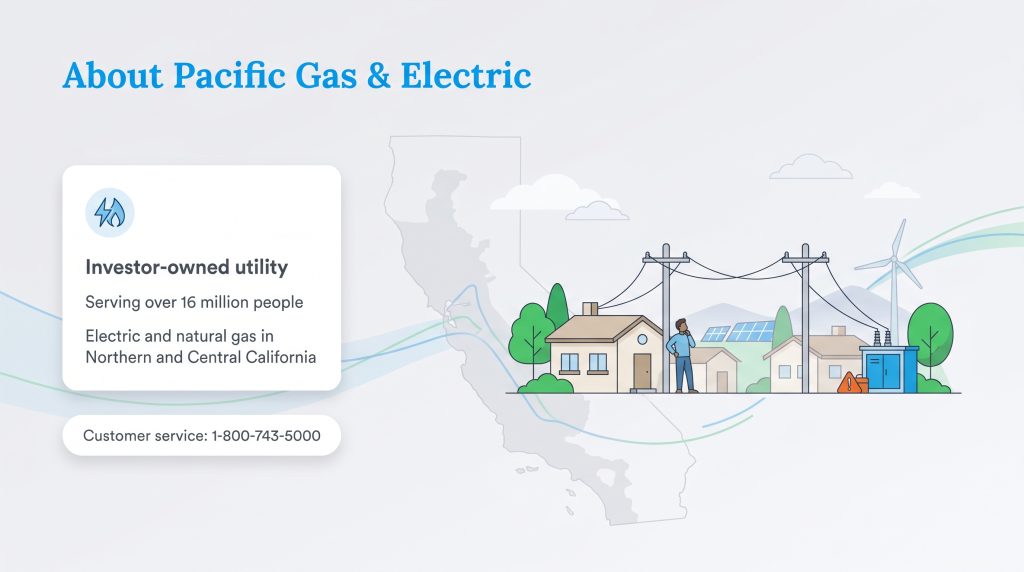
Pacific Gas & Electric (PG&E) operates as an investor-owned utility providing critical electric and natural gas service to residents across Northern and Central California. The company is actively modernizing the state’s grid, investing heavily in sweeping wildfire prevention strategies, and continually expanding its clean energy offerings. If you are moving to the region, PG&E will almost certainly be your primary utility provider. For general account inquiries, you can reach PG&E customer service directly at 1-800-743-5000.
Here is a quick snapshot of the company’s historical and operational footprint:
- Founded Date: 1905
- Headquarters: Oakland, California
- Customers Served: Over 16 million people
- Primary Service Types: Electricity generation and delivery, alongside natural gas supply

- Calculate Your Moving Costs
- Compare Moving Companies
- Get Multiple Quotes
- Move with Confidence
PG&E Coverage Area (Including Major Cities)
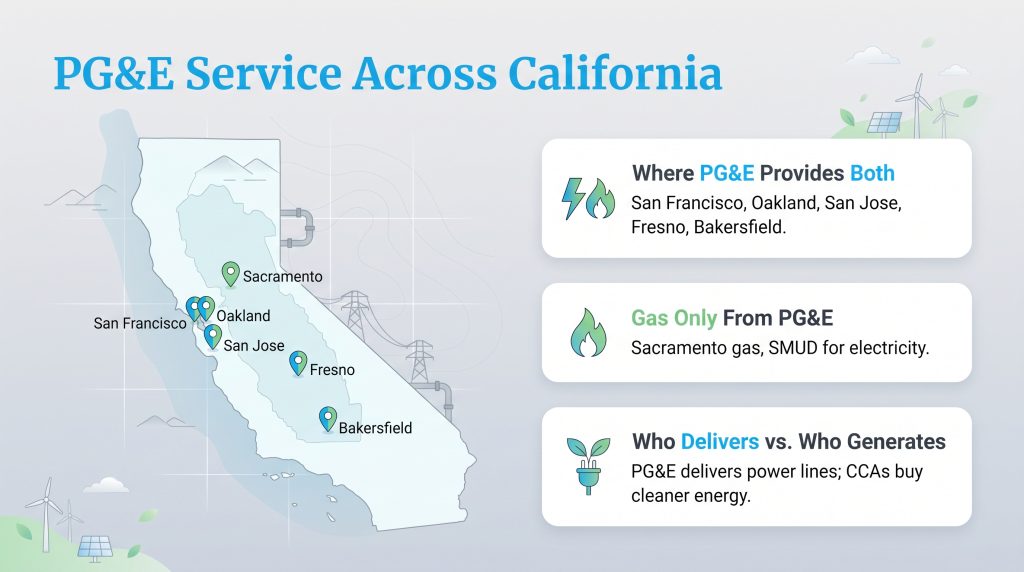
The vast PG&E gas and electric service area covers a sprawling 70,000-square-mile geographic region. This massive territory stretches across Northern and Central California, encompassing major urban centers alongside numerous rural communities.
When reviewing the map, it helps to know precisely what utility services are delivered to specific regions. While some cities receive both gas and power, others only utilize PG&E for a single utility line:
- San Francisco: Receives both electric and natural gas service.
- Oakland: Receives both electric and natural gas service.
- San Jose: Receives both electric and natural gas service.
- Fresno: Receives both electric and natural gas service.
- Bakersfield: Receives both electric and natural gas service.
- Sacramento: Predominantly receives natural gas service from PG&E, while electricity is managed by the Sacramento Municipal Utility District (SMUD).
While PG&E acts as the default delivery monopoly for electricity throughout this footprint, residential customers do have a few choices regarding how their power is generated. In California’s partially deregulated energy market, many cities participate in Community Choice Aggregation (CCA) programs. This means your local government can purchase alternative electric generation on your behalf from renewable sources, while PG&E simply continues to maintain the physical power lines and deliver the energy to your home.
PG&E Plans and Pricing (2026 Rates)
It is a well-known fact that PG&E electric rates 2026 remain among the highest in the nation. With current residential averages hovering around 39 cents per kilowatt-hour (kWh), careful rate plan selection is absolutely critical for managing your household budget. Your usage habits — especially when and how you consume electricity — will dictate which Pacific Gas and Electric plans and pricing models ultimately save you the most money.
Time-of-Use (TOU) vs. Tiered Plans
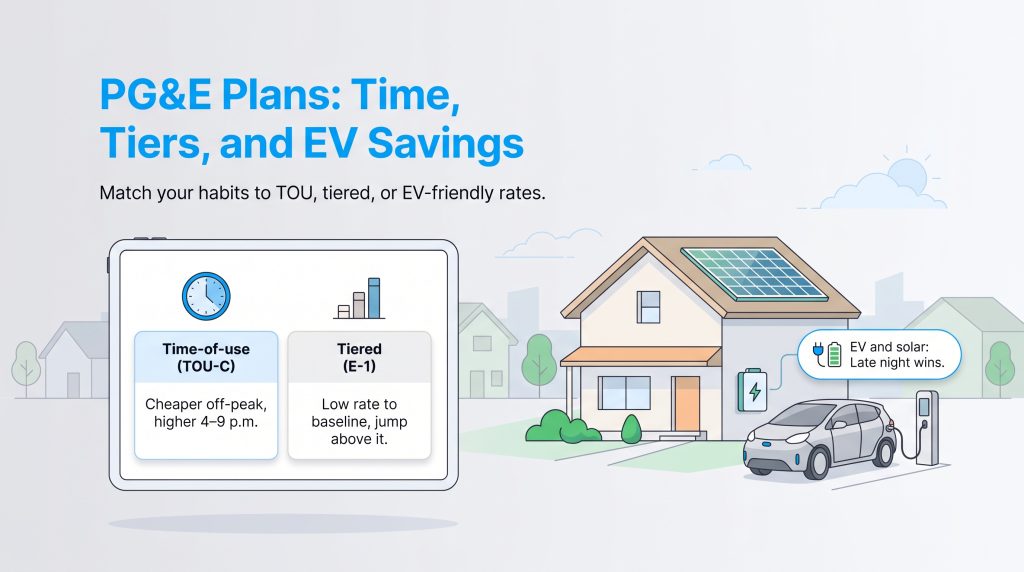
The core decision for most households centers on the PG&E time of use vs tiered debate. Most residential customers are automatically enrolled in a Time-of-Use rate structure, specifically the standard TOU-C plan. This model heavily incentivizes you to use energy outside the high-demand peak window of 4:00 p.m. to 9:00 p.m. every single day. If you can wait to run your air conditioner, charge smart devices, or turn on the dishwasher until before 4 p.m. or after 9 p.m., you will benefit from much cheaper energy rates.
On the flip side, the standard tiered plan (known as the E-1 rate schedule) ignores what time of day you use energy. Instead, it charges a set rate up to a certain threshold known as your baseline allowance. Once you cross that usage limit during your billing cycle, you enter a significantly more expensive pricing tier. This plan is only ideal for highly energy-conscious consumers who use very little electricity overall and rarely exceed their baseline limits.
| Plan Type | How It Works | 2026 Estimated Rate Ranges |
|---|---|---|
| Time-of-Use (TOU-C) | Rates fluctuate based on the time of day. Energy is more expensive during peak hours (4–9 p.m.) and cheaper during off-peak times. | Off-Peak: ~34–37 cents/kWh Peak: ~42–45 cents/kWh |
| Tiered (E-1) | You are given a monthly baseline allowance at a lower rate. Exceeding that allowance triggers a sharp price increase. | Tier 1 (Baseline): ~35 cents/kWh Tier 2 (Over Baseline): ~44 cents/kWh |
EV, Battery, and Net Metering (NEM 3.0)
If you own an electric vehicle or a home battery storage system, PG&E offers an E-ELEC rate that drastically discounts electricity during late-night hours. This plan is perfect for affordably charging your car while you sleep. Additionally, for homeowners installing new solar panels, the PG&E net metering 3.0 structure (officially called the Net Billing Tariff) applies. Under NEM 3.0, the credit you receive for exporting excess solar energy back to the grid is notably lower than in previous years, making it highly advantageous to pair new solar panels with a home battery to store your own power.
Choosing a Retail Natural Gas Provider (RNGP)
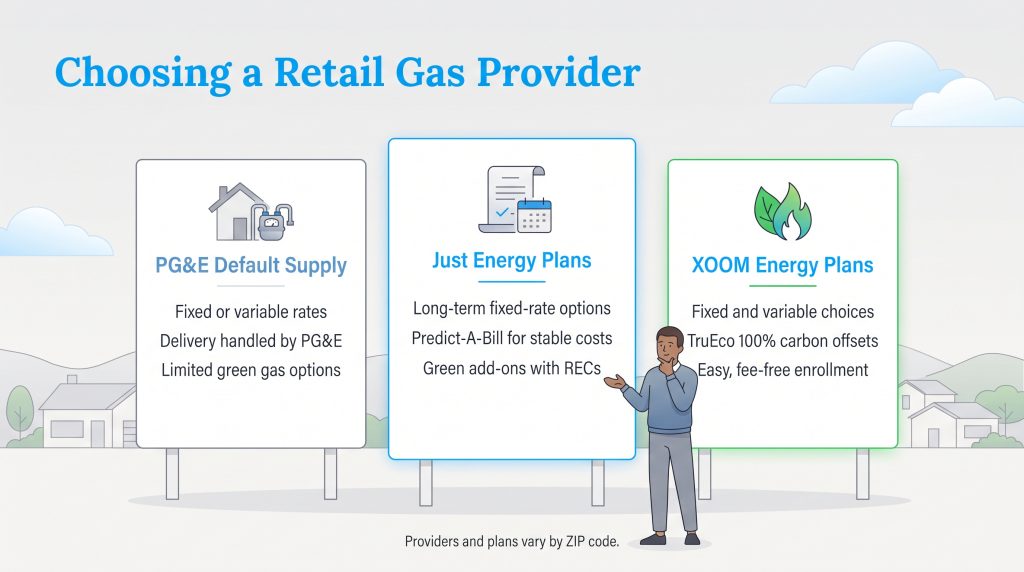
If you live within PG&E’s natural gas service footprint, you actually have the option to purchase your gas from a certified third-party provider. These competitive companies are known as Retail Natural Gas Providers (RNGP), and they can offer fixed-rate plans, unique renewable gas options, or potentially lower prices than PG&E’s default supply rates.
| Provider | Plan Highlights | Renewable/Carbon Offset Options | Key Considerations |
|---|---|---|---|
| PG&E | Fixed or variable rates, no alternative provider needed. Handles gas delivery. | Limited green options (focuses on electricity renewables). | Rates regulated by CPUC. |
| Spark Energy | Fixed-rate plans (up to 12 months). | Renewable Energy Credits (RECs) via add-ons. | Early termination fee ($50); plans may include carbon offsets. |
| XOOM Energy | Fixed-rate, variable-rate, and TruEco® carbon offset plans. No enrollment fees. | Offsets 100% of natural gas emissions via TruEco®. | Seamless switching. |
*Providers and plans may vary by location. Search your ZIP code to see what’s available in your area.
PG&E Fees, Deposits, and Guarantees
Understanding standard PG&E connection fees and deposits can help you avoid surprise charges on your first utility bill. Like most utility companies, PG&E outlines specific financial requirements to establish and maintain an active account.
- Standard Connection Fee: When you start new service, expect a modest one-time connection charge (typically ranging from $15 to $19) applied directly to your first monthly statement.
- Security Deposits: New customers may be required to pay an upfront security deposit, which is often calculated as twice the average monthly bill for your residence. However, you can frequently waive this deposit by providing a formal letter of credit from your previous utility provider demonstrating a history of consecutive, on-time payments.
- Late Payment Penalties: If your monthly statement is not paid by the scheduled due date, unpaid balances generally incur a late fee of 1% on the past due amount.
- Paper Bill Fee: To encourage eco-friendly habits and reduce waste, PG&E charges a $2 per month fee if you opt out of paperless billing and require a physical statement mailed to your home.
Deals, Discounts, and Ways to Save on Your PG&E Bill
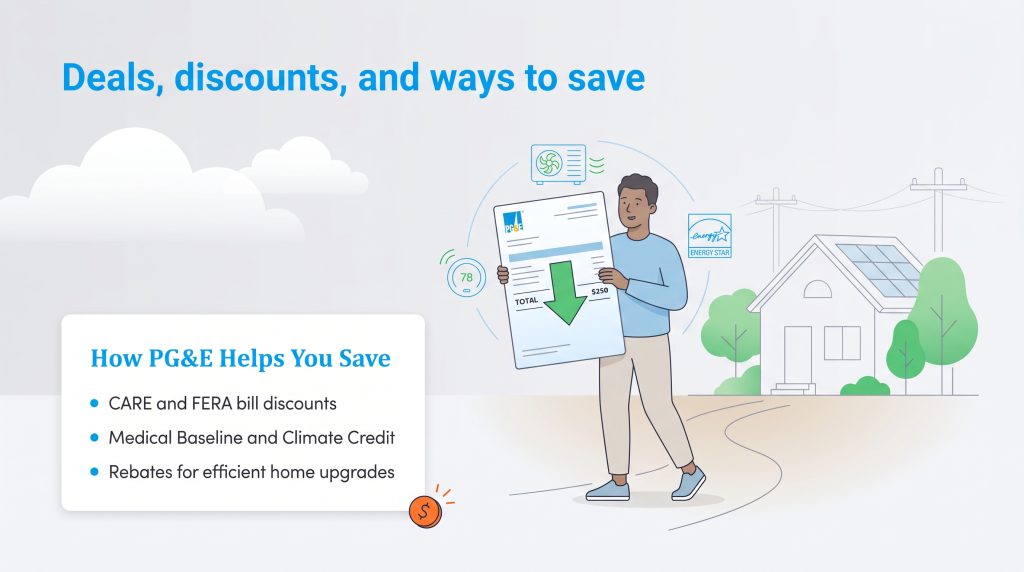
Mitigating the high costs of energy delivery in California requires a proactive approach. PG&E offers several specialized financial assistance programs designed to ease the burden for households that need it most. Beyond income-based discounts, they provide compelling rebates for home energy efficiency upgrades that can lower your consumption over time.
Primary Assistance Programs and Rebates:
- PG&E CARE Program (California Alternate Rates for Energy): This is the most popular financial assistance option, offering a discount of 20% or more on monthly gas and electric bills for income-qualified households.
- FERA (Family Electric Rate Assistance): Designed for slightly larger families (three or more people) whose income slightly exceeds CARE guidelines. It offers an 18% discount on electricity.
- Medical Baseline Allowance: Provides an additional allotment of energy at the lowest tier price for customers who require electrically powered medical equipment at home.
- California Climate Credit: A bi-annual credit applied directly to customer bills (usually arriving in April and October) that distributes your share of the state’s cap-and-trade program funds.
- Hardware Rebates: You can apply for significant cash-back rebates on energy-efficient upgrades, including smart thermostats, high-efficiency electric heat pumps, and ENERGY STAR certified appliances.
Reporting and Searching for PG&E Outages
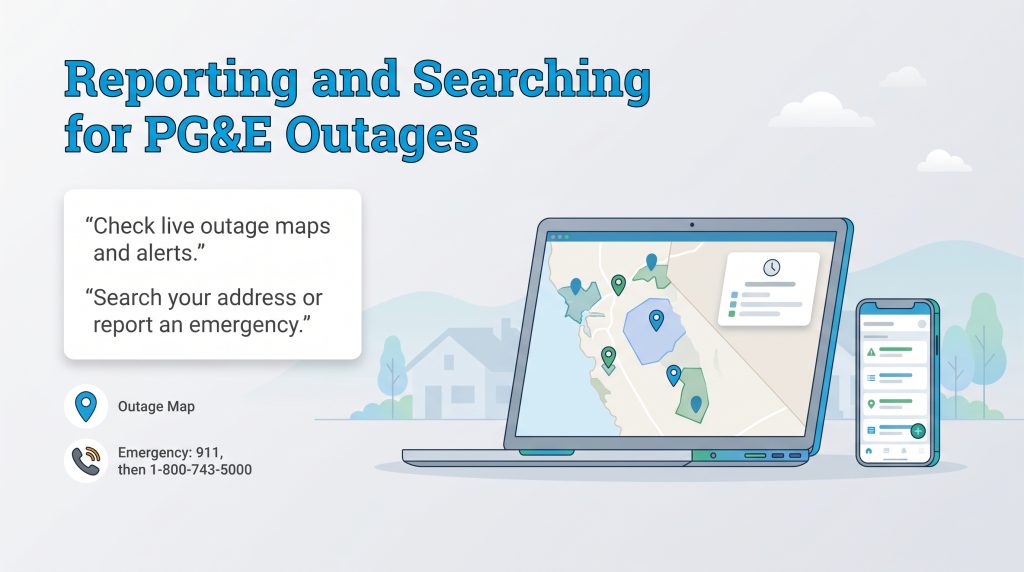
Because Northern and Central California frequently face extreme weather and heightened wildfire risks, PG&E offers a robust set of tools for tracking power statuses. Whether you want to see if your neighborhood is affected by a severe winter storm or you need to check restoration timelines, their official outage center keeps you connected.
A major feature of grid management in this region is the Public Safety Power Shutoff (PSPS). During periods of severely dry conditions and high winds, the utility proactively turns off power lines to prevent sparking catastrophic wildfires. Proper PG&E outage map reporting tools allow you to prepare your household before these planned shutoffs occur.
How to Check the Outage Map:
- Navigate to the live outage map at pge.com/outages.
- Enter your specific street address or ZIP code into the search bar to pull real-time community updates.
- Click on the highlighted outage polygons to view estimated power restoration times and the cause of the disruption.
- Enroll in targeted outage alerts via text message or email directly from your dashboard to stay completely informed.
How to Report an Outage or Emergency:
- Online Form: Utilize the web portal to Report an Outage quickly.
- Phone Support: For urgent emergencies like gas leaks or downed power lines, call 911 immediately, then contact the PG&E emergency line at 1-800-743-5000.
The PG&E Mobile App and Account Management
There is often confusion surrounding PG&E mobile app access because the utility officially does not offer a primary billing or account management app. Instead of searching the app store for a way to pay your monthly bill, you should access the highly responsive, mobile-friendly web portal through your smartphone’s browser to handle all financial transactions securely.
For smart home enthusiasts looking to monitor their daily energy consumption, iOS users can now connect their PG&E smart meter data directly to the Apple Home app. This seamless integration provides a detailed overview of your usage alongside your connected smart thermostats and eco-friendly appliances.
While you won’t use an app to pay your bill, the specialized PG&E Report It app remains a vital community tool for reporting safety hazards.
PG&E Report It Features:
- Report Safety Concerns: Easily flag non-emergency issues like trees growing dangerously near powerlines, damaged utility poles, or corroded electrical equipment.
- Submit Visual Evidence: Attach clear photos or a short video (up to 10 seconds) right from your phone.
- Track Submissions: Receive app notifications when your report is under review and ultimately resolved by a field team.
The app is available for free on iOS and Android devices.
Sustainability and Renewable Energy Initiatives
PG&E supplies energy from a massive mix of clean, renewable, and carbon-free sources. This aligns with California’s ambitious climate goals and helps customers automatically reduce their household carbon footprint. The company has made substantial strides in eco-conscious energy delivery, proudly achieving a massive milestone in 2023 by delivering 100% greenhouse-gas-free electricity to its retail customers.
Current Energy Mix (as of 2023):
- 53% Nuclear (sourced heavily from the Diablo Canyon Power Plant)
- 34% Renewable (solar, wind, geothermal, and eligible biomass)
- 13% Large Hydropower, utilizing dams across Northern California
*Source: https://energydigital.com/articles/pg-es-electricity-100-greenhouse-gas-free-utility-says
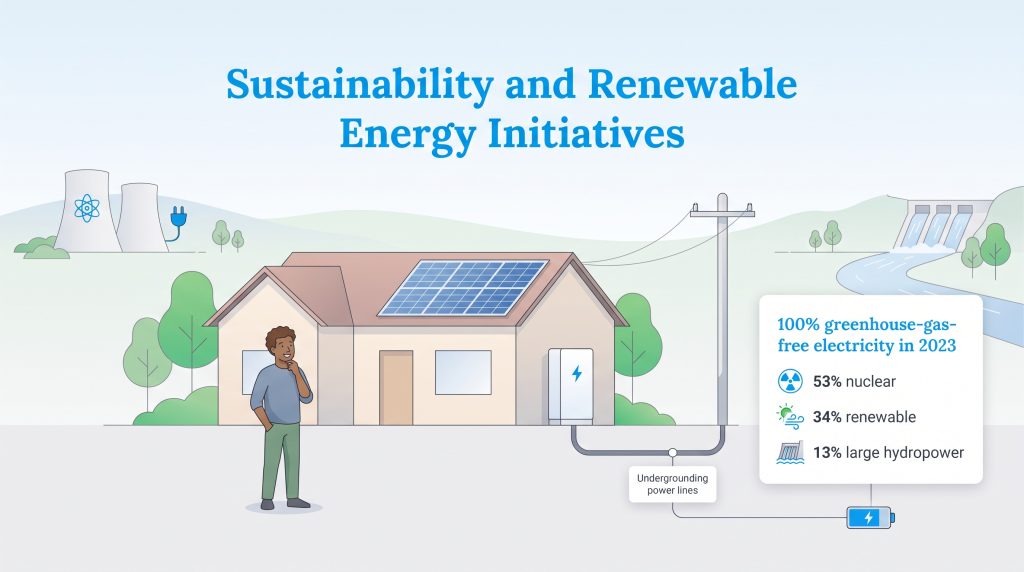
In addition to cleaner generation, PG&E continues to support the adoption of residential solar power through the NEM 3.0 (Net Billing Tariff) program, incentivizing homeowners to install panels and battery storage. The company has also surpassed 2,100 MW in battery energy storage capacity to enhance grid reliability. Beyond power generation, the utility is currently undertaking a massive, multi-year infrastructure project to physically underground 10,000 miles of power lines in high-fire-threat districts — a critical step toward mitigating future wildfire liabilities.
Customer Reviews and Ratings
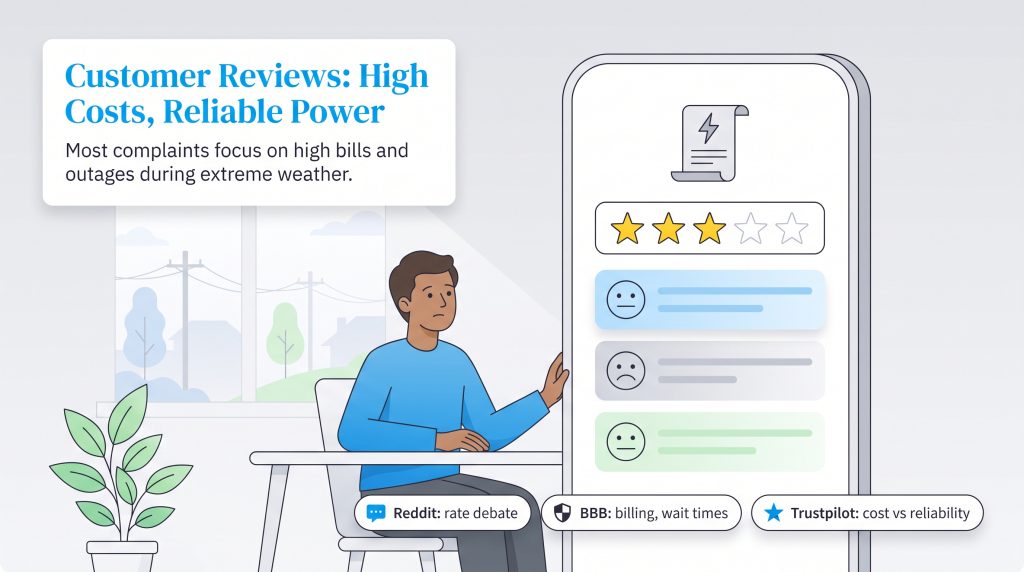
When searching for Pacific Gas and Electric customer reviews across the internet, the aggregated sentiment undeniably trends negative. However, this is quite common for massive utility monopolies where consumers lack the ability to switch providers for their primary electricity delivery. Here is a breakdown of what users are saying across different platforms:
- Reddit: Active discussions frequently revolve around the PG&E time of use vs tiered debate. Many users share tips on how to pre-cool their homes before 4 p.m. to beat the expensive peak rates, while others express frustration over broad seasonal rate hikes.
- Better Business Bureau (BBB): Reviews and formal complaints heavily cite issues with steep bills during extreme summer and winter months, as well as prolonged wait times when trying to reach customer service representatives during major storm outages.
- Trustpilot: Similar to the BBB, reviewers focus their complaints on the high cost of living and expensive baseline energy pricing. However, a segment of users acknowledges that standard electrical delivery remains highly reliable outside of extreme weather events.
Why Choose PG&E and Who It Is Best For
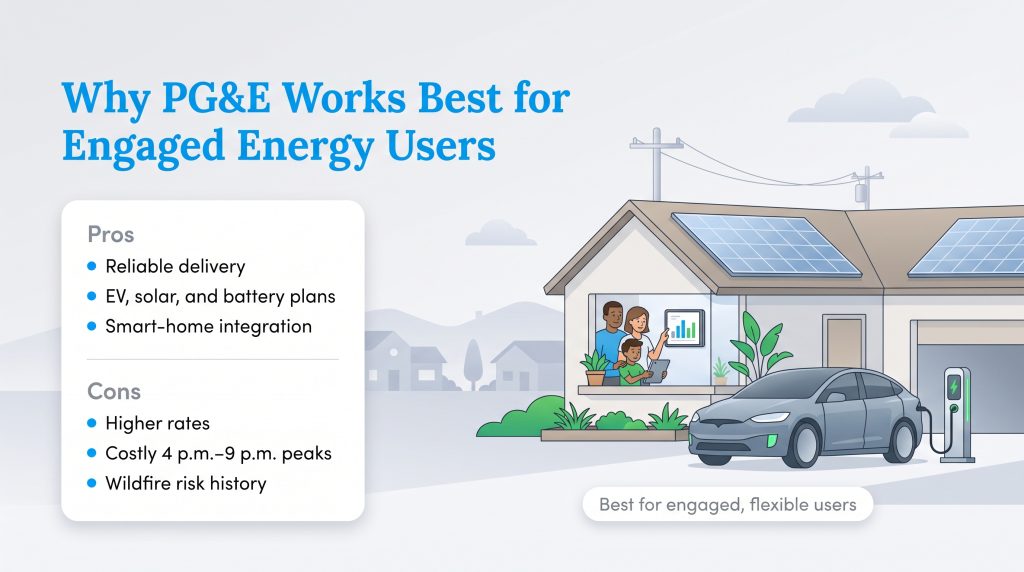
Because PG&E operates as a geographic monopoly for electricity delivery across Northern and Central California, most residents simply do not have an alternative option for their physical power lines. However, evaluating the provider’s strengths and weaknesses can help you maximize the value of your mandatory connection.
| Pros | Cons |
|---|---|
| Highly reliable power delivery during standard weather conditions. | Some of the highest electricity rates in the United States. |
| Robust selection of specialized plans (EV, battery, and solar). | Peak hours (4 p.m. to 9 p.m.) can drastically inflate your bill. |
| Excellent integration with smart home technology (Apple Home). | Historical connection to severe regional wildfire liabilities. |
Ultimately, PG&E is best suited for consumers who actively engage with their energy usage. Households that embrace smart-home automation, drive electric vehicles, and proactively shift their heavy appliance use away from the 4 p.m. to 9 p.m. peak window will benefit the most from the specialized E-ELEC and Time-of-Use plans. If you are willing to manage your consumption habits, you can offset the high baseline costs and take full advantage of the utility’s renewable energy milestones.
Preparing for Your PG&E Setup (Start or Stop Service)
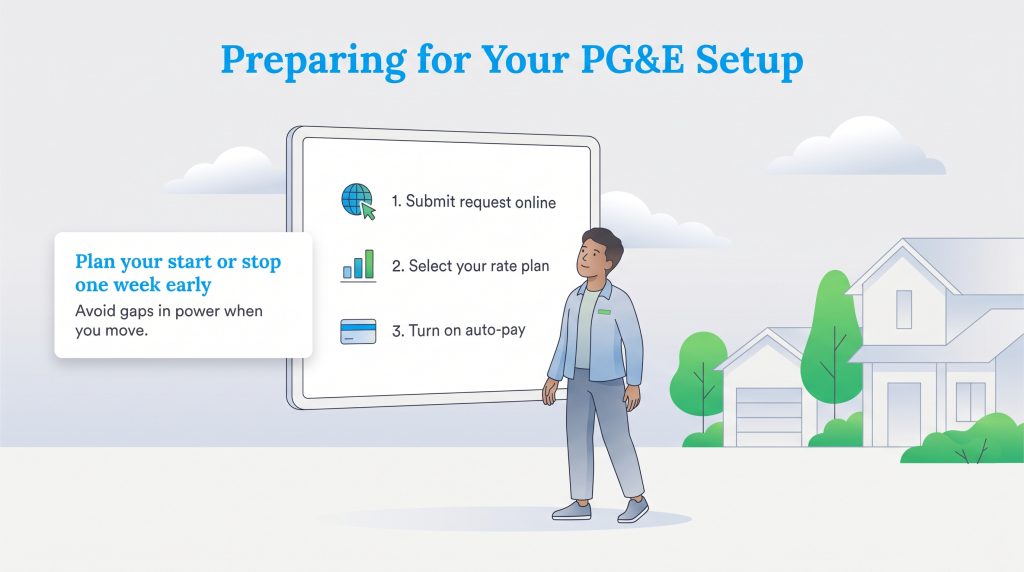
If you are relocating into a new apartment or purchasing a home in the region, coordinating your utility transition shouldn’t be stressful. We highly recommend that you start or stop PG&E service at least one full week prior to your official move-in or move-out date to ensure continuous power.
New Resident Setup Checklist:
- Submit Your Request Online: Head to the official PG&E website roughly 7 to 10 days before your move to input your new address and schedule a specific connection date.
- Select Your Rate Plan: Review your lifestyle and home setup to choose between the standard TOU-C plan or the Tiered E-1 plan. Selecting the right option ensures your initial billing cycle is optimized for your habits.
- Configure Auto-Pay: Once your online dashboard is active, link your preferred checking account or credit card for automatic payments. This simple step helps you avoid costly late fees or missed deadlines amidst the chaos of moving.
Taking Control of Your PG&E Energy Service
If you are moving to or living in PG&E’s expansive service area, you are connected to a massive grid with a strong, ongoing push toward renewable sustainability. While electricity delivery is less flexible in terms of choosing a competitor, smart consumers can still take absolute control of their expenses. By selecting the optimal rate plan, diligently utilizing the outage map during storm season, and capitalizing on income-qualified discounts or rebates, you can efficiently manage your utility bills and make the most of your residential service.
Frequently Asked Questions About Pacific Gas & Electric
What are the peak hours for PG&E?
Does PG&E charge a deposit to start service?
How do I stop or transfer my PG&E service when moving?
What services does PG&E provide?
Does PG&E offer renewable energy options?
How can I lower my PG&E bill?
– Enroll in CARE or FERA (income-qualified discounts)
– Use Budget Billing to even out monthly payments across seasons
– Get rebates for energy-efficient appliances
– Switch to a time-of-use (TOU) plan if it fits your schedule
What’s the best way to pay my PG&E bill?
– Online (securely via their mobile-responsive website browser)
– AutoPay (highly recommended to avoid late fees)
– Phone (1-877-704-8470)
– Mail (check/money order)
– In person (at authorized neighborhood payment centers)
Does PG&E charge a fee for paper bills?
What should I do if I smell gas?
Does PG&E have a grace period for late payments?
Why is my PG&E bill so high?
How do I dispute a charge on my PG&E bill?
About the Author

David has been an integral part of some of the biggest utility sites on the internet, including InMyArea.com, HighSpeedInternet.com, BroadbandNow.com, and U.S. News. He brings over 15 years of experience writing about, compiling and analyzing utility data.