

Understanding Local Service Providers, Cooling Costs, and Moving Deadlines Can Help You Plan Your Mississippi Move
Key Takeaways
- Housing in the Magnolia State ranks among the most affordable in the nation, though heavy summer air conditioning usage means you need to budget carefully for seasonal electricity spikes.
- Because Mississippi has a regulated energy market, your utility providers are determined by your exact address and the utility’s service territory, with electricity supplied by Entergy, Mississippi Power, local distributors, and electric cooperatives.
- Preparing your home with ENERGY STAR upgrades and a verified understanding of local storm risks is the smartest way to combat Gulf Coast humidity, lower your carbon footprint, and keep monthly bills manageable.
Swapping sky-high rent or a cramped starter home for a sprawling front porch, rich blues history, and genuine Southern hospitality makes moving to Mississippi an easy sell for budget-conscious families. While the appealing real estate market and wide-open spaces grab all the headlines, some of the most important things to know before relocating revolve around how your new home will actually run day to day. Between sticky subtropical summers that push air conditioners to their limits and a regulated utility grid where your exact address dictates your providers, a little upfront planning goes a long way. We’re breaking down cost of living factors, how to get your utilities connected on time, and the smartest eco-conscious upgrades to keep your monthly bills in check.
Is Mississippi a Good Place to Live? Pros and Cons for Newcomers
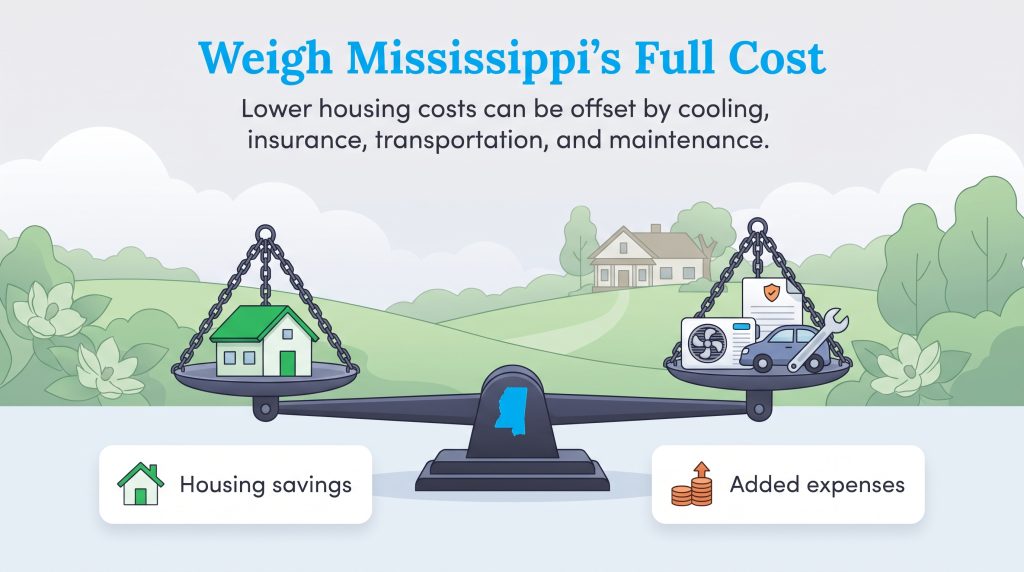
Whether Mississippi is a good fit depends on your budget, work, and lifestyle. Your housing costs may be lower than in your current city, but you should compare the full monthly budget before deciding, as cooling, insurance, transportation, and property-specific maintenance can change the savings. Weighing these benefits and drawbacks will help you evaluate if the Magnolia State matches your household’s needs.
| Pros of Living in Mississippi | Cons of Living in Mississippi |
|---|---|
| Relatively low housing costs compared to national averages | Oppressive summer heat and humidity from May through September with frequent 90°F+ days |
| Rich cultural heritage anchored by world-famous blues music, literature, and culinary scenes | Severe weather risks including Gulf Coast hurricanes, spring tornadoes, and flash flooding |
| Scenic Gulf Coast shoreline paired with abundant rivers, lakes, and state parks | Higher-than-average monthly electricity consumption driven by constant air conditioning use |
| Affordable higher education and lively SEC and regional college towns | Limited job market in specialized corporate sectors compared to neighboring metros like Atlanta |
| Lower overall tax burden, including specific tax exemptions for qualifying retirees | Patchy high-speed fiber internet availability in remote rural counties |
| Genuine Southern hospitality and tight-knit communities where neighbors still wave | Heavy reliance on personal vehicles, ranking high in per capita gasoline expenditures |
Quick Fact
While Mississippi boasts some of the lowest retail gasoline prices in the country, its spread-out rural highways mean residents spend more per capita on gas than almost any other state. Choosing a fuel-efficient or hybrid vehicle is an environmentally mindful choice that protects your wallet when relocating here.
Before You Sign a Lease or Purchase Agreement
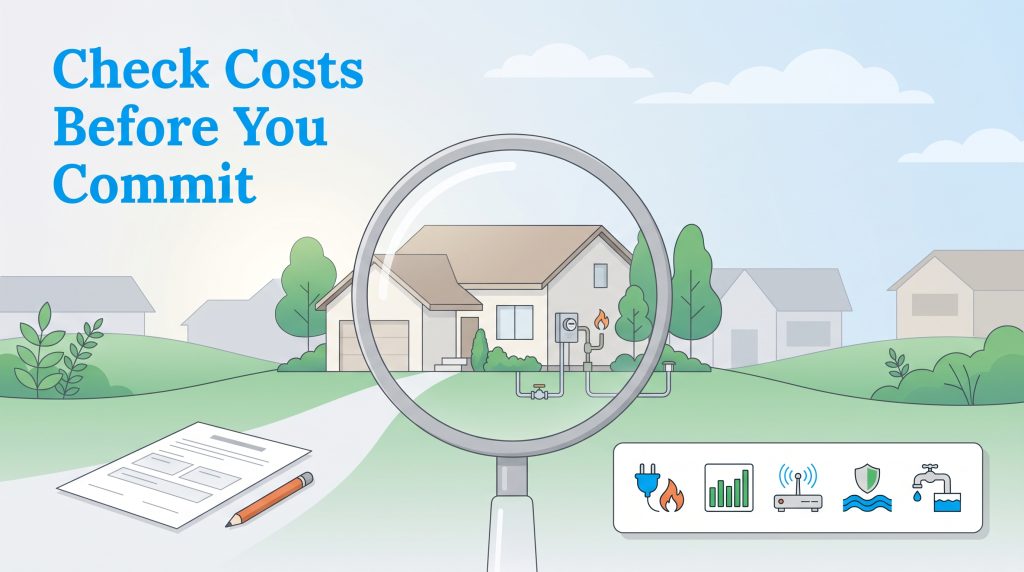
Taking a proactive approach to your home setup can save you from unexpected expenses after move-in day. Before finalizing a lease or mortgage contract, complete these essential property checks to ensure your new home aligns with your budget and lifestyle. Knowing these details ahead of time prevents unwanted surprises.
- Confirm your specific utility providers using the home’s exact street address.
- Ask whether the home is all-electric or if it relies on natural gas or propane for heating and cooking.
- Request available historical energy-use information from the previous 12 months, with the owner’s permission, to accurately project your summer cooling bills.
- Confirm internet installation availability directly with the provider instead of assuming service based on coverage maps.
- Check local flood exposure and obtain property-specific insurance quotes to understand the full cost of homeownership.
- Identify your water and wastewater sources to determine if the property uses a municipal system, a private well, or a septic system.
Breaking Down the Cost of Living in Mississippi (Including Hidden Utility Costs)
When you start crunching the numbers on the cost of living in Mississippi, you’ll likely find that everyday expenses are generally lower than the national average. Yet if you move into an older, poorly insulated home without preparing for a subtropical climate, your seasonal energy bills can easily catch you off guard. Understanding how housing savings interact with home energy demands is the key to building an accurate monthly budget.
| Expense Category | Mississippi Context | National Comparison |
|---|---|---|
| Overall Cost of Living | More than 12% below the national baseline based on 2026 data | Ranks among the most affordable states in the country overall |
| Median Home Sale Price | ~$194,500 | Significantly lower than the national median home price |
| Sales Taxes | 7% general state sales tax | Some municipalities levy an additional local sales tax, and exceptions like grocery taxes apply |
| Average Retail Electricity Rate | ~14.54 cents/kWh | Lower per-kWh rate than the U.S. average, but paired with very high monthly kWh usage |
| Monthly Utility Costs | Varies sharply by season and usage | Water, sewer, natural gas, and trash may be billed separately or grouped together depending on your municipality |
Why do electric bills spike so sharply between May and September? Bills reflect your total consumption, your utility’s rates, fixed charges, and seasonal riders. Because subtropical humidity lingers day and night for nearly half the year, central air conditioners, heat pumps, and dehumidifiers run constantly during peak summer months, pushing residential kilowatt-hour usage much higher than in cooler climates.
Setting Up Utilities in Mississippi: How to Get Connected by Region
If you’re relocating from a deregulated energy state like Texas or Ohio where residents shop around for retail power plans, setting up utilities in Mississippi works a bit differently. Mississippi operates a regulated energy market, meaning you generally cannot choose a competing retail electricity supplier. Your provider depends on your exact address and its assigned service territory.
Electricity Providers: Entergy, Mississippi Power, TVA, and Local Co-ops
Depending on which region of the state you call home, your electric service will fall under one of four major power territories:
- Entergy Mississippi: Serves many counties across western and central Mississippi, including the greater Jackson metro area, Vicksburg, and parts of the Delta.
- Mississippi Power: Covers a large portion of southeastern Mississippi, stretching from Meridian and Hattiesburg down to Gulf Coast hubs like Gulfport, Biloxi, and Pascagoula.
- Tennessee Valley Authority (TVA) Distributors: Supplies power to local municipal utility departments and some electric cooperatives across northern and central Mississippi.
- Electric Cooperatives: A network of member-owned rural electric cooperatives, such as Coast Electric, Singing River Electric, and 4-County Electric Power Association, powers vast stretches of rural and suburban communities statewide.
Ask each provider what identification, occupancy documents, deposits, and connection fees apply. Requirements and deposit-waiver options vary from one utility to the next, so plan to start the process 10 to 14 days before you are legally entitled to occupy the property.
Natural Gas, Water, and Trash Collection
If your home uses natural gas for space heating, water heating, or cooking, your service will likely be managed by Atmos Energy, Delta Utilities, or Spire, though several smaller towns operate their own municipal gas systems. If you’re buying a rural acreage property outside the pipeline grid, ask the seller whether the home relies on a leased or owned residential propane tank so you can coordinate deliveries before winter.
Your water, sewer, and trash collection are handled locally by your city utility department or a county rural water association. If you are moving to a rural property, ask whether the home relies on a private well and a septic system, as these require specific maintenance instead of monthly municipal billing. When you call to set up your water account, always ask whether curbside trash pickup and recycling are bundled directly into your monthly municipal water bill or if you need to set up a separate account with the county solid waste authority.
Checking Broadband Internet Coverage Before You Sign
For remote workers and streaming households, verifying internet service is one of the most critical steps in your house hunt. Metro areas and university towns boast fast fiber from providers like C Spire and AT&T, and Mississippi’s electric cooperatives have led an impressive push to string high-speed fiber across rural counties. Still, remote countryside roads can have sudden dead zones. Check the FCC National Broadband Map, then confirm serviceability, installation timing, speeds, and any construction fees directly with the provider.
Water Check
Before moving in, review the public water system’s latest water-quality report and any current advisories. If you use a private well, arrange appropriate testing and choose treatment only after identifying a specific issue.
Compare Mississippi Communities for Your Move
Mississippi isn’t a monolith, and the communities you compare offer vastly different lifestyles depending on your region. Your utility providers, insurance costs, and seasonal home maintenance priorities will look completely different in a walkable northern college town compared to a raised cottage overlooking the Mississippi Sound. Knowing what to expect in each region can help you anticipate your long-term housing costs.
College Towns: Oxford, Starkville, and Hattiesburg
Home to Ole Miss, Mississippi State, and Southern Miss, these lively university hubs attract remote professionals, retirees, and young families alike with their walkable downtown squares, thriving culinary scenes, and regional healthcare systems. Utilities inside city limits are frequently managed by responsive municipal departments — backed by TVA power in Oxford and Starkville — and all three towns feature robust fiber-optic internet networks designed to support heavy campus and work-from-home bandwidth.
The Gulf Coast: Ocean Springs, Biloxi, and Bay St. Louis
If your dream involves coastal breezes, fresh Gulf seafood, golf cart-friendly art districts, and scenic shoreline, the Gulf Coast delivers unbeatable coastal value. Keep in mind that coastal living comes with specific home service realities. Your power will come from Mississippi Power or Coast Electric, flood insurance is generally separate from standard homeowners insurance, while wind coverage depends on the policy and the property location, and your outdoor HVAC condenser will need regular rinsing and anti-corrosion maintenance to survive the salty coastal air.
Jackson Metro Suburbs: Madison, Brandon, and Ridgeland
Families relocating to central Mississippi often flock to suburban communities surrounding the state capital in Madison and Rankin counties. Cities like Madison, Brandon, and Ridgeland are known for their public school districts, proximity to major medical centers, and master-planned subdivisions. Here, you can expect reliable suburban grid infrastructure serviced primarily by Entergy Mississippi along with Delta Utilities or Atmos Energy for natural gas.
North Mississippi: DeSoto County and Tupelo
Tucked right below the Tennessee state line, DeSoto County communities like Southaven, Olive Branch, and Hernando serve as booming commuter suburbs of Memphis. Meanwhile, Tupelo anchors nearby Lee County as a vibrant manufacturing and cultural hub (and the birthplace of Elvis Presley). Residents in north Mississippi enjoy reliable TVA-backed electric rates, noticeably lower hurricane exposure than the southern half of the state, and four distinct seasons that require balanced winter heating and summer cooling.
Sustainable Living in the Magnolia State: Beating the Heat and Storms
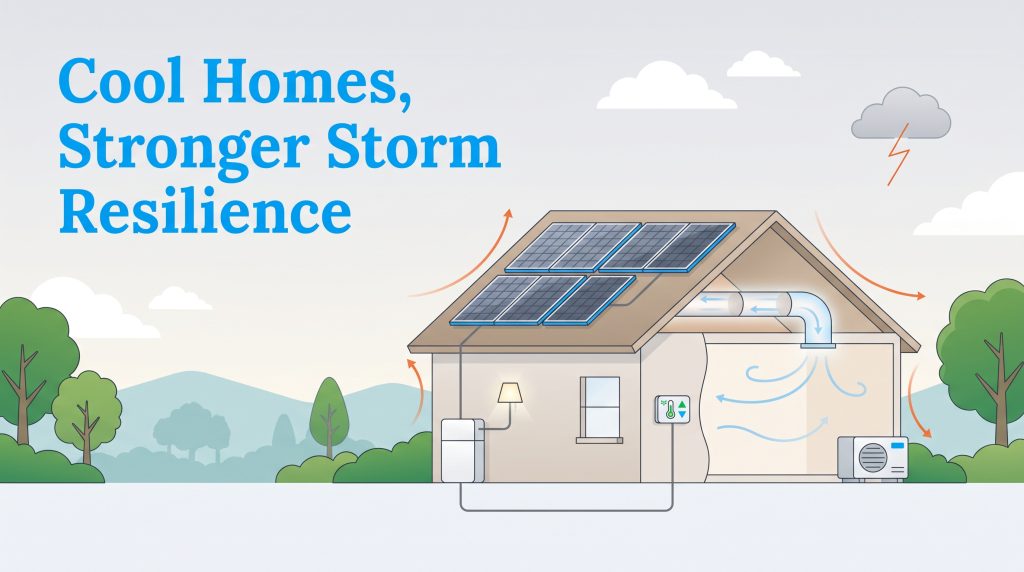
Embracing sustainable living in Mississippi isn’t about chasing trendy buzzwords; it’s the most practical, wallet-friendly way to defend your budget against 95°F August afternoons and severe thunderstorm seasons. Making targeted efficiency upgrades right after move-in shrinks both your monthly kilowatt-hour usage and your household’s environmental impact. By planning ahead, you can keep your home comfortable without overburdening the power grid.
- Outsmarting Gulf Humidity with ENERGY STAR: Heating and cooling account for nearly half of a typical home’s energy consumption. If you move into a house with an aging air conditioner, upgrading to an efficiency-rated heat pump and consulting the ENERGY STAR heating and cooling efficiency guide can dramatically cut your cooling load. An ENERGY STAR certified smart thermostat paired with sealed attic ductwork can noticeably boost your cooling efficiency. A dehumidifier might also be useful if you have an identified humidity problem, helping to manage sticky moisture indoors so your primary A/C unit doesn’t have to overwork.
- Navigating Solar Energy Incentives in Mississippi: Before budgeting for solar, check current incentives and utility export-credit rules. While the federal Residential Clean Energy Credit under Section 25D ended for direct residential purchases after Dec. 31, 2025, abundant Southern sunshine still makes rooftop solar appealing. Homeowners might still benefit from state net-metering structures or explore third-party solar leases that utilize the commercial Section 48E tax credit.
- Clean Storm Resilience: Summer lightning storms, spring squall lines, and tropical systems can knock out rural and coastal power lines for days. Standard grid-connected solar usually shuts down during a power outage unless you have appropriately configured backup equipment. A battery or portable power station may support selected loads, providing a quiet, fume-free, eco-conscious alternative to portable gas generators. If you do use a portable gas generator, always operate it outdoors far from windows to prevent carbon monoxide buildup.
Eco Edge
Check with Entergy Mississippi and Mississippi Power for available residential energy audits and smart thermostat rebates, as program availability and eligibility can change. Scheduling an energy checkup right after you move in is an easy energy-saving option that helps you pinpoint leaky window seals or thin attic insulation before summer temperatures peak.
Your Step-by-Step Moving to Mississippi Checklist
A stress-free relocation comes down to timing your utility transfers and local county paperwork in the right order. Keeping these essential things to know before moving to Mississippi organized on a timeline ensures you won’t be stuck unpacking boxes in a sweltering house without air conditioning or running water. Follow this chronological moving to Mississippi checklist to stay ahead of every deadline:
- Four weeks before moving: Confirm your exact utility providers for electricity, natural gas, water, and trash, and verify wired high-speed internet options at your new address using the FCC National Broadband Map if you work remotely.
- Two weeks before moving: Contact your electric, gas, and water providers to schedule service activation for the day before your moving truck arrives so the air conditioning is already cooling the house while you unload.
- Move-in week: Swap out all HVAC return air filters immediately, test every smoke and carbon monoxide detector, locate your main water shut-off valve, and confirm your municipal trash and recycling pickup schedule.
- Within 30 days of moving: Register your out-of-state vehicles at your local county Tax Collector’s office after establishing residency to avoid hefty late penalties.
- Within 60 days of moving: Transfer your out-of-state driver’s license through the Mississippi Department of Public Safety (DPS). Remember that voter registration is a separate process with its own eligibility rules.
- Between Jan. 1 and April 1: File for your Mississippi Homestead Exemption at your county Tax Assessor’s office if you owned and occupied the home as your primary residence on Jan. 1.
Money Saver
Don’t miss the April 1 filing window for the Mississippi Homestead Exemption if you bought a primary residence. Filing this regular exemption with your county Tax Assessor can lower your annual property tax bill, provided you continue to meet the eligibility requirements. Qualifying older homeowners or people with disabilities may also be eligible for additional benefits.
Making Yourself at Home in the Magnolia State
Moving to Mississippi rewards you with relatively low housing costs, friendly neighbors who still take time to chat, and a wonderfully unhurried pace of life. While the subtropical summers and storm seasons require a little respect, taking a proactive approach to your utility setup and home energy efficiency is the secret to keeping your total monthly overhead manageable. By getting your accounts connected early, sealing up leaky ductwork, and leaning on smart, sustainable cooling habits, you’ll be ready to kick back on your front porch with a glass of sweet tea.
Frequently Asked Questions About Moving to Mississippi
Still have questions about budgeting for your move or getting your home services up and running? Here are straightforward answers to the most common questions newcomers ask when relocating to the Magnolia State.
How Much Are Utilities Per Month in Mississippi?
Can I Choose My Own Electricity Provider in Mississippi?
What Salary Do You Need to Live Comfortably in Mississippi?
Does Mississippi Have Good High-Speed Internet in Rural Areas?
Is Solar Power Worth It for Mississippi Homeowners?
How Long Do I Have to Transfer My Driver’s License After Moving to Mississippi?
About the Author

LaLeesha has a Masters degree in English and enjoys writing whenever she has the chance. She is passionate about gardening, reducing her carbon footprint, and protecting the environment. She also recently served as President of the Board for City Sprouts (a community garden).

Claudio is a sustainability-focused writer with a background in Anthropology and Psychology from NC State University. He has spent over 15 years working in writing, interpretation, and translation, driven by a deep interest in how human culture shapes the environment. Today, he shares his curiosity with readers by writing about sustainable living solutions and the connection between everyday choices and environmental impact.