
Dallas residents and local businesses face compounding rate hikes starting June 1, 2026, to pay for pipeline safety and system modernization.
Key Takeaways
- Dallas gas bills are increasing by an average of $9.46 per month for residential customers and $32.44 per month for commercial accounts starting June 1, 2026.
- These price hikes fund pipeline safety and infrastructure upgrades, with Atmos Energy investing over $321 million locally to replace aging gas lines.
- You cannot switch gas providers due to regional monopolies, but you can manage costs using budget billing, financial aid, or home electrification.
Moving into a new home or managing a local business is exciting, but opening your first utility bill shouldn’t feel like a jump scare. Unfortunately, if you live in the Dallas area, you are about to see a bump in your monthly expenses. On June 1, 2026, Atmos Energy implemented a negotiated $34.1 million annual revenue increase that directly affects more than 208,000 residential gas customers. We know how frustrating it is to watch your hard-earned money slip away to basic services, which is why we’re breaking down exactly why these rates are changing, who is impacted, and the smart steps you can take to keep your budget on track.
Why Atmos Energy Is Raising Your Gas Rates
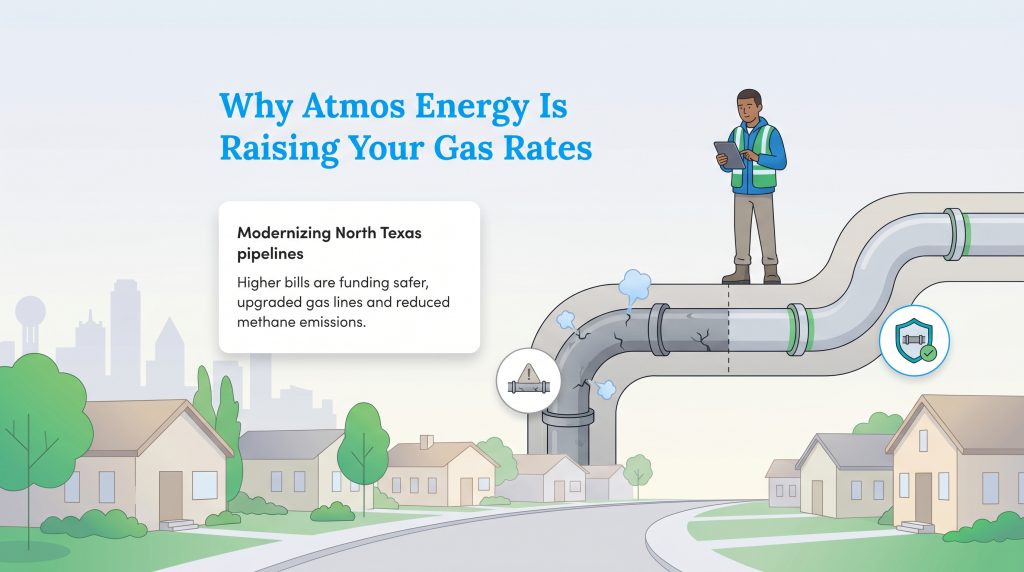
If you feel like your gas bill has been climbing year after year, you are not imagining things. Atmos Energy has been steadily raising its base rates in North Texas to fund a massive, multi-year safety and modernization initiative. Between October 2024 and September 2025, the utility poured more than $321 million into the city of Dallas alone to replace fragile steel lines and improve system safety.
The Cost of Modernizing North Texas Pipelines
Maintaining an underground gas network is an incredibly expensive and complex task. To keep communities safe and prevent hazardous leaks, Atmos Energy is currently executing a $26 billion capital investment plan that runs through 2030. In Dallas, these funds translated into replacing 36 miles of main pipelines, upgrading 3,500 customer-owned service lines, and repairing approximately 11,900 leaks in just a 12-month span. The utility is also working to reduce its operational footprint, aiming to slash methane emissions from its distribution system by 50% by 2035.
How the 2026 Rate Hikes Impact Your Monthly Bill
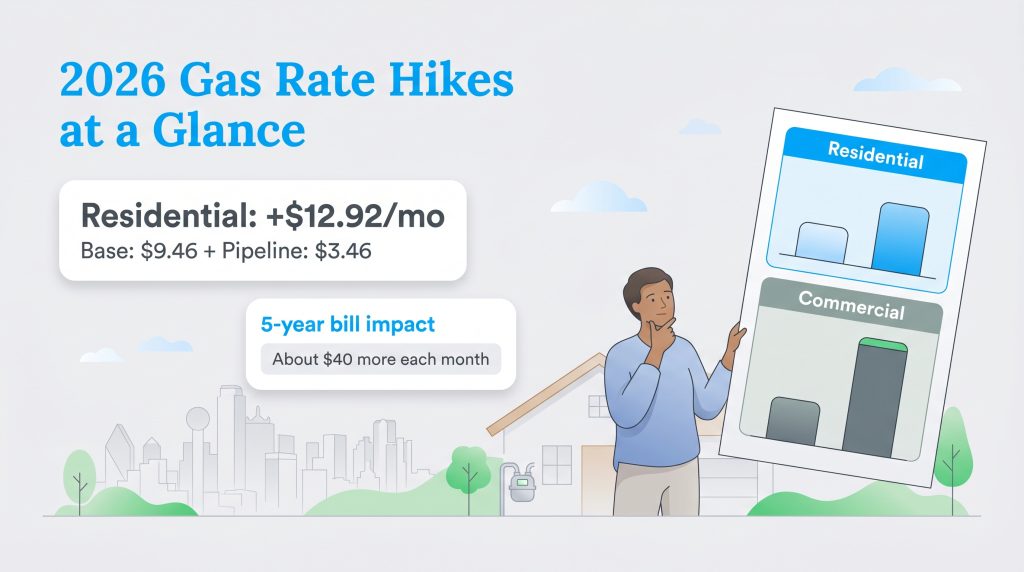
The newly approved base rate increases represent a significant jump for both local households and commercial operations. While Atmos initially requested an even larger $38.1 million revenue hike, Dallas city leaders negotiated a slightly lower compromise to ease the burden on families. Still, these changes add up quickly when combined with separate regional pipeline charges.
Breaking Down the Residential and Commercial Costs
For the typical household, the base rate adjustment adds an average of $9.46 per month to your gas bill, while commercial accounts will see an average monthly increase of $32.44. However, your actual bill could be higher. In addition to this city-specific rate review, Atmos implemented a separate $109.5 million system-wide pipeline charge on May 29, 2026, under the state’s Gas Reliability Infrastructure Program (GRIP). This pipeline charge adds roughly $3.46 per month to residential bills, meaning Dallas households face a combined monthly increase of nearly $13 in mid-2026.
A History of Compounding Dallas Utility Hikes
To put this into perspective, we have tracked how these annual base rate changes have stacked up over the last five years:
- 2022: Rates rose by an average of $4.17 per month.
- 2023: Rates rose by an average of $5.73 per month.
- 2024: Rates rose by an average of $13.69 per month.
- 2025: Rates rose by an average of $7.83 per month.
- 2026: Rates rose by an average of $9.46 per month.
In total, Dallas residents are paying over $40 more per month — or nearly $490 more each year — in basic customer charges today than they were in 2021, even before accounting for the actual cost of the gas they burn.
Why You Cannot Switch Providers (and What You Can Do Instead)
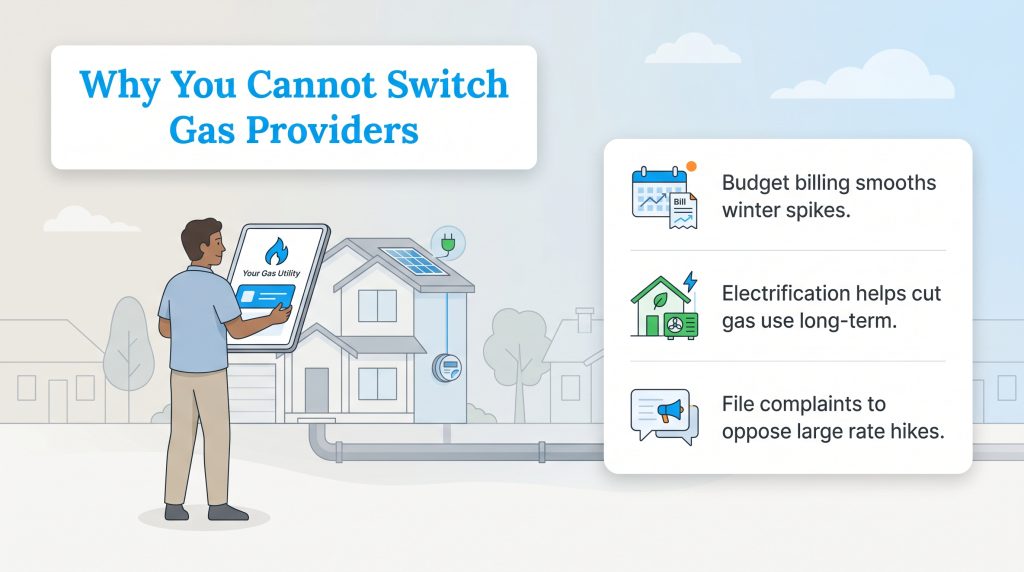
If you are used to shopping for electricity in Texas, you might expect to hop online and compare gas plans to find a better deal. Regrettably, the natural gas market does not work that way. While most of the state has a deregulated electricity market where you can shop on the Power to Choose electricity comparison portal to lock in low rates, natural gas remains a strictly regulated monopoly.
Understanding Your Energy Choices
Because installing competing sets of underground gas pipelines is physically impractical and extremely expensive, Texas grants exclusive regional territories to gas utilities. If you live in Dallas or Fort Worth, Atmos Energy is your sole option, and you cannot switch to another provider. You also cannot lock in a lower commodity rate, as the wholesale price of the gas itself is passed directly to you without any markup.
Smart Strategies to Control Your Natural Gas Bill
Even though you cannot switch providers, you are not completely powerless. Here are a few practical steps you can take to lower your energy expenses and prevent seasonal bill shock:
- Enroll in Budget Billing: This free program averages your historical 12-month usage to calculate a predictable, flat monthly payment. It is a lifesaver for avoiding massive bill spikes during freezing winter months.
- Choose an Environmentally Mindful Alternative: If you want to reduce your fossil fuel dependence and eliminate the gas customer charge entirely, you might consider residential electrification. Replacing an old gas furnace or water heater with a high-efficiency electric heat pump is an excellent energy-saving option. Transitioning to electricity also allows you to power your home with solar panels or choose a green plan with up to 100% renewable energy.
- Make Your Voice Heard: If you want to oppose future rate increases, you have the legal right to file a formal complaint using the RRC Customer Complaint Form. While individual complaints rarely stop infrastructure upgrades, public pressure helps city coalitions negotiate smaller rate increases.
Financial Assistance and Community Relief Programs
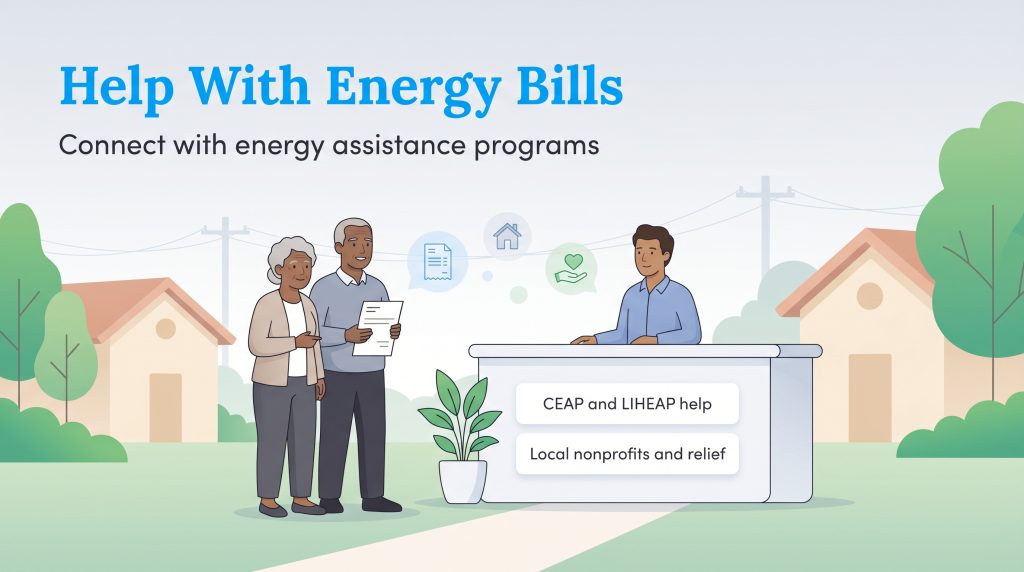
We understand that any increase in your monthly utilities can strain a tight household budget. Fortunately, there are several federal, state, and community-funded safety nets designed to help vulnerable households keep the heat running.
Applying for the Comprehensive Energy Assistance Program
The federally funded Low Income Home Energy Assistance Program (LIHEAP) is distributed in Texas through the Comprehensive Energy Assistance Program (CEAP). Administered by the Texas Dept. of Housing and Community Affairs network, this program provides direct utility bill payments and emergency heating repairs to households earning at or below 150% of the federal poverty guidelines. If you live in Dallas County, you can apply through Dallas County Health and Human Services by calling 214-819-1848.
Community Safety Nets and Nonprofit Resources
Atmos Energy also partners with local charities and matches customer donations through its “Sharing the Warmth” program, which distributed over $4.98 million in 2024 to help families pay utility bills, fund home weatherization upgrades, and repair gas appliances. In the Dallas-Fort Worth metroplex, you can reach out to these dedicated nonprofit partners for emergency funding:
- Catholic Charities Dallas: Call 866-223-7500 (received $80,000 in Atmos funding to assist with gas bills, deposits, and past-due debt).
- The Senior Source: Contact via 211 (received $50,000 for specialized senior assistance).
- Community Lifeline Center (McKinney): Contact via 211 (received $30,000 for Collin County families).
- Catholic Charities Fort Worth: Contact via 211 (received $20,000 for emergency utility support).
Geographic Scope: Which Major Texas Cities Are Impacted?
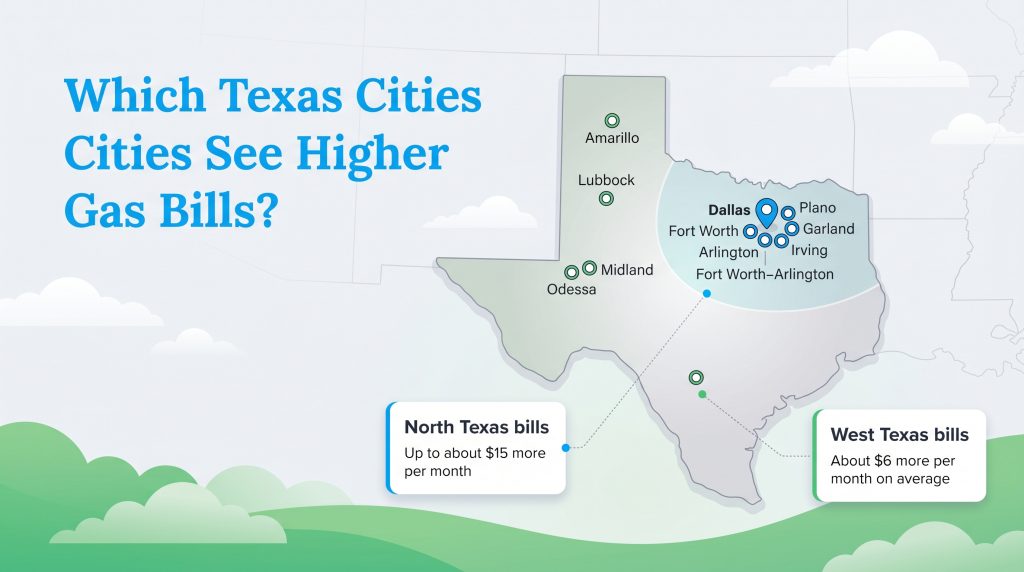
While the June 1, 2026 rate hike specifically targets customers living inside the Dallas city limits, similar price increases are rolling out across the entire state. Because Atmos Energy operates separate divisions in Texas, almost all North and West Texas residents will feel the impact of infrastructure modernization this year.
The Mid-Tex Division and Rate Review Mechanism Cities
The Atmos Mid-Tex Division serves approximately 1.26 million residential customers across 447 cities in North Texas. On April 1, 2026, the utility filed a separate Rate Review Mechanism (RRM) request seeking a $291.1 million annual revenue increase. If approved, this change will take effect on Oct. 1, 2026, and will add an average of $14.94 per month to residential bills in major cities like Fort Worth, Arlington, Plano, Garland, and Irving.
The West Texas Division RRM Filing
If you live in West Texas, your gas is delivered by a separate division that serves Lubbock, Amarillo, Midland, and Odessa. On April 1, 2026, the West Texas Division filed its own RRM rate review seeking a $13.3 million annual increase. If approved, residential accounts in these communities will see their monthly bills rise by an average of $6.34 starting Oct. 1, 2026.
Taking Control of Your Home Energy Future
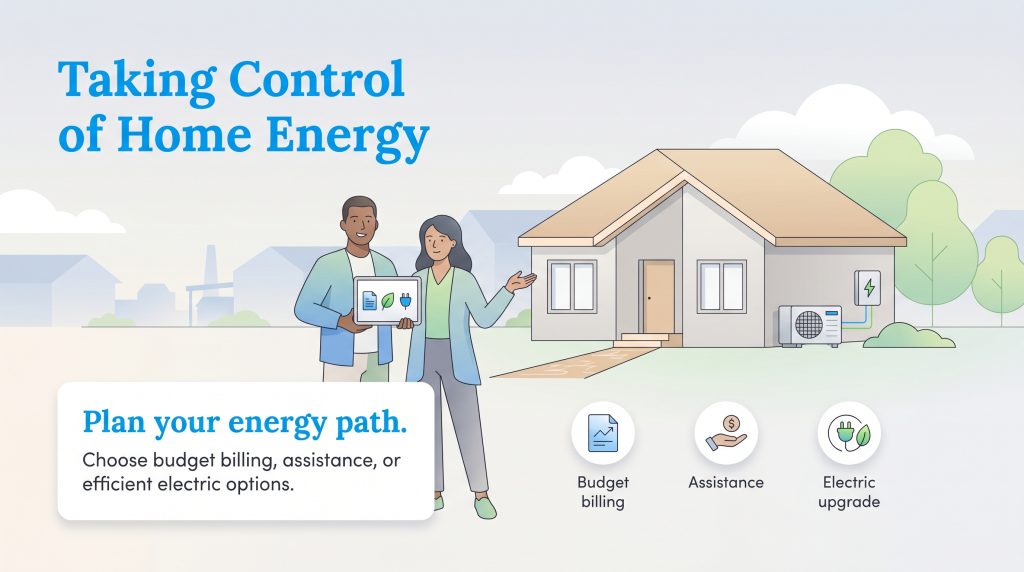
Navigating rising utility rates can feel overwhelming, especially when you are dealing with a regulated monopoly like natural gas. While pipeline safety and system modernization are crucial for keeping our neighborhoods safe, the compounding costs make it more important than ever to be proactive with your home energy choices. Whether you decide to smooth out your payments with budget billing, apply for local financial assistance, or take the leap toward an energy-saving electric alternative, taking charge of how your home uses power is the best way to protect your hard-earned budget. We are here to help you every step of the way as you settle into your new space and make smart, sustainable decisions for your family.
About the Author

Claudio is a sustainability-focused writer with a background in Anthropology and Psychology from NC State University. He has spent over 15 years working in writing, interpretation, and translation, driven by a deep interest in how human culture shapes the environment. Today, he shares his curiosity with readers by writing about sustainable living solutions and the connection between everyday choices and environmental impact.