

Navigating the logistics of a Hawaiian relocation requires strict budgeting and proactive utility planning to ensure a smooth transition to island life.
Key Takeaways
- Mastering Hawaii’s cost of living in 2026 requires a highly strategic budget, particularly regarding housing, shipping, and daily goods.
- Setting up utilities in Hawaii early will help you bypass common logistical hurdles like deposit delays and service disruptions.
- Investing in sustainable home features like solar panels can significantly offset the nation’s highest electricity costs.
Trading snowy winters and mainland traffic for year-round trade winds and stunning beaches is a beautiful dream, but packing your life into a shipping container and crossing the Pacific Ocean takes serious coordination. Once you decide to make the leap, the dream gets a lot easier when you pair it with a practical plan. A successful relocation requires understanding the unique realities of island economics, knowing exactly when to contact local service providers, and preparing your new residence for the unique demands of an isolated grid. If you are serious about making the islands your permanent home, we are here to help you navigate the essential steps, costs, and sustainable upgrades you need to thrive.
Understanding the Real Cost of Moving to Hawaii
When measuring the Hawaii cost of living against your current budget, the sticker shock is often the first major hurdle. You’re moving to one of the most geographically isolated population centers in the world, which means nearly everything you consume arrives by cargo ship. This supply chain reality drastically alters daily expenses. While you gain access to unparalleled natural beauty and a vibrant local culture, the financial trade-off is steep.
To put things in perspective, housing will consume the largest portion of your budget. In many parts of Hawaii, single-family homes cost far more than the U.S. median, and rental prices can also be steep, especially near job centers and beaches. But the housing market is just the baseline. The true financial adjustment happens at the checkout counter, where you’ll quickly realize that mainland budgeting rules no longer apply.
You need to brace your budget for these top hidden costs of island living:
- Elevated grocery bills: Fresh produce, dairy, and meat often cost noticeably more than on the mainland due to refrigerated shipping demands.
- The General Excise Tax (GET): Hawaii’s General Excise Tax is charged to businesses on many types of income, and many businesses pass that cost along to customers. That means you may see it reflected in prices for goods, services, rent, and groceries.
- Higher transportation costs: Gas prices typically hover well above the national average, and vehicle registration fees can be surprisingly high based on your car’s weight.
- Frequent home maintenance: Salty ocean air, high humidity, and intense sun exposure accelerate wear and tear on everything from vehicles to exterior paint and metal appliances.
Island-by-Island Utility Differences
Hawaii is not one uniform market. Costs, utilities, weather, electricity options, and internet access vary meaningfully by island and even by neighborhood. Here is a quick look at what to expect depending on where you land:
| Island | Utility and Home Setup Notes |
|---|---|
| Oahu | Strongest urban infrastructure, more internet options, high housing costs |
| Maui | Good service in populated areas, but wildfire recovery and housing constraints may affect availability |
| Hawaii Island | Larger rural areas, possible catchment water, varied broadband access |
| Kauai | Served by Kauai Island Utility Cooperative for electricity |
| Molokai and Lanai | More limited provider options and slower logistics |
Hawaii Utility Setup Timeline
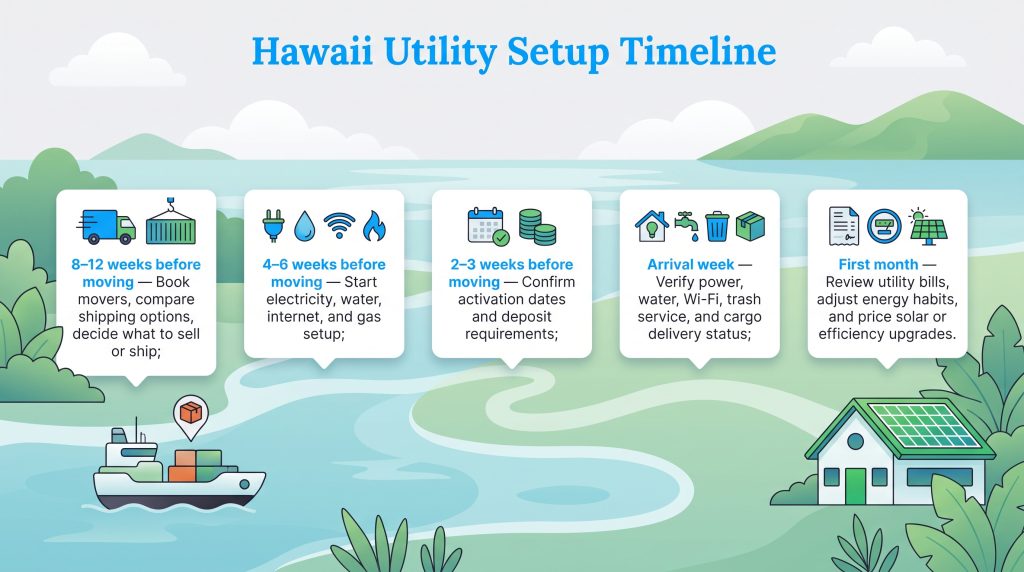
Because the islands operate on their own timelines and logistical networks, setting up utilities in Hawaii requires far more advance notice than you might be used to. Do not wait until your plane lands to make these phone calls. This simple timeline will keep your move on track:
| Timeline | What to Do |
|---|---|
| 8-12 weeks before moving | Book movers, compare shipping options, decide what to sell or ship |
| 4-6 weeks before moving | Start electricity, water, internet, and gas setup |
| 2-3 weeks before moving | Confirm activation dates and deposit requirements |
| Arrival week | Verify power, water, Wi-Fi, trash service, and cargo delivery status |
| First month | Review utility bills, adjust energy habits, and price solar or efficiency upgrades |
How to Start Electricity, Water, Gas, and Trash Service
Hawaiian Electric serves Oahu, Maui County, and Hawaii Island, while Kauai residents get electricity through Kauai Island Utility Cooperative. Getting connected usually requires navigating a standard utility deposit, which serves as a financial safety net for the provider. You can begin the activation process by visiting Hawaiian Electric’s start service page to fill out an application and submit your identification documents. Keep your lease agreement or closing documents handy, as customer service representatives frequently request proof of residency before turning on the grid.
When you contact your electricity or water provider, be prepared to provide:
- Service address and move-in date
- Government-issued ID
- Lease, deed, or closing documents
- Social Security number or tax ID, if required
- Previous utility payment history, if requesting a deposit waiver
Pro Tip
You may be able to reduce or avoid a deposit by providing a letter of credit from your previous utility showing a strong payment history. Confirm current requirements directly with Hawaiian Electric before your move.
Your water and sewer services are managed at the county level. On Oahu, you’ll deal with the Board of Water Supply, while the neighbor islands have their own dedicated county water departments. If you are renting, clarify with your property manager whether water is sub-metered or included in your flat rent. If you need to open an account yourself, be prepared to pay a standard activation fee. Finally, for those relying on gas for cooking or water heating, Hawaii Gas is the primary provider across the state, offering both piped synthetic natural gas in certain urban zones and delivered propane tanks for more rural or elevated neighborhoods.
Setting Up Trash, Recycling, and Green Waste Service
Service is typically handled by county agencies or private haulers, depending on your location and housing type. If you are moving into a condo or standard rental, property management usually handles routine trash service. For single-family homes, you will need to check your county’s specific rules. Bulky-item pickup schedules and recycling options vary dramatically by island. Yard waste and green waste may also have separate drop-off or pickup rules, which is important to know given Hawaii’s rapid plant growth.
Who to Contact for Hawaii Utilities
Keep track of these common providers to make your setup smoother:
| Utility Type | Common Provider | What to Confirm |
|---|---|---|
| Electricity | Hawaiian Electric (Oahu, Maui, Hawaii Island) or KIUC (Kauai) | Deposit requirements and time-of-use rate options |
| Water | County specific (e.g., Honolulu Board of Water Supply) | If water is included in rent or billed separately |
| Gas | Hawaii Gas | Whether your home uses piped gas or delivered propane |
| Trash & Recycling | County agencies or private haulers | Bulky-item rules and green waste pickup days |
Watch for Rural Utility Setups
Many mainland movers may not realize that some Hawaii homes, especially in rural areas, use nonstandard utility setups. If you are looking at homes outside the main urban centers, ask detailed questions about the property’s infrastructure.
- Catchment water systems are common in some rural areas, especially on Hawaii Island, meaning you will collect and filter your own rainwater.
- Septic systems and cesspools are frequently used instead of county sewer lines and may require regular maintenance and inspections.
- Propane is often utilized where piped gas is completely unavailable.
- Internet and cell service can be spotty, so test them directly at the property before signing a lease or closing on a home.
Why Hawaii Electricity Costs Are So High
No discussion about moving to the islands is complete without addressing Hawaii electricity costs. The state consistently ranks as the most expensive place in the nation for power, largely because the majority of its electricity is generated by burning imported petroleum. While the state is aggressively pushing toward a 100% renewable energy goal by 2045, current residents still bear the brunt of volatile global oil prices.
Depending on your household size and whether you run air conditioning, your monthly energy bill may be much higher than what you paid on the mainland, especially if you rely on air conditioning. Recent U.S. Energy Information Administration data consistently shows Hawaii’s residential electricity rates among the highest in the country. To see how these rates compare, you can review the https://www.eia.gov/state/?sid=HI”>Hawaii State Energy Profile from the U.S. Energy Information Administration.
Use this as a planning example, not a fixed quote. Your actual bill will depend on your island, utility rate, home size, solar setup, and air conditioning use.
| Metric | U.S. Average Energy Bill | Hawaii Example Monthly Bill Range |
|---|---|---|
| Average Rate (cents per kWh) | 15.4 cents | 42.5+ cents |
| Typical Monthly Cost | $135 | $260 – $400 (highly variable) |
| Primary Fuel Source | Natural Gas, Coal, Renewables | Imported Oil, Solar |
Money Saver
If your utility offers a time-of-use plan and you’re enrolled in it, running major appliances during lower-cost daytime solar hours may help reduce your bill. Check your current rate schedule before changing your routine.
Solar, Battery Storage, and Energy-Saving Upgrades
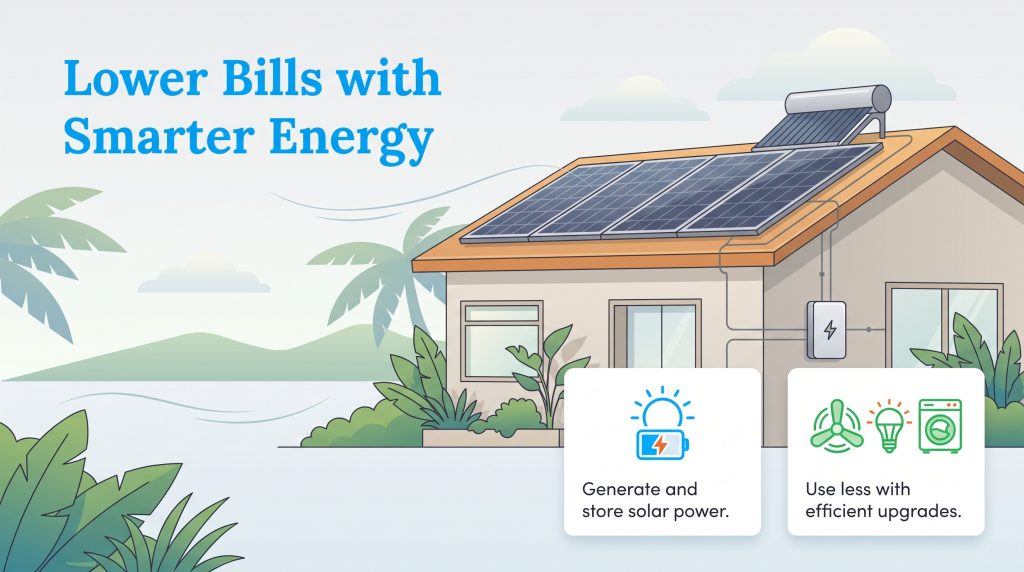
Adopting an eco-conscious lifestyle on the islands isn’t just about protecting the fragile local ecosystem — it is an absolute financial necessity. Sustainable living heavily revolves around finding ways to generate your own power or drastically cut your usage. Because grid electricity is so costly, prioritizing homes with solar panels, battery storage, or solar water heating is one of the smartest investments you can make.
Photovoltaic (PV) solar panels combined with home battery walls allow you to capture intense tropical sunlight during the day and power your home at night without drawing expensive electricity from the utility company. Even if you cannot afford a full solar array right away, installing a solar water heater can meaningfully reduce electric water heating costs, especially in homes where hot water is one of the biggest energy uses. The state government actively encourages these upgrades through aggressive tax credits and specialized loan programs. Before purchasing a property or starting renovations, we suggest consulting the Database of State Incentives for Renewables & Efficiency (DSIRE) Hawaii incentives page to see which financial incentives you currently qualify for.
Eco Edge
Swapping out an old refrigerator for an ENERGY STAR certified model is a low-impact environmentally mindful choice that significantly reduces the constant ambient draw on Hawaii’s delicate island grid. Heat-pump water heaters are another excellent energy-saving option where appropriate.
Beyond major upgrades, sustainable living is easily achieved through mindful daily habits. Using ceiling fans to capture natural trade winds instead of blasting a central air conditioner will dramatically curb your energy footprint. Small changes, like switching to LED lighting and utilizing smart thermostats, help you live comfortably while honoring the island’s limited resources. If you’re buying, ask for the home’s last 12 months of electric bills before making an offer. If you’re renting, ask whether the unit has solar, solar water heating, ceiling fans, efficient appliances, or window AC units, because those details can change your monthly budget.
Choosing Internet Service in Hawaii
Staying connected in the middle of the Pacific requires knowing which Hawaii internet providers service your specific neighborhood. The two major broadband competitors across the islands are Spectrum and Hawaiian Telcom. Spectrum generally offers robust cable internet speeds in most residential zones, while Hawaiian Telcom has been rapidly expanding its fiber-optic network to provide symmetrical gigabit speeds.
However, geography plays a massive role in your available choices. If you plan to rent or buy a home tucked away in a lush, remote valley or perched on a steep mountainside, fiber may not reach every rural road, valley, or mountainside property. In these specific microclimates, your best option for reliable service might actually be a satellite internet provider or a mobile hotspot backup. Always verify the physical connection status of a home before signing a lease, as cellular dead zones and slow internet pockets are common outside the major urban centers.
Quick Fact
Internet speeds can be strong in many populated parts of Hawaii, but service still varies by neighborhood, terrain, and provider infrastructure.
What Renters Should Ask Before Signing a Lease
If you are renting a home or apartment, the utility setup can be confusing because every landlord handles utilities differently. Before you sign a lease, ask these essential questions so you can accurately forecast your monthly costs:
- Is electricity individually metered, or split among multiple units?
- Is water included in rent?
- Is the home cooled by central AC, window units, ceiling fans, or natural trade winds?
- Is there solar or solar water heating to help keep costs down?
- Is internet already wired for Spectrum, Hawaiian Telcom, or another provider?
- Is trash service included in the rental price?
- Are there any catchment water, septic, or propane systems you need to manage?
- Are there HOA or condo rules affecting electric vehicle (EV) charging, solar, batteries, or outdoor equipment?
Shipping Belongings and Vehicles to Hawaii
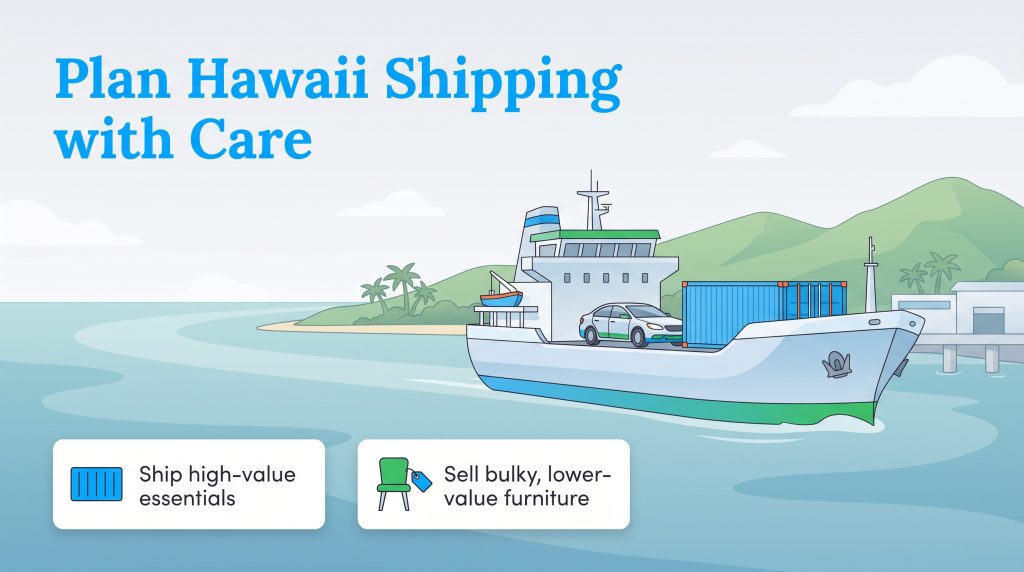
Shipping belongings to Hawaii takes careful timing because your furniture, car, and essentials may all arrive on different schedules. Most container ships take several weeks to reach the islands from the West Coast, meaning you’ll likely live out of suitcases for a considerable portion of your first month. Shipping a standard sedan costs a significant amount and fluctuates based on the port of origin, while renting an entire 20-foot shipping container for your household goods requires careful negotiation with specialized marine freight companies. When preparing, seriously consider what to ship versus what to sell, as replacing heavy, lower-value furniture locally is often cheaper than paying to ship it.
Because delays are completely normal when dealing with ocean freight, you need a pragmatic approach to your arrival. Check out our comprehensive moving resources to streamline your prep, and rely on this prioritized moving to Hawaii checklist for your first 48 hours on the ground:
- Retrieve your vehicle from the port: Schedule your pickup immediately, as ports charge hefty daily storage fees if you leave your car sitting on the lot.
- Turn on the main water valve: Locate the main shut-off valve at your new home and run all faucets to clear out any stagnant water in the pipes.
- Verify your Wi-Fi activation: Plug in your router and ensure your scheduled internet activation is live so you can manage the rest of your moving logistics online.
- Inspect your delivered cargo: Thoroughly check your shipping container or moving boxes for signs of moisture damage or pests that may have infiltrated during the long sea voyage.
Start Island Life With a Smarter Home Setup
Successfully moving to Hawaii is entirely possible, provided you swap out a vacation fantasy for a practical, budget-conscious strategy. Relocating to a tropical island means accepting higher costs at the grocery store, navigating a unique utility landscape, and proactively managing your energy consumption to combat soaring electricity rates. By focusing on sustainable upgrades and staying organized with your shipping logistics, you set a strong foundation for your new life. Embrace the transition with patience and respect for the local culture, and you’ll quickly find that the trade-offs are well worth the incredible lifestyle the islands offer.
Frequently Asked Questions About Moving to Hawaii
What is a standard Hawaii utility deposit?
How much are average Hawaii electricity costs for a single-family home?
Are solar power systems for Hawaii homes worth the upfront cost?
Which Hawaii internet providers offer the most reliable service?
What is the most important item on a moving to Hawaii checklist?
Can I easily transition to sustainable living in Hawaii if I rent?
About the Author

LaLeesha has a Masters degree in English and enjoys writing whenever she has the chance. She is passionate about gardening, reducing her carbon footprint, and protecting the environment. She also recently served as President of the Board for City Sprouts (a community garden).

Claudio is a sustainability-focused writer with a background in Anthropology and Psychology from NC State University. He has spent over 15 years working in writing, interpretation, and translation, driven by a deep interest in how human culture shapes the environment. Today, he shares his curiosity with readers by writing about sustainable living solutions and the connection between everyday choices and environmental impact.