

Understanding the three main types of electric utilities can help you navigate your new home’s energy bills and customer service options
Key Takeaways
- Investor-owned utilities (IOUs) are private, for-profit companies that deliver electricity to the majority of U.S. homes.
- Public utilities and electric cooperatives are community-owned, not-for-profit entities designed to serve their members rather than corporate shareholders.
- While you rarely get to pick your utility type, knowing how your local grid operates helps you predict energy costs and access exclusive rebates.
Moving into a new home often means inheriting an unfamiliar electric provider along with your fresh set of keys. You usually can’t choose who owns the poles and wires outside your home, but knowing whether your address is served by an investor-owned utility, public utility, or electric cooperative can help you understand your bill, find rebates, and know where to turn when service issues come up. Once you grasp the specific motivations and governance structures behind your electricity provider, you will know exactly what to expect regarding customer service, rate adjustments, and energy efficiency programs.
What Are the Main Types of Electric Utilities?
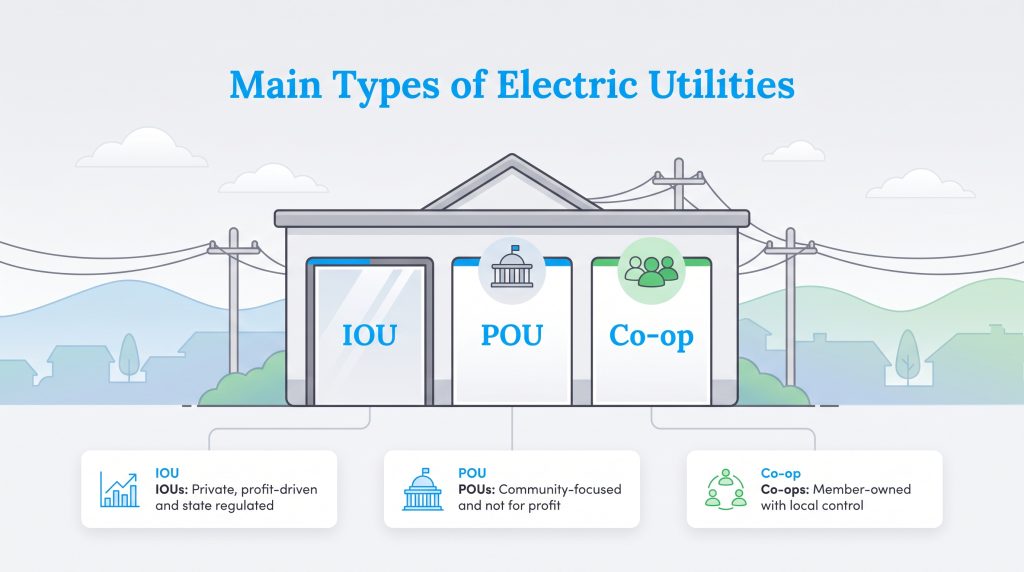
Most residential electric service in the U.S. comes through three main utility ownership models: investor-owned utilities, publicly owned utilities, and electric cooperatives. In some areas, federal utilities, retail energy suppliers, or community choice programs may also affect how your electricity is generated, purchased, or billed. According to the U.S. Energy Information Administration, while there are thousands of distinct providers nationwide, investor-owned utilities serve the majority of customers, while public power utilities and cooperatives serve smaller shares but make up a large number of local utility operators.
Investor-Owned Utilities (IOUs)
Investor-owned utilities are private companies owned by shareholders and overseen by a board of directors. In exchange for serving a defined territory, they typically operate under state regulation that limits how rates are set and how much return they can earn on approved investments. Because they are fundamentally profit-driven businesses, their primary objective is delivering a reliable financial return to their investors while providing power to millions of customers. However, they don’t have unchecked power; IOUs are heavily regulated by state public utility commissions to ensure they charge fair rates. Common investor-owned utilities examples include giants like Pacific Gas and Electric (PG&E) and Duke Energy, which maintain sprawling infrastructure across multiple states. In deregulated states, your local IOU may only deliver the electricity, while a separate retail supplier sells the actual energy.
Publicly Owned Utilities (POUs)
Publicly owned utilities operate as municipal or state-run organizations, typically managed by a local city council or an elected public utility board. They are usually not-for-profit public entities. After covering operating costs, debt payments, and infrastructure needs, extra revenue may be reinvested in the utility system or returned to the community through local services, transfers, or lower rates. You can learn more about how these localized grids operate through the American Public Power Association’s public power statistics.
Electric Cooperatives (Co-Ops)
If you are wondering what is an electric cooperative, the answer is surprisingly democratic. Co-ops are independent, member-owned organizations, meaning every single homeowner who pays a monthly utility bill gets a voting say in how the local grid is run. Co-ops have deep roots in rural electrification, and some now serve fast-growing suburban or exurban areas as communities expand into former rural service territories. Their focus remains squarely on delivering at-cost power directly to their membership base rather than generating external wealth.
💡 Pro Tip: If you move into a co-op territory, ask whether the utility retires capital credits. Some co-ops return a portion of past margins to members, but the timing and amount vary by utility.
IOU vs. Public Utility vs. Co-Op: Quick Comparison Table
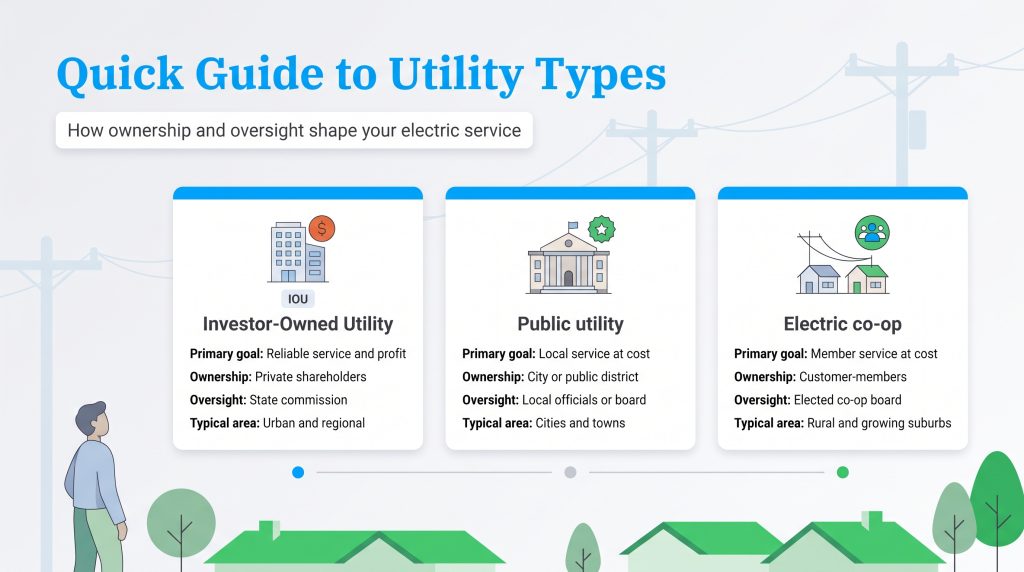
Unpacking the difference between IOU and cooperative models — alongside municipal providers — helps clarify why billing policies, customer service response times, and rate structures vary so wildly from one county to the next. Let’s look at a straightforward breakdown of how these distinct organizations stack up against one another.
| Utility Type | Primary Goal | Ownership | Oversight/Governance | Common Service Area |
|---|---|---|---|---|
| Investor-owned utility | Provide reliable service while earning a regulated return | Private shareholders | State public utility commission | Urban, suburban, and regional service territories |
| Publicly owned utility | Provide local service at cost | City, county, state, or public district | Local elected officials, utility board, or public authority | Cities, towns, and public utility districts |
| Electric cooperative | Provide reliable electric service at cost for member-owners | Customer-members | Elected co-op board | Rural areas and some growing suburban communities |
How Utility Type Can Affect Your Electric Bill
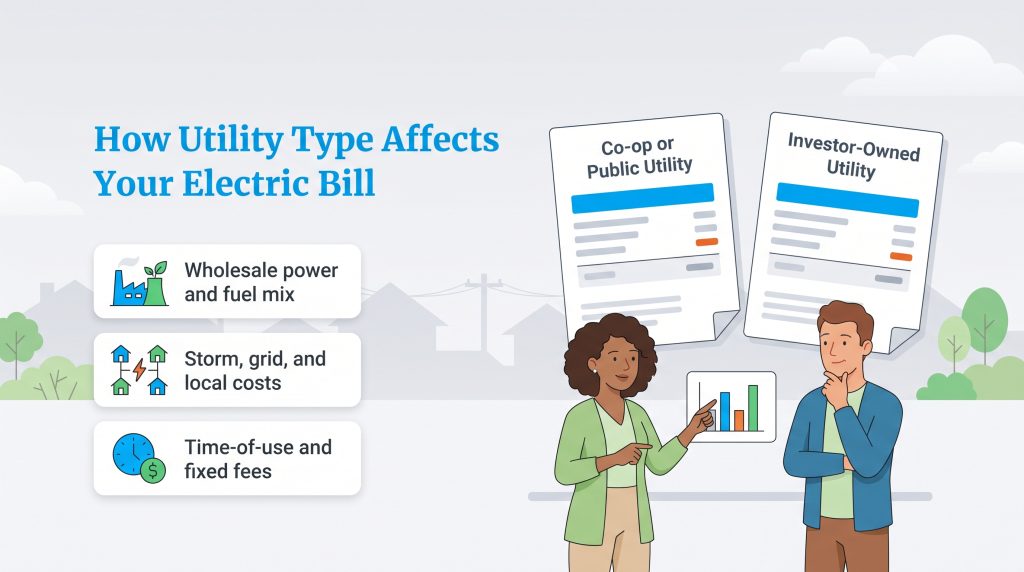
When settling into a fresh neighborhood, many homeowners naturally ask: are electric co-ops cheaper than investor-owned providers? Co-ops and public utilities often have structural cost advantages because they don’t pay shareholder dividends. That doesn’t automatically mean your bill will be lower, though. Rates still depend on local infrastructure costs, wholesale power prices, storm recovery expenses, state rules, and how much electricity your home uses.
When reviewing your new utility’s rates, keep an eye out for these common factors that influence your final bill:
- Wholesale power costs and fuel mix
- Customer density across the service territory
- Storm recovery and grid-hardening costs
- Local taxes or franchise fees
- State regulatory structures
- Time-of-use pricing and fixed monthly service charges
However, it is vital to recognize that IOUs benefit heavily from massive economies of scale. Because they cover huge swaths of the country, these private giants can purchase fossil fuels, solar panels, and infrastructure materials in massive bulk quantities. This immense purchasing power can occasionally level the playing field during severe energy crises, softening the blow of volatile global fuel markets in a way that smaller co-ops simply can’t.
Regardless of who physically maintains the poles in your backyard, actively managing your home’s energy consumption remains the most effective strategy for keeping your costs down. From upgrading your attic insulation to monitoring hidden vampire loads, you always hold a powerful degree of control over your final statement.
Pros and Cons of Each Utility Type
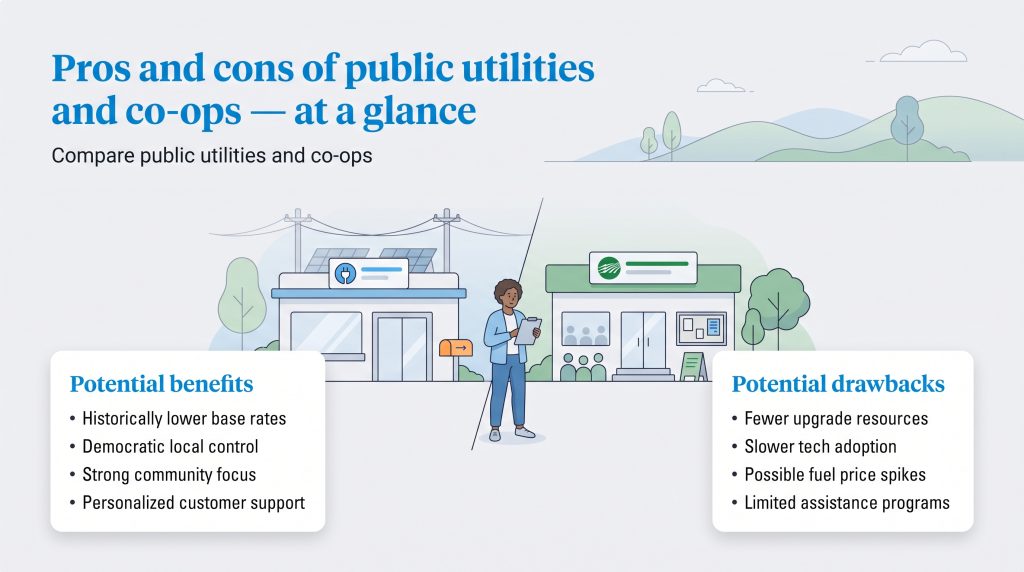
Understanding the pros and cons of public utilities and electric cooperatives can help you set realistic expectations for rates, customer service, reliability, and local decision-making.
Potential Benefits of Public Utilities and Co-Ops
- Historically lower base rates due to a strict non-profit structure.
- Democratic control, allowing residents to vote on major grid initiatives.
- A tight community focus that prioritizes local economic development.
- More personalized, easily accessible customer service channels.
Potential Drawbacks to Watch For
- Fewer capital resources for major, sweeping infrastructure upgrades.
- Slower adoption of high-tech grid tools, like advanced smart meters.
- Vulnerability to sudden price spikes during regional fuel shortages.
- Limited customer assistance programs compared to massive IOU funds.
Which Utility Type Is Best for Solar and Renewable Energy?
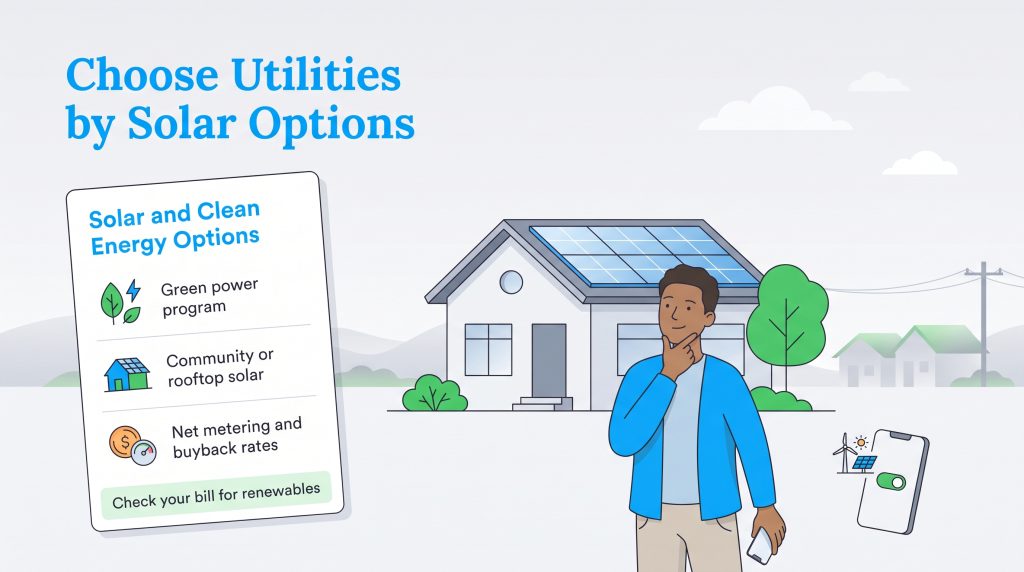
No utility type is automatically the greenest. The better question is what clean energy options your specific provider offers. Instead of assuming one operational model is superior, look into the concrete sustainability programs available in your new zip code.
When comparing your new utility’s eco-friendly offerings, be sure to check for:
- Renewable energy subscription or green pricing programs
- Community solar options for renters or homeowners who can’t install rooftop panels
- Rooftop solar interconnection rules and initial fees
- Net metering or solar buyback rates
- ENERGY STAR appliance rebates for home upgrades
- Smart thermostat or demand response programs that reward efficiency
- Time-of-use rates that incentivize off-peak electricity use
Many of these providers participate actively in EPA Green Power programs, offering environmentally mindful choices tailored specifically to regional climates. If you are exploring installing a home solar system, reach out to your local utility early to clarify their exact net-metering policies.
🌱 Eco Edge: Take a close look at your new utility bill for an option to opt into a renewable energy purchasing program. These affordable initiatives allow you to source a percentage of your power directly from local wind or solar farms.
How to Find Out Who Serves Your New Home
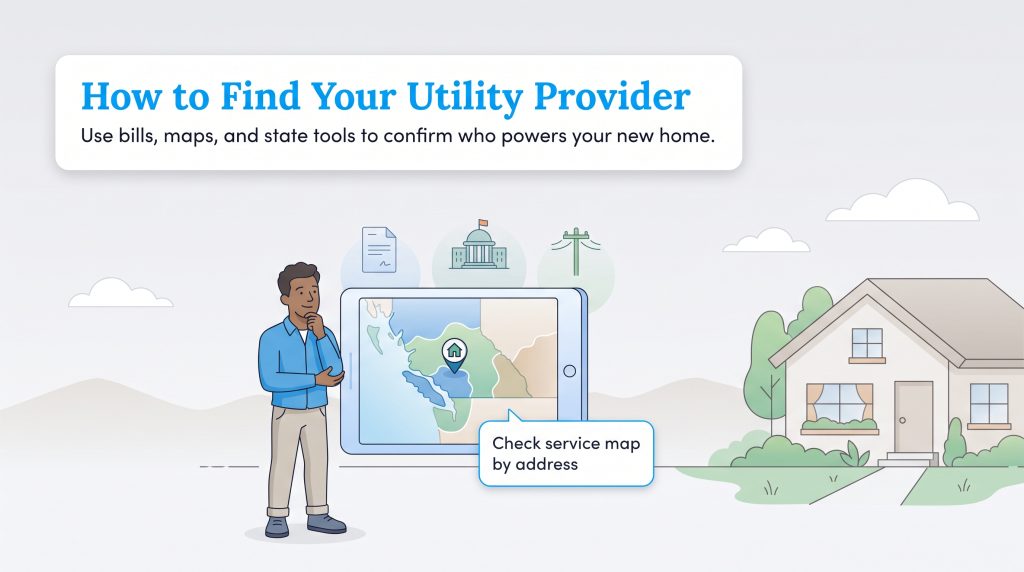
Before you can optimize your energy usage, you need to identify exactly which utility type controls your new grid. Because electric infrastructure usually operates as a geographic monopoly, identifying your provider is a necessary first step.
- Check the previous owner’s or tenant’s electric bill. This is the fastest way to see who actively services the property.
- Search your address on the local utility’s service territory map. Most state commissions provide regional maps showing clear boundary lines.
- Visit your state public utility commission website. These state-level portals offer directories of every registered utility operating within your county.
- Ask your city or county government. A quick call to the local clerk’s office can clarify if you fall under a municipal provider.
- Separate your delivery utility from your retail supplier. If you live in a deregulated electricity market, remember that the company maintaining the poles may be different from the one selling you the power.
What to Do After You Identify Your Utility
When comparing municipal vs. investor-owned utilities, remember that you rarely have a choice in the underlying grid operator holding the monopoly in your zip code. However, choosing an electric provider for new home addresses involves focusing heavily on the elements you can actually control. If you live in a choice state, checking out our guide on setting up electricity in a deregulated market can help you shop for a competitive retail supply rate.
- Set up service early. Aim to transfer or initiate your electricity connection at least one to two weeks before move-in day.
- Ask about upfront requirements. Verify whether the utility requires a security deposit, a soft credit check, or proof of your new lease or mortgage.
- Confirm outage reporting options. Make sure you know exactly where to call or which app to download if the lights go out during a storm.
- Check for budget billing. Many providers offer leveled billing programs that smooth out extreme seasonal spikes.
- Look for new-customer energy audits or smart thermostat rebates. Most IOUs and cooperatives offer distinct sign-up incentives, free home energy assessments, or heavily discounted smart home gadgets for new residents.
- Understand your voting rights. If your new address falls under a co-op or POU, find out when the next utility board election takes place so you can start shaping your community’s energy future.
🚩 Heads Up: In deregulated electricity markets, the company that delivers your power may not be the same company that sells you the electricity supply. Your local utility still handles outages, poles, wires, and meters, while your retail provider controls the supply plan and rate.
Finding the Right Power Fit for Your New Home
Whether your power comes from a large investor-owned utility, a city-operated public utility, or a member-owned co-op, understanding the model behind your electric service helps you make smarter choices. While you may not be able to choose the utility that owns the physical wires outside your property, you still have control over your household energy usage, which billing plans you select, and how you take advantage of available rebates.
We encourage you to get involved with your local energy provider by attending public rate hearings or voting in cooperative board elections. Taking an active role in how your neighborhood powers itself not only secures your household budget but builds a vastly more resilient community grid for years to come.
Frequently Asked Questions About Electric Utilities
If you are still wrapping your head around the various operational structures powering your new neighborhood, you aren’t alone. Here are a few common questions homeowners ask when trying to understand their local electric utility types.
What is the main difference between an investor-owned utility and a cooperative?
Can I choose my electric utility provider when I buy a new home?
Are municipal utilities the same as investor-owned utilities?
What happens to the profits made by an electric cooperative?
Do electric co-ops offer solar programs?
Why do I have separate delivery and supply charges on my electric bill?
Are public utilities regulated the same way as investor-owned utilities?
About the Author

David has been an integral part of some of the biggest utility sites on the internet, including InMyArea.com, HighSpeedInternet.com, BroadbandNow.com, and U.S. News. He brings over 15 years of experience writing about, compiling and analyzing utility data.

LaLeesha has a Masters degree in English and enjoys writing whenever she has the chance. She is passionate about gardening, reducing her carbon footprint, and protecting the environment. She also recently served as President of the Board for City Sprouts (a community garden).