
Discover everything you need to know about Entergy’s utility plans, billing features, and coverage map to manage your home’s energy with ease.
Key Takeaways
- Entergy operates as a regulated utility across four Southern states, meaning most customers rely on them for both energy generation and delivery.
- You can easily manage your account, pay your bills, and track real-time outages using the comprehensive myEntergy digital portal and mobile app.
- Customers have access to several energy-efficiency rebates and budget billing options designed to help keep monthly electricity expenses manageable.
Navigating your electricity service shouldn’t feel like wandering in the dark, especially when you are setting up utilities for a new residence or searching for ways to lower your monthly expenses. As the primary electricity provider for millions of households across Arkansas, Louisiana, Mississippi, and Texas, Entergy offers regulated energy plans alongside a suite of surprisingly robust digital tools. By exploring their various billing programs, eco-conscious efficiency rebates, and mobile app features, you can make the most of your home’s energy usage without any unnecessary stress. Whether you are transferring your service to a different city or logging into your myEntergy account for the very first time, understanding exactly how your electric provider operates is the first step to mastering your household budget.
About Entergy
Entergy is a massive, integrated utility company headquartered in New Orleans that provides reliable electricity to approximately 3 million residential and commercial customers across four states in the South. Because it operates primarily as a fully regulated utility, Entergy takes on the dual responsibility of generating power at its own regional plants and delivering that electricity directly to your home over its own network of poles and wires. This operational model means the company does not act like a retail supplier you would casually shop among in a highly competitive market.
Practically speaking, your choices with this provider will focus heavily on specialized billing structures, energy-saving incentives, and optional green energy add-ons rather than switching among dozens of competing electric companies. Instead of spending your time comparing introductory rates from different providers every few months, you can channel your energy into reducing your household consumption through smarter habits and ENERGY STAR upgrades. Overall, Entergy consistently positions itself around grid reliability, robust storm readiness, and a profound commitment to transitioning toward a gradually cleaner power mix as it modernizes its massive generation fleet for the future.

- Calculate Your Moving Costs
- Compare Moving Companies
- Get Multiple Quotes
- Move with Confidence
Is Entergy Regulated or Deregulated?
If you are moving into the area from a deregulated energy market, you might find yourself wondering why you cannot hop online and shop around for a different electricity plan. Entergy operates strictly as a regulated utility, which is a stark contrast to a deregulated retail electric provider (REP) that simply buys wholesale power and sells it to consumers. As an integrated monopoly in its assigned service territories, Entergy owns the power plants, the heavy transmission lines, and the neighborhood distribution poles that physically bring the electricity to your smart meter.
Because of this integrated structure, Entergy customers do not have the power to choose alternative energy suppliers. State public utility commissions heavily regulate the rates the company can charge, ensuring that pricing remains fair, transparent, and reflective of the actual cost to provide service. If you live in Entergy’s Texas service area, you are actually situated outside of the state’s main deregulated ERCOT grid. This means you are completely exempt from the Texas “Power to Choose” marketplace and will rely exclusively on Entergy. While you might not get the thrill of shopping for a new provider every year, the regulated model does offer excellent stability and protects your household from the sudden, predatory price spikes sometimes seen in volatile deregulated zones.
Entergy Coverage Area by State
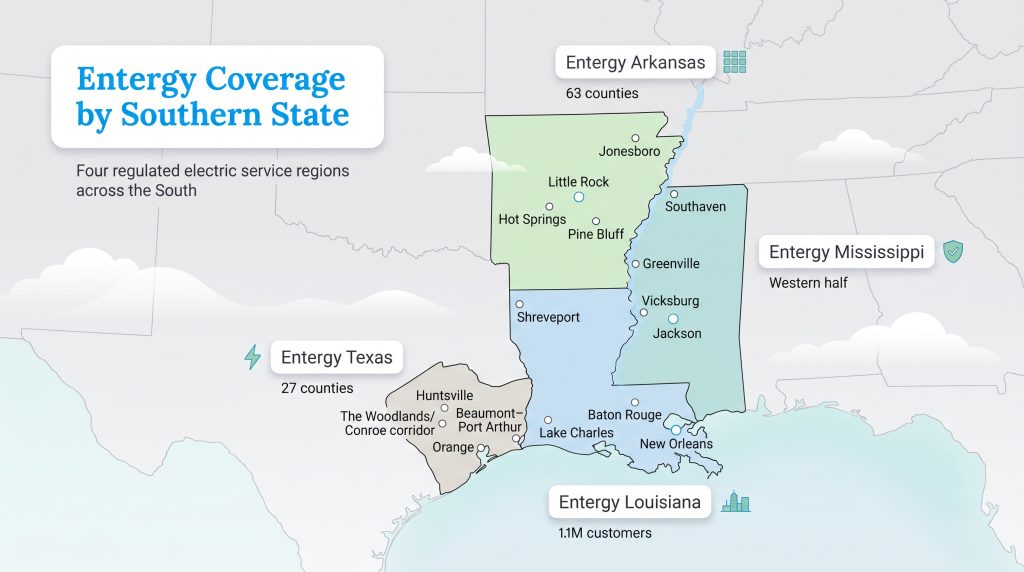
Understanding exactly where Entergy operates is crucial if you are planning a move across the South. The company’s regulated utilities deliver service through distinct regional subsidiaries, blanketing a wide and diverse geographical footprint.
Entergy Arkansas
Entergy Arkansas serves approximately 730,000 customers across 63 counties, making it the state’s most extensive electric utility. The company has been supplying reliable power to this region for over a century and focuses heavily on modernizing the local grid for improved efficiency.
- Little Rock
- Hot Springs
- Pine Bluff
- Jonesboro
Entergy Louisiana
Serving over 1.1 million electric customers alongside its sister company in New Orleans, Entergy Louisiana is the dominant power provider across the Pelican State. This operating company delivers electricity to a vast array of communities, spanning from the northern parishes down to the bustling Gulf Coast.
- New Orleans
- Baton Rouge
- Shreveport
- Lake Charles
Entergy Mississippi
Entergy Mississippi delivers essential electricity to roughly 461,000 customers spread throughout the western half of the state. The utility works continuously to maintain affordability and grid resilience against the severe weather events common to the deep South.
- Jackson
- Southaven
- Vicksburg
- Greenville
Entergy Texas
Operating exclusively outside of the deregulated ERCOT grid, Entergy Texas supplies power to roughly 500,000 customers across 27 counties in Southeast Texas. This territory spans roughly 15,000 square miles and relies on a stable mix of natural gas and emerging solar generation.
- The Beaumont–Port Arthur metropolitan area
- The rapidly growing The Woodlands/Conroe corridor
- Huntsville
- Orange
Entergy Rates, Plans, and Billing Options
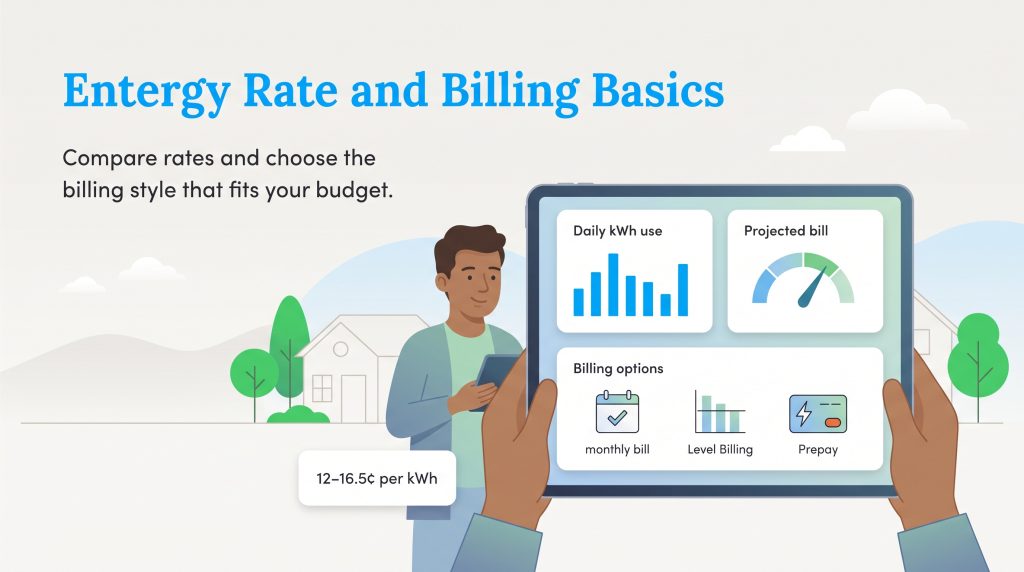
When evaluating your household budget, you will want a clear understanding of your current Entergy rates per kWh. Depending on your specific state, localized municipal fees, and seasonal fuel adjustment riders, residential electricity rates typically range from 12¢ to 16.5¢ per kWh. While these regulated prices can fluctuate slightly during peak summer and winter months based on natural gas commodity costs, they remain highly competitive compared to the broader national average. Your specific choices with this utility will revolve around selecting the right billing cadence and utilizing digital management tools to match your family’s financial situation.
To help residential users track these costs actively, the company provides an excellent feature known as the Bill Toolkit. This comprehensive digital dashboard allows you to analyze your historical usage trends, project your upcoming statement total, and identify exactly which home appliances might be driving up your costs during extreme weather.
Use the Entergy Bill Toolkit found inside your online dashboard to check your daily kilowatt-hour usage. Catching a sudden spike in consumption early can help you adjust your thermostat and save money before the monthly statement even arrives.
Standard Residential Service (RS) and Current kWh Rates
This is the default service tier for almost all customers living in Entergy’s territory. Your monthly rate structure features a few standard components, including a flat base delivery charge, a variable energy charge based on your exact kilowatt-hour (kWh) usage, and a fluctuating fuel adjustment charge.
- Standard service ensures reliable grid access, ongoing infrastructure maintenance, and robust 24/7 customer support.
- Current kWh rates vary significantly depending on your specific state subsidiary and are strictly monitored by local regulatory bodies to prevent price gouging.
- You can manage this standard plan easily by enrolling in AutoPay or choosing paperless billing to reduce mailbox clutter and streamline your finances.
Budget Billing / Level Pay
If you prefer a highly predictable monthly bill — which is especially helpful when your HVAC usage skyrockets during sweltering Southern summers — Entergy’s Level Billing program is an excellent solution.
- The system averages your historical annual usage over 12 months, meaning your monthly payments remain relatively flat and highly predictable.
- This program is fantastic for strict household budgeting and completely eliminates the dreaded winter or summer sticker-shock.
- Be aware that your account is periodically reconciled. If your actual usage increases significantly over the year, your averaged payment amount will be adjusted higher at the next annual recalculation.
Prepay / Pay-As-You-Go
In select regions, Entergy offers flexible prepay or pay‐as‐you‐go service. This model allows you to pay in advance for your electricity consumption rather than receiving a massive, comprehensive bill at the end of the month.
- You actively monitor your prepaid credit balance alongside your daily usage. If your funds drop too low, you simply top up your account to avoid immediate disconnection.
- It is an ideal choice for folks who prefer paying upfront, avoiding soft credit checks, and doing away with traditional monthly statements entirely.
- This method does require a bit more active, hands-on management of your myEntergy account to ensure your lights stay on without interruption.
Understanding Entergy Fees and Surcharges
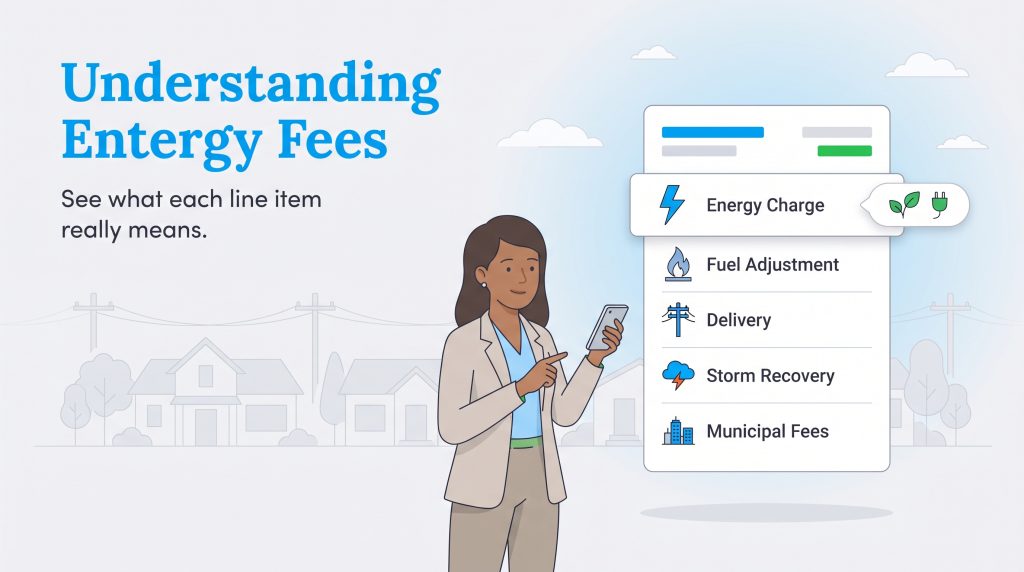
Reading a utility bill can sometimes feel like trying to decipher a complex foreign language. Because Entergy is a regulated utility, every single fee on your monthly statement must be explicitly approved by your state’s public utility commission. However, understanding what these line items actually mean is crucial for evaluating your total home energy costs and identifying areas where you can conserve power.
Your statement is essentially divided into two broad categories: the cost of creating the electricity and the cost of delivering it safely to your door. By upgrading to ENERGY STAR appliances or utilizing a smart thermostat, you can directly influence the energy generation portion of this bill. Here is a quick breakdown of the standard fees and surcharges you can expect to see on a typical Entergy statement:
- Energy Charge: This is the base cost of the electricity you actually consumed during the billing cycle, measured in kilowatt-hours (kWh). The less you use, the lower this number will be.
- Fuel Adjustment Charge: Since Entergy relies heavily on natural gas to generate base-load power, the fluctuating cost of that raw commodity is passed directly to you. This is a dollar-for-dollar passthrough cost, meaning Entergy does not make a profit on this specific fee.
- Delivery and Distribution Fees: These fixed and variable charges cover the physical costs of maintaining the neighborhood power lines, utility poles, substations, and the smart meter attached to your home.
- Storm Recovery Riders: Living in the South means facing severe weather. These approved surcharges help the utility quickly recover the massive costs of rebuilding the grid after devastating hurricanes or ice storms.
- Municipal Franchise Fees: Local city governments often charge the utility for the right to use public land for power lines, and this minor fee is passed on to the residential consumer.
Setting Up, Moving, or Canceling Your Service
Moving into a new home is stressful enough without having to worry about whether the lights will turn on. Thankfully, starting, stopping, or transferring your service with Entergy is a streamlined process that can be handled entirely online without ever picking up the phone.
To set up a new account, simply navigate to the myEntergy online portal and select the “Start Service” option. You will need to provide the physical address of your new residence and the exact date you want the power activated. Entergy typically requires new customers to undergo a soft credit check using their Social Security Number to verify identity. Depending on your specific credit history, you may be required to pay a standard security deposit before your service officially begins.
If you are asked to pay a hefty security deposit, you may be able to waive it entirely. Ask your previous electric utility to provide a “Letter of Good Credit” showing a strong history of on-time payments, and submit it to Entergy’s customer service team during enrollment.
If you are simply moving from one Entergy service address to another, use the convenient “Transfer Service” tool to seamlessly disconnect your old home and energize your new one on the exact dates you specify. Always try to submit these requests at least a few business days in advance to ensure a smooth, stress-free transition.
Entergy Login, Bill Pay, and Customer Service
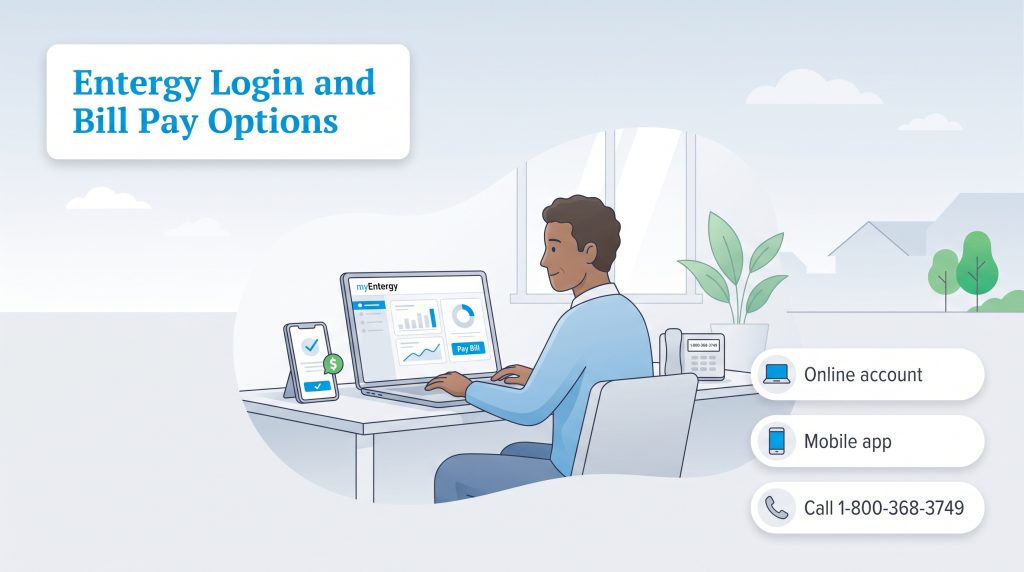
Effectively managing your monthly utility costs means having quick, reliable access to your account data. Entergy provides a variety of convenient communication channels so you can handle your finances in a way that works best for your personal schedule. We highly recommend you log into your myEntergy account immediately after your service starts to configure your communication preferences, enroll in paperless billing, and review your initial usage patterns.
When it comes time to execute an Entergy bill pay, you have several secure options at your disposal to ensure your account remains in good standing:
- Online via myEntergy Account: Log into your digital dashboard via a desktop browser to pay instantly with a bank account or credit card.
- Mobile App: Download the free application to your smartphone to manage quick payments on the go.
- By Phone: Call the automated payment system to clear your balance securely over the phone.
- Authorized Payment Locations: Visit one of the hundreds of partnered retail locations across their service territory to pay in person using cash.
If you encounter confusing billing discrepancies, need to set up an emergency payment extension, or simply have detailed questions about a recent meter reading, you can quickly reach out for comprehensive support. You can contact Entergy customer service at 1-800-368-3749 to speak directly with a knowledgeable representative during standard business hours.
How to Report an Entergy Power Outage
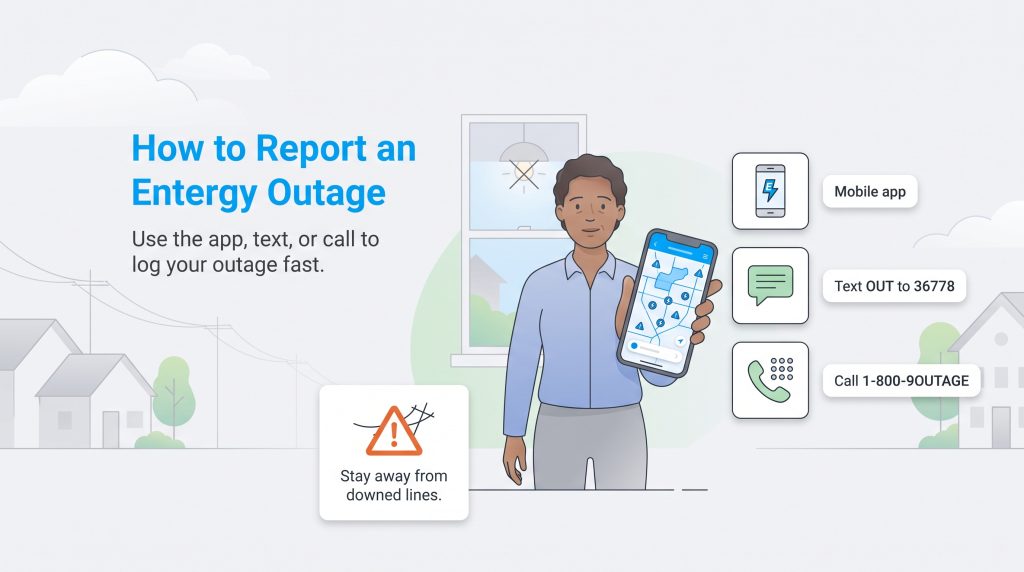
Severe weather is an unavoidable reality of living in the South, and knowing exactly what to do when the lights go out can keep your family safe and comfortable. If you experience a sudden blackout, the first step is to view the Entergy outage map to see if the utility is already aware of the widespread problem in your neighborhood. This interactive visual tool provides real-time updates and estimated restoration times for your specific zip code.
If your immediate neighborhood isn’t already highlighted in red, you need to notify the utility immediately so they can dispatch a crew. Here is exactly how to quickly report an outage:
- Use the Mobile App: Open your downloaded app and tap the prominent “Report an Outage” button right on the main dashboard.
- Send a Text Message: If you have already registered for mobile alerts, simply Text OUT to 36778 to automatically log your home’s blackout in their system.
- Call the Hotline: Dial the automated emergency reporting system directly at 1-800-9OUTAGE and follow the simple voice prompts.
- Check the Entergy Outage Map: Visit the official website or use your app to actively monitor the progress of repair crews and receive updated restoration timelines.
🚩 Heads Up: Always assume any downed power lines are completely energized and extremely dangerous. Stay far away from fallen wires, keep children and pets indoors, and immediately report the hazard to local emergency services and the utility company.
Sustainability, Rebates, and Efficiency Programs
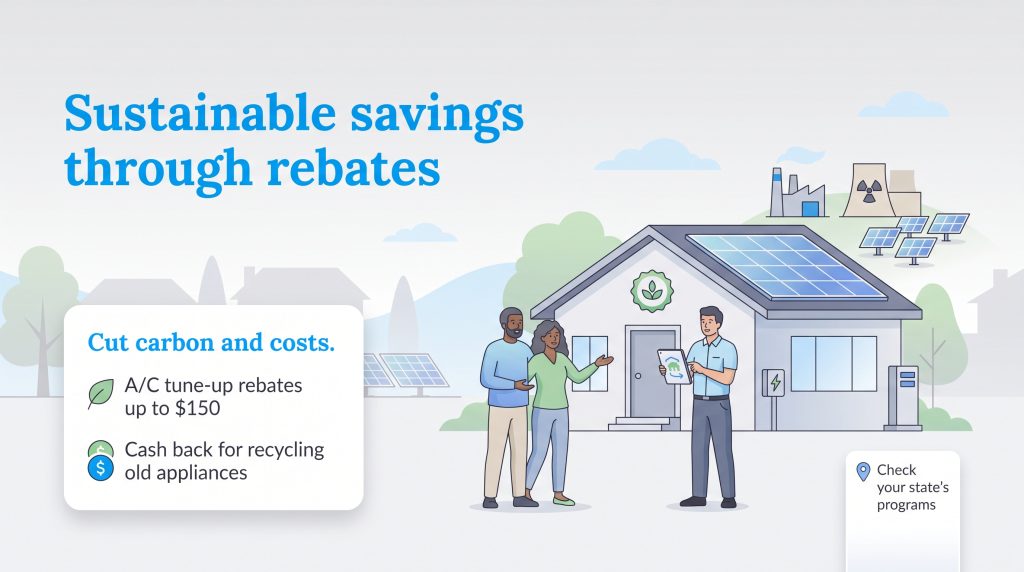
While highly efficient natural gas and zero-carbon nuclear power remain the structural backbone of their massive 24,000 MW generation fleet, Entergy is steadily adding utility-scale solar and other environmentally mindful choices to their energy portfolio. The company has publicly committed to an ambitious net-zero emissions goal by 2050, slowly retiring legacy fossil-fuel units in favor of cleaner alternatives. For eco-conscious consumers looking to make an immediate impact, optional green-power riders are available in select areas. These unique programs allow you to match a percentage of your monthly usage with certified renewable energy for a tiny premium.
But practicing sustainability at home goes hand-in-hand with saving money. The robust Entergy Solutions energy-efficiency program runs a wide variety of excellent rebates and cash incentives that differ slightly by state. Taking full advantage of these local offers can dramatically shrink your household energy footprint without requiring a massive upfront investment.
Some of the most popular and highly accessible offerings include subsidized A/C tune-ups, comprehensive home performance assessments, and generous appliance recycling initiatives. For example, Entergy Louisiana advertises instant rebates up to $150 for vital A/C tune-ups and provides additional substantial incentives for complete ENERGY STAR HVAC replacements. Meanwhile, Entergy Arkansas frequently highlights a $25 cash-back reward simply for allowing their partner crews to haul away and responsibly recycle your old, inefficient secondary refrigerator. Always check your specific state’s efficiency portal before making a major appliance purchase to ensure you don’t miss out on accessible, energy-saving funds.
Entergy Reviews and Ratings
When assessing any major utility provider, it helps immensely to see what your neighbors are actually experiencing. Because Entergy operates as a mandatory monopoly in its specific service areas, overall customer sentiment often reflects a complex blend of appreciation for modern digital conveniences and lingering frustration over macroeconomic forces completely outside their control.
Across Better Business Bureau (BBB) profiles, state public utility commission data, and local community forums, reviews tend to highlight a few very consistent themes. On the positive side, residential users consistently praise the seamless functionality and highly intuitive design of the myEntergy mobile app. Customers absolutely love the convenience of the text-based outage alerts and the detailed daily usage trackers found in the Bill Toolkit, which successfully empower them to take actionable control of their daily consumption.
Conversely, the most frequent and vocal customer complaints generally center around sudden spikes in the fuel adjustment charges during the brutal peak summer months. Because these raw natural gas costs are legally passed through directly to the consumer, a sweltering summer combined with high commodity prices can lead to surprisingly steep bills. Additionally, while the company prepares extensively year-round for severe weather, some residents have historically expressed understandable frustration over the unavoidable delays in post-hurricane storm recovery efforts in heavily damaged, hard-to-reach rural areas.
Mastering Your Home’s Energy with Entergy
Maximizing your comfort and minimizing your utility bills starts by taking immediate control of your new electricity profile. Log into your myEntergy account today to configure your AutoPay settings and enroll in the Bill Toolkit to actively track your daily usage. By utilizing these proactive digital tools and opting into seasonal energy-efficiency rebates, you will seamlessly manage your monthly budget and enjoy reliable home power year-round.
Frequently Asked Questions About Entergy
What is the average Entergy rate per kWh?
While exact pricing fluctuates based on your location and seasonal fuel costs, average Entergy rates per kWh typically range between 12¢ and 16.5¢. You can view your exact, current rate by reviewing the detailed energy charge breakdown on your latest monthly statement.
How do I find my Entergy account number?
You can locate your unique account number at the top right corner of your physical paper bill. Alternatively, you can easily find this critical information by navigating to your digital dashboard once you securely log into your myEntergy account.
Where can I view the Entergy outage map?
You can access the real-time Entergy outage map directly through the free myEntergy mobile app or by visiting the dedicated Storm Center on their official website. This highly interactive tool provides neighborhood-level updates, crew status, and estimated repair times during severe weather.
What states does Entergy serve?
Entergy provides regulated electric service across Arkansas, Louisiana, Mississippi, and Southeast Texas. This footprint covers major metropolitan cities such as Little Rock, New Orleans, Baton Rouge, Jackson, and parts of the Beaumont–The Woodlands region.
Can I choose a different electric supplier instead of Entergy?
For the vast majority of customers living within Entergy territory, no. It operates as a regulated monopoly and acts as your mandated default provider. You cannot shop among competing electricity suppliers like you would in deregulated markets. Your choices are primarily focused on billing preferences, green energy riders, and specific energy-saving efficiency programs.
How do I read my Entergy bill and what are the fees?
Your monthly statement is cleanly divided into a few key areas. You will see a variable Energy Charge based on your actual kilowatt-hour consumption, alongside fixed Delivery Fees that cover the sheer cost of maintaining the local grid. You will also see a Fuel Adjustment charge, which is a direct passthrough cost reflecting the fluctuating price of the natural gas used to physically generate your electricity.
Is a deposit required to start service with Entergy?
Yes, in many cases a standard security deposit is required when setting up a brand new account. Entergy performs a soft credit check during the digital enrollment process to determine the exact deposit amount. You can often waive this upfront fee entirely by providing a valid Letter of Good Credit from your previous electric utility showing a strong history of on-time payments.
Does Entergy offer renewable energy options?
Yes. Many local areas have access to specific green power programs, which allow you to match a percentage of your monthly electricity usage with certified renewable sources for a minor premium fee. Entergy is also aggressively expanding its utility-scale solar and other clean-energy resources across its broader Southern service network.
What types of billing options are available?
The provider offers traditional standard billing, Level Billing (a helpful budget billing plan designed to keep payments relatively even throughout the entire year), AutoPay, paperless statements, and in certain regions, strict prepay/pay-as-you-go options for those who prefer to avoid monthly statements.
Are there cancellation fees if I move?
Generally, there are no standard early termination fees like those found in competitive retail markets. You simply schedule a standard stop-service date online and receive a final, prorated bill. Any original security deposit tied to your account will be applied directly to the final balance or refunded to you after your account officially closes.
About the Author

David has been an integral part of some of the biggest utility sites on the internet, including InMyArea.com, HighSpeedInternet.com, BroadbandNow.com, and U.S. News. He brings over 15 years of experience writing about, compiling and analyzing utility data.