

Moving to the Mountain State can lower your housing costs, but your budget will depend on how your rural home gets water, heat, and internet service.
Key Takeaways
- West Virginia offers a lower median home value than the national average, though total living costs depend heavily on your county, heating fuels, and private utility setups.
- Rural properties often rely on private wells, septic tanks, and delivered propane, requiring you to actively manage your systems and prepare for winter power outages.
- Mountain broadband is expanding, but you should verify address-qualified internet service before committing to any property to ensure it meets your remote work needs.
Moving to West Virginia can lower your housing costs, but your budget will depend on where you settle and how your home gets water, heat, and internet service. We’ll help you compare regions, check utility availability before you commit, and prepare for the maintenance responsibilities that can come with a rural property.
| Metric / Category | West Virginia Benchmark |
|---|---|
| Population | ~1.79 million |
| Typical Home Value | ~176,500(late2026Zillowdata,vs.~350,000+ U.S. median) |
| Top Personal Income Tax Rate | 4.58% (as of 2026) |
| Average Residential Electricity Rate | ~16.3 cents/kWh (late 2026 EIA data) |
| Primary Climate | Four distinct seasons; warmer in the lower valleys and colder with more snow in the high-elevation Alleghenies |
The Pros and Cons of Living in West Virginia
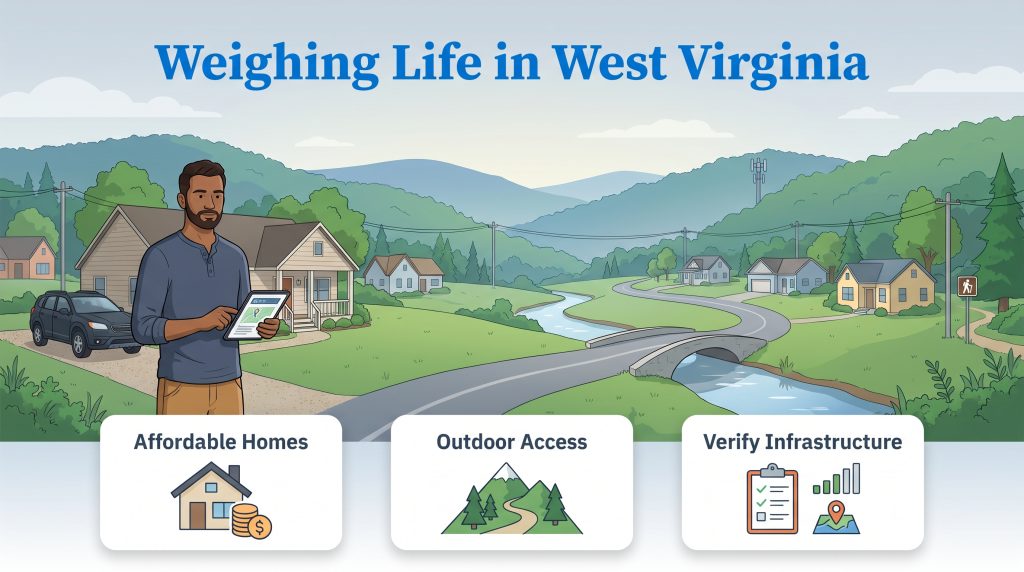
If you are asking whether West Virginia is a good place to live, the honest answer depends on how much you value space and self-reliance over big-city convenience. The Mountain State isn’t a one-size-fits-all destination, and newcomers who expect urban amenities around every bend can experience culture shock. However, for remote workers, retirees, and homesteaders who prepare for its unique infrastructure quirks, evaluating the pros and cons reveals opportunities for greater financial flexibility and daily access to world-class nature.
| Pros of Living in West Virginia | Cons of Living in West Virginia |
|---|---|
| Home values run significantly below the national median with relatively low property taxes | Steep, winding secondary roads take a beating during winter freeze-thaw cycles |
| Selective financial perks like the conditional Ascend WV remote worker program | Deep valleys (“hollers”) create cellular dead zones and can limit wired cable internet |
| Immediate access to New River Gorge National Park, skiing, rafting, and hiking | Specialized healthcare and high-paying local jobs cluster tightly around a few cities |
| Welcoming neighborhoods with a strong regional identity | Narrow river valleys face elevated flood risks and require vigilant home winterization |
The Perks of Mountain State Living
Housing affordability is a frequent reason newcomers look across the state line. While buyers in nearby Maryland, northern Virginia, and metropolitan Pennsylvania battle over half-million-dollar townhomes, West Virginia buyers can frequently find single-family houses on acreage for substantially less. Property taxes are equally gentle on your wallet, with effective rates consistently ranking among the lowest in the country. Note that vehicle personal property taxes apply and deserve a separate review based on your county.
The state also offers targeted initiatives for specific new residents. Through the Ascend WV remote worker program, approved out-of-state telecommuters who are selected to move to a participating community can receive $12,000 in cash distributed conditionally over two years, free access to modern coworking spaces, and complimentary outdoor gear rentals. Families with school-aged children also benefit from the Hope Scholarship, an education savings account providing around $5,435 per student for the 2026–2027 academic year for private tuition, homeschooling curricula, or tutoring if eligibility requirements are met.
Beyond the numbers, your quality of life gets an immediate upgrade if you love the outdoors. You get four-season recreation right out your back door, from world-class whitewater rafting and rock climbing in New River Gorge National Park and Preserve to backcountry skiing and trout fishing in the Monongahela National Forest. Even better is the neighborly Appalachian culture: people value a live-and-let-live mindset and are generally quick to lend a hand in their communities.
The Realities You Need to Prepare For
Mountain topography shapes every aspect of daily life here, starting with your daily drive. Steep grades, hairpin curves, and winter freeze-thaw cycles chew up secondary backroads, meaning you’ll need to budget extra commute time and potentially invest in a reliable all-wheel-drive vehicle depending on your elevation. Those same rugged ridges and deep valleys frequently block cellular signals and traditional cable lines, making address-by-address broadband verification mandatory before you sign a mortgage or lease.
You also need to plan around regional healthcare and economic realities. Outside of primary hubs like Morgantown, Charleston, and Huntington, local job markets can be tight, and reaching a medical specialist may require an hour-long drive. Finally, steep mountainsides channel heavy spring downpours directly into narrow creek beds, making valley flooding and winter pipe freezes top home-maintenance priorities.
Before You Sign: A Pre-Purchase Checklist
Because rural property setups vary so widely, verifying your infrastructure before committing to a home is essential. Use this checklist to ask the right questions during your due diligence period.
| Check Before Committing | What to Request or Confirm |
|---|---|
| Internet | Address-qualified service, installation timing, upload speeds, and equipment requirements |
| Electricity and heating | Actual utility provider, heating fuel, equipment condition, and 12 months of utility bills |
| Water and wastewater | Supplier information or well records, water-test results, and septic inspection |
| Access and hazards | Flood exposure, driveway maintenance responsibility, winter access, and insurance quotes |
| Move-in costs | Deposits, connection fees, fuel deliveries, equipment charges, and inspection expenses |
Heads Up
Before making an offer on a home tucked into a scenic creek or river valley, check county FEMA flood maps and inspect the basement for a working sump pump with a battery backup system.
Breaking Down the Cost of Living in West Virginia
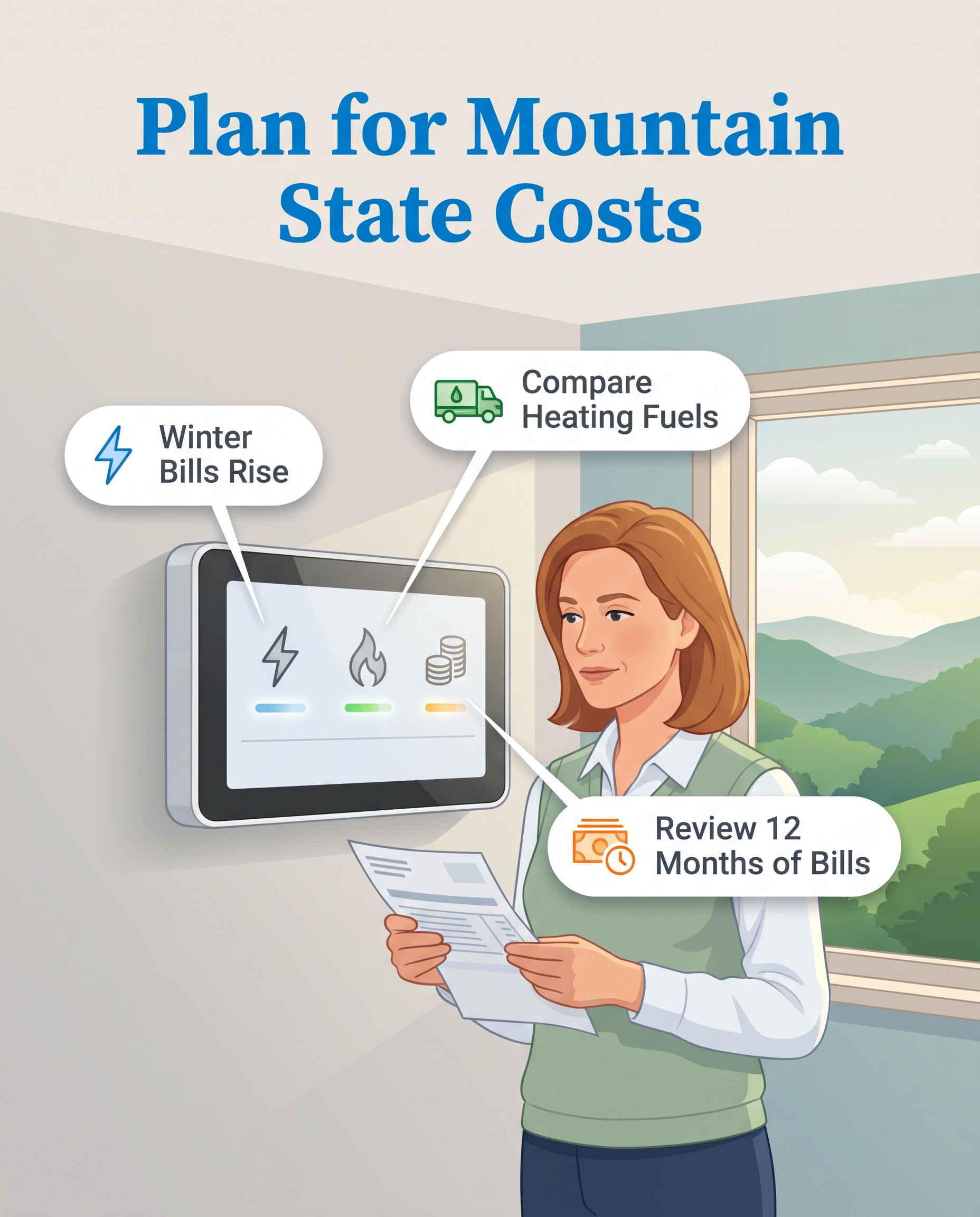
According to data from the Missouri Economic Research and Information Center (MERIC), the cost of living in West Virginia consistently ranks among the top three most affordable states in the nation. When you relocate here from a major coastal or mid-Atlantic metro area, your household budget undergoes a dramatic shift as housing and tax burdens drop sharply. Understanding where you’ll save — and where mountain living can sneakily add to your tab — helps you build a practical monthly budget.
Housing, Taxes, and Everyday Expenses
For older adults considering a move to West Virginia for retirement, the state offers several tax advantages. West Virginia fully exempts Social Security benefits from state income tax for most retirees, lowered its top personal income tax rate down to 4.58% for the 2026 tax year, and assesses residential property taxes at highly competitive effective rates. Remote workers relocating on coastal salaries often find their housing costs decrease substantially. Just keep in mind that your vehicle budget might tick upward slightly: navigating steep mountain grades and dodging white-tailed deer at dusk means you might go through brake pads and tires faster, and comprehensive auto insurance is a must.
What Your Utilities Might Cost
Because the state is an energy powerhouse rich in coal and natural gas, the U.S. Energy Information Administration shows average residential electricity rates hovering around 16.3 cents per kilowatt-hour (kWh) as of late 2026. Despite relatively competitive rates per kilowatt-hour, utility costs in West Virginia often catch newcomers off guard during the winter. Much of the state’s housing stock was built decades ago with minimal wall insulation, drafty windows, and inefficient heating systems, driving up total energy consumption from November through March.
Rather than relying on a single statewide average, it helps to look at two illustrative monthly budget scenarios. For a home using electric heat, you might budget $200 to $300 for electricity during the winter, $75 to $100 for municipal water and trash, and $65 to $110 for high-speed internet. Conversely, a home using delivered propane or natural gas might see winter electricity bills drop to $100 to $150, but you will need to budget $150 to $250 a month (often paid in large lump sums) for fuel deliveries. Always remember to factor in deposits, installation fees, and private well maintenance as separate costs.
Money-Saver
Ask the seller or landlord for 12 months of past utility bills before signing a contract. While previous bills don’t guarantee your exact future costs, they can reveal if an older home hides a $400 January heating bill due to a lack of insulation.
Best Places to Live in West Virginia by Lifestyle and Budget
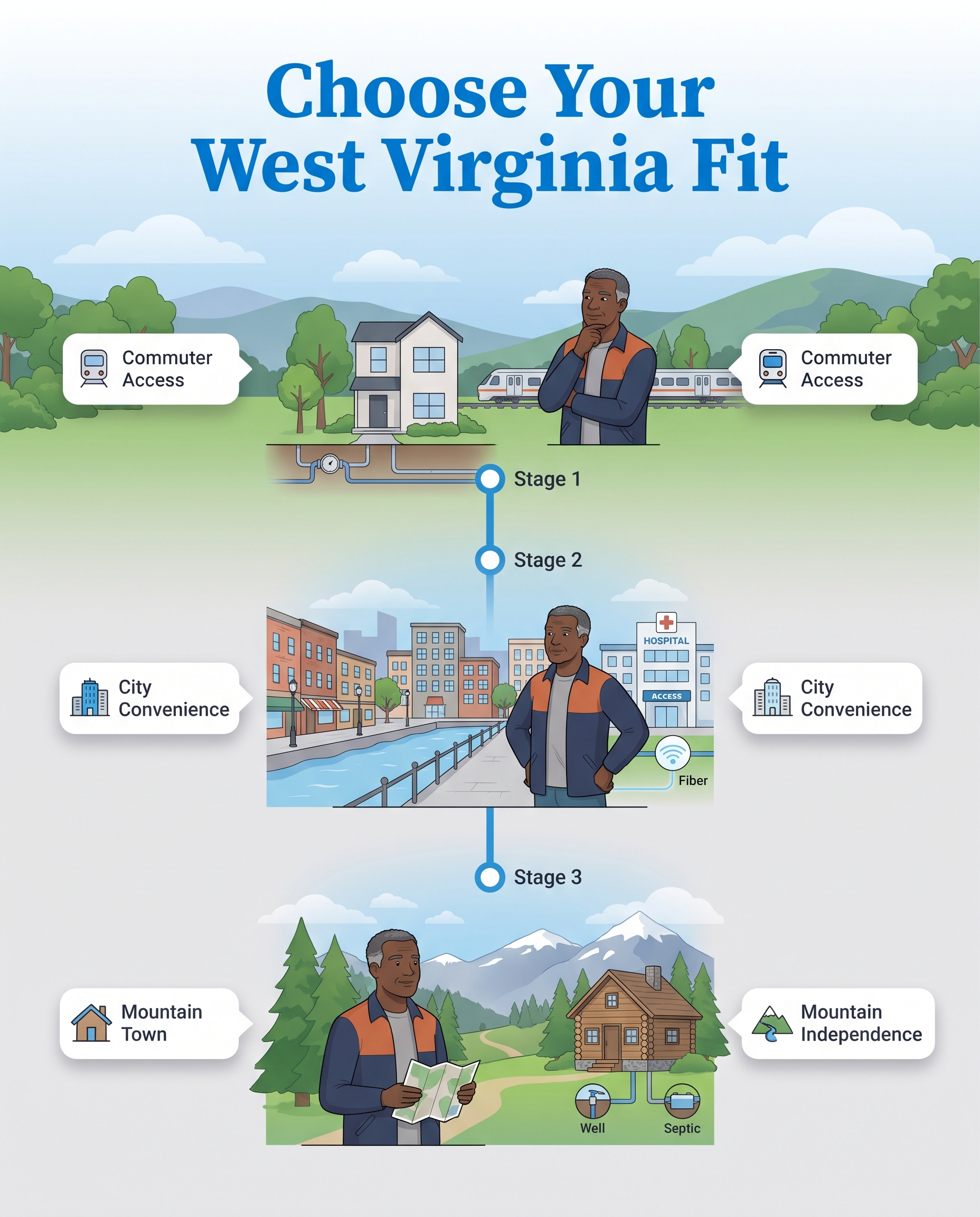
West Virginia is far from a geographic or cultural monolith. Because the state stretches from the footsteps of the Washington, D.C., metro area to the rugged coalfields of the south and the snowy peaks of the Allegheny Highlands, the best places to live vary widely in price, vibe, and utility infrastructure. Picking the right region ensures your daily lifestyle matches your expectations.
The Eastern Panhandle (Martinsburg, Charles Town, Shepherdstown)
Tucked between Maryland and Virginia in the Shenandoah Valley, the Eastern Panhandle functions as an outer ring of the Washington, D.C., and Northern Virginia commuter belt. Towns like Martinsburg and nearby Duffields offer MARC commuter train access straight into the nation’s capital, while historic Shepherdstown brims with university charm, indie bookshops, and farm-to-table dining. Because of its proximity to major job centers, you’ll pay higher home prices here than in most other parts of the state, but you’ll also have an easier time finding modern suburban subdivisions with reliable municipal water, natural gas lines, and widespread fiber or cable internet.
Vibrant College Towns & Urban Hubs (Morgantown, Charleston, Huntington)
If you want walkable neighborhoods, cultural events, and top-tier medical care without sacrificing affordability, focus your search on the state’s primary cities. Morgantown, home to West Virginia University, pulses with youthful energy and houses the state’s flagship hospital system. Charleston, the state capital, sits along the Kanawha River with historic brick streets and thriving local markets, while Huntington offers a flat, bike-friendly layout anchored by Marshall University. Moving to these urban hubs often provides a simpler utility setup, complete with robust electric grids, competitive fiber internet, and city sewer systems — though you still must verify connections at your specific address.
Mountain Towns & Outdoor Havens (Fayetteville, Lewisburg, Davis, Thomas)
For nature lovers, artists, and eco-conscious buyers, West Virginia’s small mountain towns are highly desirable. Fayetteville serves as the vibrant basecamp for New River Gorge hikers and paddlers, Lewisburg pairs historic Greenbrier Valley elegance with a renowned arts scene, and the twin high-elevation towns of Davis and Thomas sit high in the Alleghenies near Canaan Valley’s ski slopes and alpine bogs. Just remember that town boundary lines matter immensely here: buying a house two miles outside town limits frequently means trading municipal water and gas hookups for a private well, a septic tank, and significantly more demanding winter weather.
Setting Up Utilities in West Virginia: Town Grids vs. Rural Homesteads
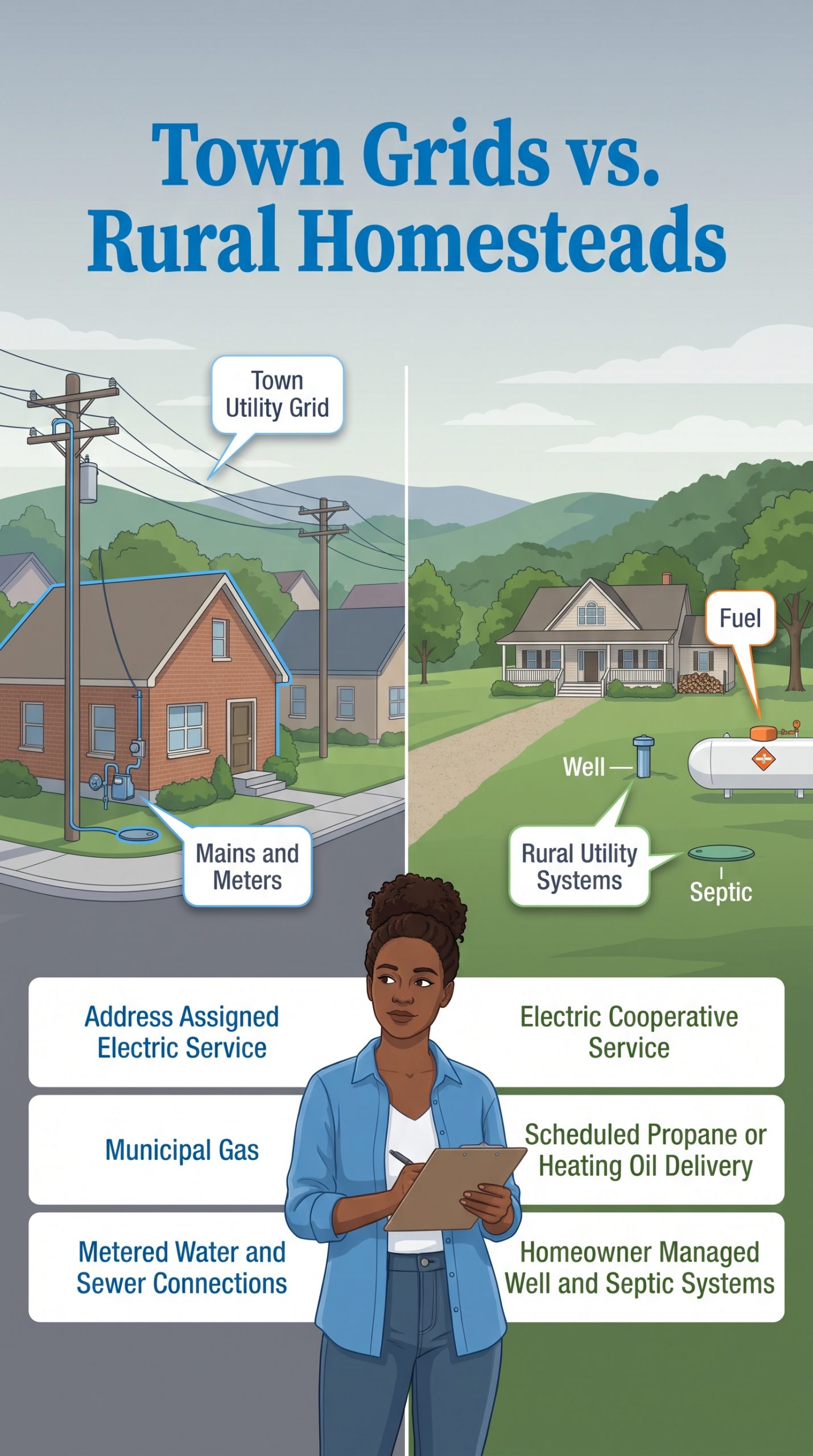
When you’re setting up utilities in West Virginia, your checklist splits sharply depending on whether your new address sits inside an incorporated town or out in an unincorporated county. In town, transferring service takes a few quick phone calls to established monopoly providers. Out in the country, you essentially become your own utility manager, overseeing private water systems and scheduling fuel deliveries before the first frost hits.
Electricity and Natural Gas Providers
For residential electricity, West Virginia operates as a fully regulated energy state. You don’t have to navigate confusing third-party energy suppliers; your utility provider is assigned strictly by your street address. When you check out our guide on how to set up electricity to prepare your move-in timeline, you’ll work with major electric utilities like Appalachian Power, which serves southern and western counties, or Mon Power and Potomac Edison (both subsidiaries of FirstEnergy), which power northern West Virginia and the Eastern Panhandle. Confirm the provider for your specific address, as smaller utilities or cooperatives may serve other areas.
If your new home sits in a town or suburban neighborhood with accessible gas mains, setting up winter heat is equally straightforward. Our natural gas guide breaks down how to transfer service safely. In West Virginia, you’ll likely set up an account with Mountaineer Gas Company (the state’s largest distributor) or Hope Gas. Schedule your connection at least two weeks before closing to ensure a technician can verify meter safety if the home has been vacant.
Navigating Rural Heating: Propane, Heating Oil, and Wood
Once you leave town limits, municipal natural gas lines disappear quickly. Rural homes keep utility costs manageable by relying on large outdoor liquid propane tanks (typically 500 to 1,000 gallons), fuel oil furnaces, or wood and pellet stoves. If you buy a home with a propane tank, immediately ask the seller whether the tank is owned or leased. Owning the tank gives you the freedom to shop around local agricultural co-ops and fuel distributors for the lowest per-gallon summer fill-up rate, whereas a leased tank legally locks you into purchasing fuel exclusively from the company that owns the tank under its contract terms.
Municipal Water vs. Private Wells and Septic Systems
Town residents typically set up water and sewer service through West Virginia American Water, a public service district, or a local municipal water board. If you’re moving to a rural property, however, your drinking water will likely come from a private drilled well or mountain spring, and wastewater will flow into an underground septic system. Because historic coal mining, natural gas drilling, and agriculture can affect local aquifers, test your private well water annually for total coliform bacteria, nitrates, total dissolved solids, and pH. Ask your local health department or a qualified laboratory whether nearby land uses call for additional testing. Before closing on a rural house, always pay for an independent water quality test, hire a qualified professional for a full septic inspection, and visit our water filtration overview to compare whole-house systems that match your specific contaminant profile.
Pro Tip
If your new home uses a private electric well pump, a winter power outage won’t just turn off your lights — it will also cut off your running water, so keep emergency water jugs stored or invest in a backup power source.
Solving the Mountain State’s Broadband Puzzle: Rural Internet Providers in West Virginia
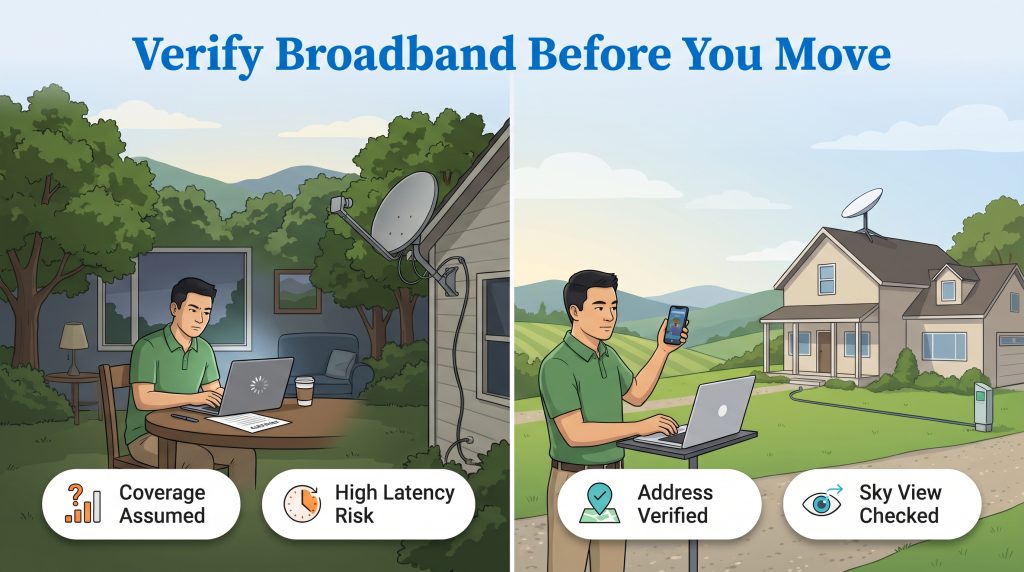
Almost every relocation blog warns newcomers about spotty Appalachian internet, and years ago, that reputation was well earned. Today, however, aggressive state-backed fiber builds and low-earth-orbit satellites have transformed the landscape for rural internet providers in West Virginia. If you work from home, you can get fast, dependable bandwidth in many areas, but you must independently verify coverage before signing your housing contract.
Major Fiber and Cable Providers in Towns
Inside cities, college towns, and corridor communities, wired broadband is faster than ever. Frontier Fiber has rolled out fiber-optic lines across dozens of West Virginia municipalities, offering symmetrical upload and download speeds ideal for heavy video conferencing. Optimum serves as a primary cable and fiber workhorse across Charleston, Beckley, and the Teays Valley corridor, while Xfinity provides widespread service in Morgantown, Wheeling, and the Eastern Panhandle. Additionally, Shentel and its Glo Fiber network continue expanding reliable high-speed connections across central and eastern counties.
Reliable Satellite and 5G Alternatives for Deep Valleys
If your dream homestead sits down a gravel lane where cable lines don’t reach, skip legacy geostationary satellite companies with laggy data caps and look straight to Starlink. Starlink’s low-earth-orbit constellation is a highly popular choice for rural West Virginia homes, frequently delivering fast download speeds with lower latency. The only catch is topography: before buying a property, use the Starlink smartphone app’s obstruction tool to verify that tall oak trees or steep mountain ridges don’t block your view of the sky. Where cellular networks have direct capacity and address eligibility, T-Mobile 5G Home Internet and Verizon 5G Home also provide budget-friendly wireless broadband. Always cross-check a property’s exact connectivity using the Federal Communications Commission’s National Broadband Map and directly with providers regarding installation timing and upload performance.
Sustainable Living and Winterization Tips for West Virginia Homes
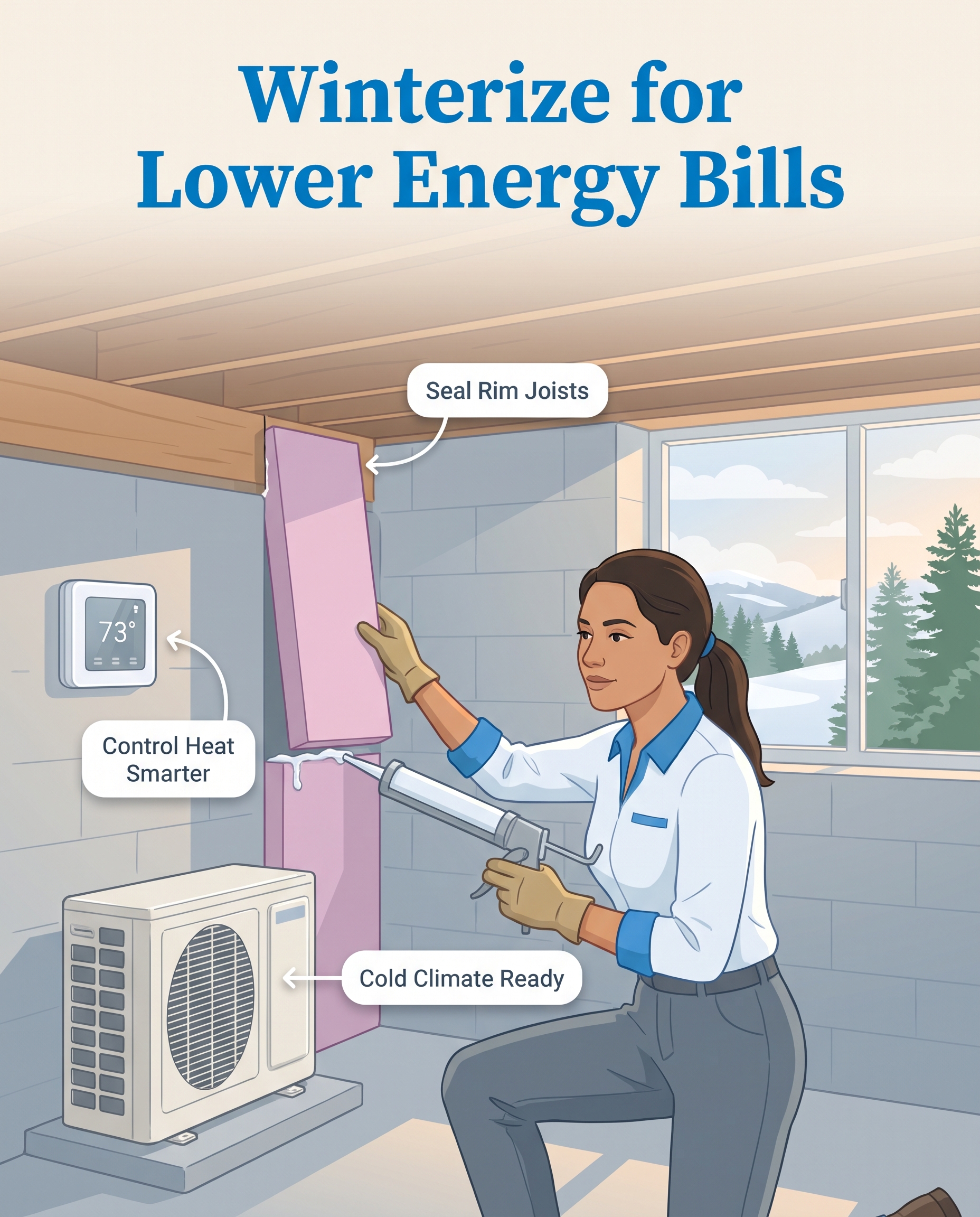
In the Mountain State, sustainability isn’t an abstract concept; it’s the most practical way to keep your home warm and lower your utility bills during freezing mountain winters. Making targeted efficiency upgrades right after moving to West Virginia protects your monthly budget while reducing strain on the regional grid.
Upgrading to Cold-Climate Heat Pumps and Weatherization
Many older West Virginia homes rely on energy-hogging electric baseboard heaters, aging fuel oil furnaces, or pricey propane systems. Swapping those out for an ENERGY STAR certified cold-climate air-source heat pump is an energy-saving option that efficiently extracts heat from outdoor air even when temperatures plunge below zero. While wood pellet stoves can offer a cozy secondary heat source, remember that most require electricity to run their fans and augers and produce emissions.
Before upgrading equipment, tackle the building envelope. Sealing drafty basement rim joists with rigid foam insulation, blowing cellulose insulation into under-insulated attics, and installing a programmable smart thermostat can meaningfully lower winter heating waste. Be sure to check with your specific utility company after moving in, as many offer residential energy-efficiency rebates for smart thermostats, home energy audits, and heat pump water heaters.
Solar Viability, Net Metering, and Eco-Conscious Backup Power
Residential solar is gaining steady traction across West Virginia. Both Appalachian Power and Mon Power offer net metering programs that credit your utility bill for excess electricity your panels send back to the grid, though you should confirm their current tariffs and interconnection rules. Because steep mountain ridges and dense hardwood forests can shade roofs in the late afternoon, have a certified installer run a lidar shade analysis on your property; rural homeowners often find that a ground-mounted solar array in a sunny pasture outperforms a shaded rooftop system.
Even more valuable than bill credits is energy resilience. Heavy wet snow and winter ice storms frequently snap tree limbs across rural power lines. Remember that ordinary grid-tied solar generally shuts down during an outage for safety reasons. Pairing your solar setup with a home battery storage system is an eco-conscious alternative that can keep your electric well pump and refrigerator running during a blackout. Make sure to specify compatible equipment and surge capacity with your installer to ensure it supports heavy loads like your well pump.
Eco Edge
Choosing an ENERGY STAR certified cold-climate heat pump is an environmentally mindful choice that can significantly reduce your winter heating energy use compared to standard electric resistance heat or older oil furnaces.
Your West Virginia Moving Checklist
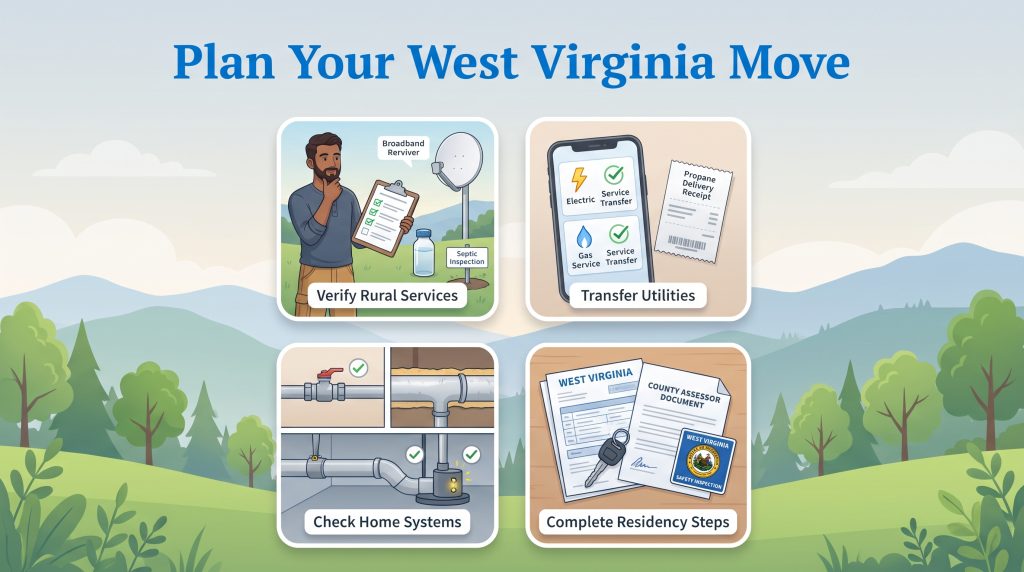
A smooth mountain move comes down to sequencing your logistics in the final 30 days before the moving truck arrives. Use this checklist directly on this page to keep your utility transfers, rural inspections, and residency paperwork on track when setting up your new life.
- During Due Diligence: Verify exact wired or satellite broadband availability at your new address. If you’re buying a rural property, schedule a certified private well water test and a professional septic tank inspection before closing.
- Two Weeks Before Moving: Contact your assigned electric utility and your local gas provider to schedule service transfers, or order your initial propane tank fill-up. Set up municipal trash pickup or locate your nearest county solid waste transfer station, as many rural backroads do not offer curbside trash collection. Invest in heavy-duty, bear-resistant trash cans if your new home borders forested land.
- First Week in Your New Home: Download the official WV 511 app for real-time mountain highway conditions and winter weather alerts, locate your main interior water shut-off valve, insulate exposed crawlspace pipes, and test your basement sump pump.
- Within 30 Days (DMV & Residency): Visit the West Virginia DMV within 30 days of establishing residency to transfer your out-of-state driver’s license and vehicle registration. Remember that registering a car in West Virginia requires visiting your county assessor’s office first to obtain the required property tax documentation or exemptions, followed by getting an official West Virginia vehicle safety inspection sticker.
Making Yourself at Home in the Mountain State
Moving to West Virginia rewards newcomers who do a little extra homework up front. Taking the time to verify your internet connection, evaluate well systems, and weatherize your home before winter arrives will save you money and protect your peace of mind. By proactively managing your home’s essential infrastructure, you’ll be well-prepared to fully enjoy the natural beauty and welcoming communities that define the Mountain State.
Frequently Asked Questions About Moving to West Virginia
Review these common questions to help you prepare your budget and set up your essential utilities before moving to the state.
How Much Money Do You Need to Live Comfortably in West Virginia?
How Does the Ascend WV Remote Worker Program Work?
Can You Get Reliable High-Speed Internet for Remote Work in Rural West Virginia?
Is West Virginia Tax-Friendly for Retirees?
What Is the Biggest Hidden Cost of Buying a Rural Home in West Virginia?
Do I Need All-Wheel Drive and a Backup Power Source to Live in West Virginia?
About the Author

LaLeesha has a Masters degree in English and enjoys writing whenever she has the chance. She is passionate about gardening, reducing her carbon footprint, and protecting the environment. She also recently served as President of the Board for City Sprouts (a community garden).

David has been an integral part of some of the biggest utility sites on the internet, including InMyArea.com, HighSpeedInternet.com, BroadbandNow.com, and U.S. News. He brings over 15 years of experience writing about, compiling and analyzing utility data.