

Relocating to the Old Dominion is easier when you understand regional price differences, utility setup timelines, and smart ways to keep your monthly energy bills low.
Key Takeaways
- The cost of living in Virginia varies dramatically by region, with steep housing prices in the Northern Virginia suburbs contrasting sharply with more affordable mountain and coastal towns.
- Setting up utilities requires advance planning, especially when coordinating electric, natural gas, and local water transfers two weeks before moving day.
- New residents face strict administrative deadlines, including a general 30-day requirement to title and register vehicles and 60 days to obtain a standard driver’s license.
Moving to Virginia puts you right in the middle of one of the most geographically and culturally diverse states on the East Coast. Within a variable drive depending on your starting point, you can go from the fast-paced commuter suburbs of Washington, D.C., to the misty peaks of the Blue Ridge Mountains or the sandy shoreline of the Chesapeake Bay. Understanding these local differences can help you avoid unexpected costs when setting up your new household. We put together this guide to help you pick the right region for your budget, estimate real-world household and utility expenses, and check off every essential home setup task without the usual moving-day stress.
Things to Know Before Moving to Virginia: Pros and Cons
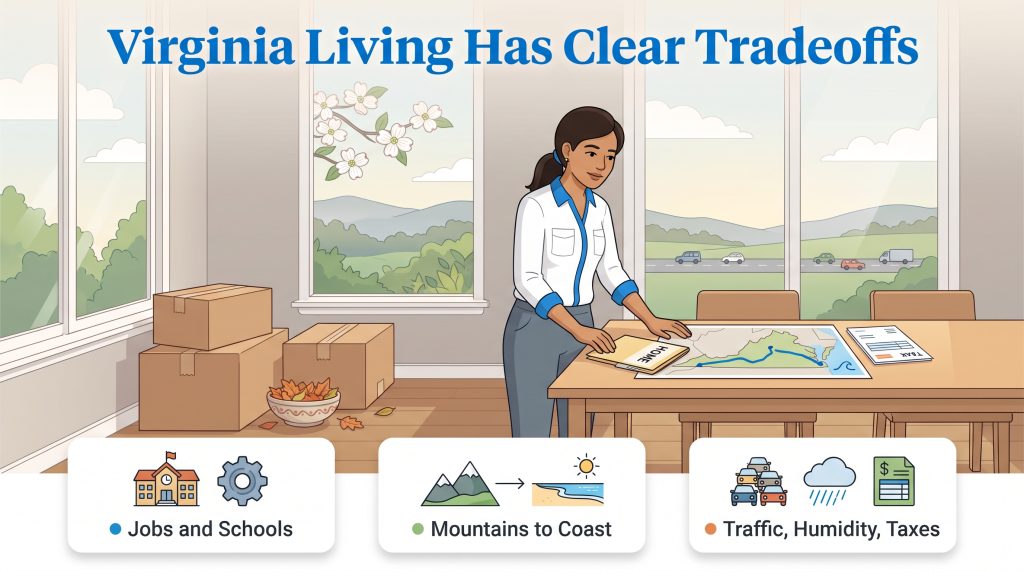
Thousands of people pack up their boxes and relocate to the Commonwealth every year. A diverse job market draws plenty of newcomers, while a mild four-season climate seals the deal for retirees and families alike. Still, weighing the pros and cons of living in Virginia before you sign a lease or mortgage will keep unpleasant surprises at bay.
The Perks of Living in the Old Dominion
Virginia punches well above its weight when it comes to career opportunities and quality of life. Whether you work in cybersecurity, defense contracting, agriculture, or a remote role, the state economy offers many avenues for growth. Families often move here specifically for the public school districts and world-class public universities like the University of Virginia, Virginia Tech, and William & Mary. Outside of work and school, you get four distinct seasons (complete with vibrant spring dogwood blooms and crisp autumn foliage) plus weekend access to both the Appalachian Trail and the Atlantic Ocean.
The Drawbacks to Keep on Your Radar
No state is perfect, and any honest neighbor will warn you about a few local headaches. If you settle along the Interstate 95 corridor or anywhere in Northern Virginia, prepare for heavy congestion that requires patience and strategic commuting. Summers across the Piedmont and Tidewater regions get thick with humidity, which pushes air conditioning units to their limits in July and August. Spring pollen counts can also test anyone with seasonal allergies, and county-level vehicle taxes often catch new residents off guard when their first local tax bill arrives in the mail.
| Pros of Living in Virginia | Cons of Living in Virginia |
|---|---|
| Thriving job market across tech, defense, healthcare, and maritime logistics | Notorious traffic bottlenecks along I-95, I-66, and the Capital Beltway |
| Highly regarded public school systems and prestigious state universities | Muggy, high-humidity summers that drive up cooling bills |
| Easy weekend access to both mountain trails and coastal beaches | High housing costs in the Washington, D.C., metro suburbs |
| Four distinct seasons without the brutal winter blizzards of New England | Annual county personal property taxes levied on vehicles (often called the “car tax”) |
Best Places to Live in Virginia by Region and Lifestyle
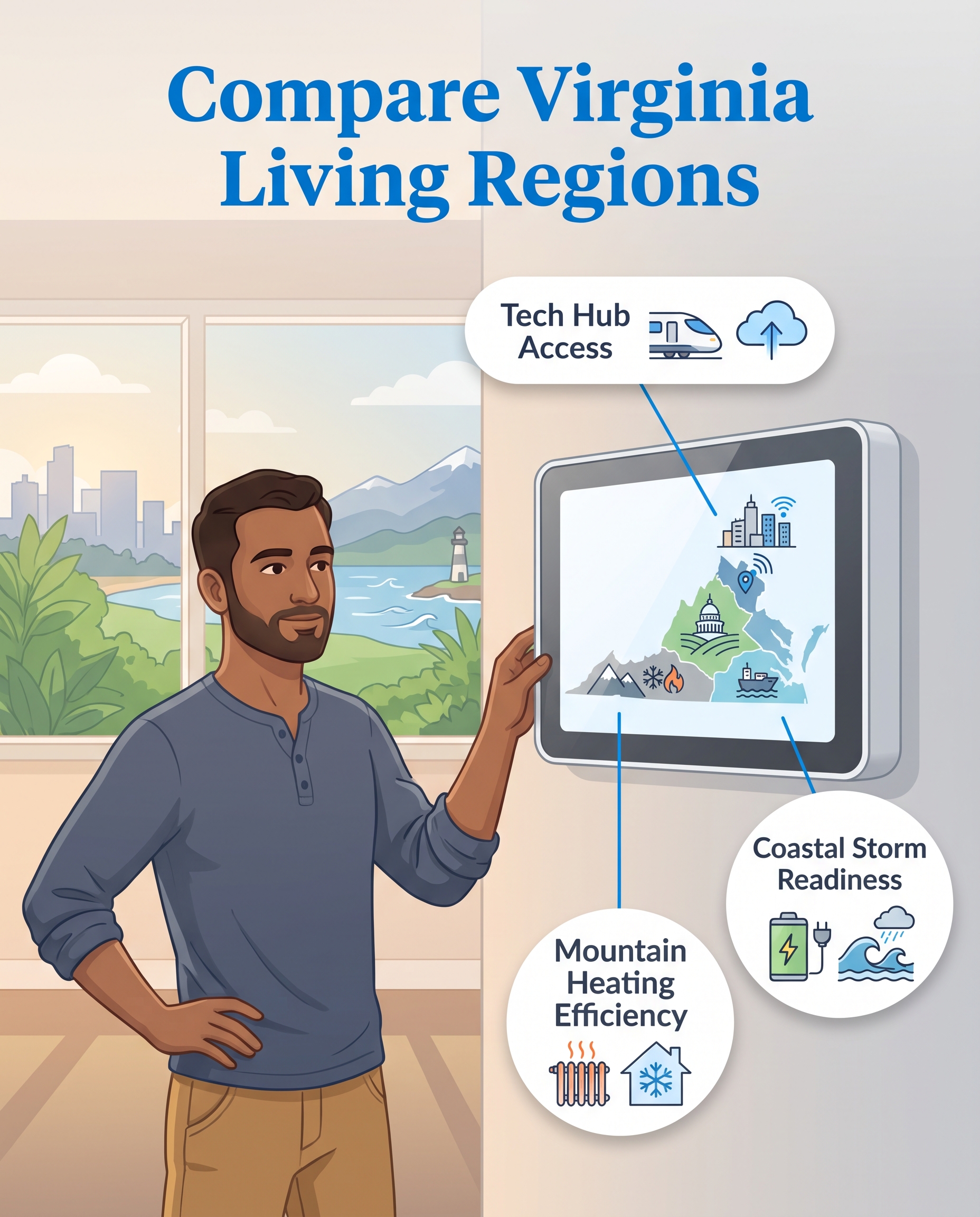
Virginia is far from a monolith, and your daily commute, housing budget, and home energy needs will look completely different depending on where you land. Before you make your final housing decision, it helps to compare the four core regions that make up some of the best places to live in Virginia.
Northern Virginia (NoVA): High-Energy Career and Tech Hub
Stretching across Arlington, Alexandria, Fairfax, and Loudoun County (famously known as “Data Center Alley”) Northern Virginia operates as an economic powerhouse right across the Potomac River from Washington, D.C. Residents enjoy walkable urban villages, direct access to the WMATA Metro rail system, and some of the highest median household incomes in the country. The trade-off is steep housing competition, where townhomes and condos routinely command prices that would buy a sprawling estate elsewhere in the state.
Central Virginia and Richmond: Historic Charm Meets Modern Culture
Anchored by the state capital of Richmond (often called RVA) and the university town of Charlottesville to the west, Central Virginia blends historic architecture with a thriving arts and culinary scene. You can kayak Class IV rapids on the James River right through downtown Richmond or spend Saturdays exploring vineyards in Albemarle County. Housing here is much more approachable than in NoVA, though buyers eyeing historic rowhouses in neighborhoods like The Fan should pay close attention to insulation and older HVAC ductwork.
Hampton Roads and Coastal Virginia: Maritime Living on the Bay
Where the James, York, and Elizabeth rivers meet the Chesapeake Bay, you will find Hampton Roads. This massive coastal metro encompasses Virginia Beach, Norfolk, Chesapeake, Newport News, and Williamsburg. (Across the bay, you will find the distinct and quiet rural towns of the Eastern Shore). Home to the world’s largest naval base and busy commercial ports, this region offers relaxed waterfront living and mild winters. Because tropical weather and nor’easters roll through in late summer and fall, flood insurance and reliable backup power are smart priorities for local homeowners.
Shenandoah Valley and the Blue Ridge Mountains: Scenic and Affordable
If your dream move involves mountain views, lower property prices, and a slower pace of life, look west to the Shenandoah Valley and Southwest Virginia. Cities and college towns like Roanoke, Staunton, Harrisonburg, and Blacksburg deliver lively downtowns surrounded by national forests and the Blue Ridge Parkway. Your housing dollar stretches furthest here, though higher elevations bring colder winter nights and significant winter weather that make home heating efficiency a top priority.
Quick Fact
Seasonal temperatures in Virginia swing from humid 90-degree summer afternoons along the coast to freezing 20-degree winter nights in the southwest mountains, directly affecting how you heat, cool, and weatherize your home.
Breaking Down the Real Cost of Living in Virginia
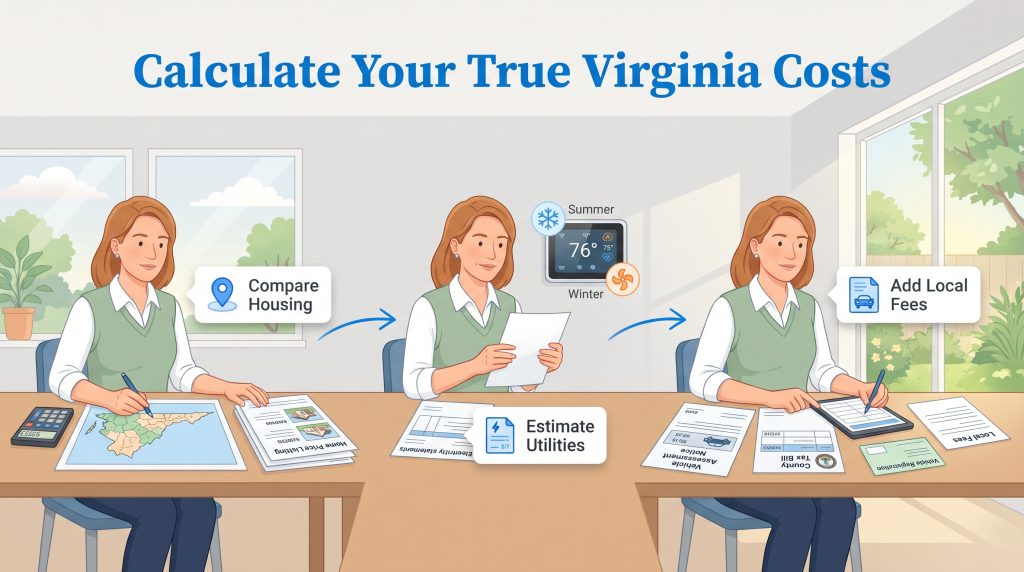
On a statewide level, Virginia ranks right near the middle of the pack for overall affordability nationally. However, statewide averages hide massive local swings driven by real estate values and municipal taxes. Understanding the true cost of living in Virginia means looking closely at both housing benchmarks and the average utility cost in Virginia before setting your monthly household budget.
Housing costs in the Commonwealth vary widely based on your proximity to major employment hubs like Washington, D.C., and Richmond. State sales tax sits at 4.3%, though local municipalities can tack on additional percentages, pushing the final checkout rate higher in many areas. When it comes to keeping the lights on and the house comfortable, Virginia’s residential energy profile from the U.S. Energy Information Administration shows that residential electricity rates generally align with or sit slightly below the national average. Even with reasonable per-kilowatt-hour rates, heavy summer air conditioning and winter electric heat pumps will dictate your overall energy budget.
| Virginia Region | Housing Affordability | Typical Utility Demands |
|---|---|---|
| Northern Virginia (NoVA) | High cost (Most expensive real estate and rent in the state) | High summer cooling needs |
| Central Virginia / Richmond | Moderate cost | Balanced seasonal heating and cooling |
| Hampton Roads / Coastal | Moderate cost | High summer cooling and humidity control |
| Shenandoah Valley / Southwest | Most affordable | Higher winter heating needs due to elevation |
Watch Out for Virginia’s Annual Car Tax and Local Fees
One line item that catches almost every newcomer by surprise is Virginia’s local personal property tax on motor vehicles. Unlike states where you pay a flat registration fee once a year and forget about it, Virginia cities and counties levy an annual tax based on the assessed market value of your car, truck, or motorcycle. Depending on your county’s tax rate and the value of your vehicle, this can add several hundred dollars (or more for newer luxury models and SUVs) to your annual expenses when the county treasurer sends out bills in the spring or fall.
Setting Up Utilities in Virginia: Providers and How to Connect
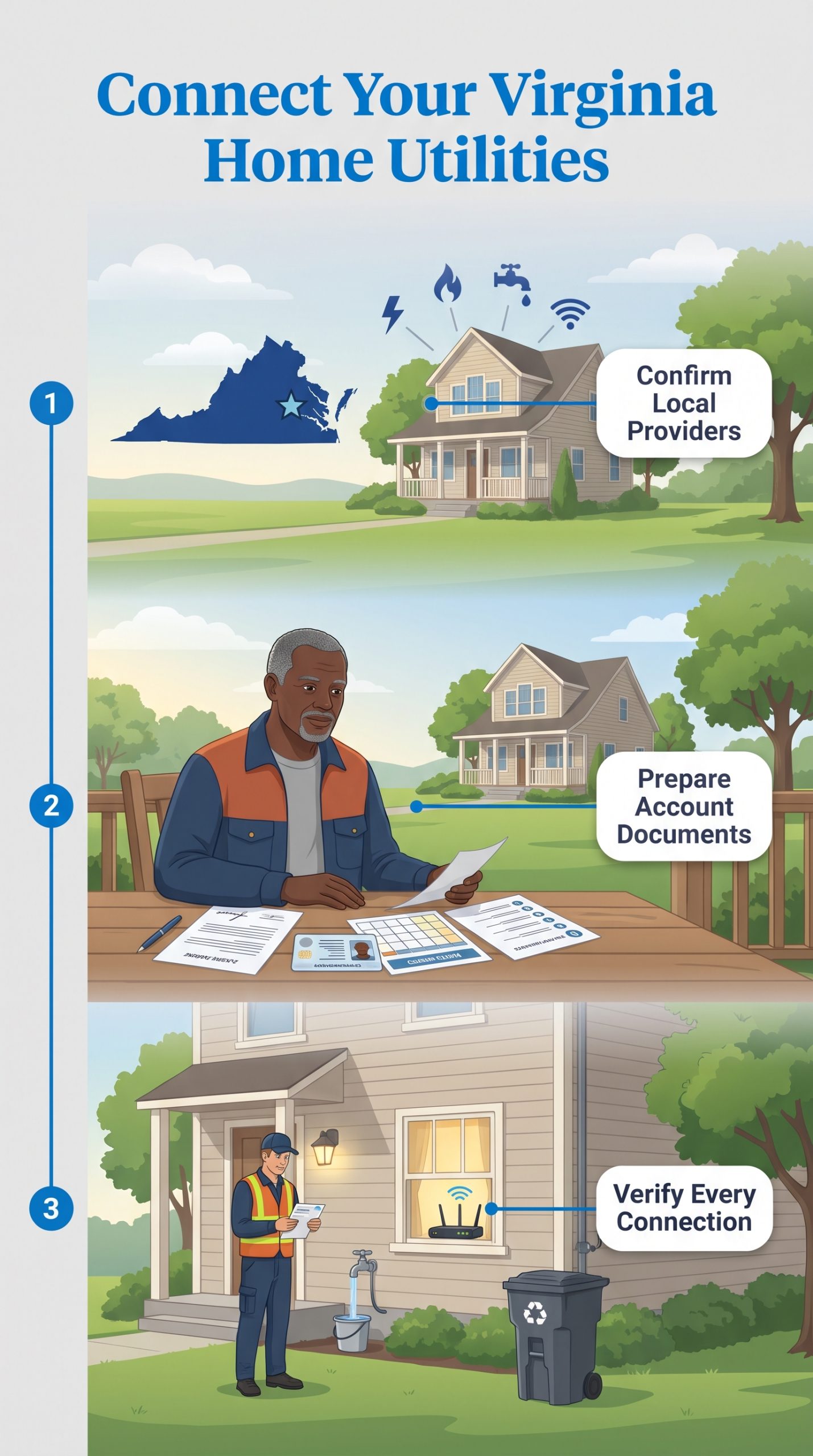
Your address determines which utility delivers electricity to your home. Most Virginia households start service with that utility, though some customers may have additional supply options depending on their service territory and current rules. We recommend contacting your providers at least two weeks before your move-in date so your power, hot water, and Wi-Fi are ready while you unload the moving truck.
Virginia Electric and Gas Providers by Territory
When you start evaluating your new home’s meter setup and residential electricity service, your home will fall into one of several main electric categories. Dominion Energy is the largest investor-owned utility in the state, powering most of Northern Virginia, Central Virginia, Richmond, and Hampton Roads. If you move to Roanoke, Lynchburg, or Southwest Virginia, your power will likely come from Appalachian Power (an AEP company). Meanwhile, rural counties and outer suburban pockets are served by Virginia’s 13 electric cooperatives or local municipal electric utilities.
Many Virginia homes rely on dual-fuel systems or furnaces powered by natural gas service for winter heating and cooking. Your gas utility also depends on your region, with common examples including:
- Washington Gas: Serves Northern Virginia suburbs including Fairfax, Loudoun, Arlington, and Prince William counties.
- Virginia Natural Gas: Covers the Hampton Roads metro area and southeastern coastal communities.
- Columbia Gas of Virginia: Operates across suburban Central Virginia, the Shenandoah Valley, and parts of Southside.
- Roanoke Gas: Supplies households throughout the greater Roanoke Valley.
- City of Richmond Department of Public Utilities (DPU): Operates a municipal natural gas utility for city residents and parts of neighboring counties.
How to Set Up Service as a Homeowner vs. Renter
If you are buying a home, ask the seller for a list of current utility providers during the closing process so you can transfer service smoothly. You will usually need your closing disclosure, a government ID, and to pay a small account setup fee or deposit. If you are renting, review your lease carefully to see which utilities are included in your rent and which ones require you to set up a direct account. Landlords often handle municipal water and trash collection, leaving renters responsible for opening their own electric and internet accounts.
Water, Sewer, and Trash Collection
Water and wastewater services are managed locally by municipal departments or regional authorities. For example, the Hampton Roads Sanitation District (HRSD) primarily handles wastewater treatment for coastal cities, while local city departments handle the drinking water. You will typically need your closing disclosure or signed lease agreement, a government ID, and a small account setup fee to start service. Trash and recycling rules vary by neighborhood. City dwellers usually receive municipal curbside pickup, whereas suburban HOA communities and rural counties often require you to hire a private waste hauler. If you buy a country property in the Shenandoah Valley or Piedmont that runs on a private well and septic system rather than municipal home water utilities, make sure you know how to test your water for bacteria during your home inspection.
High-Speed Internet and Fiber Availability
Broadband options vary by address, even within the same city. Check availability at the exact property before signing a lease or relying on a connection for remote work. Metro areas across NoVA, Richmond, and Hampton Roads enjoy widespread gigabit fiber and cable options through Verizon Fios, Cox Communications (now Spectrum), and Xfinity. If you are heading to a rural town in the Blue Ridge Mountains or Southside, regional electric cooperatives have partnered with state broadband initiatives to build out high-speed fiber-to-the-home networks alongside expanding 5G fixed wireless and low-earth-orbit satellite services.
Pro Tip
Ask the seller or landlord for a history of electric and gas bills before closing or signing your lease. Prior energy bills can help you estimate your future costs and understand how occupancy patterns affect the home’s overall consumption.
Eco-Conscious Upgrades: Solar and Green Energy Incentives in Virginia
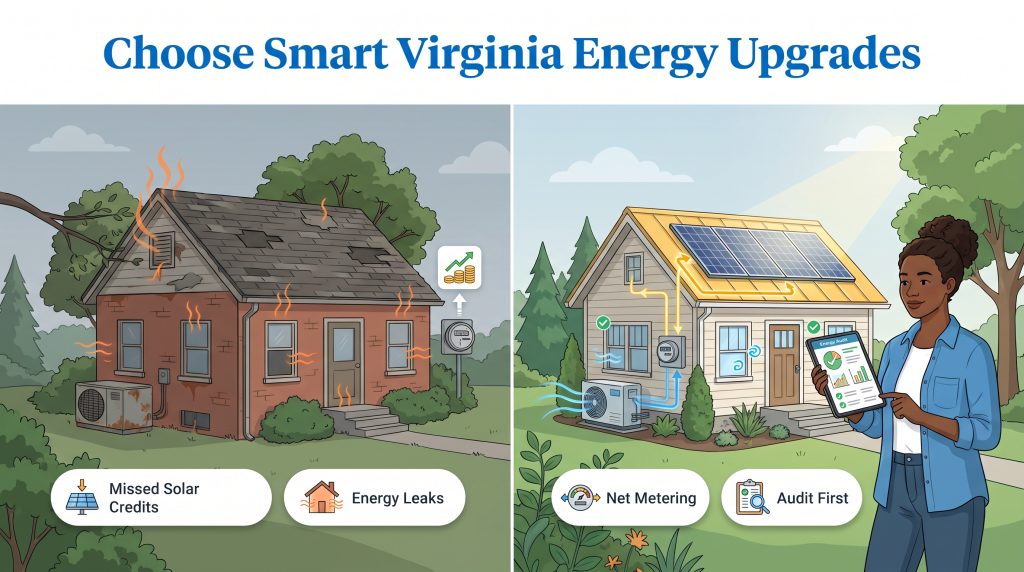
Thanks to the Virginia Clean Economy Act (VCEA), utilities across the Commonwealth are steadily retiring older fossil-fuel plants and expanding renewable generation. That statewide policy shift creates practical opportunities for homeowners to take advantage of solar and green energy incentives in Virginia while trimming their monthly utility bills.
Rooftop Solar, Net Metering, and Green Power Options
Depending on your roof’s shading, condition, and orientation, installing home solar panels is a popular energy-saving option for Virginia homeowners. Under Virginia’s net metering rules, qualifying customers can often send excess daytime solar electricity back to the grid in exchange for kilowatt-hour credits on their monthly power bills, though eligibility and system limits depend heavily on your specific utility. Better yet, Virginia allows some homeowners to sell Solar Renewable Energy Certificates (SRECs) for the clean power their roof generates. Additionally, the state provides a statutory tax exemption for qualifying small solar installations, protecting your property tax rate from spiking after the upgrade. If you rent an apartment or live in a shaded townhome, exploring your utility’s voluntary renewable energy purchasing program or checking the availability of a community solar subscription offers an alternative way to support green energy.
Home Energy Audits and Efficiency Rebates
Before you spend thousands on new mechanical equipment, scheduling a professional home energy assessment is an environmentally mindful choice that targets wasted energy right at the source. An auditor will inspect your attic insulation, check window seals, and evaluate your HVAC performance. From there, you can search for local utility rebates using the ENERGY STAR Rebate Finder by entering your new Virginia ZIP code. Depending on your electric and gas providers, you can often claim cash-back rebates on smart thermostats, heat pump water heaters, high-efficiency clothes washers, and weatherization upgrades that pay off during humid July afternoons. Exploring simple sustainable living upgrades during your first month in the house keeps your carbon footprint low and your indoor temperatures steady.
Eco Edge
Swapping an aging electric baseboard system or worn-out central air conditioner for an ENERGY STAR-certified cold-climate heat pump handles both Virginia’s muggy summers and chilly winters while often noticeably cutting annual heating and cooling costs compared to older units.
Your Step-by-Step Moving to Virginia Checklist (Including DMV Deadlines)
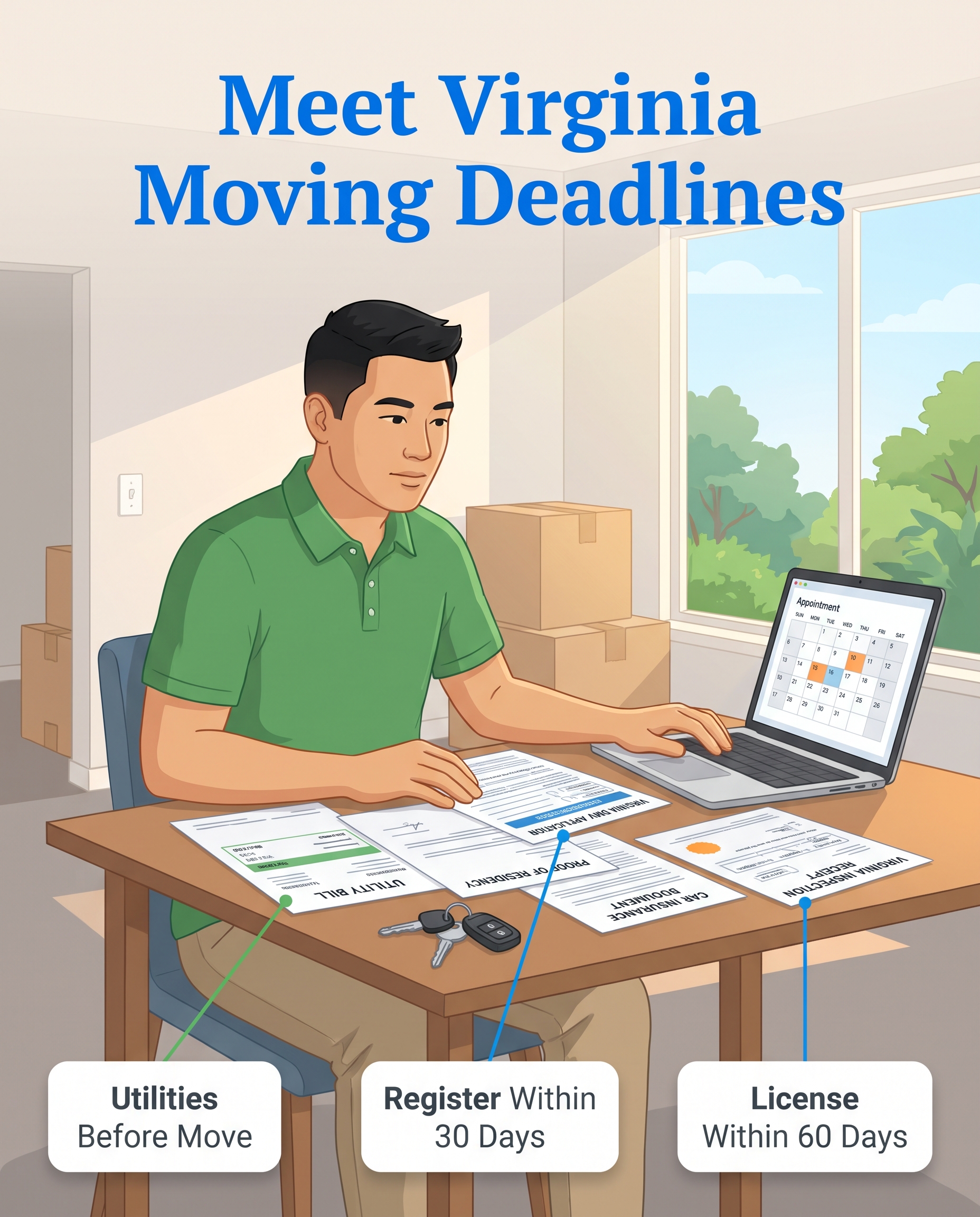
Once the moving truck pulls out of the driveway, staying organized during your first two months will keep you out of long government lines and prevent expensive late fees. Follow this step-by-step checklist to coordinate your home services and knock out your administrative requirements on time.
Two to Four Weeks Before Moving Day: Home and Utility Prep
- Confirm utility start dates: Schedule your electric, natural gas, and municipal water transfers to go live the day before you arrive so your refrigerator is cold and the lights work during your walk-through.
- Book your internet installation: If your new address requires a technician to run a fiber line or activate an optical network terminal (ONT), book that appointment two weeks out to avoid a gap in remote work connectivity.
- Update your address and insurance: File an official USPS change-of-address form and transfer your homeowners or renters insurance policy to your new Virginia address.
- Transfer family records: Request official school transcripts, immunization records, and veterinary records if you are relocating with children or pets.
Your First 30 to 60 Days: The Virginia DMV New Resident Checklist
Virginia enforces strict timelines for new residents bringing vehicles into the state, and tasks must be completed in a specific order. Review the official Virginia DMV new resident requirements and complete these five steps as soon as you unpack:
- Verify your auto insurance coverage: Before you can legally operate or register a car in Virginia, your policy must meet the state’s minimum liability coverage requirements through an insurer licensed in the Commonwealth.
- Pass state safety and emissions inspections: Unless specifically exempted, most vehicles registered in Virginia must pass an annual safety inspection at a certified service station or garage. In addition, if you move to Northern Virginia (specifically Arlington, Fairfax, Loudoun, Prince William, or Stafford counties, or the cities of Alexandria, Fairfax, Falls Church, Manassas, or Manassas Park) your vehicle must also pass a biennial Department of Environmental Quality (DEQ) emissions inspection.
- Title and register your vehicle within 30 days: Once your insurance and inspections are squared away, you generally have 30 days from establishing residency to title and register your car and get your Virginia license plates.
- Get your Virginia driver’s license within 60 days: Standard drivers have 60 days to obtain a Virginia driver’s license (or 30 days if you hold a commercial driver’s license). Bring your out-of-state license, proof of identity, legal presence, and two official proofs of Virginia residency (such as your new utility bill and lease or deed) to complete the process. You also have the option to apply for a REAL ID-compliant card.
- Register with your local Commissioner of the Revenue: Separate from the state DMV, most Virginia counties and independent cities require you to register your vehicle locally for personal property tax assessment and residential parking permits. Check with your local tax office for their specific reporting deadlines.
Heads Up
Virginia requires valid auto insurance on all registered vehicles and enforces steep penalties if your coverage lapses. Also note that if you drive a fuel-efficient hybrid, electric vehicle, or even a highly efficient gasoline vehicle, you may be required to pay an annual highway use fee during registration to help fund state road maintenance.
Getting Comfortable in Your New Virginia Home
Moving to Virginia opens the door to historic neighborhoods, mountain trails, coastal breezes, and some of the strongest career hubs in the country. Whether you are unpacking boxes in a classic brick rowhouse in Richmond, a transit-friendly townhome in Fairfax, or a quiet farmhouse in the Shenandoah Valley, getting ahead of your utility setup and DMV paperwork makes all the difference.
By connecting your electric, gas, water, and internet accounts early and identifying exactly which services you are responsible for, you will keep your home comfortable through humid August afternoons and frosty January mornings. Welcome to the Old Dominion, and enjoy every bit of your new Virginia home.
Frequently Asked Questions About Moving to Virginia
Preparing for a move to the Commonwealth comes with a lot of administrative and financial questions. We compiled answers to the most common queries new residents have below.
How Much Money Do You Need to Live Comfortably in Virginia?
Can I Choose My Own Electricity or Natural Gas Provider in Virginia?
What Is the Average Monthly Utility Bill in Virginia?
How Long Do I Have to Switch My Driver’s License and Car Registration After Moving to Virginia?
Which Counties in Virginia Require a Vehicle Emissions Inspection?
Are Heat Pumps a Good Choice for Virginia’s Climate?
About the Author

LaLeesha has a Masters degree in English and enjoys writing whenever she has the chance. She is passionate about gardening, reducing her carbon footprint, and protecting the environment. She also recently served as President of the Board for City Sprouts (a community garden).

David has been an integral part of some of the biggest utility sites on the internet, including InMyArea.com, HighSpeedInternet.com, BroadbandNow.com, and U.S. News. He brings over 15 years of experience writing about, compiling and analyzing utility data.