
Everything you need to know about setting up your electricity, understanding your bill, and maximizing your energy savings with Appalachian Power.
Key Takeaways
- Confirm your exact address falls within the Appalachian Power footprint.
- Review specific rate options, including standard residential pricing and time-of-use plans.
- Learn step-by-step instructions for starting service and discover state-specific energy rebates.
Moving into a new home brings enough decisions without adding utility confusion to your moving day checklist. If Appalachian Power serves your new address in Virginia, West Virginia, or Tennessee, you will need a clear roadmap to get the lights turned on without unnecessary stress. Understanding exactly how to start service, what rate options apply to your household, and whether a security deposit is required helps you avoid frustrating delays. This comprehensive guide walks you through the absolute essentials — from navigating their online platform to finding the latest energy-saving tools — so you can get your electricity set up with fewer surprises and make smarter, eco-conscious choices once you settle in.
Appalachian Power Coverage Area
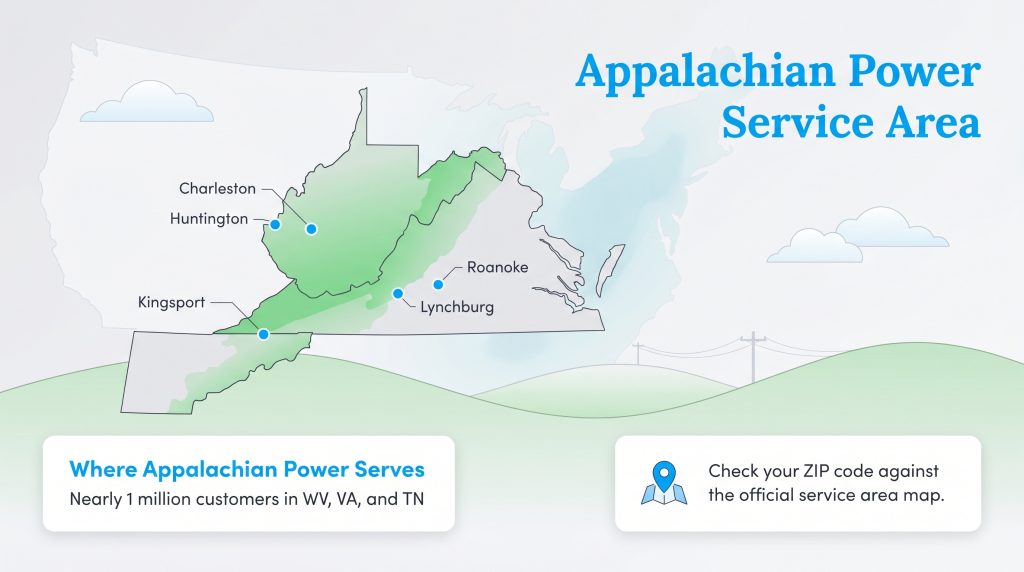
As a major subsidiary of American Electric Power (AEP), the Appalachian Power coverage area supplies electricity to a massive, rugged network encompassing nearly one million customers. The utility operates across a diverse geographic footprint that spans parts of West Virginia, Virginia, and Tennessee. If you are relocating to bustling economic hubs like Charleston and Huntington in West Virginia, putting down roots in Roanoke and Lynchburg in Virginia, or moving to Kingsport in Tennessee, you will likely rely on this provider for your home’s daily electricity needs.
Because local utility territories can occasionally overlap or split right down the middle of a neighborhood street, checking your exact ZIP code against the official service area map remains the safest way to verify your provider. In rural or newly developed areas, borders between regional electric cooperatives and Appalachian Power can be surprisingly complex, making direct address verification a mandatory first step before you start setting up your accounts.
🚩 Heads Up: Appalachian Power rates, deposits, rebates, and renewable options can vary widely by state. Always check the current regulatory rules for your specific address in Virginia, West Virginia, or Tennessee before enrolling in a billing plan.
Residential Plans and Pricing Options
Understanding exactly how your electricity bill is calculated puts you in a much better position to control your monthly household expenses. When reviewing Appalachian Power plans and pricing, you will notice the total cost is split into a few distinct categories. First, you pay standard base rates that cover the fixed costs of maintaining meters, updating billing systems, and providing local customer support. Then, you see variable fuel and transmission charges, which fluctuate based on the actual raw cost of generating power and pushing it across the high-voltage lines to your neighborhood. Tracking these moving parts helps you anticipate seasonal billing jumps, especially when heavy summer cooling or intensive winter heating pushes your energy consumption to its limits.
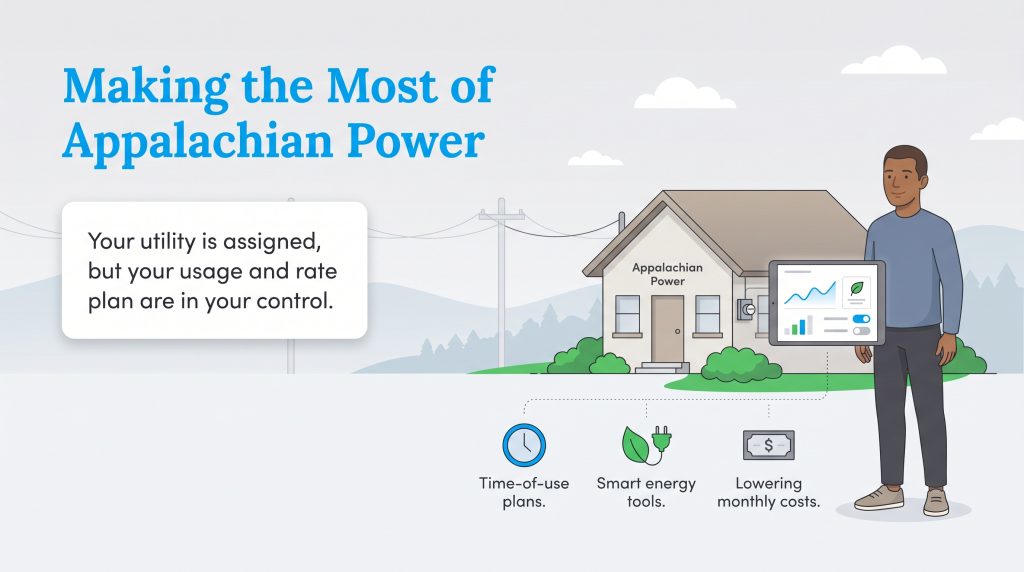
To get a baseline idea of what you might pay, looking at Appalachian Power electric rates offers excellent context. Currently, standard residential effective rates often hover around 12 to 16 cents per kilowatt-hour (kWh), though this fluctuates based on approved regulatory changes in your specific state. In some areas, customers may also have access to time-of-use or time-of-day rate options. While standard service provides a predictable, flat rate for electricity no matter what time of day you run your dishwasher, time-of-use pricing incentivizes you to shift heavy energy consumption to off-peak hours. This structure offers significantly lower rates late at night or early in the morning, while charging a premium during peak, high-demand afternoon periods.
If you prefer ultimate stability, the Average Monthly Payment (AMP) plan is an incredibly popular billing option designed to shield your wallet from extreme seasonal weather. Instead of facing unexpectedly massive bills during July heatwaves or January freezes, the AMP plan calculates a rolling average of your past 12 months of usage. You still pay for exactly the electricity you use, but the costs are smoothed out into a highly predictable, budget-friendly amount that remains fairly steady all year long.
| Plan Type | How It Works | Best For |
|---|---|---|
| Standard Residential | Charges a flat rate per kilowatt-hour (kWh) regardless of the time of day. | Households with unpredictable schedules or those who are home all day. |
| Time-of-Use or Time-of-Day Rate | Varies the rate based on demand, offering cheaper electricity during nights and weekends. | Customers who can easily delay running the dishwasher, laundry, or EV charging until late evening. |
Questions to Ask Before Choosing a Time-of-Use Rate
If you have the option to select a time-of-use plan, carefully weigh your household’s daily routines before making the switch. Consider asking yourself these practical questions:
- What are the specific peak and off-peak hours enforced in my state?
- Does enrolling in this rate plan require a new smart meter installation?
- Are weekends and federal holidays priced at the cheaper, off-peak rate?
- Can I switch back to standard service without a penalty if my bills increase?
- How much of my heavy appliance usage can I realistically shift to the late evening?
Deals, Discounts, and Ways to Save
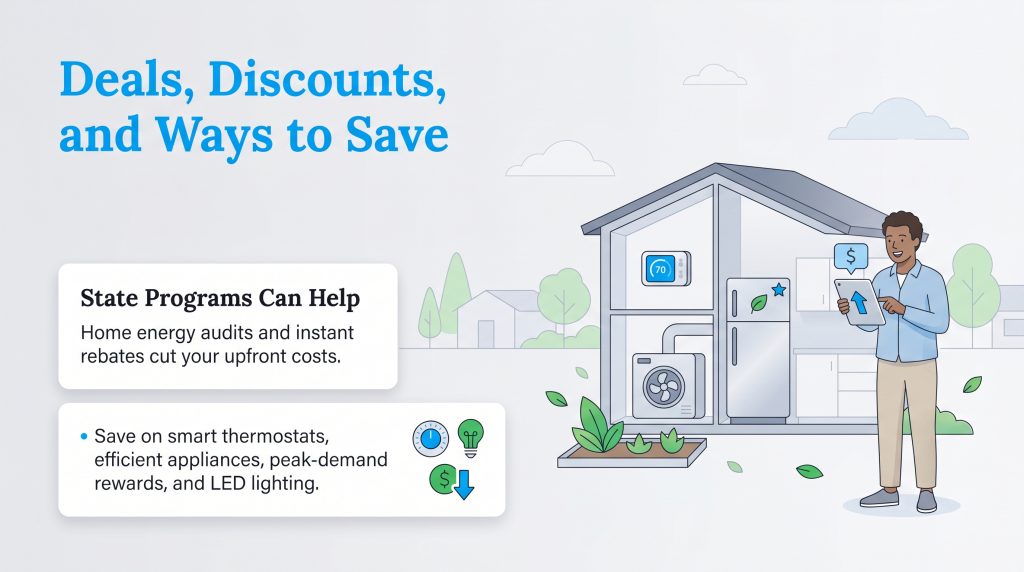
Keeping your monthly utility budget in check is entirely achievable when you proactively tap into local efficiency programs. Depending on which state you live in, initiatives like TakeCharge VA and TakeCharge WV provide an incredibly valuable set of resources designed to slash your overall energy consumption. These programs empower residents to schedule professional home energy audits, instantly identifying drafty windows, poor attic insulation, or aging HVAC systems that drain electricity. Taking full advantage of these state-sponsored incentives can drastically lower the upfront cost of your next major home improvement project.
- Claim instant rebates on smart thermostats that learn your daily schedule and seamlessly optimize your HVAC usage.
- Apply for substantial discounts when purchasing ENERGY STAR® certified appliances that pull significantly less power than older models.
- Access specialized rebates for upgrading to a modern, high-efficiency heat pump, which can dramatically lower your winter heating costs.
- Inquire about low-income weatherization assistance programs offered through TakeCharge VA and TakeCharge WV, which help eligible households upgrade their home’s efficiency at no cost.
- Participate in peak-demand reduction programs, which actively reward you financially for using less energy during extreme summer weather events.
🌱 Eco Edge: Upgrading your home’s efficiency not only lowers your monthly costs but significantly reduces your household’s overall carbon footprint by easing the strain on local power plants.
Expected Fees and Guarantees
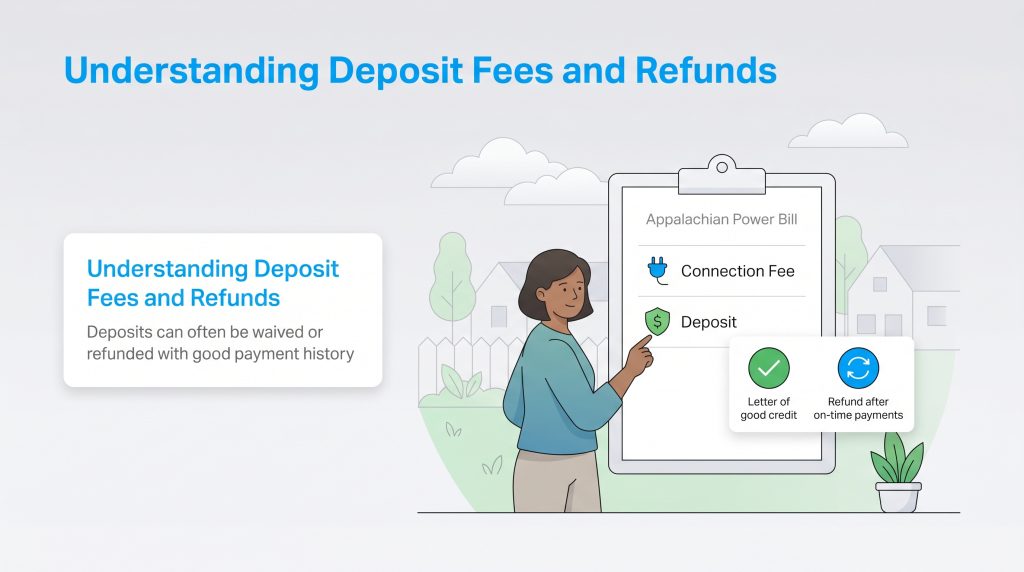
Like most major utility providers, getting your electricity flowing frequently involves a few standard upfront costs that you should factor into your moving budget. When activating a new address, you will likely encounter a small, one-time connection fee tacked onto your very first bill. Connection fees and deposit amounts vary heavily by credit history, account type, and your specific location. In fact, specific deposit rules vary by state — meaning regulations in Virginia differ slightly from those in West Virginia and Tennessee. Depending on the results of an initial soft credit check, you might be required to pay an upfront security deposit. This isn’t a punitive fine; it is simply a standard utility procedure used to protect the provider against defaulted accounts, especially if you lack a robust credit history or have a record of missed utility payments in the past.
Fortunately, you have a few easy avenues to navigate or entirely avoid this upfront expense. We highly recommend having a letter of credit ready from your previous utility provider. Customers who can prove an established history of on-time payments can almost always get the deposit fee waived instantly. If you do have to pay it, rest assured that the money isn’t gone forever. In many cases, Appalachian Power returns deposits — occasionally with a small amount of interest — after a continuous 12-month period of on-time payments. Always verify the current deposit policy for your specific state before finalizing your moving budget.
What to Confirm Before Starting Service
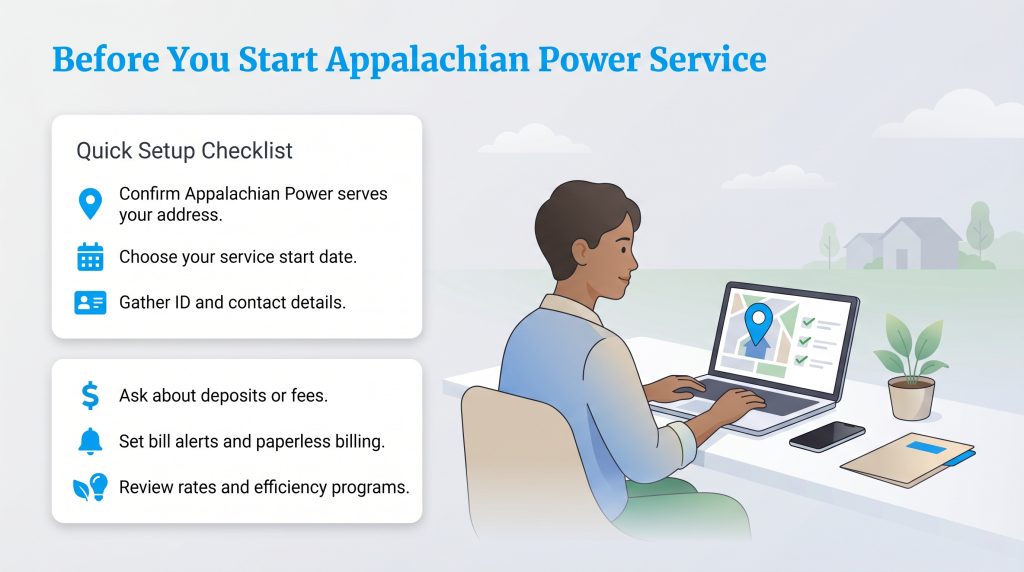
Before you dive into the activation process, taking just a few minutes to gather your personal details can help you avoid lengthy delays. Confirm that Appalachian Power officially serves your exact street address, choose your preferred service start date, and gather your ID, contact information, and previous utility account details so everything is on hand.
How to Start Service When You Move
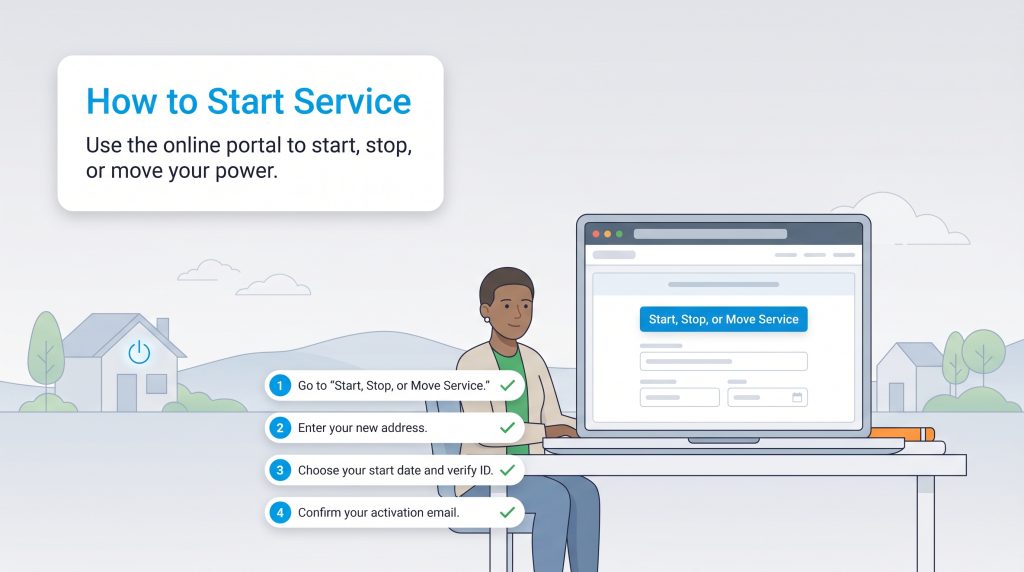
Once your documents are ready, getting your account activated is a highly straightforward process. Whether you are a first-time customer looking to establish new credentials or a current resident aiming to schedule a quick transfer request, their online portal serves as the most efficient route. We highly recommend completing this transition carefully as you complete your new home utility checklist.
- Navigate to the official Appalachian Power website and select the clear “Start, Stop, or Move Service” prompt on the homepage.
- Provide the exact address of your new residence, being careful to include any specific apartment, suite, or unit numbers to avoid connecting the wrong meter.
- Enter your preferred service start date and securely provide identity information, such as a Social Security number or tax ID, which is required for account setup and the mandatory deposit screening.
- Review the final confirmation email to ensure your scheduled activation date aligns perfectly with your moving timeline.
💡 Pro Tip: Always submit your service transfer or activation request at least a week before your official move-in date. This strategic buffer helps you dodge weekend delays and ensures the lights flip on the moment you walk through the door.
Appalachian Power Mobile App and Customer Service
Managing your household electricity shouldn’t require you to be tied to a desktop computer. The Appalachian Power mobile app ensures you have total control over your account right from your pocket. Available for both iOS and Android devices, this robust application completely transforms how you interact with your utility provider. You can securely track your daily kilowatt-hour usage to spot unusual energy spikes, enroll in paperless billing, and sign up for custom push notifications that offer helpful billing reminders and payment confirmations.
When it comes time to settle your monthly balance, the utility offers several convenient ways to safely submit your payment. Whether you prefer digital convenience or traditional methods, you have options:
- Online Portal: Access the Appalachian Power login page on their main website to pay directly from a checking account or credit card.
- Mobile App: Use the dedicated smartphone application to securely pay your bill with just a few quick taps.
- By Phone: Utilize the automated telephone system to process a payment anytime, day or night.
- By Mail: Send a traditional check or money order using the return envelope provided with your paper bill.
If you encounter a complex billing error or simply need to speak with a live representative about a service issue, getting in touch is simple. You can reach out directly by calling the official Appalachian Power customer service number at 800-956-4237. This line is essential to keep saved in your contacts for any urgent inquiries regarding your account or to quickly coordinate a payment extension during financially tight months.
How to Report and Search for Power Outages
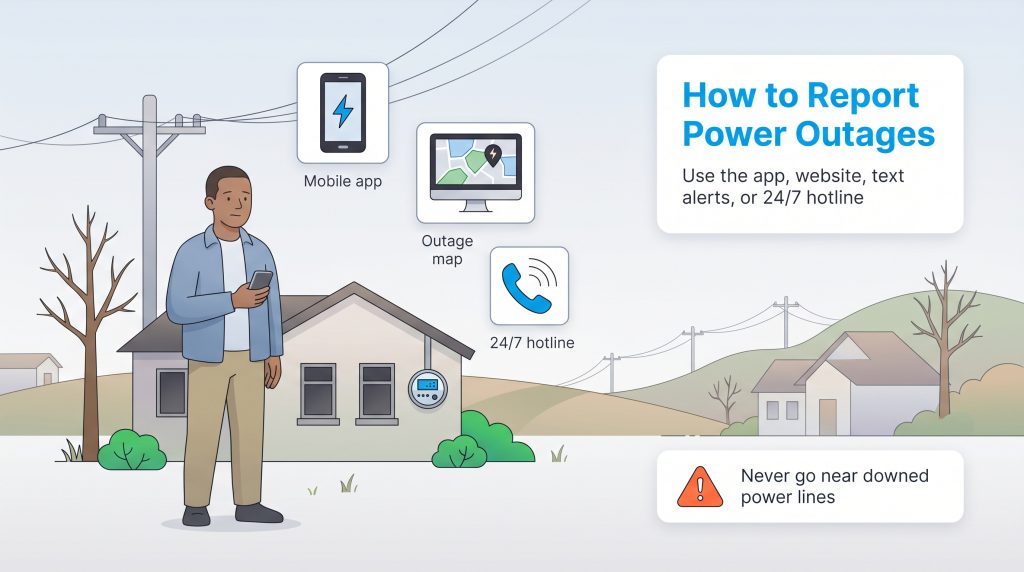
Living in the rugged Appalachian region means navigating a highly diverse climate where severe summer thunderstorms, heavy winter ice accumulation, and high winds can occasionally disrupt the electrical grid. When the lights inevitably go out, staying actively informed minimizes the frustration of waiting in the dark. The utility maintains a highly accurate Appalachian Power outage map directly on their website and mobile app. This interactive tool provides a real-time visual of affected areas, current customer outage counts, and estimated restoration times when available. If your home goes dark, it is crucial that you report power outage Appalachian Power status immediately to help field crews pinpoint the damaged infrastructure faster.
- Log into the mobile app to swiftly report your specific outage with a single tap.
- Visit the official website, navigate to the outage center, and input your account details or ZIP code.
- Call their dedicated 24/7 customer service hotline at 800-956-4237 to speak with an automated reporting system or a live representative.
- Sign up for SMS text alerts through your online account to receive instant, real-time updates on estimated restoration times sent straight to your phone.
Safety First: Never approach, touch, or attempt to move downed power lines under any circumstances. Always treat them as fully energized, highly dangerous, and report them immediately to local emergency services.
Sustainability and Renewable Energy Initiatives
If actively shrinking your carbon footprint ranks high on your priority list, you will be happy to know that exploring renewable energy initiatives is an accessible option in many parts of the Appalachian Power territory. Depending on state-level regulations, customers may be able to support clean power through voluntary utility green pricing options or by purchasing renewable energy certificates (RECs). While enrolling in these specialized programs doesn’t change the physical electrons delivered directly to your electrical meter, your financial contribution actively supports renewable generation — like local wind and solar farms — on the broader regional grid. Making this environmentally mindful choice proves that everyday households can collectively drive the transition toward a cleaner energy future without needing the upfront capital to install expensive rooftop solar panels.
Appalachian Power Reviews and Ratings
Because traditional electric utilities operate as regulated monopolies in this specific region, you cannot simply shop around for a competing energy supplier if you are unhappy with the service. This lack of choice makes understanding the overall customer sentiment incredibly important. When browsing Appalachian Power reviews across consumer advocacy sites like the Better Business Bureau (BBB) and local community forums like Reddit, you will find a mixed bag of feedback that is very typical for large utility providers.
On the critical side, some common complaints highlight unexpectedly high seasonal bills and frustration over recent state-approved rate hikes that have pushed monthly costs upward. Consumers often voice concerns when their winter heating bills spike drastically compared to the previous year. However, it is essential to balance these financial frustrations with the positive remarks frequently shared by the community. Customers consistently praise the utility’s robust infrastructure and the impressive speed of their line crews, noting swift outage restorations even during severe Appalachian winter storms. To combat the pain points associated with high bills, we strongly advise readers to proactively utilize home energy audits and weatherization programs, which return a level of financial control back to the homeowner.
Important Scam Warnings for Customers
Unfortunately, utility customers remain frequent targets for sophisticated scams, and staying vigilant is the best way to protect your personal information and your wallet. One particularly common issue in the region involves aggressive door-to-door solar solicitors who falsely claim to be partnered directly with, or sent by, Appalachian Power. These bad actors often use high-pressure sales tactics to convince homeowners to sign expensive, long-term solar panel leases under the guise of an official utility mandate.
It is vital to know that Appalachian Power does not partner with door-to-door solar sales companies to sell residential rooftop systems. If a representative shows up at your door claiming an official affiliation, you should independently verify the third-party company before signing any contracts or handing over a copy of your utility bill. Furthermore, any legitimate solar installation process requires a formal interconnection service application to be approved by Appalachian Power before the system can legally go live and push power back onto the grid. Always verify credentials directly through the utility’s official customer service channels if you ever feel pressured or suspicious.
Preparing for Your Appalachian Power Connection
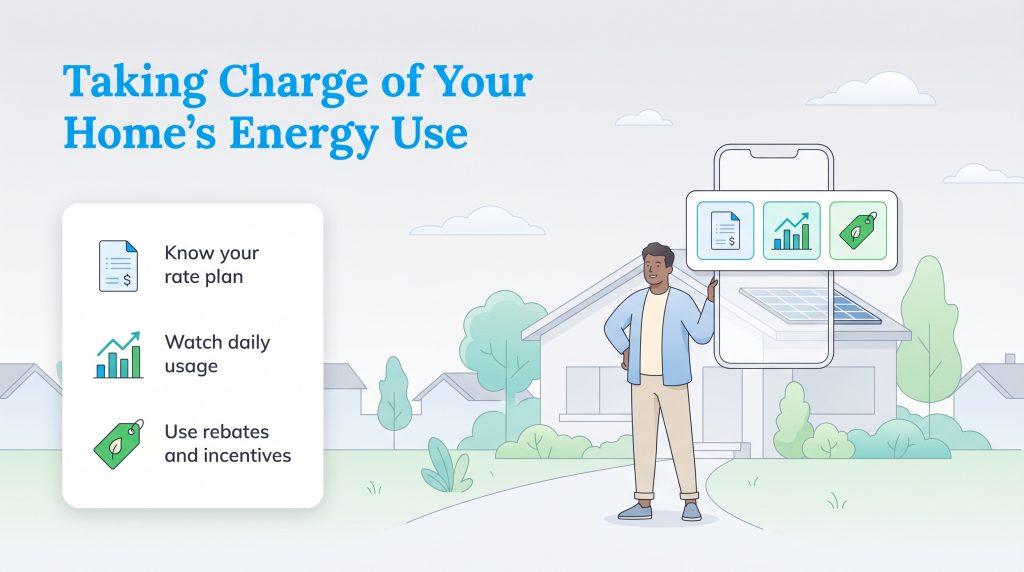
Relocating inevitably brings a whirlwind of stressful adjustments, but establishing your new electricity account should feel like a minor speed bump rather than a frustrating roadblock. By taking the time to understand the nuances of your specific rate plan, actively using the mobile app to monitor your daily kilowatt-hour usage, and leveraging state-sponsored energy-efficiency rebates, you gain vastly better control over your household expenses. Ultimately, a little proactive planning not only secures your home’s daily comfort during extreme weather but also empowers you to make environmentally mindful choices that benefit the broader Appalachian community for years to come.
Frequently Asked Questions About Appalachian Power
How do I contact Appalachian Power customer service?
Where do I log in to pay my Appalachian Power bill?
Why is my Appalachian Power bill so high?
How long does it take to get Appalachian Power connected?
Does Appalachian Power offer budget billing?
Can I compare Appalachian Power rates with other suppliers?
What happens if I can’t afford my Appalachian Power deposit fee?
Are there ways to get Appalachian Power alerts during a storm?
About the Author

David has been an integral part of some of the biggest utility sites on the internet, including InMyArea.com, HighSpeedInternet.com, BroadbandNow.com, and U.S. News. He brings over 15 years of experience writing about, compiling and analyzing utility data.