

Setting up your utilities in Connecticut is simple when you know the top providers, understand the deregulated energy market, and follow a clear checklist
Key Takeaways
- Take stock of your needs early by gathering important documents like your lease or closing paperwork, Social Security number, and new address before contacting providers.
- Shop around for the best electricity rates using the EnergizeCT rate board, as Connecticut has a deregulated energy market giving you the power to choose.
- Contact local water and gas providers directly, since these utilities are typically determined by your specific municipality and cannot be shopped around.
Moving to a new state often feels overwhelming, but sorting out your home services shouldn’t add to the stress. Between unpacking boxes and exploring your new neighborhood, you want your lights on and water flowing the moment you walk through the front door. We created this Connecticut utility setup guide to help you navigate the process smoothly. From understanding the deregulated energy market to finding your local water provider, consider this your practical, single place to sort out the essentials in the Nutmeg State so you can settle in comfortably.
Connecticut Utility Provider Directory
Before diving into the specific steps for each service, it helps to know which companies operate in the state. This quick reference guide outlines the main providers you will likely encounter when activating your new accounts.
| Utility Type | Main Connecticut Providers | What You Can Choose | Setup Notes |
|---|---|---|---|
| Electric Delivery | Eversource, United Illuminating, municipal electric utilities | Delivery provider is based on your address | Contact your electric delivery company first to start service |
| Electric Supply | Licensed Connecticut electricity suppliers | Supplier is optional in Eversource/UI areas | Compare rates through EnergizeCT |
| Natural Gas | CNG, SCG, Eversource Gas | No supplier shopping for most residential customers | Provider depends on service territory |
| Water and Sewer | Municipal departments, Aquarion, Connecticut Water, Regional Water Authority, local districts | Usually address-based | Renters may not need a separate account |
| Internet | Xfinity, Frontier, Optimum, GoNetspeed, local fiber/cable options | Usually can compare plans | Availability varies by address |
What to Know Before Setting Up Utilities in CT
Before you start dialing phone numbers or filling out online forms, gathering the right information will save you serious time and headaches. Getting organized early ensures setting up utilities in CT is a breeze rather than a frustrating scramble for scattered paperwork. Utility providers require specific personal and property details to open a new account, verify your identity, and ensure future billing accuracy.
To make the transition efficient, we recommend putting together a quick Connecticut moving utilities checklist with the following essentials readily available before you contact any companies:
- Your exact new service address, including any specific apartment, floor, or unit numbers.
- The official lease start date or your home closing date to schedule the activation.
- Your previous residential address so they can send the final bill or transfer your existing service.
- Your Social Security number or an alternative government-issued ID for account verification.
- Your previous account number, if you are simply transferring service with the same provider.
- Your phone number and email address for billing and outage notifications.
- Your landlord or property manager’s contact information, if applicable.
Having everything organized means you won’t have to pause a customer service call to rummage through sealed moving boxes looking for your lease agreement. Many major providers let you start service online, but smaller municipal utilities may still require a phone call, emailed form, or in-person account setup.
Connecticut Utility Setup Checklist for Moving Week
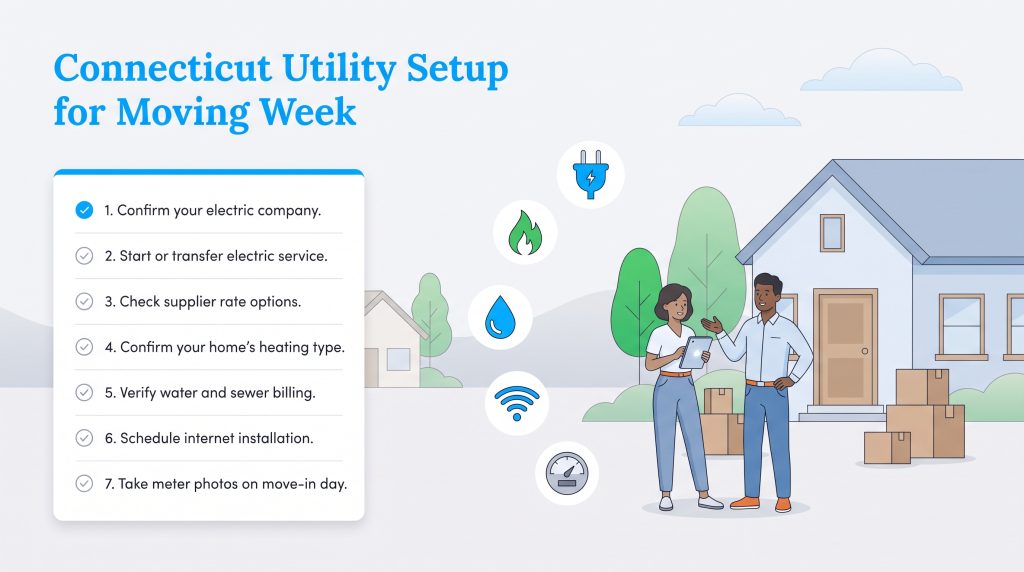
Timing your utility activations correctly prevents you from spending your first night in the dark. Follow this step-by-step checklist to keep your move on schedule and avoid service interruptions.
- Confirm which electric delivery company serves your address.
- Start or transfer electric service for your move-in date.
- Compare electricity supplier rates if your address is eligible.
- Identify whether your home uses natural gas, heating oil, propane, or electric heat.
- Ask your landlord, seller, or town clerk about water and sewer billing.
- Schedule internet installation as early as possible.
- Take meter photos on move-in day if meters are accessible.
Understanding Connecticut Electricity Suppliers
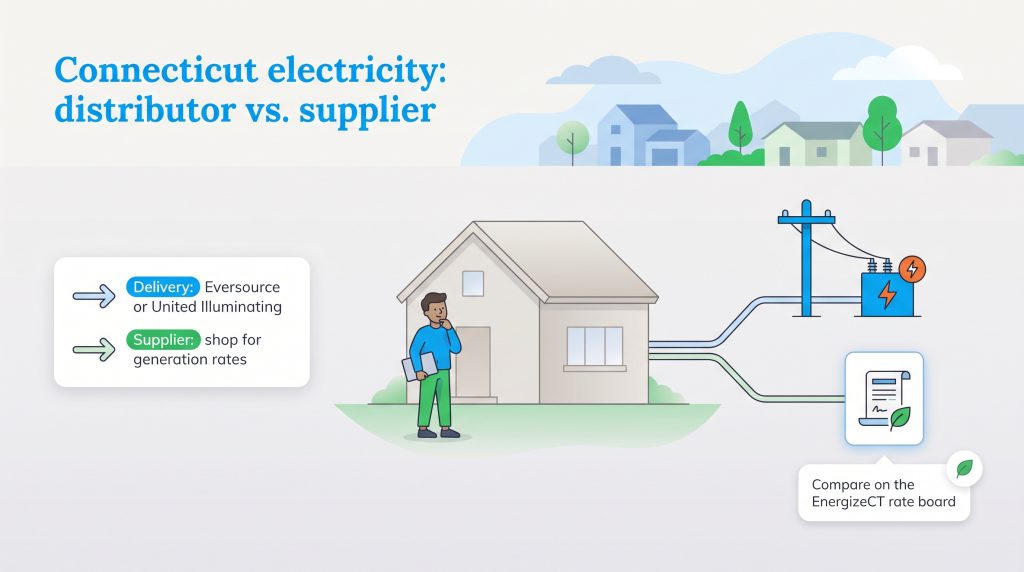
If you’re coming from a state where one company handles everything, navigating a deregulated energy market CT style might seem slightly confusing at first. Simply put, deregulation means you have the power to choose who supplies your electricity generation. This structure splits your electric service into two distinct parts: the distributor and the supplier.
Your distributor is the utility company that owns the power lines, maintains the grid, and restores power during an outage. In Connecticut, this is typically either Eversource or United Illuminating, depending on where you live. If Eversource is your electric delivery utility, start service through an Eversource CT start service request before your move-in date. Alternatively, if your new address is in United Illuminating’s service area, use its moving or start-service process to schedule electric delivery.
Suppliers sell the generation portion of your electricity, while your delivery utility still maintains the power lines, sends the bill in many cases, and handles outages. It’s important to note that if your address is served by a municipal electric utility, you may not be able to choose a third-party electricity supplier the same way Eversource or United Illuminating customers can. While you can opt to stick with your distributor’s default standard service generation rate, shopping around for a third-party supplier often unlocks lower fixed rates or specialized energy plans.
To confidently browse your choices, you can use the official state rate board to compare Connecticut electricity supplier rates through EnergizeCT. This tool allows you to view different terms, pricing structures, and contract lengths side by side.
How to Compare Supplier Rates Without Getting Burned
Shopping for electricity is a great way to control costs, but it requires a careful eye. Always check the price per kWh and compare the supplier rate directly with your utility’s standard service rate. Watch out for early cancellation fees, and double-check whether the rate is fixed or variable. Variable rates can spike unexpectedly, so understanding your contract end date is crucial for long-term budgeting.
Taking the time to understand these options ensures you’re not overpaying for the electricity you use every day. If you want to dive deeper into maximizing your home’s power setup, learn more about your electric service options to make the most informed decision possible.
Guide to Connecticut Natural Gas Providers
Unlike the electricity market, you can’t shop around for different Connecticut natural gas providers. Natural gas service is tied directly to your specific municipal territory. Your geographical location determines which company you’ll need to call to establish service.
As you sort through the various Connecticut utility providers, you’ll find that the state primarily relies on three major natural gas distributors. Each company manages a specific network of underground pipes, ensuring safe and reliable heating for homes in their designated regions. If your new home uses natural gas for heating or cooking, you’ll need to identify your regional provider to get the billing transferred into your name.
To help you figure out who services your new neighborhood, we’ve broken down the state’s main providers and their examples of service areas.
| Natural Gas Provider | General Service Region |
|---|---|
| Connecticut Natural Gas (CNG) | Greater Hartford area and parts of Greenwich |
| Southern Connecticut Gas (SCG) | Bridgeport, New Haven, and surrounding coastal towns |
| Eversource | Various towns across central, eastern, and western Connecticut |
These are general service regions, not a guarantee of service at a specific address. Always confirm using the provider’s service lookup or customer service line, as service territories can occasionally overlap near town borders. Additionally, if your home doesn’t have natural gas, ask the seller, landlord, or property manager whether it uses heating oil, propane, electric heat, or a heat pump. Heating oil and propane usually require a separate relationship with a fuel delivery company, and you may need to check tank levels before move-in. For more detailed steps on scheduling your activation safely, check out our guide on setting up your natural gas connection.
Setting Up Water and Sewer Services
Water and sewer utilities in the state are highly regionalized, meaning the process looks different depending on exactly where you live. Searching for Connecticut water companies by town is often the best strategy, as there’s no single statewide provider. Depending on your location, your water may be managed by a private company like Aquarion Water Company or Connecticut Water, a regional entity like the South Central Connecticut Regional Water Authority, or a local town water and sewer department.
If you’re renting your new home, check your lease agreement first. Landlords frequently cover water and sewer costs, folding them directly into your monthly rent. However, if you’re buying a home, you carry the responsibility of contacting your municipal provider or a regulated regional company to transfer the billing into your name before closing.
Because service districts vary wildly, we recommend visiting your new town hall’s official website to find the exact contact information for your local water authority. Alternatively, you can search state resources like the Public Utilities Regulatory Authority (PURA) water page for regulated companies operating within your specific district. Getting ahead of this ensures you’ll have running water ready for moving day cleanup.
What Renters Should Ask Before Move-In
If you are moving into an apartment or rental property, don’t assume every utility is handled the same way. Ask your property manager if water is included in the rent or if sewer is billed separately. You should also confirm who pays for trash and recycling collection, whether there are any move-in account transfer fees, and if outdoor lawn irrigation is metered separately from your main living space. Discover more insights on managing your water consumption with our guide to setting up residential water services.
Setting Up Internet Service in Connecticut
For most movers, an active internet connection is just as essential as electricity, especially if you work from home. Connecticut offers a mix of providers ranging from traditional cable to high-speed fiber optics, but finding the right one requires a bit of research.
Always check availability by your specific address, not just your town, as network coverage can vary dramatically from street to street. Major providers like Xfinity, Frontier, Optimum, and GoNetspeed serve different pockets of the state. Be sure to schedule your installation early, particularly if a technician visit is required to run new lines to your property. When comparing plans, remember to ask whether equipment rentals, installation fees, and promotional pricing structures will affect your monthly total after the first year. For more tips on finding the perfect provider, explore our guide to connecting home internet.
What Is the Average Utility Bill in Connecticut?
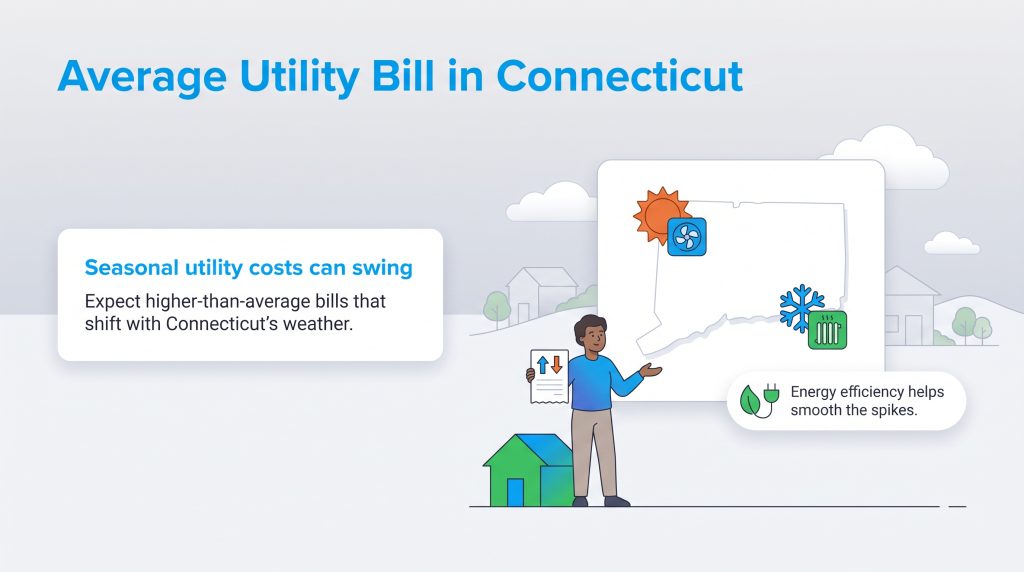
Budgeting for your new life in the Nutmeg State requires a solid understanding of the average utility bill in Connecticut. Because New England experiences both hot, humid summers and bitterly cold winters, your monthly costs will naturally fluctuate throughout the year.
While exact numbers depend heavily on the size of your house, the age of its insulation, and your family’s personal usage habits, Connecticut residents typically face higher energy costs than the national average. For a single-family home, combined utilities can easily move by hundreds of dollars from season to season, especially if you heat with natural gas, heating oil, or electric resistance heat. According to the U.S. Energy Information Administration’s Connecticut State Energy Profile, regional pricing surges often correlate directly with seasonal weather extremes.
| Utility | What Affects the Cost Most | Connecticut Budgeting Notes |
|---|---|---|
| Electricity | Supplier rate, delivery charges, AC use, home size | Connecticut electricity prices are often above the national average |
| Natural Gas | Heating system, winter weather, insulation | Winter bills can rise sharply for gas-heated homes |
| Heating Oil | Market price, tank size, delivery timing | Common in parts of Connecticut and often billed separately |
| Water and Sewer | Town rates, irrigation, household size | Renters may have this included in rent |
| Internet | Provider, speed tier, equipment fees | Promotional rates may increase after the first year |
Focusing on energy efficiency is the smartest strategy to combat these regional pricing surges. Simple habit changes and smart home technology go a long way in managing your consumption. If you want to take control of your upcoming expenses, explore some proven ways to lower your electric bill so you never experience sticker shock when the envelope arrives in the mail.
Making Your Connecticut Move as Seamless as Possible
Relocating involves juggling a dozen different tasks at once, but preparing your utility setup ahead of time makes the actual moving day significantly less stressful. By gathering your documents early, understanding your options in a deregulated market, and reaching out to local municipal providers, you eliminate the guesswork from the entire process.
Taking these proactive steps means you can walk into your new home and immediately turn on the lights, adjust the thermostat, and run the tap without a second thought. Start with electric delivery, confirm heat and water responsibilities, then compare electricity suppliers once your account is active. Settle in, unpack at your own pace, and enjoy the comfort of your fully functioning new Connecticut home.
Frequently Asked Questions About Moving to Connecticut Utilities
These quick answers cover the most common questions movers have about Connecticut utilities. Use them to double-check timing, provider choice, deposits, and local service rules before your move-in date.
Do I Need to Contact Both a Supplier and a Distributor for My Electricity?
Can I Choose My Electric Company in Connecticut?
How Far in Advance Should I Schedule My Utility Transfers?
What Utilities Should I Set Up First When Moving to Connecticut?
What Happens if I Move to a Town With Public Municipal Utilities?
Will I Be Charged a Deposit When Setting Up New Utilities?
Is Water Included in Rent in Connecticut?
How Do I Find Out Who My Specific Utility Providers Are?
About the Author

LaLeesha has a Masters degree in English and enjoys writing whenever she has the chance. She is passionate about gardening, reducing her carbon footprint, and protecting the environment. She also recently served as President of the Board for City Sprouts (a community garden).

David has been an integral part of some of the biggest utility sites on the internet, including InMyArea.com, HighSpeedInternet.com, BroadbandNow.com, and U.S. News. He brings over 15 years of experience writing about, compiling and analyzing utility data.