
We are breaking down the recent summer rate drops, the looming Eversource distribution hike, and the best ways to protect your wallet.
Key Takeaways
- Standard service supply rates dropped by 8% to 13% on July 1, 2026, bringing immediate monthly relief to Connecticut households.
- An 11% average distribution rate hike has been proposed by Eversource, which could go into effect in July 2027 if state regulators approve it.
- You can easily bypass standard utility prices by switching to a third-party supplier or upgrading your home with state-backed energy efficiency programs.
Setting up utilities or managing a household in Connecticut can feel a bit like riding an energy rate roller coaster. While we recently celebrated standard service supply rate cuts on July 1, 2026, that lowered electric supply charges for Eversource and United Illuminating customers, there is already an intense political battle brewing over Eversource’s proposed 11% distribution rate hike for next year. We want to help you make sense of these complex changes, see how your monthly bill is impacted, and show you exactly how to protect your wallet by shopping for better rates or using state-backed energy efficiency programs.
Why Connecticut Electric Rates Are Changing Right Now
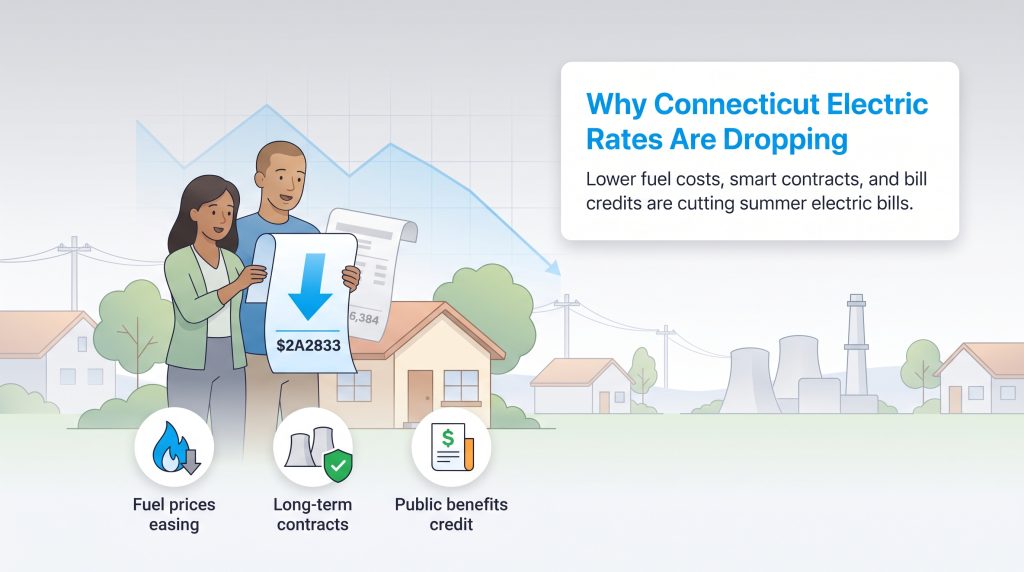
Every year, standard electric rates in Connecticut see-saw twice — once on Jan. 1 and again on July 1. This summer, customers received some highly welcome news at the meter. Standard service supply rates dropped by roughly 8% for Eversource customers and 13% for United Illuminating (UI) customers. These standard service reductions, occurring in tandem with significant regulatory adjustments enacted on May 1, 2026, have provided immediate financial relief to households during the high-demand summer cooling months.
The physical cost of generating electricity (the supply charge) is a direct pass-through with zero markup or profit for the utilities. Several key drivers made this summer’s rate cuts possible:
Easing Fuel Constraints and Contract Timing
Historically, New England electricity rates spike in the winter because the region relies heavily on natural gas to heat homes and fuel power plants. During the summer, natural gas heating demand drops, which naturally eases wholesale electricity prices. Additionally, state officials noted that because utility companies purchase electricity in cycles throughout the year, many of the contracts for this summer’s supply were locked in early. This strategic timing shielded local consumers from global energy market spikes.
Long-Term Nuclear Power Agreements
Connecticut has strategic long-term power purchase contracts with the Millstone Nuclear Power Station in Waterford and the Seabrook Station in New Hampshire. These fixed-price agreements act as a buffer against volatile fossil fuel markets, helping state officials keep ratepayer-funded program costs more stable.
The May Public Benefits Credit
A separate regulatory decision by the Public Utilities Regulatory Authority (PURA) on May 1, 2026, virtually eliminated the cost of the “public benefits” charge. To deliver short-term relief, PURA cut the public benefits charge by approving an interim decision to transition this charge into a bill credit through at least September 2026. This relief was bolstered by Public Act 25-173, which authorized the state to use bond financing for utility hardship and pandemic-era debt rather than collecting those costs directly from ratepayers.
How the Summer Rate Reductions Impact Your Monthly Bill
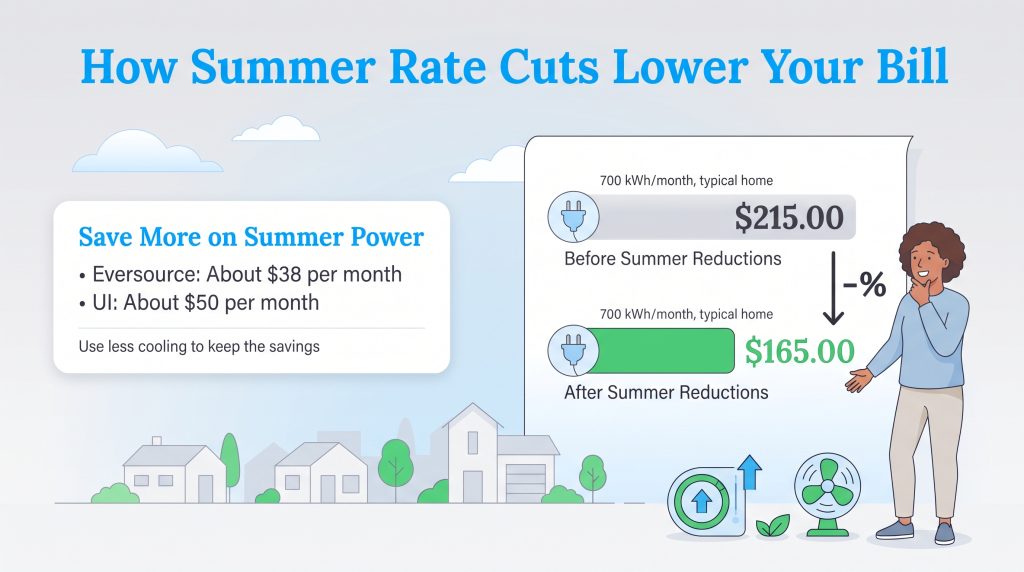
To put these rate changes into perspective, let us look at how the combined drops of May 1 and July 1, 2026, alter a typical monthly statement. For standard service customers, the savings are quite significant:
- Eversource Customers: The standard service supply rate dropped from 12.641 cents per kilowatt-hour (kWh) to 11.577 cents per kWh on July 1, 2026. Combined with the May 1 public benefits credit, a typical residential household using about 700 kWh of energy per month will see their average monthly bill decrease by approximately $38, or 18%.
- United Illuminating Customers: UI’s standard service supply rate dropped from 13.695 cents per kWh to 11.9473 cents per kWh. When paired with UI’s May 1 public benefits adjustment, a typical UI residential household will see their average monthly statement drop by approximately $50, or 18%.
The Critical Summer Catch
While lower rates are fantastic, there is a catch. The summer heat wave means your home cooling and air conditioning systems will naturally work harder. Frank Reynolds, UI Chief Executive, warned that because household electricity usage typically climbs during peak summer months, elevated consumption can offset these rate drops. To feel the full benefit of these savings, we encourage you to practice smart, energy-saving habits during peak heat periods.
Eversource’s Proposed 11% Rate Hike for 2027
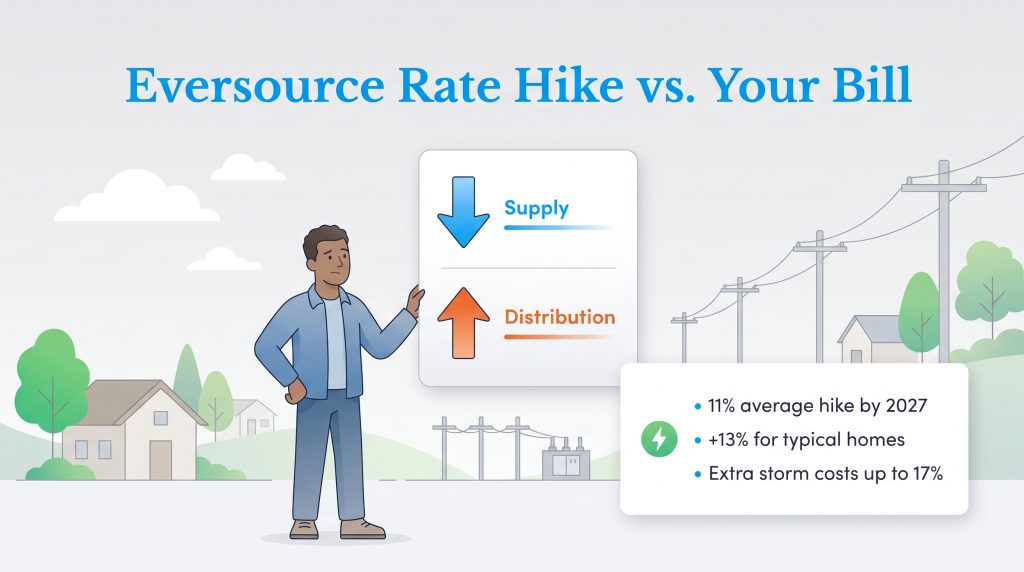
If you are wondering why there is so much talk about rate hikes when bills are dropping, it is because of the local distribution charge. While supply rates are falling, Eversource formally initiated a rate case with PURA in mid-2026, seeking a $503 million annual revenue increase. If approved, this proposed base distribution rate hike would raise average customer bills across all classes by about 11% — with a projected 13% monthly increase for typical residential households — starting in July 2027.
Why the Utility Wants a Distribution Increase
Eversource’s distribution charges cover the local physical grid — the utility poles, wires, substations, and local maintenance. This is the primary area where utility companies earn their profits. Eversource argues that the hike is necessary due to several long-term capital and operational needs:
- Unrecovered Investments: It has been nearly nine years since Eversource’s last distribution rate review in 2017. Since then, the utility has invested approximately $3.3 billion in upgrading Connecticut’s physical grid infrastructure. Roughly $600 million of those capital investments have not yet been integrated into or recovered through existing rates.
- Operational Inflation: Rising operational costs, tree clearing efforts (vegetation management to prevent outages), and general inflationary pressures account for the remaining requested revenue.
- Competitive Returns: Steve Sullivan, Eversource’s President of Connecticut Electrical Operations, argued that the utility must maintain competitive returns to attract capital from investors.
The Storm Cost Backlog and Securitization
Eversource is also seeking to recover about $1.4 billion in accumulated restoration costs from 43 major storms between 2018 and 2023. More than three-quarters of these costs represent the mobilization of mutual-aid and out-of-state utility crews to repair infrastructure. To prevent immediate ratepayer shock, Eversource hopes to utilize state-backed bonds (called securitization) to finance this storm debt over a 20-year repayment window at reduced interest rates.
If approved, this securitized bond recovery would cost a typical residential customer about $4 per month. However, if regulators reject securitization and force these storm costs directly into base distribution rates, the company’s annual revenue request would rise by an additional $278 million, pushing the typical residential monthly bill impact to approximately 17%.
The Bipartisan Political Backlash
Eversource’s application has sparked intense political friction. Attorney General William Tong fiercely condemned the utility’s timing, accusing executives of waiting until former PURA Chair Marissa Gillett resigned in October 2025 before proposing a rate hike. Meanwhile, State Senator Jeff Gordon launched a public republican protest petition to block any further distribution increases. The Town of Vernon has also launched a parallel municipal petition to reject the proposal.
How to Take Control of Your Electricity Bill
Connecticut operates in a deregulated energy market, which means you do not have to accept your utility company’s default “Price to Compare”. You have the freedom to select an alternative retail supplier for your electricity supply while your utility company continues to handle the physical delivery.
Shopping on the EnergizeCT Rate Board
You can easily compare alternative suppliers using the official EnergizeCT choosing a supplier rate board. When browsing suppliers, you will typically find two plan structures:
- Fixed-Rate Plans: These lock in your supply rate for a set contract term of 12 to 36 months. This shields you from unpredictable seasonal winter spikes, though you run the risk of locking in a higher rate if utility rates drop. Fortunately, Connecticut law prohibits third-party energy suppliers from charging early termination or cancellation fees on residential accounts, giving you the flexibility to switch as often as you want without penalty.
- Variable-Rate Plans: These rates adjust monthly with wholesale market conditions. While they can deliver short-term savings during mild spring or autumn months, they expose you to significant risk during cold winter price spikes. Keep in mind that when a fixed-term contract ends, many suppliers automatically roll you onto variable default rates that can be significantly higher than the standard service rate, so be sure to track your contract’s expiration date.
Upgrading Your Home’s Energy Efficiency
The most sustainable way to lower your electric bill is to structurally reduce the amount of energy your home uses in the first place. Administered by the state, Energize CT offers subsidized programs to help you optimize your home’s energy footprint:
- Home Energy Solutions Audits: For a standard $50 copay, all Eversource and UI customers can access a comprehensive energy audit. Technicians perform air-leak sealing, blower-door testing, and insulation evaluations.
- Income-Eligible Assessments: If your household income is at or below 60% of the State Median Income, you can access these audits and weatherization services for free.
- Low-Interest Smart-E Loans: Through the Connecticut Green Bank, you can borrow up to $50,000 at a 0.99% APR with no fees or prepayment penalties to finance solar arrays, heat pumps, or battery storage systems.
- Solar Panel Installations: Since overall residential electric rates in Connecticut average between 30 and 32 cents per kWh — more than 50% above the national average — installing solar panels serves as an eco-conscious alternative to hedge against utility rate volatility.
When moving into a new home or looking to consolidate your services, comparing electricity, natural gas, water, internet, and trash options can be overwhelming. To simplify the process, we built the directory. This platform compiles local providers, rates, and eco-friendly recommendations in one free, easy-to-use directory, helping you save time and energy during your transition.
Which Major Cities and Service Territories Are Impacted
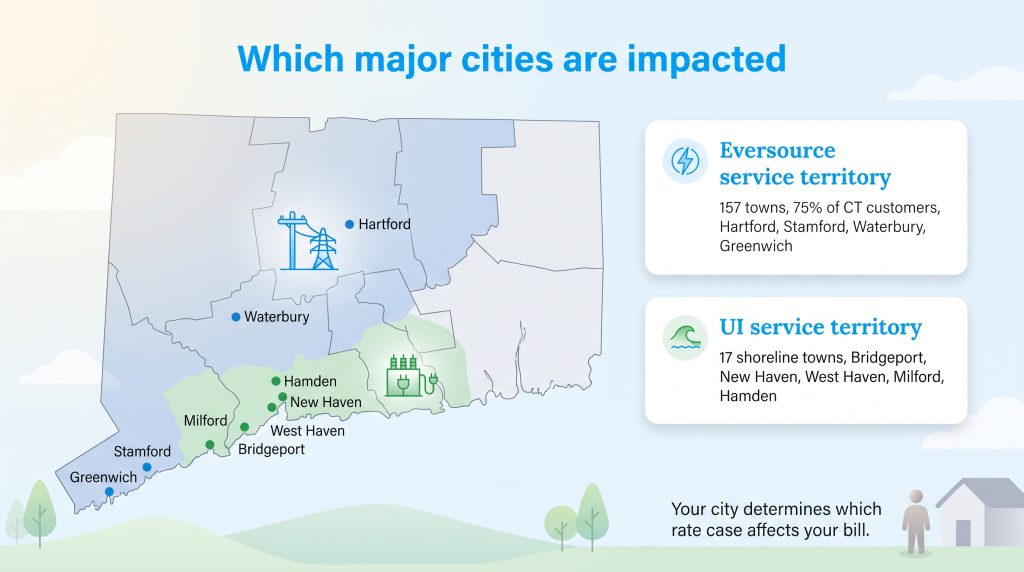
Your location in Connecticut determines which utility territory you belong to, and therefore, which rates and regulatory dockets affect your home.
Eversource Service Territory
Eversource is the largest utility in New England, serving 157 towns and roughly 75% of the state’s electric customers. If you live in Hartford, Stamford, Waterbury, or Greenwich, your home is in Eversource’s territory. This means your future distribution rates will be directly tied to the outcome of Eversource’s pending base distribution rate case.
United Illuminating Service Territory
UI operates in a highly concentrated, 335-square-mile territory along southwestern Connecticut’s shoreline. UI provides electric transmission and distribution to approximately 341,000 to 350,000 customers across 17 shoreline towns and cities. Residents in Bridgeport, New Haven, West Haven, Milford, and Hamden are in UI territory. Because UI operates independently, these households are not affected by Eversource’s pending distribution rate hike.
Taking Charge of Your Energy Future in Connecticut
Navigating the constantly shifting landscape of utility bills in the Constitution State can be tricky, but knowing how the system works is half the battle. While the temporary summer rate drops and public benefits credits are a huge win for your immediate budget, the impending 2027 Eversource rate case reminds us that energy prices will continue to face upward pressure. By shopping around on the state’s rate board, staying on top of contract terms, and utilizing energy efficiency programs, you can structurally reduce your household’s energy footprint and enjoy a more predictable, budget-friendly home.
About the Author

Claudio is a sustainability-focused writer with a background in Anthropology and Psychology from NC State University. He has spent over 15 years working in writing, interpretation, and translation, driven by a deep interest in how human culture shapes the environment. Today, he shares his curiosity with readers by writing about sustainable living solutions and the connection between everyday choices and environmental impact.