

Understanding the Unavoidable Fees That Keep the Lights On and How to Manage Your Total Bill
Key Takeaways
- Delivery charges cover infrastructure like poles, wires, and storm repairs, while supply charges cover the actual electricity you use.
- You cannot switch delivery providers or negotiate these rates, as Eversource is the regulated utility for your specific region in MA or CT.
- Reducing energy consumption is the only way to lower the variable portion of your delivery charge, though switching suppliers can lower your total bill.
Opening your electric bill can feel incredibly frustrating, especially when the eversource delivery charge rivals or outright exceeds the cost of the actual energy you used. If you are struggling to understand eversource bill totals each month, you are certainly not alone in your frustration. While state regulators strictly fix delivery rates for your local grid, you are not powerless. By learning exactly what these fees fund and how they interact with your overall usage, you can take meaningful, eco-conscious steps to manage and lower your total monthly utility expenses.
Understanding Your Eversource Electric Bill Breakdown
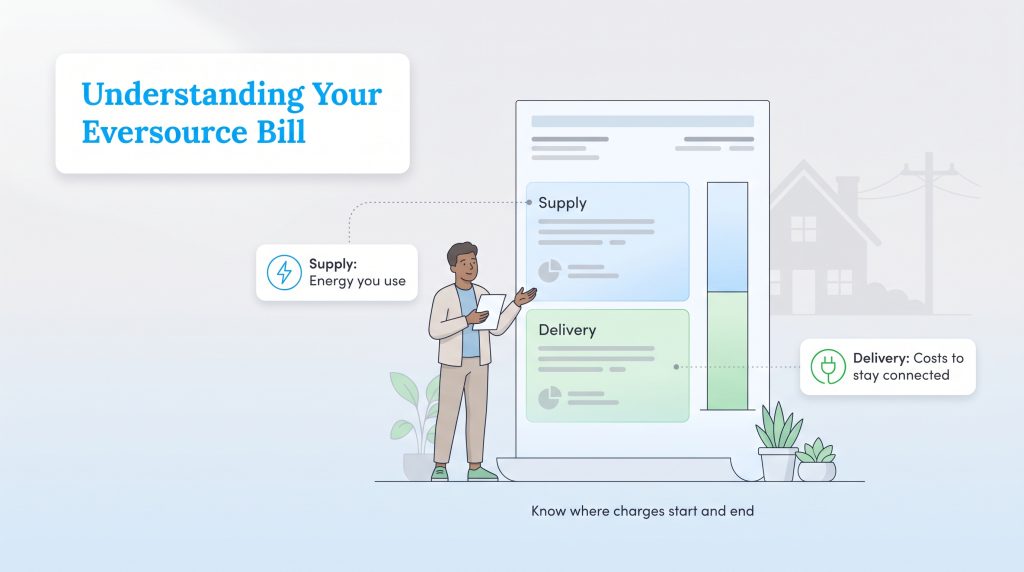
When reviewing your statement, an accurate eversource electric bill breakdown reveals two distinct components: your supply costs and your delivery costs. If you look at the first page of your statement, you will often find a helpful summary chart clearly detailing how these costs are split. Within the delivery section, you are paying for eversource basic service, which covers the foundational administrative and meter-reading costs required just to keep your home connected to the grid. On the supply side, if you have not actively chosen a competitive third-party energy supplier, you will automatically be billed at the default eversource standard service rate. Understanding where these two different charges begin and end is your first step toward finding real savings.
Eversource Delivery Charge vs Supply: What Is the Difference?
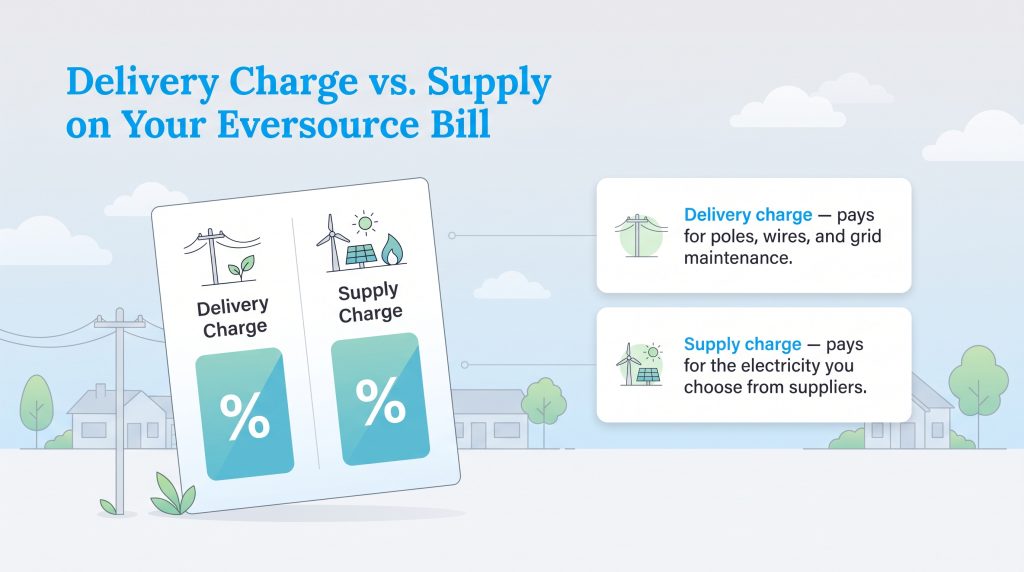
To understand the eversource delivery charge vs supply dynamic, it helps to think of electricity like buying a package online. The supply charge is the cost of the actual product (the energy you consume). Conversely, the delivery charge is the non-negotiable shipping and handling fee required to transport that power to your door, funding those transmission and delivery utility charges. If you are entirely new to this setup, our guide to understanding your electric bill explains the basics in far more detail.
In deregulated states like Massachusetts and Connecticut, you have the power to choose your supplier. However, Eversource owns the physical infrastructure in your specific region, making them your inescapable delivery provider. We have created a quick reference guide below to highlight the primary differences between these two charges.
| Delivery Charge | Supply Charge |
|---|---|
| Regulated strictly by the state and based entirely on your home’s location. | Deregulated; you can shop the competitive market for better rates. |
| Pays for the physical poles, wires, grid maintenance, and state programs. | Pays for the actual generation of electricity (burning natural gas, wind, solar, etc.). |
| Rates are fixed by the utility company and local state regulators. | Rates can be variable or fixed depending on the specific energy plan you choose. |
| You cannot choose or switch your local delivery provider. | You can choose a third-party energy supplier to effectively lower your costs. |
The Anatomy of the Eversource Delivery Charge
Your delivery cost is not a single, arbitrary fee. It is a carefully regulated collection of specific sub-charges approved by state authorities. To make sense of the sticker shock, you need to understand the exact line items funding your local infrastructure.
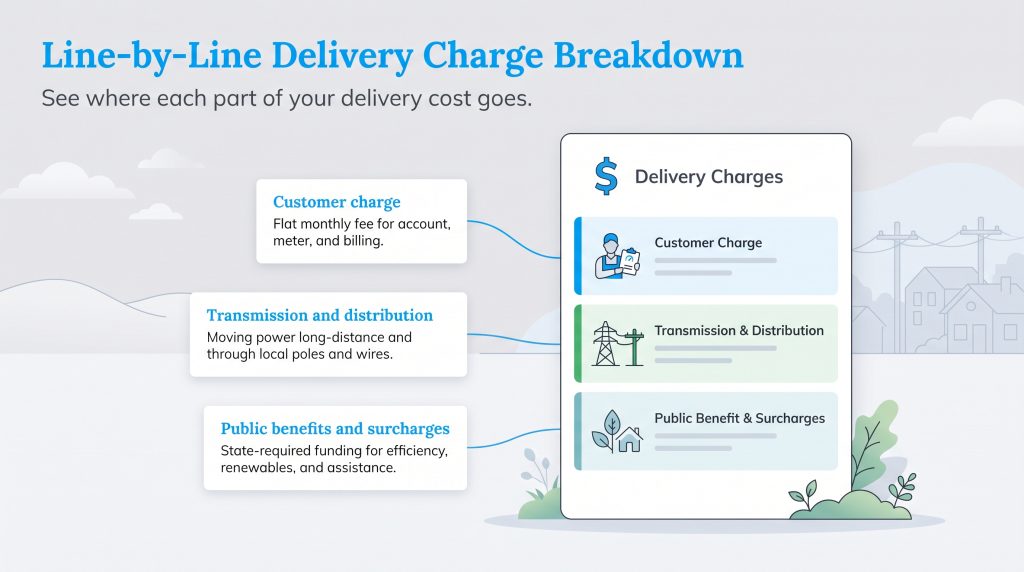
- Eversource Distribution Charge: This critical fee funds the localized delivery of power directly to your neighborhood. It covers ongoing grid maintenance like routine tree trimming, damaged pole replacements, widespread smart meter installations, and emergency crews dispatching during severe winter nor’easters.
- Eversource Transmission Charge: This portion covers the cost to transport high-voltage power over vast distances. Think of this as the interstate highway toll for electricity, paying to move massive amounts of energy from regional power plants down to your localized substations.
- Eversource Public Benefit Charge: Mandated by state legislators rather than the utility, this fee funds broad public interest initiatives. Regulated by bodies like the massachusetts dpu eversource must collect these funds volumetrically. It directly supports state-sponsored energy efficiency rebates, long-term clean energy contracts, and crucial financial assistance programs for vulnerable low-income households. You may also see surcharges tied to solar buyback programs to recover administrative costs.
- Customer Charge: Often categorized as the fixed delivery cost, this flat monthly fee covers basic administrative overhead, meter reading, and billing services regardless of how much electricity you actually use that month.
💡 Pro Tip: The public benefits charge and associated surcharges are mandated by state legislators, not Eversource. If you want to advocate for changes to these specific fees, you will need to contact your state representatives or your local Department of Public Utilities.
Why Is the Eversource Delivery Charge So High?
Over the past few years, ratepayers across New England have been severely impacted by a notable eversource delivery rate increase. This frustrating surge in your monthly costs is largely driven by sweeping state mandates and the urgent need for comprehensive grid modernization. As severe weather events become more frequent, upgrading an aging power grid with resilient poles, advanced storm-hardening technology, and modern substations requires massive, ongoing capital investments that are ultimately passed down to the everyday consumer.
Additionally, the eversource public benefit charge has heavily influenced these recent rate hikes. While these funds support essential community programs like low-income assistance, renewable energy infrastructure, and widespread energy efficiency rebates, the financial burden falls directly on ratepayers. Because these state-mandated fees are inherently volumetric, they compound rapidly during high-usage months, transforming what should be a basic utility service into a significant strain on the average household budget.
Eversource Massachusetts vs Connecticut: Regional Differences
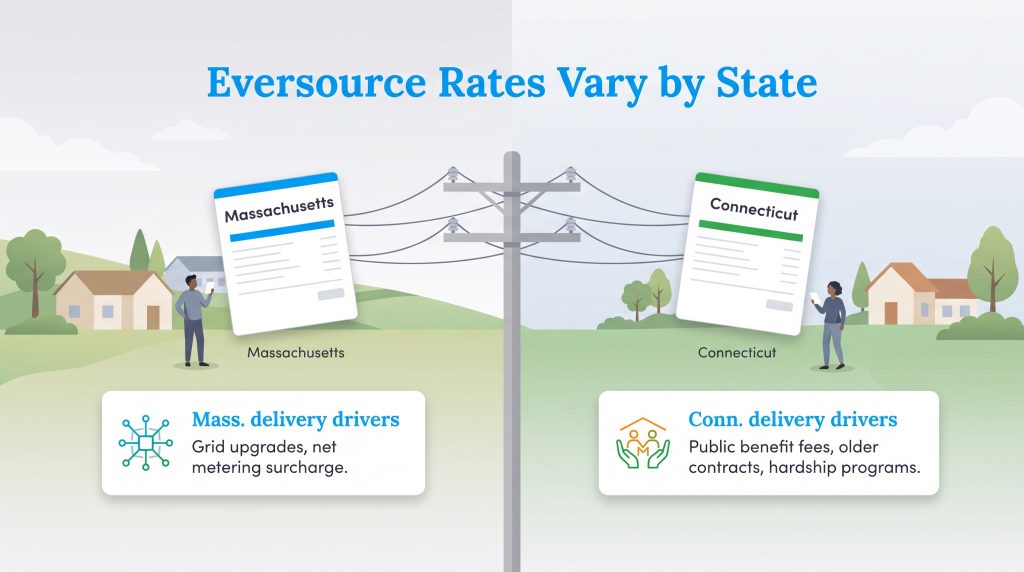
Because delivery charges are strictly localized, your overall rate will vary widely depending on which side of the state border you live on. Massachusetts and Connecticut have very different state policies, infrastructure needs, and regulatory bodies approving these costs.
In Massachusetts, delivery rates are overseen and approved by the Department of Public Utilities (DPU). Their rates are currently driven heavily by aggressive grid modernization goals and the net meter recovery surcharge. Conversely, in Connecticut, the Public Utilities Regulatory Authority (PURA) manages approvals. Connecticut ratepayers have recently seen delivery costs impacted by public benefit fees tied to older power plant contracts and pandemic-era low-income hardship programs. Ultimately, these localized decisions dictate exactly how much you pay per kilowatt-hour to keep your lights on.
How to Lower Your Eversource Electric Bill
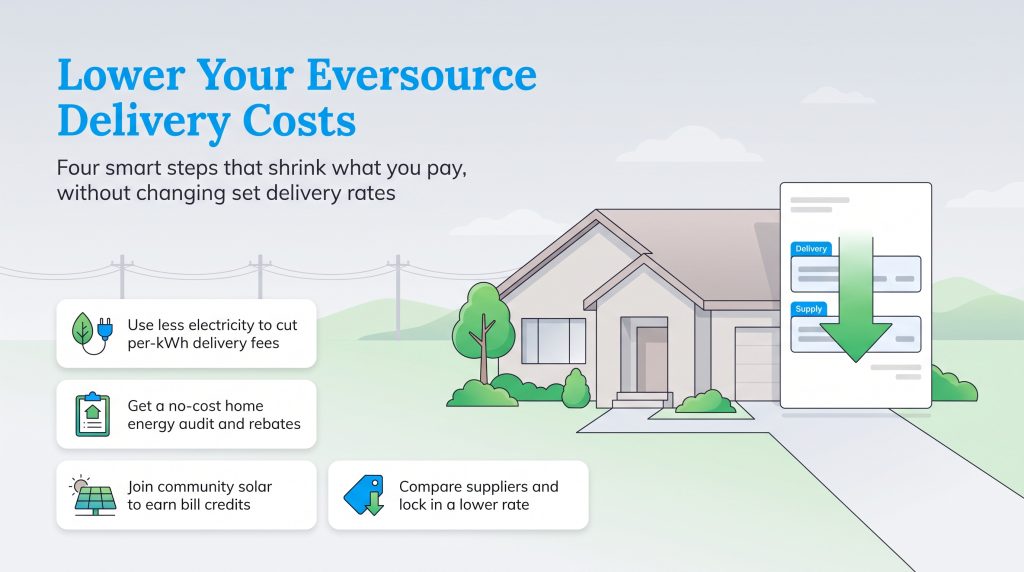
It is incredibly discouraging to learn that your utility’s delivery rates are non-negotiable. However, you still have highly actionable options to lower eversource electric bill totals. By actively managing the volumetric portion of your bill and shopping for better energy rates, you can effectively shrink your monthly budget.
- Shop for a Third-Party Energy Supplier: The most direct way to lower your total bill is to stop relying on the default supply rate. By comparing offers from competitive retail energy providers, you can lock in a significantly lower supply rate, which greatly eases the overall burden of those high delivery fees.
- Enroll in Budget Billing: To protect yourself from massive seasonal utility spikes, contact Eversource and request to be placed on a budget billing plan. This program averages out your total annual energy costs, allowing you to pay a predictable, flat rate every single month.
- Request a State-Sponsored Energy Audit: Because you are already paying a mandatory energy efficiency charge on your bill, you should absolutely take advantage of the programs it funds. Offerings like Mass Save (in Massachusetts) and EnergizeCT (in Connecticut) provide no-cost home energy assessments. These audits unlock deep rebates for eco-conscious insulation and heavily discounted heat pumps. We walk through how to maximize these benefits in our comprehensive guide to how to save on your electric bill.
- Reduce Your Volumetric Usage: Because most delivery fees are charged per kilowatt-hour, using less electricity directly lowers these “fixed” expenses. Switch to ENERGY STAR appliances, install smart thermostats, and practice daily eco-conscious habits to cut down on energy waste.
Taking Control of Your Eversource Costs
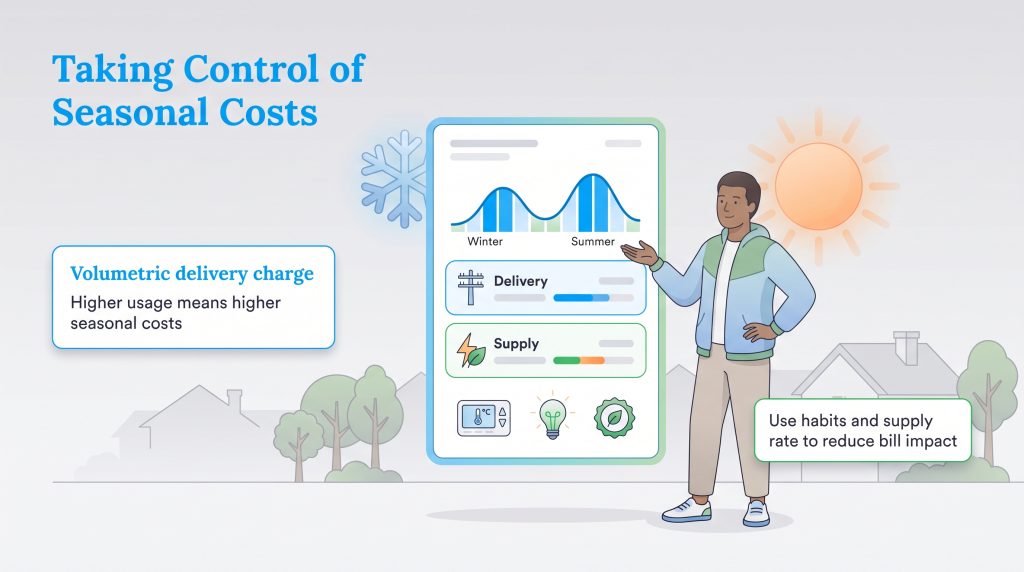
The Eversource delivery charge is the price we pay for a reliable, modernized infrastructure that keeps our homes warm in the dead of winter and cool during humid summer heatwaves. It is critical to remember that your delivery charge is largely volumetric. This means that even if the actual state-approved rate stays exactly the same all year, your total delivery cost will naturally spike during peak seasons.
By combining smart, environmentally mindful energy habits with a highly competitive supply rate, you can take the sting out of these inevitable seasonal spikes. We encourage you to view your utility bill not just as a frustrating monthly expense, but as a detailed roadmap. By analyzing exactly where your energy is going, you can make informed, cost-saving decisions that transform your residence into a highly efficient home.
💸 Money-Saver: Your delivery charge rate is non-negotiable, but your energy consumption is entirely in your hands. Taking control of your usage and securing a great supply rate ensures you are not overpaying for your basic utilities.
Frequently Asked Questions About Eversource Delivery Charges
Why is my Eversource delivery charge higher than my supply charge?
This often happens because delivery includes the massive fixed costs required to maintain the entire grid infrastructure, pay for emergency storm repairs, and fund state-mandated public benefit programs. While supply rates regularly drop when global fuel prices are low, the fixed cost to maintain physical poles and wires remains high and cumulative.
Can I opt out of the Eversource delivery charge?
No, you cannot opt out of the delivery charge if your home is physically connected to the utility grid. Even if you generate your own solar power, you will still face a minimum monthly connection and customer charge to maintain active grid access.
What is the Eversource public benefit charge?
The public benefit charge is a state-mandated fee collected by the utility to fund broad public interest programs. This typically includes subsidized energy efficiency rebates, low-income hardship assistance, and long-term renewable energy contracts. It is determined by state legislators, not the utility company.
Does switching my energy supplier lower my Eversource delivery charge?
No. Switching to a competitive retail energy supplier only lowers the supply portion of your bill. The delivery portion remains strictly regulated and goes directly to Eversource. However, significantly lowering your supply rate does successfully reduce your total monthly electric bill.
Can I change my delivery company to avoid Eversource fees?
No, you cannot switch your delivery provider. Eversource is the regulated monopoly assigned to your specific geographic region in Massachusetts or Connecticut, meaning they are the only utility legally authorized to deliver power to your physical address.
Does budget billing apply to Eversource delivery charges?
Yes, if you enroll in Eversource’s budget billing program, both your supply and delivery charges are averaged out over the course of the year. This helps prevent massive seasonal spikes during peak summer and winter months, making your total monthly payments far more predictable.
Does solar power eliminate the delivery charge?
Not entirely. Even with rooftop solar panels, you typically remain connected to the grid to draw power at night or during cloudy days. This requires paying a basic customer connection charge. However, net metering allows you to offset your volume, which can significantly reduce the variable portion of your delivery fees over time.
How often do Eversource rates change?
Eversource supply and delivery rates are reviewed regularly. While standard service supply rates typically adjust on fixed dates like January 1 and July 1, delivery rates can change at different times based on exactly when state regulators approve new rate cases or local policy adjustments.
About the Author

David has been an integral part of some of the biggest utility sites on the internet, including InMyArea.com, HighSpeedInternet.com, BroadbandNow.com, and U.S. News. He brings over 15 years of experience writing about, compiling and analyzing utility data.

Claudio is a sustainability-focused writer with a background in Anthropology and Psychology from NC State University. He has spent over 15 years working in writing, interpretation, and translation, driven by a deep interest in how human culture shapes the environment. Today, he shares his curiosity with readers by writing about sustainable living solutions and the connection between everyday choices and environmental impact.