
Understanding the latest supply rate adjustments from Eversource and Community Power Coalition of New Hampshire helps you choose the best electricity plan for your home.
Key Takeaways
- Eversource default rates will jump 23.94% on Aug. 1, 2026, raising supply charges to 14.009 cents per kWh for residential accounts.
- Community Power Coalition rates are rising just 1.95%, bringing their Granite Basic supply plan to 14.949 cents per kWh.
- You can switch suppliers without penalties to lock in short-term monthly savings or support long-term renewable energy goals.
If you are moving into a new home in New Hampshire or simply reviewing your monthly household budget, your electric bill is about to look a little different. Starting Aug. 1, 2026, residential electricity supply rates across the Granite State are undergoing major adjustments that will remain in effect through Jan. 31, 2027. Eversource, the largest electric distribution utility in the state, is increasing its default residential supply rate by 23.94%, while municipal aggregation programs under the Community Power Coalition of New Hampshire (CPCNH) — including Rye Community Power — are raising rates by a modest 1.95%. We broke down why these electricity prices are shifting, how the updates impact your average monthly utility bill, and what actionable steps you can take today to save money and energy.
Why New Hampshire Electricity Rates Are Changing
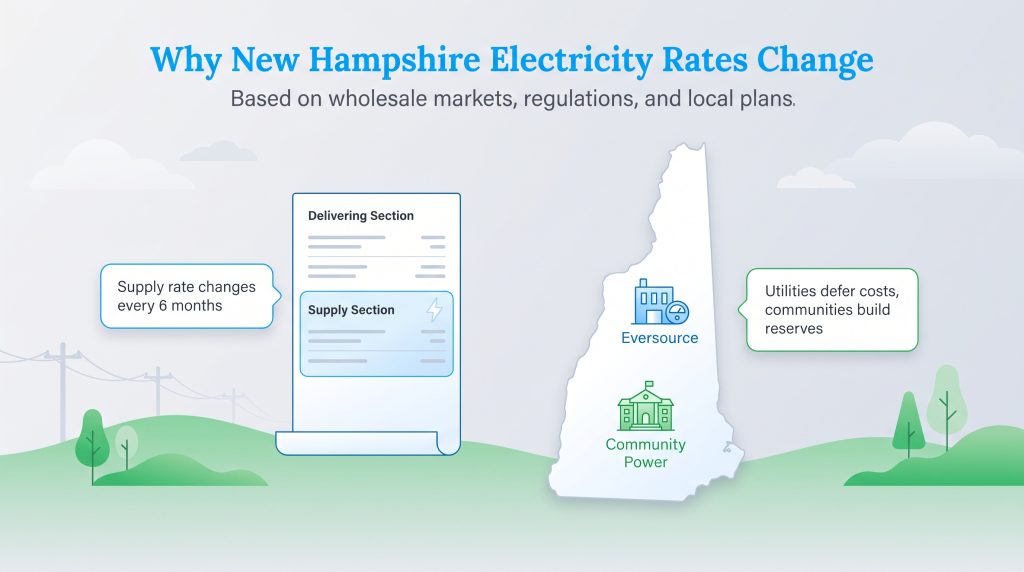
Understanding why utility supply rates fluctuate every six months helps you make smarter energy decisions for your household. The supply portion of your electric bill reflects the actual cost of purchasing power from regional wholesale markets, which is separate from the delivery charges billed by your local utility company. The rate adjustments taking effect on Aug. 1, 2026, are driven by regional wholesale fuel markets, state regulatory accounting mandates, and different financial models between utility companies and community power programs.
Wholesale Market Pressures and Winter Demand Spikes
New England relies heavily on natural gas to generate electricity across the regional power grid. When global fuel prices fluctuate due to international conflicts or high winter heating demand, power generation costs rise across the entire Northeast. ISO New England, the independent grid operator for the region, reported that recent winter energy costs ranked among the top three most expensive in regional history. These wholesale market dynamics pushed baseline procurement costs up for both traditional utilities and non-profit energy aggregators.
Eversource Cost Deferrals vs. Community Power Reserve Building
While both energy providers faced higher wholesale costs, their pricing structures differ significantly because of regulatory rules:
- Eversource Regulatory Capping: During state rate filings, Eversource testified before the New Hampshire Public Utilities Commission (PUC) that a default supply rate above 15.000 cents per kWh was necessary to cover actual wholesale procurement expenses. However, the PUC capped the utility’s default residential rate at 14.009 cents per kWh. To adhere to this cap, Eversource deferred its remaining supply expenses, adding to an existing $39 million under-collection deficit from prior billing cycles. Under state rules, Eversource must recoup these deferred costs through higher rates in future billing periods, meaning current utility pricing is temporarily held down by delaying liabilities into future rate cycles.
- Community Power Reserve Strategy: The Community Power Coalition of New Hampshire is a non-profit joint powers agency serving 68 member communities. CPCNH sets its Granite Basic rate at 14.949 cents per kWh on a true cost-of-service basis. This rate includes a 0.668-cent per kWh reserve adder used to pay off startup financing obligations, build financial reserves against future market shocks, and fund local clean energy initiatives such as a 5-megawatt community solar array in Warner, New Hampshire.
How the August 2026 Rate Changes Impact Your Monthly Bill
To see how these rate adjustments affect your household budget, it helps to break down a typical monthly electric bill. In New Hampshire, state energy assessments measure residential usage against a standard benchmark of 650 kWh per month. The electric supply rate applies directly to your overall usage, while delivery charges remain fixed based on your distribution utility.
Here is how the supply rate schedule compares across options for the billing period of Aug. 1, 2026, through Jan. 31, 2027:
| Supply Option Tier | Renewable Content | New Supply Rate (Cents/kWh) | Rate Change vs. Prior Cycle | Monthly Supply Cost (650 kWh) |
| Eversource Default Service | Statutory Minimum | 14.009¢ | +23.94% | $91.06 |
| CPCNH – Granite Basic (Default) | 25.2% Renewable | 14.949¢ | +1.95% | $97.17 |
| CPCNH – Granite Plus | 33.0% Renewable | 15.349¢ | Optional Tier | $99.77 |
| CPCNH – Clean 50 | 50.0% Renewable | 16.049¢ | Optional Tier | $104.32 |
| CPCNH – Clean 100 | 100.0% Renewable | 18.049¢ | Optional Tier | $117.32 |
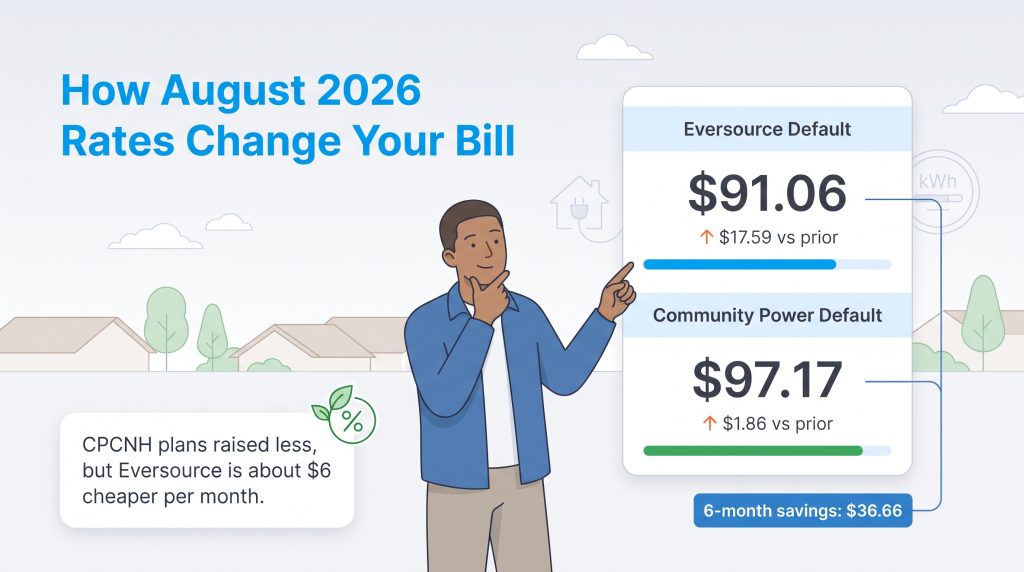
For households remaining on Eversource default service, the jump from 11.303 cents to 14.009 cents per kWh increases monthly supply costs by $17.59 (from $73.47 to $91.06). Meanwhile, households enrolled in local aggregation programs like Rye, Portsmouth, Dover, or Newmarket Community Power will see their monthly supply bill rise by just $1.86 (from $95.31 to $97.17).
Comparing the two default plans directly, Eversource’s temporary rate cap makes its supply service $6.11 per month cheaper than CPCNH Granite Basic for an average household — representing a total savings of $36.66 over the full six-month cycle.
Major Cities and Communities Impacted Across New Hampshire
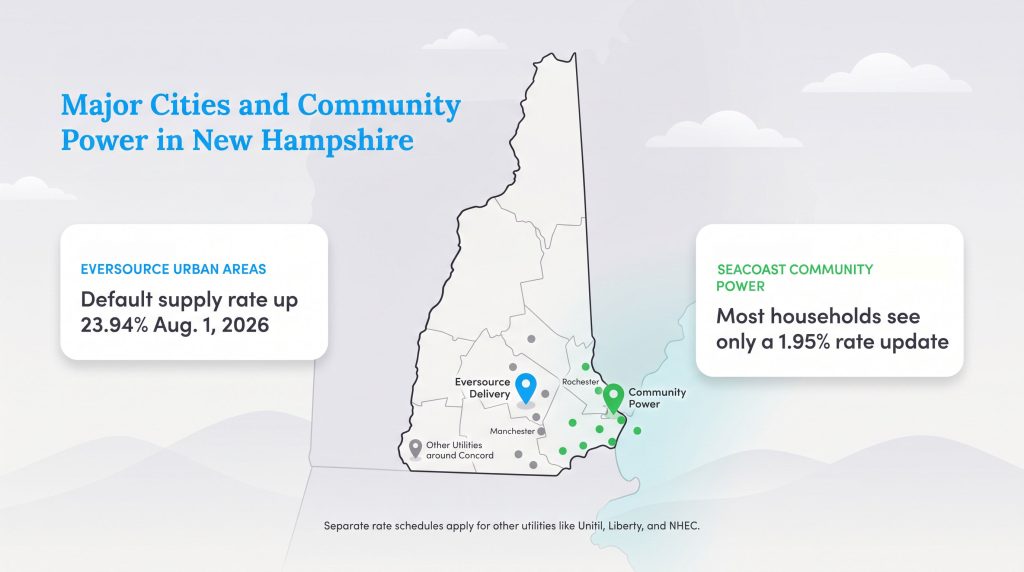
Eversource is the state’s largest electric distribution utility, delivering power to nearly 528,000 homes and businesses across 211 cities and towns. Because utility franchise boundaries determine your default service options, where you live dictates how these new rates appear on your statement.
Major Urban Areas on Eversource Delivery
Residents living in larger urban centers and suburbs served by Eversource — such as Manchester, Berlin, Claremont, Rochester, Bedford, and Exeter — receive distribution service through Eversource. If you live in these municipalities and have not chosen a third-party supplier or local aggregation program, your account will automatically adopt the 23.94% default supply rate increase on Aug. 1, 2026.
The Seacoast Community Power Network
Communities enrolled in the Community Power Coalition of New Hampshire occupy a major footprint in the Seacoast region. Towns like Rye, Portsmouth, Dover, Newmarket, Atkinson, and Tamworth rely on Eversource for physical power delivery, but source energy supply through their local municipal aggregation programs. Residents in these towns are automatically enrolled in Community Power unless they explicitly opt out, meaning most local households will absorb only the modest 1.95% rate update.
Other utility franchise areas, such as Concord (primarily served by Unitil Corporation) or communities served by Liberty Utilities and the New Hampshire Electric Cooperative, operate under separate rate schedules.
Actionable Strategies to Manage Your Home Utility Costs
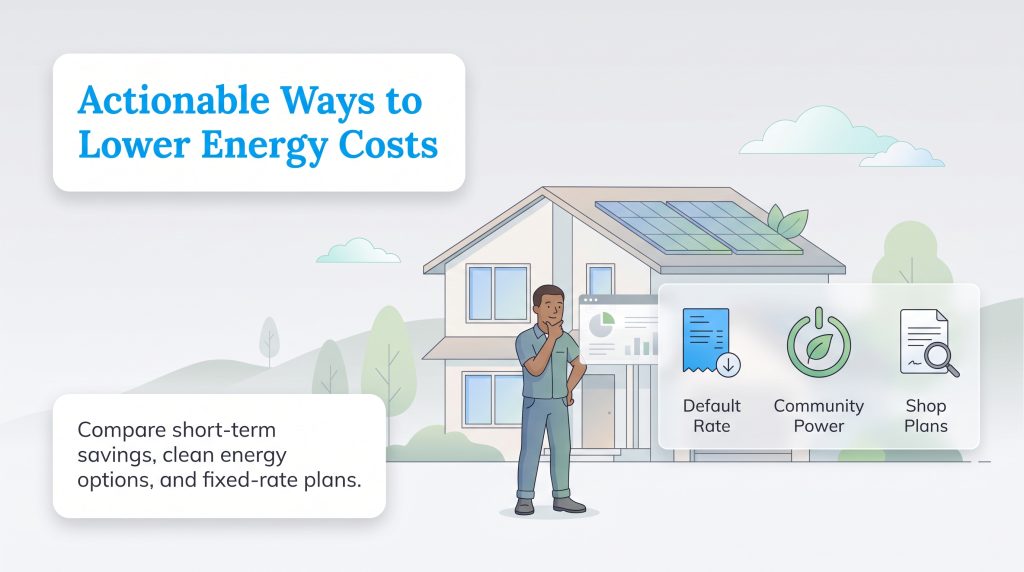
As a New Hampshire resident, energy choice rules give you the freedom to choose who supplies your electricity. Whether you want to minimize immediate monthly expenses or support long-term environmental sustainability, we identified several clear pathways to help you manage your home energy budget.
Choosing Between Immediate Savings and Long-Term Value
When evaluating your energy options for the upcoming fall and winter, consider your financial goals and sustainability priorities:
- Option 1: Switch to Eversource Default Service for Short-Term Savings: If cutting expenses right now is your main goal, opting into Eversource default service saves about $6.11 per month compared to Community Power. Keep in mind that Eversource’s rate is artificially lowered by cost deferrals, which could lead to steeper rate hikes in future billing cycles when those deferred expenses are collected.
- Option 2: Stay Enrolled in Community Power for Clean Energy: Remaining in your local program under CPCNH supports 25.2% renewable energy content — an eco-conscious alternative well above state minimums — while funding community reserves that build local solar infrastructure. You can also opt up to higher clean energy tiers like Clean 50 or Clean 100 to reduce your home carbon footprint.
- Option 3: Shop Third-Party Competitive Suppliers: You can shop for fixed-rate supply plans directly through retail suppliers. Always review contract terms carefully for hidden fees or automatic price escalations after promotional periods end.
To compare available options or manage your enrollment, visit official resources directly:
- Search retail rates using the NH Department of Energy Shopping Tool.
- Manage your municipal plan through the Community Power Coalition of New Hampshire.
- Review utility account details on the Eversource Energy website.
Rules for Switching Electric Suppliers
Switching suppliers in New Hampshire is straightforward and free of charge. You can opt in or opt out of Community Power at any time without early termination penalties. However, if you opt out of Community Power to rejoin Eversource, state rules assign your account to the utility’s monthly variable supply rate rather than the fixed default rate through Jan. 31, 2027. Additionally, re-enrolling in Community Power during future cycles requires submitting a manual opt-in request.
Making Smart and Sustainable Energy Choices for Your Home
Navigating shifting utility rates can feel overwhelming when moving into a new space or updating your household budget, but understanding your choices puts you in control of your monthly bills. While Eversource default service offers modest short-term savings through January 2027, municipal community power programs deliver long-term price stability, stronger financial reserves, and an environmentally mindful choice for cleaner local energy. By assessing your family’s budget and eco-conscious priorities today, you can select the energy-saving option that best fits your lifestyle and home energy needs.
About the Author

Claudio is a sustainability-focused writer with a background in Anthropology and Psychology from NC State University. He has spent over 15 years working in writing, interpretation, and translation, driven by a deep interest in how human culture shapes the environment. Today, he shares his curiosity with readers by writing about sustainable living solutions and the connection between everyday choices and environmental impact.