

Find the Perfect High-Speed Connection for Your Remote Home With Our Breakdown of Top Satellite, 5G, and Fixed Wireless Options
Key Takeaways
- Starlink and 5G Home Internet have revolutionized rural connectivity, offering faster speeds and lower latency than traditional satellite.
- Data caps and contracts are common pitfalls in rural plans, so check the fine print for “unlimited” claims before signing up.
- Latency matters more than speed for activities like gaming and video calls, making the connection type just as important as the provider.
Living far from the city often means dealing with the frustration of the “digital divide,” but the promise of modern 5G and Low Earth Orbit (LEO) satellite internet has dramatically changed the landscape in 2026. You no longer have to settle for restrictive dial-up speeds; today’s best rural internet providers offer highly reliable options that keep you connected to remote work, school, and entertainment regardless of your zip code. We rigorously dug into the details to help you compare the top competitors so you can seamlessly match your budget and online habits to the perfect plan. Before getting your heart set on a specific package, we highly encourage you to utilize a localized search tool to verify internet options by zip code to ensure these providers actually service your specific address.
Our Quick Picks for Rural Internet
- Best Overall: Starlink — Unmatched download speeds and low latency that perfectly mimic a standard city cable connection.
- Best Value: T-Mobile 5G Home Internet — Affordable, straightforward pricing with absolutely zero equipment fees or hidden installation charges.
- Best Budget: CenturyLink — Consistent, hardwired DSL reliability with zero data caps for cost-conscious rural households.
Top Rural Internet Providers at a Glance
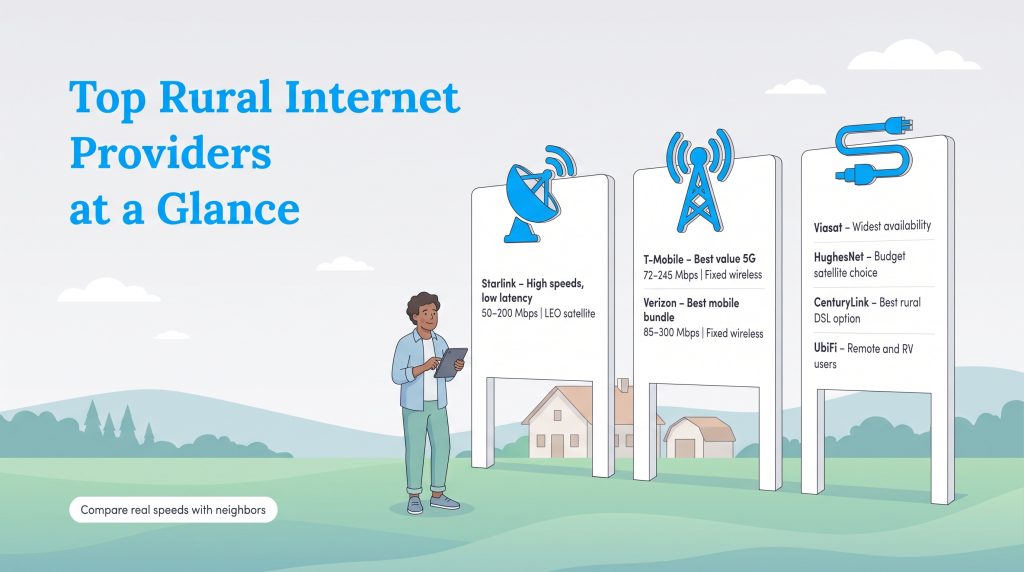
Note: The speeds listed below are advertised maximums. Real-world speeds often vary based on location, network congestion, and weather conditions. Always verify actual performance estimates with neighbors or the provider directly.
| Provider | Best For | Starting Price | Equipment Costs | Download Speeds | Connection Type |
|---|---|---|---|---|---|
| Starlink | High speeds & low latency | $55 | $599 upfront | 50 — 200 Mbps | LEO Satellite |
| T-Mobile | Best value 5G | $50 | $0 (included) | 72 — 245 Mbps | 5G / Fixed Wireless |
| Verizon | Best mobile bundle | $50 | $0 (included) | 85 — 300 Mbps | 5G / Fixed Wireless |
| Viasat | Widest availability | $99 | $300 or $15/mo | Up to 150 Mbps | GEO Satellite |
| HughesNet | Budget satellite | $75 | $300 or $15/mo | Up to 100 Mbps | GEO Satellite |
| CenturyLink | Best rural DSL | $55 | Up to $200 | Up to 140 Mbps | DSL |
| UbiFi | Remote & RV users | $90 | $300+ router | Up to 200 Mbps | 4G / 5G Fixed Wireless |
Best Satellite Internet Providers for Rural Areas
You can explore more options for your specific area by browsing our internet setup hub.
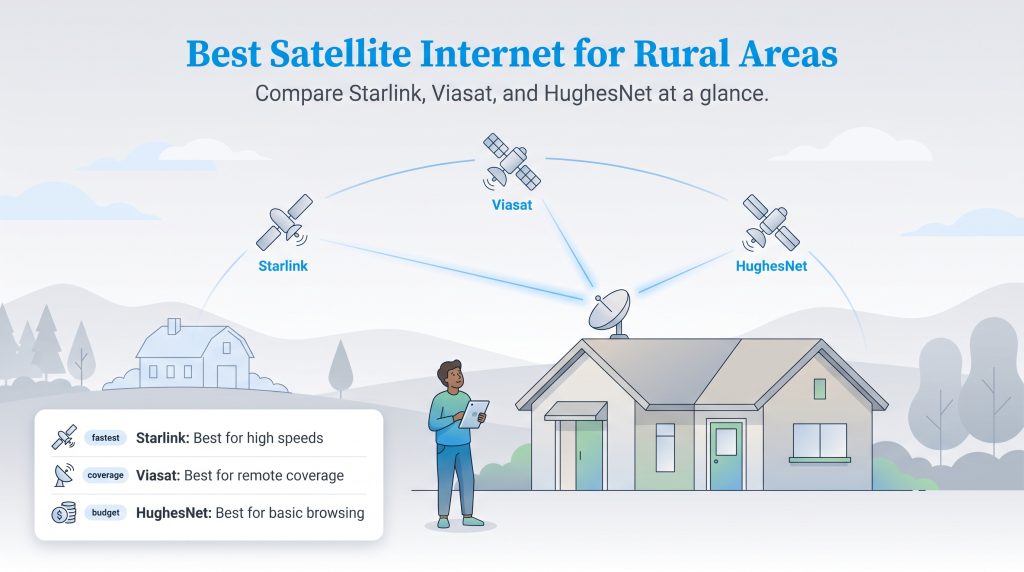
When searching for true off-grid internet options, satellite connectivity is typically the most reliable choice because it does not depend on ground-based infrastructure reaching your property line. The best overall satellite internet providers can beam a connection directly to your home as long as you have a clear, unobstructed view of the sky overhead. If you live in an extremely isolated environment miles away from traditional utility poles, satellite is often your only lifeline to the digital world.
Starlink
- Starting Price: $55 per month
- Equipment & Installation: $599 hardware kit; $0 self-installation.
- Advertised Speeds: 50 — 200 Mbps
- Data Cap Policy: Unlimited
- Pros:
- Blazing fast download speeds that easily support multiple devices.
- Extremely low latency makes it the top rural internet for gaming and video calls.
- Truly unlimited data with no restrictive soft caps.
- Cons:
- Steep $599 upfront hardware cost.
- Requires a 100% unobstructed view of the sky to prevent dropped signals.
- Customer service is notoriously difficult to reach.
Starlink has arguably done more to normalize high-speed internet for rural areas than any other provider on the market today. Unlike traditional legacy services that rely on geostationary satellites orbiting 22,000 miles away from Earth, Starlink utilizes a massive, growing constellation of Low Earth Orbit (LEO) satellites sitting just a few hundred miles above the planet’s surface. This incredibly close proximity drastically reduces latency, making it the premier satellite option that truly supports real-time activities like video conferencing and fast-paced online gaming effectively.
In 2026, Starlink lowered its barrier to entry by introducing budget-friendly residential tiers starting around $55 per month for true unlimited satellite internet. While you will still pay a significant upfront cost for the required hardware kit, the monthly performance offers a level of reliability that feels incredibly similar to a standard city cable connection. You can quickly check if your specific address is eligible on the official Starlink availability map.

- 400 Mbps
- Satellite
- Unlimited
- $55.00/mo

- 150 Mbps
- Satellite
- 150-850 GB
- $39.99/mo
*Not all internet providers and speeds available in all areas.
Viasat
- Starting Price: $99 per month
- Equipment & Installation: $300 equipment purchase or $15/month lease; installation is usually free.
- Advertised Speeds: Up to 150 Mbps
- Data Cap Policy: Soft caps apply (speeds throttle after usage limits).
- Pros:
- Available almost everywhere across the United States.
- Professional installation is typically included at no extra charge.
- Offers solid maximum download speeds on higher-tier plans.
- Cons:
- Expensive monthly rates compared to competitors.
- Strict data caps mean your speeds will drop to a crawl if you binge-watch too much television.
- High latency makes competitive gaming nearly impossible.
Viasat remains a steadfast option for homeowners located in deep valleys or densely wooded areas where establishing a clear line of sight for Starlink is simply impossible. By utilizing massive Geostationary Earth Orbit (GEO) satellites, Viasat casts an incredibly wide coverage net over the entire continent. While the latency is noticeably higher due to the physical distance the signal must travel to space and back, Viasat consistently delivers robust download speeds that are more than capable of handling everyday browsing, email, and moderate streaming.
HughesNet
- Starting Price: $75 per month
- Equipment & Installation: $300 equipment purchase or $15/month lease; $99 setup fee.
- Advertised Speeds: Up to 100 Mbps
- Data Cap Policy: Soft caps apply.
- Pros:
- A more budget-friendly satellite option for basic online needs.
- Newer HughesNet Fusion plans actively blend satellite with wireless signals to reduce lag.
- Highly reliable as a backup connection for severe weather outages.
- Cons:
- Low monthly data allowances restrict heavy internet usage.
- Slower top speeds than both Starlink and Viasat.
- Typically requires signing a restrictive long-term contract.
If you are looking for cheap rural internet and only need connectivity for basic tasks like checking email, reading the news, and paying bills, HughesNet provides an excellent, dependable service. While they do enforce stringent data caps, they heavily cater to budget-conscious seniors and minimalists who do not need the massive bandwidth required for running a smart home. Furthermore, their innovative Fusion plans successfully bridge the gap between fixed wireless and satellite, providing a hybrid connection that actively routes latency-sensitive traffic over ground networks whenever possible.
Best 5G and Fixed Wireless Internet Providers
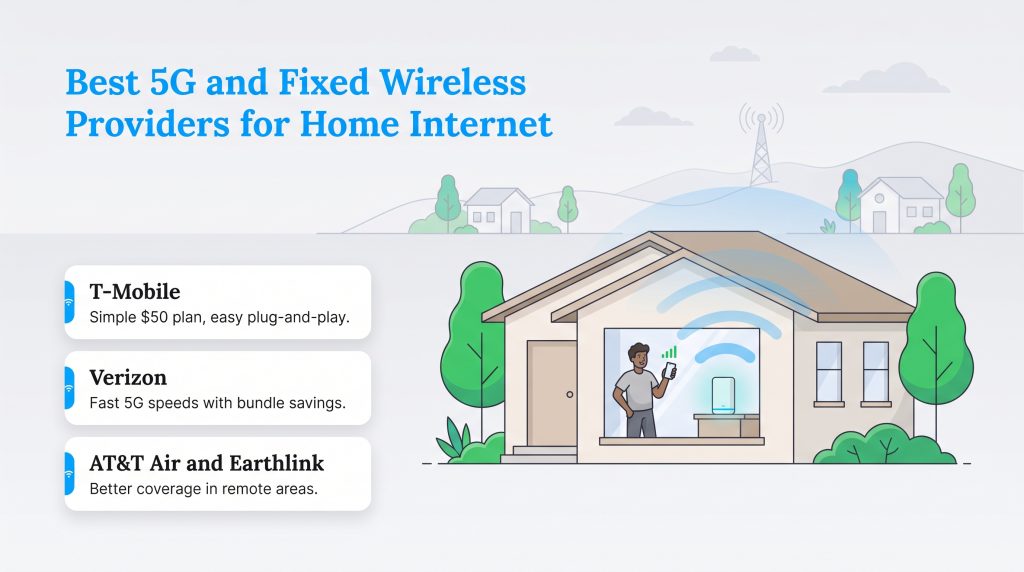
If you have a moderately strong cell phone signal at your house, you are likely a great candidate for wireless home internet. The top 5G home internet rural solutions utilize the exact same cellular towers that power your smartphone, delivering a robust Wi-Fi signal directly to a simple, plug-and-play gateway device sitting inside your living room.
T-Mobile 5G Home Internet
- Starting Price: $50 per month
- Equipment & Installation: $0 (Gateway is included for free); $0 self-installation.
- Advertised Speeds: 72 — 245 Mbps
- Data Cap Policy: Unlimited
- Pros:
- Absolutely no upfront equipment fees or hidden installation charges.
- Incredibly easy 15-minute plug-and-play setup process.
- Transparent flat-rate pricing with no annual contracts.
- Cons:
- Speeds fluctuate drastically during peak evening hours based on cell tower congestion.
- Availability is still somewhat spotty in extremely remote rural pockets.
- The provided gateway device lacks advanced custom networking features.
T-Mobile has aggressively expanded its 5G network deep into rural America, resulting in an incredibly compelling home internet product. For a flat monthly fee, T-Mobile ships you a sleek gateway tower that captures the 5G signal outside and broadcasts it as powerful Wi-Fi inside. Because there are no data caps, no cumbersome satellite dishes to mount, and zero hardware to purchase upfront, it represents the absolute best value for households trying to minimize their utility bills without sacrificing speed.
Verizon 5G Home Internet
- Starting Price: $50 per month
- Equipment & Installation: $0 (Gateway is included); $0 self-installation.
- Advertised Speeds: 85 — 300 Mbps
- Data Cap Policy: Unlimited
- Pros:
- Excellent bundle discounts if you already have a Verizon mobile phone plan.
- Highly reliable speeds powered by Verizon’s rapidly expanding Ultra Wideband network.
- No data caps and no annual contracts required.
- Cons:
- Their rural coverage footprint is currently smaller than T-Mobile’s.
- Home internet traffic is technically deprioritized behind mobile users during times of heavy network congestion.
- Strict address validation means you cannot simply take the router to a different unapproved location.
Verizon continues to push the boundaries of 5G capability. If your rural property happens to fall within their growing C-band footprint, you can access internet speeds that frequently rival standard city fiber connections. Furthermore, if you are an existing Verizon wireless customer, you can often secure their home internet service for a drastically reduced promotional price, making it an undeniable bargain for remote workers and large families looking to streamline their monthly utility expenses.

- 300 Mbps
- 5G
- Unlimited
- $35.00/mo

- 498 Mbps
- 5G
- 1.2 TB
- $35.00/mo

- 300 Mbps
- 5G
- Unlimited
- $40.00/mo
*Not all internet providers and speeds available in all areas.
AT&T Air and Earthlink
- Starting Price: $55 to $80 per month
- Equipment & Installation: $0 for AT&T; Earthlink may charge a $75+ professional installation fee depending on the area.
- Advertised Speeds: 40 — 140 Mbps
- Data Cap Policy: Unlimited (AT&T Air) / Soft caps may apply depending on the Earthlink plan.
- Pros:
- Fantastic alternatives in deeply rural locations where traditional fiber simply isn’t an option.
- Solid, dependable fixed wireless infrastructure that handles bad weather remarkably well.
- Straightforward monthly pricing without complex introductory rate hikes.
- Cons:
- Availability is highly localized and somewhat spotty.
- Overall top speeds are generally slower than premium competitors like Starlink.
- Earthlink operates as a reseller, which can sometimes complicate the customer service experience.
As legacy telephone companies actively retire their aging copper networks, AT&T has introduced AT&T Internet Air as a direct, modern replacement for their older DSL services. This fixed wireless solution leverages AT&T’s robust cellular backbone to deliver highly reliable Wi-Fi straight to your home. Similarly, Earthlink operates by leasing bandwidth from major cellular carriers to provide fixed wireless connections to extremely remote addresses. Both providers serve as incredible lifeline options when national brands decline to service your specific dirt road.
Best Rural DSL Internet Providers
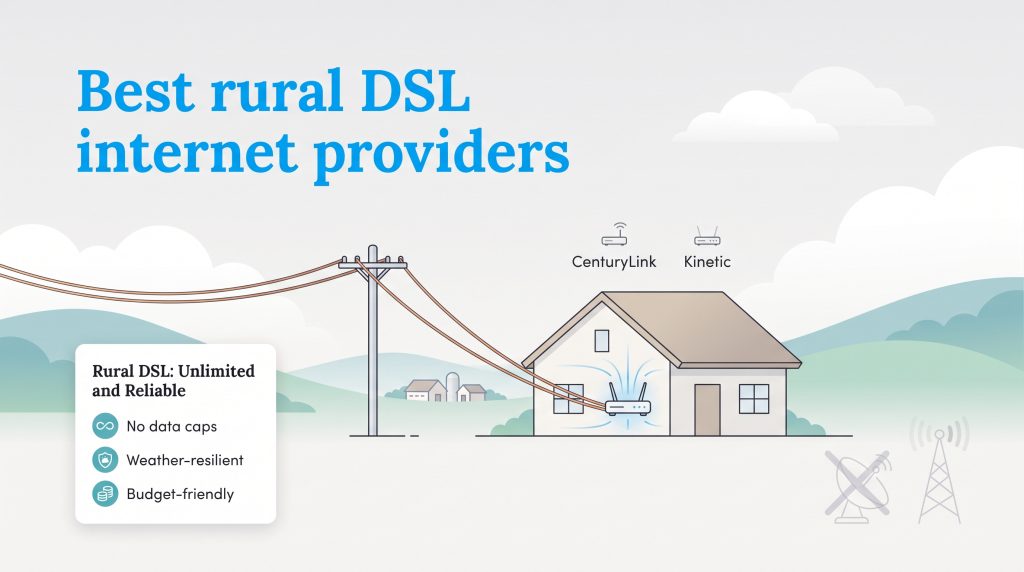
When cellular networks fail to penetrate deep valleys and satellite dishes are simply too expensive to justify, traditional Digital Subscriber Line (DSL) internet steps in to expertly fill the coverage gap. By running on the existing copper telephone lines already wired directly to your house, these providers offer steady, hardwired access that isn’t vulnerable to severe weather disruptions.
CenturyLink and Kinetic
- Starting Price: $55 per month
- Equipment & Installation: Up to $200 modem purchase or a $15/month lease; installation varies from $0 to $99.
- Advertised Speeds: Up to 140 Mbps
- Data Cap Policy: Unlimited
- Pros:
- Absolutely no data caps, allowing for worry-free streaming and downloading.
- A highly stable, hardwired connection completely immune to rain fade and heavy cloud cover.
- Affordable starting prices for budget-minded households.
- Cons:
- Actual speeds heavily depend on the physical distance between your house and the provider’s local hub.
- Runs on older copper infrastructure that is slowly being phased out.
- Upload speeds are notoriously slow, making massive file transfers tedious.
CenturyLink and Kinetic by Windstream remain crucial pillars of rural connectivity. While the technology isn’t as flashy as modern 5G, a hardwired DSL connection offers exceptional peace of mind during massive thunderstorms that would typically knock a satellite dish completely offline. If your primary goal is to secure a consistent, completely unlimited connection without breaking the bank, these legacy providers deliver tremendous everyday value.
What to Look for in a Rural Internet Provider
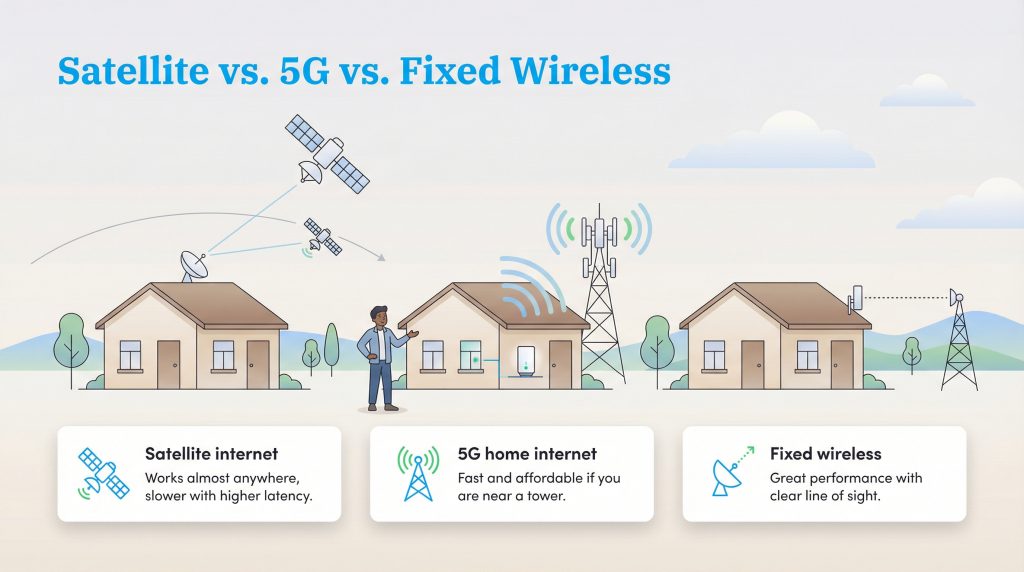
Shopping for internet outside the city limits requires an entirely different strategy. Instead of simply purchasing the package boasting the highest theoretical speed, you must evaluate how the technology physically interacts with your property’s unique geography. For example, if you live on the extreme edge of a 5G network coverage map, you might initially experience frustratingly inconsistent speeds. To remedy this, we highly recommend investing in a cellular booster or a high-gain directional antenna to aggressively pull in those weak, distant signals.
Data Caps vs. Unlimited Rural Internet
Many legacy providers heavily advertise “unlimited rural internet,” but there is often a significant catch hidden deep within the fine print. Satellite plans frequently feature a “soft cap” where your connection is severely throttled after using a set amount of data during a billing cycle. Take a realistic look at how much internet data you need before committing to a contract. Review standard Broadband Nutrition Labels, which are required by the federal government, to verify exactly what you are paying for. If your family streams movies daily or downloads massive video game updates, you absolutely must prioritize a provider like Starlink or T-Mobile that offers truly unlimited, unthrottled access.
Latency and Rural Internet for Gaming
If you heavily rely on your internet for Zoom meetings, remote work, or online gaming, raw download speed is not your most important metric — latency is. Latency is the physical time it takes for data to travel from your computer to a server and back. High latency creates a noticeable, frustrating delay that makes fast-paced online interaction essentially impossible. Learn more about 5G Home Internet vs. Satellite Internet to understand why Starlink and 5G connections have significantly lower latency than older GEO satellite models, ensuring a much smoother digital experience.
💡 Pro Tip: Always use a hardwired ethernet cable to connect your gaming console or PC directly to your router. This simple step can shave precious milliseconds off your latency compared to playing over Wi-Fi.
Equipment Costs and Installation
One of the largest hidden hurdles of setting up off-grid connectivity is the sheer cost of upfront hardware. Satellite providers typically force you to purchase complex receiver dishes. For example, Starlink requires a steep $599 upfront hardware investment just to access their service. Conversely, modern 5G providers like T-Mobile and Verizon generously lease their gateway devices to you entirely for free. When budgeting, always calculate your complete first-year total costs. A $55 monthly satellite plan quickly balloons to over $1,250 in the first year when you factor in taxes, shipping, and equipment, whereas a $50 monthly 5G plan stays cleanly at $600.
Checking Local Cooperatives and Regional Fiber
Before surrendering to high-priced satellite plans, take the time to deeply research your local electrical cooperatives and municipal broadband initiatives. In a push heavily supported by federal infrastructure grants, many local utility co-ops are aggressively stringing state-of-the-art fiber optic cables directly along their existing rural power poles. These localized, community-driven entities routinely deploy high-speed fixed wireless or true fiber to remote dirt roads that major national brands entirely ignore. A quick phone call to your regional electric provider might reveal a hidden broadband treasure right in your own backyard.
Eco-Friendly Router and Dish Optimization
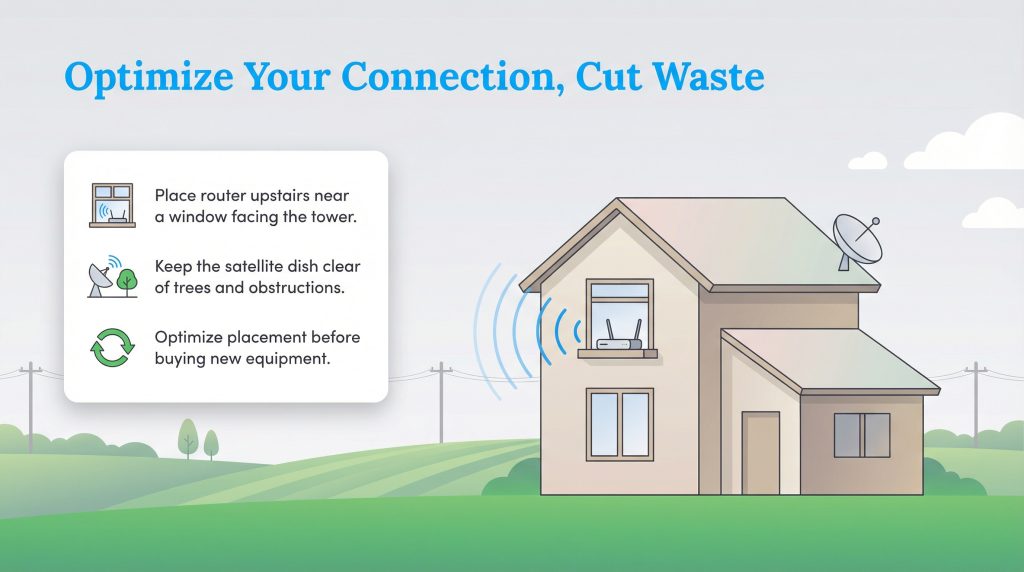
Getting the absolute most out of your rural connection isn’t just about maximizing speed; it is also about maximizing household energy efficiency. In deeply rural areas, attempting to artificially boost a frustratingly weak signal often leads homeowners to purchase expensive aftermarket routers or signal repeaters they do not actually need, creating unnecessary electronic waste. Instead of spending extra money, utilize these straightforward, zero-cost adjustments to optimize your existing equipment and lower your utility footprint (for more ways to cut waste, see our sustainable living tips):
- Elevate Your 5G Gateway: Place your 5G or fixed wireless router on the second floor near a window facing the nearest cell tower. This eliminates physical interference from walls and can instantly double your connection speed.
- Clear the Canopy: Guarantee your satellite dish is entirely free of physical obstructions like growing tree branches or severe roof overhangs. When a dish’s view is obstructed, the equipment is forcefully required to draw more power and work much harder to maintain a stable signal.
- Manage Thermal Features: Modern satellite dishes, specifically Starlink models, utilize internal heating elements to automatically melt snow in the winter. Leaving this feature running on automatic year-round actively wastes immense amounts of electricity.
🌱 Eco Edge: 5G Home Internet gateways are generally a much more energy-saving option than bulky satellite setups. To proactively conserve electricity with satellite, immediately dive into your Starlink app settings and switch the “snow melt” feature to manual, or turn it off entirely during the warmer summer months.
How We Evaluated the Best Rural Internet Providers
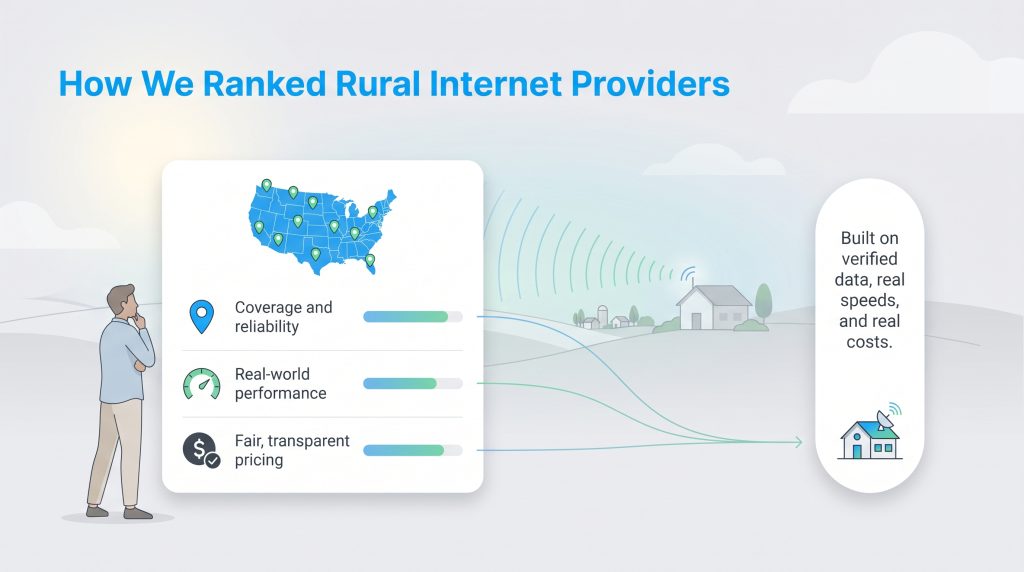
At UtilitiesForMyHome.com, we deeply understand that a dropped connection in an isolated home is far more than just a minor inconvenience — it is a severe barrier to remote work, education, and household safety. To expertly determine the absolute best rural internet providers of 2026, we developed a rigorous editorial methodology anchored entirely in practical, real-world utility.
Our final rankings are fundamentally based on officially verified FCC coverage data, guaranteeing we only recommend providers with a proven, actively working geographic footprint. We meticulously cross-referenced advertised maximum speeds against independent performance tests to effectively filter out deceptive marketing claims. Furthermore, we heavily weighed the direct financial impact of hidden hardware costs, mandatory long-term contracts, and strict data cap limitations. Providers that consistently delivered truly unlimited data, offered straightforward self-installation, and presented transparent upfront pricing naturally scored significantly higher in our evaluations. By heavily prioritizing accessibility and low-latency performance, we ensure our recommendations seamlessly serve the everyday needs of modern off-grid households.
Securing the Best Rural Internet Connection
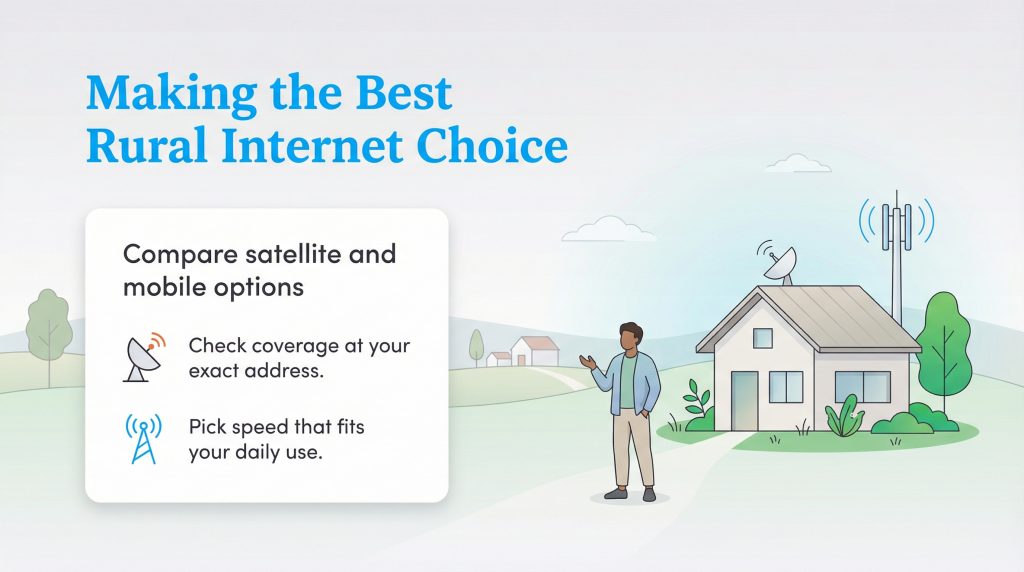
The landscape of rural connectivity has profoundly changed for the better. In 2026, you finally have genuine, highly robust competition between modern satellite giants and agile cellular networks, empowering you to confidently choose an internet plan that actually fits your budget and lifestyle. Overall, Starlink stands out as the ultimate top pick for raw speed and low latency, making it the undeniable superior choice for remote workers and active families. Conversely, T-Mobile 5G Home Internet earns the absolute top spot for overall budget value, offering fantastic speeds at a highly affordable price without forcing you into restrictive annual contracts or burying you in upfront hardware fees.
Take the time to thoroughly verify your local availability using the FCC’s official broadband availability map or an online zip code tool today. Once you have your connection sorted and scheduled, check out our detailed guide on how much internet speed you really need to guarantee you aren’t overpaying for unnecessary bandwidth. If you are still in the active process of setting up other home services, our moving utilities checklist can help keep you perfectly organized during the transition to your new rural property.
Frequently Asked Questions About Rural Internet
What is the most reliable internet for rural areas?
How can I get high-speed internet living in the country?
Can you get unlimited satellite internet in rural areas?
Is 5G home internet better than satellite for rural homes?
How do I find out which internet providers service my address?
How much does rural internet equipment cost upfront?
Is satellite internet good for gaming?
Which rural internet option is most energy-efficient?
Will fiber internet ever come to my rural area?
About the Author

David has been an integral part of some of the biggest utility sites on the internet, including InMyArea.com, HighSpeedInternet.com, BroadbandNow.com, and U.S. News. He brings over 15 years of experience writing about, compiling and analyzing utility data.

LaLeesha has a Masters degree in English and enjoys writing whenever she has the chance. She is passionate about gardening, reducing her carbon footprint, and protecting the environment. She also recently served as President of the Board for City Sprouts (a community garden).