
Competing head-to-head on price and perks, find out whether TXU’s reliable service or Just Energy’s flexible plans are the better fit for your energy needs.
Key Takeaways
- Just Energy often wins on lower introductory rates, while TXU Energy generally scores higher for customer stability and long-term service satisfaction.
- Both providers charge Early Termination Fees (ETFs), but Just Energy’s fees are often flat-rate, whereas TXU may charge based on remaining contract months.
- Solar buyback plans are limited with both providers, but understanding their “Free Nights” or time-of-use specific plans can save heavy users significant money.
Navigating the Texas electricity market often feels like choosing between two giants who promise the same thing but deliver very different bills. You have likely seen the advertisements for TXU Energy and Just Energy, both boasting about free electricity periods and low rates, yet the confusion lies in the details of the Electricity Facts Label (EFL). We are here to break down the math behind the marketing, comparing real costs, hidden fees, and contract terms so you can confidently pick the provider that fits your budget and lifestyle.

- 13.5¢ /kWh
- 3-100%
- 60 days
- 1-36 Months
- Best for Plan Variety & Reliability

- 7.7¢ /kWh
- 31%
- 60 days
- 11-60 Months
- Popular Bill Credit Plans
*rates may vary by location and household usage
The Short Verdict: TXU Energy vs. Just Energy
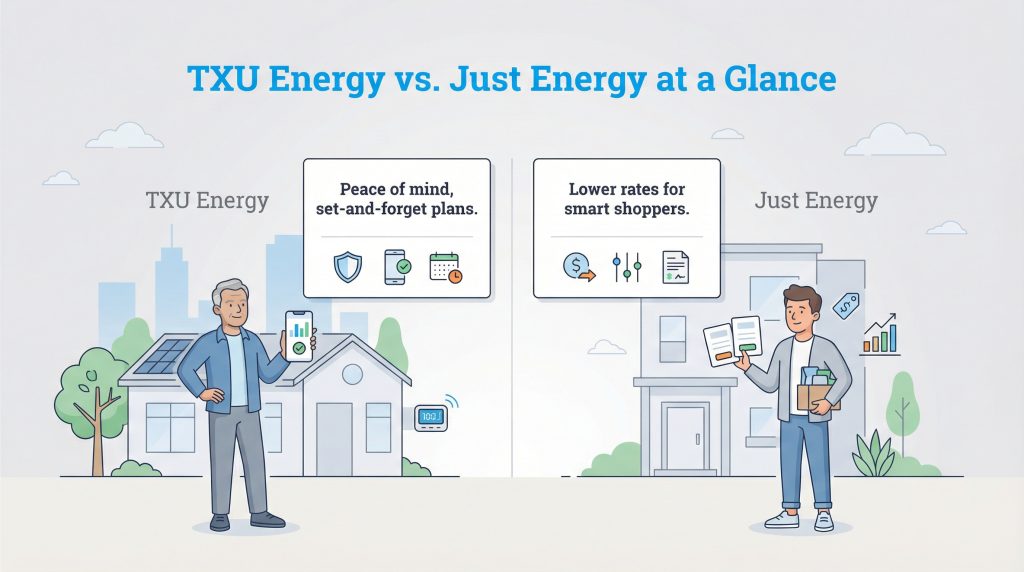
If you are looking for a quick answer, your choice largely depends on whether you prioritize potential savings or peace of mind. TXU Energy positions itself as the premium, reliable choice for homeowners who want a “set it and forget it” experience. They offer a robust mobile app, predictable billing, and solid customer support tools, making them the go-to for those who are willing to pay slightly more to avoid administrative headaches.
On the other hand, Just Energy appeals to the “smart shopper” who is willing to navigate a few more details to secure a lower rate. They are often a strong fit for renters or budget-conscious movers because their introductory rates can be very competitive. Just Energy provides flexible plan structures, including “Basics” plans that strip away some of the complexity found in other tiered offers, making them ideal if you want straightforward pricing without the bells and whistles.
| Provider | Best Suited For | Key Strength |
|---|---|---|
| TXU Energy | Homeowners & Stability Seekers | Customer Service & Digital Tools |
| Just Energy | Renters & Smart Shoppers | Competitive Rates & Flexibility |
| Feature | TXU Energy | Just Energy |
|---|---|---|
| Avg. Price Stability | High | Medium |
| Contract Lengths | Typically 12–36+ months | Typically 12–36 months |
| Green Options | Yes | Yes |
| Best For | Customer Service & Stability | Competitive Rates & Flexibility |
Rate Comparison: What You Actually Pay
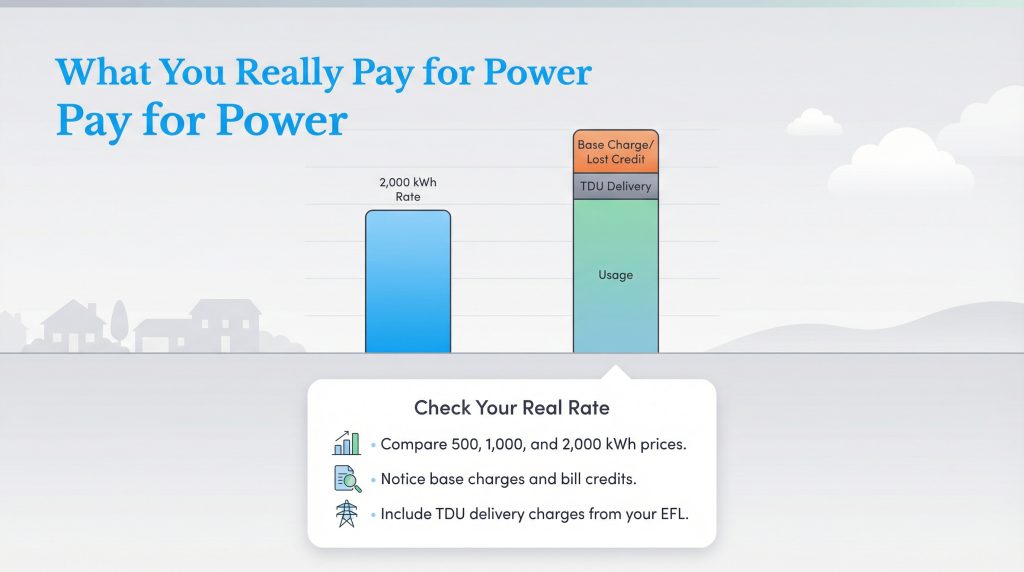
The most critical thing to understand about Texas electricity is that the advertised rate you see in big bold numbers is rarely what you pay unless you use exactly 2,000 kWh per month. Both TXU Energy and Just Energy use tiered pricing structures that can drastically change your effective rate per kilowatt-hour (kWh). For example, a plan might look cheap at the 2,000 kWh usage level, but if you live in a smaller home or apartment using only 800 kWh, your rate could jump by several cents per kWh due to base charges or the loss of bill credits.
Real Cost Example
To illustrate how usage impacts your bill, here is a hypothetical comparison of how rates might fluctuate based on plan structures common to these providers. Always check the EFL for the specific plan you are considering.
| Usage Level | TXU Example (Tiered Plan) | Just Energy Example (Base Fee Plan) |
|---|---|---|
| 500 kWh (Apartment) | Higher rate (Credits rarely apply) | Higher rate (Base fee impact is high) |
| 1000 kWh (Small Home) | Moderate rate (Bill credit may apply) | Moderate rate (Base fee diluted) |
| 2000 kWh (Large Home) | Lowest advertised rate | Competitive rate |
When comparing specific plans, such as a Just Energy Basics plan against a TXU Smart Edge plan, you must look at the “Base Charge.” Just Energy plans sometimes include a monthly base fee (often between $4.95 and $9.95) that inflates the average cost for low-usage households. TXU Energy plans often feature bill credits that only kick in after you hit a certain usage threshold, meaning if you have a mild month and use less power, you miss the credit and pay a much higher rate. It is essential to look at the “500 kWh” and “1000 kWh” columns on the EFL to see the real cost for your specific home size. For more on understanding these documents, you can visit the Public Utility Commission of Texas (PUCT) consumer guide.
age
Always check the Electricity Facts Label (EFL) for “TDU Delivery Charges.” These are pass-through fees from your local utility (like Oncor or CenterPoint) and are charged regardless of whether you choose TXU or Just Energy.
Plan Options and Structures
Both providers offer a variety of plan types designed to match different lifestyles, but they approach their offerings differently. Understanding these structures is key to avoiding bill shock during the hot Texas summers.
Fixed-Rate Plans
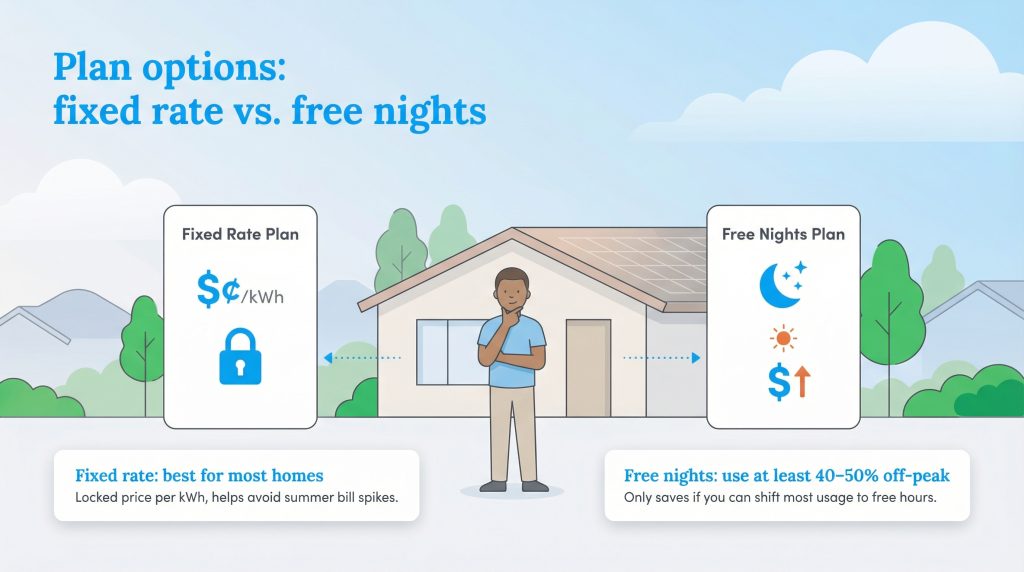
Fixed-rate plans are the standard recommendation for most residents because they lock in your price per kWh for the duration of your contract, protecting you from market volatility. Just Energy typically focuses on 12- to 36-month contracts, frequently pushing “Web Exclusive” fixed rates that are lower than their standard offers. TXU Energy commonly offers a range of fixed contracts, from around one year up to several years for homeowners who want long-term price security.
Time-of-Use (Free Nights & Weekends)
The battle for “Free Nights” is where these two providers often compete most aggressively. TXU Energy is famous for its “Free Nights & Solar Days” plans, which offer free electricity usage during specific evening hours. However, the daytime rate on these plans is often significantly higher to compensate for the free hours. This means if you work from home or run your AC heavily during the day, you might end up paying more overall.
Just Energy offers similar time-of-use options, including “Free Nights” plans. The analysis for both providers remains the same: these plans only save you money if you can shift about 40% to 50% of your total energy usage to the free window. If you aren’t prepared to run your dishwasher and laundry at 9 p.m. or later, a standard fixed-rate plan is usually the safer financial bet.
TXU Energy Plans and Pricing
| Plan Name | Rate | Plan Type | Cancellation Fee | |
|---|---|---|---|---|
| Value Edge 12 | $0.135 /kWh | 12 Months Fixed Rate | $150.00 | Check Availability |
| Smart Edge 12 | $0.139 /kWh | 12 Months Fixed Rate | $150.00 | Check Availability |
| Smart Edge 24 | $0.145 /kWh | 24 Months Fixed Rate | $295.00 | Check Availability |
| Clear Deal 24 | $0.156 /kWh | 24 Months Rate | $295 | Check Availability |
| Simple Value 12 | $0.157 /kWh | 12 Months Fixed Rate | $150.00 | Check Availability |
| Clear Deal 12 | $0.165 /kWh | 12 Months Rate | $150 | Check Availability |
| Simple Rate 12 | $0.173 /kWh | 12 Months Rate | $150 | Check Availability |
| On Your Terms | $0.175 /kWh | 1 Month Months Rate | $ | Check Availability |
| Solar Value 12 | $0.175 /kWh | 12 Months Rate | $150 | Check Availability |
| Ultimate Season Pass 12 | $0.187 /kWh | 12 Months Rate | $150 | Check Availability |
| Solar Club 12 | $0.191 /kWh | 12 Months Fixed Rate | $150.00 | Check Availability |
| Flex Forward | $0.192 /kWh | 1 Month Months Rate | $ | Check Availability |
| Texas Choice 12 | $0.192 /kWh | 12 Months Fixed Rate | $150.00 | Check Availability |
| Texas Choice 24 | $0.192 /kWh | 24 Months Fixed Rate | $295.00 | Check Availability |
| Flex Rewards | $0.193 /kWh | Variable Rate | $0.00 | Check Availability |
| Free Nights & Solar Days 12 (8 pm) | $0.195 /kWh | 12 Months Rate | $150 | Check Availability |
| Smart Deal 12 | $0.196 /kWh | 12 Months Fixed Rate | $150.00 | Check Availability |
| Solar Saver 12 | $0.198 /kWh | 12 Months Rate | $150 | Check Availability |
| Smart Deal 24 | $0.204 /kWh | 24 Months Fixed Rate | $295.00 | Check Availability |
| Smart Deal 36 | $0.204 /kWh | 36 Months Fixed Rate | $395.00 | Check Availability |
| Saver's Discount 12 | $0.211 /kWh | 12 Months Rate | $150 | Check Availability |
| Saver's Discount 24 | $0.251 /kWh | 24 Months Rate | $295 | Check Availability |
Just Energy Plans and Pricing
| Plan Name | Rate | Plan Type | Cancellation Fee | |
|---|---|---|---|---|
| Smart Choice - 6 | $0.065 /kWh | 6 Months Fixed Rate | $0.00 | Check Availability |
| Power Plus - 12 | $0.109 /kWh | 12 Months Fixed Rate | $0.00 | Check Availability |
| Smart Choice - 24 | $0.111 /kWh | 24 Months Fixed Rate | $0.00 | Check Availability |
| Sustainable Living Bundle - 3 | $0.115 /kWh | 3 Months Fixed Rate | $175.00 | Check Availability |
| Sustainable Days Bundle - 3 | $0.115 /kWh | 3 Months Fixed Rate | $175.00 | Check Availability |
| Power Plus - 24 | $0.125 /kWh | 24 Months Fixed Rate | $0.00 | Check Availability |
| Smart Choice - 12 | $0.127 /kWh | 12 Months Fixed Rate | $175.00 | Check Availability |
| Simple Choice- 12 | $0.154 /kWh | 12 Months Fixed Rate | $0.00 | Check Availability |
| Basics - 12 | $0.163 /kWh | 12 Months Fixed Rate | $0.00 | Check Availability |
| Simple Choice- 24 | $0.165 /kWh | 24 Months Fixed Rate | $0.00 | Check Availability |
| Basics - 24 | $0.167 /kWh | 24 Months Fixed Rate | $0.00 | Check Availability |
| Basics PTC - 60 | $0.175 /kWh | 60 Months Fixed Rate | $175.00 | Check Availability |
| Basics PTC - 24 | $0.175 /kWh | 24 Months Fixed Rate | $175.00 | Check Availability |
| Mega Saver - 24 | $0.202 /kWh | 24 Months Fixed Rate | $0.00 | Check Availability |
*plans and pricing may vary by location and household us
Hidden Costs: Cancellation Fees and Fine Print
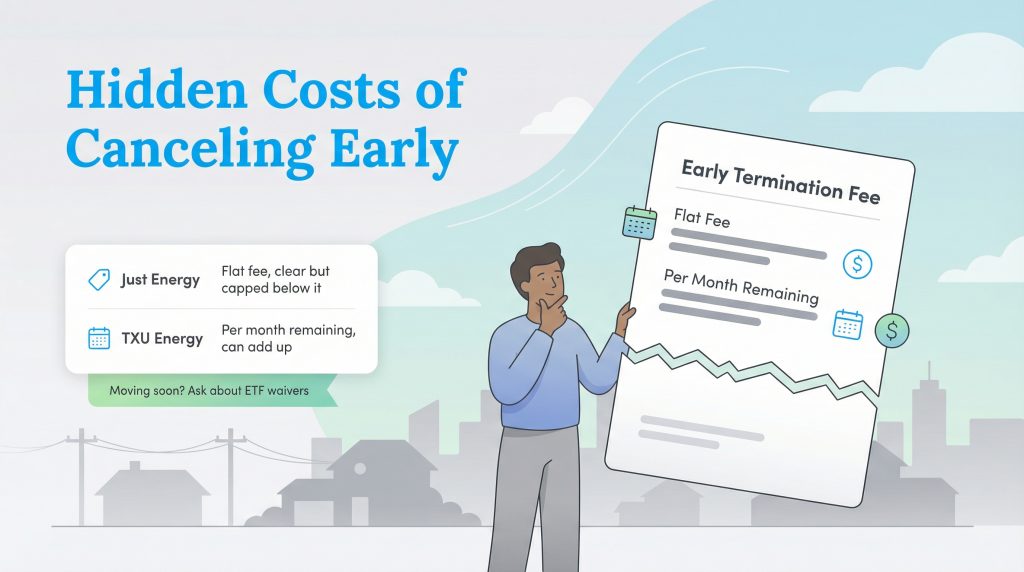
Life happens, and sometimes you need to break a contract. This is where the fine print regarding Early Termination Fees (ETFs) becomes a major factor in your decision. Just Energy typically charges a flat fee per plan, which can range from the low hundreds up to nearly $300 depending on the contract term. This flat-rate structure is easy to understand, so you know exactly what the penalty is regardless of when you cancel.
TXU Energy has historically used a different formula for some of its plans, charging an ETF based on the months remaining on your contract, often a set dollar amount for every month left. While they also use flat fees on certain plans, the “months remaining” structure can be much more expensive if you cancel early in a long-term contract. Always verify the “Early Termination Fee” section of the EFL before signing up.
| Provider | Typical ETF Structure | What to Check in EFL |
|---|---|---|
| TXU Energy | Per-month remaining OR Flat fee | Look for “$X multiplied by months remaining” language. |
| Just Energy | Flat fee (varies by term length) | Confirm the specific dollar amount (e.g., $175, $295). |
Customer Service and Reviews
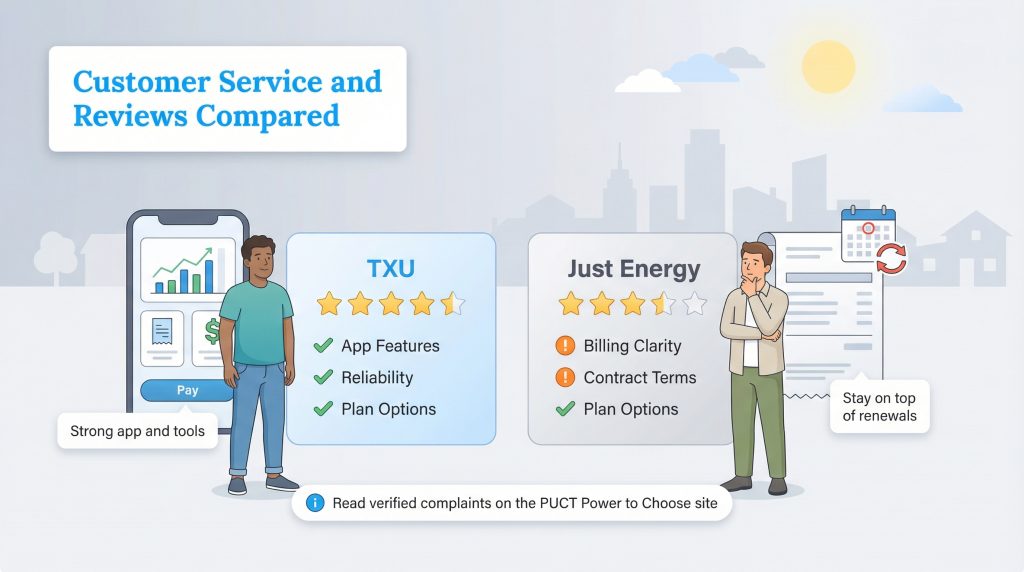
Trust is a major component of choosing a utility provider, and reviews offer a window into what you can expect after you sign up. TXU Energy is often perceived as a more established, premium brand with strong tools like a robust mobile app. As a legacy provider in North Texas, they have invested heavily in user experience, making it easy to track usage and pay bills.
Just Energy reviews present a mixed but competitive picture. Customers often highlight the attractive pricing and easy enrollment process. However, some reviews cite frustration with renewal communications or clarity regarding billing changes after a contract expires. While they are a legitimate and large provider, you may need to be more proactive in managing your account renewals compared to TXU.
For official complaint statistics and unbiased data, we recommend visiting the Public Utility Commission of Texas (PUCT) Power to Choose website.
Renewable Energy and Solar Buyback
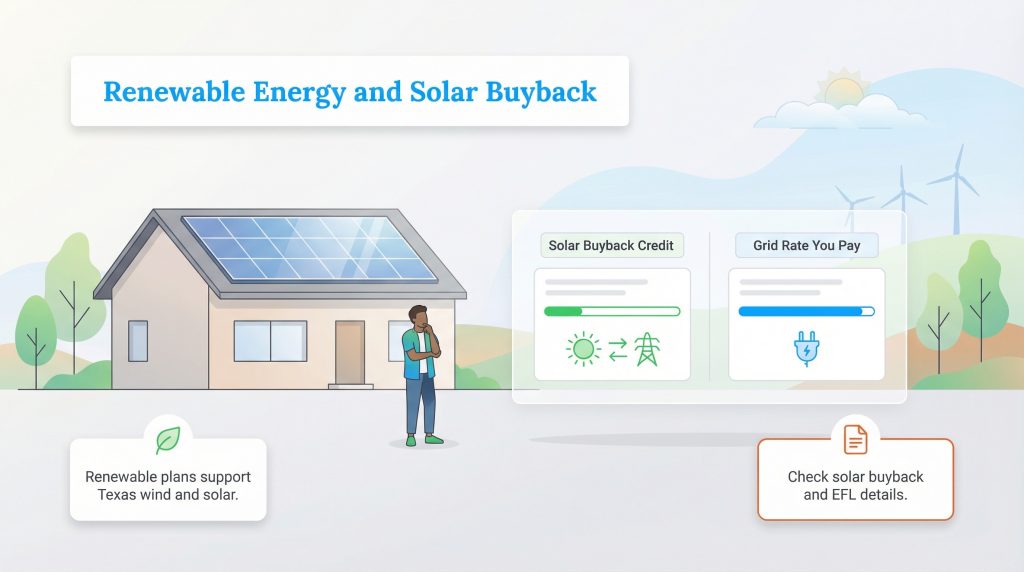
If sustainability is a priority for your household, both providers offer ways to support green energy. Both TXU and Just Energy offer plans backed by 100% renewable energy, typically through the purchase of Renewable Energy Certificates (RECs). Just Energy has a strong focus on this with their “JustGreen” add-ons. These plans are an environmentally mindful choice because they support investment in renewable projects. You can learn more about how RECs work on the EPA’s Green Power Partnership page.
However, for homeowners with solar panels, the “Solar Buyback” options can be a pain point. As an example, some solar buyback programs in the market pay less for exported solar than you pay for power you buy from the grid. You might pay a higher retail rate per kWh than the smaller credit you get for excess solar. It is crucial to look for specific “Solar Buyback” EFLs, as standard plans will typically not credit you at all for excess generation.
Making the Final Call for Your Home
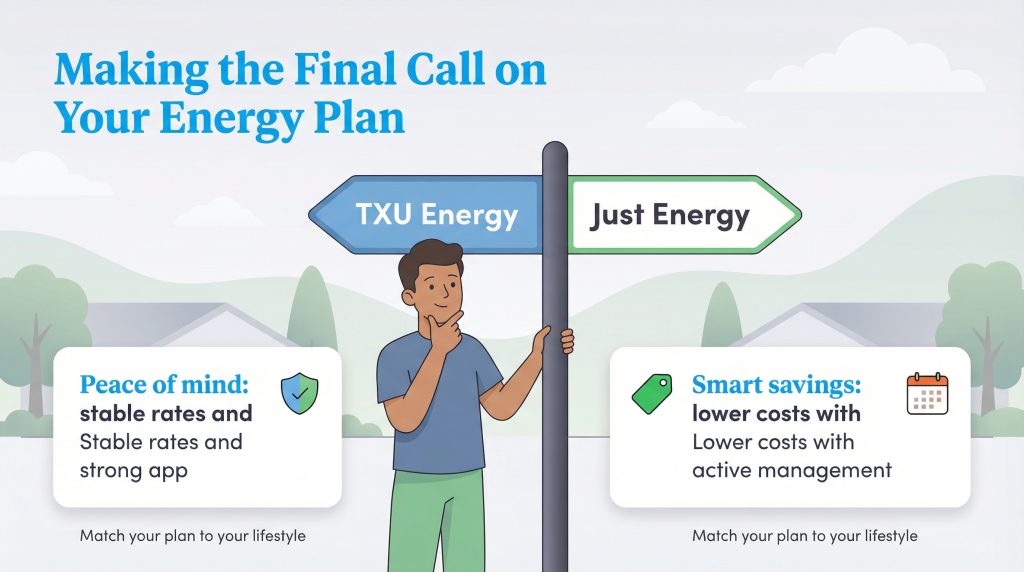
Choosing between these two energy giants ultimately comes down to your personal management style. If you are an established homeowner who values predictability, a top-tier mobile app, and responsive support, TXU Energy is the “peace of mind” choice. You might pay a little more, but the stability is often worth the premium.
Conversely, if you are a renter, a student, or a diligent budgeter looking to minimize monthly expenses, Just Energy is the “smart shopper” choice. Their competitive introductory rates and flexible options can lead to significant savings, provided you keep a close eye on your contract expiration date. If you are exploring other options in Texas, check out our guide on how to save on your electric bill for more tips on lowering your usage.
FAQs About TXU Energy vs. Just Energy
Is TXU Energy cheaper than Just Energy?
Who has better reviews, TXU or Just Energy?
Do TXU and Just Energy require a deposit?
Can I transfer my plan if I move?
What is the best plan for an apartment?
Can I get 100% renewable energy with TXU or Just Energy?
About the Author

David has been an integral part of some of the biggest utility sites on the internet, including InMyArea.com, HighSpeedInternet.com, BroadbandNow.com, and U.S. News. He brings over 15 years of experience writing about, compiling and analyzing utility data.