
While Frontier Utilities Often Offers Lower Advertised Rates Through Bill Credits, TXU Energy Provides Superior Customer Stability and Transparent Plans
Key Takeaways
- Frontier Utilities typically wins on price for specific usage tiers (usually 1,000 kWh) but carries risk if your usage fluctuates.
- TXU Energy charges a premium for brand reliability, highly-rated mobile apps, and “Free Nights” plans that benefit high-usage households.
- Always check the Electricity Facts Label (EFL) for cancellation fees, as Frontier’s fees can be significantly lower than TXU’s hefty early termination penalties.
Staring at the Power to Choose website often leaves Texas residents with a difficult choice: do you go with the household name you recognize, or take a chance on a challenger that promises a lower rate? In 2026, the average rate difference can be staggering — Frontier often advertises around 11 cents per kWh, while TXU averages closer to 16 cents. However, upfront costs tell a completely different story. While TXU requires traditional credit checks and potential $150 to $350 deposits for new customers, Frontier offers prepaid connections for as little as $30 to start. This complete TXU Energy vs. Frontier Utilities comparison looks past the advertised sticker price to crunch the numbers on bill credits, hidden fees, and real customer experiences so you can sign up with confidence.

- 10.9¢ /kWh
- 3-100%
- 60 days
- 1-36 Months
- Highest Trustpilot Rating 4.7/5 ★

- 7.3¢ /kWh
- 30-100%
- 60 days
- 4-36 Months
- Best for Short-Term Leases
*rates may vary by location and household usage
At a Glance: Head-to-Head Provider Matrix
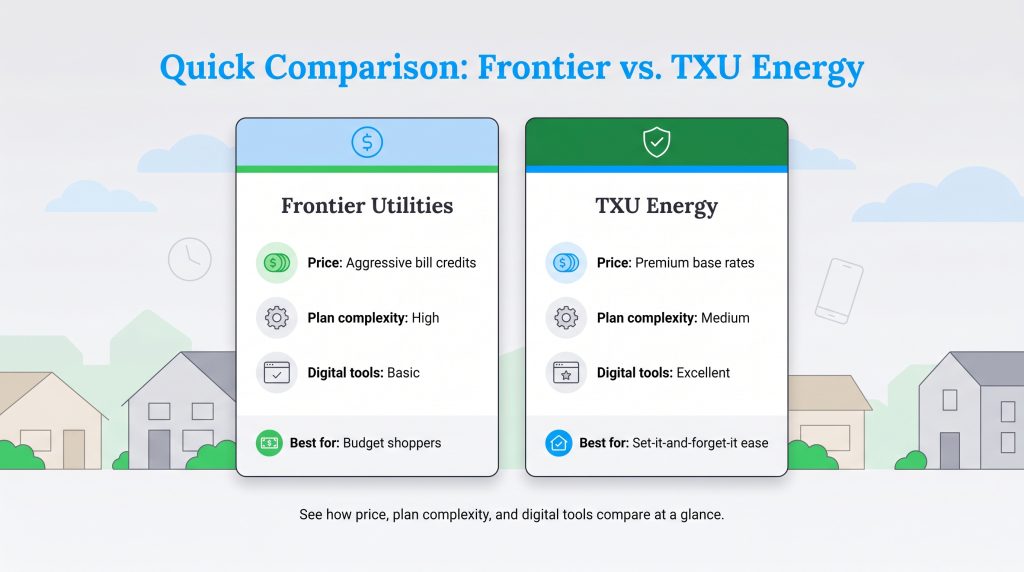
To give you a clear overview before diving into the details, we evaluated both providers across pricing, plan complexity, and customer trust signals. When you compare TXU Energy and Frontier Utilities side-by-side, it becomes obvious that one leans heavily on cost savings, while the other prioritizes a premium, hassle-free customer experience.
| Comparison Metric | Frontier Utilities | TXU Energy | Winner |
|---|---|---|---|
| Lowest Rate | Excellent (with conditional bill credits) | Moderate (higher base rates) | Frontier Utilities |
| Average Rate | Variable (high risk if usage fluctuates) | Consistent & Predictable | TXU Energy |
| Deposit Requirements | $0 to $50 (Prepaid options available) | $150 to $350 (Based on soft credit check) | Frontier Utilities |
| Early Termination Fees (ETF) | Often $20 per remaining contract month | Flat fee ranging from $150 to $295 | Tie (depends on contract length) |
| PUCT Complaint Rates | Average (around 3.5/5 Stars) | Excellent (around 4.4/5 Stars) | TXU Energy |
TXU Energy Pros and Cons
- Pro: A+ BBB accreditation and excellent customer support.
- Pro: High-quality mobile app and digital tracking tools.
- Pro: Generous same-day service cut-off times.
- Con: Higher base rates than most budget providers.
- Con: Expensive early termination fees.
Frontier Utilities Pros and Cons
- Pro: Highly aggressive pricing for predictable usage.
- Pro: Offers flexible no-deposit prepaid plans.
- Pro: Robust bilingual support options.
- Con: Strict bill credits penalize you for low usage.
- Con: Lacks advanced app features and BBB accreditation.
Rate Structures and Bill Credits Explained
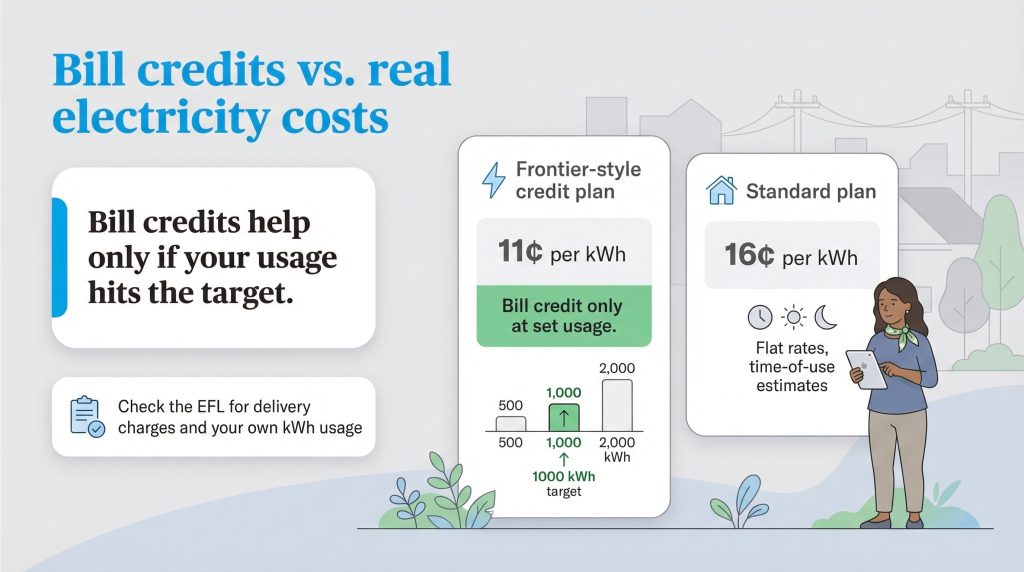
The electricity market in Texas is often a battle between legacy companies and budget challengers. As a legacy provider, TXU Energy positions itself as a premium service. You are paying for stability, robust infrastructure, and transparent billing. Frontier Utilities operates as a challenger, competing strictly on price. To appear at the top of comparison sites, they structure their rates aggressively using specific billing thresholds.
How Frontier Utilities Leverages Bill Credits
To get Frontier Utilities bill credits explained clearly, think of them as a conditional reward. These credits — often ranging from $50 to $100 — only kick in if you consume a specific amount of electricity within a single billing cycle. It is a brilliant strategy for predictable households, but it carries immense risk if your usage fluctuates.
Here is exactly how a typical $100 bill credit plan behaves based on your monthly meter reading:
- At 999 kWh: You miss the threshold by just a single kilowatt-hour. The $100 credit is denied, and your effective rate skyrockets to 21¢ per kWh. Your bill is surprisingly high.
- At 1,000 to 2,000 kWh: You hit the sweet spot. The $100 credit applies in full, driving your effective rate down to an incredible 11¢ per kWh. You successfully game the system for maximum savings.
- At 2,001+ kWh: The fixed $100 credit remains, but it is now diluted across much higher energy consumption. Your effective rate climbs back up to around 15¢ per kWh, reducing your overall savings.
TXU Energy’s Tiered Pricing Models
Because premium providers generally avoid rigid credit traps, their popular plans operate differently. TXU relies on straightforward flat rates or lifestyle-based structures like the TXU Energy free nights comparison (often branded as “Free Nights & Solar Days”). These plans typically feature a slightly higher base rate during the day but offer completely free usage periods overnight. If you can shift your heaviest appliances — running your dishwasher, washer, and dryer after 8:00 p.m. — the savings can effortlessly outpace a traditional bill credit plan.
Comparing Top Energy Plans for 2026
To make your decision easier, you need to match your home’s square footage and historical usage directly to the right plan style. Shopping for fixed rate electricity plans Texas residents can actually rely on means ignoring the marketing fluff and focusing on your exact living situation.
Best for Low Usage (Apartments)
If you live in a one- or two-bedroom apartment, you will likely average between 500 and 800 kWh a month. Avoid Frontier’s heavy bill credit plans at all costs here, as you will rarely consume enough power to trigger the discount. Instead, look for a straightforward plan like the TXU Smart Saver or a basic Frontier flat-rate plan with no minimum usage fees. By skipping the gimmicks, your 500 kWh bill will stay predictable, typically landing around $85 to $95 a month.
Best for High Usage (Large Homes)
If you own a home larger than 2,500 square feet, your summer usage will easily blast past 2,000 kWh. In this scenario, a Frontier Power Saver plan featuring a usage credit might not be as lucrative since the fixed credit dilutes over your massive consumption. TXU Energy’s tiered plans or simple flat-rate options often win here. With TXU, you lock in a reliable 14¢ to 16¢ per kWh across all usage levels, ensuring your August cooling bill does not come with hidden penalties.
| Plan Name | Rate /kWH | Plan Term | Cancellation Fee | |
|---|---|---|---|---|
| Smart 1000 Saver 12 | 11.5¢ | Month to Month | N/A | Check Availability |
| Smart 1000 Select 12 | 11.5¢ | Fixed Months | $3 | Check Availability |
| Smart Edge 12 | 13.5¢ | 12 Months | $150.00 | Check Availability |
| Smart Edge 24 | 13.9¢ | 24 Months | $295.00 | Check Availability |
| Clear Deal 12 | 14.5¢ | Month to Month | N/A | Check Availability |
| Solar Value 12 | 15.9¢ | Month to Month | N/A | Check Availability |
| Simple Rate 12 | 16.4¢ | Month to Month | N/A | Check Availability |
| On Your Terms | 16.9¢ | Month to Month | N/A | Check Availability |
| Smart 500 Start 12 | 17.1¢ | Month to Month | N/A | Check Availability |
| Simple Value 12 | 18¢ | 12 Months | $150.00 | Check Availability |
| Ultimate Season Pass 12 | 18.7¢ | Month to Month | N/A | Check Availability |
| Solar Club 12 | 19.1¢ | 12 Months | $150.00 | Check Availability |
| Flex Forward | 19.1¢ | Month to Month | N/A | Check Availability |
| Texas Choice 12 | 19.2¢ | 12 Months | $150.00 | Check Availability |
| Texas Choice 24 | 19.2¢ | 24 Months | $295.00 | Check Availability |
| Flex Rewards | 19.3¢ | Month to Month | $0.00 | Check Availability |
| Smart Deal 12 | 19.6¢ | 12 Months | $150.00 | Check Availability |
| Smart Deal 24 | 20.4¢ | 24 Months | $295.00 | Check Availability |
| Smart Deal 36 | 20.4¢ | 36 Months | $395.00 | Check Availability |
| Solar Saver 12 | 21.3¢ | Month to Month | N/A | Check Availability |
| Saver's Discount 12 | 21.9¢ | Month to Month | N/A | Check Availability |
Free Nights and Renewable Energy Options
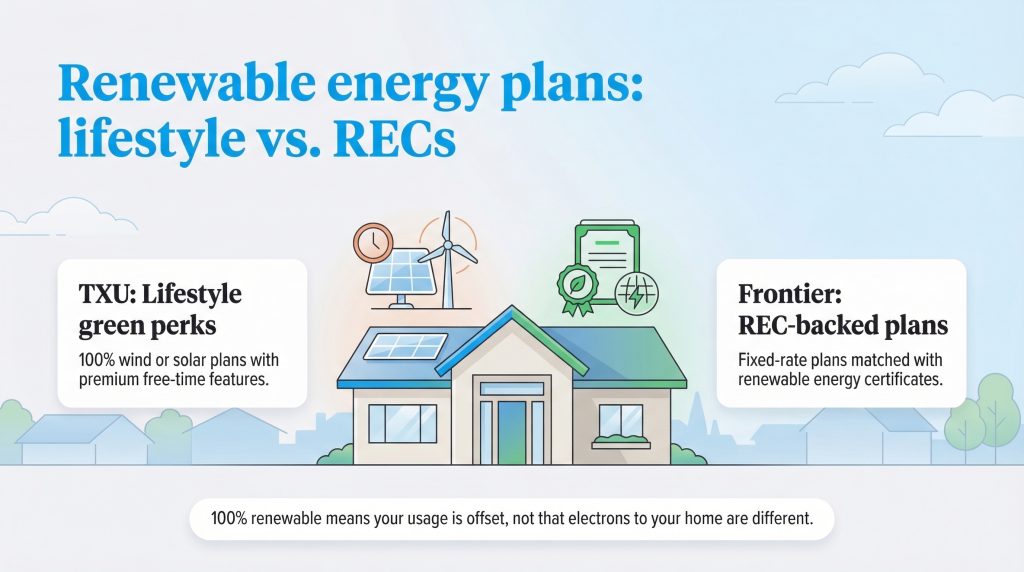
If reducing your carbon footprint is a priority, both brands offer an eco-conscious alternative to standard fossil fuel generation. TXU Energy leans into the lifestyle aspect of green energy, heavily marketing 100% wind or solar plans bundled with smart thermostats or their free-time plans. Frontier Utilities takes a simpler route, offering standard green plans backed by Renewable Energy Certificates (RECs) to match your usage perfectly without the extra gadget costs.
| Plan Name | Rate /kWH | Plan Term | Cancellation Fee | |
|---|---|---|---|---|
| Frontier Saver Plus 12 | 7¢ | Month to Month | N/A | Check Availability |
| Frontier Saver Plus 24 | 8.4¢ | Month to Month | N/A | Check Availability |
| Frontier Power Saver 3 | 11¢ | 3 Months | $150.00 | Check Availability |
| Frontier Power Saver 8 | 11.2¢ | 8 Months | $150.00 | Check Availability |
| Frontier Power Saver 12 | 11.9¢ | 12 Months | $150.00 | Check Availability |
| Frontier Budget Saver 24 | 13.8¢ | Month to Month | N/A | Check Availability |
| Frontier Budget Saver 12 | 14.8¢ | Month to Month | N/A | Check Availability |
| Frontier Saver Value Plus 12 | 15.1¢ | Month to Month | N/A | Check Availability |
| Light Saver 12+ | 15.1¢ | Month to Month | N/A | Check Availability |
| Frontier Saver Edge 12 | 15.5¢ | Month to Month | N/A | Check Availability |
| Frontier Saver Value 12 | 17.1¢ | Month to Month | N/A | Check Availability |
| Platinum 24+ | 17.3¢ | 24 Months | $200.00 | Check Availability |
| Frontier 36 | 17.3¢ | 36 Months | $200.00 | Check Availability |
| Platinum 12+ | 17.9¢ | 12 Months | $150.00 | Check Availability |
| Frontier Saver Deluxe 12 | 18.2¢ | Month to Month | N/A | Check Availability |
| Frontier Eco Saver 24 | 18.6¢ | 24 Months | $200.00 | Check Availability |
| Frontier Saver Premier 12 | 18.9¢ | Month to Month | N/A | Check Availability |
| Frontier Saver Premier 24 | 19¢ | Month to Month | N/A | Check Availability |
Hidden Fees: Deposits, Cancellations, and Startup Costs
Moving into a new residence is stressful enough without worrying about whether the lights will turn on when you flip the switch. Startup costs and connection speeds are critical factors when finalizing your choice. Both companies run soft credit checks when you enroll to determine your security deposit. However, Texas regulations provide specific avenues to bypass this requirement if you meet certain criteria.
If you want to avoid a hefty upfront bill, exploring no deposit light companies Texas residents trust is a smart move. Frontier Utilities frequently offers the Frontier Utilities prepaid electricity plan, allowing you to skip the credit check and deposit entirely. Instead of paying for what you used last month, you fund your account with a small starting balance — often just $30 to $50 — and pay ahead as you consume energy. TXU Energy focuses primarily on traditional post-paid plans. If you fail the initial credit check with TXU, you will likely need to pay a standard deposit ranging from $150 to $350 to activate your service.
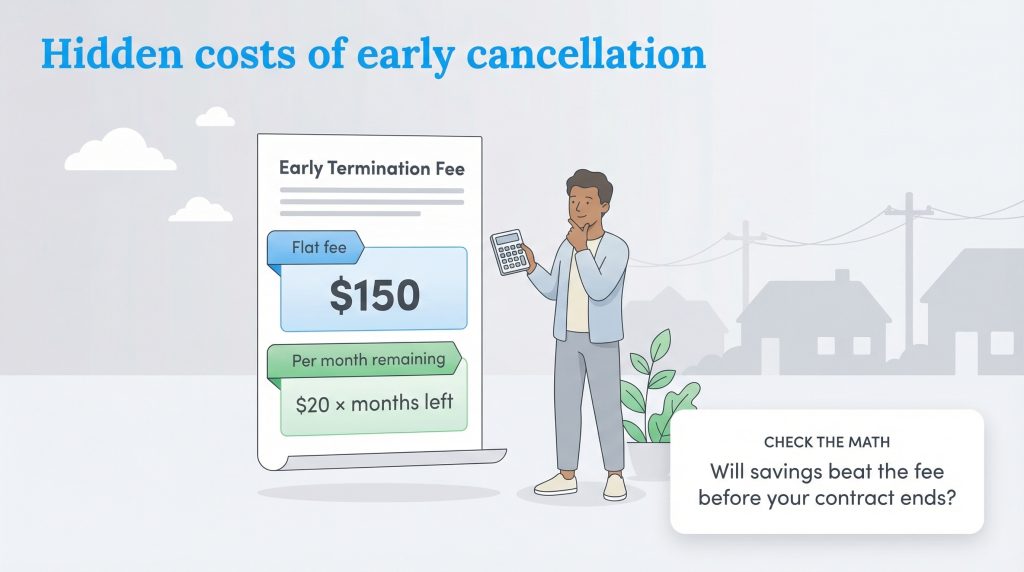
Before you commit, evaluate the exit strategy. A TXU vs Frontier early termination fees comparison reveals two very different models. TXU Energy typically charges a flat cancellation fee that scales by plan length, often set at $150 for a 12-month plan and $295 for a 24-month plan. Frontier Utilities often charges a fee for every month remaining on your contract — usually $20 per month. If you cancel a Frontier plan with 10 months left, you owe $200. Always check the fine print to understand your liability.
Additionally, it is critical to separate your actual energy rate from pass-through utility costs. When running a TDU delivery charges comparison between the two providers, you will notice these fees are identical regardless of who you choose. These charges are set by the local utility company that maintains the grid wires (like Oncor or CenterPoint) — not TXU or Frontier.
Customer Service and PUCT Complaint Rates
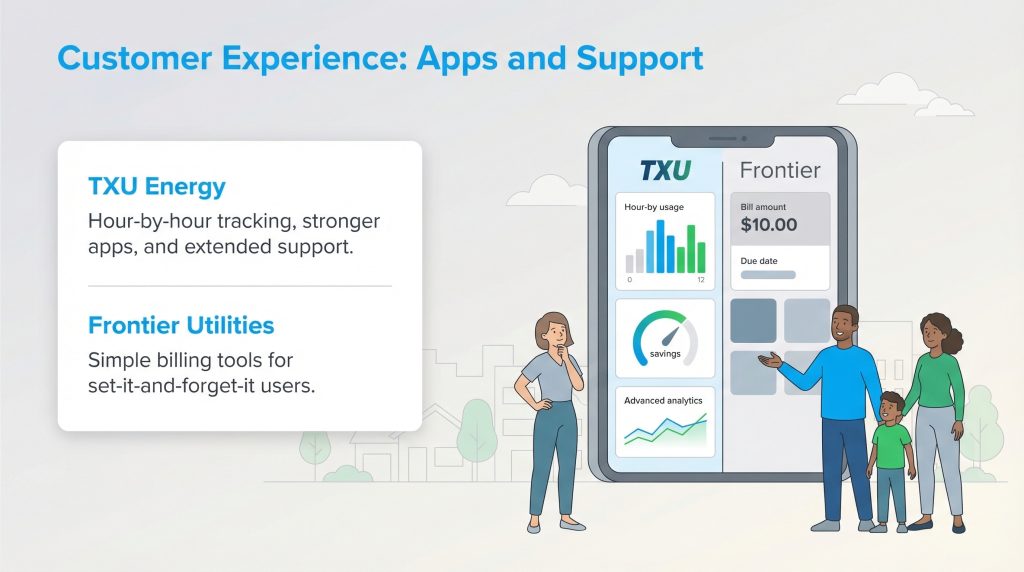
When evaluating Frontier Utilities customer reviews versus TXU feedback, you will notice a sharp divide in priorities. TXU invests heavily in its mobile app and online dashboard, offering highly detailed usage tracking tools. You can see how much power you consume hour-by-hour, which is critical if you are optimizing your home for a time-of-use plan. Furthermore, TXU stands behind a 60-Day Satisfaction Guarantee, allowing new customers to switch to a different TXU plan if they are unhappy with their initial choice.
Trust signals are vital when signing a contract. Looking at the latest Public Utility Commission of Texas (PUCT) complaint statistics, TXU Energy maintains a stellar track record, earning high marks (averaging around 4.4 out of 5 stars), which indicates a very low volume of regulatory complaints for their massive market share. The Better Business Bureau also grants TXU an A+ accreditation.
Frontier Utilities holds respectable regulatory marks from the PUCT (generally sitting around 3.5 out of 5 stars), operating without the bloated overhead of a premium brand. While their digital tools are basic, they stand out by offering excellent bilingual support, making them an accessible choice for Spanish-speaking households seeking localized, straightforward customer service.
The Final Verdict: Choosing Between TXU and Frontier
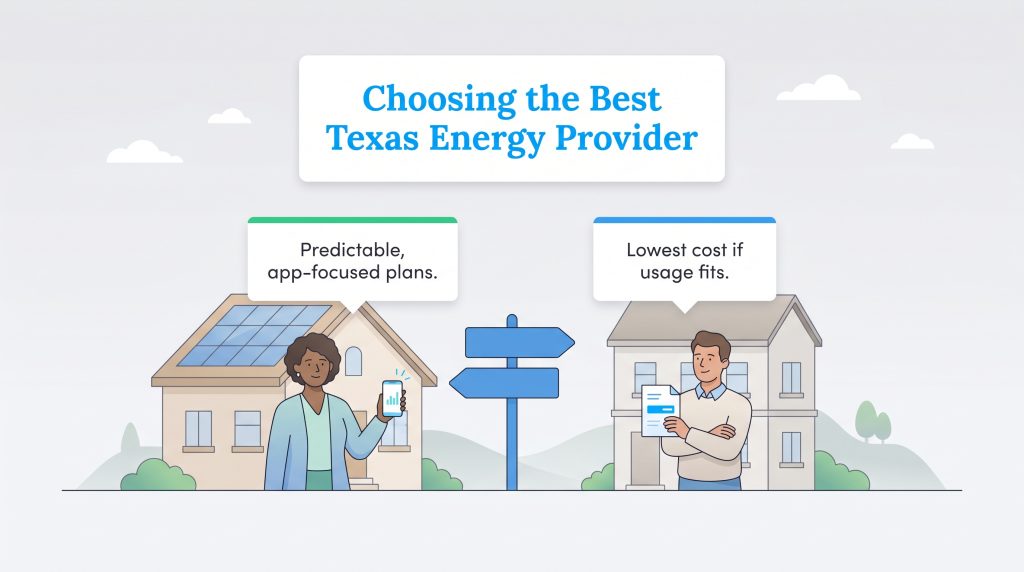
Ultimately, navigating the TXU vs Frontier power to choose debate comes down to knowing your household’s exact habits, budget flexibility, and risk tolerance. There is no single “perfect” provider — only the one that seamlessly aligns with your specific energy profile.
- Choose TXU Energy if: You are a homeowner with a large family and prioritize predictable, reliable service. If you value a high-quality app to track your daily spending, need a generous same-day connection window, or have high electricity usage that can truly benefit from “Free Nights” plans, the premium price is absolutely worth it. It is the safer choice if you refuse to worry about strict bill credit thresholds.
- Choose Frontier Utilities if: You are a savvy budget shopper who carefully monitors your historical usage. Frontier consistently ranks among the most affordable Texas electricity providers if you reliably use between 1,000 and 2,000 kWh per month. If you do not care about fancy mobile apps and simply want a low bill — or if you need a quick, no-deposit prepaid option — Frontier can save you hundreds of dollars a year. Just be sure to read the electricity plan guide carefully to understand the fine print.
Frequently Asked Questions About TXU Energy and Frontier Utilities
Is TXU Energy actually cheaper than Frontier Utilities?
Which company is better for bad credit or no deposit plans?
How do Frontier Utilities bill credits work on my monthly statement?
Can I get same-day electricity connection with TXU Energy?
Why did my Frontier Utilities bill spike this month?
Does TXU own Frontier Utilities?
What is the cancellation fee for TXU Energy?
Can I transfer my service if I move?
About the Author

David has been an integral part of some of the biggest utility sites on the internet, including InMyArea.com, HighSpeedInternet.com, BroadbandNow.com, and U.S. News. He brings over 15 years of experience writing about, compiling and analyzing utility data.