

Decoding Your Electricity Facts Label Is The Best Way To Accurately Compare Energy Plans And Protect Your Wallet From Unexpected Charges
Key Takeaways
- The Electricity Facts Label serves as a nutrition label for your energy plan, detailing the exact pricing, terms, and renewable energy content.
- Understanding the difference between your base charge and energy charge helps you calculate your true average price per kWh based on actual household usage.
- Carefully reviewing the fine print for minimum usage fees and bill credits is the best way to protect yourself from sudden rate spikes.
Shopping for a new energy provider often feels like navigating a maze of marketing jargon and teaser rates, but learning how to read an electricity facts label cuts straight through the noise. Think of this mandatory sheet as the required nutrition label for your home energy plan — instead of tracking calories and sodium, it tracks cents, fees, and contract terms. Understanding this essential document empowers you to strip away flashy promotional banners and focus entirely on the raw numbers that dictate your monthly expenses. By breaking down base fees, delivery charges, and fine-print usage thresholds, you can confidently calculate your true costs and lock in a plan that fits your lifestyle without the fear of hidden fees.
What Is An Electricity Facts Label (EFL)?
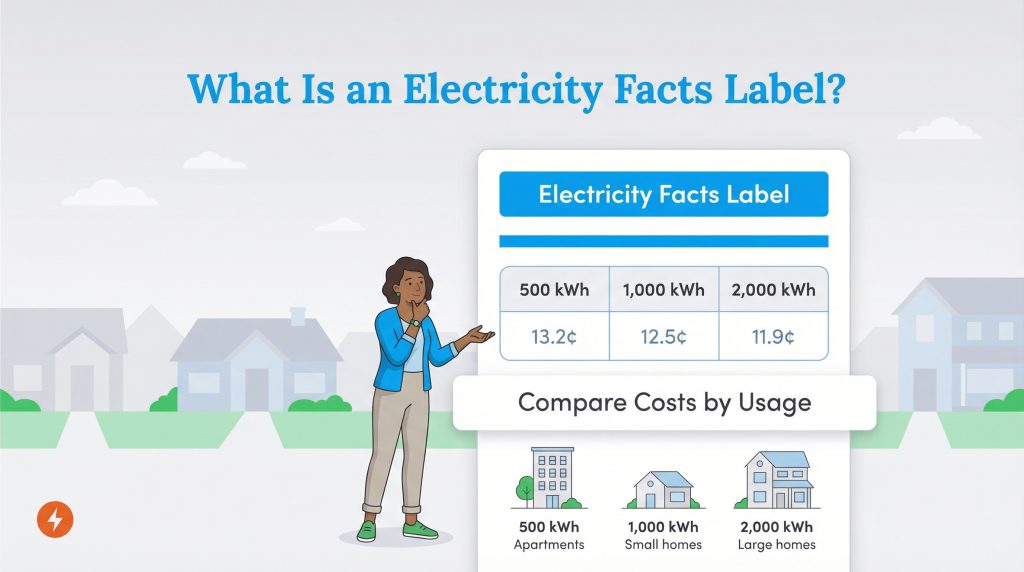
An Electricity Facts Label (EFL) is a standardized, state-mandated document that details the exact pricing, fees, and contract terms of a retail energy plan. Designed to create a level playing field, PUCT Substantive Rule §25.475 states the rule’s primary aim is to “give consumers a clear, informative and accurate guide to the electricity available to them.”
Because of these strict PUCT electricity facts label rules, the Public Utility Commission of Texas mandates this standardized disclosure document for every single plan they sell. This guarantees that shoppers receive a straightforward, uniform breakdown of costs. Understanding what goes into an EFL document Texas regulators require ensures you are never caught off guard by extra costs hidden deep within a lengthy service agreement.
Why The PUCT Requires EFLs In Texas
Before the state implemented standardized disclosures, shopping for energy plans was incredibly confusing. The Public Utility Commission of Texas introduced the EFL to create a fair, transparent marketplace for consumers living in deregulated areas. Because electric companies build their plans using wildly different base fees, conditional usage credits, and utility pass-throughs, the final cost of powering your home can vary drastically. The standardized facts label strips away these variables and forces every retail provider to use the exact same formula to display their pricing. This ensures you can evaluate competing offers on a level playing field without falling for deceptive advertising.
Where To Find Your Plan’s EFL PDF
When searching for a new energy provider, figuring out where to find electricity facts label documents is your first step toward securing a transparent rate. Retail electric companies—such as TXU Energy and Reliant Energy—and third-party comparison platforms are legally obligated to make this document highly accessible before you agree to any service terms.
If you are browsing an energy comparison marketplace like Power to Choose, look directly below the advertised rate or plan title. You will almost always see a hyperlinked text or PDF icon labeled “Electricity Facts Label” or “EFL.” If you are shopping directly on a provider’s website, the document link is usually located right next to the sign-up button. It may also be tucked into a section labeled “Plan Documents” alongside the Terms of Service. Always locate and download this PDF before completing a checkout process, as it serves as the ultimate source of truth for your future billing.
Step-By-Step Breakdown: Reading The EFL Pricing Information
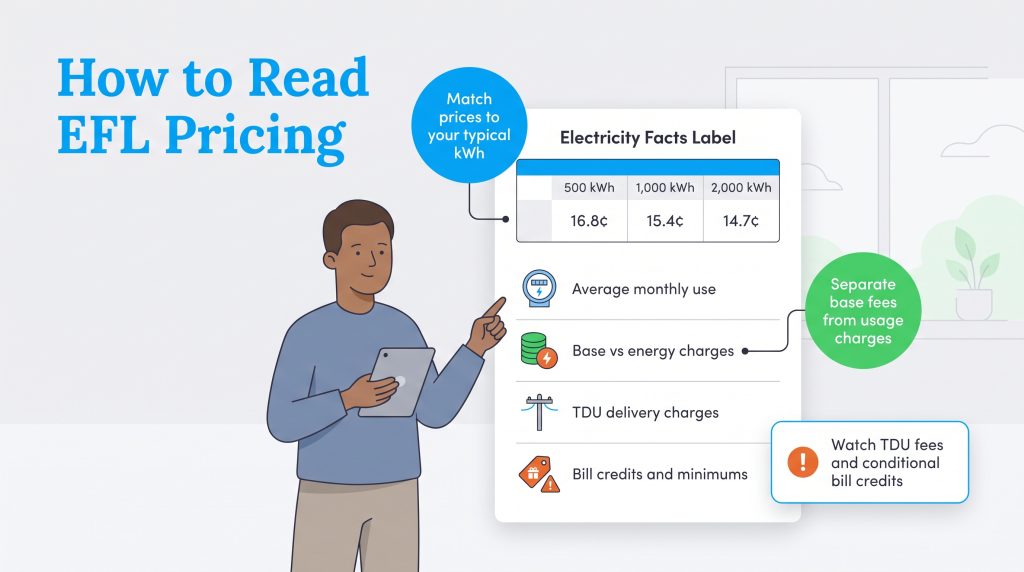
While every energy company designs its website differently, the state requires all facts labels to follow a uniform layout. When you open an EFL, you will immediately see a pricing chart at the very top. This section is the most critical part of the document because it maps out the math behind your monthly bill. Here is a step-by-step breakdown of where to look when reading the pricing section:
| Electricity Price Breakdown | |||
|---|---|---|---|
| [1] Average Monthly Use | 500 kWh | 1,000 kWh | 2,000 kWh |
| Average price per kWh | 16.8¢ | 15.4¢ | 14.7¢ |
| [2] Base Charge: $9.95 per month [2] Energy Charge: 10.0¢ per kWh [3] TDU Delivery Charge: $4.00 per month and 4.0¢ per kWh [4] Bill Credits: N/A | |||
1. Average Monthly Usage (500, 1,000, And 2,000 kWh)
When evaluating the average price per kWh EFL data, the first row you encounter highlights three standardized usage benchmarks: 500 kWh, 1,000 kWh, and 2,000 kWh. The 500 kWh tier represents an apartment or a highly efficient small space. The 1,000 kWh tier reflects moderate usage common for a small-to-medium house during mild weather. Finally, the 2,000 kWh tier indicates heavy consumption, typical for a large family home running an air conditioner during a hot summer. Because rates fluctuate wildly depending on how much power you pull from the grid, we highly recommend checking your past utility bills to find your personal historical average before referencing these numbers.
2. Base Charges Vs Energy Charges
Understanding the base charge vs energy charge is critical for understanding your electric bill components. Providers split your monthly supply costs into two distinct categories. The base charge operates as a flat monthly fee you pay just to keep your account open, regardless of whether you use a single kilowatt-hour or a thousand. Conversely, the energy charge represents the variable retail rate you pay for the actual electricity your household consumes to power your lights, appliances, and HVAC systems.
If you are a low-energy user living in a small space, choosing a plan with a high base charge heavily penalizes you because that fixed fee makes up a much larger percentage of your overall bill. To see how base fees distort your actual price per kilowatt-hour, let’s look at a hypothetical fixed-rate plan with a $9.95 monthly base charge, a 10-cent per kWh energy charge, and standard utility delivery fees (estimated at $4 plus 4 cents per kWh). As your usage goes up, the impact of those flat monthly fees goes down, completely changing your effective rate.
| Usage (kWh) | Base Charge | Energy Charge (10¢) | Est. TDU Charges | Estimated Bill | Effective ¢/kWh |
|---|---|---|---|---|---|
| 500 | $9.95 | $50 | $24 | $83.95 | 16.8¢ |
| 1,000 | $9.95 | $100 | $44 | $153.95 | 15.4¢ |
| 2,000 | $9.95 | $200 | $84 | $293.95 | 14.7¢ |
3. TDU Delivery Charges Explained
Beyond what your retail provider charges, your label also includes non-negotiable pass-through fees. Spotting the TDU delivery charges on EFL documents ensures you know exactly what is paid directly to the local utility transmission company — such as Oncor or CenterPoint — for maintaining the physical poles, wires, and meters in your neighborhood. TDU fees are completely identical regardless of retail provider you choose.
What catches many consumers off guard is that the regulatory commission frequently updates these delivery rates bi-annually. Even if you secure a fixed-rate energy plan, your final bill will fluctuate slightly when the utility company adjusts these mandatory maintenance fees.
4. Bill Credits And Minimum Usage Fees
The disclosure chart section of your label is where you spot the real terms of your contract, and it serves as your best defense against fine-print fees. Providers often create structured plans that advertise an incredibly low teaser rate by applying a conditional bill credit (such as $50 off) only if your usage falls perfectly between 1,000 and 1,500 kWh for that billing cycle.
While this sounds like a great deal on paper, household energy consumption is highly unpredictable. If a mild week in October drops your usage to 999 kWh, you lose that entire credit. Missing this narrow usage window by just a single kilowatt-hour easily causes your average rate to skyrocket.
How To Spot Complex Rate Structures On An EFL
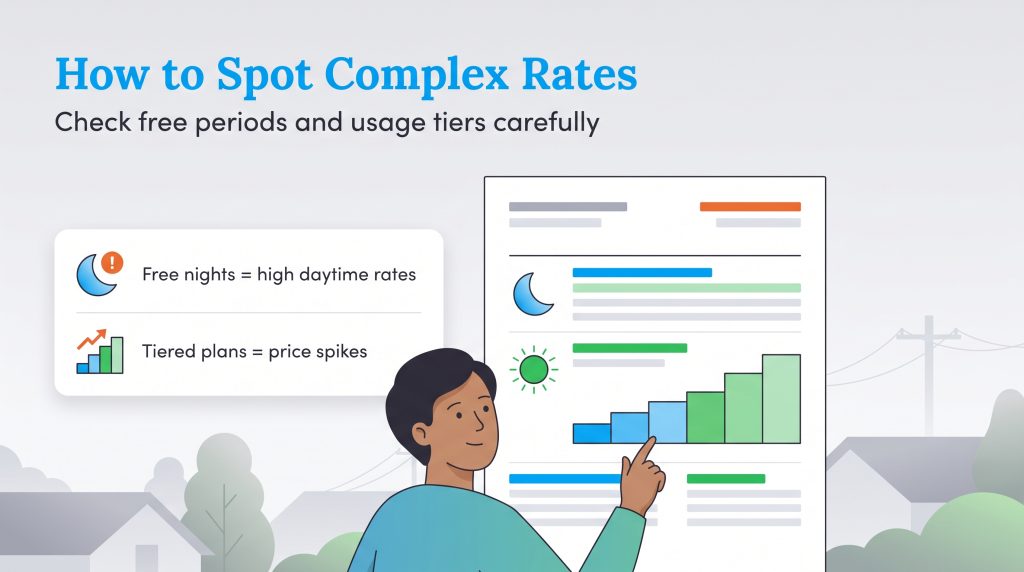
As you learn how to properly navigate these forms, you will inevitably encounter plans that deviate from standard fixed pricing. Providers often creatively structure their rates to appeal to specific lifestyle habits, but these agreements require diligent review to avoid unexpected bill spikes.
Free Nights And Weekends Plans
Free energy sounds incredibly enticing, but these non-standard plans come with a significant catch. When examining an EFL for a free nights or weekends plan, you will notice that the daytime energy charge is substantially higher than a traditional fixed-rate plan — sometimes double or triple the current market average. The “free” periods are clearly marked with a $0 energy charge.
The advertised average price per kWh heavily relies on an assumed ratio of off-peak usage. For example, the provider might calculate your estimated rate assuming you use exactly 40% of your power during the free nighttime window and 60% during the expensive daytime hours. If you work from home or run your air conditioning heavily during the day, your actual effective rate will be much higher than what the document suggests.
Tiered Rate Plans
Tiered rate plans charge wildly different prices based on specific usage milestones. On the disclosure document, you might see a structure where the first 1,000 kWh cost 12 cents per kWh, but any consumption between 1,001 and 1,500 kWh drops to zero cents, only to spike to 18 cents for anything beyond 1,500 kWh.
These “bullseye” plans reward you for landing perfectly within a narrow usage window but severely penalize you if you miss it. The facts label will explicitly chart these sudden price drops or spikes. Reviewing these thresholds is vital, as a minor shift in the weather or an extra load of laundry could easily push your household into a punishingly expensive tier.
Decoding Contract Terms And Product Types
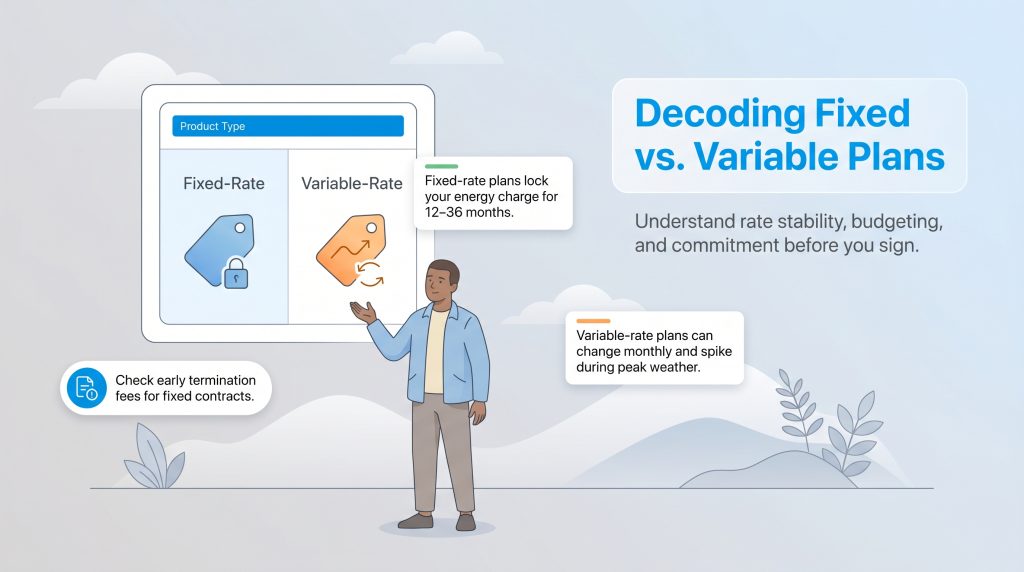
Moving past the pricing section, the middle of the label outlines the specific rules governing your agreement. It is essential to know exactly what kind of product you are buying and how long you are committing to the energy provider.
Fixed-Rate Vs Variable-Rate Plans
When deciding between fixed vs variable electricity plans, checking for a fixed vs variable rate EFL ensures you know exactly what level of risk you are accepting. We strongly prescribe fixed-rate plans for long-term budget stability, as they shield your household from unpredictable wholesale market spikes.
| Feature | Fixed-Rate Plans | Variable-Rate Plans | Indexed Plans |
|---|---|---|---|
| Rate Stability | The energy charge is locked in for the entire contract term. | The energy charge changes monthly based on market conditions. | The energy charge is tied to a publicly available index or market formula. |
| Budgeting | Predictable monthly bills that only fluctuate based on your usage. | Highly unpredictable bills that can double during peak weather. | Extreme volatility, as rates can surge dramatically during grid emergencies. |
| Commitment | Requires a long-term contract (typically 12 to 36 months). | No long-term contract required; you can switch providers anytime. | Often requires a contract, but pricing shifts automatically with the market. |
Early Termination Fees (ETFs)
If you sign up for a fixed-term contract, the disclosure section will detail the exact early termination fee electricity providers charge if you break the agreement before it expires. These penalties are typically structured as a flat fee (such as $150) or a recurring per-month charge for the remaining time on your contract (such as $20 per remaining month). Reviewing this detail ensures you fully understand the financial commitment before locking into a 12-, 24-, or 36-month plan.
How To Calculate Your Monthly Electric Bill Using An EFL
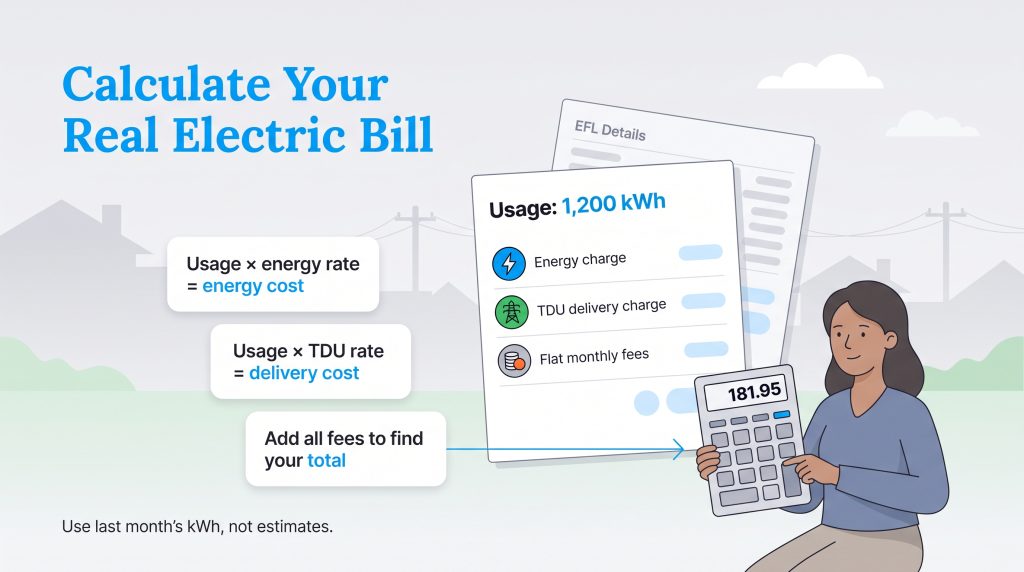
If you want absolute certainty before signing a contract, you can calculate electric bill from EFL data using a simple mathematical formula. To do this accurately, you need a recent utility bill to determine your real-world household consumption. Instead of relying on the 1,000 kWh benchmark estimate, doing the math yourself reveals the true out-of-pocket expense.
Here is the step-by-step formula to calculate your expected monthly cost:
- Identify your historical usage: Look at last month’s statement to find exactly how many kilowatt-hours you used.
- Determine your variable energy cost: Multiply your total usage by the provider’s per-kWh energy charge listed on the sheet.
- Determine your variable TDU cost: Multiply your total usage by the utility company’s per-kWh delivery charge.
- Add the flat monthly fees: Combine the provider’s flat base charge and the utility company’s flat TDU delivery fee.
- Find your final total: Add the variable costs to the flat fees to reveal your true estimated payment.
Let’s calculate a mock bill for a family that used exactly 1,200 kWh last month. They are reviewing a plan with a 10-cent ($0.10) energy charge, a $9.95 base charge, a 4-cent ($0.04) TDU per-kWh charge, and a $4.00 flat TDU fee.
- Variable Energy Cost: 1,200 kWh x $0.10 = $120.00
- Variable TDU Cost: 1,200 kWh x $0.04 = $48.00
- Flat Fees: $9.95 + $4.00 = $13.95
- Total Estimated Bill: $120.00 + $48.00 + $13.95 = $181.95
By plugging your actual historical data into this formula, you bypass the standardized estimates entirely and confidently predict what your family will pay.
Using The EFL To Compare Electricity Plans
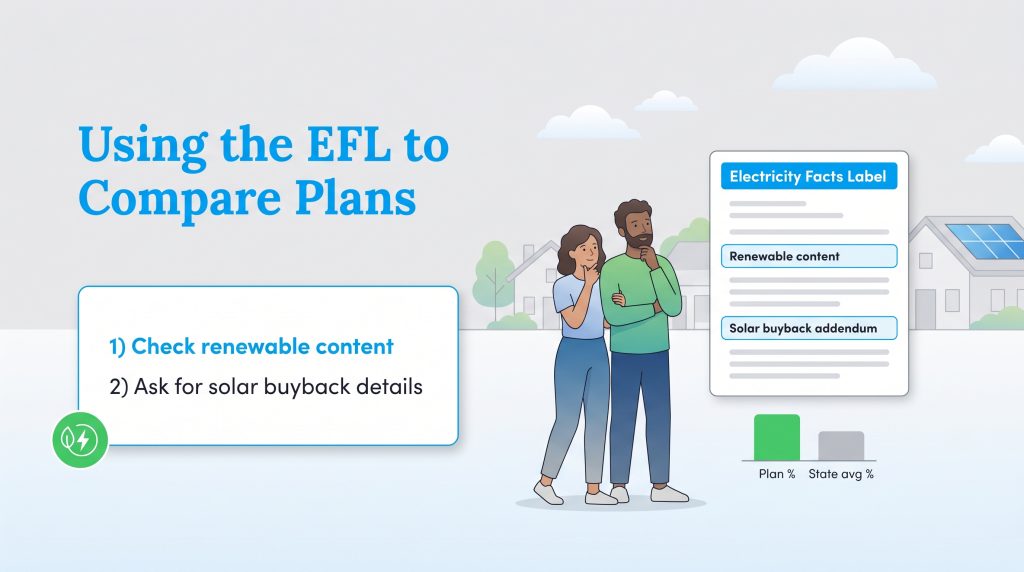
Getting your electricity facts label explained properly allows you to spot the most cost-effective option for your specific household needs. Standard documents are built for traditional consumers drawing power from the grid, which means they do not immediately account for solar buyback credits or net metering. If you are currently investing in home solar panels, you need to dig a little deeper. Solar owners must request a specialized solar buyback addendum from the provider to see exactly how their excess generation is credited back to their account.
For consumers without panels who still want an eco-conscious alternative, checking the renewable content section is an easy way to verify a provider’s environmental claims. The sheet clearly lists the plan’s renewable content percentage alongside the state average so you can compare them side-by-side. If you browse the Power to Choose website, you can specifically filter for 100% renewable plans from providers like Green Mountain Energy to easily outpace the standard grid mix.
Preparing For Your Provider Switch
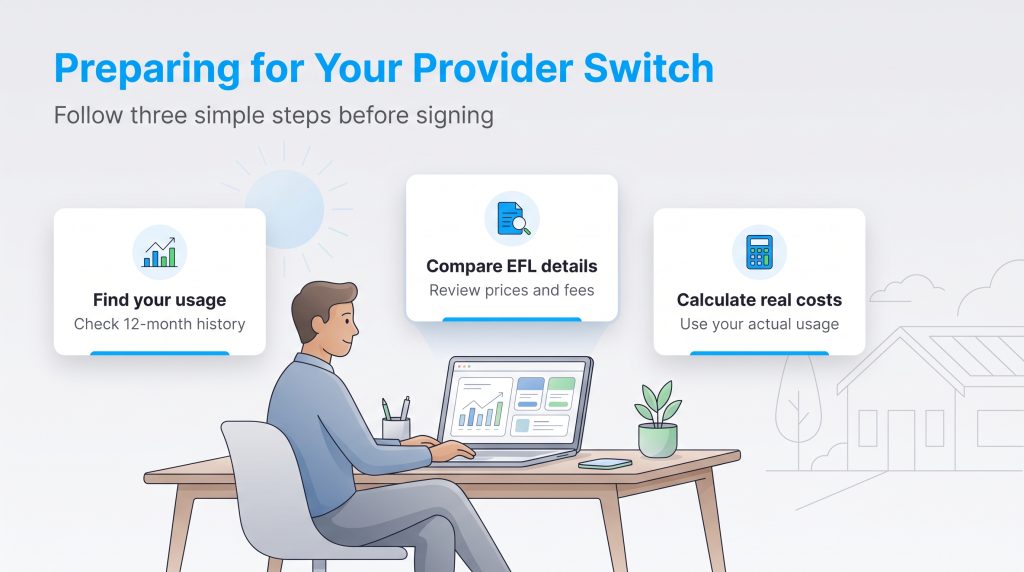
Taking control of your energy choices means doing a little homework before your current contract expires. Whether you are figuring out how to save on your electric bill or setting up services for a new property, you should never finalize an enrollment blindly. Use this simple three-step process to prepare for a successful switch:
- Find your historical usage: Log into your current utility customer portal and calculate your exact average monthly electricity usage over the past 12 months.
- Review the EFLs for three competitor plans: Pull up the documents for the top fixed-rate plans in your area to compare their average prices, base charges, and disclosure charts side-by-side.
- Calculate the real cost at your specific tier: Plug your personal household usage into each plan’s calculation to find the true out-of-pocket cost before signing a new contract.
Empowering Your Energy Choices
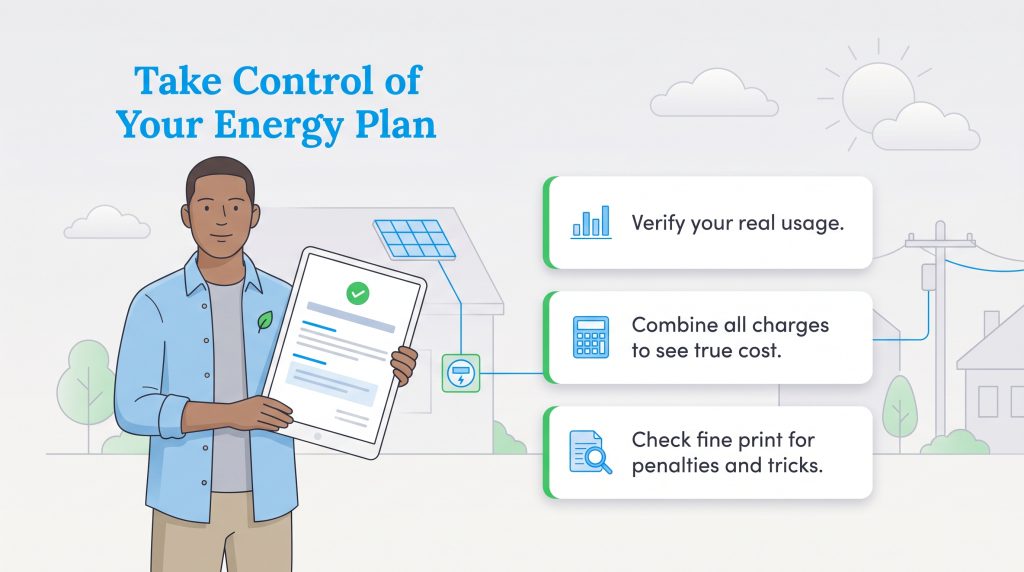
Mastering the details hidden within this document puts the power back in your hands and protects your wallet from deceptive marketing tactics. To ensure you secure a reliable rate that genuinely matches your household’s unique energy footprint, always follow this final checklist:
- Verify your real average: Check your historical usage to see if you typically consume closer to 500, 1,000, or 2,000 kWh per month before looking at the advertised rate.
- Run the complete math: Use the formula to combine the variable energy charge, the utility delivery fees, and the fixed base charges to reveal your true out-of-pocket expense.
- Scan for complex traps: Read the fine print in the disclosure chart to confirm you are not agreeing to harsh early termination penalties or gimmick usage credits.
Taking control of your home utilities does not have to be an overwhelming process. By closely reviewing your options and prioritizing transparency, you ensure your next energy contract works entirely in your favor.
Frequently Asked Questions About Electricity Facts Labels
Do all states use an electricity facts label?
Are TDU charges included in the average price per kWh on the EFL?
What is a base charge on an electricity bill?
How do I know if a plan has an early termination fee?
Do fixed-rate and variable-rate plans use the same type of label?
Why is the price on my bill different from the average price on the EFL?
What happens if the rate on my EFL doesn’t match my actual bill?
Can my TDU delivery charges change during my contract?
About the Author

LaLeesha has a Masters degree in English and enjoys writing whenever she has the chance. She is passionate about gardening, reducing her carbon footprint, and protecting the environment. She also recently served as President of the Board for City Sprouts (a community garden).

David has been an integral part of some of the biggest utility sites on the internet, including InMyArea.com, HighSpeedInternet.com, BroadbandNow.com, and U.S. News. He brings over 15 years of experience writing about, compiling and analyzing utility data.