
Analyzing the two biggest Texas electricity providers to see which one actually saves you money.
Key Takeaways
- Direct Energy is often better for flat-rate simplicity, while TXU Energy shines with high-usage households that can maximize bill credits.
- Both providers charge Early Termination Fees (ETFs), so renters should look specifically for shorter contract terms or month-to-month options.
- Pay close attention to TDU delivery charges, which are added to the advertised rate for both providers and can increase your final bill.
Choosing an electricity plan in the deregulated Texas market is stressful enough without having to decipher the marketing fluff between the two biggest industry giants. You see the commercials and the billboards, but when you look at the Electricity Facts Labels, the plans can start to look confusingly similar. We are here to cut through the noise, comparing the real costs, potential hidden fees, and customer experiences of TXU Energy and Direct Energy so you can sign up with confidence.

- 13.5¢ /kWh
- 3-100%
- 60 days
- 1-36 Months
- Best for Plan Variety & Reliability

- 13.9¢ /kWh
- 24%
- None
- 12-36 Months
- Smart Home Bundles
*rates may vary by location and household usage
At a Glance: TXU Energy vs. Direct Energy
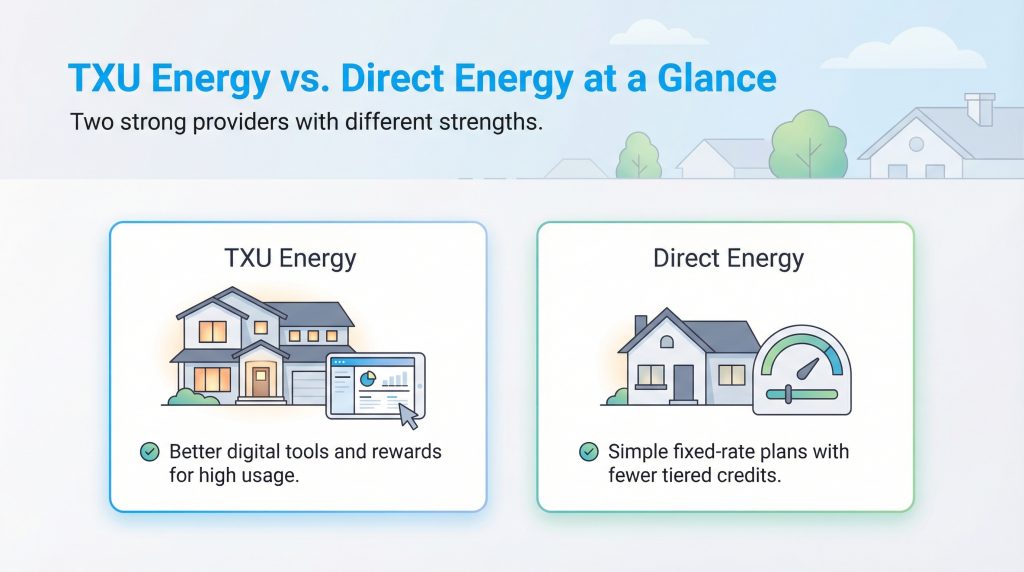
Here is a quick breakdown of how these two heavyweights stack up against each other.
| Feature | TXU Energy | Direct Energy |
|---|---|---|
| Best For | High-usage homes & tech lovers | Standard usage & flat-rate simplicity |
| Contract Lengths | Commonly 12 to 36 months (some month-to-month options available) | Commonly 12 to 36 months; availability varies by market |
| Renewable Options | Yes (100% wind/solar plans available) | Yes (Green plans available) |
| Cancellation Fees | Flat fee (often around $150–$295, depending on the plan) | Flat fee (often around $135–$295, depending on the term and plan) |
| App Rating | Highly rated in app stores | Solid but somewhat lower app ratings than TXU in many recent reviews |
While both companies offer stability and similar contract terms, they target slightly different needs. TXU Energy generally offers a more robust digital experience and plans that reward heavy usage, making it a favorite for large family homes. Direct Energy often appeals to customers looking for straightforward, fixed-rate plans without complex tiered credits.
Comparing Rates and “Real” Costs
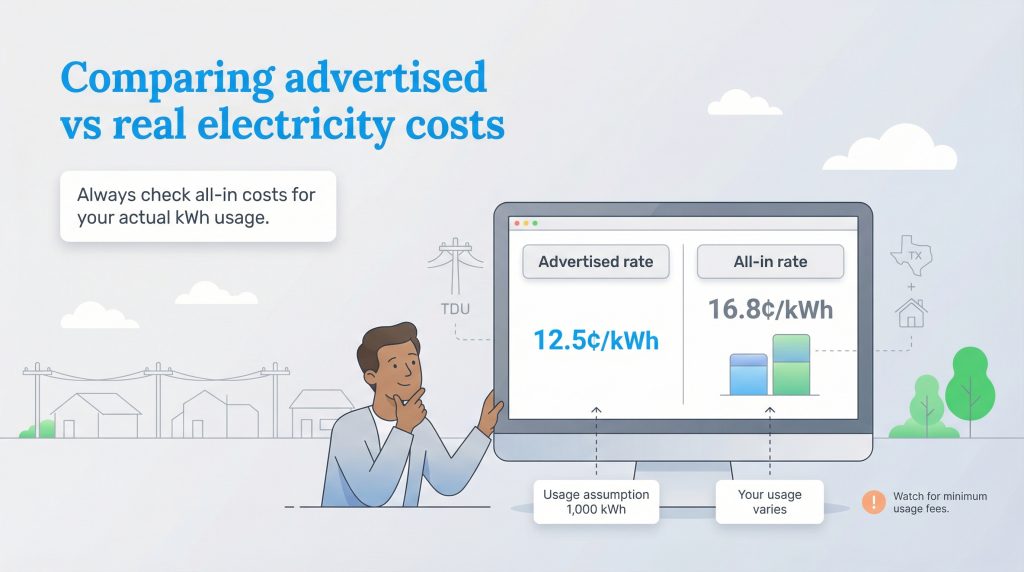
When you look at a specialized comparison of TXU Energy vs Direct Energy rates, the number you see in the big bold font is rarely the exact amount you will pay per kilowatt-hour (kWh). This is because of the difference between the “advertised rate” and the “all-in rate.” The advertised rate often assumes you use a specific amount of power, usually exactly 1,000 or 2,000 kWh. If your usage dips below or rises above that specific window, your effective rate can change dramatically. Understanding these details is key to learning how to save on your electric bill over the long term.
Furthermore, you must account for TDU delivery charges. These are fees passed through from the utility company that maintains the wires and poles in your area, such as Oncor or CenterPoint. Both TXU and Direct Energy pass these charges on to you. While the energy charge from the provider might be fixed, the TDU portion can adjust, meaning your “fixed rate” bill might still fluctuate slightly. Always look at the total estimated bill for your specific usage level, not just the cents-per-kWh figure.
Battle of the Flagship Plans: Live Brighter vs. Smart Edge
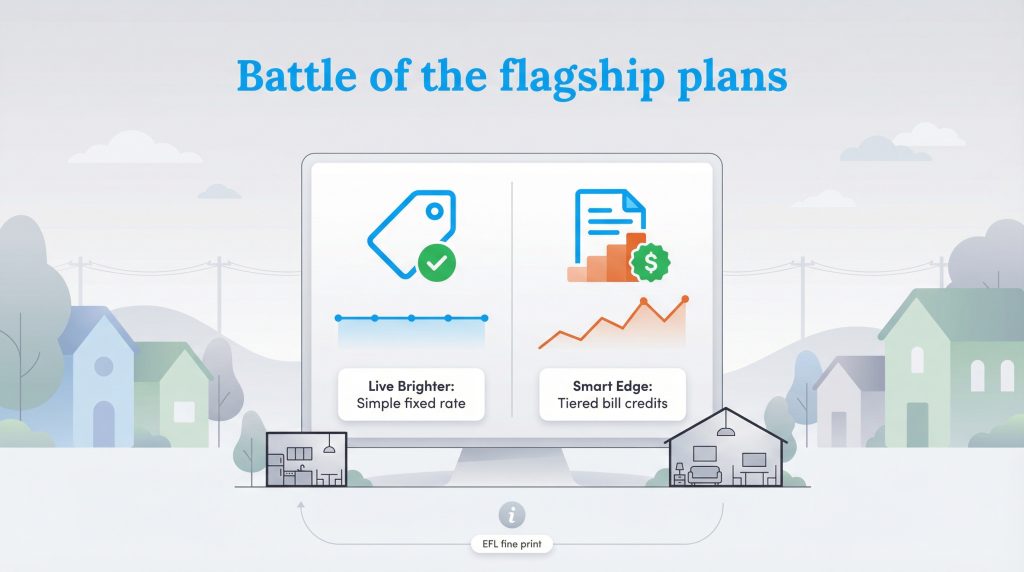
To truly understand the value difference, we have to look at the flagship plans you are most likely to see in search results. For Direct Energy, the “Live Brighter” series is a staple. For TXU Energy, you will often see “Smart Edge” or various “Free Nights” options.
Direct Energy’s “Live Brighter” plans are popular because of their simplicity. They are typically standard fixed-rate plans. You pay a set energy charge for every kWh you use, plus the TDU charges. There are fewer gimmicks, which makes predicting your bill easier if your usage varies wildly from month to month. If you travel frequently or have a small apartment with low energy needs, this structure often prevents the bill shock associated with tiered plans.
TXU Energy’s “Smart Edge” plans often utilize a tiered credit structure. For example, you might see a plan that offers a $30 bill credit once your usage hits 800 kWh, and perhaps another credit if you hit 2,000 kWh. This structure brings the average price per kWh down significantly for larger homes that consistently use a lot of power. However, if you have a very efficient home or travel for a month and fail to reach that 800 kWh threshold, you miss out on the credit, and your effective rate skyrockets.
To determine if a tiered plan is safe for you, you need to understand the fine print. We recommend reading our guide on how to read Electricity Facts Labels to spot these thresholds before you sign a contract.
TXU Energy Plans and Pricing
| Plan Name | Rate | Plan Type | Cancellation Fee | |
|---|---|---|---|---|
| Value Edge 12 | $0.135 /kWh | 12 Months Fixed Rate | $150.00 | Check Availability |
| Clear Deal 12 | $0.139 /kWh | 12 Months Rate | $150 | Check Availability |
| Smart Edge 12 | $0.139 /kWh | 12 Months Fixed Rate | $150.00 | Check Availability |
| Smart Edge 24 | $0.145 /kWh | 24 Months Fixed Rate | $295.00 | Check Availability |
| Clear Deal 24 | $0.155 /kWh | 24 Months Rate | $295 | Check Availability |
| Solar Value 12 | $0.156 /kWh | 12 Months Rate | $150 | Check Availability |
| Simple Value 12 | $0.157 /kWh | 12 Months Fixed Rate | $150.00 | Check Availability |
| Simple Rate 12 | $0.173 /kWh | 12 Months Rate | $150 | Check Availability |
| On Your Terms | $0.175 /kWh | 1 Month Months Rate | $ | Check Availability |
| Free Nights & Solar Days 12 (8 pm) | $0.189 /kWh | 12 Months Rate | $150 | Check Availability |
| Solar Club 12 | $0.191 /kWh | 12 Months Fixed Rate | $150.00 | Check Availability |
| Texas Choice 12 | $0.192 /kWh | 12 Months Fixed Rate | $150.00 | Check Availability |
| Texas Choice 24 | $0.192 /kWh | 24 Months Fixed Rate | $295.00 | Check Availability |
| Ultimate Season Pass 12 | $0.192 /kWh | 12 Months Rate | $150 | Check Availability |
| Flex Rewards | $0.193 /kWh | Variable Rate | $0.00 | Check Availability |
| Flex Forward | $0.193 /kWh | 1 Month Months Rate | $ | Check Availability |
| Smart Deal 12 | $0.196 /kWh | 12 Months Fixed Rate | $150.00 | Check Availability |
| Smart Deal 24 | $0.204 /kWh | 24 Months Fixed Rate | $295.00 | Check Availability |
| Smart Deal 36 | $0.204 /kWh | 36 Months Fixed Rate | $395.00 | Check Availability |
| Solar Saver 12 | $0.205 /kWh | 12 Months Rate | $150 | Check Availability |
| Saver's Discount 12 | $0.217 /kWh | 12 Months Rate | $150 | Check Availability |
| Saver's Discount 24 | $0.228 /kWh | 24 Months Rate | $295 | Check Availability |
*plans and pricing may vary by location
Direct Energy Plans and Pricing
| Plan Name | Rate | Plan Type | Cancellation Fee | |
|---|---|---|---|---|
| Autopay Texas 15 | $0.139 /kWh | 15 Months Fixed Rate | $150.00 | Check Availability |
| Autopay Texas 12 | $0.149 /kWh | 12 Months Fixed Rate | $150.00 | Check Availability |
| Live Brighter Lite 24 | $0.149 /kWh | 24 Months Rate | $295 | Check Availability |
| Autopay Texas 24 | $0.154 /kWh | 24 Months Fixed Rate | $295.00 | Check Availability |
| Live Brighter Lite 12 | $0.155 /kWh | 12 Months Rate | $150 | Check Availability |
| Autopay Texas 36 | $0.156 /kWh | 36 Months Fixed Rate | $395.00 | Check Availability |
| Live Brighter 1K+ 24 | $0.168 /kWh | 24 Months Rate | $295 | Check Availability |
| Twelve Hour Power 12 | $0.235 /kWh | 12 Months Rate | $150 | Check Availability |
*plans and pricing may vary by location
The Math Behind “Free Nights” and Weekends
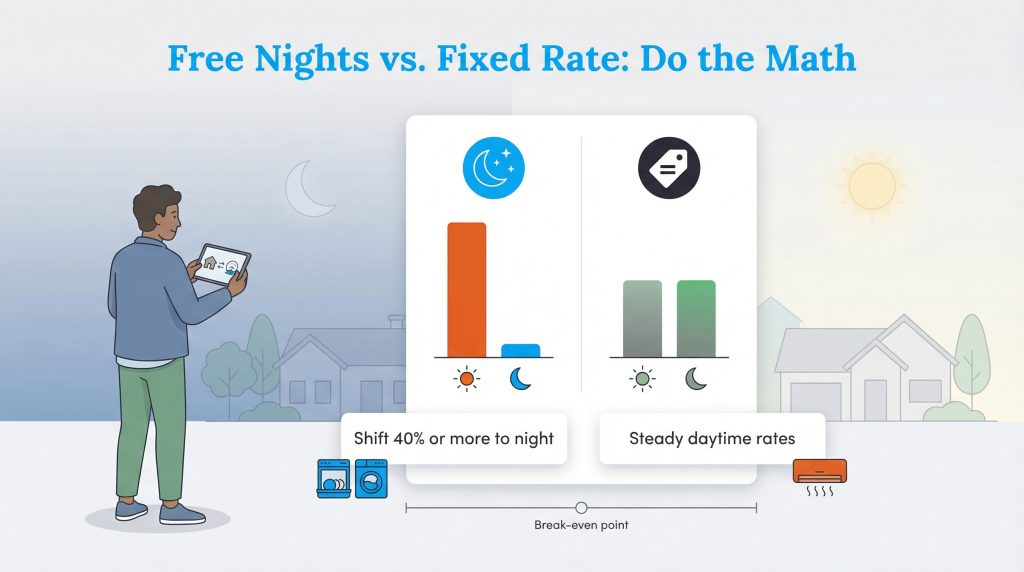
The “Free Nights and Solar Days” or “Free Weekends” plans are some of the most aggressively marketed options in Texas. Naturally, the keyword TXU Energy free nights vs Direct Energy comes up often. While the idea of not paying for electricity during certain hours sounds incredible, you have to do the math to ensure it is actually a deal.
These plans operate on a time-of-use basis. The provider gives you free energy during the specified window (e.g., 8 p.m. to 5 a.m.), but in exchange, they charge a significantly higher rate during the daytime hours. We often see daytime rates on these plans that are 3 to 5 cents higher per kWh than standard fixed plans.
For a “Free Nights” plan to save you money, in many cases, you’d need to shift roughly 40% or more of your total electricity usage to that free window. The exact break-even point depends on your plan’s day vs. night rate spread and your TDU charges. This means running your dishwasher, washing machine, and dryer late at night. If you work from home or keep your air conditioning running during the heat of the day, the higher daytime rate will likely wipe out any savings you gained overnight. For many users, a simple fixed-rate plan from Direct Energy is the safer financial bet.
Hidden Fees and Cancellation Policies
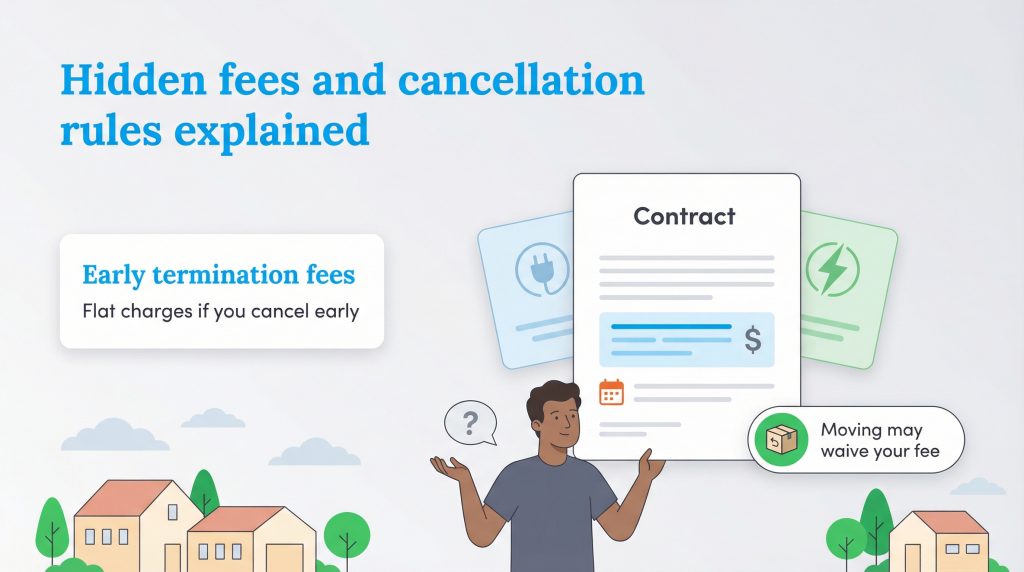
Life happens, and sometimes you need to break a contract. When comparing Direct Energy vs TXU Energy cancellation fees, you will find they are quite similar, but strict. Both providers use Early Termination Fees (ETFs) to discourage you from switching providers before your contract ends.
Direct Energy often charges flat ETFs that vary by term (for example, around $135 on some 12‑month plans and as high as about $295 on longer terms). Exact fees are listed in your plan’s Electricity Facts Label. TXU Energy follows a similar structure, with flat fees generally ranging from $150 to $295 depending on the specific plan you chose. Neither provider typically uses a “per month remaining” formula, meaning you pay the full fee even if you only have one month left on your contract.
Solar Buyback and Green Energy Options
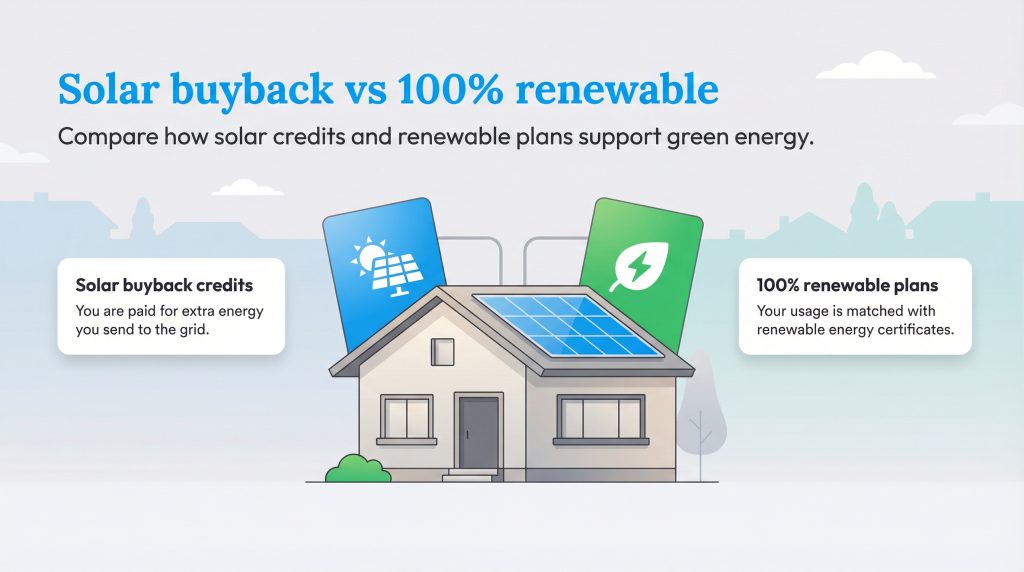
For eco-conscious homeowners, the TXU Energy vs Direct Energy solar buyback comparison is vital. Both companies have adapted to the growing number of Texas homes with solar panels, but their offers can fluctuate. TXU Energy generally offers a dedicated solar buyback plan where they credit you for the excess energy your panels send back to the grid. However, these plans often do not offer a 1:1 buyback rate, meaning they may pay you less for your power than they charge you for theirs.
Direct Energy also offers solar buyback plans in certain territories, though they are sometimes less heavily advertised than TXU’s. Beyond solar, both providers offer plans backed by 100% renewable energy certificates (RECs). Choosing a 100% renewable plan is an eco-conscious alternative that allows you to support green energy generation and reduce your carbon footprint, even if you don’t have panels on your roof. You can learn more about how renewable energy certificates work through the EPA.
Customer Service and App Experience
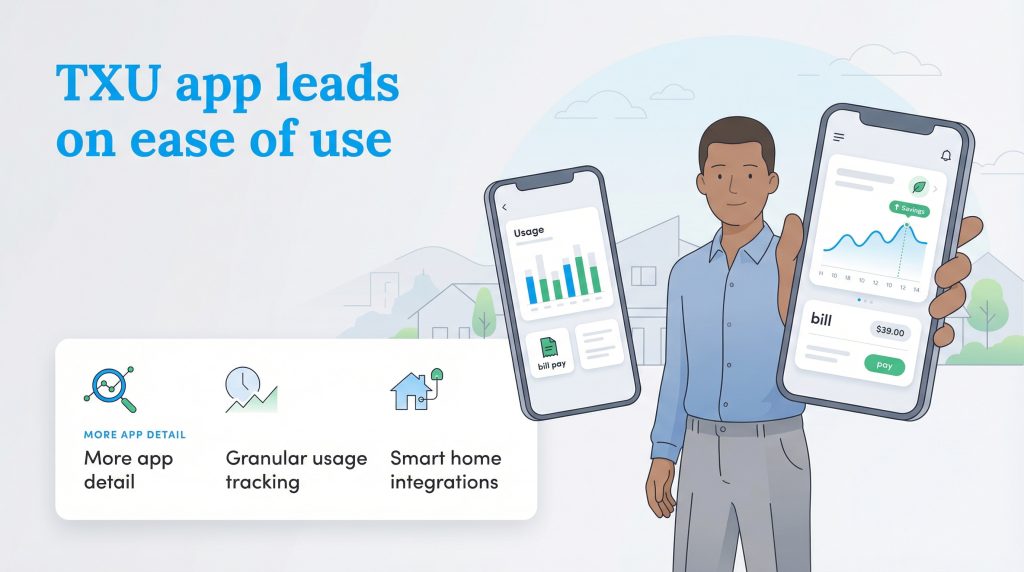
If you prefer managing your bills from your phone, this category matters. When looking at TXU vs Direct Energy reviews regarding technology, TXU Energy often takes the lead. As of recent reviews, TXU’s app typically scores higher than Direct Energy’s in both the Apple App Store and Google Play, but always check current ratings before you sign up. Their mobile app is widely considered the gold standard in the Texas market, offering granular, hour-by-hour usage tracking that helps you adjust your habits in real-time to save money.
Direct Energy provides a solid digital experience as well, with functional tools for bill pay and usage monitoring. They also have a history of integrating with smart home tech, such as Hive smart thermostats, which can be a major perk if you want to automate your energy efficiency. However, for pure “ease of use” and app reliability, TXU tends to have the edge.
Which Provider Is Right for You?
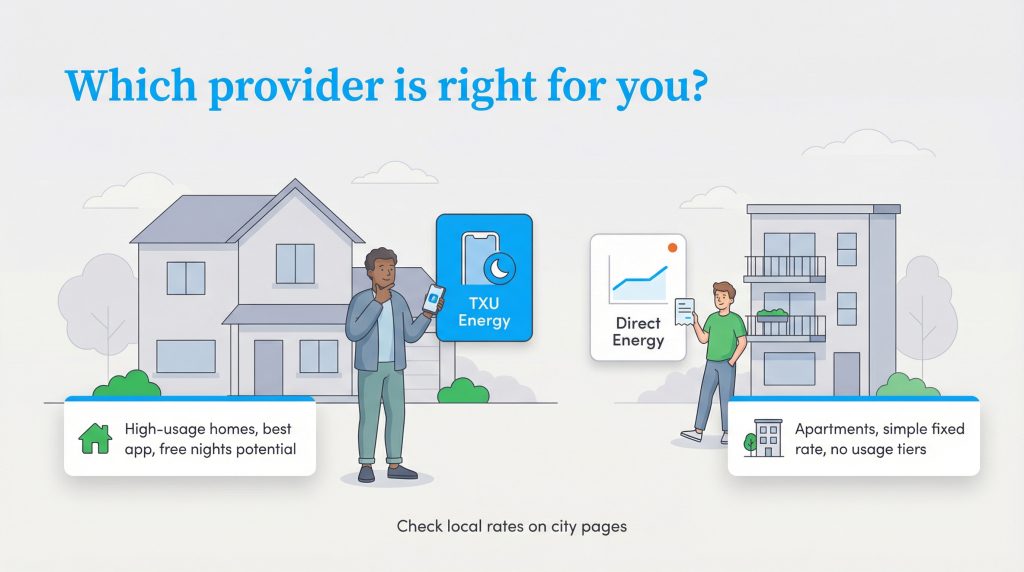
Both TXU and Direct Energy are reliable, stable choices that won’t disappear overnight. The right choice comes down to your lifestyle and home size.
- Choose TXU Energy if you have a large home with consistently high energy usage, want the best mobile app experience, or can strictly manage your habits to maximize “Free Nights” or tiered bill credits. (Best for high-usage homeowners)
- Choose Direct Energy if you prefer a simpler bill without complex usage tiers, live in a smaller home or apartment, or want the stability of a straightforward fixed rate. (Best for apartments and simple bills)
Once you have decided on a provider, be sure to check the specific rates available in your area on our Houston or Dallas utility pages to get started.
Choosing The Right Texas Electricity Fit
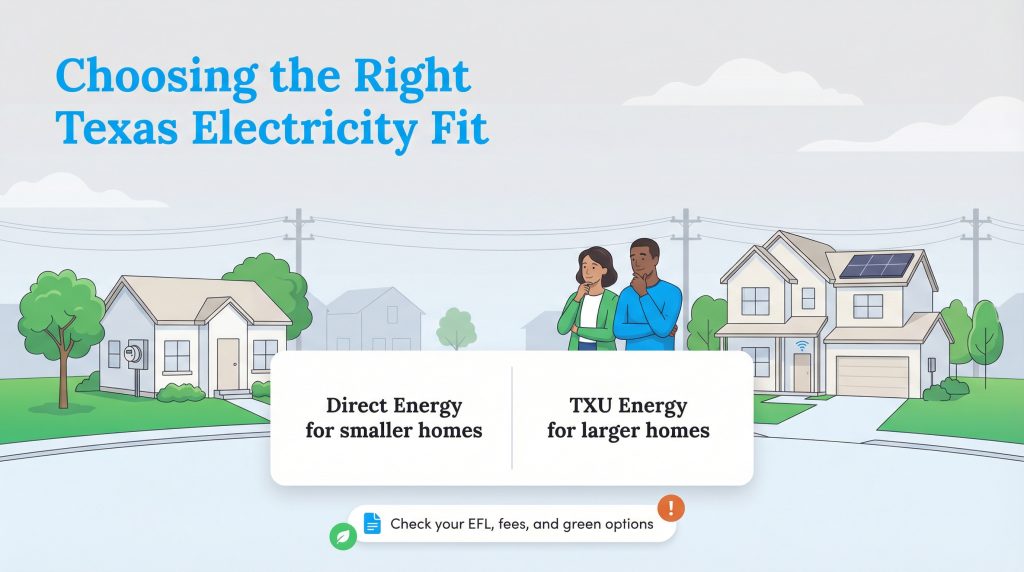
Finding the best electricity plan ultimately depends on your household’s specific needs. If you want simplicity and stability for a smaller home, Direct Energy is often the safer choice. For larger homes that can take advantage of high-usage credits or robust app features, TXU Energy is a strong contender. Whichever provider you choose, remember to check your Electricity Facts Label for TDU charges and minimum usage fees to avoid unexpected costs. By selecting an eco-conscious plan or a solar buyback option, you can also ensure your energy choice supports a more sustainable future.
FAQs About TXU Energy vs. Direct Energy
Is TXU Energy or Direct Energy cheaper?
Do TXU and Direct Energy require a deposit?
Who owns TXU and Direct Energy?
Can I switch from Direct Energy to TXU Energy without a penalty?
Where can I compare official rates for these providers?
About the Author

David has been an integral part of some of the biggest utility sites on the internet, including InMyArea.com, HighSpeedInternet.com, BroadbandNow.com, and U.S. News. He brings over 15 years of experience writing about, compiling and analyzing utility data.