


The best camping solar panel is the one that matches your devices, battery size, trip length, and available sunlight
Key Takeaways
- Evaluating your total wattage needs is the most critical step before investing in a camping solar panel or battery kit.
- The best portable solar panels combine high conversion efficiency with rugged, weather-resistant durability for unpredictable outdoor weather.
- Switching from gas generators to solar power provides a silent, eco-conscious energy solution that protects the environment while you explore it.
Nothing quite ruins the serenity of an off-grid escape like realizing your emergency radio, GPS, or smartphone has a completely dead battery. We want to help you avoid that exact frustration by guiding you toward the best solar panels for camping, ensuring your gear stays charged no matter where you pitch your tent. Whether you’re a casual family camper organizing weekend getaways, a backpacker counting every ounce on the trail, or a remote worker setting up a mobile office in the woods, finding the right portable power solution is entirely within reach. You just need to match your specific outdoor lifestyle with the right wattage, connector setup, and weather resistance.
Quick Comparison: Top Portable Solar Panels for Camping
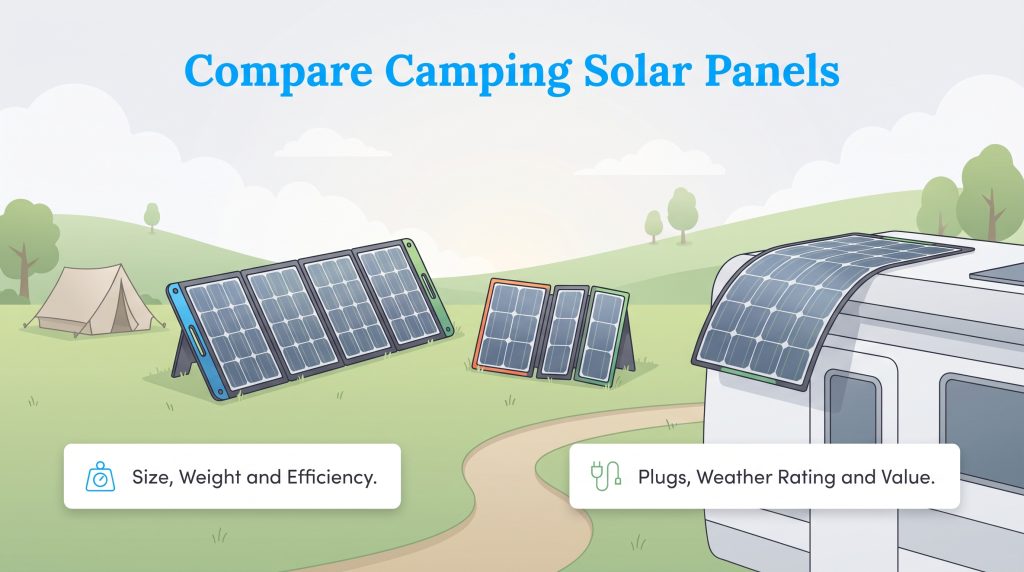
Comparing portable solar panels for camping requires looking closely at physical footprint, real-world efficiency, and plug compatibility before you head off-grid. We broke down our seven top-performing models below so you can quickly compare technical specs, weather resistance, and overall value side by side.
| Product | Best For | Price | Rated Wattage | Cell Efficiency (%) | Weight (lbs) | Folded Dimensions | Connector Type | IP Rating |
|---|---|---|---|---|---|---|---|---|
| Renogy 200W Portable Solar Panel | Best Overall Value | $219.99 | 200W | 23.5% | 14.8 lbs | 25.2 x 21.1 x 2.1 in | MC4 + USB-A/USB-C | IP65 |
| Jackery SolarSaga 200W | Jackery Power Stations | $379.99 | 200W | 24.3% | 14.1 lbs (17.6 lbs with case) | 21.2 x 24.2 x 1.6 in | Proprietary DC8020 | IP68 |
| Anker SOLIX PS100 | Compact 100W Class | $249.99 | 120W / 100W | 23.4% / 23.0% | 12.5 lbs / 10.1 lbs | 21.0 x 18.5 x 2.5 in / 21.9 x 23.9 x 1.4 in | MC4 | IP65 / IP67 |
| EcoFlow NextGen 220W Bifacial | High-Output Efficiency | $399.00 | 220W (Front) / 175W (Rear) | 25.0% | 15.9 lbs | 23.6 x 22.5 x 1.3 in | MC4 to XT60i | IP68 |
| BougeRV Arch 200W Flexible | RV & Van Roofs | $249.99 | 200W | 23.0% | 5.7 lbs | 45.4 x 27.6 x 0.08 in (Flat) | MC4 | IP68 |
| BigBlue 28W | Ultralight Backpacking | $74.96 | 28W | 24.0% | 1.25 lbs | 11.1 x 6.3 x 1.3 in | Dual USB-A | IPX4 |
| EcoFlow DELTA 2 Bundle | Complete Generator Kit | $1549.00 | 220W (+ 1,024Wh Battery) | 23.0% | 42.9 lbs Total (27 lb Battery + 15.9 lb Panel) | 23.6 x 22.5 x 1.3 in (Panel) | MC4 to XT60i | IP68 (Panel) |
Our Top Picks: The Best Solar Panels for Camping
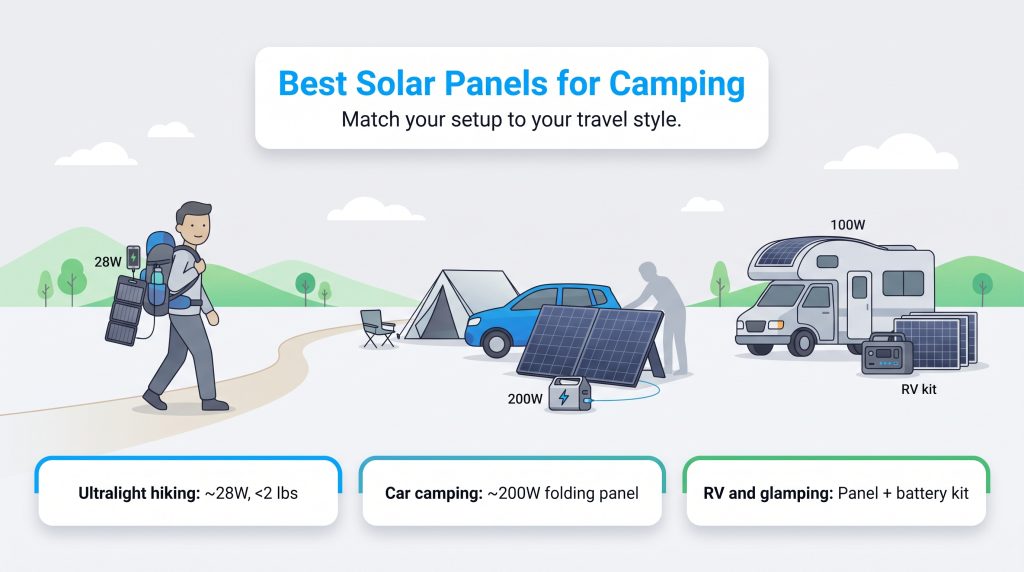
No single power solution fits every camper perfectly, since an RV owner requires a vastly different setup than an ultralight hiker. The following options are carefully categorized by specific use cases so you can track down the exact match for your unique travel style. Finding the ideal portable solar panels for camping comes down to balancing weight, wattage, and your overall budget.
Best Overall: Renogy 200W Portable Solar Panel
When you want dependable 200-watt power without paying a massive brand markup, the Renogy 200W Portable Solar Panel hits the sweet spot. Priced around $1.39 per watt, this foldable solar panel for camping delivers exceptional financial value alongside rugged field performance. Weighing in at a very manageable 14.8 pounds, its four-fold suitcase design slips easily into the back of a crossover or truck bed without hogging space meant for coolers and tents.
What truly sets this Renogy suitcase apart is its versatility right out of the box. In addition to integrated industry-standard MC4 cables that connect effortlessly to almost any third-party power station or solar charge controller, the junction box includes built-in USB-A and USB-C ports. That means you can charge smartphones, tablets, and rechargeable lanterns directly from the sun while simultaneously topping off your primary campsite battery. An ETFE-laminated surface protects the monocrystalline cells from stray branches and kicked-up gravel, making it our top recommendation for everyday car campers.
- Best For: Car campers and overlanders seeking the best balance of affordability, universal compatibility, and 200W output.
- Rated Output: 200W
- Conversion Efficiency: 23.5%
- Weight & Folded Size: 14.8 lbs; 25.2 x 21.1 x 2.1 inches
- Connectors & Ports: Integrated MC4 solar leads, two USB-A ports, and one USB-C port
- IP Rating: IP65 water-resistant (junction box is splash-proof; do not submerge)
- Pros: Outstanding cost-per-watt value (~$1.39/W), universal MC4 cables work with almost any power station, and built-in USB ports allow direct device charging.
- Cons: IP65 rating means you need to bring it inside during heavy downpours, and the kickstands require two hands to align smoothly.
Best for Jackery Power Stations: Jackery SolarSaga 200W
A 200-watt panel often hits a great balance of output and manageability for most car campers and overlanders. The Jackery SolarSaga 200W delivers exceptional power while maintaining a highly portable physical footprint. You can fold it down easily to slide alongside your camping gear in the trunk, yet it unfolds to harvest enough sunlight to keep high-demand electronics alive. With an impressive 24.3% conversion efficiency rating, it squeezes noticeable wattage out of hazy morning skies. When paired with a compatible power station, a 200W panel can help recharge the battery used for laptops, camera gear, and some efficient camping fridges, depending on weather and daily power use.
Because you do not want to waste time wrestling with complicated mounts, the integrated magnetic kickstands snap into place in seconds so you can chase the sun across the campsite. Just pay close attention to weight specs when shopping: the bare panel weighs 14.1 pounds, while variants shipped with the heavy-duty padded carrying case weigh 17.6 pounds total. Furthermore, this panel uses a proprietary DC8020 connector designed specifically to plug straight into Jackery Explorer batteries, meaning you will need an extra adapter if you use another brand.
- Best For: Campers who already own or plan to buy a Jackery Explorer portable power station.
- Rated Output: 200W
- Conversion Efficiency: 24.3%
- Weight & Folded Size: 14.1 lbs for the standalone panel (17.6 lbs including the protective carrying case); 21.2 x 24.2 x 1.6 inches
- Connectors & Ports: Proprietary DC8020 connector (includes DC8020-to-DC7909 adapter for older Jackery units; requires a third-party adapter for non-Jackery stations)
- IP Rating: IP68 waterproof and dustproof
- Pros: High 24.3% cell efficiency, seconds-flat setup with magnetic kickstands, and rugged IP68 waterproofing that shrugs off rainstorms.
- Cons: Premium price point per watt, and the proprietary hardwired cable makes connecting to non-Jackery battery brands inconvenient without adapters.
Best 100W Foldable Panel: Bluetti PV120 / Anker SOLIX PS100
If a 200W array feels too bulky for your sedan trunk or weekend power habits, stepping down to the 100-watt class makes packing dramatically easier. Both the Bluetti PV120 (which gives you a 20% wattage bonus over standard 100W units) and the Anker SOLIX PS100 represent the pinnacle of compact foldable design. They collapse down to the size of a slim briefcase, letting you tuck them behind a front passenger seat or slide them neatly beside a tent bag.
Both panels feature multi-angle, snap-button adjustable kickstands that let you dial in the exact tilt angle needed for morning, noon, or late-afternoon sun. Instead of locking you into a closed ecosystem, both the Bluetti PV120 and Anker SOLIX PS100 utilize standard MC4 output connectors. That universal plug architecture makes either model an effortless plug-and-play partner for almost any small-to-medium power station on the market, typically generating 75W to 95W of steady power under clear midday skies.
- Best For: Weekend car campers with compact vehicles who need to keep a 300Wh to 700Wh power station topped off.
- Rated Output: 120W (Bluetti PV120) / 100W (Anker SOLIX PS100)
- Conversion Efficiency: 23.4% (Bluetti) / 23.0% (Anker)
- Weight & Folded Size: 12.5 lbs and 21.0 x 18.5 x 2.5 inches (Bluetti) / 10.1 lbs and 21.9 x 23.9 x 1.4 inches (Anker)
- Connectors & Ports: Universal MC4 connectors
- IP Rating: IP65 (Bluetti PV120) / IP67 (Anker SOLIX PS100)
- Pros: Exceptionally compact trunk packability, snap-button adjustable kickstands for precise sun-angling (35°, 45°, and 55°), and standard MC4 compatibility.
- Cons: Higher cost per watt (~$2.00/W) than larger 200W panels, and may struggle to keep up with 12V fridges during cloudy weekends.
Best High-Output Bifacial Panel: EcoFlow NextGen 220W Bifacial
Traditional portable panels only harvest sunlight on one side, leaving ambient reflection completely untapped. The EcoFlow NextGen 220W Bifacial portable solar panel changes the game by integrating active solar cells on both the front and rear surfaces. While the primary face is rated at 220W, the rear side is rated for up to 175W to capture ambient light reflected off the ground. Setting this bifacial portable solar panel up on bright sand, snow, light-colored gravel, or reflective tent footprints can boost real-world output up to 193W or more in optimal conditions.
Engineered with cutting-edge N-Type TOPCon monocrystalline silicon, the NextGen model achieves an industry-leading 25% conversion efficiency and includes a built-in optical solar angle guide so you always set the panel perpendicular to the sun’s rays. Its one-piece tempered glass and ETFE construction carries a bulletproof IP68 waterproof rating, meaning it can survive a sudden torrential downpour at camp without breaking a sweat.
- Best For: Power-hungry overlanders, desert campers, and winter adventurers who want maximum wattage from a single folding unit.
- Rated Output: 220W front side / 175W rear ambient side
- Conversion Efficiency: 25.0%
- Weight & Folded Size: 15.9 lbs; 23.6 x 22.5 x 1.3 inches
- Connectors & Ports: Standard MC4 leads with an included MC4-to-XT60i charging cable
- IP Rating: IP68 waterproof and dustproof
- Pros: Dual-sided cells pull impressive extra wattage from reflective ground surfaces, integrated sun-angle guide takes the guesswork out of positioning, and top-tier IP68 weatherproofing.
- Cons: Heavier than single-sided 200W rivals, and the carrying case doubles as the kickstand, which takes a little practice to tension properly in gusty winds.
Best Flexible Panel for RV & Van Roofs: BougeRV Arch 200W Flexible
Campers outfitting a camper van, teardrop trailer, or truck canopy often prefer fixed RV solar panels that generate power automatically while driving down the highway. Instead of bolting heavy aluminum-framed glass panels to your roof rack, the BougeRV Arch 200W Flexible solar panel offers an aerodynamic, featherweight alternative. Weighing just 5.7 pounds — roughly a third of the weight of a rigid 200W panel — it bends up to 270 degrees to hug curved fiberglass RV roofs, Airstream trailers, or pop-top campers without creating wind drag or whistling highway noise.
Reinforced with specialized fiberglass and durable ETFE coating, the BougeRV Arch 200W avoids the micro-cracking problems that used to plague cheaper flexible panels. Keep in mind that because it is designed for semi-permanent or permanent mounting via pre-drilled grommets or high-bond adhesive tape, it lacks a kickstand or carry handle. You will also need to wire its standard MC4 leads through a solar charge controller if you are charging a 12V house battery directly rather than plugging into a portable power station.
- Best For: Van-lifers, RV owners, and overlanders who want a lightweight, low-profile panel mounted directly to a curved vehicle roof.
- Rated Output: 200W
- Conversion Efficiency: 23.0%
- Weight & Folded Size: 5.7 lbs; 45.4 x 27.6 x 0.08 inches (does not fold; bends up to 270 degrees)
- Connectors & Ports: Standard MC4 connectors (3-foot pre-attached leads)
- IP Rating: IP68 waterproof
- Pros: Ultra-lightweight at 5.7 lbs, conforms smoothly to curved camper roofs, and produces zero wind noise at highway speeds.
- Cons: Does not fold for trunk storage, lacks kickstands for sun-tracking, and can lose efficiency from heat buildup if mounted flush against a dark roof without airflow channels.
Best Ultralight Panel for Backpacking: BigBlue SolarPowa 28W
If you consider yourself a minimalist backpacker, every ounce in your pack matters. You cannot lug around a rigid 15-pound panel while trekking miles into the backcountry. Instead, clipping a lightweight panel directly to your backpack allows you to continuously trickle-charge a smartphone, satellite communicator, or USB power bank while you hike under the open sky. Small solar panels for backpacking must prioritize weight, packability, and durability over sheer power.
The BigBlue 28W excels in these harsh trail environments. It features a rugged, weather-resistant polymer exterior and four reinforced grommets with included carabiners, making it simple to strap to the outside of your pack. While exploring the best foldable solar panel for camping on foot, you will find that its built-in smart IC chip automatically restarts charging after you hike out from under dense tree canopy shade. It folds up to the size of a standard magazine, ensuring you barely notice the extra cargo on your back.
- Best For: Backpackers, thru-hikers, and kayak campers who only need to charge small USB electronics like phones, headlamps, and GPS beacons.
- Rated Output: 28W
- Conversion Efficiency: 24.0%
- Weight & Folded Size: 1.25 lbs; 11.1 x 6.3 x 1.3 inches
- Connectors & Ports: Dual 5V/2.4A USB-A ports (up to 4.0A max combined output)
- IP Rating: IPX4 splash-resistant
- Pros: Featherweight 1.25 lb build, smart auto-restart circuitry handles intermittent trail shade, and packs down to the footprint of a tablet.
- Cons: Cannot charge large portable power stations or laptops, and the USB port pouch must be kept zipped shut during rain showers.
Best Complete Solar Generator Kit: EcoFlow DELTA 2 + 220W Solar Bundle
While the first six picks on our list are standalone solar panels, many campers prefer an all-in-one solar generator for camping so they do not have to shop for a battery, solar charge controller, and adapter cables separately. RV owners, family car campers, and modern “glampers” typically need to store substantial energy for overnight use to run CPAP machines, electric coolers, and small kitchen appliances. Buying a complete bundle eliminates every compatibility headache right from day one.
The EcoFlow DELTA 2 + 220W Solar Bundle pairs a rock-solid 1,024Wh lithium iron phosphate (LiFePO4) battery station with EcoFlow’s high-output 220W bifacial foldable panel. The DELTA 2 delivers a massive 1,800W of continuous AC output across six wall-style outlets, easily handling coffee makers or induction cooktops at camp while replenishing its battery from 0% to 100% in just five to six hours of crisp sunlight. Choosing camping solar panels with battery storage included is the most reliable way to guarantee you have power long after sunset. If you are serious about building a reliable solar energy system for your campsite or home backup, this turnkey package gets you outdoors without any wiring guesswork.
- Best For: Campers, RV owners, and emergency preppers who want a turnkey, all-in-one solar generator for camping without buying a battery separately.
- Rated Output: 220W Solar Panel + 1,024Wh Battery Station (1,800W AC continuous output)
- Conversion Efficiency: 23.0%
- Weight & Folded Size: 15.9 lbs for panel (23.6 x 22.5 x 1.3 inches folded) + 27.0 lbs for DELTA 2 power station (15.7 x 11.1 x 7.9 inches)
- Connectors & Ports: Panel uses MC4-to-XT60i cable; power station includes six AC outlets, two USB-C (100W), four USB-A, and 12V DC ports
- IP Rating: IP68 waterproof (solar panel only; power station must be kept dry)
- Pros: Complete plug-and-play ecosystem with zero adapter anxiety, long-lasting LiFePO4 battery rated for 3,000+ cycles, and intuitive Bluetooth/Wi-Fi smartphone app monitoring.
- Cons: High upfront investment (~$1,549), and hauling nearly 43 pounds of combined equipment is strictly limited to vehicle-based camping.
Best Budget-Friendly Solar Setup: Renogy 100W Flexible Panel
Not everyone needs a flagship model to enjoy the benefits of renewable energy in the woods. The weekend warrior who wants an eco-conscious alternative without breaking the bank can absolutely find fantastic value in the current market. The best budget solar panels for camping still deliver reliable energy, provided you know exactly what features you might be sacrificing for that lower price tag.
The Renogy 100W Flexible Panel offers an incredibly cost-effective way to start harvesting sunlight. Because it sits at a lower price point, you give up premium conveniences like rigid, adjustable kickstands or a padded carrying case. Its lightweight design works well for temporary mounting on a vehicle roof rack, RV surface, or other stable, ventilated surface. Avoid placing flexible panels directly on heat-sensitive fabric or surfaces that prevent airflow unless the manufacturer says it is safe. You still gain dependable power generation, keeping your essential electronics fully charged without draining your wallet before the trip even begins.
- Best For: DIY enthusiasts looking for a budget-friendly way to mount solar to a camper or vehicle.
- Rated Output: 100W
- Weight & Design: Extremely lightweight (~4 lbs), bendable design.
- Compatibility Notes: Uses standard connectors as a bare panel; requires a compatible charge controller and wiring to safely charge your battery.
- Pros: Highly affordable, very low profile, and easy to mount on curved surfaces.
- Cons: Lacks a kickstand for optimal sun angling; requires a separate charge controller to connect to a battery.
How to Choose the Right Camping Solar Panel
Shopping for off-grid solar gear gets overwhelming fast if you don’t know which spec-sheet numbers actually impact your weekend trip. Before pulling out your credit card, you need to weigh panel capacity, financial value per watt, plug compatibility, and how heat and rain affect real-world charging.
100W vs 200W Solar Panels for Camping
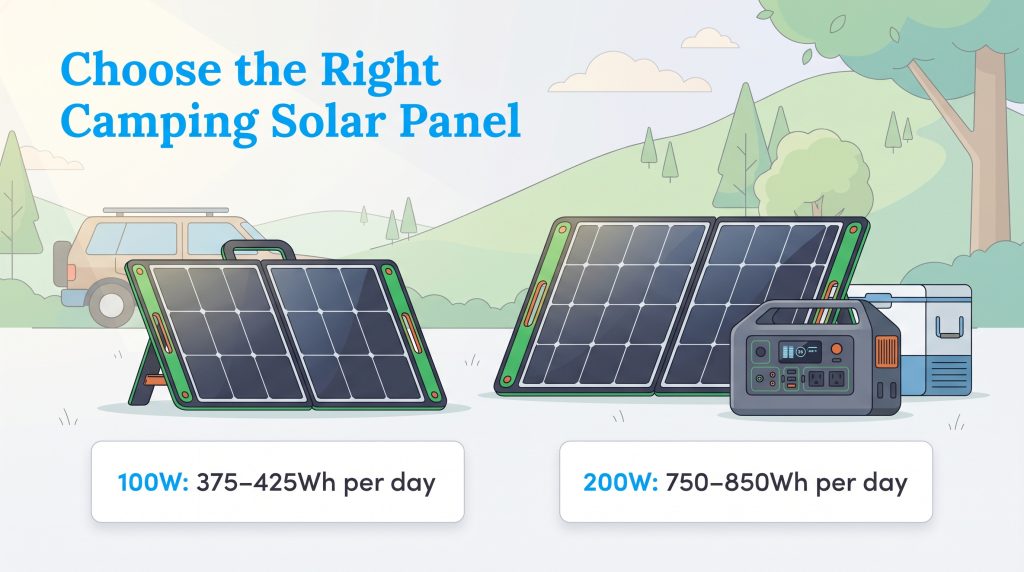
Deciding on a 100W vs. 200W solar panel camping setup comes down to your daily electricity appetite and how much trunk space you can spare. Real-world solar output typically hovers around 75% to 85% of a panel’s laboratory rating due to hazy skies, panel heat, and shifting sun angles. Under five hours of good midday sunshine, a 100W panel yields roughly 375 to 425 watt-hours (Wh) of energy per day, whereas a 200W panel harvests 750 to 850Wh daily.
Keep in mind that a larger panel is not always better if vehicle cargo space, lifting weight, or your portable power station’s input limit is restricted. Use this side-by-side breakdown to see which wattage tier aligns with your campsite routine:
What a 100W Panel Can Reliably Support:
- Battery Pairing: Portable power stations between 250Wh and 600Wh.
- Daily Personal Tech: Recharging three to four smartphones, tablets, DSLR cameras, and drones simultaneously.
- Camp Comforts: Running LED string lights, rechargeable tent fans, and a laptop for two to three hours a day.
- Medical Gear: Replenishing enough battery power for one night of CPAP use (with the heated humidifier and heated tube turned off).
What a 200W Panel Can Reliably Support:
- Battery Pairing: Large power stations and RV house batteries from 700Wh to 1,500Wh+.
- Continuous Cooling: Running a 12V compressor fridge or electric cooler 24/7 without draining your battery bank over a multi-day trip.
- Remote Work Setups: Powering a Starlink Mini dish and dual laptops for a full eight-hour workday in the woods.
- Fast Recovery: Gathering maximum wattage during short two-to-three-hour windows of direct sunlight in heavily wooded campgrounds.
Calculating Value: Cost Per Watt and Watts Per Pound
Sticker prices can be deceiving when you compare solar panels of different sizes, much like evaluating how much solar panels cost for a residential rooftop setup. To evaluate whether a panel is genuinely worth the money, use two objective metrics: Cost Per Watt and Watts Per Pound.
You can calculate Cost Per Watt by dividing the retail price by the panel’s rated wattage (Price ÷ Rated Wattage). This metric reveals why stepping up to a larger panel often saves you money per unit of energy. For example, a $250 200W panel comes out to $1.25 per watt, making it a much better financial value than a $180 100W panel that costs $1.80 per watt. In 2026, most quality portable folding panels fall between $1.30 and $2.10 per watt, with ultra-durable IP68 and bifacial models sitting near the top of that range.
Similarly, Watts Per Pound (Rated Wattage ÷ Weight in Pounds) helps car campers and backpackers judge portability efficiency. A heavy, older-generation 200W suitcase panel weighing 20 pounds delivers just 10 watts per pound. By contrast, a modern ETFE folding panel like the Jackery SolarSaga 200W (14.1 pounds bare) delivers 14.2 watts per pound, while an ultralight hiker model like the BigBlue 28W (1.25 pounds) achieves an impressive 22.4 watts per pound. The higher this number is, the less dead weight you have to haul from your trunk or carry on your shoulders.
Money-Saver
Before buying two 100W panels separately, check the price of a single 200W folding panel — you’ll almost always lower your cost per watt by 20% to 30% and avoid buying extra combiner cables.
Connector Compatibility and Daisy-Chaining
Nothing stalls a camping trip faster than unpacking a brand-new solar panel at your campsite only to discover its plug won’t fit your portable power station. While solar electricity itself is universal, brands use several different solar panel connector types. Knowing which plug is attached to your panel’s cable — and which input port sits on your battery — is essential when mixing and matching brands:
- MC4 (Multi-Contact 4mm): The universal industry standard for both rooftop and portable solar panels. Positive and negative wires terminate in separate weather-sealed plastic plugs that snap together securely. Most third-party panels (including Renogy, Bluetti, Anker, and BougeRV) come with MC4 leads, making it easy to attach cheap adapter cables for any battery brand.
- XT60 / XT60i: A compact, high-amperage yellow nylon plug used as the primary solar input on EcoFlow, Anker SOLIX, and many Bluetti power stations. The newer XT60i variant includes a third center signal pin that tells EcoFlow batteries it is safe to draw higher solar current rather than limiting the port to 8 amps for car-charging safety.
- Anderson Powerpole: Identifiable by its rectangular red-and-black modular plastic housings, the Anderson connector is a rugged staple in custom RV solar installations, camper vans, and older Goal Zero Yeti or Jackery Explorer 1000 models.
- 8mm / DC7909 / DC8020: Round barrel plugs used primarily by Jackery and Goal Zero. Older and smaller power stations typically use the 8mm (DC7909) barrel plug, while newer high-capacity Jackery Explorer Plus and Pro series batteries require the slightly thicker center pin of the proprietary DC8020 barrel connector.
If you plan to daisy-chain multiple solar panels together to recharge a big RV battery bank faster, you also need to understand series versus parallel wiring. Wiring two matching panels in series (connecting the positive MC4 plug of Panel A to the negative MC4 plug of Panel B) adds their voltages together while keeping amperage the same — which pushes power efficiently through long cable runs. Wiring panels in parallel (using Y-branch combiners to join both positives together and both negatives together) keeps voltage constant while doubling the amperage. Before connecting panels in series, always inspect the side label on your portable power station for its maximum solar input voltage and compare it against your panels’ combined Open Circuit Voltage (Voc). Exceeding your power station’s max input voltage — even by a few volts on a cold, sunny morning — can permanently fry its internal charge controller.
Weather Resistance (IP Ratings) and Heat Impact
Outdoor gear takes a beating, so deciphering a solar panel’s Ingress Protection (IP) rating helps you prevent costly water damage. In an IP rating like IP68, the first digit (6) indicates complete protection against trail dust and blowing sand, while the second digit measures water resistance. An IPX4 rating (found on ultralight backpacking panels with open USB ports) only handles light splashes from morning dew. An IP65 panel resists low-pressure water jets and light passing drizzle, but its zippered cable pouch should never sit in puddles. If you camp in the Pacific Northwest or high mountain basins where afternoon thunderstorms roll in without warning, look for IP67 or IP68 panels. Those sealed, one-piece laminated panels can survive heavy rainstorms and even temporary submersion up to one meter deep.
Pro Tip
Always check a solar panel’s IP (Ingress Protection) rating before you purchase it, as a rating like IP67 or IP68 is designed to resist dust and temporary water exposure under tested conditions.
Surprisingly, scorching heat is just as tough on solar production as rain clouds. Many campers assume a blazing 100°F desert afternoon generates peak wattage, but solar cells actually lose voltage and efficiency when they overheat — a physics trait measured on spec sheets as the temperature coefficient. Every solar panel is rated at a comfortable laboratory cell temperature of 77°F (25°C). For every degree the panel surface climbs above 77°F, monocrystalline cells typically lose about 0.35% to 0.45% of their power output. Because dark solar panels baking in direct summer sun can easily reach surface temperatures of 140°F to 150°F, heat alone can shave 15% to 25% off your real-world wattage. To combat heat loss, always prop your foldable panels up on their kickstands so cooling breezes can circulate underneath, and avoid laying portable panels flat on hot car roofs, truck tonneau covers, or dark asphalt.
How Many Watts Do You Need for Camping?
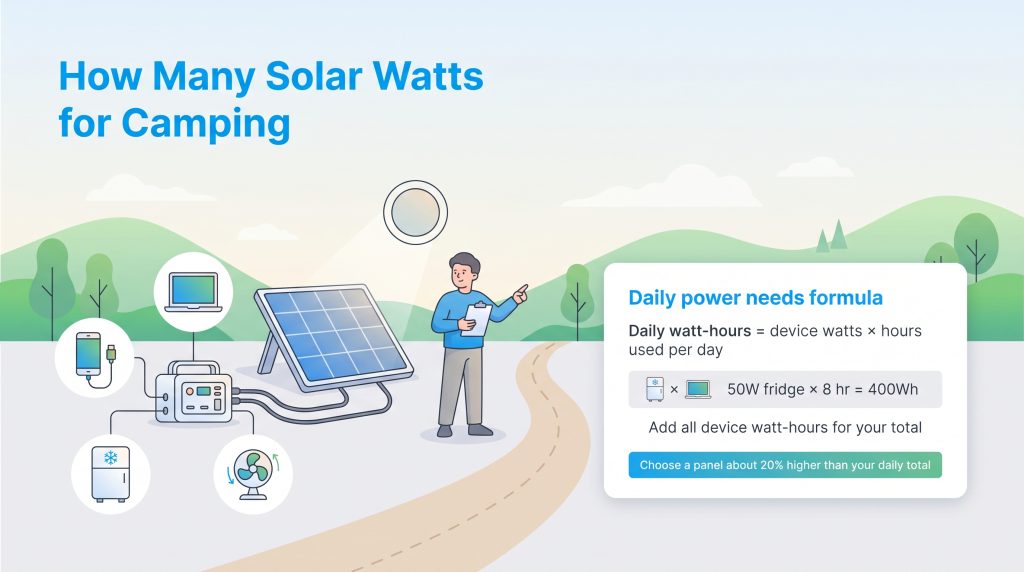
Before purchasing any equipment, you must solve the fundamental technical problem of matching a panel to your daily power consumption. Figuring out exactly how many watts solar panel for camping equipment you need simply involves adding up the watt-hours of the devices you plan to charge. Think of watt-hours as the total volume of electricity a device pulls over a set period of time.
Quick Fact
You can easily estimate your power needs using a simple formula: Daily watt-hours = device watts × hours used per day. For example, a 50W fridge running the equivalent of eight hours per day uses about 400Wh daily.
To determine your exact needs, list everything you want to power. Multiply each device’s running wattage by the number of hours you expect to use it daily. Once you have that total, learning how solar panels work will help you understand how solar energy generation works to replenish that specific capacity. Always aim to buy a panel that generates at least 20% more power than your calculated daily minimum, as clouds, shade, and imperfect panel angles will inevitably reduce your real-world output.
| Camping Device | Estimated Average Wattage | Typical Daily Usage | Estimated Daily Watt-Hours |
|---|---|---|---|
| Smartphone | 5W – 10W | 1 – 2 hours (charging) | 5Wh – 20Wh |
| LED String Lights | 5W – 10W | 4 – 5 hours (evening) | 20Wh – 50Wh |
| Portable Fan | 10W – 15W | 8 hours (overnight) | 80Wh – 120Wh |
| CPAP Machine (Heated Humidifier Off) | 15W – 30W | 8 hours (overnight) | 120Wh – 240Wh |
| Starlink Mini / Portable Wi-Fi | 20W – 40W | 4 – 8 hours (active use) | 80Wh – 320Wh |
| Laptop | 45W – 65W | 2 – 3 hours (charging) | 90Wh – 195Wh |
| Mini-Fridge | 35W – 50W | 24 hours (cycling on and off) | ~300Wh – 400Wh |
| Electric Cooler / 12V Fridge | 45W – 60W | 24 hours (compressor cycling ~8 hrs) | 360Wh – 480Wh |
Powering Critical Devices Off-Grid: CPAP Solar Setups
Taking your sleep apnea therapy into the great outdoors used to mean dragging heavy marine batteries to your campsite. Now, creating a dedicated camping solar setup for CPAP machines is highly accessible, provided you plan the logistics correctly. A solar panel alone will not keep your medical device running at night since it obviously stops generating power once the sun sets. You must pair the panel with a high-capacity portable power station that features a reliable AC outlet or a dedicated DC port specifically rated for your CPAP brand.
When you rely on medical equipment off-grid, ensuring you have enough battery storage to make it through the night is non-negotiable. Using a 12V or 24V DC converter cord plugged into your power station’s car-style cigarette lighter port prevents the 15% to 20% energy loss caused by running the power station’s AC inverter all night. Always check your CPAP manufacturer’s power requirements, use a compatible DC adapter when available, and test your exact setup at home before relying on it overnight in the woods. Bring backup power just in case.
Heads Up
Turning off the humidifier and heated hose can reduce power use significantly, but you should test your exact CPAP-and-battery setup at home before relying on it overnight.
How We Evaluated the Best Camping Solar Panels
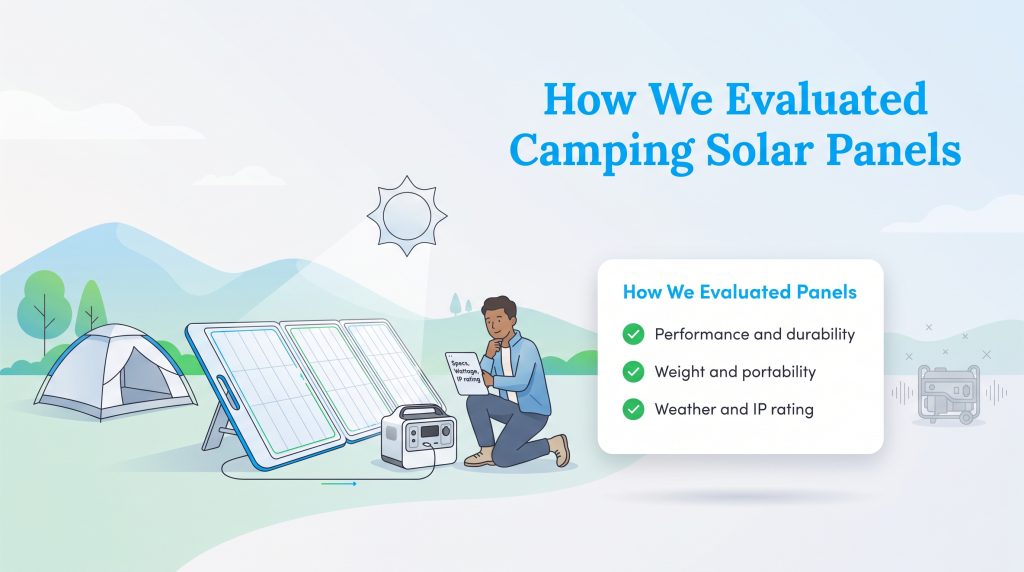
Selecting the right equipment requires looking far beyond flashy marketing claims. Across the different types of solar panels on the market, we evaluated these camping solar panels by analyzing monocrystalline silicon conversion efficiency, kickstand stability in high winds, cable storage ergonomics, weather-resistance ratings, and watts-per-pound ratios across common outdoor scenarios. An off-grid setup has to withstand unpredictable conditions while consistently delivering enough power to keep your devices running smoothly.
Specifically, we required every panel on our list to achieve at least a 23% cell conversion efficiency so you aren’t stuck waiting all day in partial forest shade for a recharge. We also scrutinized physical design details that make or break a campsite experience: flimsy fabric kickstands that collapse in a 15-mph breeze lost points to rigid, snap-strap legs and reinforced case supports. We checked integrated zippered pouches to ensure hardwired MC4 or DC cables don’t kink or pinch when folded, and calculated watts-per-pound and cost-per-watt ratios to separate genuinely portable, high-value panels from overpriced heavyweights.
You also need a system that respects the quiet nature of the outdoors. We highly recommend following guidance from the National Park Service’s Natural Sounds division, which heavily encourage minimizing noise pollution at your campsite. Silent solar setups are infinitely preferable to loud, exhaust-spewing gas generators when you want to preserve the peaceful atmosphere of nature. Furthermore, the true test of any panel is its ability to handle physical abuse on the trail. We focus on ETFE-laminated options that do not easily crack, delaminate, or fray after repeated deployments, ensuring your investment outlasts many seasons of heavy use.
Keeping Your Panels at Peak Performance
A frustrating post-purchase maintenance gap often leaves campers confused when their equipment suddenly stops charging efficiently halfway through a trip. Solar cells are highly sensitive to physical obstructions, meaning a thin layer of trail dust, sticky pine pollen, or accidental mud splatter drastically reduces their conversion efficiency. You should regularly wipe down the surface of your panels using a soft microfiber cloth and a splash of distilled water to keep them operating at maximum capacity. Never use harsh chemical cleaners or abrasive sponges, as scratching the protective coating will permanently degrade the panel’s ability to harvest light.
To ensure your panels last for years, keep these simple maintenance habits in mind:
- Store panels dry and loosely folded, rather than crushed under heavy camping gear.
- Keep your connectors capped or protected from dirt and grit when not in use.
- Avoid dragging your flexible or foldable panels across sharp rocks and rough surfaces.
- Never aggressively scrub the coated surface of the solar cells.
Eco Edge
You can maximize your renewable energy capture simply by properly angling your panels directly toward the sun, making sure to adjust them periodically throughout the day as the sun moves across the sky.
Making the Switch to Sustainable Campsite Power
Embracing renewable energy on your next outdoor adventure offers far more than just a convenient way to keep your phone charged. Compared with gas generators, solar panels are quiet, do not require fuel during use, and produce no exhaust at the campsite. It is an environmentally mindful choice that aligns perfectly with sustainable living goals and actively preserves the quiet, clean nature of the outdoors we all love to explore. By thoughtfully selecting the right equipment — or exploring community solar programs to lower your carbon footprint back home — reducing your overall electricity footprint becomes a seamless part of your routine. You can confidently head off-grid knowing your campsite will stay fully powered and wonderfully peaceful.
Frequently Asked Questions About Camping Solar Panels
Why isn’t my portable solar panel producing its full rated wattage?
Can a camping solar panel overcharge my battery or smartphone?
Can you mix and match different brands of solar panels and portable power stations?
What is the difference between flexible and rigid solar panels for camping?
Can a 100W solar panel run a camping fridge?
Do portable solar panels work in the rain or heavy clouds?
Are solar panel kits for camping worth the investment over gas generators?
About the Author

LaLeesha has a Masters degree in English and enjoys writing whenever she has the chance. She is passionate about gardening, reducing her carbon footprint, and protecting the environment. She also recently served as President of the Board for City Sprouts (a community garden).

David has been an integral part of some of the biggest utility sites on the internet, including InMyArea.com, HighSpeedInternet.com, BroadbandNow.com, and U.S. News. He brings over 15 years of experience writing about, compiling and analyzing utility data.

Jared Evans is a licensed electrician and the owner of Full Circuit Electric in Omaha, Nebraska. As an expert reviewer for UtilitiesForMyHome.com, Jared uses his 10+ years of hands-on experience to ensure our electrical advice is safe, accurate, and easy to follow. Whether he's troubleshooting a complex wiring issue or sharing tips on green energy upgrades, Jared is dedicated to helping you power your home efficiently — and safely.