

Before You Move, Verify Your Vermont Home’s Heating Costs, Internet Access, and Utility Responsibilities
Key Takeaways
- While Vermont offers incredible access to nature, newcomers must budget for a higher cost of living driven by winter heating and housing availability.
- Because so many properties sit outside town centers, setting up utilities in Vermont often involves coordinating with private well inspectors, delivered fuel providers, and regional broadband networks.
- Taking advantage of local weatherization programs and heat pump rebates is an excellent way to lower your carbon footprint and manage winter energy bills.
Daydreaming about moving to Vermont usually conjures up images of woodsmoke curling from a farmhouse chimney, maple syrup stands, historic covered bridges, and crisp mountain air. That nature-connected pace of life is very real, but relocating to the Green Mountain State means learning a new way to run a household. Before you pack the moving truck, you need to understand how dirt roads, private septic systems, and subzero January nights affect your daily routine and your wallet. We are breaking down the practical pros and cons, the cost of living, and a step-by-step roadmap for setting up utilities in Vermont so you can build an efficient, comfortable, and eco-conscious home.
Honest Pros and Cons of Living in Vermont
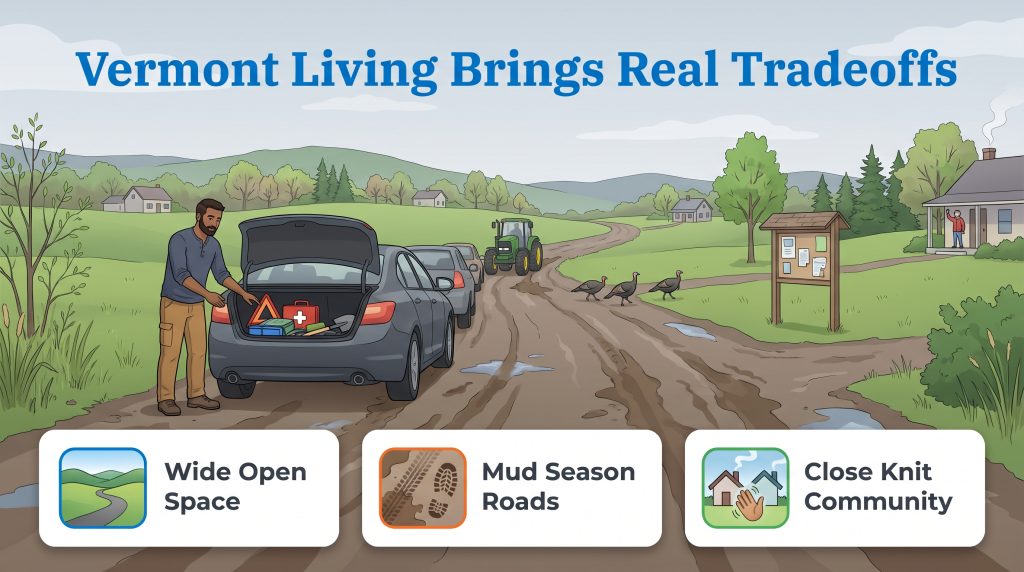
Vermont is much more than a pretty autumn postcard; it is a working rural state with distinct seasonal and infrastructure trade-offs. Locals are fiercely protective of their natural landscape (the state restricts off-premises advertising, helping preserve roadside scenery) and place a high value on community involvement. Weighing the pros and cons of living in Vermont comes down to how happily you can trade immediate retail convenience for wide-open green space and close-knit civic life.
| Pros of Living in Vermont | Cons of Living in Vermont |
|---|---|
| Preserved mountain scenery and restricted billboard advertising along highways | Long, dark, and cold winters stretching from November to April |
| Strong civic engagement and active town meeting participation | Spring freeze-thaw conditions that can severely rut unpaved dirt roads |
| A highly renewable electricity generation mix within the state | Severely limited housing inventory for both buyers and renters |
| Four-season outdoor recreation right out your back door | High property taxes, state income taxes, and winter heating bills |
| Vibrant local food systems, farm stands, and independent businesses | Very few late-night dining options, big-box stores, or delivery apps |
If you are moving to Vermont from a manicured suburb, the biggest adjustment is how the calendar dictates your routine. Between late March and May, Vermonters endure what everyone calls “Mud Season.” As the ground thaws, unpaved gravel roads can turn into deep, soupy ruts that are temporarily difficult to travel in a low-clearance sedan. You will also notice a distinct cultural rhythm. Vermonters are famously reserved and respect your privacy, but on rural roads, you should always keep an emergency kit in your car and confirm that your roadside assistance covers the area.
Quick Fact
Vermont has one of the smallest populations in New England at roughly 645,000 residents and a high percentage of rural residents, meaning “rush hour” often involves waiting for a John Deere tractor or a flock of wild turkeys to cross the road.
Breaking Down the Cost of Living in Vermont
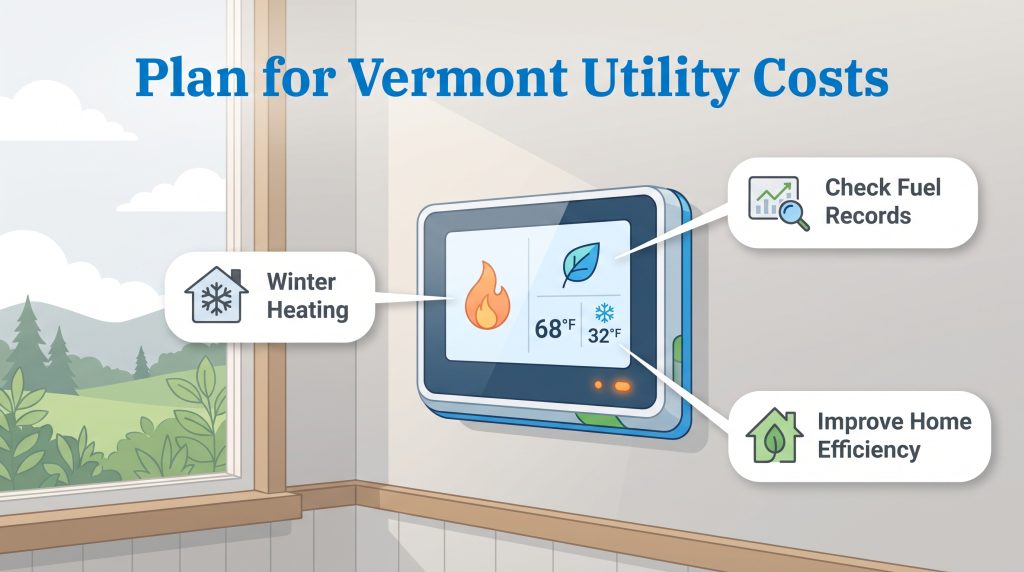
While rural New England doesn’t carry the immediate sticker shock of Boston or Manhattan, the true cost of living in Vermont catches many newcomers off guard. Housing costs vary widely by region, with Chittenden County often seeing the highest real estate prices in the state. Beyond your mortgage or rent, you need to factor in a top marginal state income tax rate of 8.75% on the highest earning brackets and education property taxes that fund local schools. If you choose an older home, maintaining and heating a vintage cape or farmhouse is often where household budgets feel the biggest squeeze.
What Is the Average Utility Cost in Vermont?
Ask a local about the average utility cost in Vermont, and they will ask you what month it is. Your monthly expenses will fluctuate dramatically between July and January. Because summer highs rarely stay in the 90s for long, most homes do not even have central air conditioning, keeping summer utility bills delightfully low. Once November rolls around, however, winter heating bills will demand a significant portion of your budget, depending on your home’s insulation and fuel setup. According to the U.S. Energy Information Administration’s Vermont State Energy Profile, roughly three in five Vermont households use petroleum products like fuel oil or propane for home heating. To accurately build your budget, always request specific documentation from the seller or landlord before you commit to a property.
| Expense | Best Information to Request |
|---|---|
| Electricity | Recent bills, annual kWh use, and current rate plan |
| Heating fuel | Delivery history, gallons used, contract terms, and tank ownership |
| Water and septic | Local rates or testing, maintenance, and repair records |
| Internet | Written availability confirmation, installation quote, and recurring price |
| Waste | Hauler quote or transfer-station fees and accepted materials |
- Electricity: While your specific utility and rate plan determine your bill, usage is heavily driven by your heating equipment, appliances, and home efficiency. Local utilities supply power that is heavily backed by renewable generation.
- Heating Oil and Propane: Delivered fuels fluctuate with global energy markets. For example, if a drafty home burns 700 gallons of oil over a single winter at an assumed $4 per gallon, that adds $2,800 to your seasonal heating expenses. Asking for 12 to 24 months of actual fuel-delivery records is the best way to estimate your future costs.
- Water, Sewer, and Trash: If you live within a town or city boundary, you will pay local fixed and usage charges for municipal water and sewer. Rural homes on private drilled wells have no municipal water bill, but you must budget for water testing, treatment systems, well pump electricity, and replacement reserves. Septic systems also require ongoing maintenance and routine pumping to prevent costly failures.
Best Places to Live in Vermont for Your Lifestyle
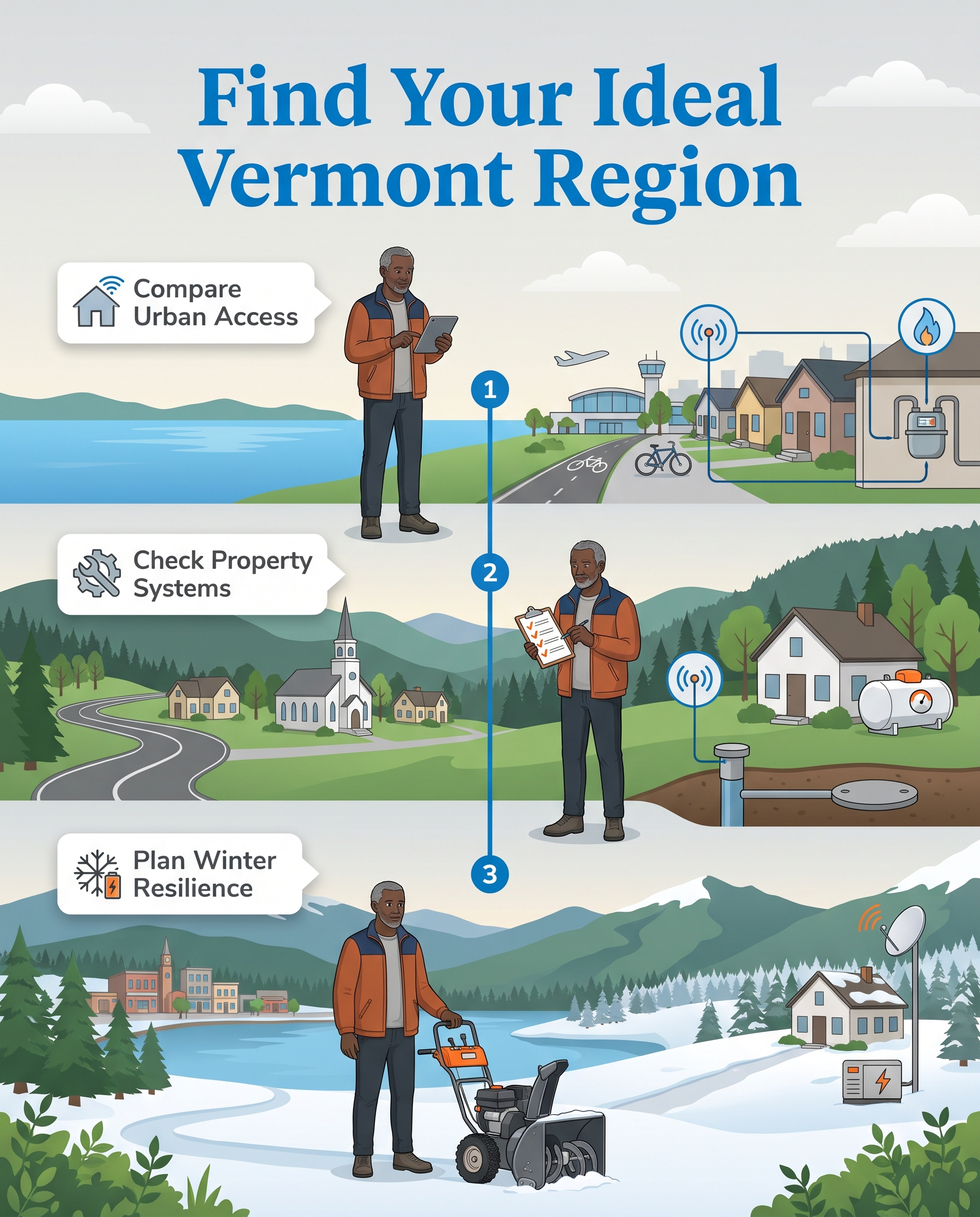
Where you decide to put down roots in the Green Mountain State dictates everything from your daily commute to which utility companies serve your address. Terrain and mountain gaps divide the state into distinct micro-regions with very different amenities. Rather than treating the state as a single rural expanse, it helps to look at the best places to live in Vermont through three regional lenses.
Chittenden County and the Burlington Area
Centered along the eastern shore of Lake Champlain, Chittenden County is Vermont’s most urban, energetic hub. Communities like Burlington, South Burlington, Essex, Williston, and Shelburne offer a lively arts scene, major healthcare employers, and easy access to Patrick Leahy Burlington International Airport. From a home infrastructure standpoint, this is the only region in the state with a broad natural gas distribution network (operated by Vermont Gas Systems, which also serves parts of Franklin and Addison counties). You will also find extensive cable and fiber internet coverage here. The trade-off is fierce competition for real estate, with the highest home prices and apartment rents in the state.
Central Vermont and the Upper Valley
If you picture classic white-steepled villages tucked between steep wooded ridges, look toward Central Vermont and the Upper Valley along the Connecticut River. Towns like Montpelier (the nation’s smallest state capital), Waterbury, Stowe, Waitsfield, Woodstock, and White River Junction are magnets for remote workers and outdoor enthusiasts. You get immediate access to world-class alpine and Nordic ski trails alongside strong community fiber networks and quick highway connections via Interstate 89 and Interstate 91. While municipal water exists in village centers, moving just two miles up a hillside road can put you firmly in private well, septic, and delivered propane territory.
Southern Vermont and the Northeast Kingdom
Southern hubs like Brattleboro, Manchester, and Bennington offer vibrant downtowns and convenient proximity for anyone commuting or visiting family in Massachusetts, New York, or Connecticut. At the complete opposite end of the spectrum sits the Northeast Kingdom — made up of Caledonia, Essex, and Orleans counties in the state’s northeastern corner. The “NEK” typically offers more affordable acreage, quietest lakes, and deepest solitude in Vermont. However, living here demands serious winter self-reliance, including planning for winter power outages, long private driveways that require heavy snow-clearing equipment, and careful vetting of rural broadband options.
Money-Saver
While state-funded remote worker grants open and close periodically based on legislative funding, you should always check whether these relocation incentives are currently active before signing a lease or mortgage, but never rely on them to balance your primary budget.
Setting Up Utilities in Vermont: Step-by-Step Guide
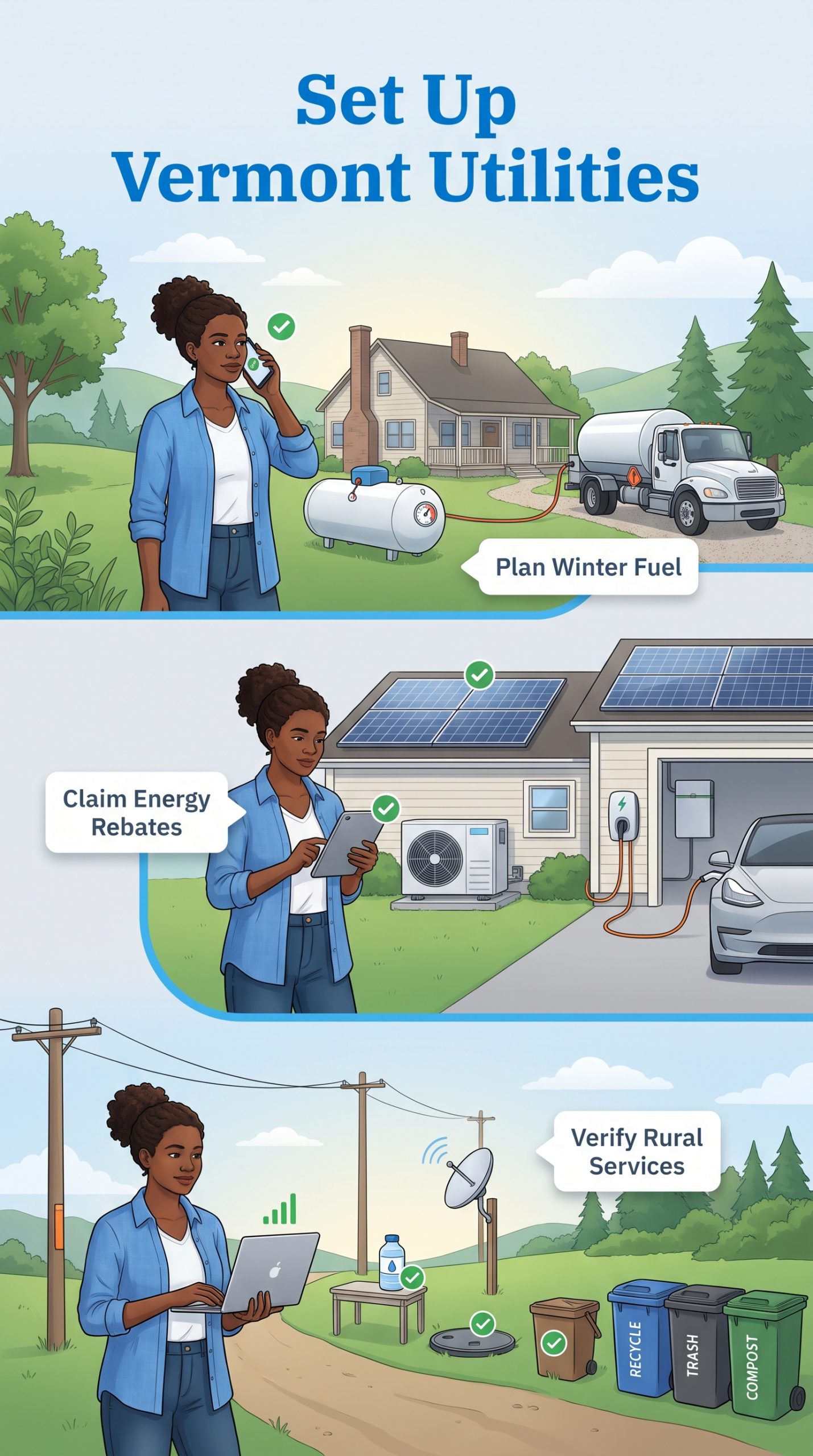
Unlike moving into a suburban subdivision where one quick phone call activates your gas, water, and trash, setting up utilities in Vermont requires a bit of project management. Because so many properties sit outside village boundaries, you will likely coordinate a patchwork of regulated electric utilities, family-owned fuel dealers, community broadband districts, and town transfer stations. Reviewing our home moving and utility setup resources early in your home search will keep you from scrambling on closing day.
Heating a Home in a Vermont Winter
For almost every newcomer, heating a home in a Vermont winter is the steepest learning curve. Because a significant portion of households rely on fuel oil, liquid propane, wood or wood pellets, or cold-climate heat pumps, you must be proactive about your fuel supply. If your home uses oil or propane, you need to set up an account with a local fuel dealer in late summer or early fall. Do not wait until the first frost in October, when technicians are booked weeks out for safety inspections.
When you call local fuel companies, double-check whether your propane tanks are owned by the homeowner or leased from a specific dealer; if they are leased, you must either buy fuel from that company or pay to have another dealer swap out the tanks. With automatic delivery, the dealer tracks daily winter temperatures to estimate your fuel usage and schedules a refill, but you should always ask about tank monitoring, access requirements, and runout procedures. Separately, you can ask about budget billing to spread your payments evenly throughout the year, or fixed-price and pre-buy contracts that lock in a specific per-gallon rate, though these may carry additional fees.
Claiming Vermont Solar and Heat Pump Rebates
High fossil fuel prices are the main reason so many Vermonters are transitioning their homes to run on clean electricity. By tapping into state and utility rebates, you can upgrade your home’s efficiency. Installing ENERGY STAR certified cold-climate ductless heat pumps and heat pump water heaters is an energy-saving option that cuts reliance on delivered oil or propane while providing high-efficiency air conditioning during sticky July afternoons. You can browse current point-of-sale discounts and cash-back incentives directly through Efficiency Vermont’s official rebates hub before you hire an HVAC contractor, though customers of Burlington Electric Department or Vermont Gas Systems should check those specific utility programs for eligible pathways.
When you set up your home electricity service, ask your provider about their smart energy storage and rate programs too. Green Mountain Power, which serves roughly three-quarters of the state’s residential customers, offers innovative lease and rebate programs for home battery backups like the Tesla Powerwall, as well as discounted off-peak EV charging rates. Keep in mind that standard grid-tied rooftop solar doesn’t automatically operate during a power outage. You will need specialized isolation equipment and a home battery to keep essential loads running. Even then, batteries have limited capacity, and many fuel-burning heating systems require electricity to circulate heat, so you should discuss your exact backup needs with a qualified installer.
Eco Edge
Schedule a comprehensive Home Energy Visit or weatherization audit through Efficiency Vermont during your first year in your home to seal attic air leaks, upgrade insulation, and completed improvements can significantly cut your winter heating demand.
Navigating Rural Internet Providers in Vermont
If your job depends on video calls, researching rural internet providers in Vermont before you sign a purchase contract or lease is essential. In many areas, traditional cable or fiber lines may end unexpectedly, regardless of whether the road is paved. Providers like Xfinity, Fidium, local telephone companies, and community networks serve very different footprint areas, so you can’t assume service based on a ZIP code alone.
To solve the rural digital divide, Vermont towns banded together to create Communications Union Districts (CUDs). These are municipal entities through which towns cooperate on communications infrastructure, though ownership and retail service arrangements differ. Networks associated with CUDs — like ECFiber in East-Central Vermont, CVFiber, and NEK Broadband — are stringing symmetrical fiber to many rural homes. Note that Waitsfield and Champlain Valley Telecom is an independent telecommunications company, not a CUD. When comparing home internet options at a specific address, check whether the local CUD has lit up fiber on your road yet. If fiber construction is still a year away, Starlink satellite internet can serve as a high-speed bridge. However, you should use the provider’s current obstruction-checking process to account for tree canopy, and be aware of potential latency or weather-related outage limitations. Always ask a provider for an installation quote to confirm whether a drop is already installed or if long-driveway construction charges apply.
Water, Septic, and Vermont’s Mandatory Composting Law
Managing water and household waste in a rural setting means taking ownership of systems you might never have thought about in a city. If you are buying a home with a private drilled well, align your water quality test with the current Vermont Department of Health guidance. This typically checks for bacteria and naturally occurring bedrock contaminants like arsenic, radon, and uranium, and you may want to test for PFAS or check the well’s yield and existing treatment systems. You should also ask the seller to show you the exact location of the septic tank lid and distribution box before snow buries the yard until April.
You will also quickly get acquainted with Act 148, Vermont’s Universal Recycling Law, which mandates the diversion of food scraps, peelings, coffee grounds, and leftovers from the household trash. Check out the Vermont Department of Environmental Conservation’s guide to organic materials to see current accepted materials and how to keep black bears out of your backyard compost bin according to state wildlife guidelines. Because most small towns do not offer municipal curbside garbage trucks, you have two choices for managing household waste and recycling: pay a private hauler for driveway pickup, or make a Saturday morning trip to your town transfer station. Locals affectionately call the transfer station “the dump,” and dropping off your sorted recycling, trash bags (which usually require purchasing town-specific punch cards or stickers), and food scraps is a genuine Saturday morning social ritual where you will catch up with half your neighborhood.
A Practical Moving to Vermont Checklist
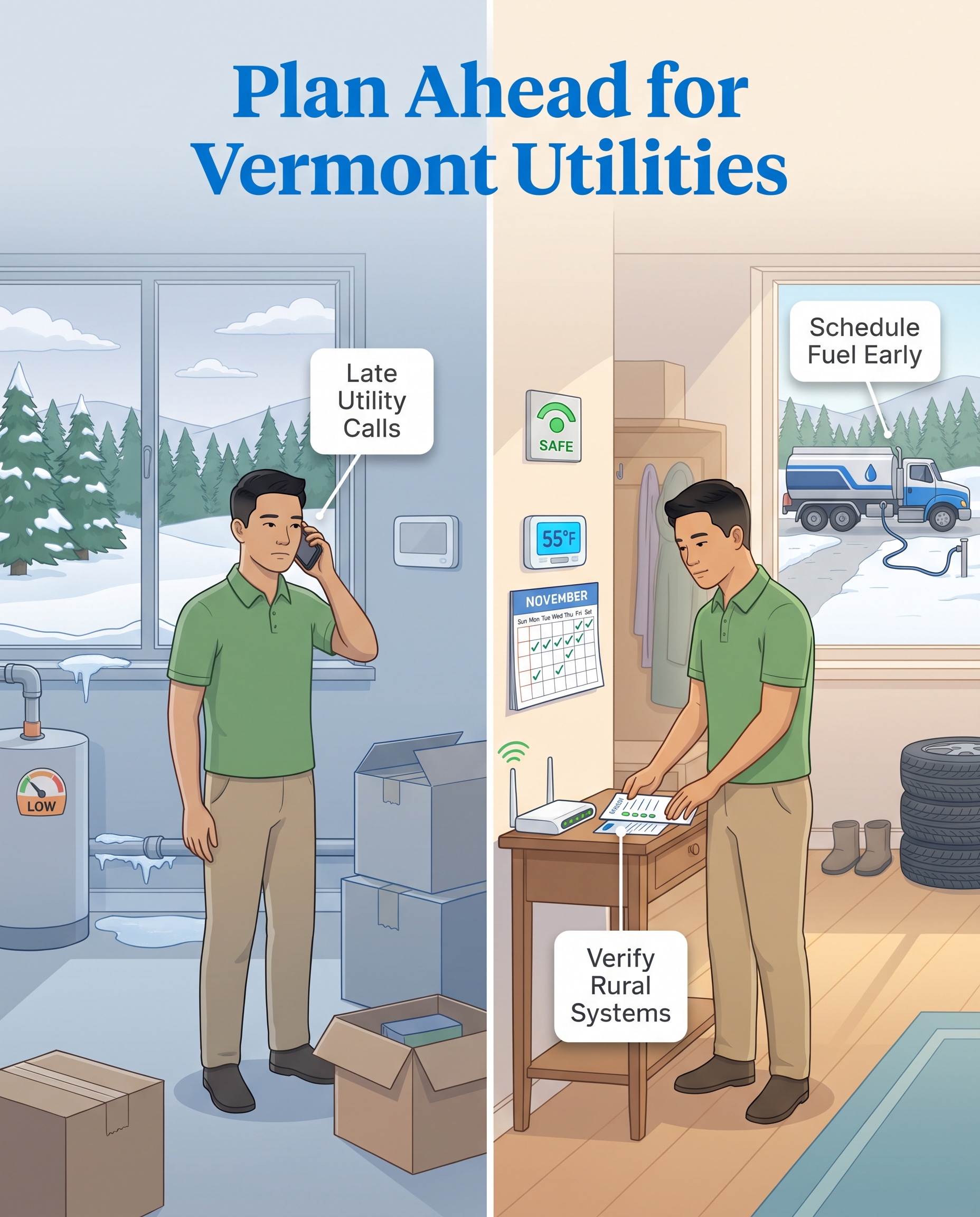
Once you have an eye on a property, conducting early due diligence will save you from frozen pipes or lapsed accounts. For renters, be sure to ask the landlord which utilities are included, who handles snow removal, and who is responsible for well or heating repairs. Use this practical moving checklist to stay ahead of rural utility logistics.
- During Your Contingency Period — Verify Broadband, Well, and Septic: Contact providers to confirm active internet service and request an installation quote. Conduct professional inspections of the private well, septic system, and any fuel-burning heating equipment to ensure they are safe and functional.
- Before Closing — Review Flood Disclosures: Under Vermont’s Act 181, sellers must provide specific flood history disclosures. You should also check state river corridor and flood maps, keeping in mind that unmapped areas can still experience flooding.
- 30 Days Out — Transfer Electricity and Schedule Fuel: Identify the specific electric utility serving your address (such as Green Mountain Power, Vermont Electric Cooperative, Burlington Electric Department, or a municipal department). Call to arrange your start date, confirm deposit requirements, and coordinate responsibility through closing. Next, set up your fuel delivery account and request a tank inspection.
- Within 60 Days of Arrival — Update License and Registration: Visit the Vermont Department of Motor Vehicles to transfer your driver’s license, and handle your vehicle registration as a separate task, as deadlines can vary. Invest in four dedicated winter snow tires or severe-snow-rated all-weather tires, as standard all-season tires lack the necessary grip for icy mountain conditions.
- By April 15 — File Your Vermont Homestead Declaration: If you own and occupy your home on April 1, you must file Form HS-122 annually by April 15. This declares the property as your primary domicile for the homestead tax rate, though qualifying for an income-based property tax credit requires additional eligibility criteria.
Heads Up
If you are moving between November and April, confirm in writing that the previous owner or landlord will take the commonly used precaution of leaving the heat set to at least 55 degrees Fahrenheit right up until closing, and hire a local snow plow contractor for your driveway before the first winter storm hits.
Settling Into Your New Green Mountain Home
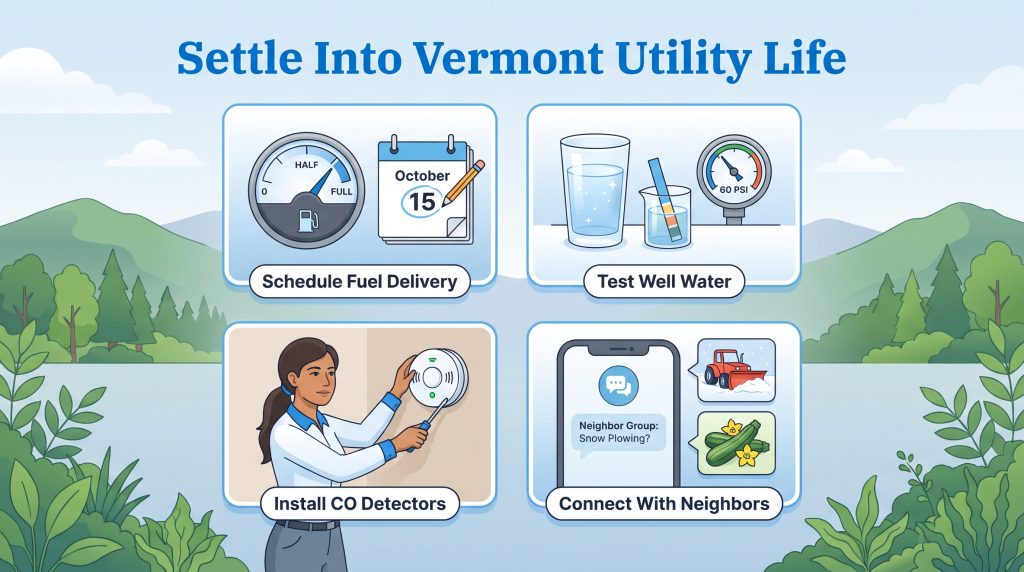
There is no denying that moving to Vermont takes a bit more grit and preparation than relocating to a standard suburban development. Between coordinating fuel deliveries, learning the ins and outs of well water and septic tanks, and rinsing out your kitchen compost pail, your relationship with your home utilities becomes much more hands-on. Yet the payoff is an extraordinary quality of life in one of the safest, cleanest, and most environmentally mindful communities in the country. Tackle your utility checklist early, ensure you have carbon monoxide detectors installed, and lean on state resources like Efficiency Vermont to weatherize your home, and don’t forget to sign up for Front Porch Forum — Vermont’s beloved hyper-local online neighborhood network where you can find everything from a trusted snow plow driver to free zucchini from a neighbor’s garden.
Frequently Asked Questions About Moving to Vermont
Moving to a new state always comes with a learning curve, especially when adapting to rural infrastructure. Here are answers to some of the most common questions newcomers have about Vermont living and utilities.
How Much Money Do You Need to Live Comfortably in Vermont?
What Is the Hardest Part of Moving to Vermont?
Can You Rely on Heat Pumps Alone to Heat a Home in a Vermont Winter?
How Do I Find Out Which Internet Providers Serve a Rural Vermont Address?
How Does Vermont Compare to New Hampshire for Cost of Living and Utilities?
What Happens if You Put Food Scraps in the Trash in Vermont?
About the Author

LaLeesha has a Masters degree in English and enjoys writing whenever she has the chance. She is passionate about gardening, reducing her carbon footprint, and protecting the environment. She also recently served as President of the Board for City Sprouts (a community garden).

Claudio is a sustainability-focused writer with a background in Anthropology and Psychology from NC State University. He has spent over 15 years working in writing, interpretation, and translation, driven by a deep interest in how human culture shapes the environment. Today, he shares his curiosity with readers by writing about sustainable living solutions and the connection between everyday choices and environmental impact.