

Preparing for Your Nebraska Move Means Budgeting Beyond Housing and Identifying the Right Providers
Key Takeaways
- Confirm utility providers by address, because service territories can differ from city and metro boundaries.
- Budget beyond the housing payment by checking property taxes, heating fuel, insurance, and previous utility usage.
- Review efficiency programs before buying equipment, since rebates and eligibility vary by utility and program.
Moving to Nebraska means planning for more than a new address. Your housing costs, property taxes, heating needs, and utility providers can vary considerably between Omaha, Lincoln, and a rural property. We’ll help you compare those trade-offs, identify the services your new home needs, and build a practical setup timeline.
The Pros and Cons of Living in Nebraska
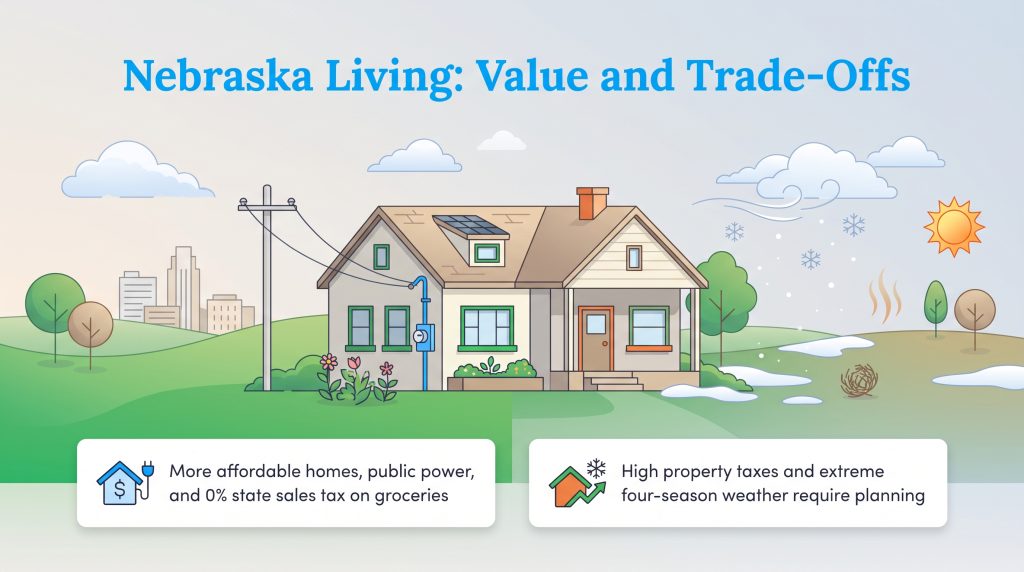
Every state comes with its own financial give-and-take, and weighing the pros and cons early will save you from budget surprises later. You’ll find plenty to love about how far your paycheck stretches here, from affordable starter homes to publicly owned utilities. Still, we believe in giving you the unfiltered truth so you can plan ahead for steep county tax assessments and seasonal temperature swings.
The Perks: Affordable Homes, Public Power, and Stable Employment
If you’re coming from the coasts or a pricey metro like Denver or Chicago, your housing budget is likely to go further. Typical Nebraska home values sit around $278,000, which is a massive discount compared to the national average of nearly $366,000. Beyond the real estate market, daily life here is backed by a remarkably resilient economy and resident-friendly utility structures.
- Consistent Job Market: Unemployment stood at 2.9% in September 2026, according to the Bureau of Labor Statistics (BLS), fueled by major healthcare networks, insurance giants, agricultural technology, and a fast-growing “Silicon Prairie” startup scene in Omaha and Lincoln.
- Public Power Rates: Nebraska’s retail electric service is provided by public power districts, municipal utilities, and member-owned cooperatives rather than investor-owned electric utilities. This model prioritizes local service over private shareholder profits.
- Tax-Free Groceries: Nebraska charges 0% state sales tax on unprepared food and food ingredients, keeping weekly supermarket runs noticeably cheaper for families.
- Room to Breathe: Even in the heart of Omaha or Lincoln, commutes are generally shorter than in major coastal cities, giving you back hours of free time every week.
The Trade-Offs: Steep Property Taxes and Wild Four-Season Weather
Where Nebraska gets its revenue is no secret once you look at county assessment bills. Because the state doesn’t rely on booming tourism taxes or high corporate tax margins to fund public schools and infrastructure, local governments lean heavily on homeowners. Right now, Nebraska property tax rates average an effective 1.44% of a home’s assessed value, ranking among the top 10 highest in the country.
At an illustrative effective rate of 1.44%, a $278,000 home would imply about $4,003 a year in property taxes. Your actual bill depends on the property’s taxable value, local levies, exemptions, and applicable relief. On the bright side, state lawmakers have been actively trimming income taxes, with the top marginal income tax rate dropping to 4.55% for 2026.
You also have to respect the Great Plains climate. Winters bring biting, subzero Arctic winds that put your furnace and home insulation to the test, while July and August serve up thick humidity that keeps air conditioners humming. Spring sits squarely in the path of severe thunderstorms, and many parts of Nebraska regularly contend with seasonal drought conditions.
Heads Up
High county property taxes often catch first-time Nebraska homebuyers off guard when calculating monthly escrow payments. However, following the August 2024 special legislative session (LB34), the state drastically restructured property tax relief, front-loading hundreds of millions of dollars in school district credits directly onto local property tax statements. Check with the Nebraska Department of Revenue for current eligibility rules.
Cost of Living in Nebraska and Average Utility Bills
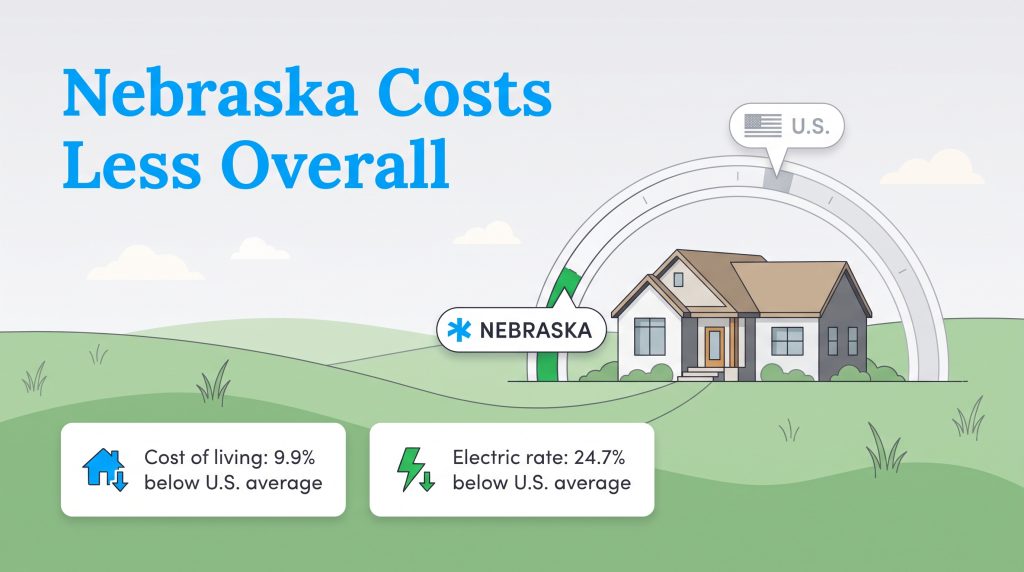
When you add up housing, groceries, transportation, and utilities, the overall cost of living in Nebraska sits roughly 10% below the national benchmark. According to the Missouri Economic Research and Information Center (MERIC) index for the second quarter of 2026 (90.1), your dollar stretches about 10 cents further here than it does in the typical U.S. state. Below is how everyday housing and utility metrics compare against national averages.
Nebraska at a Glance: Cost of Living & Utility Scorecard
| Metric | Nebraska Average | National Comparison | Primary Source |
|---|---|---|---|
| Overall Cost of Living Index | 90.1 | ~9.9% below U.S. average | MERIC (Q2 2026) |
| Typical Home Value | ~$278,299 | ~24% below U.S. average (~$366,157) | Zillow (Aug. 2026) |
| Average Residential Electric Rate | 13.78 cents/kWh | ~24.7% below U.S. average (18.31 cents) | U.S. EIA (July 2026) |
| Effective Property Tax Rate | ~1.44% | Top 10 highest in the U.S. | Tax Foundation (2026) |
While low kilowatt-hour (kWh) rates keep your summer electric bills manageable, the average utility bill in Nebraska still reflects the state’s demanding four-season climate. Heavy industrial agriculture accounts for part of the state’s high per-capita energy demand, but residential heating and cooling play a major role too. About half of Nebraska households heat their homes with natural gas, and another four in 10 rely on electric heating. Understanding how local kWh pricing interacts with seasonal usage spikes is the best way to keep your home electricity budget predictable year-round.
Omaha vs. Lincoln: Which Fits Your Move?
Finding the best places to live in Nebraska comes down to whether you want urban career momentum, college-town bikeability, or wide-open western acreage. Where you drop your anchor also determines which municipal departments or rural cooperatives handle your monthly utility connections. Confirm every provider using your exact service address. Metro boundaries, municipal boundaries, and utility service territories don’t always match. Here is how housing prices and utility providers break down across the state’s three primary regions.
Omaha vs. Lincoln vs. Rural Nebraska: Housing & Utility Providers
| Region | Electric Utility | Natural Gas Utility | Water Utility | Typical Home Value | Vibe & Top Industries |
|---|---|---|---|---|---|
| Omaha Metro | Omaha Public Power District (OPPD) | Metropolitan Utilities District (MUD) | Metropolitan Utilities District (MUD) | ~$294,600 | Bustling urban hub; finance, healthcare, and tech startups |
| Lincoln Metro | Lincoln Electric System (LES) | Black Hills Energy | Lincoln Water System | ~$270,000 – $285,000 | Vibrant capital city; state government, higher education, and ag-tech |
| Rural & Western Towns (e.g., Scottsbluff, rural acreage) | Nebraska Public Power District (NPPD) or Local Rural Co-ops | Black Hills Energy, NorthWestern Energy, or Delivered Propane | Municipal Water or Private Domestic Well | Varies greatly by county | Tight-knit agricultural, manufacturing, and outdoor recreation communities |
Omaha Metro: Big-City Amenities and Silicon Prairie Energy
Omaha wins if you want big-city dining, a major regional airport, and heavyweight corporate career paths. Home to nearly one million metro residents and corporate giants like Berkshire Hathaway, Union Pacific, and Mutual of Omaha, the city punches well above its weight economically. Typical home values hover around $294,600, whether you’re buying a historic brick Tudor in Dundee, a walkable condo near the Blackstone District, or a newer family home in suburban Papillion or Elkhorn. Utility setup here is refreshingly consolidated: many households connect electricity through the Omaha Public Power District (OPPD) and bundle both natural gas and municipal water through the Metropolitan Utilities District (MUD).
Lincoln: College-Town Vibrancy, Bike Trails, and State Government
Drive 50 miles southwest down Interstate 80 and you’ll hit Lincoln, Nebraska’s state capital and home to the University of Nebraska. Lincoln feels like a gigantic neighborhood with a lively downtown Haymarket district and affordable housing compared to the national average. It’s also a standout environmentally mindful choice for daily commuters, boasting an extensive network of paved bike trails that weave right through the city. When moving into a Lincoln address, you’ll set up your power with Lincoln Electric System (LES), your natural gas with Black Hills Energy, and your water service through the city’s Lincoln Water System.
Rural Nebraska and Tri-Cities: Wide-Open Acreage and Co-Op Utilities
If you’re heading west to the Tri-Cities (Grand Island, Kearney, and Hastings), out toward the dramatic bluffs of Scottsbluff, or onto a rural homestead, your utility checklist looks a bit different. Electricity is generally supplied by the Nebraska Public Power District (NPPD), municipal utility departments like the Grand Island Utilities Department, or one of the state’s local rural public power districts and electric cooperatives. While town centers have municipal water and natural gas lines managed by NorthWestern Energy or Black Hills Energy, rural acreage properties typically rely on delivered liquid propane tanks for winter heating. You’ll also want to arrange private well water quality testing and a thorough septic tank inspection before closing on a country home.
Your Utility Setup Checklist for Moving to Nebraska
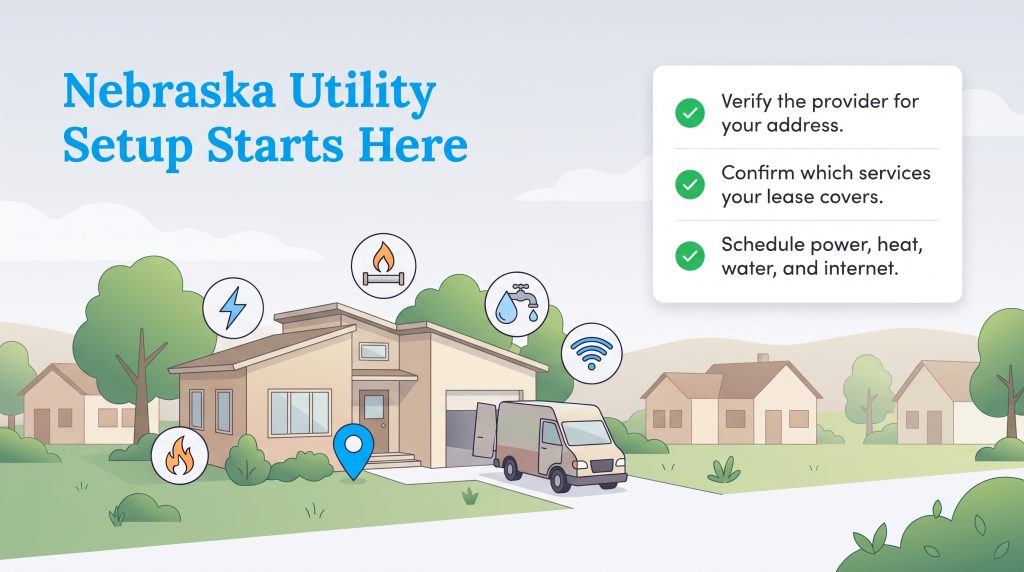
Because utility providers in Nebraska are based strictly on your address, identifying the correct company is your first step. Renters should confirm which services are included in their monthly lease and which accounts they need to open in their own name, while homeowners are responsible for all connections. Here is everything you need to know to get your power, heat, water, and internet running before the moving van pulls into the driveway.
Electricity: Why Nebraska’s Public Power Utilities Save You Money
Nebraska holds a unique title in the energy world: retail electric service here is provided entirely by public power districts, municipal utilities, and member-owned cooperatives rather than investor-owned electric utilities. As outlined on the American Public Power Association’s About Public Power resource page, these not-for-profit entities are governed by locally elected or appointed boards and reinvest revenue directly into grid reliability rather than paying out corporate dividends. That structure contributes to the fact that Nebraska residents pay substantially less per kWh than the rest of the country.
To start electric service with OPPD, LES, or NPPD, submit an online service transfer request several business days before your move-in date. You’ll likely need to provide a government-issued photo ID, your signed lease or home closing disclosure, and a Social Security number for a soft credit check, though exact requirements vary by provider.
Money-Saver
Ask your current utility providers for a 12-month “letter of credit” or good payment history statement before you move. Major Nebraska providers like OPPD, LES, and MUD frequently accept a clean payment record from your previous utility to waive new-customer security deposits entirely.
Natural Gas and Winter Heating Setup
Natural gas keeps Nebraska homes warm when January blizzards roll across the plains. If you’re moving to the Omaha metro, MUD handles your natural gas alongside your water bill for most addresses. In Lincoln and more than 300 other communities across eastern and western Nebraska, Black Hills Energy is your primary gas utility, while NorthWestern Energy serves central hubs like Grand Island, Kearney, and North Platte. If you move during late fall or winter, we strongly recommend enrolling in your provider’s Budget Billing (or levelized payment plan) right away. Averaging your natural gas utility costs across 12 months changes your payment timing, preventing a subzero January cold snap from doubling your monthly heating bill.
Water, Sewer, Trash, and High-Speed Fiber Internet
Setting up home water and sewer service is usually a one-stop call to your city utility department, such as MUD in Omaha or the Lincoln Water System. Solid waste and recycling, however, require paying close attention to municipal boundaries. Within Omaha city limits, curbside collection is funded by city taxes and contracted through Wasteline, whereas residents in Lincoln and many suburban Omaha neighborhoods must independently hire and pay a private trash and recycling hauler. For remote workers and streaming households, both Lincoln and Omaha boast rapidly expanding multi-gigabit fiber internet service from Allo Communications, Google Fiber, Quantum Fiber, and Cox (now Spectrum). Always verify internet serviceability at your exact address, checking for equipment charges and data limits before signing a contract.
Sustainable Living and Weatherization: Prepping Your Nebraska Home for Extreme Seasons
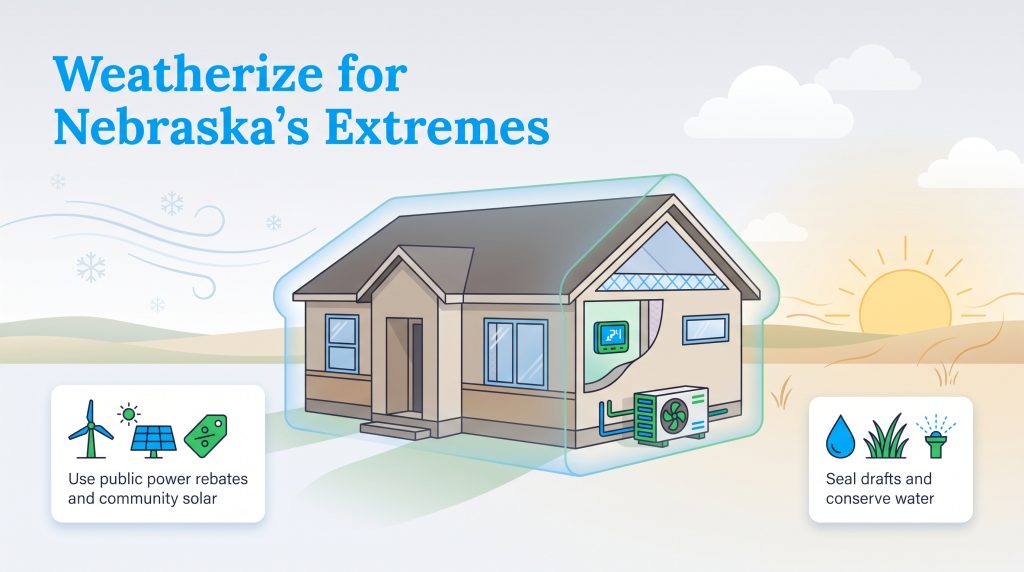
Most relocation guides warn you about Great Plains blizzards, spring tornadoes, and summer droughts, yet offer zero practical advice on how to protect your house and wallet. Taking a proactive approach to weatherization and renewable programs through Nebraska public power utilities is the smartest way to lower the average utility bill in Nebraska while shrinking your carbon footprint.
Tapping Into Public Power Green Rebates and Community Solar
Thanks to relentless plains breezes, wind power now generates a significant portion of Nebraska’s in-state electricity, and local public utilities are eager to help residents use that clean energy efficiently. Right after moving in, check with OPPD, LES, or NPPD for cash-back rebates on smart thermostats, high-efficiency ENERGY STAR® central air conditioners, and cold-climate air-source heat pumps. You can also plug your new ZIP code into the ENERGY STAR Rebate Finder to uncover instant local incentives on heat pump water heaters and efficient appliances.
If you’re renting an apartment or buying a home with a shaded roof, you don’t have to miss out on clean energy. Both LES (through its SunShares program) and OPPD offer community solar energy programs that allow you to support local utility-scale solar arrays. It’s an easy, affordable eco-conscious alternative to installing private rooftop panels, and it allows you to participate in a broader sustainable living strategy without taking on the maintenance of a personal solar system.
Eco Edge
Before choosing a cold-climate heat pump, ask a qualified contractor to calculate your home’s heating load and explain the backup-heat controls. Compare operating costs using your actual utility rates, and confirm rebate eligibility before buying equipment.
Winterizing Against Subzero Winds and Conserving Water During Droughts
Prepping your home for Nebraska’s climate extremes pays dividends over time by reducing energy waste. Before November arrives, schedule a professional home energy audit to pinpoint drafty window frames, unsealed attic hatches, and thin fiberglass insulation that let frigid plains winds seep inside. When spring storm season rolls around, consider keeping a rechargeable lithium-ion battery power station in your basement; it has no combustion exhaust during use, making it a quiet, environmentally mindful choice compared to fussing with a noisy, gas-powered portable generator during tornado warnings. Just remember that battery capacity limits which devices you can power and for how long.
During dry summer stretches, outdoor lawn watering can easily cause a spike in your municipal water bill. Swapping standard sprinkler heads for WaterSense-labeled irrigation controllers and spray sprinkler bodies, and replacing thirsty Kentucky bluegrass with native site-appropriate landscaping gives you a reliable energy-saving option that cuts both water usage and pumping costs.
Your Step-by-Step Utility Setup Checklist
Juggling packing boxes, closing paperwork, and utility transfers gets overwhelming fast if you don’t have a clear timeline. Use our chronological utility setup checklist below to stay organized while managing your home transition. If you need extra help coordinating movers or packing fragile items, explore our home moving hub for more step-by-step relocation guides.
The Ultimate Moving to Nebraska Timeline & Utility Checklist
| Timeline | Essential Relocation & Utility Tasks | Pro Tips & Sustainability Notes |
|---|---|---|
| Four Weeks Before Moving | Identify electric, gas, water, and trash providers for your exact address (verify if you are in a suburban SID or rural co-op); request a 12-month utility bill history from the seller or landlord. | Ask the seller when the furnace, AC, and roof were last serviced for hail or wind damage. |
| Two Weeks Before Moving | Submit online start or transfer requests for electricity, natural gas, water, and fiber internet; request a letter of credit from your old utilities. | Enroll in Budget Billing for natural gas and ask about green power or community solar programs during sign-up. |
| Moving Week | Photograph electric, gas, and water meter readings on move-in day; test smoke and carbon monoxide detectors; locate your main water shut-off valve and breaker box. | Knowing where your indoor water shut-off valve is located is vital before your first subzero Nebraska freeze. |
| Within 30 Days of Arrival | Verify the current legal deadlines to transfer your out-of-state driver’s license and vehicle registration at the Nebraska DMV; separately register to vote and apply for utility smart thermostat rebates. | Swap out old incandescent bulbs for LEDs and seal exterior door weatherstripping right away. |
Pro Tip
If you buy a home in a newer suburban subdivision outside Omaha or Lincoln city limits, you’re likely moving into a Sanitary and Improvement District (SID). SIDs issue tax-exempt debt to finance infrastructure like roads, water, and sewers before city annexation. Before buying, verify your property’s SID levy, outstanding obligations, and which utilities bill separately.
Settling Into the Good Life Without the Utility Stress
Moving to Nebraska offers a rare combination of affordable housing markets, welcoming neighborhoods, and reliable public power districts. While high county property taxes and dramatic Great Plains weather take some adjustment, careful planning makes it easy to get ahead financially. By setting up your utilities two weeks before arrival, taking advantage of green appliance rebates, and weatherizing your home for all four seasons, you’ll keep both your household budget and your environmental footprint in great shape as you settle into “The Good Life.”
Frequently Asked Questions About Moving to Nebraska
Sorting through local utility districts and state regulations can feel complicated when you first cross the state line. We gathered the most common questions newcomers ask about setting up their homes and finances in Nebraska.
Why Is Electricity So Cheap in Nebraska Compared to Other States?
How Soon Do I Need to Set Up Utilities and Update My Driver’s License After Moving to Nebraska?
Can I Choose My Own Electric or Natural Gas Provider in Nebraska?
Is It Better to Move to Omaha or Lincoln for Young Families and Remote Workers?
What Are Sanitary and Improvement Districts (SIDs) in Nebraska and How Do They Affect My Bills?
How Can I Keep My Heating and Cooling Bills Low During Nebraska’s Extreme Seasons?
About the Author

LaLeesha has a Masters degree in English and enjoys writing whenever she has the chance. She is passionate about gardening, reducing her carbon footprint, and protecting the environment. She also recently served as President of the Board for City Sprouts (a community garden).

Claudio is a sustainability-focused writer with a background in Anthropology and Psychology from NC State University. He has spent over 15 years working in writing, interpretation, and translation, driven by a deep interest in how human culture shapes the environment. Today, he shares his curiosity with readers by writing about sustainable living solutions and the connection between everyday choices and environmental impact.