

Packing your bags for the Palmetto State means checking more than housing prices, as your utility provider depends on your service address and summer cooling can significantly impact your budget.
Key Takeaways
- South Carolina’s housing market offers competitive pricing compared to many coastal states, but your home energy budget deserves careful planning due to heavy summer cooling demands.
- Because South Carolina operates a regulated energy market, your exact street address determines your electric and natural gas providers, with multiple investor-owned, cooperative, and municipal utilities serving the state.
- Subtropical summer humidity drives high air conditioning usage, making energy-saving options like smart thermostats and variable-speed heat pumps essential for keeping monthly utility bills predictable.
Moving to South Carolina means checking more than housing prices. Your utility provider depends on your service address, summer cooling can raise electricity costs, and vehicle taxes can surprise newcomers. We’ll help you compare regions, budget for household services, and organize the steps to get your new home running smoothly.
Weighing the Real Pros and Cons of Living in South Carolina
When you’re relocating your household, you need to look at practical lifestyle and infrastructure trade-offs. Evaluating the real pros and cons of living in South Carolina helps you match your budget and daily routines to the right neighborhood. Whether you’re moving for work or retirement, here’s what daily life really looks like.
The Perks of Life in the Palmetto State
- Tax-Friendly Environment: Homeowners here enjoy competitive property tax rates for their primary residences. If you’re moving for retirement, the financial perks stand out immediately: Social Security benefits are completely exempt from state income tax, and the state offers generous retirement income deductions alongside a homestead exemption on the first $50,000 of qualifying home value for eligible residents aged 65 and older, legally blind, or permanently disabled.
- Four Distinct Regions: You don’t have to choose between mountains and ocean when you live here. A scenic drive takes you from waterfalls and hiking trails in the Blue Ridge Mountains down through rolling midland horse country right into the historic marshlands and barrier islands of the Lowcountry.
- Four-Season Outdoor Living: Mild winters mean you can garden, play golf, and dine on your patio nearly year-round. Better yet, you won’t watch brutal winter heating bills devour your monthly utility budget from December through March.
- Booming Job and Tech Hubs: The state’s economy has evolved far beyond agriculture and tourism. Major manufacturing, aerospace, automotive, and engineering corridors in Greenville and Charleston continue to attract major global employers and high-paying remote workers alike.
The Drawbacks You Should Plan For
- Oppressive Summer Heat and Humidity: From June through September, afternoon heat indexes regularly top 100 degrees across much of the state. That thick, subtropical humidity puts heavy strain on residential air conditioners, especially in older homes with outdated ductwork or thin attic insulation.
- Hurricane Season (June 1 to Nov. 30): Living near the Atlantic coast brings the undeniable risk of tropical storms, coastal storm surges, and inland flash flooding. Even inland towns experience downed power lines and temporary utility outages when tropical systems push ashore.
- Infrastructure and Healthcare Growing Pains: Because so many people have moved here over the past decade, two-lane suburban roads and rural medical networks are playing catch-up. Depending on where you settle, public transit options may be limited, and some rapidly growing counties are still expanding their healthcare facilities to meet demand.
Heads Up
South Carolina’s famous “yellow season” (spring pine pollen) doesn’t just coat your car and porch furniture — it clogs HVAC intake filters rapidly. New movers should stock up on manufacturer-approved air filters from March through May and check them monthly to keep their cooling systems breathing easily.
Cost of Living in South Carolina: Housing, Taxes, and Average Utility Bills
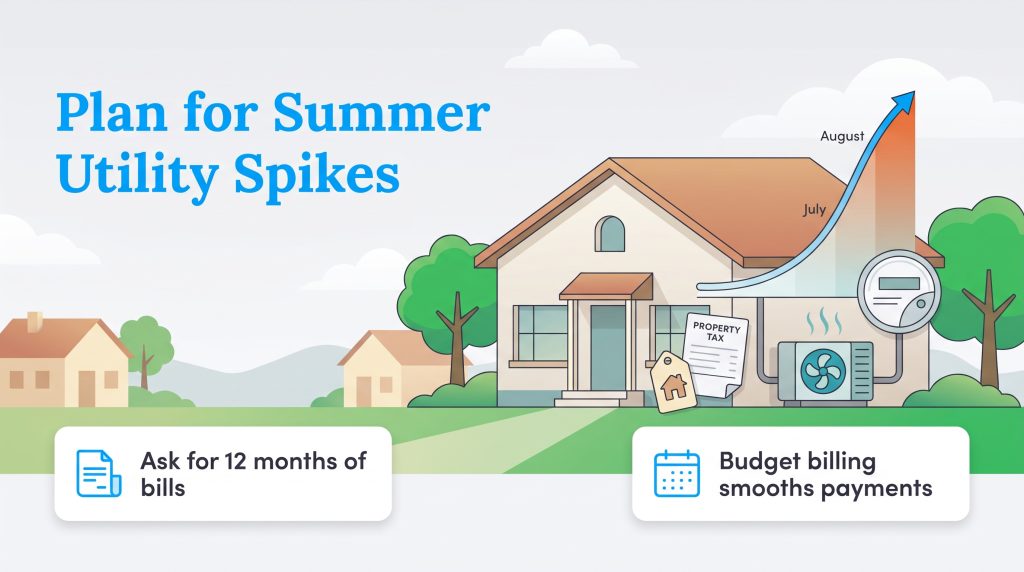
Overall, the cost of living in South Carolina often provides financial relief for anyone arriving from higher-cost regions like the Northeast or West Coast. While your monthly mortgage payment and property tax bill might drop, your home energy budget deserves a closer look before you sign a lease or closing disclosure. High summer cooling demand can easily catch newcomers off guard if they only budget based on the state’s baseline per-kilowatt-hour electricity rates.
Housing and Tax Benchmarks Across the State
Typical home values across the Palmetto State vary wildly depending on where you buy. A home-buying budget stretches further in cities like Spartanburg, Aiken, or Florence, whereas historic homes and newer coastal builds in Mount Pleasant or Hilton Head Island command significant premiums. On the tax front, South Carolina levies a 6% base state sales tax, which individual counties and municipalities frequently bump higher through local option, accommodations, and hospitality taxes. The state has also been gradually trimming its top marginal income tax rate, so checking the current South Carolina Department of Revenue guidance is essential for accurate budgeting.
Breaking Down the Average Utility Bill in South Carolina
Here is the quirk about the average utility bill in South Carolina: the actual retail price you pay per kilowatt-hour (kWh) of electricity sits slightly below the U.S. average, yet your total monthly electric bill can still run higher than what you paid up north. Why does that happen? Most Southern homes rely on electric heat pumps and central air conditioning rather than fuel oil or natural gas furnaces, and running the A/C nonstop through July and August drives up total consumption. According to the U.S. Energy Information Administration’s South Carolina profile, residential electricity consumption per household in the state ranks among the highest in the nation largely because of heavy summer air conditioning and widespread electric space heating.
| Utility Service | Example Monthly Fluctuation | What Drives Your Bill in SC |
|---|---|---|
| Electricity | Highly variable | Spikes in July and August due to constant A/C and dehumidifier usage; drops sharply in spring and fall. |
| Natural Gas | Depends on hookups | Lower annual average thanks to mild winters; mostly used for tankless water heaters, ranges, and space heating where available. |
| Water & Sewer | Depends on district | Varies by municipal water district, and whether you use a septic tank or city sewer hookups. |
| High-Speed Internet | Depends on provider | Competitive fiber pricing in metro suburbs vs. fixed wireless or satellite plans in rural counties. |
| Trash & Recycling | Depends on location | Often rolled into municipal property taxes inside city limits or billed privately in unincorporated county areas. |
Money-Saver
If you are buying a house, ask the current owners or the local electric utility for the past 12 months of billing history so you know how the home performs in August. Once you move in, enroll in your utility’s budget billing or equalized payment plan. Budget billing smooths out your payments so summer cooling spikes don’t catch your checking account off guard, though it won’t reduce your total annual energy use.
Best Places to Live in South Carolina by Region
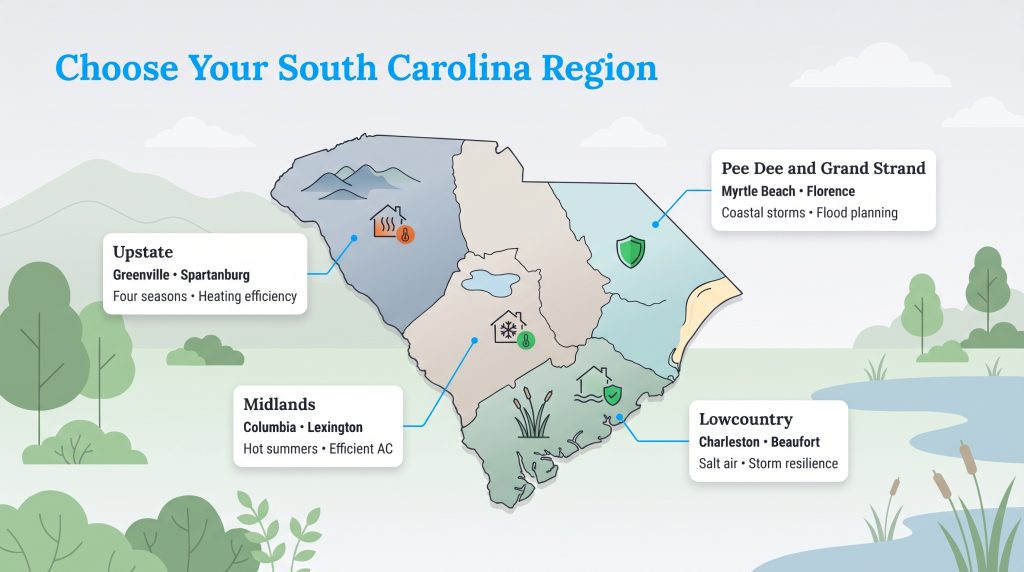
Choosing where to unpack in the Palmetto State comes down to understanding its four primary cultural and geographic zones. From the cooler mountain foothills in the northwest to the breezy barrier islands along the coast, each region offers a distinct balance of housing prices, utility infrastructure, and daily lifestyle. Exploring the best places to live in South Carolina by region makes it much easier to narrow down your home search.
The Upstate: Greenville, Spartanburg, and the Blue Ridge Foothills
Anchored by the thriving I-85 corridor between Atlanta and Charlotte, the Upstate blends revitalized, walkable downtowns with quick access to mountain lakes and state parks. Greenville draws newcomers with its famous Swamp Rabbit Trail and waterfall-centered downtown park, while nearby Spartanburg, Greer, and Anderson offer slightly quieter suburban living. Housing and rental costs here remain much more approachable than on the coast. Because the Upstate sits at a higher elevation, you will experience four true seasons here, and winter nights regularly dip below freezing — meaning home heating efficiency matters just as much as summer cooling.
The Midlands: Columbia, Lexington, and Lake Murray
Right in the geographic center of the state, the Midlands region surrounds the state capital of Columbia, the University of South Carolina, and the expansive shoreline of Lake Murray. Families and state workers gravitate toward suburbs like Lexington, Irmo, and Chapin for top-rated school districts, boating access, and some of the most affordable suburban housing in the state. Just keep in mind that Columbia’s historical tourism slogan — “Famously Hot” — reflects its summer reality. Because the city sits in a sandy geographic bowl roughly two hours away from cooling ocean breezes, summer afternoon temperatures are notoriously warm, making tight window seals and high-efficiency air conditioning non-negotiable.
The Pee Dee and Grand Strand: Myrtle Beach, Conway, and Florence
Stretching across the northeastern corner of the state, the Pee Dee region blends agricultural heritage with the booming tourism hub of the Grand Strand. Myrtle Beach, North Myrtle Beach, and Murrells Inlet provide a retiree-friendly coastal lifestyle with abundant golf courses and new-construction communities. Inland cities like Florence offer quieter, more affordable living with quick access to major interstates. If you settle near the coast here, your household budget will need to account for flood insurance and storm resilience.
The Lowcountry: Charleston, Beaufort, and Hilton Head Island
Down south in the Lowcountry, Charleston, Mount Pleasant, Summerville, Beaufort, and Hilton Head Island deliver unmatched historic charm, cobblestone streets, and Spanish moss, alongside the highest median home prices in the state. Whichever coastal pocket you pick, you’ll need to prepare your property for salt-air corrosion and potential tropical weather.
Setting Up Utilities in South Carolina: Who Provides What?
If you are relocating from a deregulated energy state like Texas, Ohio, or Pennsylvania, setting up utilities in South Carolina works a bit differently than what you might be used to. South Carolina operates a strictly regulated energy market, which means you cannot shop around for competing retail electric suppliers. Instead, your electric and natural gas utility companies are assigned strictly by your exact street address and service territory. Understanding how regulated electric utility territories operate will save you hours of confusion during your move.
South Carolina Electric Companies by Service Address
When searching for South Carolina electric companies by service address, you will find that power generation and delivery are divided among five primary utility groups across the state:
- Duke Energy (Duke Energy Carolinas & Duke Energy Progress): Duke Energy serves the vast majority of the Upstate — including Greenville, Spartanburg, Anderson, and Clemson — while its Duke Energy Progress branch powers much of the northeastern Pee Dee region and parts of the eastern Midlands around Florence and Sumter.
- Dominion Energy South Carolina: Following its merger with SCE&G a few years back, Dominion Energy covers a massive swath of the central and southern corridors, supplying power to Columbia, Lexington, Aiken, Orangeburg, Beaufort, and much of the Charleston metro area.
- Santee Cooper: Officially known as the South Carolina Public Service Authority, this state-owned public power utility generates power for over two million residents directly and indirectly. Its direct residential customer territory is concentrated in Horry, Georgetown, and Berkeley counties, covering Myrtle Beach, North Myrtle Beach, Conway, and Moncks Corner.
- The Electric Cooperatives of South Carolina: Don’t be surprised if a private utility doesn’t serve your new neighborhood. Twenty member-owned, not-for-profit electric co-ops — such as Berkeley Electric Cooperative, Palmetto Electric, Blue Ridge Electric, and Mid-Carolina Electric — cover more than 70% of the state’s landmass, including major coastal suburbs like Hilton Head Island, Bluffton, and parts of Johns Island.
- Municipal Electric Utilities: Many cities and towns operate their own public power systems. If you live within certain city limits, your electricity might be provided directly by the local municipal government rather than an investor-owned utility.
Natural Gas, Water, and Trash Services
While many newer South Carolina subdivisions are built as all-electric communities, homes with natural gas hookups are serviced by region. However, natural gas availability isn’t universal, and some rural properties may rely on delivered propane instead. For connected homes, Dominion Energy South Carolina handles natural gas across the Midlands and Lowcountry, Piedmont Natural Gas (a Duke Energy subsidiary) serves the Upstate, and several cities operate municipal gas authorities, such as Greer CPW or Greenwood CPW. Water, sewer, and trash collection are managed locally at the city, county, or special-purpose district level — such as Charleston Water System, Greenville Water, or City of Columbia Water. Be sure to have a digital copy of your signed lease or home closing disclosure alongside your government-issued photo ID ready, as most municipal water offices require proof of occupancy before activating your meter.
High-Speed Internet and Fiber Availability
Whether you work remotely or stream live sports, you should verify broadband availability at the exact street address before signing a contract. In metro areas and established suburbs, AT&T Fiber, Spectrum, and Xfinity dominate the market. Google Fiber is also expanding its footprint in select areas, though you’ll need to check your specific address to confirm eligibility. If you are buying acreage in a rural county, don’t assume you are stuck with slow DSL or pricey satellite plans. South Carolina’s electric cooperatives have increasingly partnered with local providers to expand symmetrical multi-gigabit fiber networks across rural communities. Take a moment to compare home internet options by address early in your moving timeline.
Pro Tip
Contact your electric and water providers at least 10 to 14 days before your closing or lease start date. While electric utilities with smart meters can often activate power remotely within 24 hours, several municipal water utilities in South Carolina still require in-person deposit verification or two full business days’ notice to send a technician out to unlock the curb meter.
Smart and Sustainable Ways to Beat South Carolina Heat and Storms
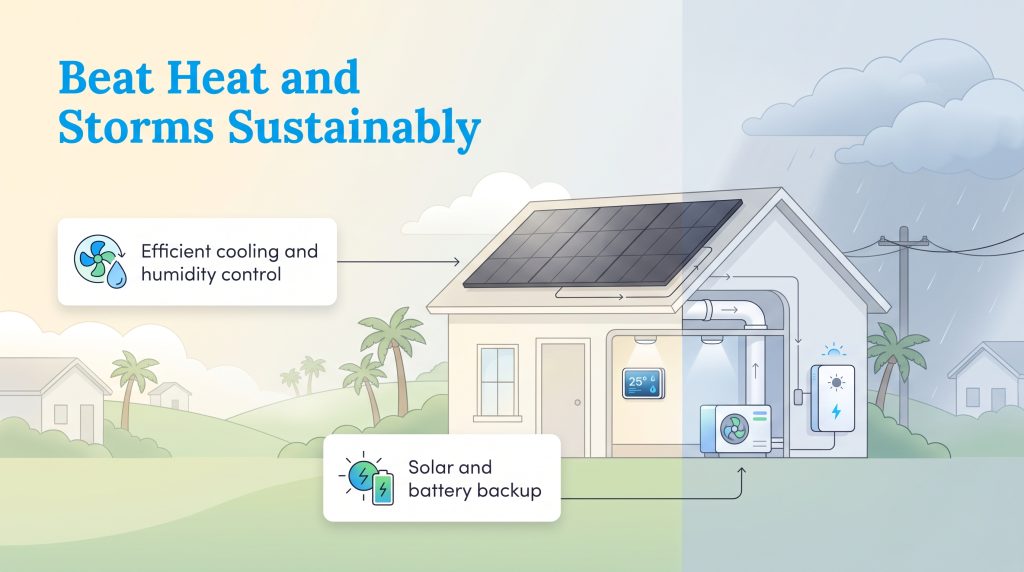
With long, muggy summers, South Carolina rewards homeowners who take a proactive approach to energy efficiency. Making an environmentally mindful choice when upgrading your appliances or weatherizing your home doesn’t just shrink your household carbon footprint. It is also the single most reliable way to lower your energy demand and protect your bank account during a four-month Carolina summer.
Prepping Your HVAC and Humidity Controls
Ask any HVAC technician the secret to surviving July, and they will point to indoor moisture control. Following ENERGY STAR heating and cooling efficiency guidelines — such as sealing leaky attic ductwork, installing a programmable smart thermostat, and upgrading to a variable-speed heat pump — can trim your annual cooling bills considerably. Using a smart thermostat or a whole-home dehumidifier is an easy energy-saving option that often qualifies for rebates depending on your provider’s current offerings. You can explore more whole-home weatherization and humidity tips in our sustainable living guides.
Solar Incentives in South Carolina and Storm Resilience
Thanks to abundant year-round sunshine and supportive state legislation, the Palmetto State is a genuine destination for residential clean energy. Homeowners exploring solar incentives in South Carolina can take advantage of the generous 25% state solar tax credit, which helps offset the cost of eligible solar installations. You can claim up to the lesser of $3,500 or 50% of your state tax liability per year, and any unused credit rolls forward for up to 10 years. When you pair rooftop solar with a compatible home battery storage system, you gain an eco-conscious alternative to loud portable gas generators when tropical storms or summer thunderstorms knock out the neighborhood grid. Keep in mind that standard grid-connected solar panels generally shut down during an outage without a dedicated battery backup.
Eco Edge
Both Duke Energy and Dominion Energy South Carolina offer subsidized or discounted home energy assessments once your residential account has been active for a few months. An energy specialist will inspect your attic insulation and ductwork, often providing customized advice or discounted LED bulbs and low-flow faucet aerators to help you save.
Your Moving to South Carolina Checklist: First 30 Days
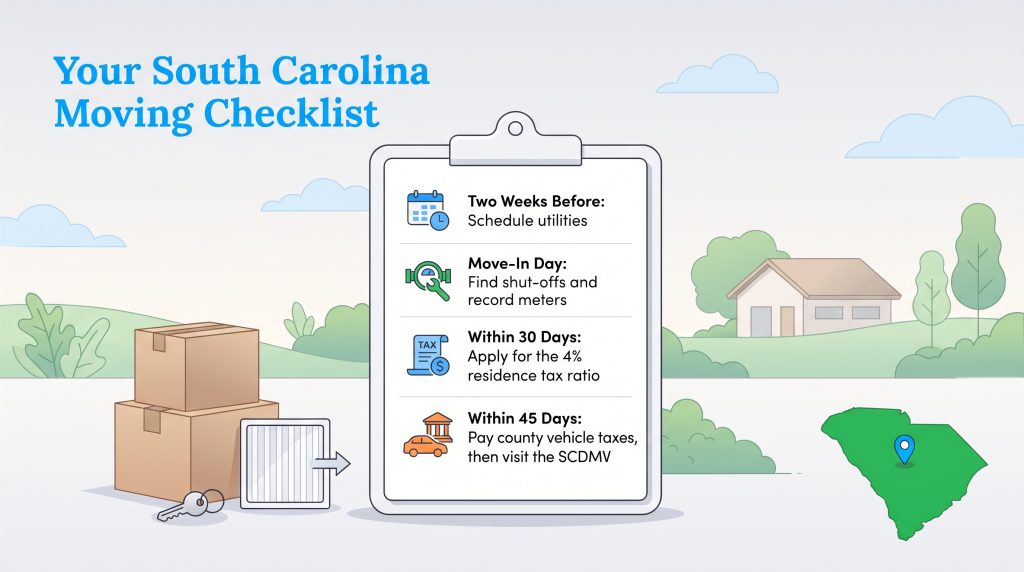
Between unpacking kitchen boxes and learning which grocery store has the best peaches, administrative tasks can easily slip through the cracks. We’ve laid out your complete moving to South Carolina checklist right here in chronological order. Follow these four steps to transition your home services and legal residency without paying unnecessary late fees or inflated tax rates.
- Two Weeks Before Move-In: Schedule Your Core Utilities
Confirm your electric, natural gas, and municipal water providers by street address and schedule your activation date for the business day before your moving truck arrives. If you need fiber internet installed or a line buried in a newly built subdivision, book your technician appointment two weeks out so you aren’t relying on a phone hotspot during your first week of work. - Move-In Day: Locate Your Shut-Off Valves and Check Filters
Before the movers stack boxes in the garage or closets, locate your main water shut-off valve (in South Carolina, this is often inside the garage, in a utility closet, or out by the street curb in a covered meter box) and your electrical breaker panel. Snap a quick smartphone photo of your initial electric, gas, and water meter readings for your records, and slide a fresh filter into the HVAC return vent. - Within 30 Days: Apply for the 4% Primary Residence Property Tax Ratio
If you bought a home, do not skip this step! By default, South Carolina counties tax residential properties at a 6% assessment ratio (the rate meant for second homes, vacation rentals, and investment properties). If the property will be your primary residence, ask your county assessor how to apply for South Carolina’s 4% legal-residence assessment ratio and applicable school operating-tax exemption. Apply promptly and confirm the county’s specific documentation requirements, as this adjustment can significantly reduce your annual property tax bill. - Within 45 Days: Establish Official Residency at the SCDMV
Learning how to establish residency in South Carolina requires doing things in a very specific two-step order. Unlike states where you go straight to the DMV, new South Carolina residents must visit their county auditor and treasurer offices first to pay their initial county vehicle property taxes and receive a paid tax receipt. Only after you have that county tax receipt in hand can you visit the SCDMV to pay the applicable Infrastructure Maintenance Fee (IMF), transfer your vehicle title and license plates, and obtain your South Carolina driver’s license (required within 45 days of moving). You can bookmark the official SC.gov Moving to South Carolina portal to access direct links to your county auditor, voter registration forms, and state tax guides.
Settling Into Your New Palmetto State Home
Moving to South Carolina gives you an enviable combination of financial breathing room, coastal and mountain beauty, and gentle winters that let you enjoy the outdoors all year long. While the summer humidity and two-step vehicle registration process take a little getting used to, a bit of upfront preparation smooths out the transition. By setting up your regulated utilities early, filing your 4% primary residence tax application if eligible, and dialing in your home’s cooling efficiency, you’ll keep your monthly bills low and predictable. Introduce yourself to your new neighbors and welcome to the Palmetto State.
Frequently Asked Questions About Moving to South Carolina
Relocating involves plenty of logistics, and it’s completely normal to have questions about setting up your new life. Here are answers to some of the most common concerns newcomers have when moving to the Palmetto State.
How Much Money Do You Need to Live Comfortably in South Carolina?
Can I Choose My Own Electric Company When Moving to South Carolina?
Why Are South Carolina Property Taxes so High on Cars and so Low on Houses?
Is South Carolina a Good State for Retirees on a Fixed Utility Budget?
Do I Need Flood Insurance or Backup Power if I Move Inland to Columbia or Greenville?
How Early Should I Set Up Utilities Before Moving Into a South Carolina House?
About the Author

LaLeesha has a Masters degree in English and enjoys writing whenever she has the chance. She is passionate about gardening, reducing her carbon footprint, and protecting the environment. She also recently served as President of the Board for City Sprouts (a community garden).

David has been an integral part of some of the biggest utility sites on the internet, including InMyArea.com, HighSpeedInternet.com, BroadbandNow.com, and U.S. News. He brings over 15 years of experience writing about, compiling and analyzing utility data.