

Confirm Your Utility Providers, Budget for Seasonal Bills, and Plan Your North Carolina DMV Tasks Before You Move
Key Takeaways
- Because North Carolina operates a regulated energy market divided among various investor-owned, municipal, and cooperative providers, setting up utilities requires checking your exact address before scheduling service.
- Once you establish permanent residency, new residents generally have 60 days to get a North Carolina driver’s license, which is required before completing your initial vehicle registration and paying applicable property and highway use taxes.
- Because July and August temperatures regularly push air conditioners to their limits, preparing for hot, humid summers with an energy-saving option like a compatible smart thermostat or a utility rebate program helps keep your seasonal energy use in check.
Moving to North Carolina means more than booking a moving truck. You’ll need to confirm which utility companies serve your new address, plan for deposits and seasonal energy use, and handle your driver’s license and vehicle registration requirements. We’ve organized the essential steps so you can prepare your home services and paperwork before moving day. Below, you’ll find practical guidance to set up your electricity, water, natural gas, and internet, build a household budget, and navigate your state residency requirements.
Setting Up Utilities in North Carolina: Step-by-Step by Service
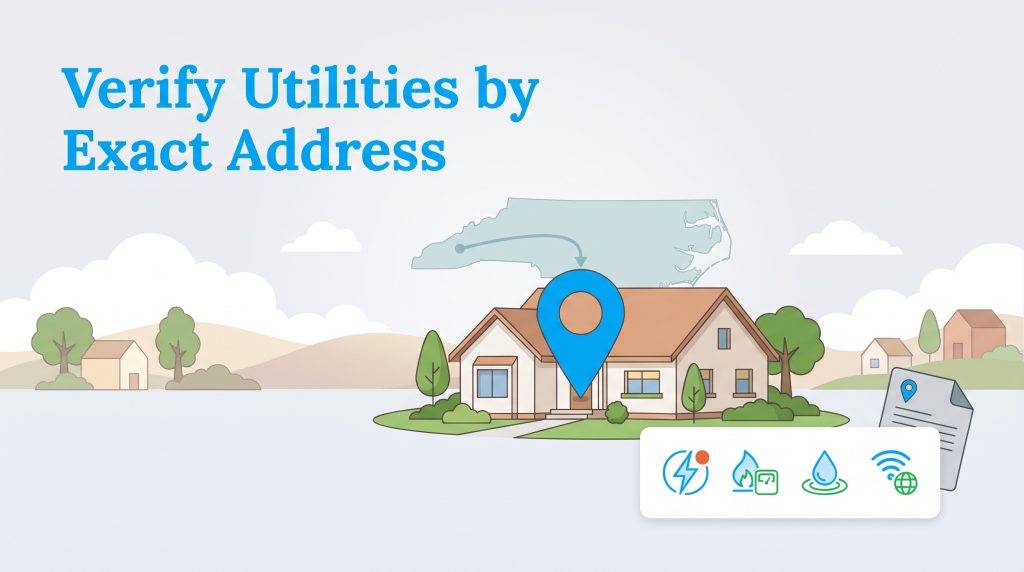
One of the first differences newcomers encounter when setting up utilities in North Carolina is that the state operates a regulated energy market. Unlike deregulated states where you shop around on a state marketplace to pick a retail electricity or gas supplier, your utility providers in North Carolina are assigned by the exact street address of your new home. Knowing which tier of the grid serves your neighborhood is essential for starting service.
Confirming Your Providers by Address
Because city names and ZIP codes don’t guarantee a specific provider, follow these steps to verify your local utility companies:
- Ask the landlord, seller, or property manager for the names of the current service providers.
- Confirm service directly with each provider using your complete address and unit number.
- Check whether water, trash, or internet is included in your rent or homeowners association fees.
- Confirm deposits, installation requirements, and your activation date before submitting any payment.
Electric Companies in North Carolina
When researching electric service for your new address, you’ll find that electric companies in North Carolina fall into a three-tier system. Two neighbors living just a mile apart on opposite sides of a county line can easily have completely different power companies and rate structures.
- Investor-Owned Utilities: The vast majority of residents are served by Duke Energy, which actually operates two distinct regional subsidiaries in the state. Duke Energy Carolinas covers Charlotte, Greensboro, Winston-Salem, and much of western North Carolina, while Duke Energy Progress serves Raleigh, Cary, Wilmington, Asheville, and large swaths of eastern North Carolina. Meanwhile, Dominion Energy supplies electricity to the northeastern coastal counties and parts of the Outer Banks.
- Municipal Power Systems (Public Power): Numerous cities and towns across the state operate their own community-owned electric grids, most of which coordinate through ElectriCities of NC. If you move into the city limits of Fayetteville (Fayetteville PWC), Greenville, High Point, Wilson, Gastonia, Concord, or Apex, check whether you’ll set up electricity directly through the city’s utility department rather than Duke Energy.
- Electric Cooperatives: If you buy or rent a home in a rural area or a fast-growing outer suburb, you may be served by one of North Carolina’s 26 local electric cooperatives. Member-owned co-ops like Wake Electric, Union Power Cooperative, Brunswick Electric, and Blue Ridge Energy deliver power across 93 of the state’s 100 counties.
To start your electric service, schedule your activation online or by phone before your move-in date. Providers may request identification, occupancy documentation, and a deposit. Ask what documents they accept, whether a credit check applies, and whether a 12-month payment history letter from a previous utility or another option can reduce the deposit.
Natural Gas and Heating Fuel Options
While many newer subdivisions in the warmer eastern half of the state are built as all-electric homes with heat pumps, hundreds of thousands of houses across the Piedmont and mountains use natural gas for winter furnaces, tankless water heaters, and kitchen ranges. Just like electricity, your natural gas provider is tied to your address.
The two dominant providers are Piedmont Natural Gas (a subsidiary of Duke Energy that serves the Charlotte metro, the Piedmont Triad, and portions of the eastern Piedmont) and Enbridge Gas North Carolina (which serves Raleigh, Durham, Chapel Hill, Gastonia, and the Asheville area). A handful of municipalities, such as Greenville Utilities Commission and the City of Wilson, also manage their own city gas lines. If you’re buying a property in the Blue Ridge Mountains or along the coast where underground gas mains don’t reach, check whether the home relies on an electric heat pump or a leased backyard propane tank that requires scheduled deliveries from a local fuel company.
Municipal Water, Sewer, and Trash Collection
Setting up home water service, wastewater, and curbside trash collection requires reaching out to your local city hall or county utility authority. Major public providers include Charlotte Water (serving much of Mecklenburg County), City of Raleigh Municipal Services, Durham Water Management, the Orange Water and Sewer Authority (OWASA) in Chapel Hill and Carrboro, and the Cape Fear Public Utility Authority (CFPUA) in the Wilmington area.
We recommend contacting your municipal water department before closing or your lease start date. Expect to ask about account activation fees or deposits, and have your closing settlement statement or signed lease ready to provide. Many municipal water departments also require a technician to physically visit the property to unlock or read the curb meter.
Pro Tip
If you’re buying a home in an unincorporated rural area outside city limits, ask your real estate agent early on whether the property uses a private well and septic system, and schedule a certified water quality test for bacteria, nitrates, and heavy metals during your inspection window.
High-Speed Internet and Fiber Availability
Because North Carolina is one of the nation’s premier hubs for remote workers and tech professionals, high-speed internet infrastructure in the state’s metro areas is robust. In the Research Triangle and Charlotte corridors, multiple fiber-optic providers keep speeds high and monthly pricing competitive.
Depending on your neighborhood, you can often choose between symmetrical multi-gigabit fiber connections from Google Fiber, AT&T Fiber, Lumos (expanding rapidly across the Triad and central NC), or Brightspeed. In the eastern town of Wilson, residents even have access to Greenlight Community Broadband, a pioneering city-owned fiber network. If fiber hasn’t reached your street yet, cable providers like Spectrum serve many urban and suburban pockets of the state. If you are moving to a rural area where wired service is limited, check if fixed wireless or satellite internet is available, but be sure to compare upload speeds, latency, data limits, and installation requirements. Always plug your exact street address into provider availability maps before signing a lease if your job depends on video calls and fast uploads.
Building Your Utility and Move-In Budget
When crunching your numbers, start with the big-ticket benchmarks. For example, according to recent estimates, median home sales prices and household incomes vary widely between booming urban centers like Raleigh and rural counties. Homeowners pay property taxes based on local county and municipal rates, while the state individual income tax rate is a flat 3.99% for 2026. Combined state and local sales tax rates also vary depending on the county and the type of purchase.
Understanding how taxes, housing, and home services fit together will help you build an accurate household relocation budget on our moving resource hub before your moving truck pulls out of the driveway.
Estimating Your Monthly Utility Bills
Your location and the age of your home’s HVAC system play a massive role in your monthly cash flow. Because winters across the Piedmont and coast are relatively mild, winter heating costs stay manageable compared to the Midwest or New England. Summer is a different story. When July and August highs hover in the low 90s with oppressive humidity, your heat pump or central air conditioner works overtime to pull moisture out of the indoor air.
According to residential data from the U.S. Energy Information Administration’s North Carolina State Energy Profile, North Carolina households rely heavily on electricity for both cooling and winter heating, though residential per-kilowatt-hour rates remain below the national average. Budgeting for seasonal swings keeps you from getting blindsided by your August statement. Below is a realistic breakdown of illustrative planning estimates for a standard single-family home. These are not a statewide bill guarantee. Your home’s size, heating fuel, insulation, usage, provider, and local fees will affect what you pay.
| Utility Service | Estimated Monthly Average | Seasonal Cost Drivers in North Carolina |
|---|---|---|
| Electricity | 135–165/month (Based on EIA state residential data) | Peaks between June and September due to heavy air conditioning and dehumidification demands; dips in April and October. |
| Natural Gas | 40–85/month (Only for homes equipped with gas lines) | Drops to a base service and water-heating charge (25–35) in summer; climbs from December to February for homes with gas furnaces. |
| Water, Sewer, and Trash | 65–95/month | Billed by city or county agencies; summer lawn irrigation can push monthly water usage higher. Trash may be included or billed separately depending on municipal rules. |
| High-Speed Internet | 60–80/month | Consistent year-round; multi-gig fiber plans in major metros cost more than entry-level 300 Mbps packages. Promotional rates and equipment rentals also apply. |
Your Chronological North Carolina Moving Checklist
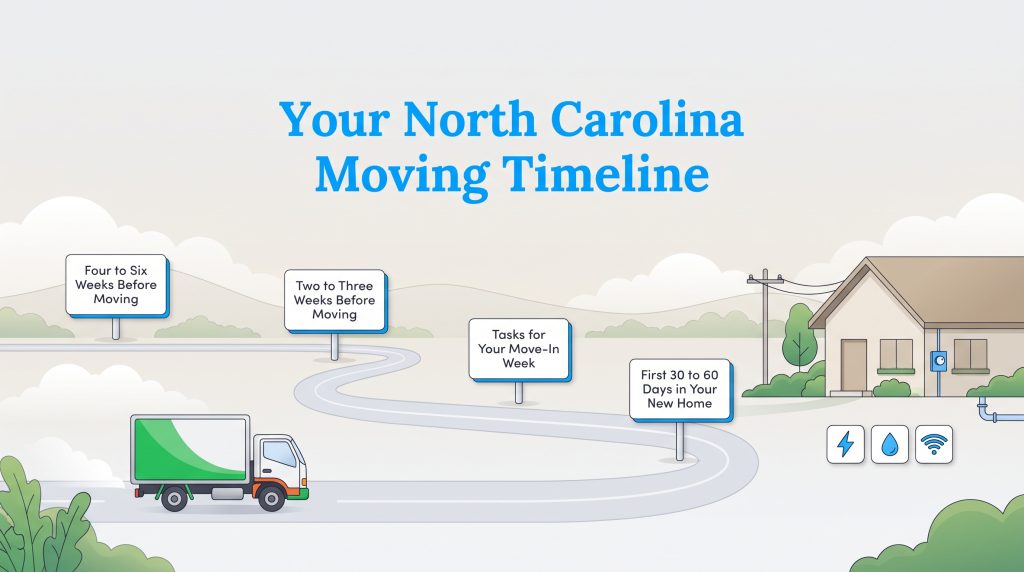
Juggling closing dates, utility deposits, and state bureaucracy is much easier when you tackle tasks in the right order. Breaking your North Carolina moving checklist into four chronological stages ensures your lights and air conditioning are running the moment your moving van pulls into the driveway. Follow this timeline to prepare when setting up utilities in North Carolina.
Four to Six Weeks Before Moving
- Book Your Moving Company or Rental Truck: Peak summer moving dates in Charlotte and the Triangle book up fast, so lock in binding estimates with a licensed interstate mover early.
- Reserve Your NCDMV Driver License Appointment: Log onto the NCDMV appointment scheduler now; suburban offices outside the major city centers often have much earlier availability than downtown locations.
- Research School Enrollment and Medical Records: If moving with children, check county school assignment maps (such as Wake County Public School System’s base and magnet calendar configurations) and request immunization and dental records.
Two to Three Weeks Before Moving
- Verify Your Address-Specific Utility Providers: Confirm whether your new home falls under Duke Energy Carolinas, Duke Energy Progress, Dominion Energy, a city public power system, or one of the state’s 26 electric cooperatives.
- Schedule Electricity and Natural Gas Activation: Schedule service for your possession date, or another date agreed to by your landlord or seller and the utility. Confirm any special requirements for weekends, inspections, or disconnected service.
- Contact Your Municipal Water and Trash Department: Submit your lease or closing disclosure to your city or county water authority, ask about any required meter deposit, and confirm when curbside trash and recycling bins will be delivered.
- Book Your High-Speed Internet Installation: Schedule a technician visit with Google Fiber, AT&T Fiber, Lumos, or Spectrum for the day after you move in if your property needs a new optical network terminal or line drop.
Tasks for Your Move-In Week
- Switch Your Auto Insurance to a North Carolina Policy: Have your insurer issue a North Carolina policy and email you a DL-123 form or NC insurance card before your DMV appointment.
- Inspect Your Water Meter and HVAC Filters: Confirm your water is flowing, locate your main water shutoff valve, test all smoke and carbon monoxide detectors, and install a fresh pleated HVAC air filter.
- File Your USPS Change of Address: Set up mail forwarding and update your residential address with your bank, credit cards, and payroll department so official mail begins arriving at your NC address for REAL ID proof.
First 30 to 60 Days in Your New Home
- Get Your North Carolina Driver’s License: Visit an NCDMV Driver License Office within 60 days with your ID, Social Security card, NC insurance proof, and two utility or housing residency documents.
- Title and Register Your Vehicle at a License Plate Agency: Take your new NC license credential, out-of-state vehicle title (or lienholder info), and MVR-1 title application to a local LPA to pay your property and applicable Highway Use taxes, and pick up your plate.
- Apply for Utility Rebates and Register to Vote: Submit your voter registration application and check your electric provider’s portal for smart thermostat credits, Time-of-Use rates, or Smart $aver® HVAC rebates.
Navigating the North Carolina DMV: Licenses, Registration, and Taxes
Once your boxes are unpacked and your lights are on, your next major errand is making things official with the state. The North Carolina Division of Motor Vehicles (NCDMV) can experience appointment backlogs in growing metros like Raleigh and Charlotte, so understanding the official NCDMV requirements for new residents will save you major headaches. Before heading out the door, review the current appointment availability and document checklists online so you don’t get turned away at the counter.
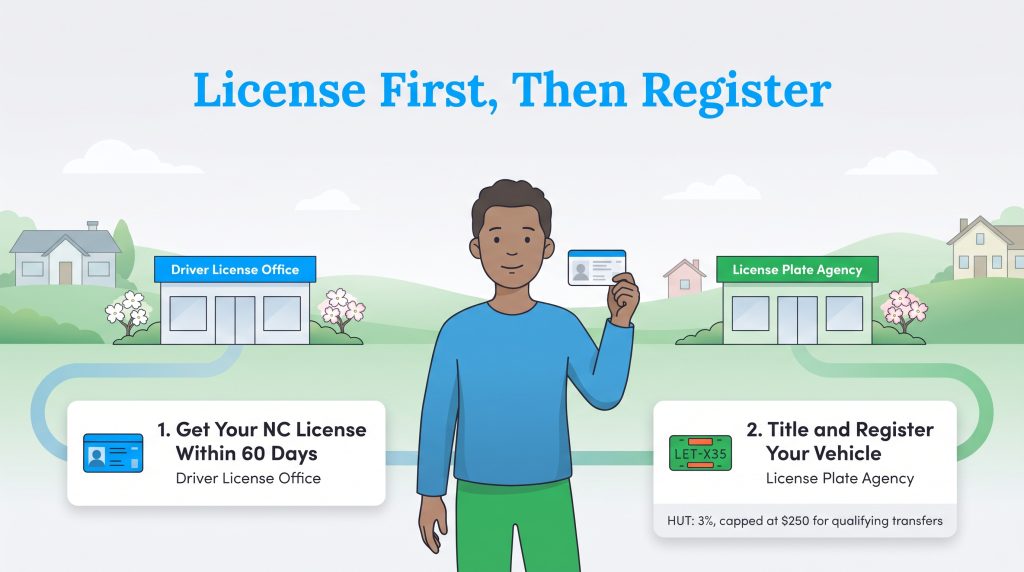
Getting Your NC Driver’s License Within 60 Days
If you establish permanent residency and plan to drive, North Carolina generally requires you to obtain a state driver’s license within 60 days. Importantly, you must secure your North Carolina driver’s license first before you are allowed to title and register your out-of-state vehicles. If your out-of-state license is valid, the NCDMV may waive the written and road tests, requiring only a vision screening and a traffic sign recognition test.
When you show up for your Driver License Office appointment, bring original physical copies of the following documents:
- Your Current Out-of-State Driver’s License: Or another acceptable primary document proving your full legal name and date of birth, such as a valid U.S. passport or certified birth certificate.
- Proof of Your Social Security Number: Your physical Social Security card, a W-2 form, or a 1099 tax form showing your full nine-digit number.
- Proof of North Carolina Liability Insurance: North Carolina requires drivers to demonstrate continuous liability coverage. If you own a vehicle, bring a printed DL-123 form or a valid NC insurance card. If you don’t own a vehicle, you may need to show proof of a non-owner liability policy or sign a fleet vehicle restriction form.
- Two Proofs of Physical NC Residency: To receive a federal REAL ID-compliant license (marked with a gold star), bring two printed documents showing your name and new North Carolina street address, such as your newly activated electric bill, municipal water statement, signed lease agreement, or mortgage closing statement.
Vehicle Registration, the Highway Use Tax, and Property Tax
Here is a quirk that trips up almost every newcomer: North Carolina separates driver’s licenses and license plates into two completely different offices. Driver License Offices are state-run facilities that issue IDs and licenses. To title your car and get your license plate, you typically must visit a separate License Plate Agency (LPA). Before registering a vehicle, confirm any deadlines tied to your residency, employment, and prior registration, and ensure you have your North Carolina driver’s license credential in hand.
When you transfer your out-of-state vehicle title at a License Plate Agency, you’ll encounter two distinct financial rules:
- The Highway Use Tax (HUT): Instead of charging traditional state sales tax on vehicles, North Carolina assesses a 3% Highway Use Tax on the value of a car whenever a title is issued. For qualifying out-of-state title transfers, the state caps this tax at a maximum of $250 per vehicle. This cap generally applies if the vehicle was already titled in your name in another state for at least 90 days before you apply for a North Carolina title. Keep in mind that this tax is separate from standard title fees, license plate fees, and your vehicle property tax.
- The “Tag & Tax Together” Program and Inspections: North Carolina combines annual vehicle registration renewals with county personal property taxes. Your initial registration also involves county vehicle property tax. New residents may qualify to defer that property tax payment for 60 days by receiving a limited registration plate, but the deferral doesn’t eliminate the tax or postpone it until the next annual renewal. Additionally, new residents bringing an out-of-state vehicle are often exempt from the state’s safety and emissions inspection at the time of initial registration, though an inspection will be required before your first annual renewal.
Money-Saver
Call your auto insurance agent to switch your policy over to a policy written specifically by a North Carolina-licensed carrier a few days before visiting the DMV, as out-of-state auto policies are rejected at the counter and can cost you a wasted day off work.
Eco-Conscious Energy Upgrades and North Carolina Solar Incentives
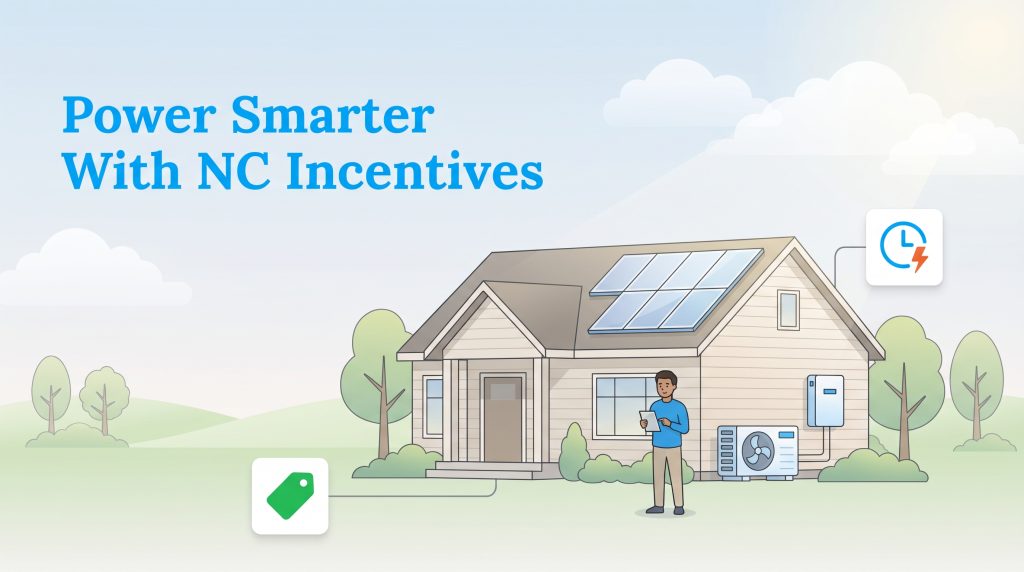
North Carolina’s abundant year-round sunshine and long cooling season make it an ideal place to invest in home efficiency upgrades. Making an environmentally mindful choice when setting up or upgrading your home systems doesn’t just shrink your carbon footprint — it directly protects your wallet when summer temperatures soar into the 90s. Whether you’re buying a fixer-upper in Durham or a newer build outside Charlotte, exploring sustainable living upgrades early in your move pays dividends for years.
Electric companies in North Carolina offer various incentives to help homeowners cut peak demand on the state grid. Before replacing an aging air conditioner or water heater, check out the following programs and North Carolina solar incentives and energy rebates:
- Utility Efficiency Rebates: Duke Energy’s Smart $aver® program offers rebates when upgrading eligible equipment, subject to current program limits and availability. Many electric cooperatives and municipal utilities offer similar cash-back credits for upgrading older HVAC equipment. You can cross-reference eligible appliances and local utility incentives by entering your new ZIP code into the ENERGY STAR Rebate Finder before buying new gear.
- Time-of-Use Rate Schedules and Green Power: Both Duke Energy territories and several electric co-ops offer optional Time-of-Use (TOU) rate plans. Switching to a TOU schedule is an eco-conscious alternative that rewards you with discounted rates during off-peak hours. However, peak electricity can cost more, and savings depend entirely on your ability to shift heavy usage away from those peak times. Always compare your actual usage history against the proposed rate. Renters and homeowners who cannot install panels on their roof can also look into territory-specific programs like NC GreenPower or Duke Energy’s Shared Solar community program.
- Rooftop Solar and Battery Storage Incentives: North Carolina consistently ranks among the top states in the country for solar capacity. For homeowners exploring home solar installation, programs like Duke Energy’s PowerPair℠ pilot offer upfront incentives (up to a $9,000 maximum combined for qualified solar and battery storage), but these are strictly limited by capacity mandates from the North Carolina Utilities Commission, and waitlists may apply depending on your specific utility territory.
Eco Edge
Pairing a compatible smart thermostat with your home’s heat pump is a simple energy-saving option that can help reduce heating and cooling use, but actual savings depend on your equipment, schedule, settings, and climate.
Weighing the Pros and Cons of Living in North Carolina
Thousands of people pack up their trucks and move to the Tar Heel State every year, drawn by a rare mix of career opportunities and geographic diversity. Most newcomers anchor their search for the best places to live in North Carolina around four major areas: the Research Triangle (Raleigh, Durham, and Chapel Hill), the Charlotte banking corridor, the Piedmont Triad (Greensboro, Winston-Salem, and High Point), or scenic mountain and coastal towns like Asheville and Wilmington. Before you unpack your boxes, it helps to weigh the everyday perks against the practical trade-offs of life in the Southeast.
Evaluating the pros and cons of living in North Carolina comes down to balancing lower taxes and mild winters against sticky summers and growing pains in fast-expanding suburbs. While you’ll likely spend far less time shoveling snow, you’ll definitely need a solid plan for keeping your home cool from June through September.
| Pros of Living in North Carolina | Cons of Living in North Carolina |
|---|---|
| Moderate Four-Season Climate: Depending on your home’s insulation, elevation, and heating equipment, milder winters in the Piedmont and coastal plain can mean lower heating bills and year-round outdoor recreation. | High Summer Humidity: July and August bring thick humidity and temperatures in the 90s, which drives up air conditioning runtime and summer electric bills. |
| Booming Job Markets: Strong corporate growth across tech, biotech, healthcare, and finance provides ample career opportunities in Charlotte, Raleigh, and Durham. | The Infamous “Yellow Pollen Season”: From late February through May, pine and oak trees coat cars, porches, and window screens in a thick layer of yellow dust. |
| Lower Overall Tax Burden: A flat state income tax and reasonable property tax rates offer potential financial relief if you’re arriving from the Northeast or West Coast. | Heavy Car Dependency: Outside of walkable pockets in uptown Charlotte or downtown Durham, public transit is limited, making a personal vehicle essential. |
| Geographic Variety: Living in central North Carolina puts you within a few hours’ drive of both the Appalachian Mountains and the Atlantic Ocean. | Severe Weather Risks: Coastal counties face hurricane and flooding threats, while western mountain valleys can experience tropical storm washouts and landslides. |
Heads Up
If you are moving to western North Carolina, verify local road infrastructure and utilities following late-2024 tropical storm recovery efforts, and stock up on the highest MERV-rated HVAC filters your system supports before the spring pollen season arrives.
Settling Into Your New North Carolina Home With Confidence
While moving to North Carolina comes with a few unique administrative quirks — like figuring out which electric territory serves your street and visiting two separate DMV offices to get your license and plates — a little early prep takes the guesswork out of the process. By scheduling your electricity, natural gas, water, and fiber internet transfers for your agreed-upon possession date, you’ll step into a cool, comfortable home with everything up and running. Take advantage of your utility’s energy-efficiency rebates to keep those humid summer cooling bills low, knock out your vehicle registration early, and get ready to enjoy everything from backyard Carolina barbecue to autumn weekend drives along the Blue Ridge Parkway.
Frequently Asked Questions About Moving to North Carolina
Below are some of the most common questions newcomers ask when planning their move and setting up home services in North Carolina.
How Early Should I Set Up Utilities When Moving To North Carolina?
Can I Choose My Own Electric Company In North Carolina?
Why Does North Carolina Have Two Different DMV Offices?
How Does The Cost Of Utilities In North Carolina Compare To Florida Or The Northeast?
Do I Need A Vehicle Inspection Right Away When Moving To North Carolina?
What Is The Best Way To Keep Summer Electric Bills Low In North Carolina?
About the Author

LaLeesha has a Masters degree in English and enjoys writing whenever she has the chance. She is passionate about gardening, reducing her carbon footprint, and protecting the environment. She also recently served as President of the Board for City Sprouts (a community garden).

David has been an integral part of some of the biggest utility sites on the internet, including InMyArea.com, HighSpeedInternet.com, BroadbandNow.com, and U.S. News. He brings over 15 years of experience writing about, compiling and analyzing utility data.