
Understanding the recent rate hikes from CenterPoint Energy, Columbia Gas, and Duke Energy can help you protect your home budget and make eco-conscious energy choices.
Key Takeaways
- Default natural gas rates for CenterPoint Energy, Columbia Gas, and Duke Energy in Ohio have climbed to $0.5481, $0.5481, and $1.0367 per Ccf, respectively, reflecting market pressures and regulatory adjustments.
- You can bypass these high utility prices entirely by switching to a competitive retail supplier or participating in a local community aggregation program.
- Combining rate-switching strategies with environmentally mindful conservation habits is the most effective way to shrink your energy footprint and lower your bills.
Moving into a new home is an exciting milestone, but setting up your utilities can feel like a crash course in finance and regulatory policy. If you reside in western, central, or southwestern Ohio, you might have recently noticed a sudden jump in your utility bills. Default natural gas supply rates for CenterPoint Energy Ohio have ticked up from $0.4903 to $0.5481 per Ccf (100 cubic feet), Columbia Gas of Ohio default rates have risen from $0.5290 to $0.5481 per Ccf, and Duke Energy Ohio default customers have watched rates climb from $0.9850 to $1.0367 per Ccf. Navigating these changes can feel overwhelming, but we are here to help you make sense of why these rates are fluctuating, how they impact your household budget, and the practical steps you can take to keep your hard-earned money in your wallet.
Why Are Ohio Natural Gas Rates Rising?
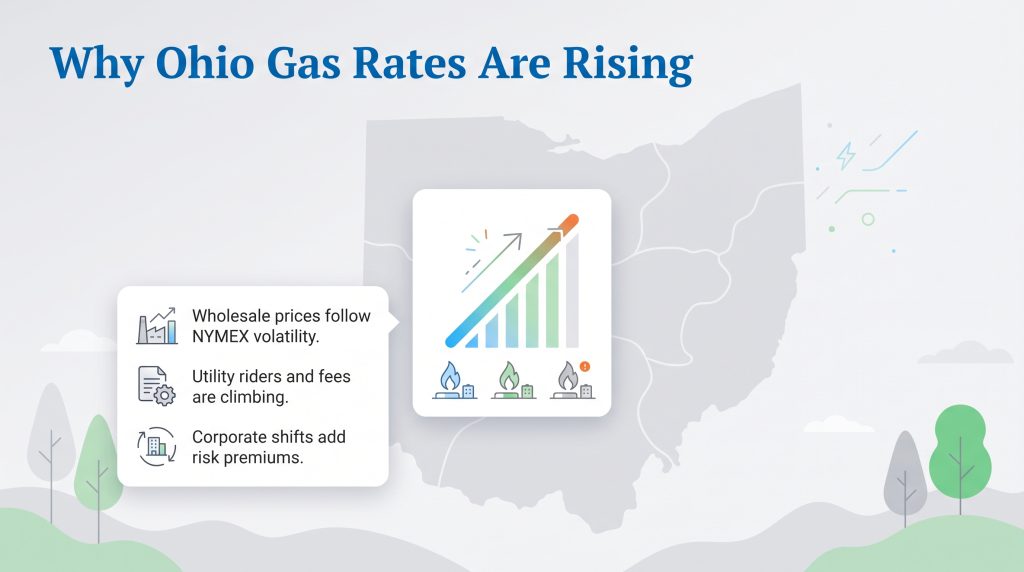
Understanding the forces driving your energy costs is the first step to taking control of your bills. Retail natural gas prices in Ohio fluctuate based on national commodity markets, corporate restructuring, and utility-specific regulatory fees — and major providers like CenterPoint, Columbia Gas, and Duke Energy are all feeling the squeeze.
Wholesale Market Volatility and Corporate Transitions
For CenterPoint Energy Ohio (formerly Vectren), the shift to $0.5481 per Ccf reflects a combination of wholesale gas cost movements and corporate changes. CenterPoint’s default Standard Choice Offer (SCO) is calculated using month-end settlement prices on the New York Mercantile Exchange (NYMEX) Henry Hub, plus an administrative fee known as the Retail Price Adjustment.
Recently, CenterPoint’s adjustment fee surged by 70%, rising from $1.30 to $2.20 per Mcf (thousand cubic feet). Suppliers participating in the state’s default auctions priced in higher risk premiums due to the pending $2.62 billion sale of CenterPoint’s Ohio assets to National Fuel Gas Company. While the regulatory approval process continues, these transition risks are passed directly to default customers in the form of higher variable supply rates.
Commodity Price Pressures and Columbia Gas Updates
Similar to CenterPoint, Columbia Gas of Ohio calculates its monthly Standard Choice Offer based on NYMEX wholesale settlement prices and a Retail Price Adjustment determined through annual auctions. Columbia’s default rate increase from $0.5290 to $0.5481 per Ccf reflects wider commodity price pressures, which are influenced by tightening national gas inventory levels and rising demand for exports. Additionally, Columbia Gas recently had a $68 million rate increase upheld by the Ohio Supreme Court, which cements high fixed costs for customers alongside these shifting commodity rates.
Duke Energy’s SSOCR Surcharge Structure
Duke Energy’s high default supply rate of $1.0367 per Ccf is heavily influenced by state-approved cost reconciliation mechanisms. Beginning April 1, 2026, Duke transitioned its default billing structure from a monthly Gas Cost Recovery charge to a market-based Standard Service Offer.
Under this new structure, Duke implemented a significant adjustment to its Standard Service Offer Cost Reconciliation Rider — or Rider SSOCR. This bypassable rider swung from a customer credit to a positive volumetric charge of $0.2758 per Billing Ccf to recover past wholesale purchasing imbalances. As a consequence of this reconciliation charge, Duke’s default service offer remains locked above the $1.00 per Ccf threshold.
What Major Cities and Areas Are Impacted?
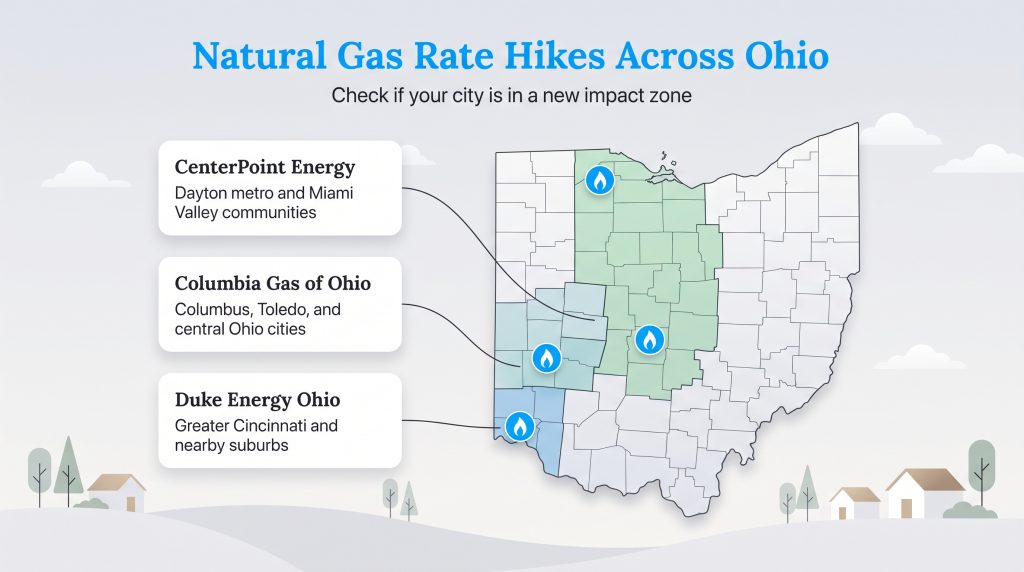
The recent natural gas rate adjustments directly impact a large portion of the population in western and southwestern Ohio. Depending on which local utility services your new home, your utility bills will reflect these changes if you are enrolled in default utility supply plans.
CenterPoint Energy Service Territory
CenterPoint Energy serves approximately 316,000 customers in a 17-county region of West Central Ohio. If you reside in the Dayton metropolitan region — including Dayton, Kettering, Centerville, Huber Heights, and Vandalia — your home falls under CenterPoint’s service area. The rate increase also directly impacts communities along the Miami Valley corridor, such as Troy, Piqua, Sidney, Beavercreek, Xenia, Greenville, and Eaton.
Columbia Gas of Ohio Service Territory
Columbia Gas of Ohio serves approximately 1.5 million residential and commercial accounts across central and southern portions of the state. Its default rate increase to $0.5481 per Ccf directly affects customers in major metropolitan hubs, specifically impacting cities like Columbus and Toledo. If you are moving into these major central Ohio municipalities, your utility service will likely fall under Columbia Gas’s jurisdiction
Duke Energy Service Territory
Duke Energy Ohio’s service area covers roughly 3,000 square miles in the southwestern corner of the state, delivering natural gas to roughly 525,000 customers. This impact zone includes the Greater Cincinnati metropolitan area, extending into suburbs like Blue Ash, Bridgetown, and Anderson Township. The rate adjustments also affect residential utility accounts across Butler, Warren, Clermont, and Brown counties, including communities like Hamilton, Middletown, and Mason.
How Do These Rate Hikes Impact Your Monthly Bill?
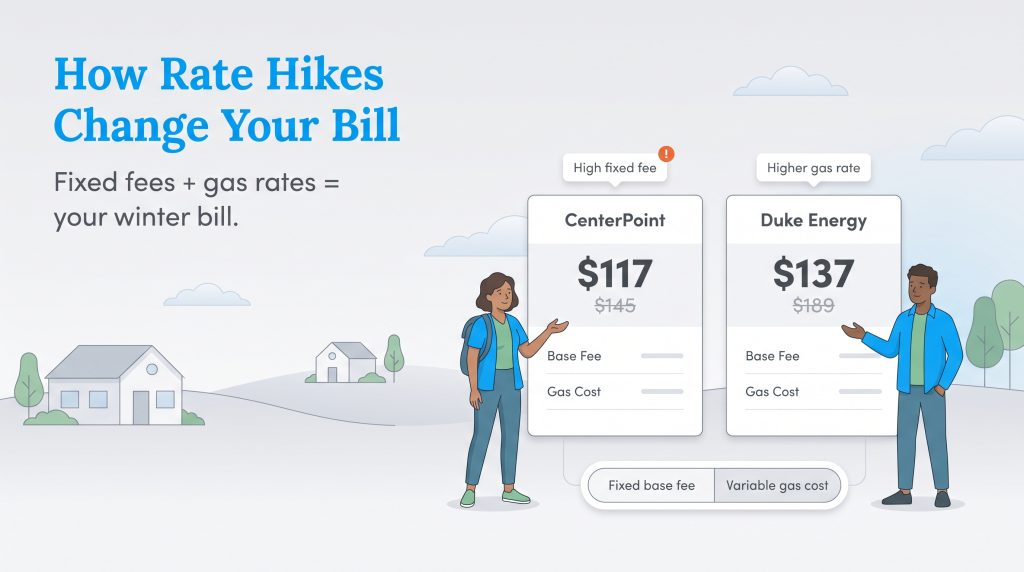
To calculate how these rate hikes affect your household budget, we must look at the two primary components of an Ohio natural gas bill: variable usage charges and fixed monthly customer charges. Many Ohio utilities use a specific regulatory structure that can keep bills high even if you practice strict energy conservation.
The Straight Fixed Variable Rate Design Challenge
Ohio regulators allow utilities to utilize a “Straight Fixed Variable” rate structure. This design separates the fixed operating costs of maintaining the pipeline network from the actual cost of the natural gas commodity. Consequently, a large portion of your monthly bill is a flat customer service fee that you must pay regardless of how much gas you consume.
For example, CenterPoint residential customers face a monthly base customer charge of $62.32, while Duke Energy charges a flat customer service fee of $33.03. Columbia Gas of Ohio customers also experience this structure. The Ohio Supreme Court recently upheld a PUCO decision leaving Columbia Gas’s residential flat monthly customer charge at $58.00 — a fee that was raised over time to provide predictable revenue for the utility while making it harder for energy-conscious consumers to lower their bills. Because these fixed charges remain completely flat, reducing your thermostat during mild spring or autumn months does not lower this portion of your bill, making the variable gas supply rate your primary tool for securing financial savings.
Moderate vs. Peak Winter Monthly Bill Projections
To illustrate how the current rates translate into actual dollars, we have modeled estimated monthly bills below. These estimates reflect a moderate usage month (100 Ccf) and a peak winter heating month (150 Ccf), factoring in standard customer service charges and variable rates.
| Billing Component | Moderate (100 Ccf) | Peak Winter (150 Ccf) |
| CenterPoint Base Fee | $62.32 | $62.32 |
| CenterPoint Gas Cost ($0.5481/Ccf) | $54.81 | $82.22 |
| CenterPoint Bill Total | $117.13 | $144.54 |
| Columbia Gas Base Fee | $58.00 | $58.00 |
| Columbia Gas Gas Cost ($0.5481/Ccf) | $54.81 | $82.22 |
| Columbia Gas Bill Total | $112.81 | $140.22 |
| Duke Base Fee | $33.03 | $33.03 |
| Duke Gas Cost ($1.0367/Ccf) | $103.67 | $155.51 |
| Duke Bill Total | $136.70 | $188.54 |
Note: Projections are based on current default supply rates and standard base customer charges, and they exclude minor local distribution riders or sales taxes.
Actionable Steps to Lower Your Utility Cost
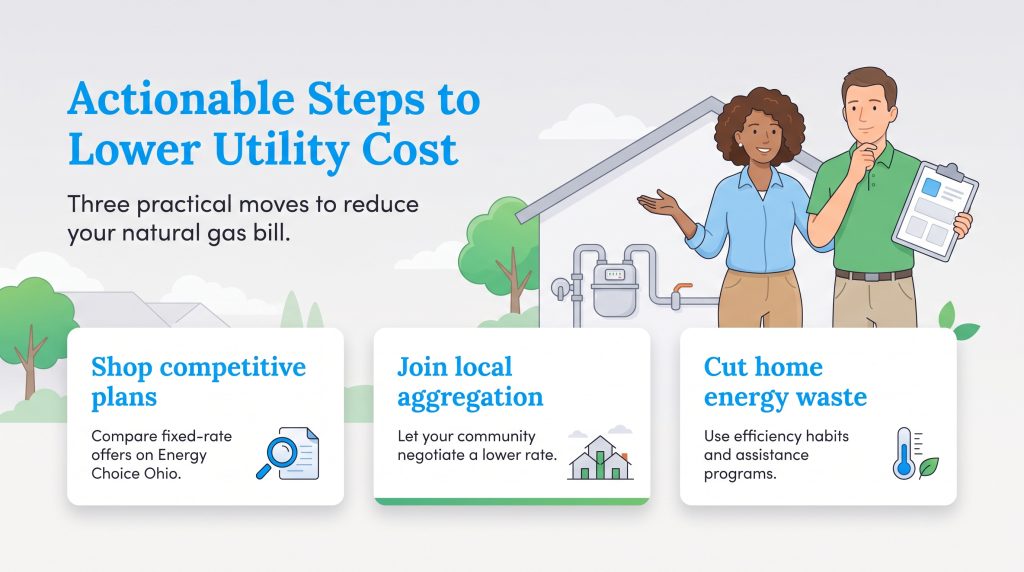
Because Ohio operates a fully deregulated energy choice market, you are not locked into paying the default rates offered by your local utility company. There are three major pathways we recommend to help you secure a lower supply rate, stabilize your budget, and reduce your energy bills.
Shopping the Energy Choice Ohio Portal
You have the legal right to choose an alternative retail natural gas supplier. We highly recommend that you explore current plans on the Energy Choice Ohio comparison portal to find competitive fixed-rate plans. When you shop, you can select between two main contract types: fixed-rate plans, which lock in your price for a set term (usually 12 to 36 months) to protect you from winter price spikes, and variable-rate plans, which offer flexibility but leave you exposed to market fluctuations.
For Duke Energy customers, shopping is an incredibly powerful option. Duke’s quarterly reconciliation surcharge of $0.2758 per Ccf is structurally designated as bypassable, meaning customers who switch to a competitive supplier are legally exempt from paying it. If you switch to a competitive 12-month fixed-rate plan — like Ohio Natural Gas’s plan at $0.4390 per Ccf — you bypass both the high default supply rate and the reconciliation rider, instantly dropping your volumetric supply charges by more than 50%!
Once you select a plan, you can easily follow the official steps to switching natural gas suppliers in Ohio to transition with zero service interruptions.
Joining a Municipal Aggregation Program
Governmental aggregation allows local community leaders to pool the collective buying power of residents to negotiate lower bulk-rate energy contracts. These programs typically operate on an opt-out basis, meaning you are automatically enrolled unless you actively choose to opt out.
For example, the Anderson Township Aggregation Program negotiated a fixed contract with Direct Energy Services starting with July 2026 meter reads. This program locks in a rate of $0.5399 per Ccf through July 2027 with no termination fees, allowing local residents to easily bypass Duke’s high default rates. You can learn more on the Anderson Township natural gas program details page to see if your new home qualifies.
Leveraging Energy Efficiency and Assistance Programs
If you want to reduce your environmental footprint while keeping more money in your pocket, combining rate-switching strategies with practical energy efficiency habits is an excellent, environmentally mindful choice. Simple changes can yield big savings — for instance, lowering your water heater temperature to 120°F and sealing drafty windows or doors to prevent heat loss. Turning your thermostat down seven to 10 degrees for eight hours a day can also reduce your annual heating costs by up to 10%.
If you are facing financial hardship, you can also explore payment assistance options like Budget Billing, which estimates your annual usage and divides it into 12 equal monthly payments to prevent seasonal billing spikes. Additionally, the Percentage of Income Payment Plan (PIPP Plus) caps gas bills at 5% of monthly income for eligible low-income households.
Protecting Your Budget with Smart Energy Choices
Rising utility prices can present a real challenge when you are settling into a new home, but Ohio’s deregulated energy market gives you the power to fight back. By actively shopping for competitive fixed rates, exploring municipal aggregation programs, and adopting energy-saving habits, you can take control of your monthly utility bills. Making these proactive, eco-conscious adjustments not only protects your household budget but also helps build a more sustainable, energy-efficient home for the future.
About the Author

Claudio is a sustainability-focused writer with a background in Anthropology and Psychology from NC State University. He has spent over 15 years working in writing, interpretation, and translation, driven by a deep interest in how human culture shapes the environment. Today, he shares his curiosity with readers by writing about sustainable living solutions and the connection between everyday choices and environmental impact.