

Your Missouri Service Address, Heating System, and Local Utility Rules Will Shape Your Move-In Plan and Monthly Budget
Key Takeaways
- While housing costs may be lower than where you live now, your overall cost of living depends heavily on your household budget and local utility usage.
- Because the state experiences humid heatwaves and freezing winters, evaluating your heating system and claiming current local energy rebates can help you manage seasonal utility bills.
- To reduce move-in delays, confirm service providers for your exact address and schedule activations at least two weeks before moving.
Moving to Missouri means comparing more than home prices. Your monthly costs will also depend on your heating system, local utilities, and whether services such as water, sewer, and trash are included in your rent. We’ll help you compare communities, identify providers for your new address, and organize the paperwork and service appointments you’ll need before and after moving.
The Pros and Cons of Living in Missouri
While Missouri isn’t a flashy coastal state, it delivers a practical lifestyle for newcomers. Weighing the pros and cons of living here comes down to balancing relatively low living costs against a few Midwestern realities and wild weather swings. If you prepare your home and budget for those quirks ahead of time, you’ll have an easier time navigating the transition.
Why People Love Calling Missouri Home
From stretchable paychecks to weekend outdoor escapes, here is why newcomers quickly fall in love with the state:
- Low housing costs: Your housing dollar often goes further here than in many coastal cities. Whether you’re buying a historic brick home or renting an apartment, you may find more affordable square footage depending on your current location.
- Central location: Sitting centrally located in the country makes domestic travel highly accessible. Even better, daily rush-hour traffic in Missouri’s major metros is typically milder than in many larger cities, which can give you back hours of your week.
- Incredible outdoor access: Nature lovers have endless weekend options, including boating at the Lake of the Ozarks and hiking through the Mark Twain National Forest. For low-impact, eco-friendly recreation, the Katy Trail State Park stretches 240 miles across the state along the Missouri River, serving as one of the longest developed rail-trails in the country for cyclists and runners.
- World-class food and culture: You’ll find famous Kansas City burnt ends, St. Louis ribs, deep jazz heritage, and passionate sports towns. Plus, Missouri excels at free public attractions, most notably St. Louis’s Forest Park, which houses a world-renowned zoo, art museum, and science center that charge zero general admission (though parking and special exhibitions may cost extra).
Drawbacks and Realities to Keep in Mind
No state is perfect, and being honest about Missouri’s challenges will help you protect your home and wallet:
- Extreme four-season weather: The old joke that you can experience all four seasons in a single Missouri week isn’t far off. You’ll need to prepare for summer heatwaves with temperatures above 95°F and high humidity, winter ice storms that can knock out power lines, and severe spring storms in Tornado Alley.
- Seasonal allergies and indoor humidity: Lush greenery comes with a catch. High spring tree pollen counts, autumn ragweed, and muggy summer air mean your home’s HVAC system and air filtration will need regular maintenance to keep your indoor air crisp.
- Car-dependent cities: Outside of a few walkable neighborhoods in St. Louis, downtown Kansas City, and college towns like Columbia, public transit is limited. Most households need a reliable personal vehicle to handle daily errands.
- Annual personal property tax on vehicles: Missouri taxes the value of your cars, boats, and motorcycles based on what you owned on Jan. 1 of the tax year. These property taxes are generally assessed annually, with payments usually due by Dec. 31.
Heads Up
Because Missouri charges an annual personal property tax based on vehicles owned on Jan. 1, new residents moving in after that date may need a “Statement of Non-Assessment” (commonly called a tax waiver) from their county assessor’s office. Check with your local assessor to see what specific documentation they require before the state will issue your new license plates.
Breaking Down the Cost of Living in Missouri
The primary magnet drawing new residents to the Midwest is affordability. According to the Missouri Economic Research and Information Center (MERIC) 2025 Cost of Living Index, the state’s cost of living sits below the national baseline. Housing is often the biggest budget factor here. In late 2025, Missouri REALTORS reported median residential home sale prices hovering around $250,000, though prices vary widely based on location. On the tax side, Missouri uses a graduated state income tax structure, and you should always check the Missouri Department of Revenue (DOR) for the current tax year’s top rate. Furthermore, if you live or work in St. Louis or Kansas City, be prepared for an additional 1% local earnings tax. The state’s base retail sales tax rate sits at 4.225%, though county and municipal additions typically push your checkout total higher.
| Expense Category | Missouri Estimate | Context |
|---|---|---|
| Cost of Living Index | 88.4 | MERIC Q3 2025 Index (National Baseline: 100.0) |
| Median Home Sale Price | $250,000 | Missouri REALTORS (Q4 2025 statewide report) |
| Average Monthly Rent | $1,050 | One-bedroom statewide average (HUD 2025 Fair Market Rents) |
| Base State Sales Tax Rate | 4.225% | Excludes local county and city additions |
Quick Fact
While local municipalities add their own taxes to retail purchases, Missouri applies a reduced 1.225% state sales tax rate to qualifying food meant for home consumption. However, keep in mind that local city and county taxes may still apply to your grocery bill.
Best Places to Live in Missouri: Comparing the Top Cities
Narrowing down the best places to live in Missouri usually starts with choosing between St. Louis and Kansas City. While those two bookend metros anchor the state’s economy along Interstate 70, mid-sized cities like Springfield and Columbia offer fantastic options for different priorities, including those looking for a slower pace or specific municipal services.
St. Louis: Historic Neighborhoods and Free Attractions
St. Louis offers a distinct split between its urban core and surrounding suburbs. In St. Louis City, you’ll find gorgeous 19th-century red-brick architecture, leafy streets, and walkable pockets like the Central West End and Soulard. Across the city line in St. Louis County, suburban communities offer highly rated school districts. Major job sectors include healthcare, biotech, and finance. When setting up your home, you’ll typically rely on Ameren Missouri for electricity and Spire for natural gas.
Kansas City: Booming Tech, Jazz, and Midwest Hospitality
Sitting on the western border, Kansas City is experiencing steady growth supported by an expanding tech sector, a revitalized downtown streetcar corridor, world-class jazz, and championship sports culture. Known as the “City of Fountains,” KC feels slightly more sprawling and Midwestern than historic St. Louis. While popularity has increased metro home prices, it remains a bargain compared to similarly sized metros like Austin or Denver. On the utility front, Evergy powers the electric grid across many parts of the Kansas City metro, while Spire manages natural gas delivery on the Missouri side.
Springfield: Gateway to the Ozarks With Municipal Utilities
Located in southwest Missouri, Springfield is a budget-friendly hub for outdoor enthusiasts. As the third-largest city in the state, it features relatively low living costs, strong hospital networks, and easy weekend access to Branson and Table Rock Lake. One of Springfield’s best perks for homeowners and renters is its utility setup: City Utilities of Springfield is a community-owned municipal provider that bundles your electricity, natural gas, and water onto one convenient monthly bill. While they manage a commercial fiber network, residential high-speed internet is typically provided by separate telecom companies like Quantum Fiber or Mediacom.
Columbia: A Walkable, Eco-Minded College Town
Affectionately called “CoMo” by locals, Columbia sits halfway between St. Louis and Kansas City right along I-70. Home to the University of Missouri (Mizzou), this energetic city of roughly 130,000 residents boasts an educated workforce, a stable healthcare and education job market, and an extensive network of connected greenway trails. It’s arguably the most bike-friendly, progressive city in the state. Columbia also runs its own municipal utility department, Columbia Water & Light, which gives residents direct access to solar rebates and voluntary renewable energy programs.
Setting Up Utilities in Missouri: Providers and Average Costs
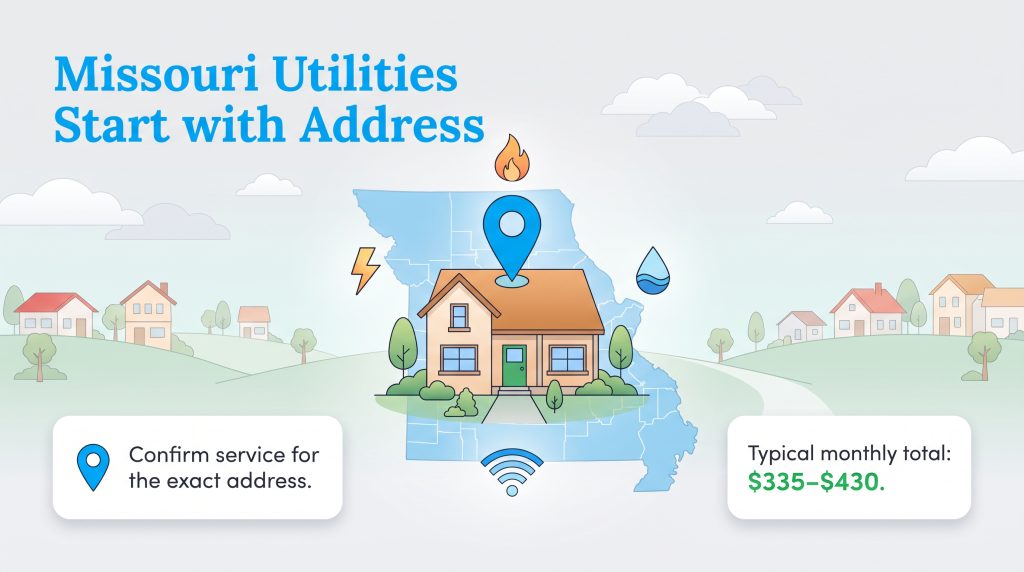
When you start planning the logistics of setting up utilities in Missouri, there is one foundational rule to understand: Your electric utility is generally determined by your service address, not by a retail supplier comparison. Confirm service for the exact address because one ZIP code can include multiple utility territories. While residents in deregulated parts of states like Texas or Ohio might shop among retail marketers, your Missouri electricity and gas providers are determined strictly by your new home’s geographic boundaries. That makes your move-in checklist much simpler, as you only need to identify the assigned local utility for your address and schedule your activation date.
Illustrative Monthly Utility Budget for a Missouri Home
Building a realistic monthly budget means looking past average electricity rates and focusing on seasonal consumption. While Missouri’s residential electricity rate sits slightly below the national average at roughly 12 to 13 cents per kilowatt-hour (kWh), according to 2024 annual data from the U.S. Energy Information Administration (EIA), total household usage spikes sharply during July and August air conditioning season and again during January and February freezes. Because the state relies heavily on coal and natural gas alongside growing wind power, seasonal fuel adjustments can also nudge your winter and summer bills upward.
Here is a realistic estimate of monthly utilities for a typical single-family home using natural gas heat and city water:
- Electricity: $130 to $150 per month (averaging lower in spring/fall, higher in peak summer)
- Natural Gas: $75 to $95 per month averaged annually (often dropping under $35 in summer and topping $150 in mid-winter)
- Water and Sewer: $50 to $75 per month
- Trash and Recycling: $20 to $35 per month
- High-Speed Internet: $60 to $75 per month
- Total Estimated Monthly Utility Budget: $335 to $430 per month
Money Saver
Ask your electric and gas providers about “Budget Billing” as soon as you set up your account. Offered by Ameren Missouri, Evergy, and Spire, this free billing option averages your home’s annual energy usage into predictable monthly payments so you’ll never be blindsided by a surprise $300 air conditioning bill during an August heatwave.
Selected Major Missouri Electricity and Gas Providers by Region
Whether you are setting up your electricity or transferring your natural gas service, knowing which company operates in your region will save you phone time. Below are the primary providers across the state:
| Utility Provider | Service Type | Primary Missouri Regions Served |
|---|---|---|
| Ameren Missouri | Electricity & Natural Gas | Electric in St. Louis Metro, Central, and Southeast MO; Natural Gas in select towns (Rolla, Cape Girardeau, Jefferson City) |
| Evergy | Electricity | Kansas City Metro (select areas), St. Joseph, Sedalia, and Western MO |
| Spire | Natural Gas | St. Louis Metro, Kansas City Metro (Missouri side), and surrounding counties |
| Liberty Utilities | Electricity & Natural Gas | Joplin, Neosho, and Southwest MO (plus gas in select SE/NE towns) |
| City Utilities of Springfield | Electric, Gas, & Water | Springfield and Greene County area |
| Columbia Water & Light | Electricity & Water | City of Columbia (Ameren handles natural gas here) |
| Summit Natural Gas | Natural Gas | Lake of the Ozarks, Branson, and Lebanon areas |
| Rural Electric Cooperatives | Electricity | 40+ distribution co-ops (such as Cuivre River, Boone Electric, and Co-Mo Electric) serving rural towns and lake communities |
Water, Sewer, Trash, and High-Speed Internet Setup
Beyond power and heat, you’ll need to coordinate your water and sewer connections and waste pickup. Missouri American Water is the largest private water utility in the state, serving St. Louis County, St. Charles, Joplin, and Jefferson City. If you live within the urban core of the two biggest cities, you will use the St. Louis City Water Division or KC Water. Pay special attention if you move to the St. Louis area: water and wastewater are split between two different entities, meaning you must set up a separate account with the Metropolitan St. Louis Sewer District (MSD) for sewer billing. Trash and recycling are typically handled by your city municipality or through private haulers like Republic Services and Waste Connections in unincorporated county suburbs. If you’re renting, confirm with your landlord which utilities remain in their name versus what you need to establish. Providers frequently run soft credit checks to determine if a security deposit is required to start service. Additionally, keep in mind that natural gas companies typically require an adult to be physically present at the home to activate the meter and inspect appliances.
For remote workers and streaming households, getting high-speed home internet connected in Missouri is straightforward, but availability changes block by block. Always enter your specific address into a provider’s database rather than assuming service based on a neighbor. Kansas City was the birthplace of Google Fiber, which offers multi-gigabit speeds alongside AT&T Fiber and Spectrum. In St. Louis and Springfield, AT&T Fiber and Spectrum dominate the market, while Socket Fiber and Co-Mo Connect provide fast, reliable fiber-optic service across Central Missouri and the Lake of the Ozarks.
Weatherproofing Your Home and Claiming Missouri Energy Rebates
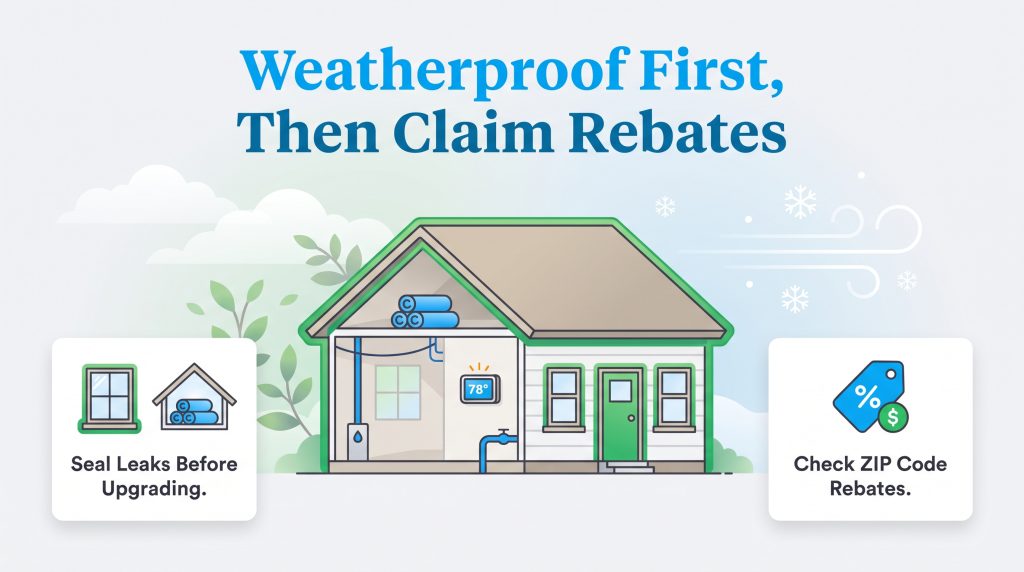
Missouri’s muggy summers and icy winter winds put serious stress on residential heating and cooling equipment. Treating energy efficiency as a top priority isn’t just an environmentally mindful choice — it’s a smart financial defense against extreme weather bills. By checking your equipment and assessing leaks before buying new appliances, you can keep your indoor climate comfortable without burning through your budget.
Smart Weatherproofing for Humid Summers and Freezing Winters
Once you get the keys to your new place, tackling these routine projects will help control your energy consumption:
- Manage basement moisture: Because sticky summer humidity trapped downstairs can encourage mold growth, running a dehumidifier can help control moisture. However, keep in mind that a dehumidifier uses electricity and releases heat indoors, so it won’t necessarily lower your total energy consumption, even if it makes the space feel more comfortable.
- Check attic insulation and window seals: Before January arctic blasts roll across the plains, inspect the weatherstripping around your doors and windows. Adding fresh caulk and topping off attic insulation prevents expensive heated air from escaping through the roof.
- Manage your thermostat: Because spring and fall days in Missouri often feature 30-degree temperature swings between morning and afternoon, a programmable smart thermostat automatically adjusts your HVAC schedule. According to ENERGY STAR, effectively using setbacks and smart programming can trim around 8% off your annual heating and cooling costs.
- Check filters and water temperature: Consult your HVAC manual before upgrading to MERV 11 or MERV 13 filters to ensure your system can handle the restricted airflow. Additionally, setting your water heater to 120°F (as recommended by the EPA for many households) can reduce scalding risks and save energy, though you should check manufacturer and household health considerations first.
How to Take Advantage of Missouri Energy Programs
If your new home has aging appliances or an older furnace, local utilities may help you pay for an energy-saving option. Ameren Missouri offers rebates for qualifying equipment like smart thermostats, high-efficiency heat pumps, and central air conditioners. They also offer the Pay As You Save (PAYS) program, which helps homeowners finance efficiency upgrades through a tariff added to their monthly electric bill, allowing you to pay for improvements over time based on estimated savings. In western Missouri, Evergy’s Energy Savings programs provide similar rebates for insulation and HVAC tune-ups, while Spire offers up to several hundred dollars back when you upgrade to an energy-efficient natural gas furnace or water heater.
Homeowners interested in residential solar power must navigate updated federal and state incentives. While the major federal residential clean energy tax credits (Sections 25C and 25D) underwent substantial changes after 2025, you should consult current IRS guidance before relying on them for new installations. At the state level, Missouri enforces a net-metering law, which allows you to connect your rooftop panels to the grid. Keep in mind that compensation rates for net excess generation can differ from full retail rates, so check your utility’s specific net-metering tariff.
What if you’re renting an apartment or buying a historic home shaded by mature oak trees? You still have an easy eco-conscious alternative. Both major utilities offer voluntary green power programs that let you support sustainable living at home. You can enroll in Ameren Missouri’s Community Solar to subscribe to a portion of a local solar array or sign up for Pure Power (an EPA Green Power Partner) to purchase renewable energy certificates that match your usage. Always verify the current residential options for your local provider, as commercial and residential subscriptions frequently change.
Eco Edge
Before buying new appliances or replacing an older HVAC system in your Missouri home, punch your new five-digit zip code into the ENERGY STAR Rebate Finder. This free tool shows many available cash-back rebates offered by your specific electric, gas, and municipal water utility so you can stack local discounts with federal energy tax credits.
Your Step-by-Step Moving to Missouri Checklist
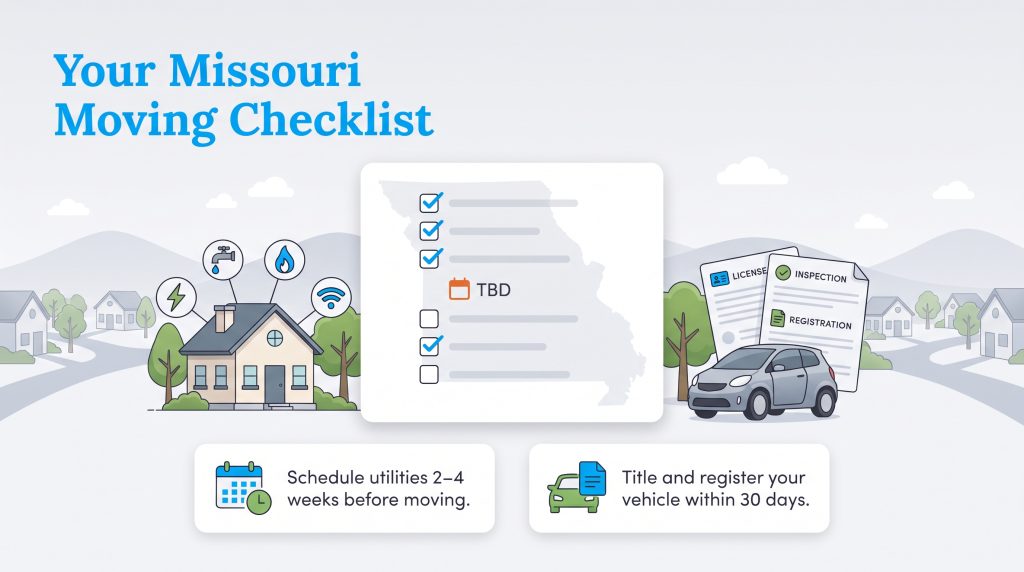
Between loading moving trucks and signing closing documents or lease agreements, small administrative tasks can easily slip through the cracks. Using structured moving resources keeps your utility activations and state legal requirements on track so you aren’t scrambling in the dark on your first night.
Two to Four Weeks Before Moving Day
- Schedule your electric, gas, and water transfers: Contact your regional providers (such as Ameren, Evergy, Spire, or your municipal utility) at least two weeks out. If you want to avoid paying for service before possession begins, ensure your utility start date perfectly aligns with your lease or closing date.
- Book your internet installation: If your new neighborhood has fiber-optic internet available, schedule a technician appointment early, as running a new fiber line from the street to your home can take a week or two to coordinate.
- Verify account responsibilities: If you are renting, review your lease carefully to understand which utilities you are financially responsible for and whether services like trash and sewer are bundled into your monthly rent payment.
Completing Your New-Resident Paperwork
Once your furniture is in place, you need to complete your new-resident paperwork. Follow these separate tasks based on current Missouri Department of Revenue (DOR) and state guidelines:
- Determine if you need a County Tax Waiver: Before you can register a car in Missouri, you may need to visit your local county assessor’s office (or their online portal in counties like St. Louis, Jackson, and Greene) with your out-of-state vehicle title or registration. Check with your specific county assessor to see what documents they require to prove you did not live in Missouri on Jan. 1 of the applicable tax year.
- Complete a vehicle safety and emissions inspection: Most vehicles older than 10 years or with over 150,000 miles require a Missouri safety inspection at an authorized mechanic. Furthermore, if you’re moving to St. Louis City, St. Louis County, St. Charles County, or Jefferson County, your car may need to pass a Gateway Vehicle Inspection Program (GVIP) smog and emissions test unless you meet specific exemptions based on vehicle age, weight, or fuel type.
- Apply for your Missouri driver’s license and vehicle plates: New residents are required to obtain a Missouri driver’s license immediately upon establishing residency, while vehicle titling and registration must happen within 30 days. These are two separate transactions. Check the DOR website for the exact list of acceptable documents you will need for a REAL ID-compliant license versus titling your car.
- Update your voter registration and mail forwarding: You can register to vote by mail, online, or in person at the county clerk’s office. While having a Missouri driver’s license makes online registration easier, it is not a universal prerequisite for voter eligibility.
Pro Tip
If you’re relocating to the greater St. Louis metro area, get your vehicle emissions test done at a certified repair shop before heading to the DOR license office. Showing up without the required GVIP emissions slip or property tax documents will result in a frustrating repeat trip.
Settling Into Your New Home in the Show-Me State
Moving to Missouri gives you a rare combination of housing affordability, welcoming neighborhoods, and easy access to both urban culture and rugged outdoor trails. While the state’s humid summers, chilly winters, and quirky car registration rules take a little getting used to, a bit of early preparation takes the friction right out of your relocation. By setting up your regional utilities ahead of time, addressing basic home maintenance, and confirming the paperwork required by the DOR, you’ll be well on your way to a comfortable transition into the Show-Me State.
Frequently Asked Questions About Moving to Missouri
Review these common questions and tips to help streamline your relocation and budgeting process.
How Much Money Do I Need to Live Comfortably in Missouri?
Can I Choose My Own Electricity Provider When Moving to Missouri?
What Is the Best Time of Year to Move to Missouri?
Why Do I Need a Tax Waiver to Register My Car in Missouri?
Is It Better to Live in St. Louis or Kansas City?
Does Missouri Offer Incentives for Home Energy Upgrades?
About the Author

LaLeesha has a Masters degree in English and enjoys writing whenever she has the chance. She is passionate about gardening, reducing her carbon footprint, and protecting the environment. She also recently served as President of the Board for City Sprouts (a community garden).

David has been an integral part of some of the biggest utility sites on the internet, including InMyArea.com, HighSpeedInternet.com, BroadbandNow.com, and U.S. News. He brings over 15 years of experience writing about, compiling and analyzing utility data.