

Your Kansas Address Determines Your Utility Providers, So Confirm Service and Installation Dates Before Moving Day
Key Takeaways
- Budget for local housing and utility costs by comparing regional price differences before signing a lease or closing on a home.
- Confirm your utility providers early because your specific Kansas address dictates your electric, water, and trash services.
- Evaluate home efficiency upgrades like weatherization or solar based on your property’s suitability and current state utility rules.
Moving to Kansas means checking more than your moving date. Your address determines your electric utility, water service, and available internet plans, while your lease may determine which accounts you need to open. We’ll walk you through the setup process, the costs to ask about, and the home-efficiency decisions worth considering before you unpack.
Understanding the Cost of Living in Kansas
Compare housing, property taxes, insurance, transportation, and expected utility bills for the specific community you’re considering. A lower purchase price doesn’t necessarily mean every part of your monthly budget will be lower. When examining the cost of living in Kansas, you will quickly notice how regional prices vary across the state. Whether you are renting a loft in downtown Wichita or purchasing a sprawling property in a rural county, your local housing market will dictate your primary monthly overhead. Property taxes vary by county, so you should always review local assessment rates when setting your budget. By understanding these regional price parities, you can accurately plan your monthly expenses.
Your Essential Moving to Kansas Checklist
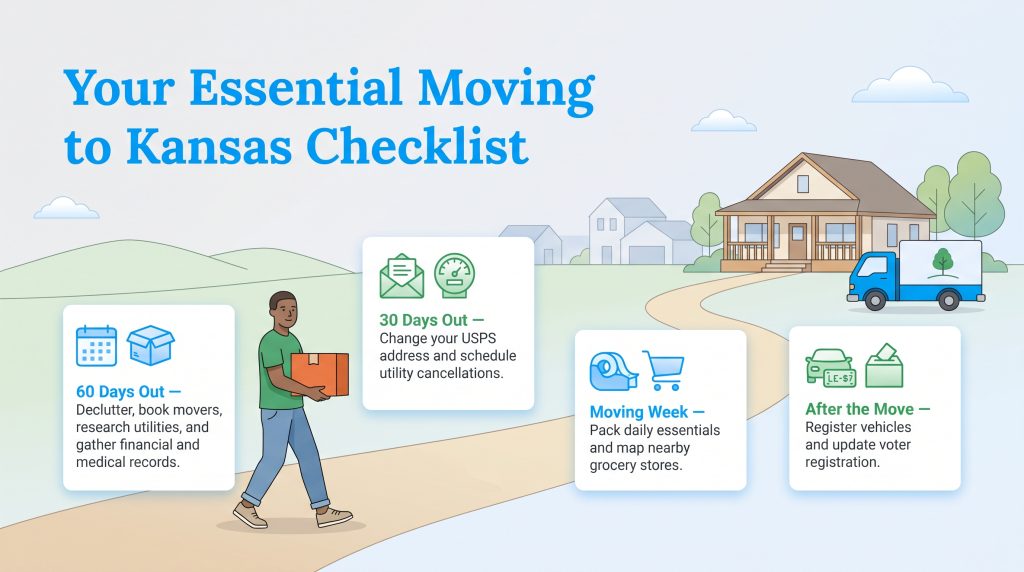
Tackling a major relocation requires a phased approach to prevent last-minute scrambling. Following a structured moving to Kansas checklist ensures you handle the heavy lifting well before closing day.
- 60 days out: Declutter your current residence, secure a reputable moving company, read up on starting or transferring utilities, and begin gathering essential financial and medical records.
- 30 days out: Process your official change of address with the USPS and notify your current utility providers of your upcoming cancellation date.
- Week of the move: Pack a dedicated box with daily essentials and map out the nearest grocery stores to your new property.
- Post-move: Register your vehicles with the Kansas Department of Revenue and update your voter registration.
Setting Up Utilities in Kansas: A Step-by-Step Approach
Navigating the logistics of powering a new home looks quite different depending on your zip code. Utility regulations can vary drastically between major cities like Wichita or Kansas City and remote rural areas. Follow these general planning steps to ensure your essential systems are active the moment you turn the key:
- Confirm who handles each service. Ask your landlord, seller, or property manager which utilities you must arrange.
- Verify the provider for the exact address. Don’t assume a nearby city’s provider serves your property.
- Gather application information. Requirements may include identification, contact details, a service address, and a lease or closing date.
- Ask about upfront costs. Check for deposits, connection charges, payment options, and any eligibility-based deposit waivers.
- Schedule activation. Confirm whether an appointment, property access, or an adult’s presence is required.
- Confirm service before arrival. Save confirmation numbers and verify activation dates.
- Review the first bill. Check the service period, rate plan, recurring fees, and any unexpected charges to better understand your electricity bills and rate plans.
| Service | Who to Contact | What to Confirm |
|---|---|---|
| Electricity | Address-assigned utility | Start date, deposit, rate plan, and connection requirements |
| Natural gas | Local distribution utility | Whether the property uses gas and whether activation requires access |
| Water and sewer | Municipality, district, or other provider | Billing responsibility, account setup, and connection status |
| Trash and recycling | City, landlord, association, or private hauler | Collection arrangements, accepted materials, and pickup day |
| Internet | Providers serving the exact address | Installation timing, upload speed, equipment charges, and total monthly cost |
Pro Tip
Contact providers about two weeks before your move when possible. Ask about appointment availability, deposits, and any connection charges rather than assuming service can start the same day.
Electricity and Natural Gas Providers
Unlike states with deregulated markets, Kansas operates under a regulated energy model. This means your address dictates your electricity provider. You will likely rely on large investor-owned utilities like Evergy in some urban centers, while sprawling rural properties typically connect to local electric cooperatives. Municipal utilities also serve many communities. When evaluating your natural gas supply, check with your local distribution utility to see if they offer specific programs or if you have alternative options. Hot summers and cold winters can increase your electricity use and monthly bill. Your total also depends on your utility’s rates, fixed charges, and any applicable time-of-use pricing. We highly recommend energy-saving home improvements — like sealing drafty windows — to keep your consumption steady year-round. Understanding your rights as a ratepayer is equally important. You can review provider maps and consumer protections through the Kansas Corporation Commission utility consumer guide before signing any service agreements.
Money Saver
When reviewing your first electricity bill, verify your service period and rate plan closely. Identifying unexpected recurring fees early on ensures you stay within your monthly budget.
Water and Waste Management
Your water, sewer, and trash arrangements depend on the property. Check whether service comes from a municipality, district, private provider, or landlord, and ask whether a rural home uses a private well or septic system. As you unpack, remember to prioritize environmentally mindful choices. Flatten and recycle your cardboard moving boxes according to your specific county regulations, or donate them to local community boards. Many Kansas municipalities offer dedicated recycling bins or local drop-off centers to help you responsibly manage your household waste right from day one.
Connecting the Best Kansas Internet Providers
Meeting the digital demands of a modern household requires a reliable broadband connection. The landscape of Kansas internet providers is diverse, scaling appropriately with the state’s varied geography. To secure the best service, always compare internet service availability for your exact address rather than relying on citywide assumptions. Some rural communities now have access to expanding fiber-optic networks, while others rely on fixed wireless broadband. Evaluate your household’s streaming, gaming, and remote work needs before locking into a long-term contract, paying special attention to upload speeds, data limits, equipment charges, and promotional-price expirations.
| Connection Type | Best For |
|---|---|
| Fiber-Optic | Remote workers and heavy streamers who require high upload speeds |
| Cable | Suburban families looking for reliable, balanced speeds |
| Fixed Wireless | Homes on the outskirts of metropolitan areas with a clear line of sight to a local tower |
| Satellite (e.g., Starlink) | Remote properties without suitable wired or fixed-wireless service; check installation requirements, obstructions, latency, and total cost |
Going Green: Solar Panels in Kansas
Viewing your relocation as a long-term investment opens the door for impactful residential upgrades. The wide-open plains and high volume of sunny days present strong potential for generating your own renewable power. Installing solar panels in Kansas is a forward-looking decision that may help insulate your household from fluctuating grid prices. However, financial returns vary drastically based on your utility’s specific net metering rules, system limits, and how exported electricity is credited. Solar costs and suitability must be weighed against these local regulations. Be aware that the federal Residential Clean Energy Credit (Section 25D) ended for systems placed in service after Dec. 31, 2025, meaning new 2026 installations no longer qualify for the former 30% tax benefit unless you are carrying forward unused prior-year credits. Always check current IRS guidance before factoring tax benefits into your budget.
Eco Edge
Prioritize practical weatherization, routine maintenance, and appropriately sized energy-efficient appliances before investing in a full rooftop solar array. Proper insulation is often the most practical first step toward an environmentally mindful home.
Embracing Your Next Chapter in the Midwest
Confirming your utility providers, understanding your first bills, and fully understanding your local housing costs empowers you to truly enjoy everything the Sunflower State has to offer. By taking a proactive stance on your logistics, you can avoid the last-minute scrambles that typically accompany a major relocation. Whether you are settling into a bustling city or a quiet rural homestead, Kansas offers a welcoming environment ready to be explored. We hope this roadmap gives you the confidence to unpack, explore your new neighborhood, and start building a comfortable, efficient life in your new state.
Frequently Asked Questions About Moving to Kansas
Preparing for a move involves understanding the local landscape of energy, internet, and municipal services. Review these common questions to finalize your relocation plans and budget effectively.
How Do I Find the Utility Providers for My Kansas Address?
What Is the Average Residential Electricity Rate in Kansas?
Can I Choose My Electricity Provider in Kansas?
When Should I Schedule Utilities Before Moving?
How Soon Must I Transfer My License and Register My Vehicle?
How Can I Check Internet Availability at a Rural Address?
Are Solar Panels Worth Considering for My Kansas Home?
About the Author

LaLeesha has a Masters degree in English and enjoys writing whenever she has the chance. She is passionate about gardening, reducing her carbon footprint, and protecting the environment. She also recently served as President of the Board for City Sprouts (a community garden).

Claudio is a sustainability-focused writer with a background in Anthropology and Psychology from NC State University. He has spent over 15 years working in writing, interpretation, and translation, driven by a deep interest in how human culture shapes the environment. Today, he shares his curiosity with readers by writing about sustainable living solutions and the connection between everyday choices and environmental impact.