

Setting up your electricity, water, and internet ahead of time ensures a smooth, stress-free move to the Grand Canyon State.
Key Takeaways
- Start transferring or setting up utilities at least two to four weeks before your moving day to avoid service interruptions.
- Arizona electric service is highly regional, so your exact street address usually dictates whether you will use APS, SRP, TEP, or a localized cooperative.
- Budgeting for high summer cooling costs is essential for new residents transitioning to the desert climate.
If you’re moving to Arizona, setting up utilities doesn’t have to feel like one more desert-sized chore. Moving to Arizona offers beautiful desert landscapes and stunning sunsets, but managing the intense heat requires a reliable air conditioning system the moment you arrive. We designed this guide to streamline your setup process, ensuring you stay cool and connected on move-in day without the usual headaches.
Your Utility Setup Timeline
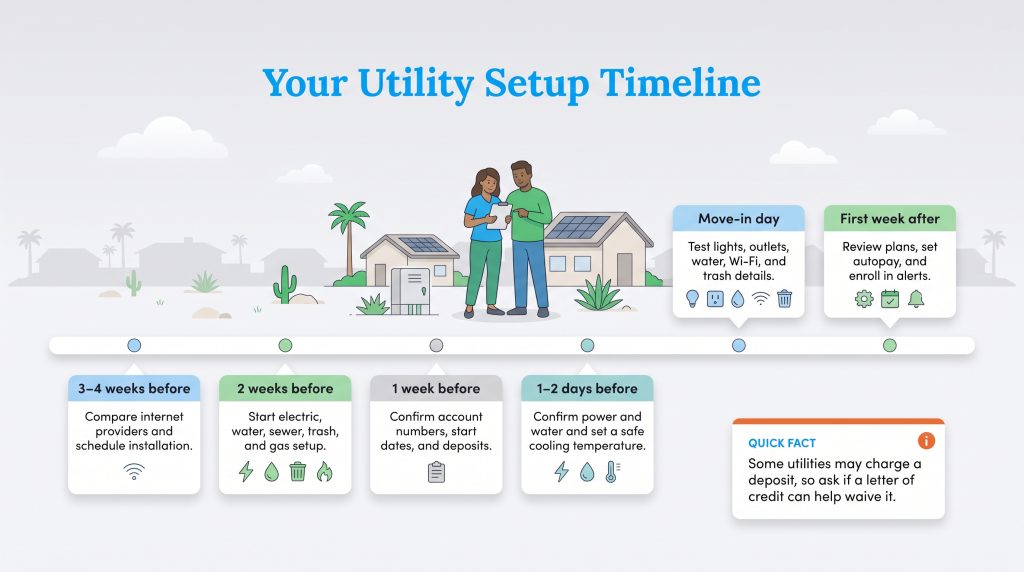
Planning your relocation with a chronological approach keeps essential tasks from slipping through the cracks. Knowing exactly how to set up utilities in Arizona ensures you won’t be left in the dark or sweating through your first night. We recommend following a structured schedule to handle the transitions smoothly.
- Three to four weeks before moving: Compare internet providers and schedule installation, especially if you need fiber, cable, or equipment delivery.
- Two weeks before moving: Start electric, water, sewer, trash, and natural gas setup.
- One week before moving: Confirm account numbers, start dates, deposit requirements, and access instructions.
- One to two days before moving: Confirm electricity and water activation; if possible, set the thermostat to a safe cooling temperature before move-in.
- Move-in day: Test lights, outlets, water pressure, hot water, gas appliances, Wi-Fi, and trash pickup details.
- First week after moving: Review rate plans, set up autopay, enroll in outage alerts, and consider time-of-use or budget billing plans.
What You’ll Need to Set Up Utilities in Arizona
Opening new service accounts usually requires verifying your identity and proving where you will live. Gathering the required information before you call providers or start an online application will save you time and frustration.
- Service address
- Move-in or lease start date
- Government-issued ID
- Social Security number or alternative identity verification, if required
- Previous utility account information, if transferring service
- Payment method
- Landlord or property manager contact, if applicable
- Closing documents or lease, if the provider requests proof of occupancy
- Desired start date and disconnect date for old service
Arizona Power Companies by City
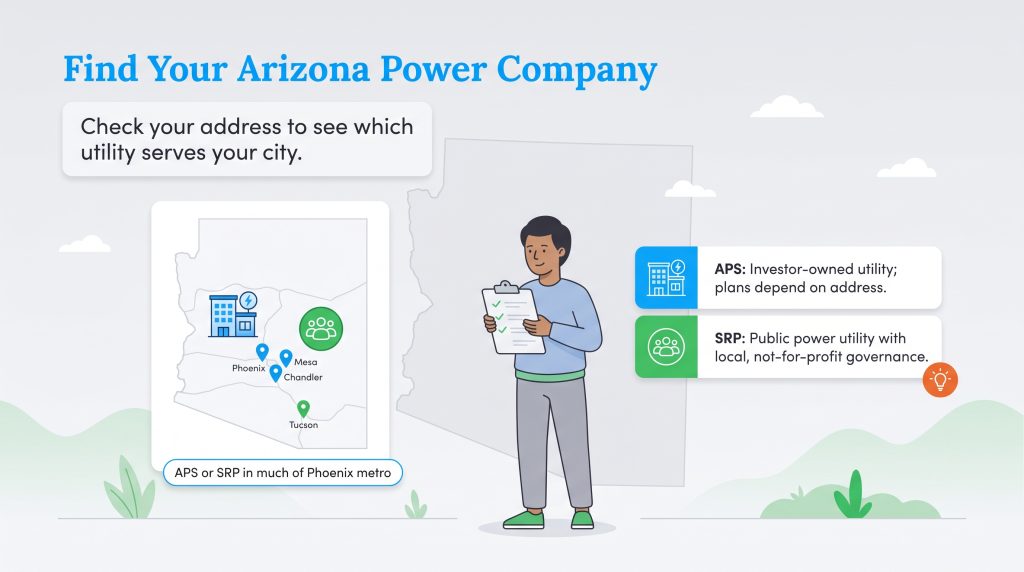
When setting up electric service in your new home, you might wonder if you can shop around for the best rate. Unlike deregulated states where you can choose your power company, Arizona electric service is highly regional, so your exact street address usually determines whether you’ll use APS, SRP, TEP, a municipal utility, or a local cooperative. Arizona electric service is organized by utility service territories. The Arizona Corporation Commission regulates many public-service utilities in the state, while public power providers such as SRP operate under different governance.
Because of this regional structure, identifying Arizona power companies by city is your crucial first step. While some rural areas rely on local electric cooperatives, major metropolitan centers typically fall under one or two massive providers.
| City | Primary Electric Provider | Service Provider Type |
|---|---|---|
| Phoenix | APS or SRP | Investor-Owned / Public Power |
| Tucson | Tucson Electric Power (TEP) | Investor-Owned |
| Mesa | SRP or City of Mesa | Public Power / Municipal |
| Chandler | SRP | Public Power |
| Gilbert | SRP or APS | Public Power / Investor-Owned |
| Glendale | APS or SRP | Investor-Owned / Public Power |
| Scottsdale | APS or SRP | Investor-Owned / Public Power |
| Tempe | APS or SRP | Investor-Owned / Public Power |
| Peoria | APS or SRP | Investor-Owned / Public Power |
| Surprise | APS | Investor-Owned |
*Provider boundaries can vary by neighborhood, so always confirm service using the provider’s address lookup tool or your city’s utility page before opening an account.
Comparing APS vs SRP Electricity
If you are moving to the greater Phoenix metropolitan area, you will quickly encounter the APS vs SRP electricity debate. The region is largely split between these two major providers. When you initiate an Arizona Public Service start service request, you will find they operate as a traditional investor-owned utility. Conversely, Salt River Project (SRP) functions as a community-based, not-for-profit public power utility.
Both providers offer unique time-of-use (TOU) plans that reward you with cheaper rates for running heavy appliances during off-peak hours. Since their service maps weave intricately through neighborhoods, you cannot simply pick the one with better rates.
| Factor | APS | SRP |
|---|---|---|
| Utility Type | Investor-owned utility | Public power utility |
| Where You’ll Find It | Parts of Phoenix metro and other Arizona areas | Much of the Phoenix metro area |
| Can You Choose It? | Usually no; depends on address | Usually no; depends on address |
| Rate Plans | Standard and time-of-use options | Standard, time-of-use, and other plan options |
| Best Next Step | Use address lookup and start-service tool | Use address lookup and start-service tool |
Setting Up Water and Trash Service
Managing your home’s water supply and solid waste collection looks a bit different than setting up electricity. In many Arizona cities, water, sewer, and trash are handled by the local municipality, but some neighborhoods use private water companies, HOAs, county services, or separate trash haulers.
To establish an account, you need to visit your local city government website. For example, a Phoenix water setup requires creating an account directly through the City of Phoenix Water Services Department. Many newcomers find it convenient that cities bundle these essential services together. Your monthly municipal utility bill may include water, sewer, trash, recycling, and local service fees in one combined municipal bill, cutting down on the number of accounts you have to juggle each month.
Natural Gas and Internet Providers
Once the primary utilities are running, you need to handle your residential natural gas services and home connectivity. If your new house uses gas for heating, cooking, or the water heater, you’ll likely need to set up service with Southwest Gas or another local gas provider. Southwest Gas serves many Arizona communities and is the provider new movers are most likely to encounter, but some areas use other natural gas utilities or private propane. Establishing this connection early is wise, though gas isn’t universally used in every Arizona community.
When comparing home internet options, you will notice that availability varies drastically depending on your exact location. Searching for Arizona internet providers by zip code helps narrow down the most reliable choices. Cox, CenturyLink/Lumen, Quantum Fiber, 5G home internet providers, and other options may be available in metro areas such as Phoenix and Tucson, depending on your address. However, if you are relocating to a more rural or mountainous area, you might need to explore satellite or fixed wireless options to get dependable coverage.
Special Considerations: Renters and Rural Homes
While standard utility setups apply to most suburban and urban homeowners, your requirements will shift if you lease your property or live far outside the city limits.
If You’re Renting in Arizona
When renting a house or apartment, setting up utilities depends entirely on your lease agreement. Renters commonly set up electricity and internet in their own name, while water, sewer, trash, or gas might be included in the monthly rent or billed back by the landlord. Always clarify these responsibilities with your property manager before your move-in date.
If You’re Moving to a Rural Arizona Home
For those moving outside of the primary metropolitan areas, your utility connections may look vastly different. Rural and unincorporated homes frequently use private septic systems instead of municipal sewer, well water instead of city water, and private propane tanks instead of natural gas lines. Additionally, high-speed cable and fiber internet are rarely available, making fixed wireless or satellite internet your best connectivity choices.
What Arizona Utility Bills Usually Include
When you look at your overall utility budget, it is important to remember that monthly costs cover much more than just the energy used by your appliances. Depending on your municipality and specific living situation, your monthly utility expenses may include a variety of different services and fees:
- Electricity
- Water
- Sewer
- Trash and recycling
- Natural gas or propane
- Internet
- Stormwater or environmental fees in some municipalities
- Taxes, franchise fees, or service charges
Understanding the Average Utility Bill in Arizona
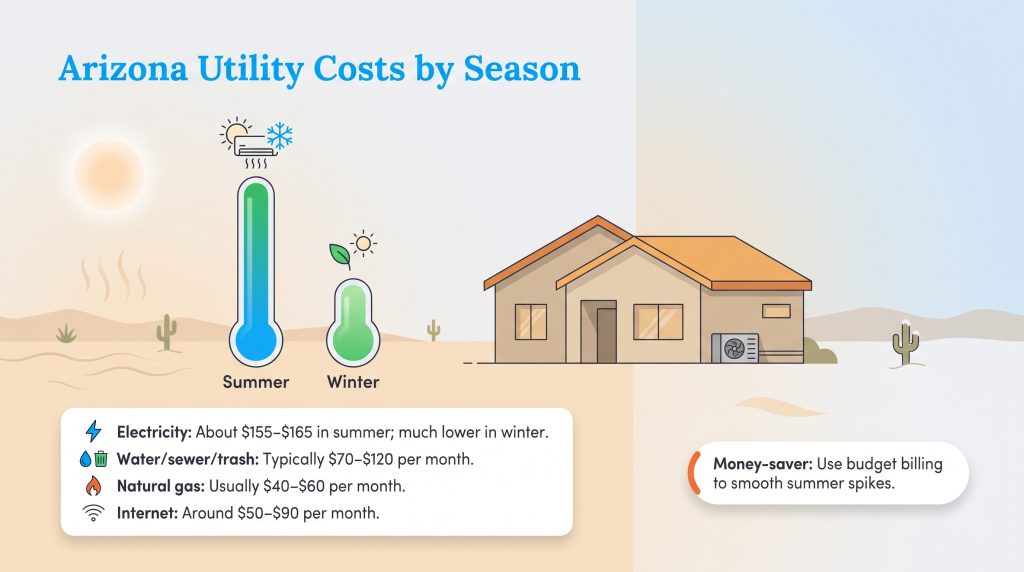
Budgeting effectively requires understanding the average utility bill in Arizona, which experiences drastic seasonal shifts unlike anywhere else in the country. New residents often experience sticker shock during their first summer in the state.
Electricity is often the largest monthly utility cost for Arizona households, especially during peak cooling season. From October through April, your energy expenses will likely drop significantly. Winter electric bills are incredibly low because the mild desert climate rarely demands heavy heating. However, from May through September, many households see electricity costs rise sharply, especially if they rely on central air conditioning throughout the day.
| Utility | What Arizona Movers Should Expect | Seasonal Notes |
|---|---|---|
| Electricity | About $155 to $165 per month, based on U.S. Energy Information Administration data. | Highest in summer due to heavy air conditioning demands. |
| Water, Sewer, and Trash | Usually $70 to $120 combined per month. | Varies heavily by city; higher water use may occur in summer if you have landscaping or a pool. |
| Natural Gas | Typically $40 to $60 per month. | Generally lower annual impact than electricity, but higher in winter if the home relies on gas heating. |
| Internet | Approximately $50 to $90 per month. | Fiber and cable are more common in metro areas; satellite and fixed wireless serve rural areas. |
Solar and Energy-Saving Options for Arizona Homes
With abundant sunshine across much of the state, Arizona is one of the country’s strongest markets for residential solar. Leveraging this abundant resource is an environmentally mindful choice that can reduce grid electricity use, especially if your roof, budget, and utility rate structure make solar a good fit. Even if you aren’t ready to install roof panels right away, there are plenty of ways to maximize energy efficiency in the desert.
We suggest checking your HVAC efficiency and installing heavy window shades to block out the intense afternoon sun. Adding a smart thermostat is a fantastic energy-saving option that learns your habits and optimizes cooling schedules. Upgrading to ENERGY STAR appliances in your new home further reduces your carbon footprint. You can also research utility-sponsored renewable energy programs to support a cleaner grid without installing your own hardware.
Set Up Early So Your Arizona Home Is Move-In Ready
Moving across the country or just across town requires careful planning, but taking control of your service connections early makes all the difference. While coordinating these necessary accounts takes a bit of organization, following our guide ensures your new Arizona home will be completely cool, fully connected, and ready for you on move-in day. We hope you settle in quickly and start enjoying everything the beautiful Grand Canyon State has to offer.
Frequently Asked Questions About Moving to Arizona Utilities
How much notice do I need to give to start utilities in Arizona?
Can I choose my electricity provider in Arizona?
Is a deposit required to set up utilities in Phoenix?
Who is the main gas provider in Arizona?
What is the most expensive utility bill in Arizona?
Do renters have to set up utilities in Arizona?
Should I start electricity before my Arizona move-in day?
Are Arizona utility bills higher in the summer?
About the Author

LaLeesha has a Masters degree in English and enjoys writing whenever she has the chance. She is passionate about gardening, reducing her carbon footprint, and protecting the environment. She also recently served as President of the Board for City Sprouts (a community garden).

David has been an integral part of some of the biggest utility sites on the internet, including InMyArea.com, HighSpeedInternet.com, BroadbandNow.com, and U.S. News. He brings over 15 years of experience writing about, compiling and analyzing utility data.