
Federal Standard Directs State Regulators to Require Massive Commercial Facilities to Pay Their Own Energy Infrastructure Upgrades
Key Takeaways
- The U.S. House passed the Ratepayer Protection Act in a 417–3 vote to prevent commercial data centers from shifting grid expansion costs onto residential utility customers.
- Commercial facilities requiring 100 megawatts or more must pay the full incremental cost of dedicated transmission lines, substations, and generation units under proposed state standards.
- The legislation establishes upfront financial assurances and exit fees to ensure local families are never left on the hook for abandoned or downsized industrial energy projects.
If you’ve opened your monthly electric bill recently and wondered why delivery fees keep creeping higher, you aren’t imagining things. Across the country, the rapid expansion of energy-intensive artificial intelligence facilities and massive cloud server farms is placing unprecedented demand on our electric grid. To keep utility companies from rolling billions of dollars in specialized infrastructure upgrades into general consumer rates, the U.S. House of Representatives passed the Ratepayer Protection Act on Sept. 16, 2026. This landmark bipartisan bill establishes a clear federal advisory guideline for state utility commissions, requiring commercial operations with massive power appetites to pay their own way. We’re digging into how this legislation works, which regional power markets are seeing the biggest impacts, and what it means for your household budget.
What the Ratepayer Protection Act Does for Your Power Bill
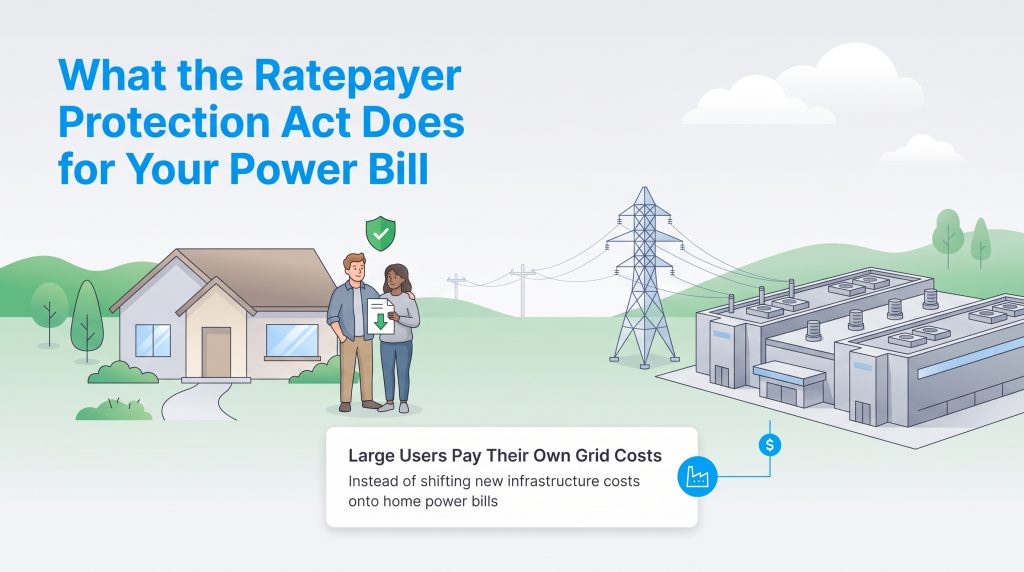
The Ratepayer Protection Act targets the growing tension between rapid technology expansion and household electricity affordability. Under traditional utility regulation, when an electric company builds new transmission corridors or upgrades local substations, it typically spreads those capital expenses across every customer in its service territory — a practice known in regulatory circles as “cost socialization.” When energy growth was gradual, that model spread fixed grid costs reasonably well. However, when a single commercial facility demands as much electricity as a mid-sized city, socialized billing forces residential customers to bankroll corporate power needs.
According to a press release from Representative Gabe Evans, the bill co-sponsor alongside Representative Kathy Castor, the measure updates standards under the Public Utility Regulatory Policies Act (PURPA). It directs state public utility commissions and governing bodies of unregulated electric cooperatives to formally consider adopting large-load tariffs within one year of enactment, with final determinations required within two years.
The 100-Megawatt Large-Load Standard
The bill specifically focuses on commercial and computational facilities with an electricity demand of 100 megawatts (MW) or greater. Setting the bar at 100 MW separates everyday businesses from immense computational warehouses. Standard grocery stores, office buildings, and retail plazas consume only a fraction of a single megawatt, while typical automotive manufacturing plants usually require between 10 and 30 MW.
By defining 100 MW as the threshold, the standard directly addresses hyperscale computing campuses without placing extra administrative hurdles on local commercial enterprises or community job creators.
Full Incremental Cost Recovery
Under the proposed rules, utilities cannot place the capital expenses of serving these mega-facilities into the general rate base. Instead, the incoming commercial customer must pay the “full, incremental cost” of every asset required to connect and serve them. This includes:
- Dedicated high-voltage transmission lines and line extensions
- Newly constructed or expanded step-down substations
- Advanced distribution transformers and switching stations
- Dedicated generation capacity required to meet peak reliability requirements
As noted in a Utility Dive industry report, including generation supply costs is a critical shift. Historically, interconnection tariffs focused strictly on wires and poles, leaving general consumers vulnerable to rising generation costs when utilities had to build or contract new power plants in a hurry.
Upfront Collateral and Early Exit Protections
One of the largest risks facing everyday ratepayers is stranded grid debt. If a utility spends $300 million constructing high-voltage infrastructure for a tech developer that suddenly scales back operations or relocates five years later, who pays off the remaining construction bonds? Without strict rules, that unpaid balance defaults straight into household delivery rates.
The Ratepayer Protection Act directs regulators to require binding financial assurances, such as letters of credit or cash escrow deposits, before ground is broken on utility construction. It also mandates guaranteed cost recovery terms through structured exit fees, ensuring tech firms remain financially responsible for the full lifespan of the equipment built for them.
Why Massive Data Centers Strain Local Electric Grids
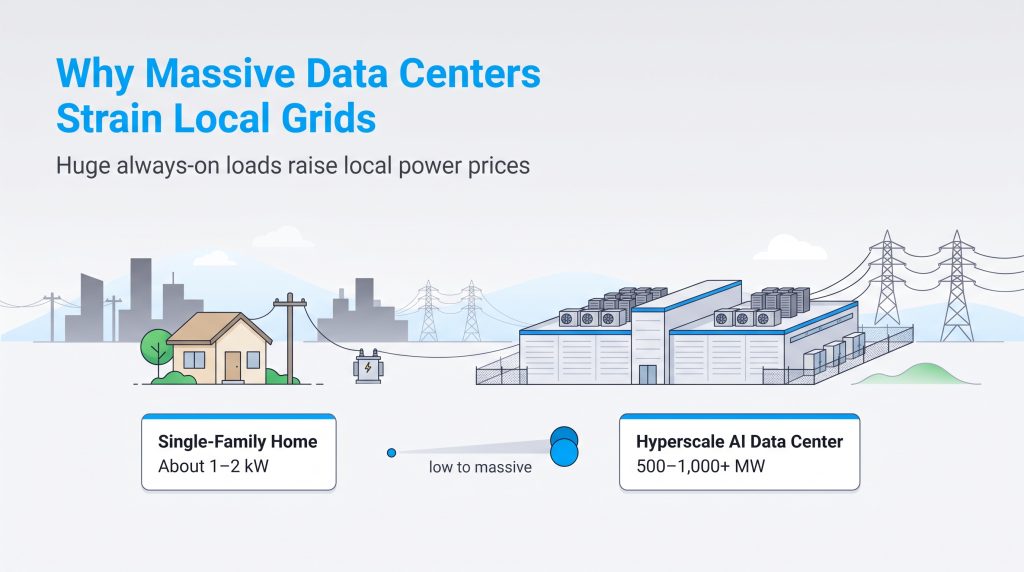
To understand why Congress stepped in with an overwhelming 417–3 bipartisan vote, we have to look at the staggering scale of modern computing demand. The newest generation of artificial intelligence training clusters requires non-stop, 24/7 baseload electricity at volumes that dwarf conventional manufacturing.
An independent analysis from the Reason Foundation highlights how modern server campuses compare to traditional industrial electricity users:
| Facility Type | Typical Electricity Demand | Relative Grid Impact |
|---|---|---|
| Single-Family Home | 1.2 to 1.5 kilowatts (peak) | Baseline consumer demand |
| Commercial Retail Center | 0.5 to 2 megawatts | Handled by standard local distribution feeders |
| Automotive Assembly Plant | 10 to 30 megawatts | Requires dedicated utility feeder lines |
| Large Industrial Steel Mill | 100 to 200 megawatts | Requires specialized industrial substation hookups |
| Hyperscale AI / Cloud Data Center | 500 to 1,000+ megawatts | Requires dedicated high-voltage lines and power plants |
When loads reaching 500 to 1,000 MW connect to a regional grid, they consume existing regional reserve margins. That triggers tight regional wholesale capacity auctions, driving up the baseline supply price of electricity for every home in the surrounding territory.
Regional Breakdown of High-Impact States and Communities
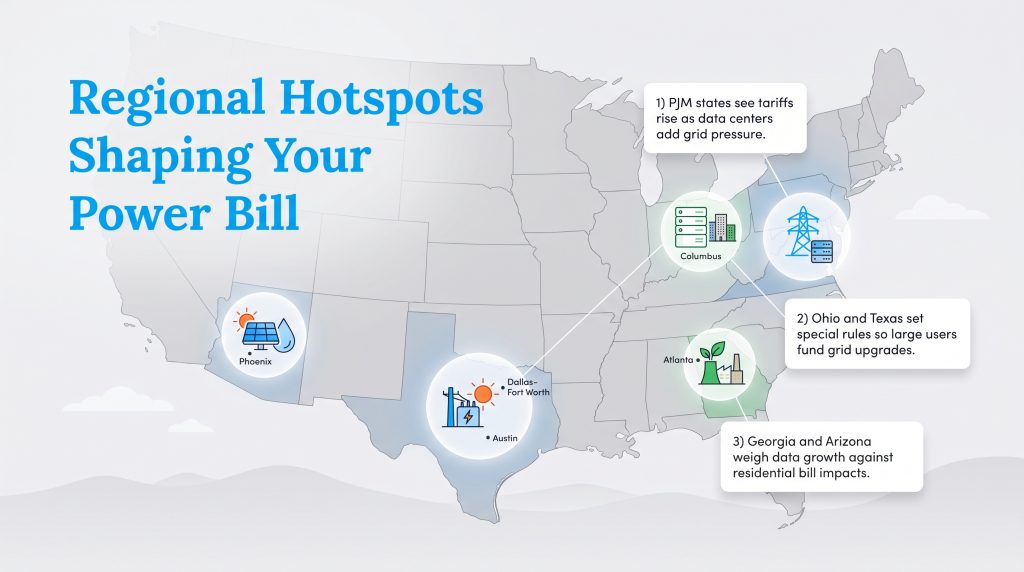
While the Ratepayer Protection Act sets a national advisory standard, the day-to-day impact depends heavily on where you live. According to energy market analysts, 37 states have already begun introducing their own large-load tariffs to get ahead of surging commercial demand. If you live in one of the primary data center corridors listed below, state utility proceedings will directly shape your monthly energy bill over the next two years.
Northern Virginia and the PJM Interconnection
Northern Virginia remains the undisputed data center capital of the world. In Loudoun County, Fairfax County, and Prince William County, data centers consume a substantial share of total electricity delivered by Dominion Energy and Northern Virginia Electric Cooperative (NOVEC). Communities around Ashburn, Sterling, and Manassas have seen local transmission projects multiply to keep up with server farm clusters. Because Virginia sits within the 13-state PJM Interconnection grid, capacity auction prices across Virginia, Maryland, Pennsylvania, and New Jersey have experienced upward pressure, prompting state regulators to aggressively evaluate ring-fenced customer tariffs.
Central Ohio and the Columbus Metro Area
Central Ohio has rapidly emerged as the primary Midwest hub for hyperscale computing. Counties like Franklin, Licking, and Delaware have welcomed dozens of massive projects across New Albany, Hilliard, and Columbus. American Electric Power (AEP) Ohio recently petitioned the Public Utilities Commission of Ohio (PUCO) for specialized large-load rules, requesting that incoming computational users pay for upfront capacity studies and commit to long-term minimum take-or-pay agreements so that existing residential customers in Columbus and surrounding rural townships do not face double-digit delivery rate hikes.
Texas and the ERCOT Grid
Texas operates its own independent grid under the Electric Reliability Council of Texas (ERCOT). Across the Dallas–Fort Worth metroplex (including Collin and Denton Counties), the Austin tech corridor, and West Texas, massive data centers and digital processing operations have competed directly with peak summer air conditioning loads. The Public Utility Commission of Texas (PUCT) is actively structuring rules to ensure large-load applicants either supply their own on-site generation or pay substantial interconnection fees before tapping into municipal and investor-owned transmission systems operated by Oncor, CenterPoint, and AEP Texas.
The Southeast and Georgia Power Service Territories
Georgia has experienced a massive wave of industrial development throughout metro Atlanta, Douglas County, and rural counties along the Interstate 20 corridor. The Georgia Public Service Commission has engaged in contentious integrated resource planning hearings to determine how Georgia Power will meet gigawatts of projected commercial demand without driving up bills for residential customers who have already weathered multiple rate adjustments over the past two years.
Arizona and the Desert Southwest
In the desert Southwest, high-tech clusters in Maricopa County — especially Mesa, Chandler, and Phoenix — have expanded rapidly. Regulated utilities like Arizona Public Service (APS) and the Salt River Project (SRP) face the twin challenges of meeting 100+ MW loads while managing extreme summer peak electricity demand and scarce water supplies used for cooling towers. Arizona regulators are scrutinizing large-load interconnection requests to make sure new facilities bring clean energy resources along with them.
Practical Steps to Shield Your Household Energy Budget
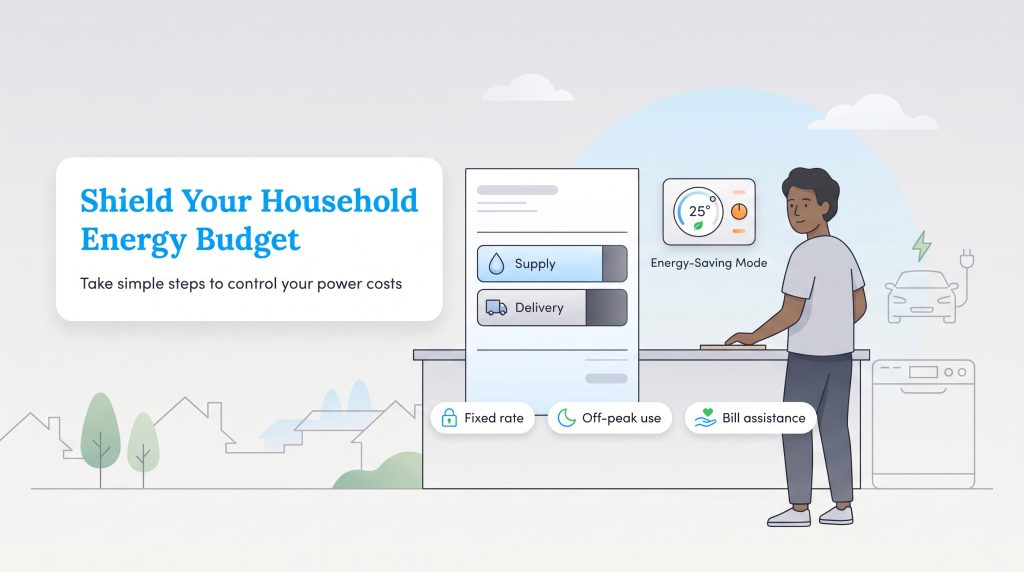
While state public utility commissions work through these new federal directives over the coming 12 to 24 months, there are direct steps you can take right now to keep your household electric bills manageable.
First, check the itemized breakdown on your monthly power statement. Electricity bills are divided into supply charges (the cost of the kilowatt-hours you use) and delivery or transmission charges (the cost of the physical poles, wires, and substations). Watching your delivery line items will tell you whether your local utility is attempting to pass through transmission expansion costs.
Second, if you reside in a deregulated retail energy state (such as Ohio, Pennsylvania, Illinois, or Texas), examine your electricity supply contract. Variable-rate plans expose you directly to wholesale capacity spikes during hot summer afternoons or cold winter freezes. Choosing a transparent, fixed-rate plan can lock in your energy supply costs and provide predictable monthly budgeting.
Third, explore an energy-saving option through your utility’s Time-of-Use (TOU) rate plan. Many utilities now offer discounted off-peak rates during late night and early morning hours. By shifting heavy appliance use — such as dishwashers, laundry dryers, and electric vehicle charging — away from afternoon peak windows, you can immediately reduce your bill. Pairing off-peak habits with an eco-conscious alternative like a smart thermostat certified by ENERGY STAR helps automate your savings without sacrificing comfort. Finally, if rising living expenses have made keeping the lights on difficult, check your eligibility for the federal Low-Income Home Energy Assistance Program (LIHEAP), which provides direct grant assistance to qualifying households.
Looking Ahead at Fair Energy Billing for American Households
The decisive 417–3 House vote behind the Ratepayer Protection Act signals that protecting families from corporate energy cost-shifting is a shared national priority. As the bill heads to the Senate, lawmakers will weigh whether to keep these standards advisory for state public service commissions or incorporate binding federal interconnection rules under the Federal Energy Regulatory Commission (FERC). Regardless of the legislative timetable in Washington, state regulators are already putting these common-sense guardrails into motion. Ensuring that commercial mega-projects pay their fair share will keep American innovation moving forward while keeping electric rates fair, transparent, and affordable for our homes.
Frequently Asked Questions About the Ratepayer Protection Act
What is the Ratepayer Protection Act?
Will this bill lower my current electric bill immediately?
Why are data centers singled out by this legislation?
What happens next before the bill becomes law?
About the Author

Claudio is a sustainability-focused writer with a background in Anthropology and Psychology from NC State University. He has spent over 15 years working in writing, interpretation, and translation, driven by a deep interest in how human culture shapes the environment. Today, he shares his curiosity with readers by writing about sustainable living solutions and the connection between everyday choices and environmental impact.