

Understanding How Massive Data Centers Consume Electricity Can Help You Navigate Rising Utility Rates and Grid Strain in Your Community
Key Takeaways
- Data center power consumption is rising rapidly, fueled by the explosive growth of artificial intelligence and high-density cloud computing.
- Local grids frequently face increased strain and infrastructure costs, which can quickly translate into higher residential electric bills for everyday homeowners.
- Implementing smart energy-saving habits at home can help you offset the potential rise in your monthly utility costs as regional demands expand.
As we move through 2026, the explosive growth of cloud computing and artificial intelligence has transformed data center power consumption from a manageable utility load into a massive industrial strain on regional power grids. According to the Department of Energy, projected data center expansion means these facilities could consume up to 12% of total U.S. electricity by 2028, with current commercial demand already pushing many local utility providers to their limits. Whenever you stream a movie, save photos to the cloud, or prompt an advanced AI assistant, those invisible digital actions require an intense, uninterrupted physical cost that directly impacts your community’s energy infrastructure. We want to break down exactly what drives data center energy usage, how modern computing hardware accelerates global energy demand, and what actionable steps you can take to shield your household from rising utility bills.
What Drives Data Center Power Consumption?
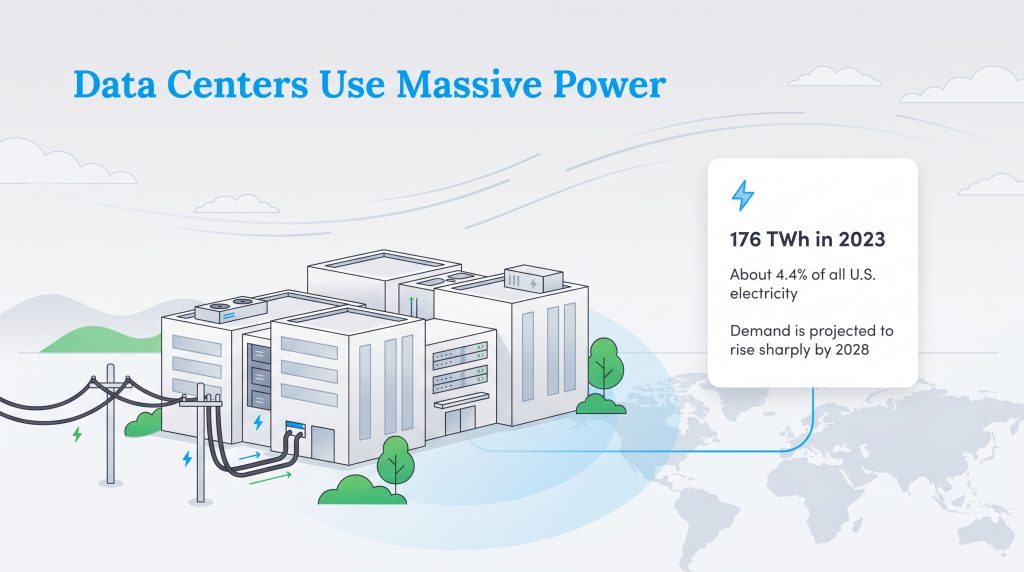
A data center is essentially a massive, highly secure building designed to house thousands of computer servers. While the concept sounds simple, actual data center power consumption is driven by incredibly complex, high-density hardware running uninterrupted. In the U.S., this electricity use has scaled into a colossal industrial draw. The Department of Energy reported that data centers used about 176 terawatt-hours (TWh) of electricity in 2023, equal to roughly 4.4% of total U.S. electricity use. To put a terawatt-hour into perspective for the average homeowner, one TWh can power approximately 90,000 to 100,000 homes for an entire year. This means the country’s collective digital infrastructure is pulling the exact same amount of power as tens of millions of households combined.
| Scope | Current or Recent Estimate | Why It Matters for Homeowners |
|---|---|---|
| Global demand (Data centers, AI, and crypto) | Estimated to rise from about 460 TWh in 2022 to over 1,000 TWh by 2026 (IEA) | Global growth drives supply chain pressures and large-scale grid transformations. |
| U.S. data center demand | About 176 TWh in 2023, or 4.4% of U.S. electricity (DOE/LBNL) | Directly impacts regional grid planning, potentially altering local utility rates. |
| Projected U.S. demand | Projected to reach 6.7% to 12% of total U.S. electricity by 2028 (DOE/LBNL) | Rapid increases require new infrastructure, often funded by ratepayer increases. |
Today, these tech facilities vary drastically in their energy requirements based on their intended purpose. A small edge data center — built to support localized, immediate operations — might require a relatively modest 1 to 5 megawatts (MW) of continuous power. Medium-sized enterprise facilities typically draw between 10 and 20 MW to manage broader corporate workloads. However, the true driver of modern utility strain is hyperscale data center electricity demand. Operated by major cloud providers, these colossal campuses frequently require dedicated power substations just to keep the lights on, pulling anywhere from 20 to well over 100 MW of continuous base-load power.
The primary driver of this immense energy use is the computing equipment itself. Unlike your personal laptop that conveniently goes to sleep when you close it, data center servers operate 24 hours a day, 365 days a year. These servers act as the operational brain of the internet, packing advanced processors and memory drives into incredibly tight spaces. Because they handle digital workloads that fluctuate vastly throughout the day, the hardware must be ready to hit peak performance at a moment’s notice, drawing a massive, steady current from the local transmission lines.
The Impact of AI on Global Energy Demand
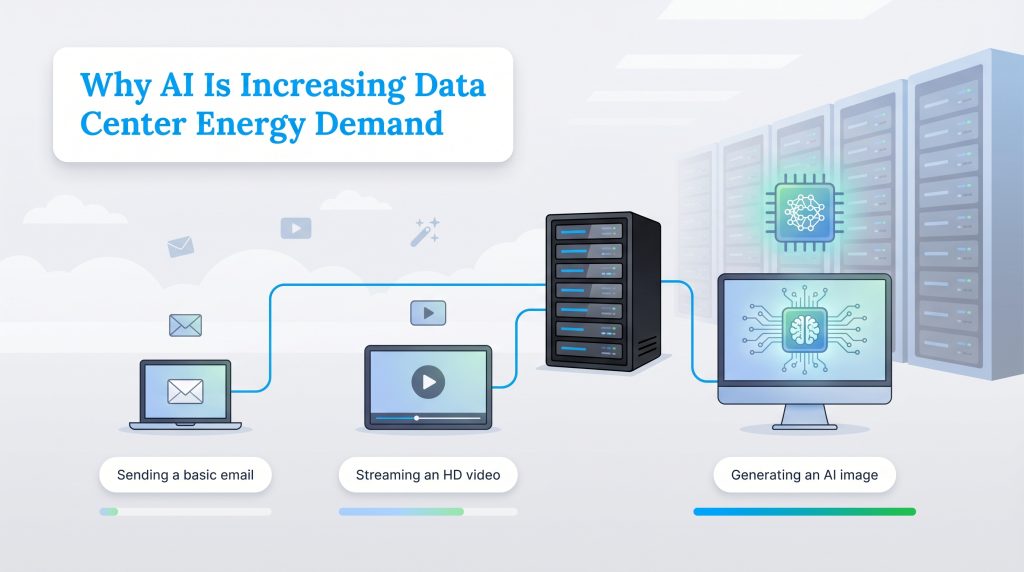
Artificial intelligence is transforming how we interact with technology, but this digital leap comes with an intense appetite for electricity. AI data center energy use operates on an entirely different scale compared to traditional web browsing. Generative AI tools do not simply retrieve existing information; they must actively synthesize millions of data points to generate new text, complex code, or hyper-realistic images. This computational intensity requires specialized hardware that draws substantial power around the clock.
To understand the specific difference in power draw, we can look directly at the hardware level. Traditional cloud storage and standard web servers are highly efficient, but modern AI-training servers rely on power-hungry graphic processing units (GPUs) that exponentially increase a facility’s base-load demands:
- Standard Cloud Servers: A typical server rack dedicated to standard web hosting and routine cloud storage draws between 5 and 10 kilowatts (kW) of power.
- High-Density AI Servers: Racks packed with advanced hardware designed specifically for AI training and complex machine learning require significantly more energy, often drawing between 40 and 100 kW per rack.
We rely on standard cloud services for daily internet activities, but AI generation demands vastly more effort per request. For example, a standard internet search requires roughly 0.3 watt-hours of electricity to retrieve existing information from web directories. In stark contrast, a generative AI query requires approximately 2.9 to 3.0 watt-hours of electricity — nearly 10 times the energy of a standard search — to predict and produce original content. While 3 watt-hours sounds small on an individual level, when multiplied by billions of daily queries worldwide, the aggregate AI data center energy use results in massive, permanent spikes on regional power grids.
Calculating Power Usage Effectiveness (PUE)
To ensure our digital growth doesn’t completely overwhelm the power sector, data center energy efficiency has become a critical focus for facility engineers. The industry relies on specialized metrics to track how well a building utilizes its resources. The most widely adopted measurement for identifying sustainable operations is Power Usage Effectiveness (PUE).
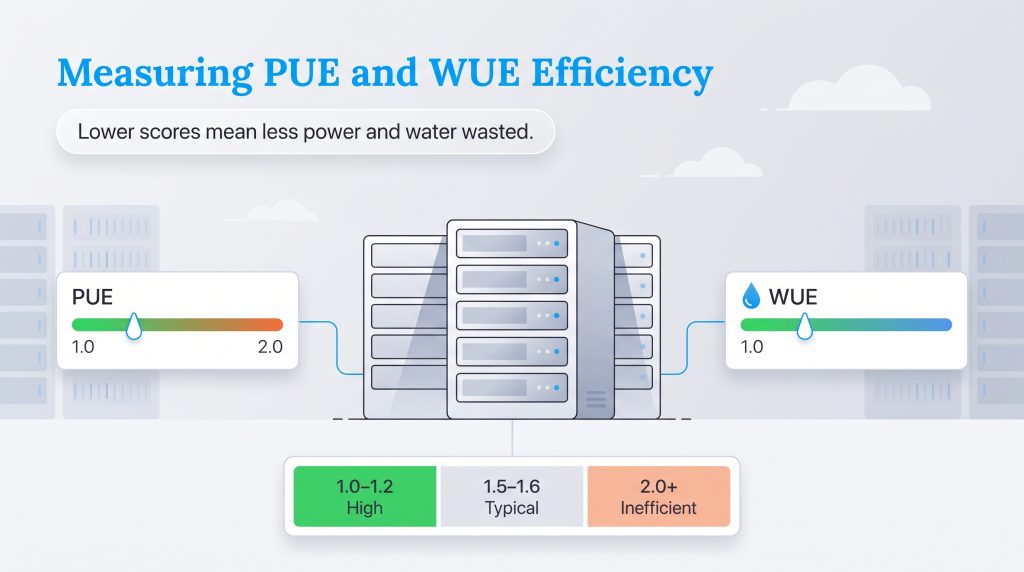
PUE is a specific formula that compares the total amount of energy a facility uses to the energy exclusively delivered to the actual computing equipment. A perfect PUE score would be 1.0, meaning every single watt of electricity entering the building goes directly to powering the servers, with zero energy wasted on overhead items like lighting, cooling, or power conversion. The current industry standard PUE target sits tightly between 1.2 and 1.5 for highly optimized, modern facilities.
To calculate PUE, facility managers follow a straightforward equation. For example, assume a regional data center draws a total of 100,000 kilowatts (kW) from the local utility grid. Out of that total, the servers and network hardware consume 75,000 kW to process data. By dividing the total facility power by the IT equipment power (100,000 / 75,000), you arrive at a PUE of 1.33. This means the facility operates efficiently within the standard industry target.
PUE = Total Facility Energy / IT Equipment Energy
| PUE Score | Efficiency Rating | What It Means for the Facility |
|---|---|---|
| 1.0 to 1.2 | Highly Efficient | Excellent data center energy efficiency. The facility uses advanced liquid cooling, highly optimized airflow, and wastes virtually no power. |
| 1.5 to 1.6 | Average / Standard | Typical performance for an older or moderately updated facility. A significant portion of electricity is still required for traditional air conditioning. |
| 2.0 or Higher | Inefficient | Poor performance. For every watt used by a server, another full watt is wasted on cooling and overhead, placing heavy, unnecessary strain on the grid. |
Air vs. Liquid Cooling: Energy Requirements
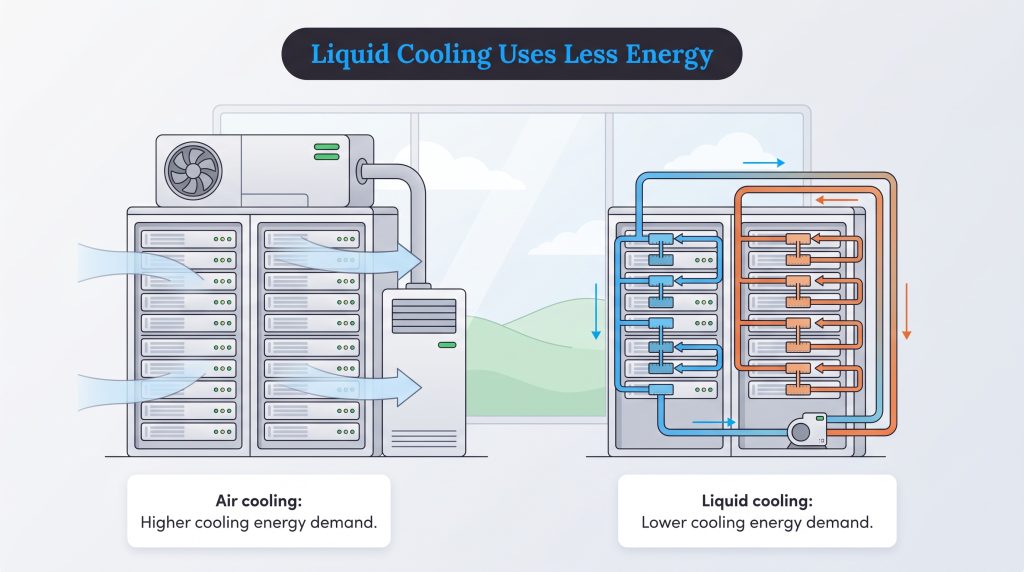
When thousands of high-powered computers work simultaneously in a confined space, they generate extreme amounts of heat. Efficient data center cooling systems are essential for preventing overheating, equipment damage, or catastrophic network outages. Traditionally, facility managers relied on massive industrial air conditioning systems — huge ventilation fans and computer room air conditioning (CRAC) units moving chilled air across the server racks. This standard air cooling process requires enormous amounts of non-compute electricity.
However, as AI server density increases, traditional air cooling struggles to manage the thermal load without wasting tremendous energy. To combat this inefficiency, modern hyperscale facilities are rapidly transitioning to advanced liquid cooling. By pumping specialized coolant directly to the computer chips via a closed-loop system, or utilizing full immersion tanks, liquid cooling transfers heat significantly better than blown air. This shift drastically reduces electrical draw and helps facilities effectively lower their PUE scores.
| Cooling Method | Energy Efficiency | Initial Implementation Cost | Maintenance Requirements |
|---|---|---|---|
| Traditional Air Cooling | Low to Moderate. Requires massive amounts of electricity to run large fans and CRAC units constantly. | Generally lower. Standardized equipment that is easier and cheaper to install in traditional builds. | High. Demands frequent filter replacements, mechanical fan upkeep, and rigorous airflow management. |
| Advanced Liquid Cooling | Highly Efficient. Specialized coolants transfer heat far better than air, drastically lowering total energy draw. | High. Requires specialized plumbing, leak prevention infrastructure, and custom high-density server racks. | Moderate. Closed-loop systems require less mechanical upkeep but demand strict fluid monitoring protocols. |
Transitioning to Renewable Energy for Data Centers
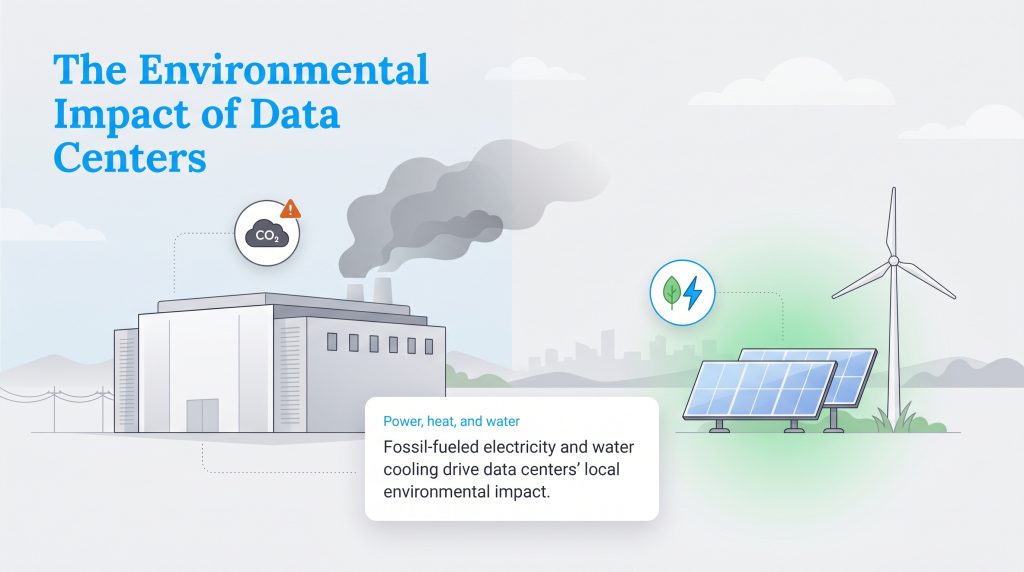
The environmental impact of data centers extends far beyond the physical space they occupy in a community. Because the majority of the global power grid still relies heavily on fossil fuels, the massive electricity draw creates a severe carbon footprint for cloud computing. This rapid digital expansion must be carefully managed; otherwise, greenhouse gas emissions will skyrocket just as states attempt to transition toward cleaner energy portfolios.
Tech giants must aggressively pivot toward environmentally mindful choices to mitigate this damage. We are actively seeing major corporations fund massive solar and wind farms to power their operations, creating a direct eco-conscious alternative to traditional grid reliance. Rather than merely purchasing standard grid energy, they sign long-term power purchase agreements that guarantee new renewable energy is added directly to the local grid to offset their enormous draw.
However, running a 24-hour facility entirely on wind and solar remains difficult when the wind stops blowing or the sun goes down. To bridge this gap, companies utilize renewable energy certificates and carbon offset programs, striving to decouple digital growth from atmospheric emissions. The push for a fully sustainable green facility is strong, but the industry still faces a challenging transition.
🌱 Eco Edge: Many leading tech companies are now committing to “24/7 carbon-free energy” goals. This means they are working to match their electricity use with clean energy generation on an hourly basis, rather than just buying annual carbon offsets that don’t solve local nighttime grid reliance.
Preparing Your Digital Infrastructure for Evolving Power Grids
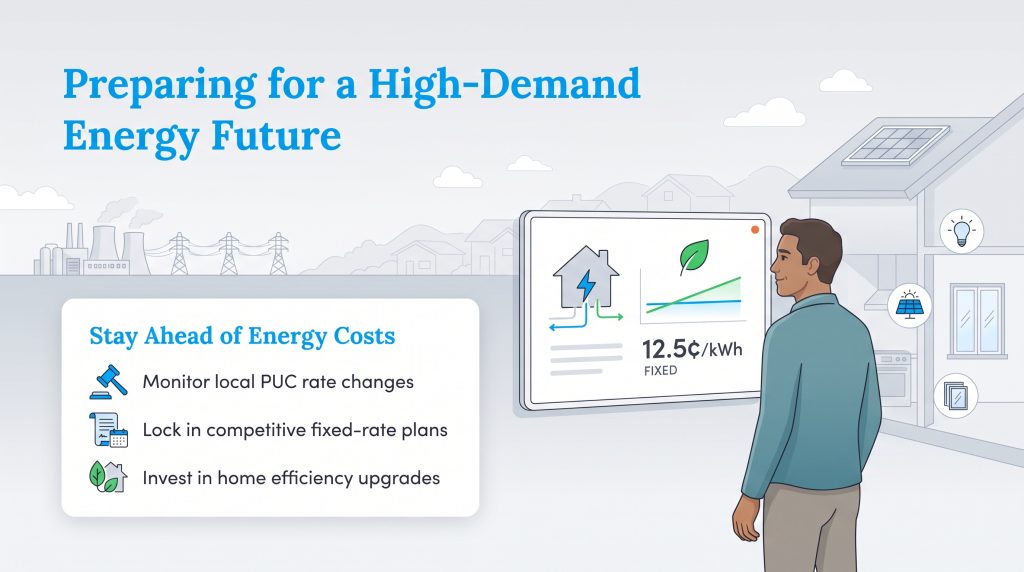
Our reliance on cloud computing and artificial intelligence shows no signs of slowing down, meaning commercial energy demands will remain a permanent fixture on our power grids. To prepare effectively, both facility operators and everyday homeowners must proactively adapt. If you hear about a new tech campus coming to your city, you might wonder how it will affect your monthly expenses. Utilities must petition regulatory boards, like your state’s public utility commission, to approve cost recovery plans for new transmission lines or substations, often reflecting as higher transmission and distribution charges on your bill. Keeping an eye on these public rate cases allows you to budget for structural cost increases long before they appear on your monthly statement.
If you live in a deregulated energy market, evaluating your options can help you navigate these shifts. Consider locking in a fixed-rate energy plan to limit your exposure to sudden wholesale price swings triggered by massive grid expansions. When a large commercial facility announces construction in your region, wholesale electricity futures often climb in anticipation of the added strain. By securing a competitive, long-term fixed contract early, you insulate your household budget against market volatility.
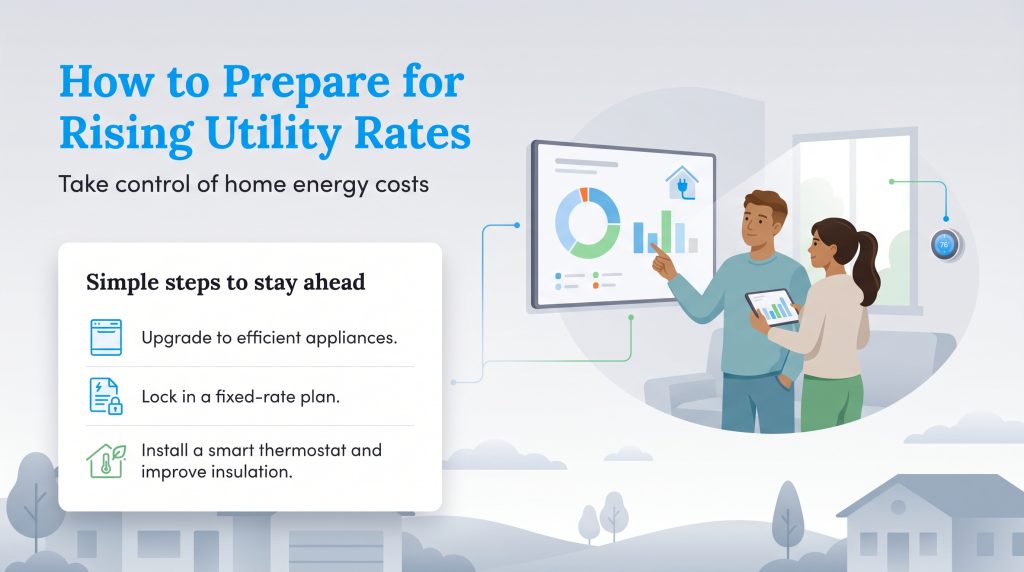
Beyond choosing the right energy plan, adopting a proactive approach to your home energy use becomes your strongest defense. Start by setting a baseline for your current usage through past utility bills, and consider these actionable steps to optimize your residential energy footprint:
- Upgrade to certified appliances: When replacing old refrigerators or washing machines, look for ENERGY STAR certified appliances, which meet strict energy-efficiency guidelines set by the EPA and reduce your daily baseload.
- Install a smart thermostat: Automating your heating and cooling schedules ensures you never pay to condition an empty house, easily trimming your total power consumption during expensive peak demand hours.
- Audit your home insulation: Sealing drafty windows and adding heavy insulation to your attic prevents expensive conditioned air from escaping, naturally reducing the daily workload on your HVAC system.
Navigating the Future of Digital Energy Consumption
Ultimately, while this massive digital expansion might feel overwhelming, staying informed about local infrastructure changes equips you to make smarter financial choices. By understanding the true scale of data center energy usage, you gain valuable insight into how global technological advancements directly influence your regional power grid. Actively managing your household consumption, saving on your electric bill by locking in reliable energy rates, and making sustainable home upgrades ensure you can confidently navigate shifting utility costs and keep your home running comfortably — no matter how fast our digital world grows.
Frequently Asked Questions About Data Center Energy Usage
These quick answers cover the most common questions homeowners have about data center energy usage, AI power demand, and potential utility bill impacts. Use them as a starting point when comparing local energy trends or reviewing your household electricity plan.
How much electricity does a typical data center use?
What percentage of global electricity do data centers consume?
How does AI increase data center energy consumption?
Does liquid cooling save energy in data centers?
Can data centers operate on renewable energy?
Will a new data center in my city increase my electric bill?
How can I tell if my utility rates are rising because of data centers?
About the Author

David has been an integral part of some of the biggest utility sites on the internet, including InMyArea.com, HighSpeedInternet.com, BroadbandNow.com, and U.S. News. He brings over 15 years of experience writing about, compiling and analyzing utility data.

Claudio is a sustainability-focused writer with a background in Anthropology and Psychology from NC State University. He has spent over 15 years working in writing, interpretation, and translation, driven by a deep interest in how human culture shapes the environment. Today, he shares his curiosity with readers by writing about sustainable living solutions and the connection between everyday choices and environmental impact.