

Your Location Helps Determine Your Electricity Pricing Area, Which Can Influence the Retail Rates and Plans Available Where You Live
Key Takeaways
- Load zones are geographic areas used by grid operators to price electricity based on local supply, demand, and transmission conditions.
- In many retail-choice markets, your utility territory or load zone influences the electricity plans and rates available to your home.
- You can often find your utility load zone by using your service address, state shopping site, utility territory tool, or grid operator map.
Opening your monthly power bill can feel like deciphering a secret code, especially when you realize your cousin a few towns over is paying a vastly different rate for the exact same amount of power. While it is easy to assume someone else is simply using electricity more efficiently, location is often the underlying reason rates differ, alongside your local utility territory and supplier plan terms. In this guide, we want to demystify load zones and help you understand exactly how your physical location on the grid impacts how retail electricity providers (REPs) and energy service companies (ESCOs) set their rates. By learning the mechanics behind wholesale electricity markets, you can take control of your utility expenses and make smarter, more cost-effective choices for your home when you set up moving utilities.
What Is a Load Zone?
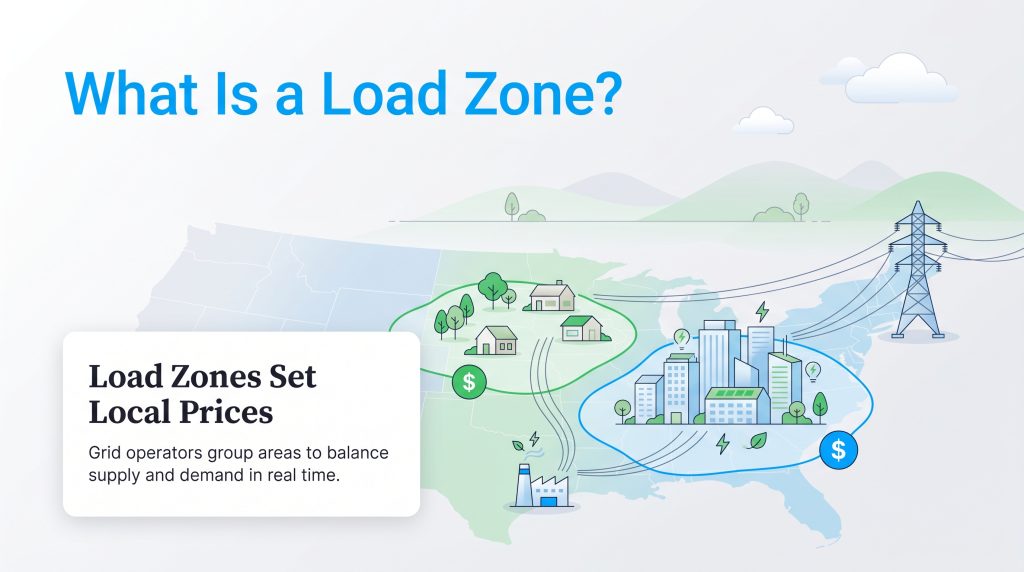
If you are wondering what a load zone actually is, it helps to think of the regional power grid like a massive food delivery network. When you order dinner, the delivery fee fluctuates based on how far away the restaurant is, the current demand for drivers, and how busy the streets are in your specific neighborhood. Similarly, wholesale electricity load zones are distinct geographical areas used by grid operators to manage daily grid operations, plan financial settlements, and price power based on localized supply and demand. A grid operator — often known as an Independent System Operator (ISO) or Regional Transmission Organization (RTO) — is the organization that monitors the regional electric system and coordinates power supply, demand, and transmission reliability.
To fully grasp this concept, you need to understand the fundamental difference between the generation of electricity and the transmission of it. Power plants supply the actual energy, but a highly complex web of high-voltage transmission lines must securely deliver that power to your local electric utility. The farther the electricity has to travel, or the more congested the wires get during a blistering summer afternoon, the harder it is to physically move that power. Knowing how electricity is delivered to consumers helps clarify why energy prices constantly shift across different regions and even across different zip codes within the same state.
Load zones are ultimately a pricing boundary. Because it is physically impossible to store massive amounts of alternating current (AC) electricity on the grid without large-scale battery systems, grid operators must balance supply and demand in real-time. By segmenting a massive state into smaller load zones, grid operators can accurately calculate the cost of pushing electricity into specific, high-demand metropolitan areas versus rural communities.
How Load Zones Affect Electricity Rates
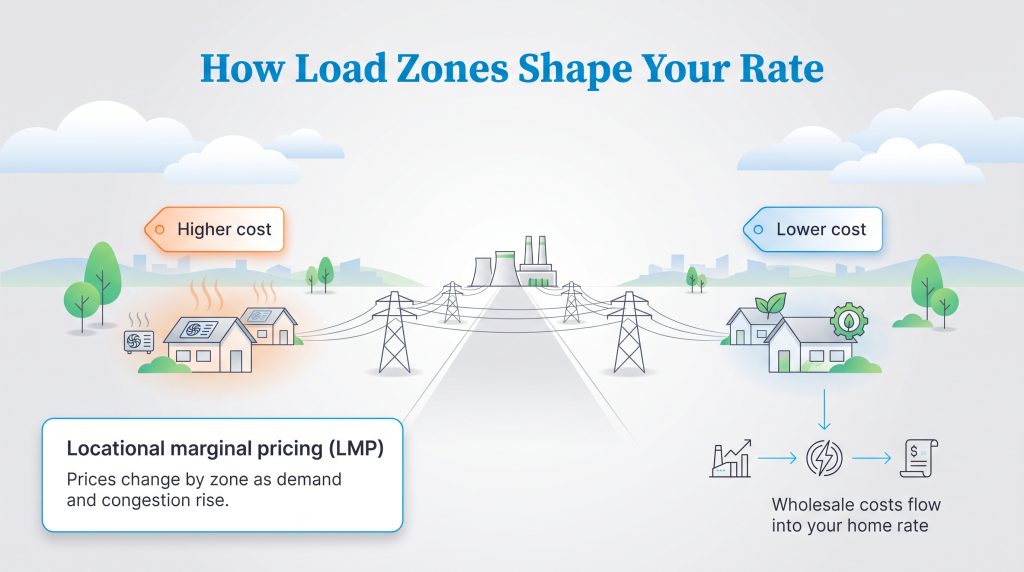
Exactly how load zones affect electricity rates comes down to a fundamental financial mechanism used by grid operators known as locational marginal pricing (LMP). While that sounds like a mouthful of industry jargon, LMP is simply a method of pricing electricity based on where it gets injected into the grid and where it is ultimately pulled out. Under this system, the wholesale price of electricity in your specific load zone is always the sum of three distinct components: the energy cost, the transmission grid congestion cost, and the marginal loss cost.
The energy cost is the baseline price to generate electricity at that specific moment, assuming there are no limits on the transmission lines. However, the grid is rarely perfect. If you live in a highly populated area where thousands of air conditioners are running simultaneously, the local demand for power skyrockets. When that demand surges, the transmission lines carrying power into your zone can hit their physical thermal limits, much like a multi-lane highway shrinking down to a single lane during rush hour. This creates the second component: grid congestion costs. To keep the grid stable, operators have to fire up more expensive, localized power plants to meet the neighborhood’s needs. The LMP system automatically bakes those extra congestion costs into the wholesale price of electricity for that specific geographical pocket.
The third component is the marginal loss cost. Because of the laws of physics, a small percentage of electricity dissipates as heat when traveling across long-distance power lines. The farther your load zone is from the power plant generating the electricity, the more energy is lost in transit, and grid operators must price that physical loss into the wholesale cost.
While you don’t buy power directly off the wholesale market, those fluctuating LMP costs trickle right down to your residential retail bill. Retail energy providers purchase electricity in bulk based on these wholesale prices and pass the regional expenses on to you. Understanding this chain reaction is a major step toward lowering your monthly electricity costs, because it highlights exactly why rates vary so dramatically between neighboring zip codes. A fixed-rate plan may bundle those regional risks into one predictable rate, while a variable-rate plan can change more often as wholesale market conditions shift.
Hubs vs. Load Zones: Making Sense of the Grid
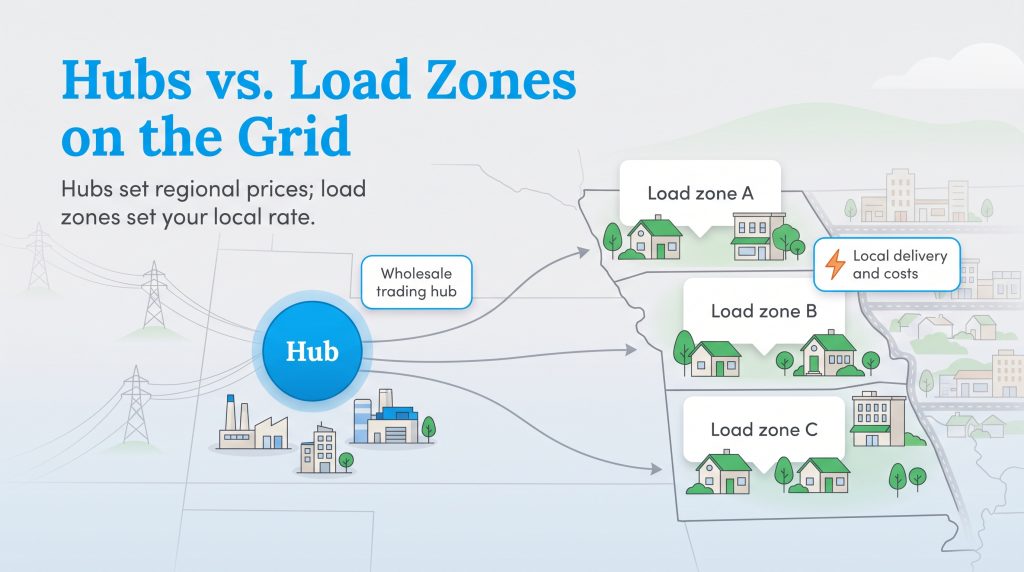
As you start exploring your local power market, you might hear the terms “hub” and “load zone” tossed around by energy analysts or brokers. Understanding hub vs. load zone electricity mechanics is surprisingly straightforward once you realize they serve two entirely different purposes on the grid. Hubs act as highly liquid commercial trading points where wholesale electricity is bought and sold by generators, suppliers, and financial institutions. They represent massive, aggregated pricing benchmarks for the broader region, giving the market a reliable average price to trade against.
Conversely, load zones represent the physical, geographical areas where that electricity is actually delivered to and consumed by homes and businesses. While a hub gives wholesale traders a centralized price for a vast chunk of the state, the load zone dictates the granular, localized cost of pushing that power into your specific neighborhood. A supplier might buy a futures contract at a hub price, but they ultimately have to pay the local load zone price to settle the physical delivery of power to your meter.
| Energy Hubs | Load Zones |
|---|---|
| Act as central, commercial trading benchmarks for the wholesale electricity market. | Represent specific geographical boundaries where electricity is delivered and consumed. |
| Used primarily by energy generators, traders, and suppliers to buy and sell power in bulk. | Directly influence the retail electricity rates offered to everyday homeowners and renters. |
| Prices are generally broader and reflect the overall health and supply of a large region. | Prices are highly localized and account for local transmission congestion and neighborhood demand. |
Major Energy Grids and Their Load Zones
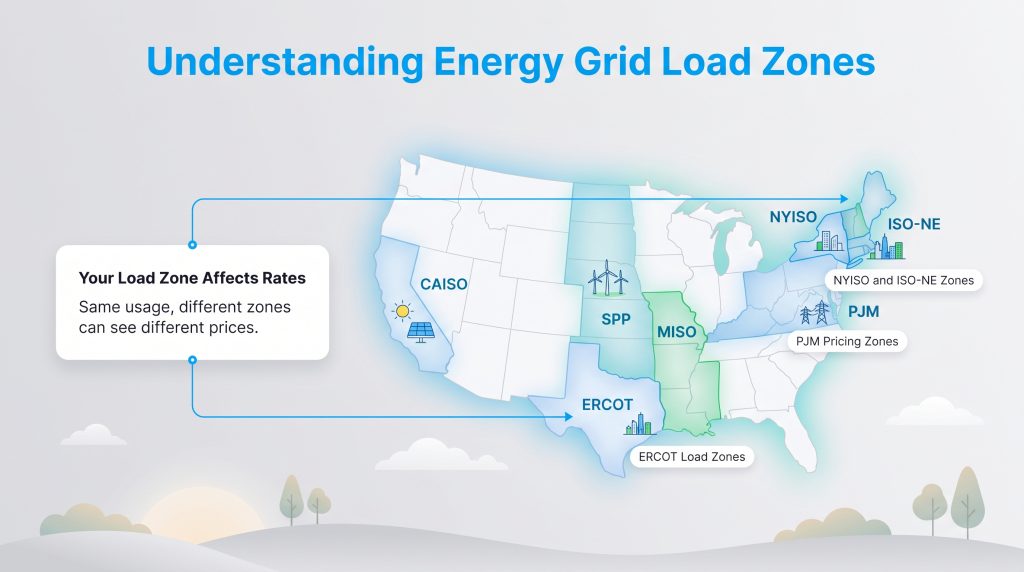
In many deregulated or retail-choice markets across the United States, you may be able to choose your electricity supplier while your local utility still delivers the power. If you live in one of these choice states, knowing your specific geographical zone is the key to unlocking the best rates. Retail suppliers often account for local wholesale costs, utility territory, expected seasonal usage, and market risk when setting residential plan prices. Let’s break down how the largest grid operators manage their territories.
Texas (ERCOT Load Zones)
The Electric Reliability Council of Texas (ERCOT) manages a grid that is largely isolated from the rest of the U.S. power system. Because ERCOT operates under its own market rules with extremely limited interconnections to neighboring grids, managing internal congestion is vital. To handle local demand across such a massive state, operators divide the territory into four primary ERCOT load zones: North, South, West, and Houston.
Each of these zones faces entirely different weather patterns and population densities. A household cooling down a Houston high-rise during a humid gulf summer will likely see different pricing dynamics than a sprawling ranch in the wind-heavy West Texas zone. While these are wholesale settlement zones, Texas retail offers are shown by zip code and utility delivery area. If you are comparing plans in Texas, two homes with the exact same usage can see different advertised rates if one is in the Houston load zone and the other is in the North load zone. The supplier is simply pricing the unique wholesale congestion costs, delivery territory fees, and market risks of that specific geographical pocket.
New York (NYISO Load Zones)
New York manages a highly complex grid overseen by the New York Independent System Operator (NYISO). The state is broken down into 11 distinct NYISO load zones, conveniently labeled from A through K. Because the state’s geography is so diverse — ranging from the hydroelectric power generated near Niagara Falls to the massive skyscrapers of Manhattan — the pricing constraints vary wildly from region to region.
Living in a densely packed area like New York City (Zone J) or Long Island (Zone K) creates significant transmission bottlenecks. Pushing power down into the city is incredibly difficult, which leads to high congestion costs. Conversely, residents in upstate zones (like Zones A, B, or C) may face significantly lower wholesale congestion costs because they are located much closer to large-scale renewable generation and face less dense demand.
New England (ISO-NE Load Zones)
Up in the Northeast, the ISO New England (ISO-NE) grid stretches across multiple closely connected state lines, requiring operators to manage power flow with incredible precision. The system relies on eight distinct ISO-NE load zones to price energy efficiently across states like Massachusetts, Connecticut, Rhode Island, New Hampshire, Vermont, and Maine. Notably, Massachusetts is divided into three separate zones (NEMA, SEMA, and WCMA) to handle the intense urban demand of Boston versus the western portion of the state.
By segmenting this dense, interconnected region into smaller pricing pockets, the grid can effectively manage severe winter demand spikes and ensure reliable power delivery to everyone from coastal cities to rural mountain towns. Retail choice rules vary heavily by New England state, so your specific load zone may matter more for wholesale grid stability than for how you personally shop for electricity on a state website.
Pennsylvania and PJM Pricing
The PJM Interconnection is the largest regional grid operator in the country, coordinating the movement of wholesale electricity in 13 states and the District of Columbia. In Pennsylvania and other PJM states, load zones are typically aligned with the legacy service territories of major local utility companies.
Because the grid spans such a massive geographical area from New Jersey to Illinois, PJM relies heavily on locational marginal pricing to ensure power moves efficiently from rural generation hubs to dense urban centers. For residents, retail electricity shopping is organized around your local utility territory. While wholesale prices are tied directly to PJM pricing zones, residential shoppers usually compare offers by simply entering their zip code on their state’s official shopping portal.
Other Major Markets: CAISO, MISO, and SPP
While the East Coast and Texas feature prominent load zones tied heavily to retail choice, other major wholesale markets across the United States also utilize zonal pricing to keep their regional grids stable. Even if you live in a regulated market where you cannot choose your supplier, your state utility still buys power based on these wholesale boundaries.
- California (CAISO): The California Independent System Operator uses Sub-Load Aggregation Points (Sub-LAPs) to manage pricing. These zones largely correspond to the major utility territories like Pacific Gas and Electric (PG&E), Southern California Edison (SCE), and San Diego Gas & Electric (SDG&E), helping the grid balance heavy solar generation during the day with massive demand spikes in the evening.
- The Midwest (MISO): The Midcontinent Independent System Operator spans a massive footprint from the Canadian border all the way down to the Gulf South. MISO utilizes Local Resource Zones (LRZs) to manage immense north-to-south transmission congestion and ensure that localized pricing accurately reflects the difficulty of moving wind power across the central United States.
- The Southwest Power Pool (SPP): Operating primarily in the central U.S. wind belt, SPP focuses heavily on managing transmission congestion. Their pricing zones help the grid efficiently push massive amounts of renewable energy generated in remote, rural areas toward densely populated cities, pricing the transmission bottlenecks accordingly.
Capacity Markets vs. Energy-Only Markets by Zone
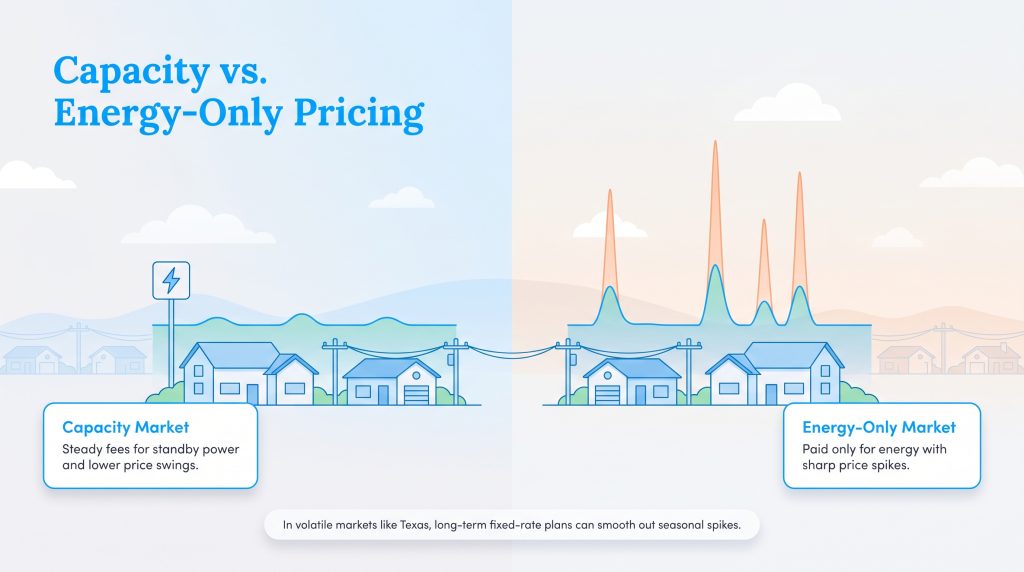
Understanding your load zone becomes even more critical when you look at how different grid operators actually pay power plants to produce electricity. Across the United States, wholesale energy markets are generally split into two distinct financial structures: capacity markets and energy-only markets. The way your local load zone operates under these models heavily influences the final retail rates you pay.
In a capacity market — utilized by grid operators like PJM, NYISO, and ISO-NE — power plant owners are paid simply to exist and be available to generate power on standby. Grid operators forecast how much electricity each specific load zone will need years in advance. They then run capacity auctions, paying generators a steady fee to guarantee they will turn on during extreme weather events or peak demand days. These capacity charges are baked into your load zone’s pricing structure, meaning you pay a slight premium year-round to ensure the grid has a safety net of reliable power.
Conversely, an energy-only market — most famously utilized by ERCOT in Texas — only pays power plants for the electricity they actually generate and sell on a daily basis. There are no standby capacity payments. Instead, the grid relies solely on the economic principle of scarcity pricing. When load zone demand surges during a harsh winter freeze or a brutal summer heatwave, the wholesale price of electricity is allowed to spike dramatically. These massive price spikes are the financial incentive for generators to build new power plants and keep them running.
| Market Type | Primary Grid Operators | How Generators Are Paid | Impact on Load Zone Pricing |
|---|---|---|---|
| Capacity Market | PJM, NYISO, ISO-NE | Paid for both actual energy generated and for remaining on standby. | Prices include a steady capacity charge, leading to generally stable but slightly elevated baseline costs year-round. |
| Energy-Only Market | ERCOT (Texas) | Paid only for the actual electricity generated and sold to the grid. | Relies on extreme price spikes during high demand to incentivize generation, creating higher volatility for retail suppliers. |
Where Load Zones Matter Most (The Role of ESCOs and REPs)
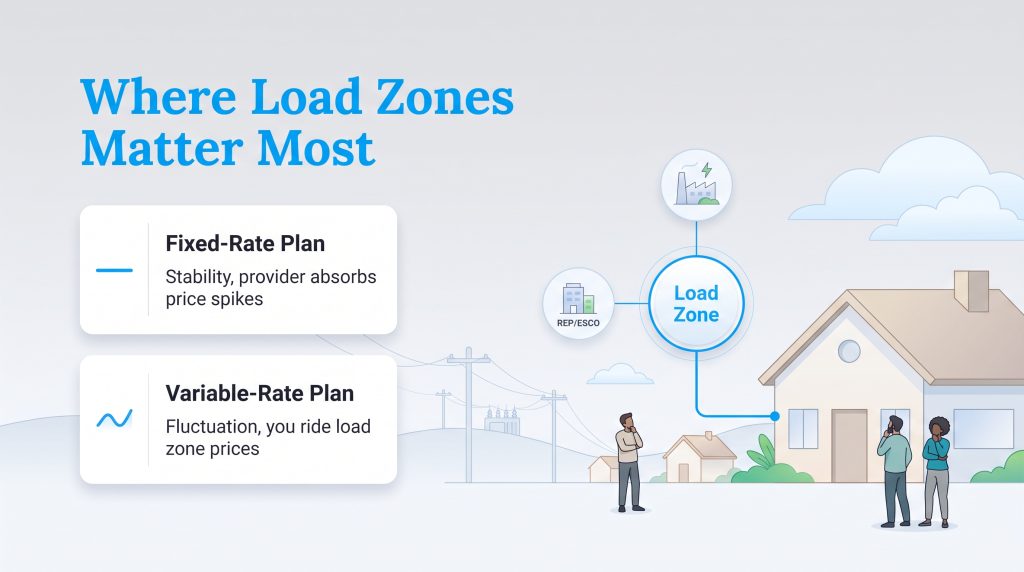
Load zones matter most when you live in a deregulated state that allows you to choose who supplies your home’s power. In these retail-choice markets, businesses known as Retail Electricity Providers (REPs) in Texas or Energy Service Companies (ESCOs) in New York act as the crucial middleman between the volatile wholesale grid and your monthly residential bill. These companies do not generate the power, nor do they own the utility wires. Instead, their entire business model revolves around mastering load zone pricing.
When an ESCO or REP builds a retail electricity plan for your neighborhood, they look closely at the historical and forecasted locational marginal pricing for your specific load zone. If you sign up for a 12-month fixed-rate contract, the retail provider takes on the massive financial risk of wholesale price spikes. They purchase complex financial hedges and bulk power contracts at your load zone’s pricing hub to guarantee they can supply your home at the steady rate they promised, regardless of whether a heatwave causes grid congestion costs to skyrocket.
Alternatively, if you enroll in a variable-rate plan, the REP or ESCO passes those load zone fluctuations directly to you. If grid congestion clears up and wholesale prices drop, your monthly rate might decrease. But if extreme weather hits your specific area, you absorb the financial blow of those locational marginal pricing spikes. This dynamic is exactly why understanding your location on the grid is so empowering — it helps you grasp the risks and rewards of the plans these suppliers offer you.
How to Find Your Utility Load Zone
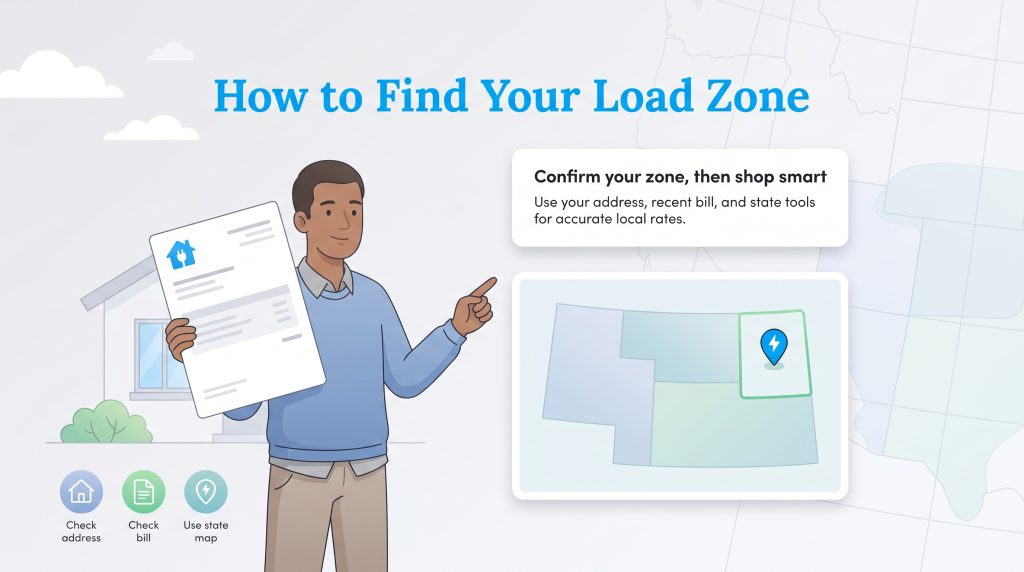
If you’re setting up service in a new home or simply hunting for a better rate, you might be wondering how to actually pinpoint your location on the grid. Fortunately, you don’t have to be an industry insider to find your utility load zone. Grid operators and state regulators make it incredibly easy for consumers to look up their pricing territory using a combination of their zip code and a recent utility statement. You can even view a regional load zone electricity map on your state’s public utility commission website to see exactly where the borders are drawn.
Ready to identify your zone and start shopping? Follow these straightforward steps to track down your neighborhood’s pricing tier.
- Check your exact service address: Always use your full service address, rather than just a generalized zip code, when checking official shopping tools. Zip codes can sometimes overlap between two different utility territories, so your street address ensures perfect accuracy.
- Confirm your delivery utility: Verify the name of your local delivery utility or transmission and distribution utility (the company that owns the physical poles and wires in your neighborhood).
- Look for details on your bill: Grab your most recent electricity statement and look for your rate class, service territory, or specific zone information. Some detailed bills may explicitly list a zone, but many residential statements simply show the utility name.
- Use state portals or grid maps: If you don’t see it on your bill, use your state’s official shopping site, your utility’s service-territory lookup, or your regional grid operator’s public load-zone map to cross-reference your neighborhood.
- Shop for localized rates: Use resources like the official Texas energy comparison tool or the Pennsylvania electric shopping portal to compare retail plans based strictly on your actual utility territory and historical usage, avoiding misleading statewide averages.
What You Can Control When You Know Your Load Zone
Knowing your load zone and utility territory is essential for managing your monthly bills, but it is equally important to understand which factors you actually have the power to change. Use these insights to make informed choices:
- You can compare plans using your exact service address to find the most accurate pricing.
- You can check whether your utility territory has different delivery charges compared to nearby towns.
- You can choose a fixed-rate or variable-rate plan based on your personal risk tolerance.
- You can reduce your household’s usage during high-demand seasons to help lower your overall bill.
- You cannot switch load zones without physically moving to a new residence.
Preparing to Shop for Local Electricity Rates
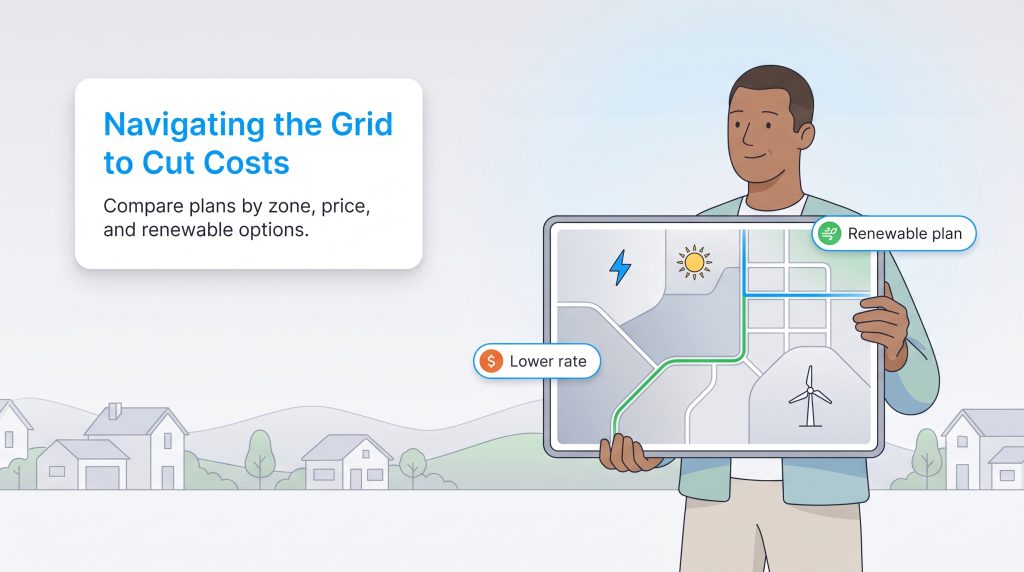
While you can’t physically change your designated territory without packing up and moving to a completely new home, understanding the mechanics of the grid puts you back in the driver’s seat. Recognizing why your rates fluctuate based on local demand and transmission congestion takes the mystery out of your monthly utility bill. Armed with this knowledge, you are fully empowered to navigate your local market, compare competitive ESCO or REP rates, and evaluate the fine print on fixed versus variable contracts.
Before you lock in a new contract, carefully read the Electricity Facts Label (EFL) or plan summary provided by the retail supplier. This document clearly outlines how your load zone’s baseline energy costs, utility delivery fees, and potential base charges combine to form your final effective rate. Because suppliers price their risks based on location, you should always compare multiple plans customized to your exact zip code rather than relying on generic, nationally advertised rates that might not apply to your local grid constraints.
As you browse the current offers in your area, keep an eye out for an environmentally mindful choice that aligns with your household values. Many retail suppliers offer an eco-conscious alternative backed by wind or solar generation, allowing you to support renewable energy without leaving your current geographical footprint. These legitimate green energy plans operate via Renewable Energy Certificates (RECs). When you sign up, your supplier purchases RECs to match your exact household usage, effectively guaranteeing that your consumption is offset by clean energy pushed into the broader grid. By staying informed about your local pricing dynamics and REC options, you can secure a rate that protects both your wallet and the planet.
Frequently Asked Questions About Utility Load Zones
These quick answers cover the most common questions homeowners and renters have after learning how load zones work. Use them to understand what your zone means, what it does not control, and how it fits into electricity shopping.
Why is my electricity rate different from my neighbor’s?
What is the difference between a load zone and a dispatch zone?
Can I change my load zone?
Do load zones change over time?
What is a load zone electricity map?
How does transmission congestion affect load zone pricing?
Is my load zone the same as my utility company?
Do load zones exist in regulated energy markets?
Does choosing a renewable energy plan change my load zone?
About the Author

LaLeesha has a Masters degree in English and enjoys writing whenever she has the chance. She is passionate about gardening, reducing her carbon footprint, and protecting the environment. She also recently served as President of the Board for City Sprouts (a community garden).

David has been an integral part of some of the biggest utility sites on the internet, including InMyArea.com, HighSpeedInternet.com, BroadbandNow.com, and U.S. News. He brings over 15 years of experience writing about, compiling and analyzing utility data.